


.png)


.png)

Work Related Concerns
How to Go Back to Work After Maternity Leave: Practical & Emotional Guide for Working Mothers in India

.png)
Written by
Aarohi Parakh,
Psychologist and Content Writer

Reviewed by
Sanjana Sivaram,
Psychologist and Clinical Content Head


Introduction
Returning to work after maternity leave is an emotional rollercoaster and one of the biggest transitions a mother makes. It is logistically demanding and can be significantly overwhelming. Research shows that 73% of Indian women leave their jobs after giving birth; 50% leave their jobs to take care of their children; and even among those who manage to return, 48% drop out within four months of rejoining the workforce. A structured maternity benefit programme is one of the most effective ways organisations can close this gap, providing continuous support from pregnancy through the return-to-work period.
Just ask Riya, who found herself putting together a baby bag, a laptop, and a breast pump at 7 a.m., all while holding back tears she couldn’t even explain. Amidst navigating childcare, managing sleep deprivation, rebuilding work routines, and coping with mom guilt, she felt like she was being pulled in opposite directions every minute.
If you’re feeling anxious, torn, or unsure of how to balance everything, you’re not alone. Most working mothers in India experience a myriad of emotions, including relief, guilt, excitement, fear, and exhaustion, when returning to work after maternity leave. And every mother, like Riya, is simply trying to figure it out one moment at a time.
This guide brings together emotional support, practical steps, information about your legal rights under Indian law, and workplace resources and tips to help you transition with clarity, confidence, and compassion towards yourself.
Understanding the Transition: What New Mothers Typically Experience
Going to work after maternity leave is more than just a schedule change; it’s an enormous psychological shift. The postpartum period, which generally lasts six to eight weeks post-childbirth, leads to physical and emotional changes, and sometimes the symptoms can last months. Coupled with this is the loss of independence and autonomy, which can alter how a woman sees her identity. Let’s break this down for greater understanding:
A. Emotional Changes
Mothers might feel happy or tense, hopeful or sad, almost oscillating between the two extremes. They may experience:
1. Mom guilt after returning to work
- Guilt about leaving your baby at home
- Guilt about “not doing enough” or “not being physically present”
- Guilt about “wanting to have a career”
- Guilt about “feeling exhausted”
💡Normalise this guilt; it is common and not a sign of failure.
2. Postpartum anxiety
There may be worries related to:
- Pumping/breastfeeding routines
- Performance at work after re-joining
- Your baby’s safety
- Childcare reliability and accessibility
- Judgement from colleagues
💡Hormonal changes (elevated oxytocin levels) along with sleep deprivation can intensify the episodes of postpartum anxiety.
3. Identity shifts
Motherhood means being responsible for caring for another human being, and this often leads to rethinking one’s own identity. It is natural to revisit one’s “professional identity”, noticing an iota of “imposter syndrome”, especially when faced with new ways of working or new colleagues. The role of a parent adds a new dimension to one’s existing sense of self, feelings, and abilities—but is often a struggle to adjust to fully.
B. Physical and Mental Health Considerations
1. Sleep Deprivation
Irregular sleep patterns can adversely affect concentration, energy levels, mood, and work performance.
2. Postpartum Recovery
Different women heal physically in different ways after giving birth, and the need for self-care may take longer than expected. It can be hard to go back to work before full recovery.
3. Breastfeeding/Pumping Fatigue
Managing breastfeeding routines while working can be tiring, especially without adequate workplace support.
4. Decision fatigue
Taking care of a newborn, doing chores around the house, and going to work can make it hard to concentrate and make decisions consistently.
C. When to Seek Support
While it is normal to have mixed feelings during the transition period, recognising the signs when to seek professional support can be helpful.
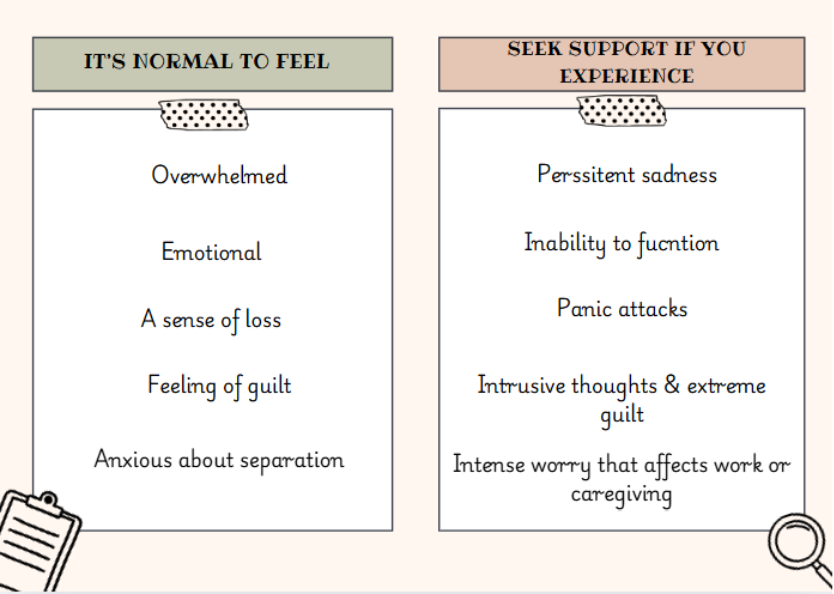
If you are struggling and need support, please reach out to 1to1Maternity, where counsellors offer guidance on returning to work with confidence.
Your Rights as a Working Mother in India
The Maternity Benefit Act, 1961, as amended in 2017, provides the legal framework for maternity in India. Understanding their legal rights can help returning mothers feel more secure, empowered, and confident during the transition.
Duration of Leave
- First two children: 26 weeks of paid leave, with the option to take up to 8 weeks before delivery.
- Third child, adoption, or surrogacy: 12 weeks of paid leave. In case of adoption, the child should be below 3 months of age; in the case of surrogacy, the same provision applies to a commissioning mother (biological mother).
Protection from Dismissal
It is illegal for an employer to dismiss or discriminate against a woman during maternity leave.
Breastfeeding Rights
Working mothers are entitled to:
- Nursing breaks (2 daily) until the child reaches 15 months of age.
- Access to an appropriate lactation space within the workplace, which must not be a washroom.
Crèche Facility Requirements
Workplaces with 50 or more employees must provide a childcare facility. Mothers can visit the crèche up to four times a day.
Flexible Work Options
While not globally mandated, many organisations support returning mothers through:
- Hybrid work arrangements
- Work-from-home options
- Reduced working hours
- Gradual return-to-work programmes
💡Note: Internal policies vary by organisation, and new/returning mothers are encouraged to check their HR guidelines.
Preparing for Your Return: A Step-by-Step Plan
Maternity leave isn't just a "break" from work; it's also a time to get ready for one of the most challenging jobs in life: being a parent. No one can prepare you for this, yet you have another human being entirely dependent on you. Returning to work after this whirlwind journey requires strategic preparation, discipline, and workplace support.
A. Two Weeks Before Returning
1. Childcare Trial Period
Slowly exposing the child to new environments and/or “time away from mother” helps them adjust and allows the mother to observe the child's patterns.
2. Establish Morning and Feeding Routines
Setting consistent, easy-to-follow schedules helps both the baby and the mother feel stable.
3. Begin a Pumping Schedule (if breastfeeding)
Creating a schedule in advance makes workplace pumping easier. Informing the manager and HR about the pumping plan (in line with the legal rights) can help smooth the transition.
4. Discuss Division of Workload
Open discussions with partners and family members about shared tasks such as feeding, cooking, and caregiving can ease the burden on the new mother.
For expert guidance and resources that support parenting, please get in touch with 1to1Parenting.
B. One Week Before Returning
1. Adjusting the Baby’s Sleep and Wake Rhythm
Morning stress can be better managed by aligning the baby’s sleep schedule with a work-compatible routine.
2. Preparing Daily Essentials
Mornings that could otherwise feel rushed can be made more efficient by organising meals, baby bags, pump supplies, and work clothes in advance.
3. Practise Commute
Identifying logistical issues and determining travel time would help you plan efficiently.
4. Reconnect with Team/Colleagues
Anxiety about returning to work can be reduced with a quick check-in with the team.
C. The First Week Back
1. Set Realistic Expectations
Understanding how becoming a mother shifts your identity can make it easier to prevent burnout at work.
2. Acknowledge Emotional Fluctuations
Crying, hesitation, excitement, or worry is common during this time.
3. Seek Clarity
Setting clear expectations up front with managers helps improve confidence and work performance.
4. Prioritise “Easy Wins”
Small wins, such as “clearing your inbox” or “creating a to-do list”, can help rebuild professional momentum.
Childcare Planning for Working Mothers in India
A mother planning to return to work after maternity leave has to rely heavily on the childcare options available to her.
A. Common Childcare Options
- Daycare: Structured environment with other kids, safety measures, and developmental activities.
- Nanny: Provides flexible, customised, and personalised care.
- Grandparents: A trusted option, though they may require support and readjustment with modern caregiving practices.
- Combination care: Many families rely on a mix of daycare, nanny support, and family members.
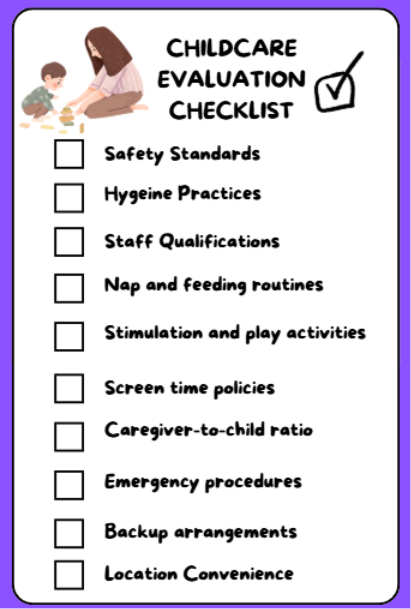
B. Childcare Evaluation Checklist
Before finalising on a childcare option, new mothers can assess the following parameters:
C. Gradual Transition for the Baby
A gradual, phased transition over 1-2 weeks is recommended. During this period, the mother can plan “time away from the baby” and go to work.
- Day 1-4: 1-2 hours
- Day 5-8: Half day
- Day 9-12: Full day
💡Note: There is no perfect timeline for such a transition. Depending on the mother's emotional readiness and the baby's response, this can be decided.
Balancing Breastfeeding & Work
Breastfeeding is vital for a child's overall development. Breastfeeding while working is achievable for new mothers with planning and a nurturing work environment.
A. Pumping at Work Logistics
- Establishing a schedule: Typical times would include before leaving home, mid-morning, afternoon, and evening. The schedule should be aligned with the new mother's lactation schedule.
- Providing a private room or space: This helps employees to return to work and shows that they are respected, recognised, and supported as new mothers.
- Storing milk at work: Depending on the convenience and accessibility, mothers may use chilled bags, insulated flasks, or workplace refrigerators.
- Communicating needs to manager/HR: Up front and early discussion ensures smoother arrangements for pumping breaks.
B. Setting Realistic Expectations
Combination feeding (a mix of breast milk and formula) or gradual weaning may be necessary as schedules evolve and in alignment with lifestyle/work.
C. Normalising Emotional Struggles
While breastfeeding can be a beautiful way to bond with your baby, it can come with its emotional challenges for many new mothers. Some feel joy and connection while breastfeeding, while others may feel frustrated, guilty, overwhelmed, or even disconnected from the baby. It is essential to remind oneself that these emotional ups and downs are common and valid. While your body is still healing from labour, sleep is limited, and routines are unpredictable, this transition to motherhood comes with its own challenges.
Having the Right Conversation With Your Manager
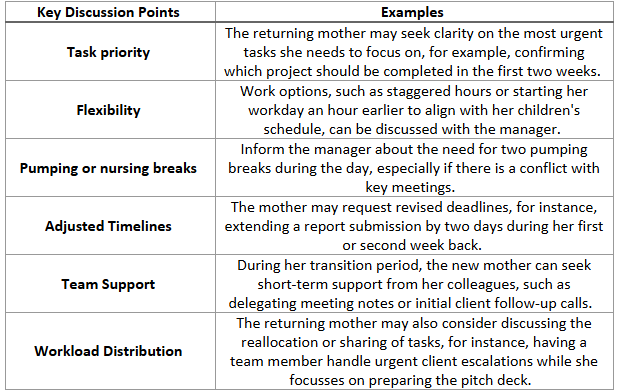
Open and honest communication helps ensure clarity and support during the transition back to work.
A. What to Discuss (Explained with Examples)
B. Sample Scripts for Professional Conversations
1. Requesting Flexible Hours
“Given my childcare schedule, I’d like to discuss the possibility of shifting my start time by one hour. I will ensure all deliverables and team commitments are met.”
2. Managing Workload
“I want to ensure I do not compromise on the quality of my work. Could we discuss which tasks are the top priority so I can plan accordingly?”
3. Childcare Logistics
“I will need short breaks twice during the day to pump. I’ll try to align them around meetings so there is no disruption.”
C. When You Need Accommodation
- Access personalised, always-on care through 1to1help Employee Assistance Programmes (EAP).
- 1to1Maternity offers personalised, counsellor-guided support to help your employees navigate pregnancy, parenthood, and return-to-work with confidence.
- Speak to your HR team to understand internal policies and guidelines that can support you during the transition.
Managing Emotions: Guilt, Worry & Overwhelm
Emotional wellness is the ability to understand, express, and manage feelings in healthy ways. This skill becomes important when navigating the balance between work and motherhood.
A. Common Emotional Triggers (with Examples)
- Separation from the child: Many new mothers feel separation anxiety when leaving their baby for the first time. For instance, they may worry during their commute if the child has settled in with the nanny.
- Workplace performance pressure: Immediately after returning to work, the mother may fear that she may fall behind professionally, especially when it comes to meeting deadlines or meeting targets.
- Comparing oneself to other mothers: Looking at other friends or female colleagues who appear to maintain a balance may create feelings of inadequacy.
- Fear of being judged at work: For some returning mothers, the fear of being judged by their team members is real. They think that they may be perceived as less dedicated if they leave the office early to pick up their child.
- Perfectionism: The efforts to excel at work, ace household chores, and meet caregiving needs for their child all at once may lead to placing unrealistic expectations on oneself.
B. Evidence-Based Coping Strategies
- Reframing expectations: A new mother may decide that completing essential tasks at work, rather than aiming for home-cooked food, is enough for the day.
- Boundary setting: Deciding to decline or delegate late-evening meetings to ensure that the baby’s sleep schedule is not compromised can be an example of setting clear boundaries
- Asking for help: For an important client meeting that she cannot skip, she may ask her partner to handle the morning routine, while a nanny manages the baby’s afternoon nap schedule.
- Self-care and mindfulness: This may look like stretching in between meetings, deep breathing exercises at the work desk, or even journaling any negative thoughts, to reset mentally.
C. When to Seek Professional Help
As highlighted earlier, symptoms such as persistent sadness, disrupted day-to-day functioning, severe anxiety or intrusive thoughts require professional support. Speaking confidentially to trained and qualified counsellors at 1to1help can help you navigate challenging times
A Realistic Work-Life Balance for New Moms
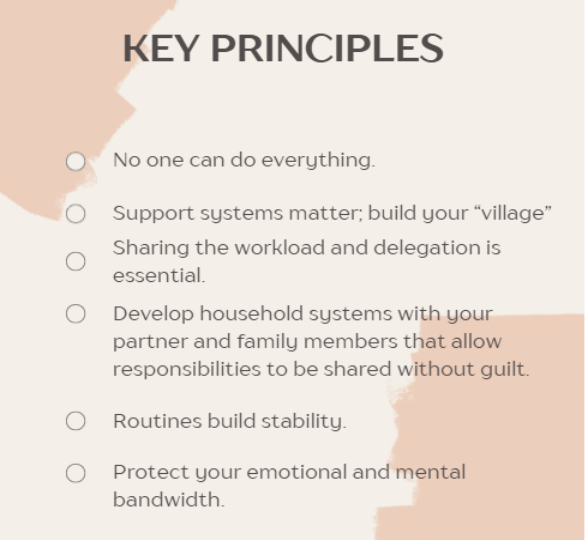
Achieving work-life balance for mothers is not about chasing perfectionism in every role. Instead, it entails intentionally prioritising their emotional needs and seeking support.
Key Principles Based on Ground Realities
Sample Balanced Daily Routine
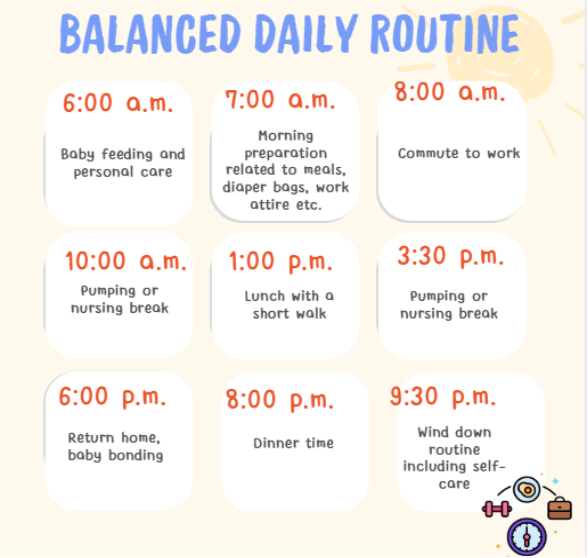
💡Note: This is just a suggestion. Based on the individual needs, resources, and city of work, the schedule can be realigned
Support Employers Should Offer Working Mothers
Supportive workplaces play a crucial role in retaining and empowering mothers returning to work after maternity leave. Let’s look at some of the key initiatives that HR teams can implement:
- Manager Training: Sensitising managers and leaders towards the emotional, physical, and mental health needs of returning mothers.
- Flexible Working: Hybrid options like Work from Home, altered schedules, or staggered hours during the day.
- Breastfeeding Rooms: Designated and private spaces at the workplace for pumping, nursing breaks, and refrigeration options for storage of milk.
- Returnship Programmes: Structured programmes that offer re-entry of mothers into the workforce.
- Mental Health Support: Counselling, EAP services, workshops on stress management, work-life balance, and peer support networks. To see how organisations design this kind of targeted parenting support at scale, 1to1help's cohort-based wellbeing programmes explain how 1to1Parenting fits alongside the EAP as part of a broader wellbeing strategy.
Explore 1to1Maternity and 1to1help EAP services to help you thrive at your workplace while managing the needs of motherhood.
FAQs
Q1. How long should I wait before returning to work after having a baby?
Under the Maternity Benefit Act, the standard entitlement for most working mothers in India is 26 weeks of paid maternity leave for the first two children. Some mothers may return earlier due to personal, financial, or workplace considerations, while others may choose to take additional unpaid leave if organisational policies allow. The timing of the return ultimately depends on the mother’s health, the baby’s needs, and the family’s circumstances.
Q2. How do I overcome “mom guilt” when going back to work?
Feelings of guilt, anxiety, or sadness are very common during this transition. Many mothers experience conflicting emotions, such as wanting to return to work while simultaneously worrying about leaving their baby. These reactions are typically temporary and lessen as routines stabilise, and the mother gains confidence in her childcare arrangements and work responsibilities. Emotional support from family, colleagues, or professionals can make this adjustment smoother.
Q3. What are my rights during and after maternity leave in India?
Several provisions under the Maternity Benefit (Amendment) Act, 2017, protect working mothers in India. These include:
- Paid maternity leave of 26 weeks.
- Job protection, meaning no woman can be dismissed due to pregnancy or maternity leave.
- Nursing breaks until the child reaches 15 months.
- Access to a crèche facility in organisations with 50 or more employees.
These legal protections ensure that mothers can return to work without fear of discrimination or job loss.
Q4. How do I manage breastfeeding when I return to work?
Breastfeeding can be maintained through a planned pumping routine, typically involving sessions at home and during work hours. Effective management often includes:
- Setting a consistent pumping schedule
- Communicating needs with HR or the manager to arrange suitable break times
- Using safe storage methods such as insulated bags or workplace refrigeration
Many mothers also explore combination feeding to balance workplace demands with the baby’s nutritional needs.
Q5. Is it normal to feel anxious when leaving my baby at home?
Yes, it is entirely normal for mothers to feel anxious when they first leave their baby at home after maternity leave. This anxiety often stems from concerns about the baby’s safety, the reliability of childcare arrangements, and the emotional difficulty of separation. Such feelings are common among new mothers and typically ease as consistent routines are established and trust in the caregiver grows. If the anxiety becomes persistent or begins to affect daily functioning, professional support can be beneficial.
Conclusion
Returning to work after maternity leave is a multifaceted transition involving emotional, physical, legal, and workplace support considerations. With the proper planning, support systems, and organisational resources, working mothers can tide this phase with confidence and stability.
Professional support is available for mothers who feel overwhelmed or uncertain during this period.
Speak to a counsellor confidentially.
Resources
- Read our earlier article on Maternity Leave, which breaks down the legal rights, benefits, and how workplaces can support expecting or returning mothers.
- Explore our blog on Burnout Prevention at Workplaces that shares practical tips supporting recovery and preventing long-term harm.
- Understand how Work-Life Balance looks for Indian professionals with practical strategies to reduce stress and stay productive.
References
- The Maternity Benefit Act. (1961). Ministry of Labour and Employment, Government of India. https://labour.gov.in/sites/default/files/the_maternity_benefit_act_1961_0.pdf
- Peters, J. (n.d.). To make breastfeeding work at work. UNICEF India. https://www.unicef.org/india/stories/how-make-breastfeeding-work-work
- Cleveland Clinic. (n.d.). Mom guilt: What it is and how to cope. Cleveland Clinic Health Essentials. https://health.clevelandclinic.org/mom-guilt
- Cleveland Clinic. (n.d.). Postpartum: What to expect after childbirth. https://my.clevelandclinic.org/health/articles/postpartum
- Calm Blog. (n.d.). Separation anxiety in moms. https://blog.calm.com/blog/separation-anxiety-in-moms
- Gupta, Shivani. “’Why Don’t Brilliant Women Return to Work After Motherhood?': Startup Finding Jobs for New Moms.” The Better India, 10 May 2024. https://thebetterindia.com/349558/chennai-sankari-sudhar-job-portal-for-new-mothers-women-with-career-break-overqualified-housewives/
- Healthline. (n.d.). What is mindfulness? https://www.healthline.com/health/mind-body/what-is-mindfulness
- Humanise. (n.d.). A new mom’s guide: Returning to work post maternity leave. https://www.humanise.co.in/posts/a-new-moms-guide---returning-to-work-post-maternity-leave
- Heloa. (n.d.). Returning to work after maternity leave. https://heloa.app/en-in/blog/parents/daily-life/returning-to-work-after-maternity-leave
- Motherly. (n.d.). Combination feeding guide. https://www.mother.ly/baby/baby-feeding-guides-schedules/combination-feeding/
- WPA Therapy. (n.d.). How to support your mental health while breastfeeding. https://www.wpatherapy.com/post/how-to-support-your-mental-health-while-breastfeeding
- Health.com. (n.d.). What is emotional wellness? https://www.health.com/what-is-emotional-wellness-11700066#toc-strategies-for-improvement
- Psychology Today. (2024). The transition to motherhood. https://www.psychologytoday.com/us/blog/parenting-matters/202407/the-transition-to-motherhood
- Magnify Mind. (n.d.). Oxytocin in motherhood. https://magnifymind.com/oxytocin-in-motherhood/
- Psychology Today. (2025). Borrowing confidence: Steps to overcoming impostor syndrome. https://www.psychologytoday.com/us/blog/optimizing-success/202511/borrowing-confidence-steps-to-overcoming-imposter-syndrome


.svg)
.svg)
.svg)
.svg)