

.png)


.png)

Work Related Concerns
Psychological Safety: The Science, the Behaviours, and How Teams Can Practise It Every Day

.png)
Written by
Aarohi Parakh,
Psychologist and Content Writer

Reviewed by
Sanjana Sivaram,
Psychologist and Clinical Content Head


Introduction: Why Psychological Safety Matters More Than Ever
Psychological safety at work is more than a buzzword. It has become one of the most significant predictors of team performance, innovation, mental health, and long-term organisational success. Employees require more than just “skills” in today's fast-changing world of hybrid teams, AI-driven uncertainty, rising burnout, and increasingly diverse workplaces. They also need an environment where they feel comfortable challenging assumptions, asking questions, and owning their mistakes.
At its core, psychological safety means you will not be punished, embarrassed, or ignored for speaking up openly and honestly. It is the foundation that enables teams to learn quickly, solve problems creatively, and support one another during high-stress moments.
Imagine this! The night before a product launch, a junior software engineer, Shreya, discovers a significant coding error. When psychological safety is low, Shreya keeps quiet, worried she’ll be held responsible for bringing it up last minute. The result? Delays, rework, and potential reputational damage for the organisation. On the other hand, in a high-safety culture, she raises the concern right away, saving the team from an expensive, customer-facing crisis.
That single difference, fear versus openness, captures the meaning of psychological safety.
Have you ever questioned your manager’s decision in your own mind, but felt it was safer not to say anything out loud? If yes, then keep reading.
What Is Psychological Safety? A Clear and Evidence-Based Definition
The term psychological safety was coined by Dr Edmondson, a Harvard Business School professor, who noted that it is a critical factor for high-performing teams.
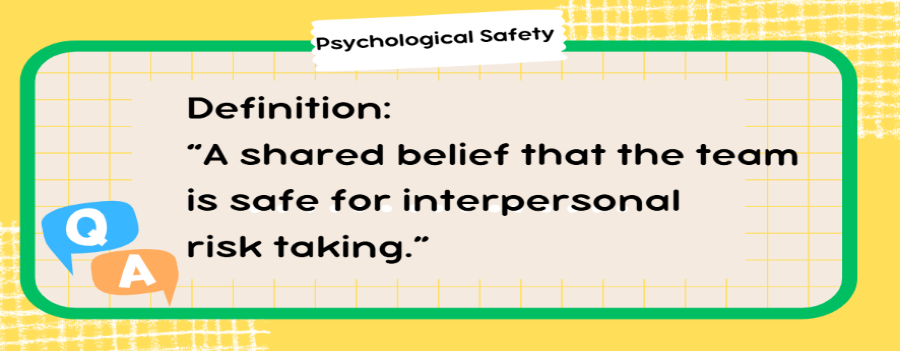
Simply put, it means individuals feel free to share ideas, disagree openly, share feedback, raise concerns, admit mistakes, and challenge decisions without fear.
It should, however, be noted that psychological safety is not:
- Comfort
- Agreement or harmony
- Low accountability
- Constant politeness
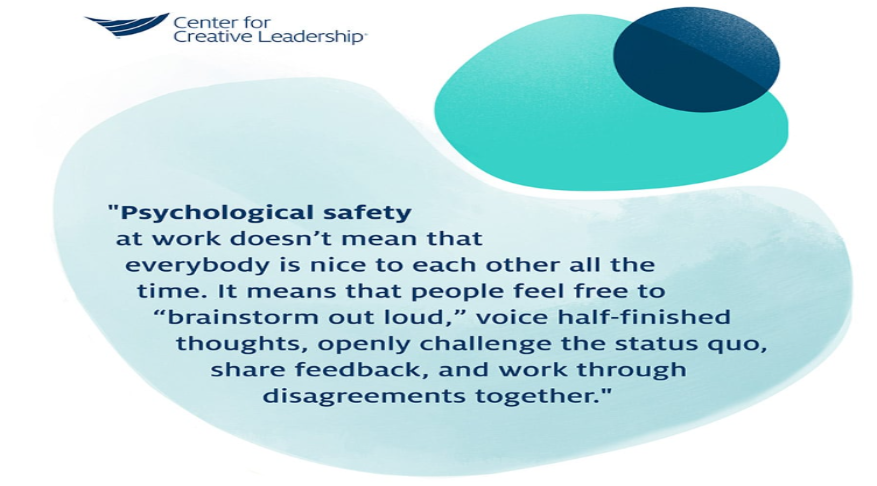
Psychological safety at the workplace does not mean limiting freedom to think creatively to maintain peace. On the contrary, it helps foster an environment where employees are encouraged to brainstorm ideas without the fear of judgement.
The Four Stages of Psychological Safety
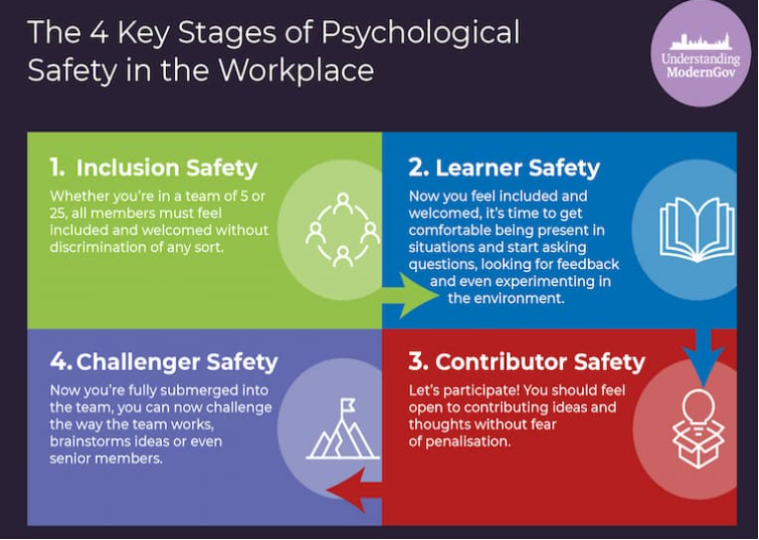
As organisations build psychological safety, they move through four stages. Like Maslow’s hierarchy of basic needs, employees must feel accepted before they can contribute fully to improve their organisations.
According to Dr. Timothy Clark, author of The 4 Stages of Psychological Safety: Defining the Path to Inclusion and Innovation, employees have to progress through the following four stages before they feel free to make valuable contributions and challenge the status quo.
- Stage 1 — Inclusion Safety: You feel safe to be yourself and are accepted for who you are, including your unique attributes and defining characteristics.
- Stage 2 — Learner Safety: You feel safe asking questions, giving and receiving feedback, and learning from mistakes.
- Stage 3 — Contributor Safety: You feel safe to use your skills and abilities to make a meaningful contribution.
- Stage 4 — Challenger Safety: You feel safe to speak up and challenge the status quo when you think there’s an opportunity to change or improve.
These stages explain why Google’s research initiative, Project Aristotle, found psychological safety to be the strongest predictor of high-performing teams across the organisation. The teams that excelled were the ones where members felt comfortable speaking up at every stage, from asking basic questions to challenging assumptions.
It is the responsibility of leaders and managers to nurture and promote their team's sense of psychological safety in the workplace by helping them navigate through these four stages. Building this capability is exactly what 1to1help's cohort-based wellbeing programmes are designed for — the Leaders Programme strengthens resilient decision-making, inclusive leadership, and psychological safety at the senior team level.
The Science Behind Psychological Safety
Psychological safety is supported by decades of research from MIT, McKinsey, APA, Harvard Business School, and other leading institutions.
Origins in Team Dynamics Research
Amy Edmondson discovered that high-performing teams reported more mistakes than low-performing teams. They were not making more errors. They were more willing to speak openly about them. Similar patterns emerged in organisations like Toyota, where workers are encouraged to pull the “andon cord” to stop the assembly line when they spot an issue. Because employees are not punished for voicing concerns, problems are caught early and quality remains consistently high.
More recently, Google's research on the characteristics of high-performing teams identified psychological safety as its top indicator of team performance.
How Psychological Safety Affects the Brain
Let's break it down to understand what happens in the brain when we experience psychological safety or its absence.
- The Role of the Amygdala: The Amygdala, often referred to as the brain’s alarm system, is key to processing our fears and threat detection. In a psychologically unsafe workplace, the amygdala is frequently activated due to perceived threats like criticism from a manager, judgement from team members, or job insecurity. This "fight-or-flight" response reduces the ability to think creatively, solve problems, empathise, and collaborate, all of which are essential for workplace success.
- Prefrontal Cortex and Higher-Order Thinking: The prefrontal cortex, which is responsible for executive functions of the brain, such as complex thinking, decision-making, and emotional regulation, is more active when psychological safety is present. Employees would be encouraged to engage in open communication and innovative thinking in an environment that fosters psychological safety.
- Social Connection and Oxytocin: Psychological safety promotes greater team cohesion through neurochemical changes in the brain. Oxytocin, a hormone linked to trust, bonding, and positive social interactions, can be released in response to positive interactions at the workplace. Oxytocin fosters teamwork and trust while lowering stress and anxiety.
- Neuroplasticity and Growth Mindset: Neuroplasticity is the brain’s ability to form new neural connections, which enables individuals to learn new skills, adapt to challenges, and function without the fear of failure. While psychologically unsafe workplaces would impede the development of their employees through a rigid mindset, on the contrary, employees are more likely to adopt a growth mindset in psychologically safe environments, leading to neuroplasticity.
Cognitive Diversity and Learning
Cognitive diversity is a vital asset for any high-performing team. This diversity refers to the fundamental differences in how people think, perceive challenges, and solve problems; it goes beyond factors such as gender, ethnicity, age, or educational background. In the face of novel, uncertain, and complex situations, a high level of cognitive diversity could generate accelerated learning and performance. Furthermore, building a foundation of psychological safety is essential to fully utilising the advantages of cognitive diversity. Recent research highlights the connection between psychological safety and team innovation because it promotes open feedback and iterative learning, both of which are essential for flexibility and development. (Example: Diverse teams at companies like Microsoft nurture curiosity and respectful debate)
Key Psychological Triggers That Shut People Down
Certain situations instantly reduce psychological safety and activate the brain’s social threat system, leading to withdrawal, silence, or defensiveness.
- Fear of judgement or humiliation
- Fear of negative impact on career
- Unpredictable or inconsistent leader behaviour
- Lack of clarity in expectations
- Power imbalance during discussions
- Micromanagement signalling a lack of trust
- Cultural or identity-based bias
- Public criticism or embarrassment
Media organisations have documented that even a single incident of public shaming, such as a journalist being reprimanded in a meeting, can cause employees to withdraw and stop contributing ideas for months.
Why Psychological Safety Is Critical in the Workplace
Psychological safety is not just a “nice-to-have” HR initiative; it delivers measurable value across performance, innovation, risk management, and organisational resilience. This is evident in creative organisations like Pixar, where open-feedback sessions known as the Braintrust allow anyone, regardless of seniority, to critique story ideas. Leaders credit this culture as a major reason behind Pixar’s long-running creative success.
Business Impact
Research shows that psychological safety drives measurable business outcomes.
- Psychological safety is associated with a 50% increase in employee engagement.
- Psychological safety has been linked to a 25% reduction in employee burnout.
- 88% of employees say that psychological safety is essential for effective teamwork.
- 55% of employees in high psychological safety environments feel more committed to their organisation.
- 70% of employees report that their relationships with colleagues influence their overall job satisfaction
- Leaders who foster psychological safety see a 35% reduction in workplace conflicts.

Team Performance Impact
At the team level, Amy Edmondson’s foundational research showed that psychological safety predicts learning behaviour. Teams with higher safety ask more questions, share more information, and explicitly discuss errors, which produces faster team learning and better performance on complex tasks.
- Teams with high psychological safety are 21 times more likely to contribute innovative ideas.
- High-safety teams show up to 30% higher performance.
- Teams with high psychological safety are 15% more likely to learn from failures.
- Teams with higher psychological safety report more experimentation, higher-quality decisions and fewer repeated mistakes because errors are surfaced early and analysed rather than hidden. That improves time to resolution and reduces downstream costs.
Individual Wellbeing Impact
Psychological safety and employee mental health are strongly interlinked.
- American Psychological Association (APA) survey work finds that employees who experience higher psychological safety report better job satisfaction and lower levels of workplace stress and strain. Conversely, toxic or unsafe workplaces show much higher rates of poor mental health.
- A recent review of research into “psychological safety and individual job burnout” found a consistent negative relationship: lower psychological safety is associated with higher burnout across studies.
- A recent longitudinal study of healthcare workers (before and during a crisis period) found that higher baseline psychological safety had protective benefits. When psychological safety was higher, staff were less likely to burn out or quit under stress.
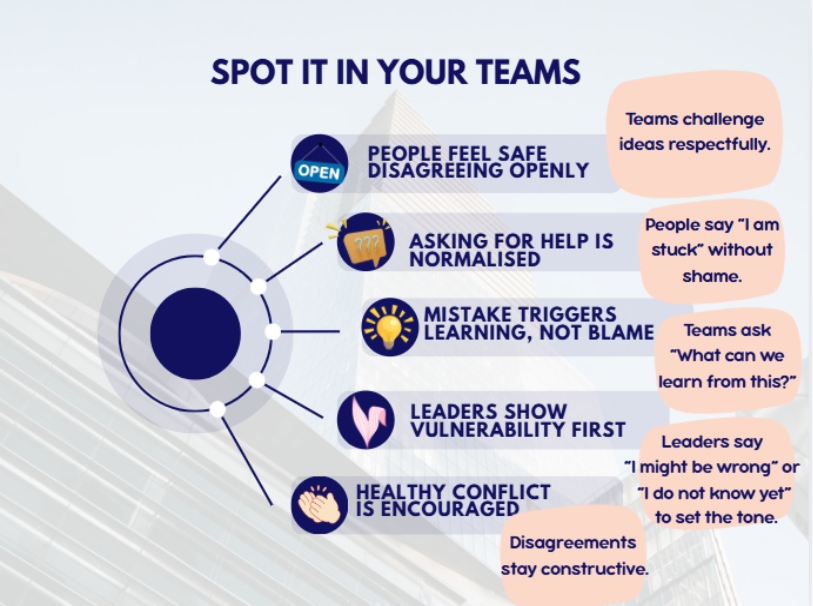
The Five Indicators of Psychological Safety in a Team
Here are signs of healthy psychological safety in a team that managers can look out for.
Common Defensive Behaviours That Signal Low Psychological Safety
Our threat responses are deeply wired into our brains and act as survival strategies we carry into adulthood, including the workplace. The work environment is high-energy, with conflicts, deadlines, power dynamics, and performance pressure. And in situations where our work environment feels unsafe, our threat responses are often reactivated.
Withdrawing
- Cause: Fear of judgement
- Looks like: Staying silent
- Impact: Lost ideas
- Fix: Invite contributions gently
Over explaining
- Cause: Fear of misunderstanding
- Looks like: Long justifications
- Impact: Reduced decision-making ability
- Fix: Reassure that mistakes are expected
Avoiding conflict
- Cause: Fear of confrontation
- Looks like: “No worries” or “It is fine”
- Impact: Unresolved issues
- Fix: Normalise constructive debate
Blaming or defensiveness
- Cause: Punitive culture
- Looks like: “It was not my fault”
- Impact: No learning
- Fix: Ask learning-focused questions
Silent agreement
- Cause: Power imbalance
- Looks like: Nodding along without real agreement
- Impact: Poor decisions
- Fix: Invite challenge
Passive compliance
- Cause: Fear of being labelled difficult
- Looks like: Doing what is told without input
- Impact: Low ownership
- Fix: Rotate decision-making roles
Causes of Low Psychological Safety
- Fear-based leadership: A manager raises their voice or publicly calls out mistakes, so people stop asking questions to avoid being embarrassed.
- Punitive performance environments: Employees get blamed for minor errors in reviews, which makes them hide problems instead of reporting them early.
- Unclear expectations: Team members are unsure what success looks like, so they hesitate to take action because they fear choosing the wrong approach.
- Lack of inclusive communication: Meetings are dominated by a few voices while others are talked over or ignored, so quieter members stop sharing ideas.
- Micromanagement: Managers check every small task and provide no autonomy to team members, which signals to employees that their judgement is not trusted.
- Past trauma from previous workplaces: Someone who was criticised harshly or shut down in a former job stays guarded and avoids speaking up even in a healthier team.
- Cultural and generational differences: Different communication styles, accents or indirect ways of speaking can cause misunderstanding or silence. Senior employees may rely on hierarchy, while younger members expect openness, which can create hesitation to speak up.
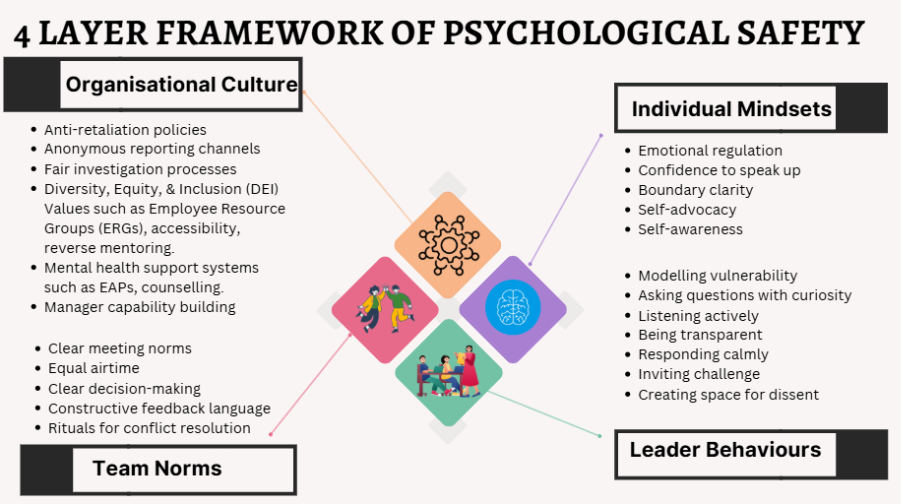
The Psychological Safety Framework: Four Layers
The concept of building sustainable psychological safety at workplaces can be understood through the following four-layer framework that works hand-in-hand:
How to Build Psychological Safety as a Leader (Practical, Actionable Steps)
- Ask “round-robin” questions in meetings: Go around the room so everyone speaks once, preventing louder voices from dominating and making quieter members feel included.
- Normalise “I might be wrong, what do you think?”: Sharing your thoughts first, while inviting input during discussions, signals that disagreement is welcome rather than risky.
- Share mistakes to set the tone: A leader admitting “I overlooked this last week” shows that errors are normal and reduces fear of being judged.
- Replace blame with curiosity: Instead of asking “Who missed this?” ask “What made this happen?” which encourages honest discussion.
- Reward learning behaviours: Acknowledge people who try new methods or share lessons from a failed attempt, so experimentation feels safe.
- Give clarity and autonomy: Define the goal clearly, then let the team decide how to reach it, which builds trust and ownership.
- Close the loop on feedback: Tell employees what you changed after hearing their input, showing that speaking up leads to real action.
Before and After Example of Leadership Tone
Before: “I do not want excuses. Fix it.”
After: “Let us understand what happened so we can improve the process together.”
Note: Small shifts like this reduce fear and increase honesty.
How Teams Can Build Psychological Safety (Peer Practices)
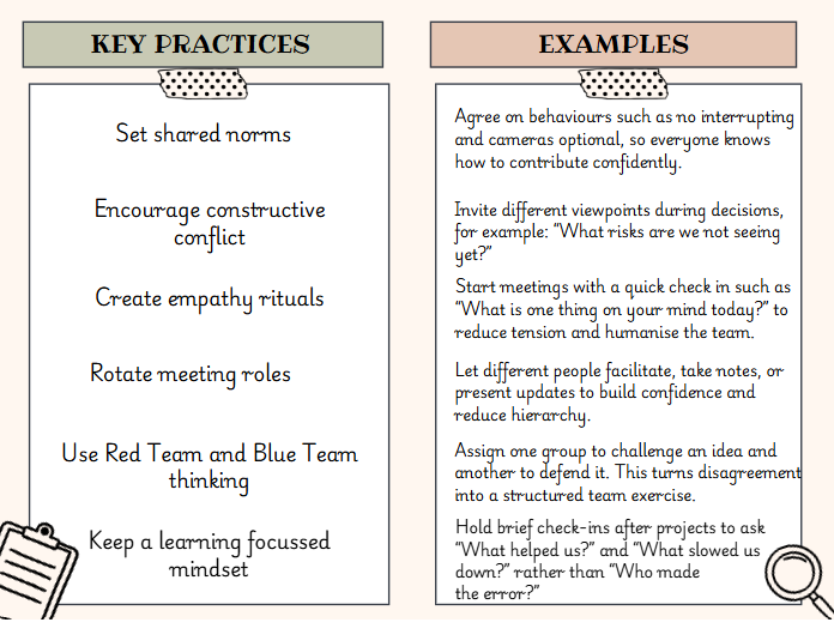
Feedback phrasing examples (to keep conversations safe):
“One thing I appreciate is…”
“One thing I am curious about is…”
“One thing we can try differently is…”
How Organisations Can Build Psychological Safety (Policy-Level Actions)
- Clear Anti-retaliation policies: Employees know they will not face negative consequences for reporting issues or disagreements.
- Anonymous feedback channels: Suggestion boxes or digital forms allow people to raise concerns even when they worry about hierarchy.
- Transparent investigations: HR explains the steps taken during complaints so employees trust that issues are handled fairly.
- Learning based performance reviews: Performance discussions focus on growth and skill development, not only mistakes or ratings.
- Manager training: Leaders are trained in active listening, inclusive communication and conflict handling so daily interactions feel safe.
- Psychological safety surveys: Regular pulse checks help HR spot early signs of silence, fear or disengagement in teams. For a more comprehensive view of workforce vulnerability, an emotional risk survey assesses psychological safety alongside resilience, burnout, and emotional regulation at the cohort level.
- Strong counselling and wellbeing systems: Employees have access to counselling or EAP support, which encourages early help seeking and reduces stress. For organisations looking to embed this support at the peer level, employee emotional care support through a structured Emotional Care Champions network ensures every team has a trained, approachable first point of contact.
If you or your organisation is looking for EAP support or access to confidential counselling services, please reach out to 1to1help today.
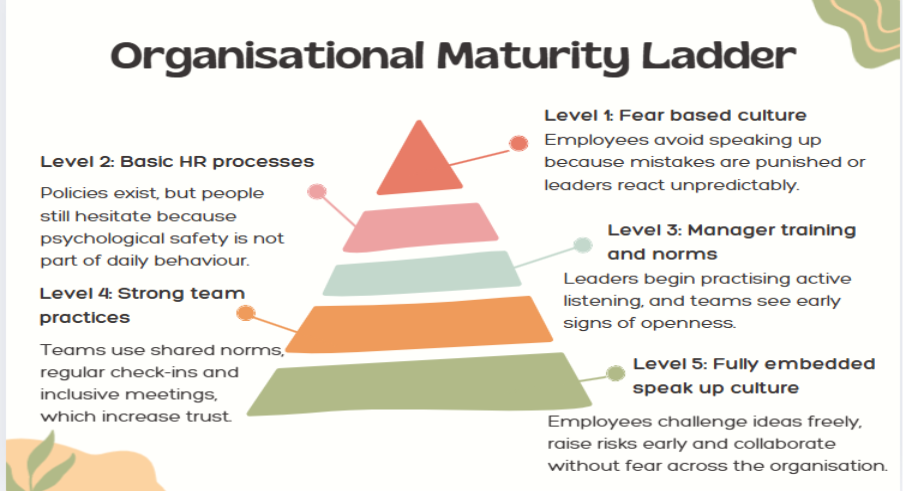
Organisational Maturity Ladder (With Workplace Context)
The organisational maturity ladder shows how workplaces gradually evolve from fear and silence to a fully open and speak up culture. It helps leaders understand where their organisation currently stands and what steps are needed to reach higher psychological safety
How to Measure Psychological Safety
Psychological safety measurement helps teams understand whether employees feel safe to speak up, take risks and share ideas. It also shows HR and leaders where silent pockets or fear-based behaviours may be emerging. Tracking these indicators allows organisations to improve workplace psychological safety in a structured, evidence-based way.
Key metrics
- Speak up frequency: How often employees raise ideas, concerns or questions in meetings.
- Mistake reporting patterns: Whether errors are surfaced early or hidden due to fear of blame.
- Participation equality: Whether airtime is balanced or dominated by a few voices.
- Quality of peer feedback: Whether feedback is constructive and respectful or avoided entirely.
- Engagement and wellbeing indicators: High stress, low motivation and withdrawal often signal low psychological safety.
- Manager responsiveness: Whether leaders acknowledge concerns and act on them promptly.
- Anonymous EAP insights: Patterns of stress or anxiety reported through counselling can indicate safety gaps.
Tools to measure psychological safety
- Pulse surveys: Short, regular check-ins that capture how safe teams currently feel.
- 1:1 meetings: Managers can identify silence, hesitation or emotional strain through private conversations.
- Retrospectives: Teams reflect on what went well and what hindered learning or communication.
- HR analytics: Patterns in retention, complaints, utilisation of support systems and feedback scores reveal deeper issues.
- Digital feedback channels: Anonymous tools allow employees to share concerns without fear of judgement.
Measurement helps teams identify progress and address low psychological safety before it becomes harmful.
Psychological Safety in Hybrid & Remote Teams
Remote and hybrid teams experience additional barriers that affect team psychological safety. Without in-person cues, tone and intent are harder to read, and silence is often misinterpreted as disengagement.
Common challenges
- Camera pressure: Employees may feel judged for not switching on cameras even when they need privacy.
- Tone misunderstanding: Short messages on Slack or Teams can be misinterpreted as rude or impatient.
- Delayed feedback: Waiting for replies increases anxiety and uncertainty.
- Conflict escalation: Tension builds when difficult conversations are handled through text instead of video or voice.
- Back channel conversations: Side chats create exclusion and erode trust.
Examples of behaviour
Good remote behaviour:
“Here is the context. I welcome your feedback.”
Poor remote behaviour:
“Why did you not reply? Are you working?”
Managers should clarify intent, write with warmth and assume positive effort to maintain psychological safety in remote environments.
Psychological Safety for Diverse and Underrepresented Employees
Psychological safety and diversity are closely connected. Employees from minority or underrepresented groups often experience a higher social risk when speaking up due to microaggressions, bias or concerns about being misunderstood.
Key challenges
- Microaggressions: Small but harmful comments that signal exclusion.
- Cultural differences: Different ways of expressing ideas or disagreement may be misinterpreted.
- Stereotype threat: Fear of confirming negative assumptions reduces confidence.
- Fear of judgement for identity or accent: People hold back to avoid being mocked or dismissed.
- Extra pressure to prove competence: Minority employees often feel they must outperform to be taken seriously.
Manager actions to build inclusive psychological safety
- Rotate airtime: Invite quieter or underrepresented voices first.
- Ask “Whose voice is missing?”: Encourages reflection and inclusion.
- Address microaggressions immediately: Stopping harmful behaviour builds trust.
- Protect people from retaliation: Employees should feel safe raising concerns without fear of backlash.
Psychological safety is essential for building inclusive, diverse and equitable workplaces.
Psychological Safety in High-Stress Roles
Some roles naturally carry high stakes and constant pressure. In these environments, low psychological safety increases error rates, burnout and attrition.
Industries with higher risk
- Healthcare
- Emergency services
- BPO and customer support
- Technology and engineering
- Education
- Sales sectors
Workplace examples
- Customer service staff often hide escalation issues to avoid criticism.
- Healthcare teams may avoid reporting system delays due to fear of conflict.
- Tech teams under tight deadlines may silence junior members to save time.
In these roles, team psychological safety directly influences well-being, accuracy and decision-making quality.
Psychological Safety and Mental Health
There is strong evidence that workplace psychological safety and employee mental health are closely linked. Without safety, employees remain in a constant state of threat, affecting their emotional and physical well-being.
Effects of low psychological safety on mental health
- Burnout from chronic stress
- Emotional exhaustion
- Anxiety from fear-based cultures
- Depressive symptoms due to isolation or silence
- Withdrawal and disengagement to avoid conflict
How psychologically safe workplaces support wellbeing
- Employees feel comfortable asking for help early
- Healthy boundaries and communication reduce overload
- Trust and empathy strengthen team resilience
- Stress-related health risks decline when fear is reduced
When employees feel safe, they experience higher well-being and feel more supported at work.
Real World Examples of Psychological Safety
High safety example
At a software company, weekly retrospectives encouraged honest discussions. A junior developer identified a security flaw that others missed, preventing a significant breach.
Low safety example
In a customer service team, agents feared reporting system delays because the manager blamed them. The issue escalated into a large client complaint that could have been avoided.
Real-world cases show that small behaviours significantly impact team outcomes.
How 1to1help Supports Psychological Safety
1to1help strengthens workplace psychological safety through a comprehensive support ecosystem for employees and managers.
Support areas
- Leadership coaching: Helps managers build trust, communicate clearly and respond without blame.
- Anonymous counselling: Gives employees a confidential space to manage stress, anxiety and workplace challenges.
- Conflict and communication workshops: Help teams discover healthier ways of interacting, disagreeing and collaborating.
- Insights for HR: Aggregated EAP data highlights themes around stress, burnout and silence in teams.
- Crisis support: Rapid assistance for teams facing workplace trauma or intense pressure.
- Manager development programmes: Practical training that equips leaders to create psychologically safe teams.
The focus is on building open, supportive and healthy workplace cultures. Explore 1to1help cohort-based programmes for support and assistance.
FAQs
Q1. Is psychological safety the same as trust?
They are related but different. Trust is between individuals. Psychological safety is a shared belief across the entire team.
Q2. Can psychological safety be measured?
Yes, through surveys, participation patterns, feedback trends and behavioural signals.
Q3. What destroys psychological safety fastest?
Blame, micromanagement, inconsistent leadership, exclusion and public criticism.
Q4. Does psychological safety mean low accountability?
No. It means accountability is fair and focused on learning, not punishment.
Q5. What should leaders do when people shut down?
Pause, acknowledge emotion and gently invite thoughts to rebuild safety.
Summary and Checklist
Psychological safety at work is a key driver of high performance, employee wellbeing, diversity outcomes and innovation. It requires consistent leadership behaviours, explicit team norms and strong organisational systems.
- Psychological Safety Checklist (Can be used by Leaders and Managers): Psychological Safety Checklist for Leaders
- 7-Day Psychological Safety Challenge (Can be practised by Leaders and Managers): 7-Day Psychological Safety Challenge_CCL
Recommended Readings
- Our article on burnout prevention shares practical strategies for recognising the signs and preventing long-term harm.
- Our article on management skills explores practical ways to build them along with insights tailored to Indian workplaces.
- Our blog on building resilience shares proven ways to build resilience tailored for unique stressors and challenges at the workplace.
References
- BrainWorks Institute. (n.d.). The neuroscience behind psychological safety at work. https://www.brainworksinstitute.org/post/the-neuroscience-behind-psychological-safety-at-work
- Burstan, G. (2025, June 9). How Pixar’s Brain Trust saved the company and sparked creativity. Considerable. https://www.considerable.com/how-pixars-brain-trust-saved-the-company-and-sparked-creativity/
- Center for Creative Leadership. (n.d.). What is psychological safety at work? https://www.ccl.org/articles/leading-effectively-articles/what-is-psychological-safety-at-work/
- CIPD. (2024). Evidence review: Trust and psychological safety. https://www.cipd.org/en/knowledge/evidence-reviews/trust-psychological-safety/
- Cleveland Clinic. (2020). What happens to your body during the fight or flight response? https://health.clevelandclinic.org/what-happens-to-your-body-during-the-fight-or-flight-response
- Cleveland Clinic. (n.d.). Oxytocin: Function, benefits and how it supports connection. https://my.clevelandclinic.org/health/articles/22618-oxytocin
- Edmondson, A. C. (1999). Psychological safety and learning behavior in work teams. Administrative Science Quarterly, 44(2), 350–383.
https://web.mit.edu/curhan/www/docs/Articles/15341_Readings/Group_Performance/Edmondson%20Psychological_safety.pdf
- Forbes Coaches Council. (2025). Unlocking team potential: The power of cognitive diversity and psychological safety. https://www.forbes.com/councils/forbescoachescouncil/2025/02/04/unlocking-team-potential-the-power-of-cognitive-diversity-and-psychological-safety/
- Gallup. (2017). Create a culture of psychological safety. https://www.gallup.com/workplace/236198/create-culture-psychological-safety.aspx
- Google re:Work. (2018). The five keys to a successful Google team. https://nobl.io/changemaker/google-high-performing-teams/
- Harvard Business Review. (2022). Why psychological safety is the hidden engine behind innovation and transformation. https://www.harvardbusiness.org/insight/why-psychological-safety-is-the-hidden-engine-behind-innovation-and-transformation/
- Harvard Business Review. (2025). Six defensive behaviors that show up at work and how psychological safety can help. https://hbr.org/2025/10/6-defensive-behaviors-that-show-up-at-work-and-how-psychological-safety-can-help
- Harvard Business School. (n.d.). Psychological safety buffers burnout and improves retention. https://www.hbs.edu/ris/Publication%20Files/ijph-69-1607332_e9d73103-4ad3-478d-b3ff-cbab79c06da1.pdf
- Harvard Business School Online. (n.d.). Psychological safety in the workplace. https://online.hbs.edu/blog/post/psychological-safety-in-the-workplace
- ICQ Global. (n.d.). Cognitive diversity and team performance. https://icq.global/cognitive-diversity/
- McKinsey & Company. (n.d.). What is psychological safety? https://www.mckinsey.com/featured-insights/mckinsey-explainers/what-is-psychological-safety
- Open Psychology Journal. (2024). Psychological safety and job burnout. https://openpsychologyjournal.com/VOLUME/16/ELOCATOR/e187435012307090/FULLTEXT/
- People Plus Science. (2023). Psychological safety and the brain. https://peopleplusscience.com/psychological-safety-5/
- Quantum Workplace. (2024). How to create psychological safety in the workplace. https://www.quantumworkplace.com/future-of-work/create-psychological-safety-in-the-workplace
- ResearchGate. (2021). Challenges in the new economy: A new era for work design. https://www.researchgate.net/publication/377752046_Annual_Review_of_Organizational_Psychology_and_Organizational_Behavior_Challenges_in_the_New_Economy_A_New_Era_for_Work_Design_Keywords
- ResearchGate. (2024). Research on the relationship between psychological safety and individual job burnout. https://www.researchgate.net/publication/349130172_Research_on_the_Relationship_between_Psychological_Safety_and_Individual_Job_Burnout
- Six Sigma Daily. (2018, January 8). What is an Andon cord? Six Sigma Daily https://www.sixsigmadaily.com/what-is-an-andon-cord/
- WorldMetrics. (2023). Psychological safety statistics. https://worldmetrics.org/psychological-safety-statistics/


.svg)
.svg)
.svg)
.svg)