

.png)


.png)

Work Related Concerns
Developing Adaptability in the Workplace: 10 Essential Tips for Career Success
.png)
.png)
Written by
Aarohi Parakh,
Psychologist and Content Writer

Reviewed by
Sanjana Sivaram,
Psychologist and Clinical Content Head


Introduction
The workplace is an ever-changing, dynamic place. A campaign that works brilliantly one day doesn’t land the next. The colleague you’ve always relied on is suddenly out on leave. We have all seen how businesses and professionals had to adjust to working through a pandemic. From new technologies and shifting team structures to evolving performance expectations, today’s professionals are constantly required to adapt.

This well-written quote by Dolly Parton emphasises the significance of adapting to our circumstances. While things may not be in our control, how we navigate through them to move forward is definitely in our hands. In the workplace, adaptability is the ability to keep sailing, even when the wind changes unexpectedly. Like many other soft skills, adaptability can be learnt.
Adaptability in the workplace has emerged as one of the most critical professional development skills for long-term career success. Employers increasingly value individuals who can manage uncertainty, cope with change at work, and remain effective even when circumstances are far from ideal. This blog explores what adaptability skills really mean, why they matter, and how employees can actively develop and improve adaptability at work through ten practical, evidence-informed strategies.
What Are Adaptability Skills and Why Do They Matter at Work?
Defining Adaptability Skills: Flexibility in a Changing Environment
Adaptability skills are traits that allow individuals to adjust to new circumstances, challenges, changing demands, and environments effectively. In simple terms, adaptability is the ability to remain flexible and functional even when plans do not go as expected. This includes being open to new ideas, eager to learn, and flexible enough to adapt as needed.
Being adaptable at work entails more than simply "going with the flow." It involves being flexible, stepping outside one's comfort zone, responding proactively rather than reacting, and proposing or embracing novel approaches to work. For example, an adaptable employee may willingly learn a new software tool when processes are updated or adjust their communication style when working with a new manager or a diverse team.
In fast-paced work environments, adaptability becomes the bridge between uncertainty and performance. Without it, even highly skilled professionals may struggle to remain effective.
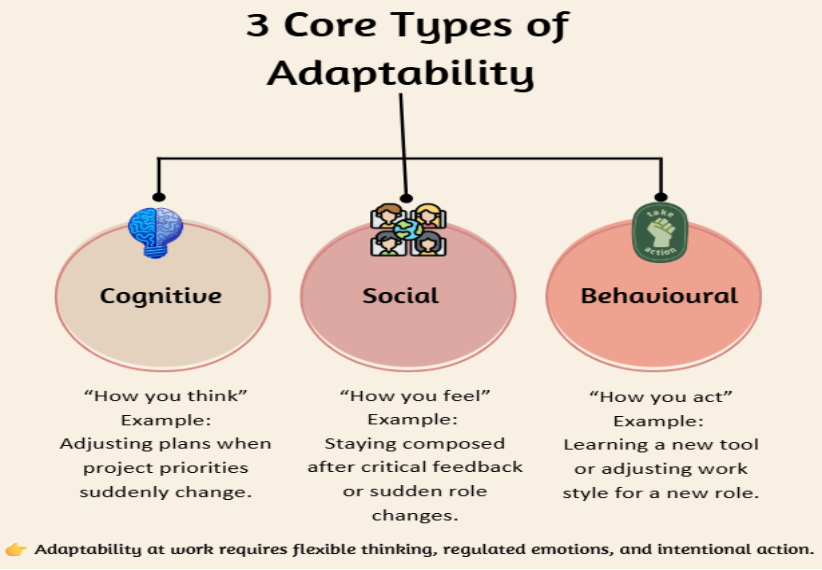
The 3 Key Types of Adaptability
Adaptability is not a single skill but a combination of interrelated abilities. Understanding its core types helps employees identify where growth is most needed.
- Cognitive Adaptability: This refers to the ability to shift thinking patterns, perspectives, and problem-solving approaches when faced with new information. It involves mental flexibility and openness to alternative viewpoints.
For example, when managing multiple tasks with shifting priorities, cognitive adaptability enables individuals to reorganise plans and reframe problems without feeling overwhelmed.
- Social Adaptability: It is the capacity to adjust interpersonal behaviour across different social and professional contexts. This includes active listening, empathy, and modifying communication styles to align with colleagues, clients, or leaders.
For example, adapting to a new team culture or collaborating with colleagues from different cultural backgrounds requires strong social adaptability.
- Behavioural Adaptability: It involves making conscious, action-oriented changes in response to new demands. This might include learning a new skill, altering work routines, or changing feedback approaches.
For example, an employee who proactively enrols in training after a role change demonstrates behavioural adaptability.
Importance of Adaptability: Navigating Work Challenges
- Workplace change can take many forms, such as new leadership, team restructuring, role ambiguity, difficult colleagues, or increased workload. Without adaptability, such situations can lead to stress, disengagement, or burnout. With adaptability, employees are better equipped to manage uncertainty, maintain performance, and continue professional growth.
- Additionally, studies show that companies with high adaptability scores are 270% more likely to be profitable than their less adaptable counterparts. This statistic shows not only the importance of adaptive strategies but also their direct impact on your bottom line.
- Challenging oneself in unexpected situations not only hones problem-solving skills, but can also help rewire the brain. As an individual continues to face challenges, adapt, and bounce back with different solutions, the brain learns that nothing is insurmountable.
- Adaptability supports long-term employability, emotional well-being, and career progression, making it one of the most valuable professional development skills today.
10 Actionable Tips to Develop and Improve Adaptability at Work
Adaptability in the workplace can come naturally to some people. However, it is a skill that can be learnt and developed over time, with effort and practise. The following strategies go beyond surface-level advice and focus on how individuals can build and improve adaptability at work in a practical manner.
1. Acknowledge and Process Your Emotions
Any transition or change in the workplace can be challenging to accept. It is natural for employees to experience a range of emotions, such as shock, anger, frustration, fear, or disappointment, when faced with uncertainty. However, these emotional responses are often rushed past in the name of professionalism, leading individuals to suppress rather than process their feelings.
Adaptability in the workplace begins with emotional awareness. When emotions are swallowed or ignored, they do not disappear; instead, they remain unresolved and often resurface as irritability, disengagement, procrastination, reduced concentration, or burnout. To develop adaptability skills, emotions need to be acknowledged and expressed in healthy ways rather than denied.
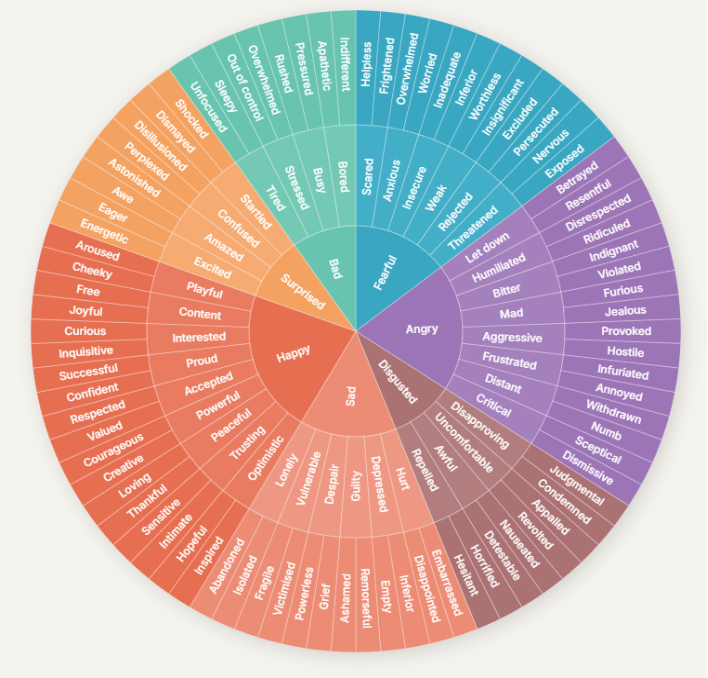
The next time a workplace situation feels unsettling, instead of pulling away or distracting oneself, it can be helpful to slow down and mentally label the emotion. Telling oneself, “I am feeling disappointed” or “I am feeling anxious,” helps connect with the emotional experience rather than avoiding it. This simple act of naming emotions supports emotional adaptability by reducing their intensity and improving clarity.
In many cases, individuals struggle to identify what they are feeling beyond a general sense of distress. Tools such as the feelings wheel can help employees connect with emotions they may not be consciously aware of. Greater emotional clarity enables more thoughtful responses to change rather than impulsive reactions.
Case example:
A marketing executive is suddenly reassigned to a new team following organisational restructuring. While she continues to perform her tasks, she feels persistently overwhelmed and irritable. When she pauses to reflect, she recognises that the underlying emotion is anxiety about meeting new expectations. By acknowledging this feeling rather than dismissing it, she can seek clarity from her manager and approach the transition with greater confidence.
💡Key takeaway: Emotional adaptability begins when emotions are acknowledged, named, and processed rather than suppressed.
2. Watch Out for Changes and Be Proactive
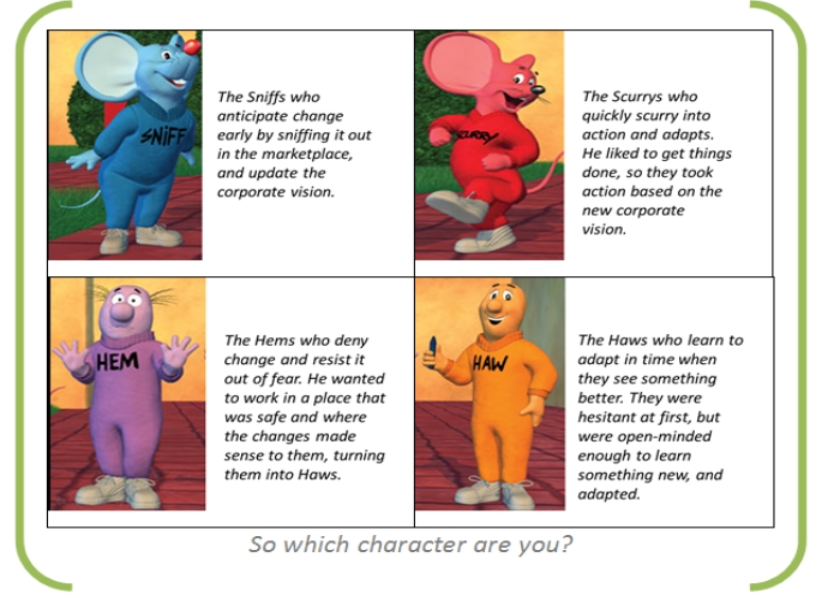
An impactful story titled "Who Moved My Cheese" highlights how attitudes toward change play a crucial role in workplace adaptability. The central message of the story is that what served individuals well in the past may no longer deliver the same results. Recognising this early allows employees to remain flexible rather than resistant when circumstances shift.
Developing adaptability skills involves being mindful of possible changes before they fully unfold. Workplace change can take several forms, such as changes in management, revised roles, the need to adopt new technology, or shifts in market and client needs. Employees who stay alert to these signals are often better prepared to adjust both mentally and practically.
Being proactive also means seeking understanding rather than relying on assumptions. Open discussions with colleagues and managers can offer clarity around upcoming changes and expectations. These conversations can become useful spaces to brainstorm new ideas, explore alternative strategies, and identify opportunities for growth during transitions.
Case example:
An employee notices recurring discussions about digital transformation in leadership meetings. Instead of waiting for formal role changes, he speaks with his manager and team members to better understand future expectations and begins upskilling in relevant areas.
💡Key takeaway: Mindful awareness and proactive conversations help employees stay prepared for change rather than overwhelmed by it.
3. Embrace Curiosity and Cultivate a Growth Mindset
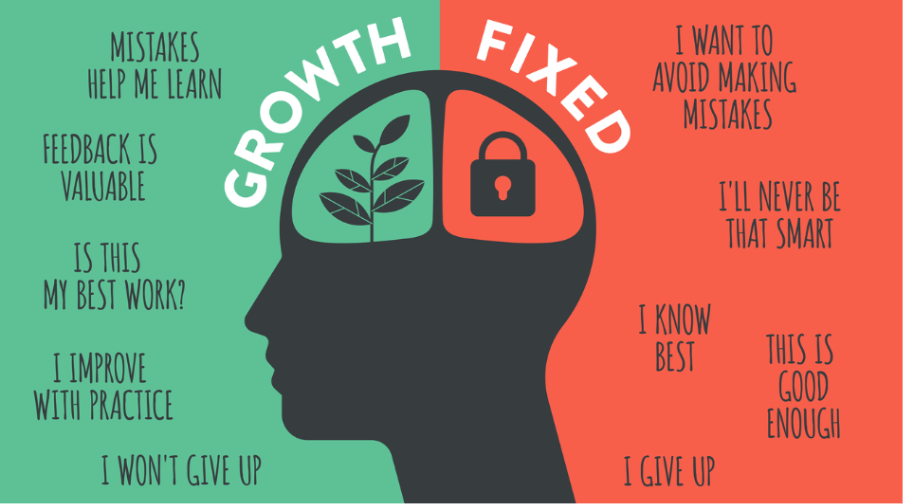
Curiosity is a strong indicator of a growth mindset at work. When employees ask questions, it signals openness to learning rather than resistance to change. Curiosity allows individuals to move beyond surface-level reactions and engage more deeply with what is unfolding around them.
Asking thoughtful questions also supports cognitive adaptability. The information gained through inquiry helps employees assess situations more realistically, evaluate available options, and make informed decisions. This process often brings clarity to changes that may initially feel confusing or overwhelming.
Reflective questions can be particularly useful during transitions. Employees may find it helpful to ask themselves, “What does this change mean to the company?”, “Why is it required for me to adapt to this?”, and “How will this benefit my way upward as an employee?” Such questions shift the focus from fear and resistance to purpose and possibility.
Case example:
When a new reporting structure is introduced, an employee initially feels uncertain about expectations. By asking clarifying questions and understanding how the change aligns with organisational goals, she is able to adjust her approach and engage more confidently with her role.
💡Key takeaway: Curiosity transforms uncertainty into understanding and supports a growth-oriented response to change.
4. Stay Relevant Through Upskilling and Lifelong Learning
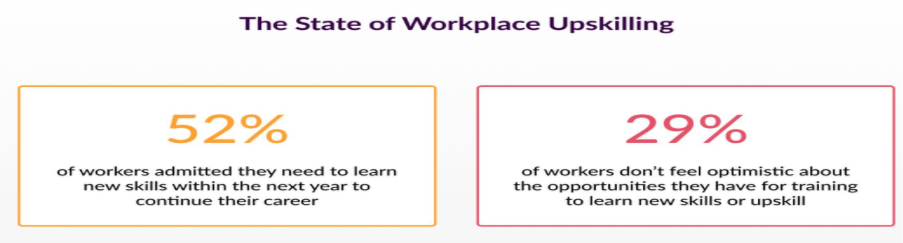
With rapid technological advancements and ongoing industry innovation, it has become essential for employees to stay on par with their peers. Developing adaptability in the workplace is closely linked to the willingness to upskill and update one’s knowledge in response to changing demands.
Upskilling helps employees sustain themselves in dynamic work environments while supporting long-term career growth. This may involve strengthening soft skills such as communication, time management, leadership, and emotional intelligence, as well as acquiring hard skills relevant to one’s field. Both forms of learning contribute to improved workplace flexibility and performance.
Beyond skill acquisition, cultivating a lifelong learning mindset is equally important. Employees who view learning as an ongoing process tend to experience higher self-esteem and confidence in their abilities. This mindset encourages openness to new information and reduces fear associated with unfamiliar tasks or roles, thereby increasing adaptability at work.
Case example:
A mid-career professional notices increasing reliance on digital tools within his team. Instead of feeling intimidated, he enrols in short training programmes and refines his leadership and communication skills, helping him remain confident and effective in his role.
💡Key takeaway: Continuous learning and a lifelong learner mindset strengthen adaptability and support a sustained career.
5. Reframe Opportunities and Challenge Negative Self-Talk
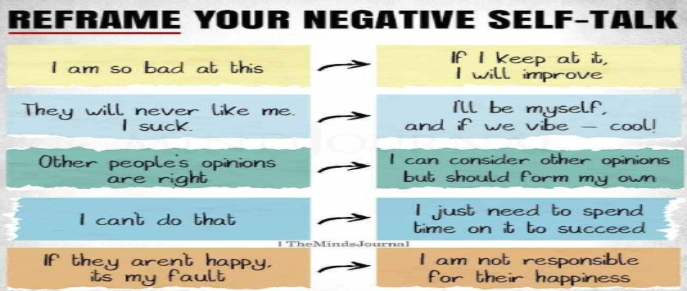
Dealing with change or adversity at work often brings up doubt, fear, and worry. In such situations, employees may find themselves caught in a cycle of negative self-talk, imagining unfavourable outcomes or questioning their own abilities. These thoughts focussed on the future play a significant role in shaping emotional responses. Thoughts influence feelings, and together they guide behaviour.
While these thoughts and emotions are valid responses to uncertainty, they are not always accurate reflections of reality. Developing cognitive adaptability involves learning to pause and examine these thoughts more closely. When evaluated objectively, many negative thoughts are revealed to be assumptions rather than facts.
A helpful practice is to consciously identify unhelpful thoughts and reframe them with a healthier, more balanced perspective. For example, the thought, “This is a new technology, I would never be able to learn this,” can be reframed as, “This is new and does seem difficult, but I will gradually learn it.” Such reframing reduces emotional distress and encourages constructive action rather than avoidance.
Case example:
An employee feels anxious after being assigned a project that requires unfamiliar skills. By identifying her fear-based thoughts and reframing them (“I can’t do this” to “I can try and learn”), she becomes more open to seeking training and support, which improves both confidence and performance.
💡Key takeaway: Challenging and reframing negative self-talk strengthens adaptability by promoting realistic and supportive thinking.
6. Practice Self-Kindness and Compassion
Adapting to change and learning new concepts is rarely easy. Frustrations are inevitable, mistakes occur, and individuals often fall short of their own expectations. This is a shared human experience rather than a personal failure. Recognising this reality supports emotional adaptability and reduces unnecessary self-criticism.
During such moments, practising self-kindness instead of harsh self-judgement can make adaptation more sustainable. Self-compassion involves responding to oneself with the same understanding and care you would offer a friend during a difficult time. Rather than ignoring discomfort or criticising perceived inadequacies, it helps to pause and acknowledge the challenge.
A simple self-compassion practice is to gently tell oneself, “This is really difficult right now. How can I comfort and care for myself in this moment?” Taking this brief pause supports emotional well-being and makes workplace adaptation easier.
Case example:
A team lead struggling to adjust to increased responsibilities begins to blame herself for small mistakes. When she shifts to a more compassionate self-response, she remains engaged, seeks feedback, and adapts more effectively to her role.
💡Key takeaway: Self-compassion helps maintain emotional balance and supports adaptability during challenging transitions.
Try this activity to cultivate self – compassion and be kinder to yourself!
7. Understand and Set Flexible Boundaries
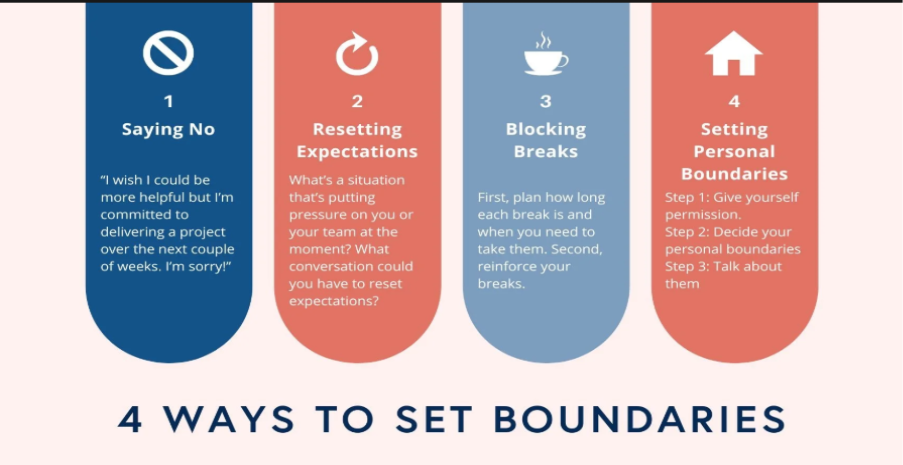
There is a fine line between setting healthy boundaries to prevent feeling overstretched or burnt out and being overly rigid in ways that reduce adaptability. Many employees struggle to identify what this balance should look like, especially during periods of change.
In the workplace, effective employees tend to function like a rubber band rather than a metal wire. This does not mean letting go of boundaries altogether. Instead, it involves being mindful about what is negotiable and what is non-negotiable. Such flexibility creates space for professional growth while ensuring individuals do not feel personally compromised.
Case example:
During a temporary increase in workload, an employee agrees to extend working hours for a short period, clearly communicating the limits and recovery time. This approach allows her to support team goals without experiencing burnout.
💡Key takeaway: Flexible boundaries support adaptability without sacrificing well-being.
8. Learn to Relax and Manage Stress Effectively
Learning to manage stress helps improve adaptability in the workplace. High stress levels often reduce emotional regulation and cognitive flexibility, making it harder for employees to respond constructively to change.
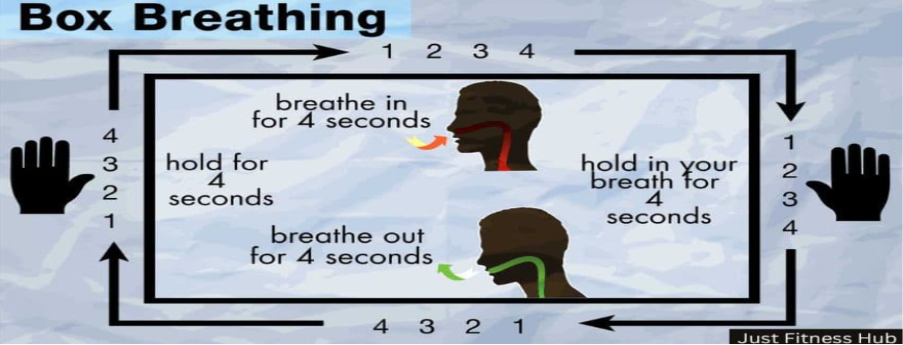
Research suggests that practising controlled breathing helps restore emotional balance and calm the mind. A calmer mental state enhances flexibility and supports better decision-making during challenging situations. One effective technique is the 4-4-4-4 box breathing exercise. This involves closing the eyes, inhaling for four counts, holding the breath for four counts, exhaling for four counts, and holding again for four counts. Repeating this cycle six to eight times can help soothe anxiety and reduce stress, especially when practised regularly.
Alongside breathing practices, engaging in self-care and taking adequate breaks are essential for sustaining adaptability. Rest and recovery allow employees to remain mentally and emotionally available for change.
Case example:
Before high-pressure meetings, a team lead practises box breathing to manage anxiety. This helps her remain calm, communicate clearly, and respond thoughtfully rather than reacting impulsively.
💡Key takeaway: Managing stress through relaxation and self-care supports emotional balance and improves adaptability at work.
9. Reach Out for Support and Interdependence
Adapting to change at work does not require managing everything alone. Workplace adaptability improves when employees recognise interdependence within teams, stay open to different perspectives, and seek help when needed.
Sharing concerns with colleagues can provide fresh insights into how others handle similar situations. Reaching out to friends or family outside of work can also provide emotional relief and a helpful break from workplace stress. Seeking support sets a positive example and reinforces the idea that employees are not alone during transitions.
Case example:
A new employee feeling overwhelmed by unclear expectations speaks with a senior colleague and gains reassurance, clarity, and practical guidance. This support helps her adjust more confidently to her role.

💡Key takeaway: Seeking support strengthens adaptability and reduces the emotional load of change.
10. Seek Professional Help (Counselling/EAP)
Seeking professional support through counselling not only helps employees address current challenges but also serves as a preventive measure during periods of change and adversity. Counselling is a collaborative process in which individuals can discuss concerns related to work, career growth, self-development, or relationships in a safe, structured environment.
Through counselling, underlying issues contributing to stress or difficulty in adapting are explored, and practical strategies are developed. Skills such as effective communication, problem-solving, decision-making, and leadership are often strengthened through this process, thereby directly supporting adaptability in the workplace.
At 1to1help, counselling services are provided by trained psychologists and counsellors, with a strong emphasis on confidentiality. In addition to counselling sessions, the Employee Assistance Programme (EAP) includes self-help resources and self-assessments to support overall well-being.
Case example:
An employee experiencing ongoing stress after organisational changes accesses counselling through the EAP. With professional support, she gains clarity, builds coping strategies, and adapts more effectively to her evolving role.
💡Key takeaway: Professional support strengthens adaptability by addressing challenges early and building practical coping skills.

Conclusion: Take the First Step Towards Workplace Flexibility
Change in the modern workplace is inevitable, and learning to manage it has become essential for long-term career success. Developing adaptability in the workplace allows employees to respond more effectively to uncertainty, evolving expectations, and new challenges without feeling overwhelmed.
Workplace flexibility is built through small, intentional actions. When employees focus on developing adaptability skills such as emotional awareness, curiosity, continuous learning, stress management, and seeking support, coping with change at work becomes less taxing and more empowering. Over time, these practices strengthen employee resilience, improve workplace flexibility, and open up new opportunities for professional growth.
While adaptability skills may not always be listed on a résumé, they play a critical role in career progression. Employees who consistently work towards improving adaptability at work are better equipped to sustain performance, navigate change, and thrive in an ever-evolving workplace.
References
- Asana. (n.d.). Workplace adaptability skills: Why they matter and how to build them. https://asana.com/resources/workplace-adaptability-skills
- BetterUp. (n.d.). Types of adaptability skills and how to develop them. https://www.betterup.com/blog/types-of-adaptability-skills
- Coursera. (n.d.). Time management skills: Definition and examples. https://www.coursera.org/articles/time-management
- Feelings Wheel. (n.d.). Feelings wheel. https://feelingswheel.app/
- HR Vision Event. (n.d.). Implementing upskilling programs for growth. https://www.hrvisionevent.com/content-hub/implementing-upskilling-programs-for-growth/
- Johnson, S. (1998). Who moved my cheese? An amazing way to deal with change in your work and in your life. G. P. Putnam’s Sons.
(Referenced via summary: https://www.tobysinclair.com/post/book-summary-who-moved-my-cheese-dr-spencer-johnson)
- Psychology Today. (n.d.). Burnout. https://www.psychologytoday.com/us/basics/burnout
- Psychology Today. (n.d.). The transformative power of self-compassion. https://www.psychologytoday.com/us/blog/flourish-and-thrive/202511/the-transformative-power-of-self-compassion
- Psychology Today. (n.d.). Using negative self-talk to your advantage. https://www.psychologytoday.com/us/blog/social-instincts/202512/2-ways-to-use-your-negative-self-talk-to-your-advantage
- Self-Compassion. (n.d.). Identifying what we really want. https://self-compassion.org/exercises/exercise-7-identifying-what-we-really-want/
- Simply Psychology. (n.d.). Emotional intelligence. https://www.simplypsychology.org/emotional-intelligence.html
- SparkMoor. (n.d.). 10 effective strategies for adapting to rapid changes in the workplace. https://sparkmoor.com/10-effective-strategies-for-adapting-to-rapid-changes-in-the-workplace/
- TimesPro. (n.d.). Important workplace adaptability skills. https://timespro.com/blog/important-workplace-adaptability-skills
- Verywell Mind. (n.d.). Stress and health. https://www.verywellmind.com/stress-and-health-3145086
- Verywell Mind. (n.d.). What is empathy? https://www.verywellmind.com/what-is-empathy-2795562
- Verywell Mind. (n.d.). What is active listening? https://www.verywellmind.com/what-is-active-listening-3024343
- Verywell Mind. (n.d.). The psychology of procrastination. https://www.verywellmind.com/the-psychology-of-procrastination-2795944
- Yale School of Management, Chief Diversity Officer Blog. (2024, October 4). Adaptability skills in the workplace. https://cdo.som.yale.edu/blog/2024/10/04/adaptability-skills-examples-and-10-tips-on-how-to-improve-yours


.svg)
.svg)
.svg)
.svg)