


.png)


.png)

Work Related Concerns
Employee Retention Strategies: Meaning, Drivers & Best Practices
.png)
.png)
Written by
Aarohi Parakh,
Psychologist and Content Writer

Reviewed by
Sanjana Sivaram,
Psychologist and Clinical Content Head


Introduction: Why Employee Retention Matters
When Shekhar, a talented analyst in Bengaluru, handed in their resignation, nobody on the leadership team remembered the quiet one-on-one that had happened six months earlier — the one where they said they wanted work that would add to their growth, clearer promotion criteria, and more mentorship. The exit interview, unfortunately, read like a checklist of avoidable mistakes: a manager who checked in only when things went wrong, an ambiguous career path, and missed recognition.
These human moments explain why employee retention is now a strategic priority rather than a traditional HR function for Indian organisations. Businesses with effective retention strategies reap the benefits of lower hiring costs, improved performance, an increased loyal customer base, and a stronger culture. And those without them? They lose talent faster than they can replace it.
This article explains what employee retention strategies entail, why they are more important than ever in India, the causes of attrition, and the actionable steps HR and team leaders can take to build workplaces where employees genuinely want to stay.
Rising attrition in India
India is facing a retention crisis across IT, BFSI, retail, start-ups, and digital-first sectors. India's attrition rate averages 17% across industries, with the tech and e-commerce sectors experiencing turnover rates of up to 28%, significantly impacting operational continuity. Shifts in demographic composition (higher percentage of millennial and GenZ workers), job market volatility, and shifting work priorities are some of the key trends shaping industry-level attrition rates.
Cost of losing employees
The actual cost of attrition extends beyond headcount; it impacts an organisation’s finances, productivity, and reputation.
- Replacing leadership roles can cost up to 200% of the employee’s annual salary, while frontline replacements cost around 40%.
- Frequent changes in client-facing teams can damage long-standing business relationships.
- Companies with high turnover often struggle to attract premium talent, creating a self-perpetuating cycle.
- High turnover disrupts workflow and burdens remaining staff, leading to productivity loss.
Retention as a strategic priority
High attrition disrupts projects, increases workload for remaining staff, slows organisational momentum, and harms morale. Companies with stronger retention strategies enjoy:
- lower hiring costs
- better client consistency
- higher productivity
- stronger teamwork
- improved employer branding
What Are Employee Retention Strategies?
Definition
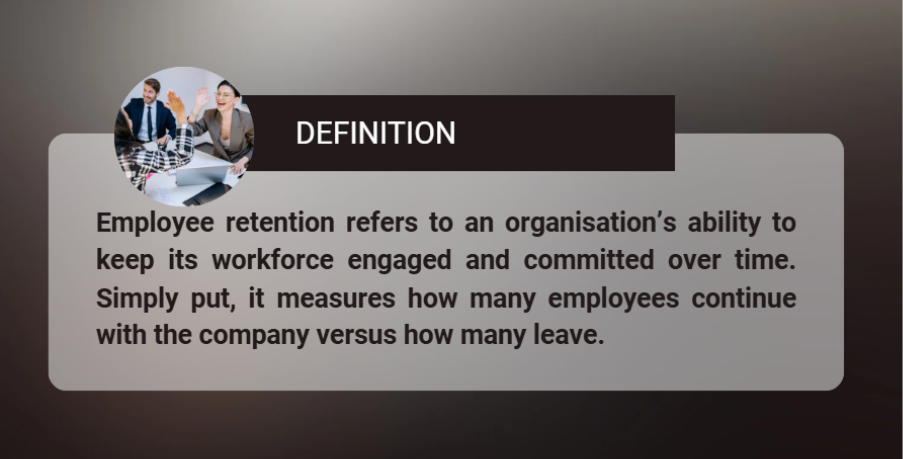
In Human Resource Management (HRM), retention strategies refer to intentional policies and practices designed to retain employees by improving job satisfaction, engagement, well-being, and career clarity.
Purpose and objectives
They aim to:
- reduce voluntary attrition
- ensure fair and competitive reward systems
- create meaningful development pathways
- strengthen manager capability
- support mental wellbeing
- foster a workplace culture where employees want to stay
💡Pro-Tip: Map your retention strategy to your employee lifecycle — onboarding → growth → recognition → wellbeing → career mobility.
Why Retention Needs Focus in India
Expectations of the younger workforce
Deloitte’s 2025 Gen Z & Millennial Survey shows that young Indian employees prioritise growth, wellbeing, flexibility, and meaningful work. They do not stay for stability alone; they stay for development and purpose.
Remote work and job-hopping trends
Remote and hybrid work has expanded job opportunities across locations. Talent no longer competes locally; they compete nationally and globally. This has accelerated job-switching, especially in skilled roles.
Need for work–life balance and well-being
Employees increasingly expect mental health support, boundaries, and humane workload practices as part of retention. The percentage of Indian jobseekers prioritising work-life balance stands at 52% (Randstad 2025 Survey), significantly higher than the global figure of 31%.
Why Employees Leave (Key Turnover Drivers)
To develop effective employee retention strategies, leaders must first understand the reasons employees leave. In Indian workplaces, where high turnover is common in specific sectors, the drivers are both structural as well as cultural.
Lack of growth
Career stagnation is a major driver of attrition. LinkedIn’s Workplace Learning Report highlights that employees stay significantly longer in organisations that offer internal mobility and clear paths to professional growth.
💡Pro-Tip: Managers should hold quarterly “growth conversations” outlining skills the employee will build next.
Poor manager relationships
Gallup reports that managers influence around 70% of the variance in employee engagement. Poor communication, unclear expectations, or a lack of recognition often push employees to explore other opportunities.
💡Pro-Tip: Train managers in coaching micro-skills: listening, asking open questions, and giving constructive feedback.
Burnout and stress
India ranks among the highest globally on burnout indicators: As per a report by the Federation of Indian Chambers of Commerce & Industry (FICCI), 58% of Indians experience burnout and workplace exhaustion, well above the global average of 48%. Work overload, long hours, and unclear priorities contribute significantly to attrition.
💡Pro-Tip: If high performers are disengaging, it could be a warning sign that burnout is at play.
Compensation gaps
Competitive pay is a powerful differentiator in India's competitive job markets, particularly in IT and BFSI. It is more difficult to retain talent when salaries fall short of benchmarks or when benefits such as health insurance and financial wellness programs fall short of industry standards.
💡Pro-Tip: Check perceived pay fairness, not only market data — perception gaps trigger resignations early.
Weak culture or engagement
A mismatch between company culture and employee values, exacerbated by poor leadership, pushes valuable employees to seek healthier environments. Employees leave when they do not feel seen, valued, or connected.
💡Pro-Tip: Celebrate cultural milestones, recognise team wins publicly, and ensure leadership visibility to reinforce trust and belonging.
Core Employee Retention Strategies
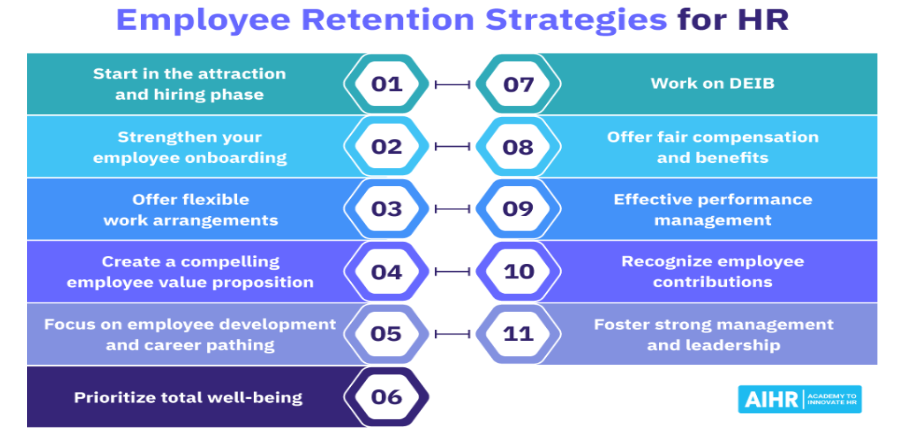
Below are eight proven strategies to create workplaces where employees can thrive and stay.
Compensation benchmarking and fairness
Ensuring market-aligned pay is foundational. However, employee compensation should not just include base salaries, but performance-based bonuses, health insurance, retirement plans, time off for personal and family matters, and other financial perks.
Examples:
- Salesforce conducts pay equity assessments and makes adjustments, demonstrating a commitment to fair and competitive compensation.
- Flipkart has implemented mid-cycle salary corrections for high-demand tech roles.
💡Pro-Tip: Communicate “WHY” salary adjustments are made. Transparency builds trust.
Growth and skill development
This approach focuses on providing clear career advancement paths and continuous learning opportunities, empowering employees to enhance their skills and progress within the organisation. Initiatives such as individualised development plans (IDPs), cross-functional projects, mentorship programmes, tuition reimbursement for further education, clearly defined internal promotion pathways, and ongoing opportunities for upskilling and reskilling support employees in their career aspirations.
Examples:
- Amazon’s Career Choice program, covering 95% of tuition for in-demand fields, Accenture India’s continuous cloud & digital upskilling, and IBM’s Your Learning platform, which offers personalised professional development, further highlight the growing emphasis on employee growth.
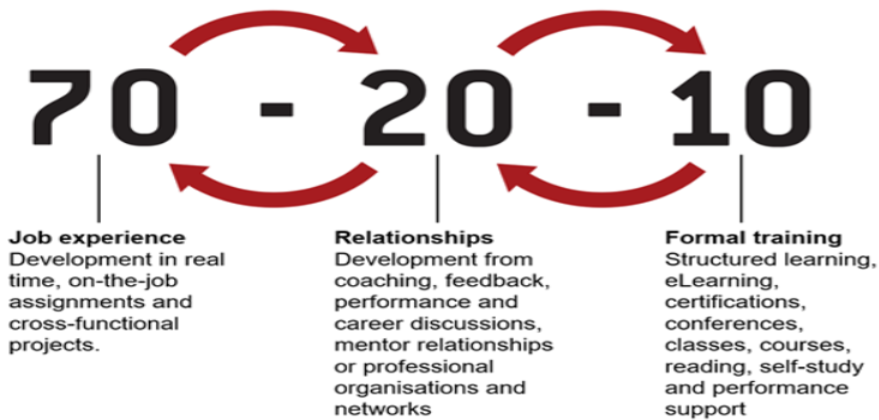
💡Pro-Tip: Offer structured “learning credits” employees can redeem for courses or certifications.
Manager capability building
The cliché that “people don’t quit jobs, they quit managers” holds truer than ever. Strong managers can lead to higher employee retention, and thus, providing them with adequate training and support becomes crucial.
💡Pro-Tip: Train managers in empathy, conflict resolution, and career coaching, not just task delegation.
Rewards and recognition systems
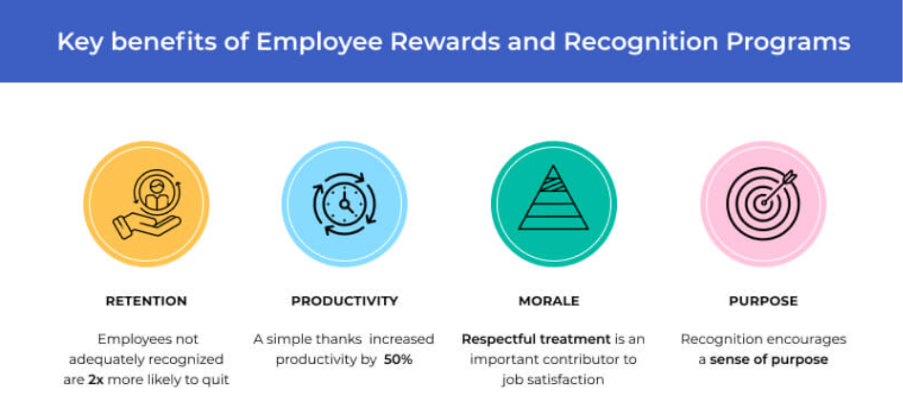
To feel valued and appreciated is a core human need, and organisations that systematically acknowledge employee contributions (both formal and informal methods) help create a sense of morale and belonging in the workforce. Employees who feel recognised are substantially less likely to leave.
Effective methods:
- peer-to-peer recognition
- monthly appreciation circles
- public shout-outs
- milestone celebrations
Examples:
- Zappos’ Wow programme allows employees to reward colleagues with points redeemable for prizes, empowering peer-to-peer recognition.
- LinkedIn’s Bravo! Platform for peer recognition with point values promotes a culture of appreciation and feedback.
💡Pro-Tip: Recognition should be timely, specific, and personal — not generic.
Flexible and hybrid work models
Following the pandemic, people's priorities have shifted, and many employees now value remote or more flexible ways of working. Work arrangements such as remote work, hybrid work, part-time or staggered hours can significantly increase employee satisfaction without a dent in performance. Organisations adopting these flexible models are more likely to retain employees.
Examples:
- Firms like Deloitte India and PWC India use structured hybrid models with fixed collaboration days, giving employees clarity and reducing scheduling stress.
💡Pro-Tip: Define team-based hybrid rules: focus days vs collaboration days.
Employee engagement programmes
True engagement goes beyond organising events or festivals. Effective programmes create two-way communication, encourage employees to contribute ideas, and strengthen their sense of belonging. Engagement is built when employees feel heard, respected, and involved in decisions that affect their daily work, especially in large, hierarchical or shift-based environments.
- Examples:
Many Indian manufacturing companies use structured “listening circles” and shop-floor forums to engage blue and grey-collar employees.
- Tata Steel, for instance, has publicly highlighted its regular dialogue forums and joint consultation groups, where employees can voice concerns, suggest operational improvements, and participate in safety and process decisions. These practices build trust, reduce conflict, and foster a more inclusive workplace culture.
💡Pro-Tip: Don’t just collect feedback — close the loop. Share back what was heard and what actions will follow. Engagement rises sharply when employees see their input leading to real change.
Wellbeing and mental health support
It’s essential to be mindful that total well-being extends beyond physical health to include your employees’ mental, social, financial, and career well-being. Stress and burnout are leading contributors to attrition. Organisations should increasingly adopt:
- employee assistance programmes (EAPs)
- stress management workshops
- resilience training
- manager sensitisation
When employees see that their employers actively care about their well-being, they are far more likely to remain loyal.
Examples:
- Firms like Wipro and Accenture have introduced mental health programs, counselling hotlines, yoga sessions, and financial wellness programs to support employees.
💡Pro-Tip: Leaders should model healthy boundaries (e.g., no weekend emails unless critical).
Strong onboarding and role clarity
Given that large companies lose up to 16% of new employees within the first six months, a well-structured onboarding process is a key step to minimising new hire attrition and retaining top talent. New hires are more often than not enthusiastic about their work, however, a poor onboarding process can prevent them from knowing what they need to do to succeed, leaving them demotivated and dissatisfied.
Effective onboarding includes:
- a 90-day roadmap
- buddy system
- early wins
- structured role clarity
💡Pro-Tip: Track 30, 60, 90-day check-ins rigorously. Most early attrition is preventable.
How Retention Strategies Work
It should be noted that employee retention is not a one-time project for any organisation. It is a continuous mechanism that needs long-term efforts from HR and team leaders.
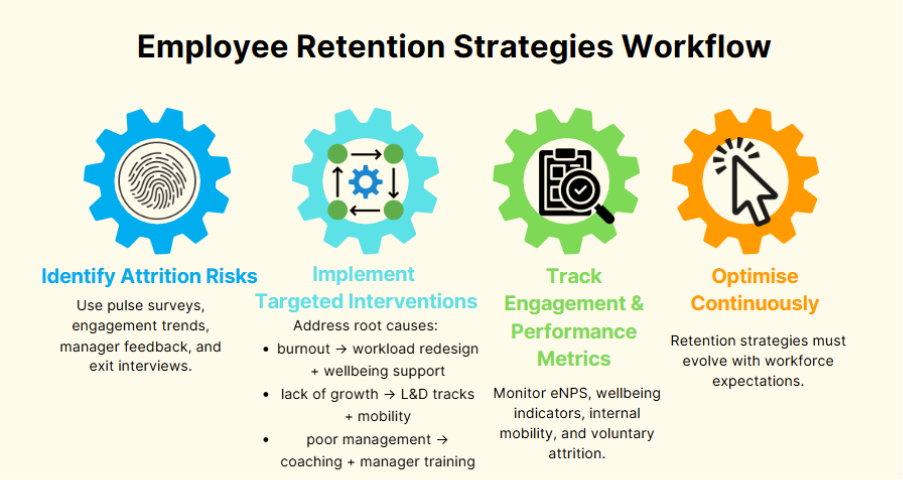
💡Pro-Tip: Review retention metrics monthly or quarterly, not annually.
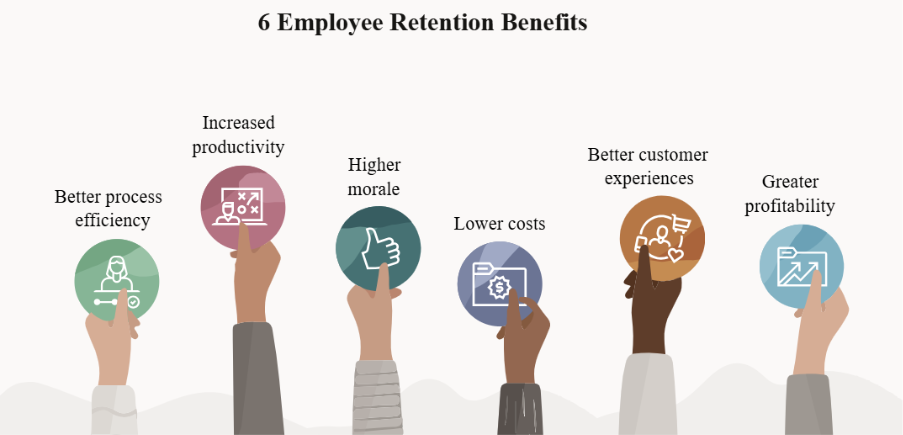
Benefits of Strong Employee Retention Strategies
For Indian workplaces, employee retention is a competitive advantage. Strong retention rates translate into stability, trust, and a healthier bottom line.
Higher job satisfaction
Employees feel valued, supported, and secure, leading to higher job satisfaction.
Career growth and clarity
Clear development pathways increase motivation and reduce job-hunting/ job-switching behaviour.
Reduced attrition cost
Recruiting and training new employees is expensive. Lower turnover rates mean increased focus on the development of existing employees rather than onboarding replacements. Employees are more likely to stay when they feel genuinely supported during significant life events, not just during performance cycles. A structured maternity benefit programme is one of the clearest signals an employer can send that this support is real — particularly given that 48% of Indian women leave within four months of returning from maternity leave.
Higher productivity
Long-time employees are usually more efficient and make fewer mistakes than newer ones, who typically need time to get accustomed to the company and its work processes.
Stronger culture and employer brand
High retention supports a stable company culture and improves employee morale. Retention is a signal: “People thrive here.”
Greater profitability
A Gallup study found that businesses with highly engaged employees and low turnover rates are 23% more profitable than those with employees who aren’t engaged.
How HR Can Measure Retention Effectiveness
Measuring retention isn’t just about counting how many people left. It’s about understanding why they left, when they left, and what signals appeared before they made that decision. Strong HR teams and leaders use a mix of quantitative and behavioural indicators to predict and prevent attrition.
Here are the core retention metrics every organisation should track, along with case examples from Indian workplaces.
Voluntary Attrition Rate
This shows how many employees left by choice. Tracking it quarterly and by department, tenure, and manager helps HR identify concentrated problem areas.
Case Example (Tech, Bengaluru): A delivery unit showed unusually high exits within the first 6 months. HR strengthened onboarding and buddy support, and early attrition dropped noticeably.
Retention Rate
It measures the percentage of employees who remain with the organisation over a specific period. A high retention rate reflects a stable workforce and strong employee satisfaction.
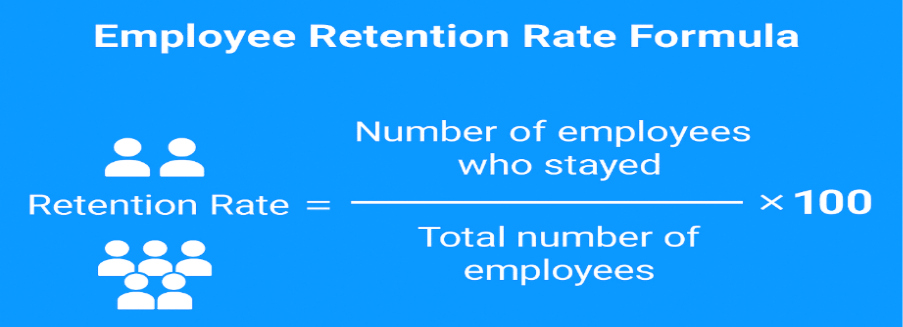
Case Example (BFSI, Mumbai): Post-appraisal retention dropped to 84%, signalling dissatisfaction with pay fairness. After standardising appraisal criteria, retention improved to 93% in the next cycle.
Engagement Score Trends
Engagement surveys (quarterly or biannual) reveal how connected employees feel. Sudden dips, especially around trust, clarity, recognition or workload, often predict resignations well before employees verbalise dissatisfaction.
Case Example (FMCG Plant): Night-shift workers’ engagement dipped due to poor handovers and limited supervisor visibility. Fixing these improved engagement and reduced exits.
Manager Effectiveness Indicators
Managers shape 70% of the employee experience (Gallup). Poor managers cause disengagement long before compensation or workload becomes an issue.
Track:
- manager ratings
- feedback from skip-level meetings
- quality of one-on-ones
- attrition by manager
Case Example (Retail): Two stores with the highest attrition were led by managers with poor communication and feedback. After coaching, turnover stabilised.
Internal Mobility Rate
Linkedin research shows that at companies with high internal mobility, employees tend to have 53% longer tenures overall compared with those at companies with low internal mobility.
Track:
- percentage of roles filled internally
- lateral moves
- career pivots
- time-in-role before movement
Case Example (BFSI): A bank launched an internal job portal; early-tenure attrition reduced as employees gained clearer growth pathways.
Exit Interview Patterns
Exit interviews are not about individual stories, but identifying and analysing patterns stemming from them. Despite exit interviews being commonplace, with around 75% of organisations conducting them, fewer than one-third regularly act on the findings, making it one of the most underutilised tools in retention analysis.
Track recurring themes:
- lack of growth
- manager behaviour
- pay fairness
- workload intensity
- culture issues
Case Example (Logistics): Repeated “no career path” feedback led HR to introduce clear progression bands—exits citing growth concerns dropped.
Employee Net Promoter Score (eNPS)
eNPS captures loyalty and advocacy, both strong predictors of who will stay. Declining eNPS often signals emerging dissatisfaction well before resignations begin.
Employees answer: “How likely are you to recommend this organisation as a great place to work?”
Case Example (Tech, Pune): Project Managers rated eNPS low due to unclear promotion criteria. After defining a merit-based path, scores and retention improved.
💡Pro-Tip: Cluster exit insights by department → identify hotspots → intervene early.
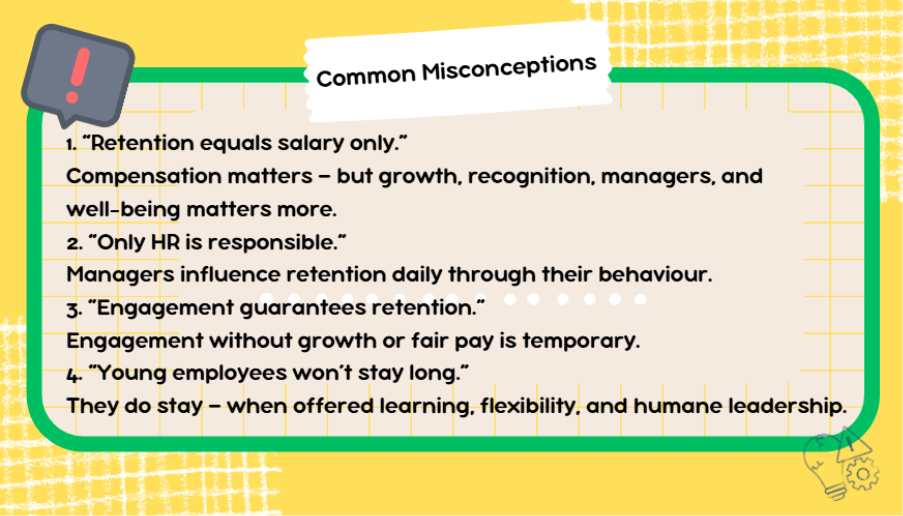
Common Misconceptions About Retention
Some common misconceptions about employee retention that leaders should be wary of.
How 1to1help Supports Employee Retention
1to1help enhances employee retention by fostering a supportive and emotionally healthy workplace culture.
- Counselling and mental health support: Confidential access to professional counsellors helps reduce burnout, workplace conflict, crisis support, and emotional fatigue.
- Burnout and stress reduction programmes: Workshops, resilience training, self-care tools (articles and videos) and early detection of burnout.
- Leadership and manager coaching: Leadership capabilities in communication, empathy, boundary-setting, and people management through cohort programmes.
- Workforce analytics and insights: Data on wellbeing, stress patterns, and sentiment trends to enable early HR intervention.
Refer to our EAP services and Cohort-based programmes for expert solutions tailored to your needs.
Additional Case Examples
Case 1: Reducing Burnout-Related Attrition in the Technology Sector
A Bengaluru-based software-as-a-service (SaaS) company experienced a surge in resignations during peak product launch cycles. The introduction of wellbeing interventions, access to an employee assistance programme (EAP), and manager-led workload monitoring resulted in a significant reduction in voluntary attrition over six months.
Case 2: Enhancing Retention through Learning and Development in the Banking, Financial Services, and Insurance Sector
A banking, financial services, and insurance (BFSI) organisation implemented quarterly learning credits and established internal mobility pathways. Employees reported increased role clarity, and retention rates improved among early-career banking professionals.
Case 3: Addressing Early Attrition in Start-Up Organisations
A rapidly expanding start-up organisation experienced a high rate of early employee exits. Enhancements to onboarding processes and the assignment of peer mentors reduced 90-day attrition and increased employee engagement.
FAQs
Q. What are effective employee retention strategies?
Fair compensation, strong managers, growth pathways, recognition, wellbeing, and clear onboarding are some of the most effective employee retention strategies.
Q. Why do employees leave companies?
Burnout, lack of growth, weak manager relationships, compensation gaps, and poor culture are some of the common reasons why employees leave organisations.
Q. How can HR quickly improve retention?
Some strategies include improving the onboarding process, training managers, benchmarking pay, conducting pulse surveys, and offering well-being support.
Q. What is meant by employee retention strategies?
Structured HR and leadership actions that help organisations reduce voluntary turnover.
Conclusion
Retention isn’t built through one policy; it’s built through everyday experiences of clarity, support, and growth. When organisations listen early, act consistently, and invest in their people, employees choose to stay and thrive.
Ready to strengthen retention and wellbeing in your organisation?
Talk to us to build evidence-backed, high-impact programmes for your workforce.
Related Resource
- [Work-Life Balance in India: Meaning, Benefits & Real Strategies That Work] — Learn how mindful leadership and flexible policies can improve retention and prevent burnout.
- [Understanding Employee Attrition: A Complete Guide for Indian Workplaces] — Understand the types and causes of employee attrition in India, along with actionable steps companies can take to reduce turnover and strengthen their workforce.
- [Employee Burnout in India: Signs, Causes, Recovery & Prevention Strategies] — Understand employee burnout in India: Its signs, causes, and discover practical prevention tips to build healthier workplaces.
- [State of Emotional Wellbeing at Work 2024] —Understand the latest mental-health trends shaping corporate India’s workforce and discover practical, data-backed insights to strengthen your EAP and culture of care.
References
- Gallup. (2018). The right culture: Not just employee satisfaction. Gallup. https://www.gallup.com/workplace/236366/right-culture-not-employee-satisfaction.aspx
- Verywell Mind. (2020). Stress and burnout: Symptoms and causes. Verywell Mind. https://www.verywellmind.com/stress-and-burnout-symptoms-and-causes-3144516
- AIHR. (2021). Employee retention strategies: The complete guide. AIHR. https://www.aihr.com/blog/employee-retention-strategies/
- Oracle. (2022). Employee retention: Benefits, strategies & best practices. Oracle. https://www.oracle.com/human-capital-management/employee-retention/#benefits
- Deloitte. (2023). Gen Z and Millennial Survey. Deloitte. https://www.deloitte.com/global/en/issues/work/genz-millennial-survey.html
- LinkedIn Learning. (2023). Workplace Learning Report. LinkedIn. https://learning.linkedin.com/resources/workplace-learning-report
- Springworks. (2024). Employee retention statistics. Springworks. https://www.springworks.in/blog/employee-retention-statistics/
- Taggd. (2024). Employee retention strategies. Taggd. https://taggd.in/blogs/employee-retention-strategies/
- Sociabble. (2024). Employee retention & engagement in India. Sociabble. https://www.sociabble.com/in/blog/employee-engagement-in/employee-retention/
- Lapaas. (2024). Employee retention in India: Blueprint. Lapaas. https://lapaas.com/bizlabs/employee-retention-india-blueprint
- Springworks. (2024). Employee rewards & recognition ideas. Springworks. https://www.springworks.in/blog/employee-rewards-and-recognition-ideas/?ref=
- Edenred Rewards India. (2024). Best employee rewards & recognition platforms in India. Edenred.
https://www.edenredrewards.co.in/magazine/best-employee-rewards-and-recognition-platforms-india
- LinkedIn Talent Blog. (2024). How internal mobility benefits employers. LinkedIn.
https://www.linkedin.com/business/talent/blog/talent-acquisition/how-internal-mobility-benefits-employers
- Inclusion Geeks. (2024/2025). Gallup 2025 Workplace Report: Engagement is falling and managers hold the key.
https://www.inclusiongeeks.com/the-gallup-2025-workplace-report-shows-engagement-is-falling-and-managers-hold-the-key/
- Business Standard. (2024). 58% Indians feel burned out, higher than global average: FICCI–BCG report.
https://www.business-standard.com/industry/news/58-indians-feel-burned-out-higher-than-global-average-ficci-bcg-report-124090300768_1.html
- India Today. (2024). Flipkart employees to get merit-linked payouts instead of hikes: Report.
https://www.indiatoday.in/business/story/flipkart-employees-to-get-merit-linked-payouts-instead-of-hikes-report-2517788-2024-03-21
- The New Indian Express. (2025). Indian employees prioritise workplace flexibility over pay: Survey finds.
https://www.newindianexpress.com/business/2025/Mar/04/indian-employees-prioritise-workplace-flexibility-over-pay-survey-finds
- WiseMonk. (n.d.). Managing attrition in India. https://www.wisemonk.io/blogs/managing-attrition-in-india
- Forbes Advisor. (n.d.). Employee retention strategies: How to keep your top talent.
https://www.forbes.com/advisor/business/employee-retention-strategies/


.svg)
.svg)
.svg)
.svg)