


.png)


.png)

Leadership and Team Effectiveness
Delegation of Authority: Master the Art of Effective Delegation
.png)
.png)
Written by
Aarohi Parakh,
Psychologist and Content Writer

Reviewed by
Sanjana Sivaram,
Psychologist and Clinical Content Head


Introduction
Rohan was excited when he was promoted to a team lead position at an IT company in Bengaluru. However, within a few months, he was handling all client enquiries, reviewing documents, and often stepping in to “fix” issues that his team could have managed. On top of this, he was also supposed to manage people. His workdays extended late into the night, and despite all his efforts, his team remained dependent and lacked confidence.
When Rohan began delegating responsibilities with clarity and trust, the situation improved significantly. He was able to concentrate on high-impact work, team members became more proactive, and project timelines were back on track. These experiences are common in Indian workplaces, where managers are reluctant to assign work out of concern that quality will suffer or that it won't be done correctly.
In reality, delegation of authority is one of the strongest leadership skills, enabling teams to grow while giving leaders the freedom to focus on high-impact decisions. It is also a core part of developing strong management skills, helping leaders balance strategic thinking with operational efficiency. Research shows that companies led by executives who delegate effectively generate 33% more revenue, proving that delegation is not simply a managerial convenience—it is a strategic necessity.
This blog breaks down what delegation of authority truly means, why it is essential for leadership in organisations, and how to master the process of delegating work effectively.
What is Delegation of Authority? (Meaning & Definition)
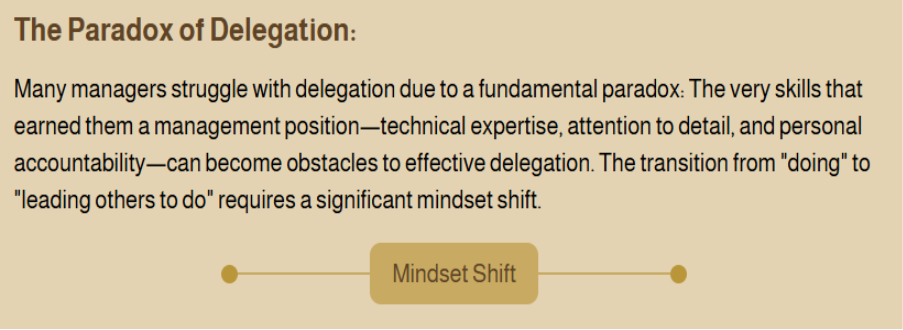
Delegation of Authority is the process by which a manager transfers responsibility, decision-making authority, and accountability for specific tasks to another person. Effective delegation goes beyond simply assigning tasks; it involves empowering employees to take ownership and make decisions within defined boundaries. When done well, it also helps employees develop essential leadership skills, preparing them for more complex responsibilities in the future.
Delegation vs Task Assignment
While assignment and delegation are both ways of distributing tasks or responsibilities within a group or organisation, they differ significantly. Assignment involves providing clear expectations and instructions to the assigned person based on their skills, expertise, or availability. However, delegation goes a step further: the individual is entrusted with the authority to make decisions and be accountable for them. It involves not only assigning tasks but also granting the necessary power and autonomy to accomplish them.
Why leaders must embrace delegation
Leaders who avoid delegating often become bottlenecks in the process. Delegation helps them:
- Leverage the team’s skills and perspectives
- Shift focus towards strategy, innovation, and long-term planning
- Improve team confidence and job satisfaction
- Reduce stress and workload
- Prepares employees for future leadership roles
Examples in Indian contexts
- Corporate Setting (IT/Tech): A project manager at a Gurugram-based startup delegates authority to a senior developer to lead a client demo to, including decision-making power on the solution design. This builds client-handling confidence within the team and removes dependency on the manager.
- Small Business Setting: A retail store owner assigns inventory and vendor management to the supervisor, giving them authority to negotiate within a set budget. This allows the owner to focus on expansion, marketing, or improving customer experience.
Effective delegation fosters trust and accountability among team members, motivating them to excel in their roles. Studies have shown that organisations with a culture of effective delegation tend to outperform those with a more centralised decision-making structure.
The Strategic Importance of Delegation for Leadership
Delegation is more than a productivity hack; it is a strategic pathway to stronger leadership skills, nuanced management skills, and organisational success.
- Delegation as a strategic necessity, not just convenience: In today’s fast-paced work environment, Delegation of Authority enables leaders to focus on long-term goals instead of daily operational bottlenecks.
Example: A CXO at a Mumbai fintech startup delegated operational reporting to a business analyst, freeing up time to build strategic partnerships, resulting in a 20% increase in enterprise clients.
- Focusing leaders on high-priority tasks: Effective delegation ensures leaders spend their energy on planning, innovation, and decision-making rather than routine tasks.
Example: A small manufacturing unit owner in Pune delegated production scheduling to a trained supervisor, allowing him to spearhead a new product line that expanded revenue.
- Improved time management and streamlined workflow: When leaders delegate responsibility appropriately, tasks flow faster, delays are reduced, and overall efficiency improves.
Example: An HR manager at a Bengaluru IT firm delegated campus-hiring coordination to a senior recruiter, reducing recruitment turnaround time by nearly 30%.
- Benefits: Efficiency, Productivity, and Growth: Delegation boosts team productivity by distributing work based on strengths and ensuring leaders focus on value-adding activities.
Example: A retail store chain delegated inventory optimisation to store managers, resulting in better stock availability and a noticeable rise in monthly sales.
- Fostering trust and motivation among team members: Delegating work signals trust, increasing motivation and engagement across the team.
Example: A restaurant owner in Delhi empowered the head chef to design weekly menus. The autonomy boosted morale, reduced dependency, and improved customer satisfaction ratings.
Step-by-Step Guide: How to Effectively Delegate Work
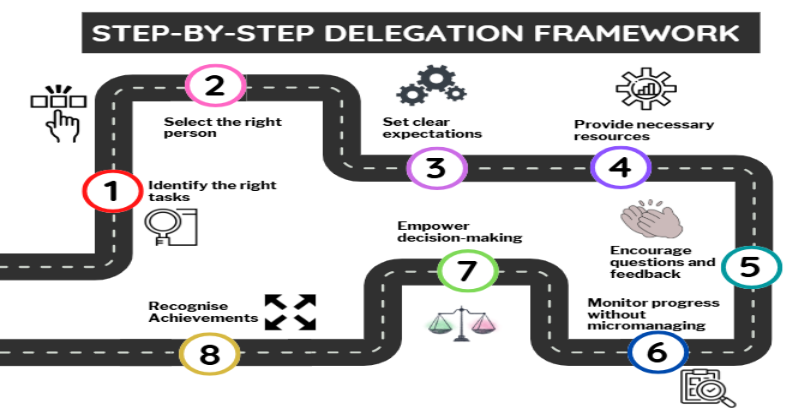
Effective delegation of authority requires a structured approach to ensure tasks are executed efficiently and the authority is used responsibly. Here is a practical step-by-step framework leaders can apply across industries to master the art of delegation. Let’s take the example of Kiara, a Marketing Manager at a Bengaluru-based e-commerce company, who delegates the execution of a festive campaign to a Senior Marketing Executive.
- Step 1: Identify the Right Tasks: Begin by identifying tasks that can be delegated without compromising the quality or integrity of the work. In this case, the manager selects tasks that do not require her direct involvement, such as campaign execution, vendor coordination, and social media scheduling, while retaining strategic decisions such as budget approval and brand positioning. This ensures she focuses on high-impact work while practising effective delegation.
💡Pro-Tip: Delegate tasks that are time-consuming but teach valuable skills to the team.
- Step 2: Select the Right Person: Consider the skills, experience, and capability of potential delegates. Assign tasks to individuals or teams that are well-suited to handling them. She selects a Senior Marketing Executive who has demonstrated strong project management skills and is seeking to grow into a leadership role.
Aligning the task with capability and aspiration strengthens the delegation process.
💡Pro-Tip: Match delegated tasks with employees' development goals for maximum impact.
- Step 3: Set Clear Expectations: Clearly define the task, its objectives, and the desired outcomes. Be explicit about the authority delegated and the decision-making boundaries. As the manager, Kiara outlines the campaign goal (a 10% increase in holiday sales), timelines, target audience, creative direction, and decision-making boundaries.
By defining outcomes upfront, she ensures accountability without micromanaging.
💡Pro-Tip: Ask the delegate to repeat back the expectations to ensure shared understanding.
- Step 4: Provide Necessary Resources: Ensure that the delegates have the resources, information, and tools required to perform the task effectively. She grants access to design teams, campaign budgets, previous campaign data, and vendor contacts. Equipping the executive with tools and information supports effective delegation and reduces roadblocks.
💡Pro Tip: Remove potential roadblocks upfront by ensuring tool and access permissions are in place before work begins.
- Step 5: Encourage Questions and Feedback: Create an environment where delegates feel comfortable asking questions and providing feedback. Open communication is key to successful delegation. Kiara reassures the executive that asking questions is welcome and that feedback on challenges is encouraged.
💡Pro Tip: Normalise questions by scheduling an “open door” time slot specifically for clarifications.
- Step 6: Monitor Progress without micromanaging: Keep a watchful eye on the task’s progress without micromanaging. Regular check-ins can help identify and address any issues promptly. She sets short, structured check-ins twice a week to review progress while giving complete autonomy on execution decisions.
💡Pro Tip: Use check-ins to ask guiding questions, such as “What options have you explored?” rather than offering solutions.
- Step 7: Empower Decision-Making: Trust your delegates to make decisions within the defined scope of authority. Avoid interfering in their decision-making process unless necessary. Kiara clearly states that the executive has full authority to make day-to-day campaign decisions, including creative variations, influencer selections, and platform-level tweaks, within the agreed scope. She avoids stepping in unless a significant risk arises.
💡Pro Tip: Tell the delegate one specific phrase: “I trust your judgement—go ahead.” This boosts confidence significantly.
- Step 8: Recognise Achievements: Acknowledge and reward the successful completion of tasks to motivate your team and reinforce the delegation process. When the campaign achieves strong engagement and exceeds expected sales, Kiara, as the manager, publicly acknowledges the executive’s leadership and ownership.
💡Pro Tip: Recognition is most powerful when shared in front of peers or leadership—make it specific, not generic.
Principles for Achieving Effective Delegation
In addition to building leadership skills, effective delegation enhances day-to-day management skills by helping leaders balance oversight with autonomy and maintain clarity in roles and responsibilities. To achieve effective delegation of authority, leaders should keep in mind the following principles:
- Trust Your Team: Delegation is built on trust. Trust your team members to handle tasks and make decisions. When they feel trusted, they are more likely to perform at their best.
- Balanced Delegation: Ensure that the distribution of tasks and authority is balanced. Avoid overloading or underutilising team members. Delegate based on skills and capacity.
- Effective Communication: Clearly convey the expectations, objectives, and boundaries of the delegated task. Encourage open communication and provide support when needed.
- Feedback and Learning: Establish a feedback loop to learn from the outcomes of delegated tasks. This feedback can inform future delegation decisions and contribute to continuous improvement.
- Continuous Evaluation: Periodically review the effectiveness of your delegation process. Adjust and refine your approach as needed to optimise outcomes.
- Skills Development: Invest in developing your delegation skills and those of your team members. Provide training and mentorship to enhance delegation capabilities.
The Profound Impact of Effective Delegation on Teams
The impact of effective delegation of authority can be profound on both individuals and organisations. Here are some of the key benefits and outcomes:
- Increased Productivity: Delegation streamlines workflow and allows teams to accomplish more in less time.
Case Example: At a Hyderabad-based SaaS company, a product manager delegated user testing coordination to a junior analyst. This freed the manager to focus on product strategy while the analyst rapidly completed testing cycles, reducing the time-to-market for a new feature by 25%.
- Enhanced Employee Engagement: When employees are empowered with responsibility and trust, engagement and motivation rise significantly. Case Example: In a Mumbai advertising agency, a creative director delegated ownership of a client pitch to a young copywriter. Feeling trusted, the copywriter put in extra effort, delivered an outstanding pitch, and later reported feeling more valued and committed to the organisation.
- Leadership Development: Delegation helps employees build leadership skills, judgement, and decision-making abilities.
Case Example: A small bakery in Jaipur delegated order tracking and delivery planning to a senior staff member. This allowed the owner to focus on new product development while ensuring smoother operations and reducing raw material waste.
- Risk Management: Sharing authority distributes responsibility and prevents single points of failure.
Case Example: In a Delhi logistics company, the operations head delegated route planning and client updates to team leads. When the head unexpectedly took medical leave, deliveries continued smoothly because decision-making was already decentralised.
- Adaptability and Responsiveness: Organisations that practise effective delegation respond faster to new opportunities and challenges.
Case Example: A Chennai-based EdTech startup delegated content experimentation authority to its content team. This flexibility allowed the team to respond quickly to market trends, launching new micro-courses within days rather than weeks.

Common Myths About Delegation (and the Truth)
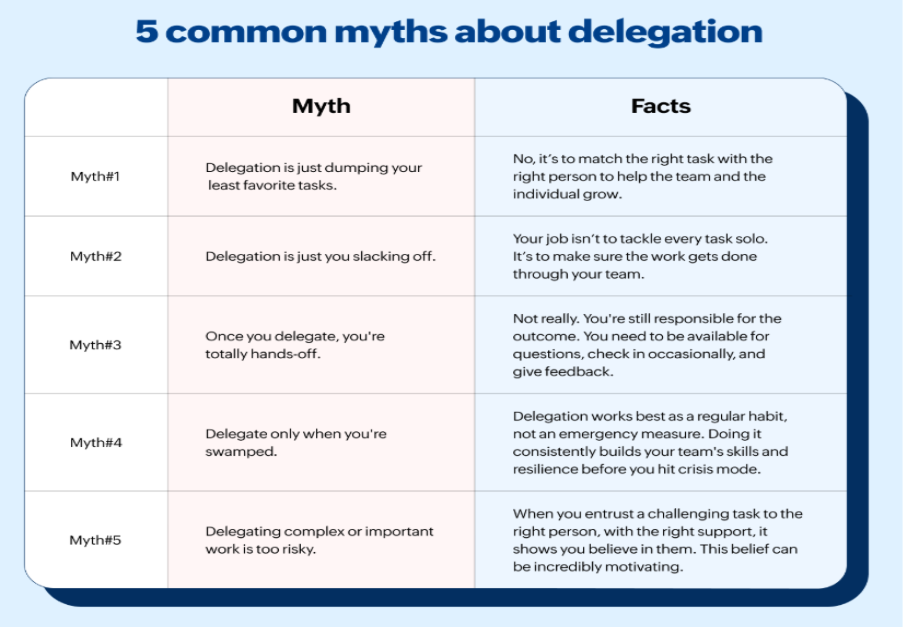
- Myth 1: Delegation is dumping unwanted tasks: Delegation isn’t about offloading boring work—it’s about assigning the right tasks to the right people so both the team and individual can grow.
- Myth 2: Delegation means you're slacking off: Leaders aren’t meant to do everything themselves. Your role is to guide the team and ensure the work gets done—not to complete every task personally.
- Myth 3: Delegating means hands-off: You still stay accountable. Effective Delegation includes check-ins, support, and feedback—not abandoning the task or the person.
- Myth 4: Delegate only when overwhelmed: Delegation shouldn’t be a crisis response. When done regularly, it builds skills, confidence, and resilience across the team.
- Myth 5: Important tasks are too risky to delegate: With the right person and proper guidance, delegating complex work can lead to some of the strongest learning and performance gains.
FAQs
Q1. What is Delegation of Authority in simple terms?
Delegation of Authority means transferring responsibility and decision-making power for specific tasks to capable team members while remaining accountable for the overall outcome.
Q2. How do I know what tasks to delegate?
Delegate tasks that do not require your direct expertise, tasks that help team members grow, or routine responsibilities that slow down your strategic work. Avoid delegating sensitive or confidential matters.
Q3. Isn’t delegation risky for important work?
Not if done correctly. When you choose the right person, set clear expectations, and provide support, delegating complex work strengthens both team capability and organisational performance.
Q4. How do I avoid micromanaging after delegating?
Agree on check-in points, trust your delegate’s judgement, and focus on outcomes rather than methods. Intervene only when risks or blockers arise.
Q5. What if the person I delegate to makes mistakes?
Mistakes are part of the learning process. Instead of taking the task back, offer guidance and feedback. This helps build confidence and long-term leadership skills within your team.
Q6. How does delegation improve leadership skills?
Delegation teaches leaders how to manage effectively, communicate clearly, empower others, and focus on strategic priorities—core competencies for strong leadership.
Conclusion
Delegation isn’t about losing control; it’s about enabling your team to take ownership and strengthening your leadership impact. When you delegate well, you create space to focus on high-value priorities while supporting others in developing their skills and confidence.
Ultimately, effective delegation is a win-win: your team has opportunities to excel, and you gain the clarity and capacity to lead with purpose.
If you or your organisation want to deepen these skills, 1to1help can support you with:
- Our trained counsellors can help you reflect, communicate better, and cultivate a people-first mindset. Begin your leadership journey today →here
- Practical, structured learning experiences that help emerging and experienced leaders build confidence and master essential leadership capabilities. Explore our cohort-based programme →here
References
- Al Mithaq Institute. (n.d.). The art of effective delegation in management. https://almithaqinstitute.com/en/blog/the-art-of-effective-delegation-in-management/
- Zoho Workplace. (n.d.). Effective delegation: What it is and how to do it. https://www.zoho.com/workplace/articles/effective-delegation.html
- Indeed Editorial Team. (n.d.). Delegation of authority: Definition, benefits, and tips. Indeed Career Guide. https://www.indeed.com/career-advice/career-development/delegation-of-authority
- Economics Discussion. (n.d.). Delegation of authority: Meaning, principles, importance, process and advantages. https://www.economicsdiscussion.net/management/delegation-of-authority-meaning-principles-importance-process-and-advantages/31610
- The Leadership Mission. (n.d.). The art of delegation. https://www.theleadershipmission.com/post/the-art-of-delegation
- ET HR World. (2024). Mastering the art of delegation at work: How to do it. https://hrme.economictimes.indiatimes.com/news/learning-and-development/mastering-the-art-of-delegation-at-work-how-to-do-it/120279008
- Dennis, M. (n.d.). The art of effective delegation. LinkedIn. https://www.linkedin.com/pulse/art-effective-delegation-michael-dennis-zxgge/
- Forbes Coaches Council. (2025, January 14). Mastering the art of delegation: Stop doing, start leading. Forbes. https://www.forbes.com/councils/forbescoachescouncil/2025/01/14/mastering-the-art-of-delegation-stop-doing-start-leading/
- The Alternative Board UK. (n.d.). Benefits of delegation. https://www.thealternativeboard.co.uk/insights/benefits-of-delegation
- This vs That. (n.d.). Assignment vs delegation. https://thisvsthat.io/assignment-vs-delegation
- Positive Psychology. (n.d.). Job satisfaction: The science behind how we feel at work. https://positivepsychology.com/job-satisfaction/
- World Health Organization. (n.d.). Stress: Q&A. https://www.who.int/news-room/questions-and-answers/item/stress
- Tavakoli, M., Keenan, A., & Brown, A. (2018). A study on stress and coping mechanisms at work. Journal of Behavioral Sciences. https://www.sciencedirect.com/science/article/abs/pii/S1048984318303199
- Verywell Mind. (n.d.). How to deal with micromanagers. https://www.verywellmind.com/how-to-deal-with-micromanagers-7372296


.svg)
.svg)
.svg)
.svg)