


.png)


.png)

Leadership and Team Effectiveness
Accountability vs. Responsibility That Leaders Must Know

.png)
Written by
Aarohi Parakh,
Psychologist and Content Writer

Reviewed by
Sanjana Sivaram,
Psychologist and Clinical Content Head


Introduction: The Language of Ownership
In most organisations, the words accountability and responsibility appear everywhere. They feature in job descriptions, performance reviews, project briefs, and board meetings. Yet when something goes wrong, the difference between the two suddenly becomes very real.
A project overruns its deadline. A product launch underperforms. A compliance gap emerges. Conversations begin. Who was responsible? Who was accountable?
Too often, leaders discover that while many people were “involved”, no one truly owned the outcome.
This confusion does not stem from incompetence. It stems from language. Responsibility and accountability are often treated as synonyms. They are not. They are distinct constructs that shape culture, behaviour, and performance.
At their core, accountability and responsibility are the twin pillars of high-performance culture. They intersect constantly, but they are not interchangeable. When both are clearly defined, teams move decisively. When they are blurred, work slows, frustration increases, and projects quietly derail.
The simplest way to distinguish them is through the Task vs. Outcome Framework.
- Responsibility concerns the task. It is about doing the work.
- Accountability concerns the outcome. It is about owning the result.
When leaders confuse the two, familiar problems surface. Deadlines slip because assumptions replace clarity. Decisions are delayed, and ownership becomes diluted. Over time, this erodes trust and contributes to organisational stagnation.
Research from Gallup consistently shows that role clarity is one of the strongest predictors of engagement. When employees clearly understand what they are accountable for, performance improves. When clarity is missing, disengagement rises, and blame culture takes the forefront.
This blog examines the difference between accountability and responsibility in leadership, explores their psychological foundations, introduces practical tools such as the RACI Model, and outlines how leaders can use this distinction to build ownership, psychological safety, and measurable performance in modern organisations.
Deep Dive: Responsibility – The “Doer”
What Responsibility Really Means
Responsibility is the obligation to complete a defined task or duty. It is operational and execution-focused. The individual or team responsible for a task is the Doer.
Responsibility focuses on the “how”.
It answers practical questions:
Has the task been completed?
Was it delivered to standard?
Was it delivered on time?
In most organisations, responsibility is clearly distributed. Teams know which tasks are assigned to them. Marketing is responsible for campaigns. Engineering is responsible for system stability. HR is responsible for recruitment processes.
Yet responsibility alone does not guarantee results.

Key Characteristics of Responsibility
1. Task-Oriented Focus
Responsibility sits at the level of activity and execution. Examples: A finance manager is responsible for producing accurate monthly reports. An HR professional is responsible for conducting employee reviews. A project team is responsible for delivering agreed milestones.
Key Performance Indicators (KPIs) often fall into this category: timeliness, efficiency, and quality standards.
2. Shared Nature
Responsibility can be shared across individuals or teams. Examples: A whole development unit may be responsible for writing code. A marketing team may share responsibility for campaign delivery.
Shared responsibility is often necessary in complex work environments. However, it introduces risk if outcome ownership is unclear.
3. Delegation
Responsibility can be passed down through delegation. Leaders routinely assign responsibility to build capability, distribute workload, and create space for strategic focus. In theory, once a task is delegated, responsibility sits with the individual who has accepted it.
In practice, however, delegation often falters not at the point of assignment but at the point of difficulty.
This is where the metaphor of “The Monkey on the Back” becomes useful. The monkey represents the task. When a leader delegates, the monkey moves to the Doer’s back. Yet the moment a problem arises, many leaders instinctively step in, thus offering solutions, rewriting plans, or absorbing the issue entirely. The monkey quietly climbs back up the hierarchy.
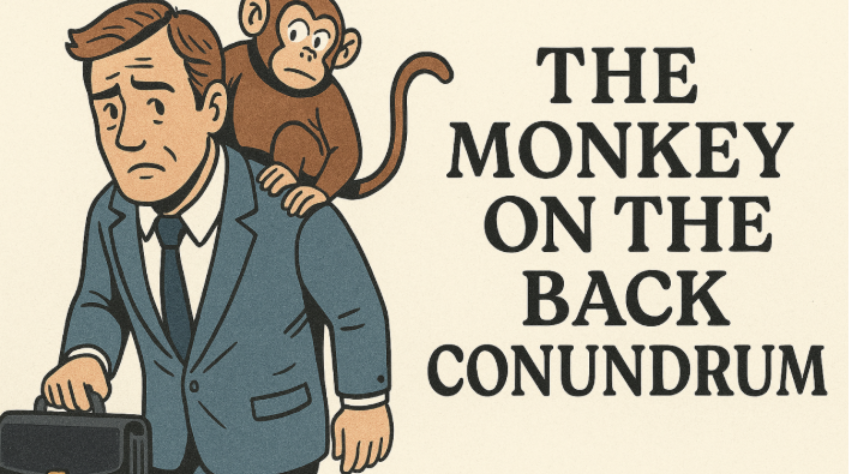
Over time, this pattern erodes confidence and blurs task ownership. Team members learn that complex problems will be reclaimed. Leaders become overloaded with operational detail. Responsibility, though formally delegated, is behaviourally retained.
Case Example: Shared Responsibility Without Outcome Clarity
A regional logistics company introduced a digital tracking system to improve customer transparency.
- IT was responsible for system implementation.
- Operations was responsible for workflow integration.
- Customer service was responsible for communication with clients.
Each department delivered its piece competently.
Six months later, customer satisfaction scores had not improved.
A review revealed the gap: while tasks had been assigned responsibly, no single leader had been accountable for customer experience outcomes. Each function optimised its part. No one owned the outcome entirely. Responsibility generated activity. Lack of accountability weakened the impact.

Leadership Tips: Strengthening Responsibility
- Define responsibilities with precision. Avoid ambiguous verbs such as “support” or “assist”.
- When delegating, clarify scope, authority, and escalation thresholds.
- Allow team members to resolve problems before intervening.
- In cross-functional work, confirm how individual responsibilities align with a clearly defined accountable owner.
Deep Dive: Accountability (The “Decision Maker”)
Responsibility governs execution. Accountability governs consequence.
What Accountability Really Means
Accountability, as per the Oxford Dictionary, means being responsible for your decisions and actions and being expected to explain them when you are asked. The accountable individual is the Decision Maker, the one who owns the result.
Accountability concerns the “what”.
It asks result-oriented questions such as:
Did the initiative achieve its objective?
Did the strategy deliver measurable value?
Was risk managed effectively?
Accountability also makes conversations clearer. Instead of hiding problems, people are open to talking about delays or challenges. This way, the team can adjust early and avoid bigger issues later. At the end of the day, accountability is what keeps promises real, builds trust, and helps teams move forward together.
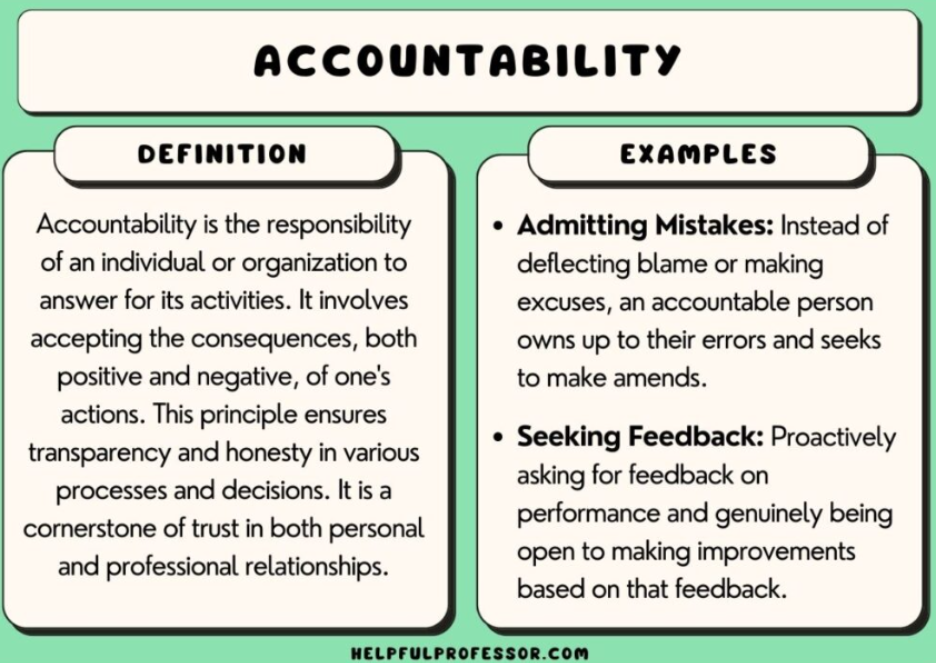
Characteristics of Accountability
1. Outcome-Oriented Focus
Accountability attaches to results and performance metrics. Without measurable outcomes, accountability becomes rhetorical rather than operational.
This is where performance metrics and KPIs matter. They translate accountability into tangible expectations.
2. Solo Nature
While responsibility may be shared, accountability is typically singular. High-performing organisations resist shared accountability because it is often diluted.
The phrase “one throat to choke” is blunt, but the principle is clear: clarity accelerates decisions.
3. Non-Transferable Nature
Responsibility can be delegated. Accountability cannot.
Example: A Regional Sales Director may delegate prospecting tasks. If revenue targets are missed, the Director remains accountable. This is the essence of “the buck stops here”. i.e. to say that one accepts their ownership and does not try to pass it on to someone else.
Singular accountability does not imply isolation. The Decision Maker relies on responsible teams. What it ensures is that trade-offs and final decisions have a clear owner.
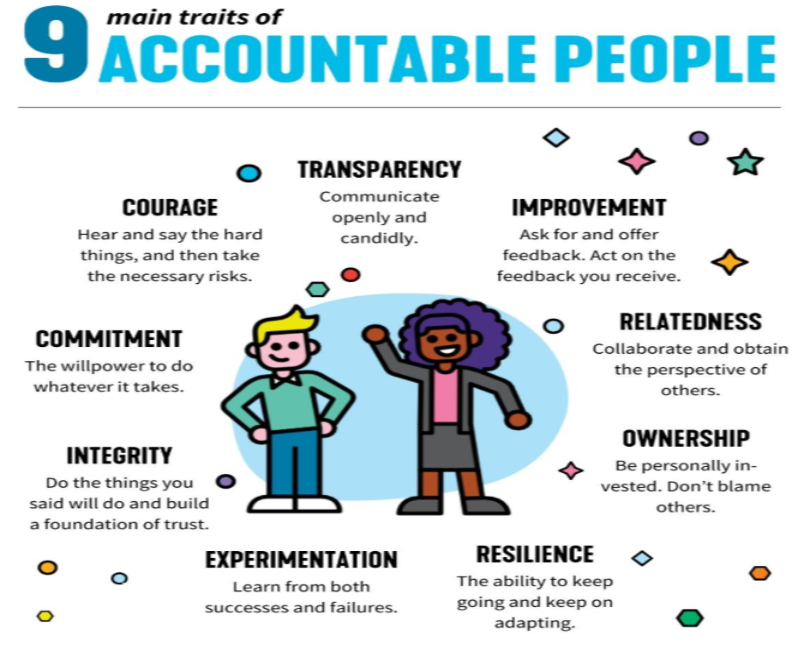
Psychological Dimension
Accountability demands emotional maturity. It involves accepting visibility and scrutiny.
Dr Carol Dweck’s research on growth mindset shows that individuals who see abilities as malleable embrace challenges and learning opportunities. In contrast, those with a fixed mindset tend to avoid tasks that might expose their limitations. This psychological framing suggests that leaders with a growth mindset are more likely to view accountability as developmental and an opportunity for improvement, whereas fixed-mindset leaders may experience it as a threat to their competence and identity.
Research on team accountability underscores that initial accountability expectations are strongly related to team trust, commitment, and willingness to persist. This aligns with the idea that when leaders model reflective ownership, i.e., openly acknowledging strategic missteps and inviting dialogue, they help cultivate norms in which teams feel safe to surface concerns early and engage constructively with challenging outcomes.
Accountability and psychological safety are therefore interdependent. Without safety, accountability feels punitive. With safety, it becomes constructive.
Case Example: Crisis and Leadership Ownership
A healthcare organisation faced a regulatory investigation after a compliance lapse.
- Compliance officers were responsible for policy updates.
- Department heads were responsible for local implementation.
The Chief Operating Officer (COO) stated publicly that oversight of compliance ultimately sat within her remit.
This decision altered the tone of internal discussions. Rather than defensiveness, the organisation engaged in systemic analysis. Accountability at the top also reduced fear at lower levels.
Leadership Tips: Strengthening Accountability
- Assign one named accountable individual for significant initiatives.
- Ensure authority aligns with accountability. Decision rights must match expectations.
- Tie accountability to outcome-based KPIs rather than activity metrics.
- Model visible ownership during setbacks to reinforce cultural norms.
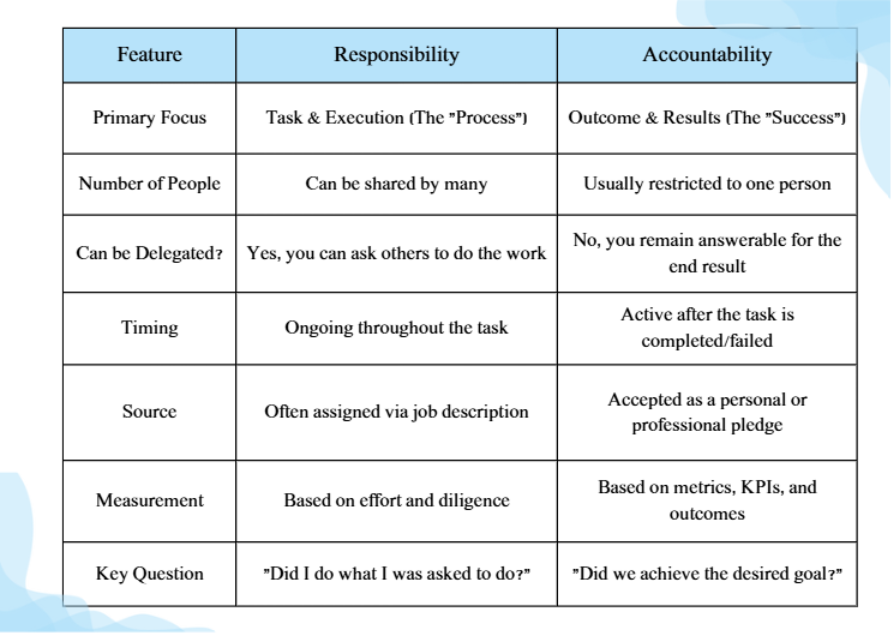
Accountability vs. Responsibility Comparison Table
The following section breaks down the key differences between accountability and responsibility across different parameters for a quick reference.
The RACI Model (Putting it into Practice)
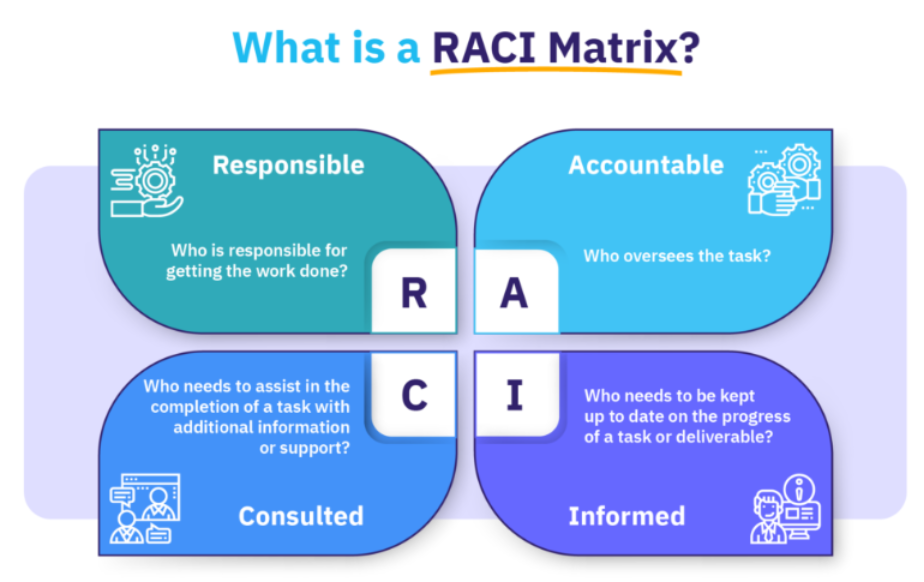
The RACI model, or responsibility assignment matrix, is a project management tool that defines and clarifies roles and responsibilities, typically within a project team. This can be extrapolated across different teams in an organisation. The RACI model categorises these roles into four components: Responsible, Accountable, Consulted, and Informed. It helps establish clear communication, improve decision-making, and ensure accountability for tasks or deliverables.
The RACI Model formalises ownership:
- R – Responsible: The Doers executing the task. A task may have more than one responsible individual.
- A – Accountable: The single owner of the result, who is the decision-maker.
- C – Consulted: Those providing expertise and are the knowledge-holders. They are available for help and advice on the task.
- I – Informed: Those kept updated about the project, typically a stakeholder, leadership team, or approver. This promotes internal transparency, team alignment, and accurate project timelines.
The most common breakdown occurs when multiple individuals are assigned as Accountable. This undermines the very clarity the framework intends to create.
Case Example: Product Launch Governance
A mid-sized SaaS technology firm was preparing to launch a new subscription feature to increase recurring revenue. The initiative was commercially significant; forecasts indicated that the feature could account for 18–22% of next year’s growth targets.
From the outset, leadership agreed to formalise ownership using an RACI framework.
- Engineering was Responsible for building and testing the feature.
- Marketing was Responsible for go-to-market execution and campaign rollout.
- Finance was Consulted on pricing strategy and margin modelling.
- The Chief Product Officer (CPO) was designated as Accountable for overall commercial performance.
On paper, this appeared straightforward. The distinction became meaningful when the launch metrics underperformed in the first six weeks.
User adoption was lower than forecast. Customer feedback suggested confusion about pricing. Marketing argued that positioning had been constrained by product functionality. Engineering pointed to delayed client feedback loops. Finance questioned the assumptions in the original revenue model.
In many organisations, this moment becomes critical. Each function demonstrates that it fulfilled its responsibilities. Meetings multiply. Defensive narratives surface. Accountability diffuses.
In this case, the governance structure prevented that drift. Because accountability had been explicitly assigned to the CPO, escalation was immediate and focused. Rather than debating which function had met its responsibilities, the conversation centred on commercial outcomes. The CPO led a rapid reassessment of pricing and positioning, authorised adjustments, and aligned the teams around revised targets.
Within a quarter, adoption stabilised.
The capability within the teams had not changed. What made the difference was clarity of accountability. Responsibility governed execution. Accountability governed direction and correction.
Without that distinction, the organisation may have defaulted to defensiveness rather than adaptation.
Leadership Tips: Applying RACI Effectively
- Limit the “A” to one individual per deliverable.
- Review RACI assignments at project initiation, not after problems arise.
- Avoid excessive “Consulted” designations, which can slow progress.
- Align RACI structures with formal decision rights.
Organisational Impact: Building the Culture
How organisations define accountability and responsibility ultimately shapes their culture and performance standards.
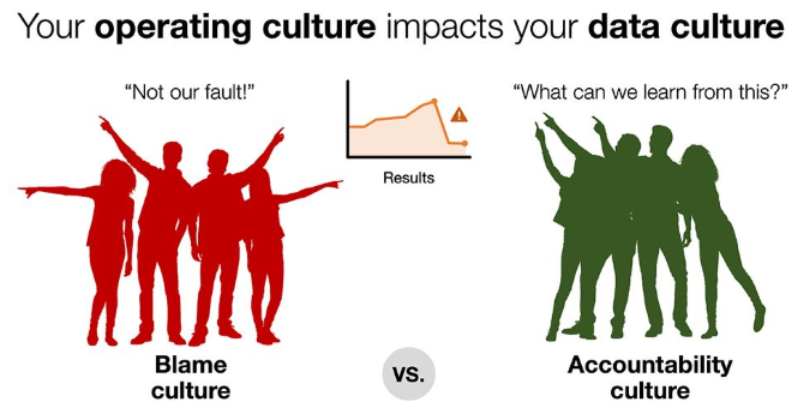
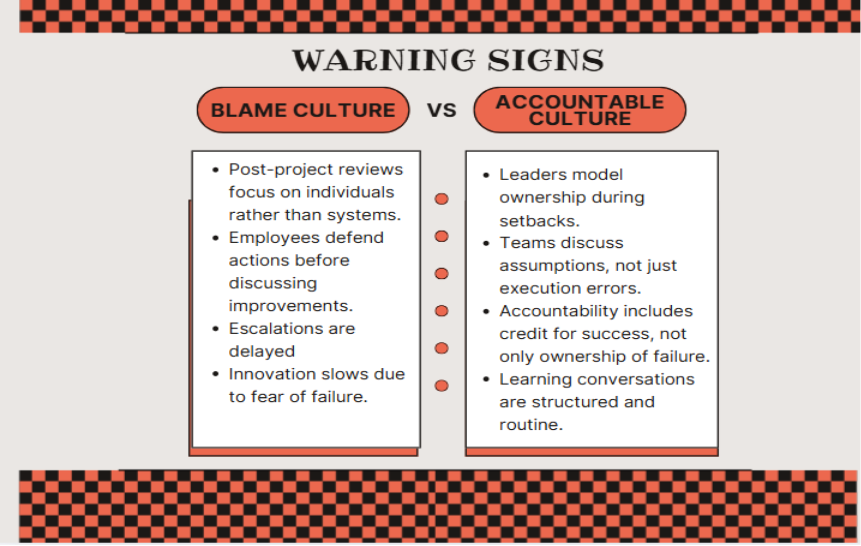
Blame Culture vs Accountable Culture
In a blame culture:
- Errors are personalised.
- Information is withheld.
- Risk-taking diminishes.
In an accountable culture:
- Setbacks are analysed constructively.
- Leaders own strategic direction.
- Teams focus on learning rather than defensiveness.
The distinction is rarely visible in policy. It is evident in behaviour, particularly under pressure.
The Danger of Over-Responsibility
When everyone is responsible, but no one is accountable, projects lose direction.
Teams complete tasks, yet outcomes remain unclear. Conversations focus on effort rather than results. Over time, this weakens ownership and contributes to organisational stagnation.
High-performance cultures avoid this by clearly separating task responsibility from outcome accountability.
Psychological Safety
Accountability cannot thrive in a blame culture. If failure leads to punishment, employees hide mistakes and avoid risks. When failure is treated as an opportunity for learning, teams are more willing to surface concerns early.
Psychological safety strengthens accountability by enabling honest conversations about results without defensiveness.
Leadership Role
Leaders define how accountability is experienced. When leaders publicly own setbacks, they reinforce that accountability is about responsibility for outcomes, not assigning blame. When they deflect, teams become cautious.
In strong cultures, leaders retain accountability even when responsibility has been widely delegated. That clarity builds trust and drives consistent performance.
Case Contrast: Two Post-Project Reviews
In one organisation, when a project failed, individuals were called out and criticised. In the months that followed, teams became more cautious. People avoided taking risks and focussed on protecting themselves.
In another organisation, the leader who had approved the project began the review by saying, “I signed off on these assumptions, and we need to look at where they didn’t hold.” The discussion quickly shifted from blame to figuring out what to improve next time.
The difference was not skill or capability. It was how ownership was handled.
Leadership Tips: Cultivating an Accountable Culture
- Conduct structured post-project reviews focused on learning.
- Separate evaluation of outcomes from personal judgement.
- Recognise accountable behaviour, not just successful results.
- Address misalignment between responsibility and authority promptly to prevent burnout.
Recommended Reads:
Real-World Examples
Real-world situations make the distinction between responsibility and accountability far clearer than definitions alone.
Project Management
In a product team, a developer may spend weeks building and testing a feature to specification. They are responsible for writing clean, stable code and delivering it on time.
However, if the feature fails to generate adoption or revenue, the Product Manager is accountable. It is the Product Manager who approved the scope, prioritised the roadmap, and signed off on launch readiness.
The developer owns the task. The Product Manager owns the outcome. Both matter, but at different levels.
Crisis Management
Following a cyber incident, several teams may work around the clock. IT implements security patches. Operations tighten internal controls. Communications prepares external statements.
Each team is responsible for its part. Yet when regulators or the board seek answers, they look to the Chief Information Security Officer. The CISO is accountable for the organisation’s overall data protection, not just the technical fix.
Responsibility addresses the immediate problem. Accountability addresses the broader consequence.
Performance Leadership
In a regional sales team, representatives are responsible for prospecting, client meetings, and closing deals. They manage day-to-day activities and individual targets.
If the region misses its quarterly revenue goal, the Regional Sales Director remains accountable. The Director set the strategy, approved pricing structures, and allocated resources.
Delegating activity does not transfer ownership of results. Accountability rests with the leader who holds decision-making authority.
The “Ownership” Toolkit
Clarity around accountability and responsibility does not emerge from intention alone. It requires discipline. The following tools are practical mechanisms leaders can adopt immediately to strengthen ownership across teams.
1. The “1-A” Rule
Principle: For every significant task or decision, exactly one person must be named as Accountable.
In many meetings, action points are recorded with multiple names attached. While this appears collaborative, it often leads to diffusion. When two or more people are accountable, no one truly is.
The “1-A” Rule introduces a simple discipline:
- Every action item must have one Responsible owner.
- Every outcome must have one Accountable owner.
- The Accountable person must be explicitly named in the meeting record.
How to Apply It in Meetings
At the end of each agenda item, ask:
- Who is Responsible for execution?
- Who is Accountable for the final outcome?
If more than one name is proposed for accountability, the conversation is not finished. This rule reduces ambiguity, accelerates decision-making, and prevents post-project confusion.
💡Leadership Insight: If a leader hesitates to assign a single accountable owner, it often signals unclear decision rights.
2. The “Blame vs Ownership” Audit
This reflection guide helps leaders assess whether they are fostering a Blame Culture or an Accountable Culture.
Diagnostic Questions for Leaders
Reflect on your recent responses to setbacks:
- When a project fails, do I first ask who caused it or what contributed to it?
- Do I publicly acknowledge my role in strategic decisions?
- Are mistakes discussed openly in team forums, or privately in corridors?
- Do team members raise risks early, or only when escalation becomes unavoidable?
- Is effort praised more than outcomes, or are both evaluated thoughtfully?
💡Leadership Insight: Accountability without psychological safety becomes fear. Psychological safety without accountability becomes complacency. Sustainable cultures require both.
3. The Directly Responsible Individual (DRI) Guide
The concept of the Directly Responsible Individual, widely associated with Apple’s operating discipline, reinforces a simple idea: every significant project must have a clearly identifiable lead.
The DRI is not necessarily the most senior person. They are the individuals responsible for driving progress and ensuring alignment across stakeholders.
Core Features of the DRI Model:
- One person owns forward momentum.
- The DRI coordinates Responsible contributors.
- The DRI escalates risks to the Accountable leader when required.
- The DRI ensures deadlines are not absorbed into committee discussion.
In large organisations, projects often stall because responsibility is distributed across functions without a central driver. The DRI prevents diffusion.
How DRI Complements Accountability
The DRI is typically Responsible for execution at the project level.
The senior leader remains Accountable for the strategic outcome.
This distinction preserves both operational clarity and leadership ownership.
💡Leadership Insight: When a project feels slow or complex, ask a simple question: Who is the DRI? If no one can answer immediately, clarity is missing.
Conclusion
Responsibility and accountability are complementary but distinct.
Responsibility defines who executes the work.
Accountability defines who owns the result.
The Task vs Outcome Framework, supported by tools such as the RACI Model, provides structural clarity. When combined with psychological safety, this clarity strengthens performance and employee wellbeing alike.
High-performance cultures are not defined by effort alone. They are defined by ownership that is both structurally clear and behaviourally modelled.
The question is not merely who is responsible.
The defining question is who is accountable and whether that answer is unmistakably clear.
For organisations seeking to strengthen this clarity at the leadership level, 1to1help’s cohort-based leadership programme focuses on building senior leaders’ skills in resilient decision-making, inclusive leadership, and emotional intelligence. By developing leaders who can hold accountability with confidence and integrity, organisations can strengthen culture, foster trust, and drive sustainable business success.
References
- AIHR. (n.d.). RACI template: A practical guide to defining roles and responsibilities. AIHR. https://www.aihr.com/blog/raci-template/
- Forbes. (2012, October 2). How well does Apple’s Directly Responsible Individual (DRI) model work in practice? https://www.forbes.com/sites/quora/2012/10/02/how-well-does-apples-directly-responsible-individual-dri-model-work-in-practice/
- Functionly. (n.d.). Understanding accountability vs. responsibility: The differences I’ve learned as a leader. https://www.functionly.com/orginometry/organizational-accountability/understanding-accountability-vs.-responsibility-the-differences-ive-learned-as-a-leader
- Gallup. (2018). Re-engineering performance management. https://www.gallup.com/workplace/238064/re-engineering-performance-management.aspx
- HeyDelegate. (n.d.). Task vs. outcome: How to delegate for results, not just action. https://heydelegate.com/task-vs-outcome-how-to-delegate-for-results-not-just-action/
- Indeed. (n.d.). Responsibility vs. accountability: What’s the difference? https://uk.indeed.com/career-advice/career-development/responsibility-vs-accountability
- Investopedia. (n.d.). Key performance indicator (KPI). https://www.investopedia.com/terms/k/kpi.asp
- LinkedIn. (n.d.). Monkey on your back: Why you're busier than you should be. https://www.linkedin.com/pulse/monkey-your-back-why-youre-busier-than-you-should-mareike-mary-popp-wlffc/
- Management 3.0. (n.d.). Fostering accountability in organizations. https://management30.com/blog/fostering-accountability/
- McKinsey & Company. (n.d.). What is decision-making? https://www.mckinsey.com/featured-insights/mckinsey-explainers/what-is-decision-making
- Medium. (n.d.). Monkey on whose back? https://medium.com/coach-jose-leadership-and-project-management/monkey-on-whose-back-94b7a42124e2
- MELP. (n.d.). Accountability vs responsibility: The real difference in the workplace. https://www.melp.us/blog/accountability-vs-responsibility-real-difference-in-the-workplace/
- Merriam-Webster. (n.d.). The buck stops here. https://www.merriam-webster.com/dictionary/the%20buck%20stops%20here
- Project-Management.com. (n.d.). Understanding responsibility assignment matrix (RACI matrix). https://project-management.com/understanding-responsibility-assignment-matrix-raci-matrix/
- Springer. (2021). Accountability and team performance: Examining the relationship between accountability expectations and team outcomes. Journal of Business Ethics. https://link.springer.com/article/10.1007/s10551-021-04969-z
- YourDictionary. (n.d.). One throat to choke. https://www.yourdictionary.com/one-throat-to-choke


.svg)
.svg)
.svg)
.svg)