Counselling helpline for employees of partner organisations


.png)
Counselling helpline for employees of partner organisations
Counselling helpline for employees of partner organisations


In India’s largest oil PSU, discipline and endurance long overshadowed personal well-being. With stigma especially high among senior employees, mental health was rarely discussed. By partnering with 1to1help, leadership brought structured EAP support, on-site counselling, and age-relevant programmes—turning silence into visible cultural change.
Access this case study to discover how PSU leaders achieved:

A structured EAP by 1to1help led to a significant cultural shift in a senior-heavy PSU, with high uptake among 40+ employees. Mental health conversations moved from silence to visibility, driving resilience and performance. The programme delivered measurable impact, with utilisation exceeding industry standards.
"I didn’t expect anyone to ask. But when they did, I realised how much I needed it, shared a senior PSU employee. In many public sector workplaces, stress is silently endured, not spoken about. But that’s beginning to change with one question: Are you okay"
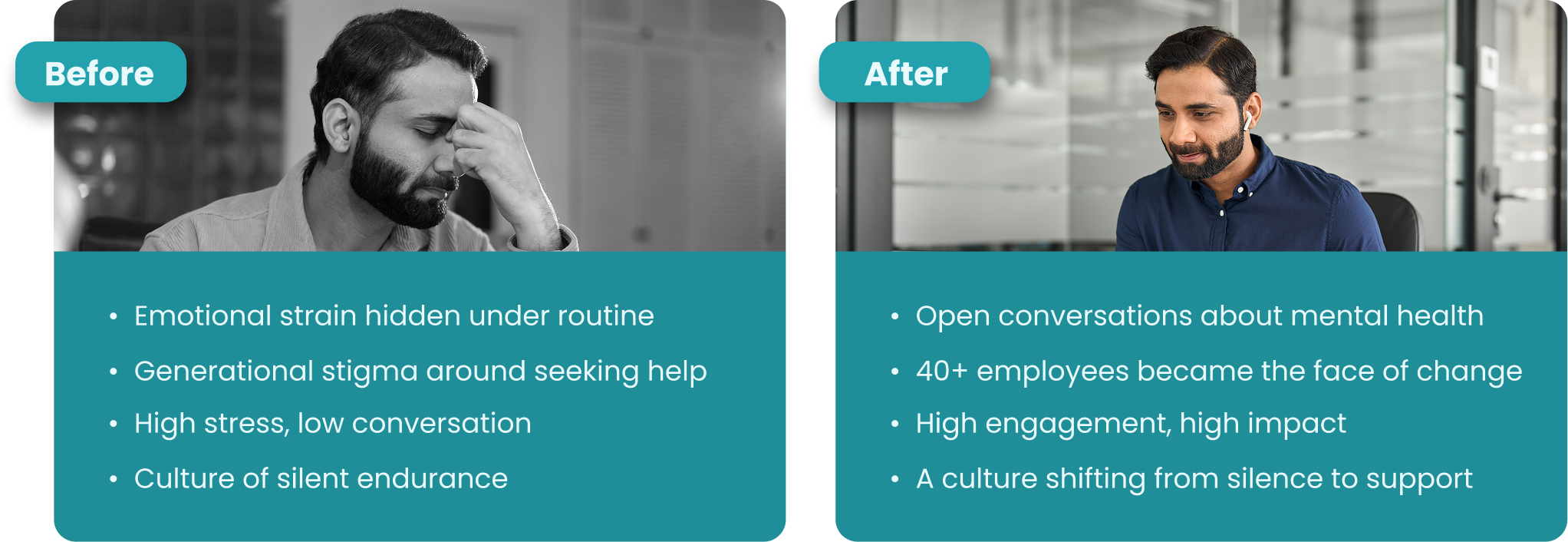
In many public sector undertakings (PSUs), especially those with a long-serving, older workforce, conversations around mental health have rarely found space. The focus has long been on discipline, endurance, and fulfilling responsibilities: both at work and at home.
Employees often juggle high-pressure roles, frequent relocations, and the added demands of caregiving whether for ageing parents, growing children, or extended family. These responsibilities are carried out with quiet efficiency. But rarely are the emotional and mental tolls acknowledged.
Cultural conditioning plays a significant role. In such environments, seeking help for stress, anxiety ,or emotional fatigue is often seen as unnecessary or worse, as a sign of weakness. Over time, this creates a workplace where personal well-being is silently sidelined, and psychological strain becomes part of the background noise.
The result is a quiet, persistent challenge:
Not just the presence of stress, but the lack of language, space, and permission to speak about it. Senior leadership at one such PSU recognised the increasing challenges faced by employees and the need to introduce a comprehensive well-being programme. In collaboration with 1to1help, they implemented an Employee Assistance Programme (EAP) aimed at normalising mental health conversations and providing confidential, stigma-free access to professional support. The initiative also focused on encouraging widespread adoption across all generations, addressing generational resistance with sensitivity and care
A dedicated on-site counsellor was deployed in the Delhi-NCR region to provide face-to-face mental health support: an approach that resonated well with the organisation’s senior workforce. Visibility was enhanced through regular floor walks, group sessions, and stress debriefings, helping reduce stigma around support-seeking.
To ensure nation-wide accessibility, employees across locations utilised the Employee Assistance Programme (EAP) via a 24/7 helpline, web portal, and mobile application which was particularly beneficial for those stationed in remote or refinery-based sites.
Customised webinars addressed age-relevant concerns, such as parenting during frequent transfers, managing elder care from a distance, and navigating mental well-being post midcareer shifts.
Monthly Business Review (MBR) meetings monitored registrations, utilisation trends, and employee feedback, allowing for data-driven iteration and strategic refinement of the programme.
High Engagement Among 40+ Employees
Within two months of programme renewal, utilisation rates exceeded industry standards. Employees aged 40+, a segment typically slower to adopt support services, showed strong engagement once trust and ease of access were established. Mental health began to be recognised as a key driver of resilience and workplace performance.
Demonstrated Value Through Measurable Impact
The programme delivered consistent, high-quality support aligned with workforce needs. Positive engagement trends and relevant session themes contributed to strong adoption across age groups and locations.

This case highlights a quiet but powerful cultural shift within traditionally rigid, senior-heavy PSU environments. By tailoring support to the specific cultural and generational realities of the workforce, the organisation was able to make mental health more approachable and less stigmatised. What once felt unfamiliar, even inappropriate, is now being normalised through consistent, trust-based outreach.
Generational resistance is gradually giving way to acceptance, as employees begin to see mental health support not as a weakness, but as a part of showing up fully. When aligned with organisational values and implemented with sensitivity, Employee Assistance Programmes (EAPs)have proven they can achieve both scale and meaningful impact.
Building on this foundation, the next steps include:
By doing so, the PSU aims to shift from offering support as an option to making it part of how the organisation works, leads, and cares
.png)
To bring structured emotional & mental health support to your workplace
Connect with 1to1help today


.svg)
.svg)
.svg)
.svg)
.png)