Counselling helpline for employees of partner organisations


.png)
Counselling helpline for employees of partner organisations
Counselling helpline for employees of partner organisations


Understanding the Human Cost of High Performance in India’s IT and GCC Ecosystem

IT and GCC teams run at full pace most days. Global handovers, late calls, early mornings, and constant delivery have become routine. Over time, the pressure doesn’t switch off. Boundaries blur, roles change quickly, and people are expected to keep up without slowing down.
This case study looks at how these realities began to show up across IT and GCC environments, and how organisations worked with 1to1help to respond. It follows the shift from ad-hoc support to a more embedded approach to emotional wellbeing, designed to fit how people actually work and sustain performance over time.
India’s IT and Global Capability Centre ecosystem sits at the core of the global digital economy. From software engineering and analytics to finance, customer experience, and emerging technologies, delivery centres in India support some of the world’s most complex and time-critical work.
What began as cost-led outsourcing has shifted. Today, IT services firms and GCCs function as strategic hubs. They own products, run platforms, manage transformation programs, and keep global operations moving day after day.
This work runs at scale and without pause.
Most IT and GCC environments are shaped by:
The result is a work environment where delivery is continuous and margins for error are thin.
At the centre of this system are people. Early-career professionals taking on responsibility quickly. Managers leading teams while navigating client pressure. Senior leaders balancing delivery, growth, and change. Their performance sustains:
As IT and GCC organisations mature, it has become clear that performance is no longer driven by systems alone. It is shaped by how people experience work, handle pressure, and sustain themselves over time.
This operating reality sets the context for the challenges that follow.
On the surface, IT and GCC organisations perform exactly as designed. Teams deliver across time zones, manage global stakeholders, and meet demanding expectations for speed, accuracy, and reliability. Output is visible. Performance is tracked. Delivery continues.
What is less visible is the cost of sustaining this pace, quarter after quarter.
Across IT and GCC environments, employees operate in conditions shaped by:
Over time, being “always on” stops feeling temporary. Exhaustion becomes part of the background. Data shows that:
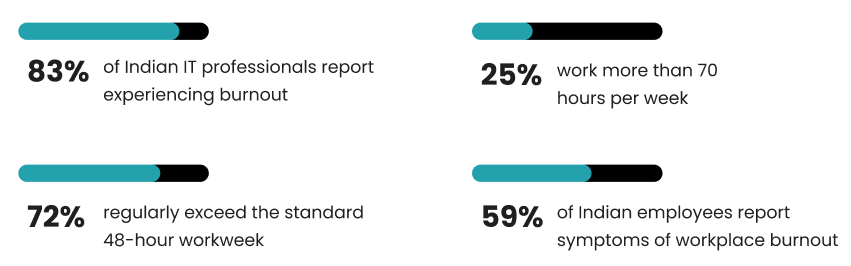
Burnout is no longer an exception. It has become a defining condition of high-performance IT and GCC work environments.
Distributed delivery models add another layer of strain. Employees routinely navigate:
What begins as flexibility gradually turns into an extended workday. Boundaries blur. Recovery time shrinks.
Many employees are moving through critical career stages at speed:
These transitions carry unspoken questions around readiness, performance, and sustainability. Slowing down often feels risky.
Alongside professional demands, employees are also managing:
The emotional load accumulates. What starts as manageable stress shifts into fatigue, disengagement, or burnout.
The consequences are visible in workforce data:
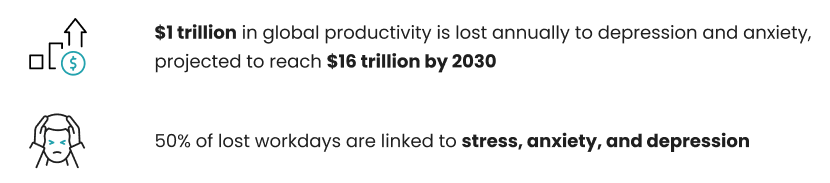

Health risks rise alongside work intensity:
Pressure is also shaping workforce stability:
Support-seeking patterns reinforce this reality:
What IT and GCC organisations are facing is not episodic stress. It is a structural condition created by continuous delivery, global work patterns, and accelerating career demands.
Responding to this requires more than isolated initiatives. It calls for an integrated, organisation-level approach aligned to how people actually work, live, and sustain performance in global delivery environments.
As pressures in IT and GCC environments became clearer, it was evident that isolated initiatives would not hold. Stress was not episodic or individual. It was built into delivery models, role expectations, and the way work accumulated over time.
At the same time, organisations recognised the performance and risk implications of emotional wellbeing. Industry evidence showed that every 1X invested in psychological support could return up to 6X through improved productivity, reduced attrition, and lower downstream health and performance costs.
Against this backdrop, 1to1help partnered with organisations to implement an integrated emotional wellness and psychological safety framework designed to operate at scale while staying human in delivery.
Support was designed for global delivery realities. Employees could access counselling through telephonic, video, chat, and e-counselling modes, supported by 24x7 crisis care, local language options, and automated follow-ups to ensure continuity. Help was available when pressure showed up, not only during office hours.
.png)
To address periods of acute stress such as restructuring or critical incidents, structured protocols were embedded. These included critical incident stress debriefing, high-risk case monitoring, clear escalation pathways, and sustained follow-up beyond the immediate event.
A web and mobile platform enabled easy booking, self-guided resources, digital assessments, stress audits, and guided e-workshops. This allowed employees to engage at their own pace while giving organisations visibility into emerging patterns.
.png)
Group-based formats such as webinars, focused group sessions, Ask-an-Expert forums, and practical workshops helped normalise conversations and reduce isolation in high-pressure environments.
Managers were equipped through sensitisation programs, consultations, distress identification training, referral pathways, and guidance on empathetic leadership and crisis handling.
Awareness campaigns, live sessions, confidentiality-led communication, HR enablement, governance, reporting, and continuous optimisation ensured emotional wellbeing became part of everyday organisational life rather than a parallel service.
Following the rollout of 1to1help’s integrated wellbeing framework, organisations saw consistent engagement across employees, managers, and HR teams. The metrics reflected not just awareness, but growing trust in the program as a reliable support system.

Managers showed greater confidence in recognising early signs, escalating concerns, and engaging support. Over time, stigma reduced, group participation increased, and help-seeking became part of everyday work conversations.
Over time, emotional wellbeing stopped being optional or peripheral. It became something employees turned to, managers relied on, and leaders stood behind to sustain performance in demanding, always-on IT and GCC environments.
Let’s explore how we can support your workforce with a customised solution.


.svg)
.svg)
.svg)
.svg)
.png)

.jpg)