Counselling helpline for employees of partner organisations


.png)
Counselling helpline for employees of partner organisations
Counselling helpline for employees of partner organisations


Blue-collar telecom workers climb towers, fix faults, and keep India connected—yet their own mental health needs often go unseen. One leading telecom giant partnered with 1to1help to break this silence, co-creating Mansik Swasth: a regional-language initiative that brought counselling and emotional support directly to the shop floor.
Access this case study to discover how telecom leaders achieved:

India’s leading telecom provider partnered with 1to1help to extend mental health support to its blue-collar workforce: technicians, linemen, and ground staff who work in high-pressure, physically demanding roles without access to emotional care. Traditional wellness programmes often excluded this segment due to language, access, and format barriers.
To address this, 1to1help co-created “Mansik Swasth”, a culturally relevant mental health initiative delivered in five regional languages and rooted in real workplace challenges. The result was a programme that felt familiar, accessible, and effective.
Across India, blue-collar telecom workers form the backbone of the country’s connectivity infrastructure. Every day, they scale towers, repair faults, and work long hours in hazardous environments to keep vital services running. Yet, their own well-being remains overlooked.
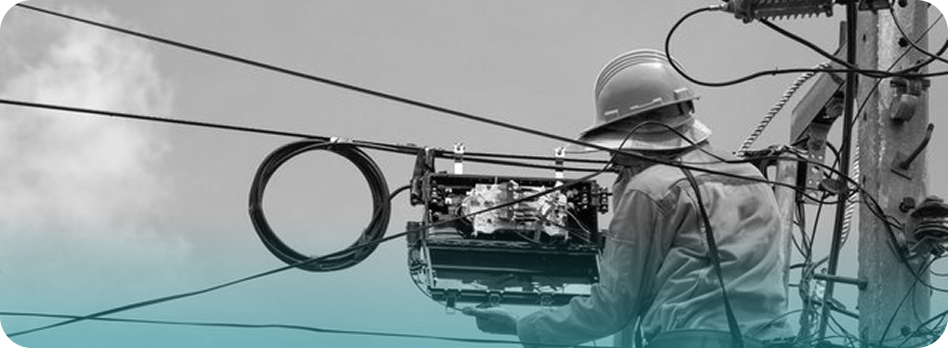
While emotional well-being support has expanded for formal, office-based employees, blue-collar workers are often left behind. Most have limited awareness of mental health, little access to care, and face cultural stigma that prevents them from seeking help. With no targeted communication, no regional language content, and no structured support systems, emotional distress frequently goes unnoticed and unaddressed.
The consequences are serious. Over time, unresolved stress has led to increased absenteeism, substance use, and in some cases, suicide.
In response, one of India’s largest telecom providers partnered with 1to1help to co-create a mental health initiative designed specifically for its blue-collar workforce. Grounded in inclusion, language accessibility, and contextual relevance, the programme aimed to bring emotional well-being support directly to those most often excluded from it.
.png)
Initial groundwork began with conversations involving HR business partners and team leads to understand the challenges faced by the blue-collar workforce. These insights informed the design of Mansik Swasth, a culturally rooted mental health programme delivered in five vernacular languages: Hindi, Tamil, Kannada, Malayalam, and Telugu.
Across locations, hundreds of blue-collar workers booked one-on-one counselling sessions for what was, for many, their first experience of mental health support. The familiarity of local language, relatable communication, and trusted outreach helped break down long-standing stigma around seeking help. The content was conversational and context-driven, using polls, relatable videos, and everyday examples to ensure accessibility and relevance.
In the pilot phase alone, over 5,000 workers were enrolled on the EAP platform with direct access to counselling. Ten Mansik Swasth sessions were conducted, each drawing 300 to 500 participants. Feedback was overwhelmingly positive, and within two quarters, EAP utilisation aligned with industry benchmarks, a clear indicator of trust and relevance.
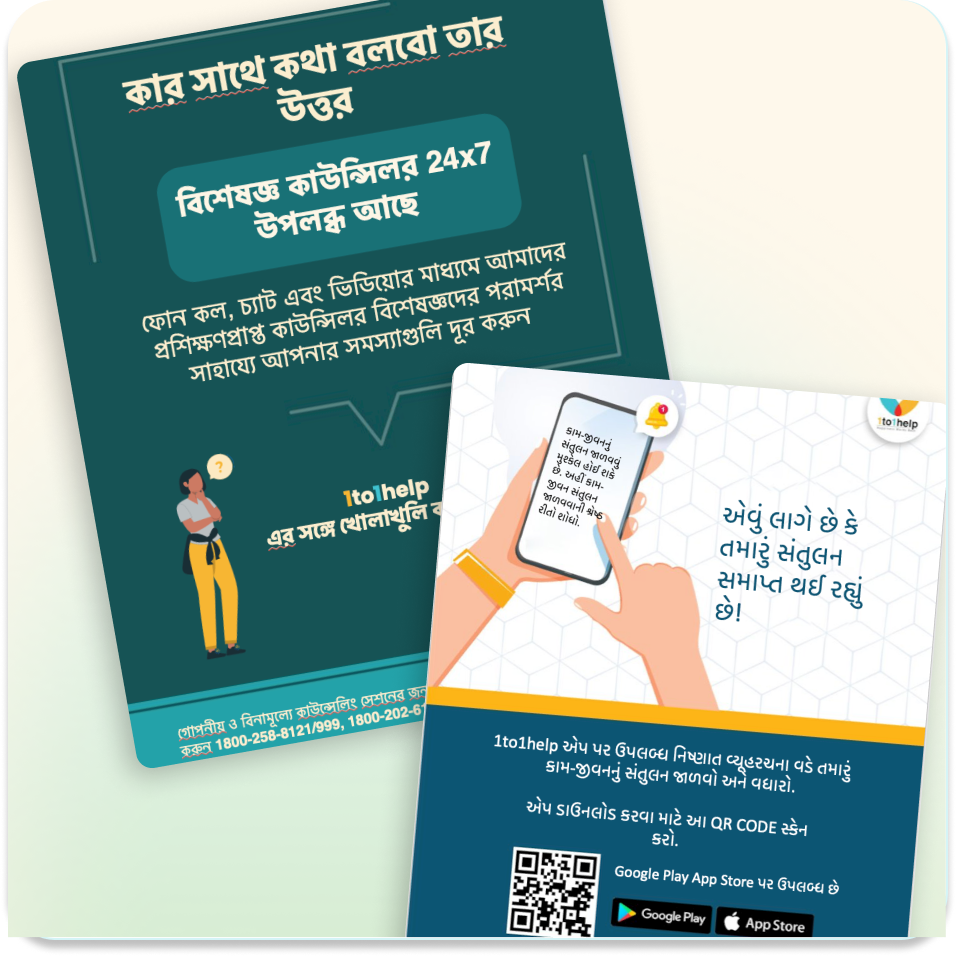
Mental Health awareness was further amplified through posters, danglers, and standees. Employees not only attended sessions but actively explored self-assessments, watched videos, read articles, and joined webinars in the language they were comfortable in. Encouraged by the results, the client expanded 1to1help’s services to an additional 50,000 blue-collar workers across the organisation.
To deepen engagement, counsellors conducted floor talks, brief, 15- to 20-minute group sessions reaching 30–50 employees at a time. These talks fit within workday rhythms and offered practical tips on emotional wellbeing and how to access help. During company events like Foundation Day and Family Day, 1to1help kiosks connected not just with employees but also with their families. Critical Incident Stress Debriefing (CISD) was introduced for teams affected by traumatic events providing timely emotional support to aid recovery.
Employees accessed a wide range of self-help resources: from assessments like How Resilient Are You, Are You Depressed, and Digital Life Balance Quiz to expert-led content on Sleep, Nutrition, Financial Health, and Managing Workplace Stress.
.png)
Checklists, guided meditations, and practical articles in vernacular languages helped employees apply what they learned to real-life situations on and off the job
.png)
Change came gradually but surely. The simple act of delivering sessions in their own languages—with real-life examples making the topic approachable. Supervisors were trained to recognise signs of emotional strain and initiate informal, human conversations.
Building on the success of the mental health initiative, the telecom provider is now working with1to1help to expand its support ecosystem for blue-collar employees. The next phase focuses on challenges that directly affect this segment, both at work and at home.
New initiatives will include financial wellness sessions tailored to the lived realities of daily-wage and contract workers, addressing common issues like debt management, budgeting, and financial planning.
.png)
Ready to Reach the Ones
Who Keep You Running?


.svg)
.svg)
.svg)
.svg)
.png)