

.png)


.png)

Mental Health Concerns
All You Need to Know About Counselling: Meaning, Process and Types of Counselling

.png)
Written by
Aarohi Parakh,
Psychologist and Content Writer

Reviewed by
Sanjana Sivaram,
Psychologist and Clinical Content Head


Introduction
Consider this: Mitali, a 27-year-old, is struggling at work as she no longer enjoys her current role. She stays alone in Bengaluru and has a limited social circle. On top of that, her father’s ailing health keeps her under constant stress.
Scenarios like these are more common than we imagine and can adversely affect emotional well-being, which is now a necessity. From work stress and relationship conflicts to anxiety, trauma, and life transitions, people across all age groups encounter moments where internal resources feel stretched thin. This is where counselling can play a vital role.
Counselling offers a structured, confidential, and professionally guided space for individuals to explore their thoughts, emotions, and challenges without judgement. Whether someone is facing a short-term difficulty or navigating a more complex mental health concern, understanding the types of counselling, the counselling process, and when to seek help can empower informed and confident decision-making.
This comprehensive guide explores counselling in depth: its meaning, value, formats, purposes, and practical application, helping readers identify the most suitable path for their well-being.
Understanding Counselling: Definition and Value
What Is Counselling?
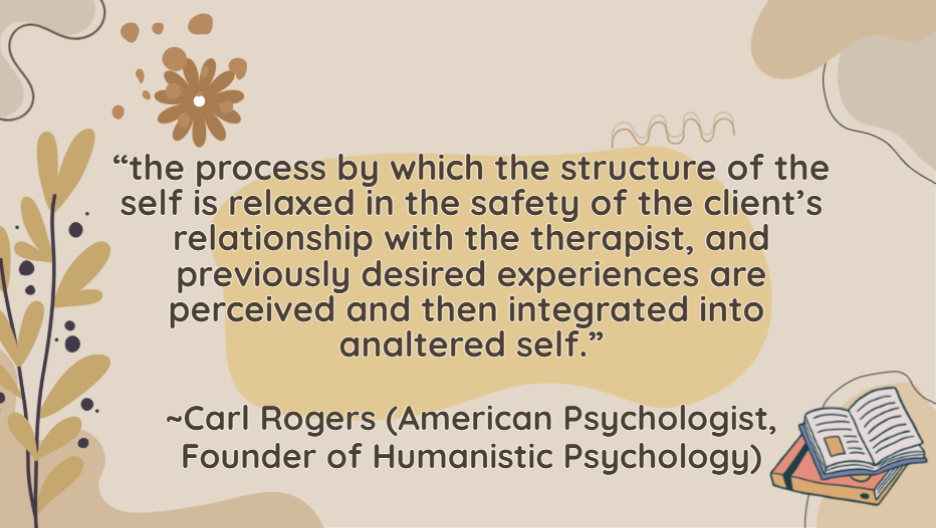
Counselling is a professional process where a trained counsellor works with a person or group to help them understand, manage, and resolve emotional, psychological, or behavioural issues. Instead of giving direct advice, counsellors guide people to find clarity, develop coping skills, and build healthier habits.
At its core, counselling is a healing conversation, intentional, ethical, and grounded in psychological theory and evidence-based practice.
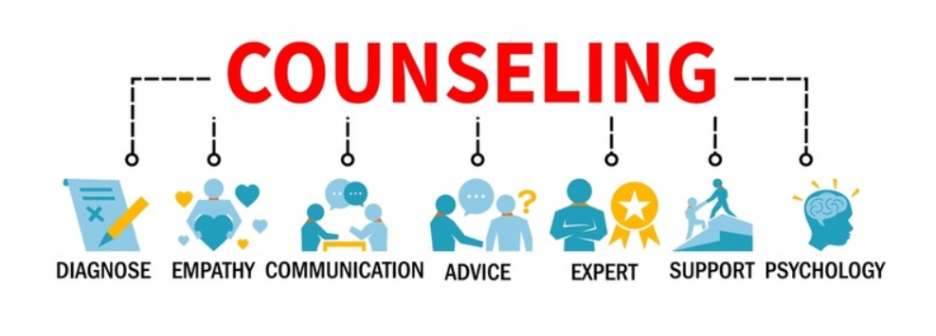
Counsellor vs a Friend: Why Professional Support Matters
While family and friends can offer comfort and empathy, counselling provides something fundamentally different:
- Professional neutrality – Counsellors do not bring personal bias or emotional involvement.
- Training and expertise – Counsellors are equipped to recognise patterns, risk and protective factors, and underlying psychological processes.
- Structured support – Sessions follow a therapeutic framework rather than just a casual conversation.
- Confidentiality – What is shared remains protected and anonymous within ethical boundaries.
The interplay of these factors creates a safe, non-judgemental space where individuals can explore concerns honestly, often for the first time.
The Importance of Confidentiality
Confidentiality is the cornerstone of counselling. Clients are clearly informed about what remains private and also the rare exceptions (such as the risk of self-harm or harm to others). Sometimes counsellors seek supervision (professional consultation from another qualified mental health expert to refine their practice or approach), and even in such situations, no personal details or identifying information about the client are shared. This assurance allows people to speak openly without fear of being judged, misunderstood, or exposed.
When Might Someone Consider Counselling?
Counselling is not reserved for crises alone. It can be beneficial when someone experiences:
- Persistent stress or emotional overwhelm
- Anxiety, low mood, or loss of motivation
- Workplace burnout or career confusion
- Relationship or family conflicts
- Grief, trauma, or significant life changes
- Difficulty coping with health or identity concerns
💡Pro-tip: If an issue begins to affect sleep, work, relationships, or daily functioning, it may be time to seek professional support.
Types of Counselling Based on Purpose (What is the Focus?)
Counselling is often categorised based on the primary concern or goal it addresses. Understanding these distinctions helps individuals choose the most relevant support.
Mental Health Counselling
Mental health counselling is one of the most commonly sought forms of professional support. It focuses on emotional well-being, psychological distress, and mental health conditions.
What Does It Address?
- Depression and low mood
- Trauma and grief
- Emotional regulation difficulties
- Conditions such as Schizophrenia, Bipolar Disorder, Autism Spectrum Disorder, ADHD, or PTSD (often in collaboration with other professionals)
The Goal: Mental health counselling aims to improve emotional awareness, build coping mechanisms, and support individuals in navigating challenges more effectively.

Rehabilitation Counselling
Rehabilitation counselling supports individuals who are managing physical, psychological, or substance-related disabilities. It takes a holistic, strength-based approach to recovery and reintegration.
Areas of Focus
- Substance use recovery
- Chronic illness or injury adjustment
- Disability-related challenges
- Social and community reintegration

The Goal: To empower individuals through advocacy, skill development, and confidence-building—helping them regain independence and quality of life.

Relationship Counselling
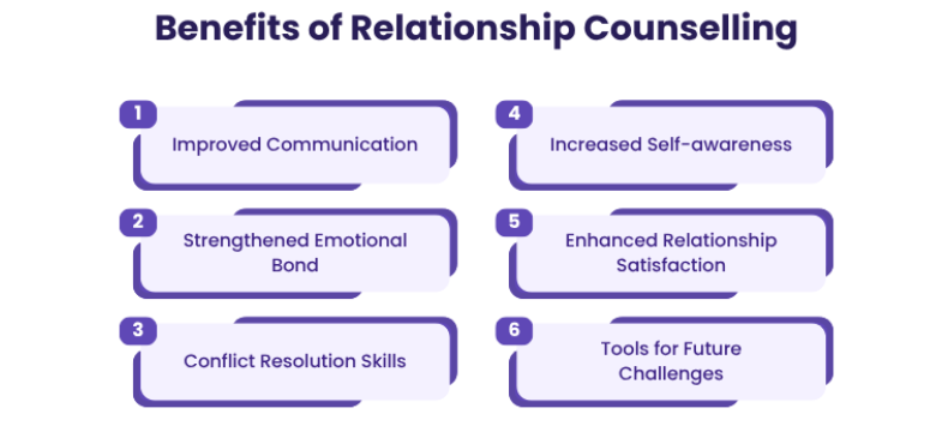
Relationship counselling supports individuals, couples, or families who are experiencing difficulties in their interpersonal relationships. It takes a collaborative, systems-oriented approach, recognising that challenges often arise from interaction patterns rather than one person alone.
Areas of Focus
- Communication breakdown and misunderstandings
- Recurrent conflict and unresolved resentment
- Trust issues, including infidelity or emotional distance
- Life transitions (marriage, parenthood, relocation, illness)
- Family dynamics and parenting challenges

The Goal: To strengthen emotional connection, improve communication skills, and help individuals and families develop healthier ways of relating—fostering mutual understanding, respect, and long-term relational resilience.
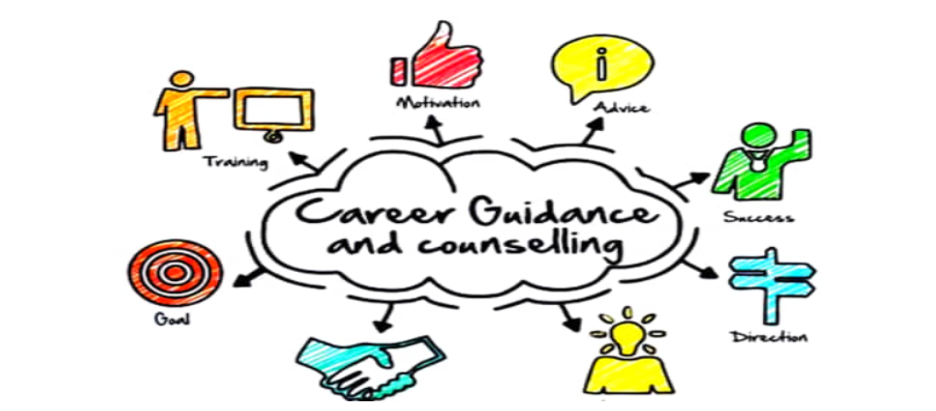
Education and Career Counselling
This type of counselling specifically focuses on helping people understand their skills and interests and make informed decisions/choices regarding their academic pathways and careers.
Who Is It For?
- Students choosing subjects or courses
- Young adults entering the workforce
- Professionals facing career stagnation or transition
- Individuals returning to work after a break

The Goal: To align interests, skills, values, and personality traits with realistic and fulfilling career paths—reducing confusion and long-term dissatisfaction.
Types of Counselling Based on Format (Who Is Involved?)
Another way to understand the types of counselling is by looking at how many people are involved in the session.
Individual Counselling (One-to-One)
Individual counselling is a private, one-on-one interaction between the counsellor and the client.
Best Suited For:
- Personal emotional concerns
- Anxiety, self-esteem, or identity exploration
- Habit change and personal growth
- Behavioural issues such as addressing addiction, anger management, and unhealthy coping mechanisms
Why It Works: The focused, confidential setting allows for deep self-reflection and personalised support.
Couple and Family Counselling
Couple and family counselling involves two or more people who are connected through family or emotional bonds.
Common Concerns Addressed:
- Communication breakdown
- Relationship dissatisfaction
- Co-parenting challenges
- Infidelity or trust repair
- Family conflicts or transitions
The Goal: To improve understanding, strengthen communication, and address patterns that affect the relationship as a whole.

Group Counselling
Group counselling typically involves 6–10 participants working through a shared concern under professional facilitation.
Common Group Themes:
- Grief and loss
- Substance use recovery
- Anxiety management
Benefits:
- Shared experiences reduce isolation
- Peer learning and validation
- Cost-effective support

Types of Counselling Based on Modes (How is it Conducted?)
Lastly, counselling can be understood in terms of how it takes place.
Online Counselling
In this mode, people connect with counsellors over the phone, video calls, chat, or email. In today’s fast-paced digital world, where flexibility is the need of the hour, there has been a gradual shift towards online counselling. For some clients, this mode is often perceived as a safer, non-threatening alternative, especially if they are seeking professional help for the first time.
Face-to-Face Counselling
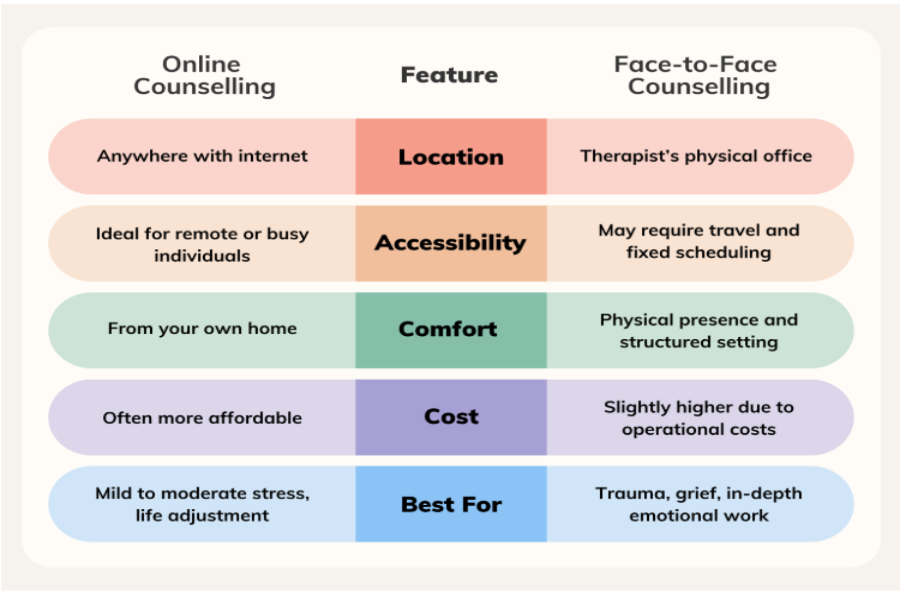
In this mode, the counsellor and client meet in person, at the counsellor’s office or clinic, which is usually a private, designated space where necessary arrangements are made, such as appropriate seating, water, tissues, notepads, etc. Rapport building in this mode of counselling can sometimes be easier to establish, especially as non-verbal cues can be picked up by both the counterparties.
The Counselling Process: 5 Essential Stages
Professional counselling follows a structured and ethical process. While every individual’s journey is unique, the counselling process generally unfolds in clear stages. Understanding these stages helps reduce uncertainty, sets realistic expectations, and reassures individuals that progress happens step by step, and not all at once. Hackney and Cormier (1987) describe the counselling process as a series of stages through which the counsellor and the client move.
To illustrate how this works in real life, consider the example of a young working professional in India navigating anxiety related to work pressure and family expectations.
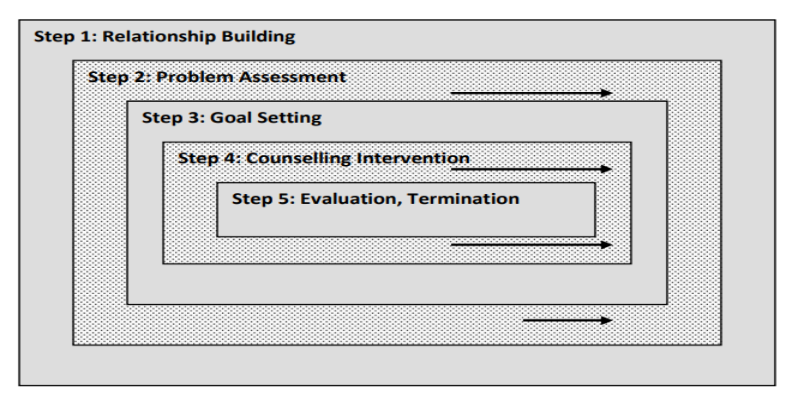
Stage 1: Relationship Building
The counselling process begins with building trust and emotional safety. In the initial sessions, the counsellor introduces their professional approach, qualifications, and clearly explains confidentiality and its ethical boundaries.
Elaborating on our example, a 29-year-old professional working in a metropolitan city may enter counselling feeling anxious, emotionally overwhelmed, and unsure about opening up. She might speak hesitantly about work stress or family pressure, fearing judgement. At this stage, the counsellor listens attentively, validates her experiences, and avoids rushing into solutions.
Goal: To create a safe, non-judgemental space where the client feels heard, respected, and emotionally secure enough to share openly.
Stage 2: Assessment and Exploration
Once trust is established, the counsellor begins a deeper exploration of the client’s concerns. This includes understanding personal history, relationships, work environment, physical health, emotional triggers, and current coping strategies.
In this example, the counsellor may notice that anxiety intensifies during performance reviews at work or conversations about marriage at home. Patterns such as people-pleasing, difficulty setting boundaries, and emotional suppression often emerge during this stage.
Goal: To understand the context, patterns, and severity of the concerns, forming a strong foundation for effective intervention.
Stage 3: Goal Setting
With clarity about the challenges, the counsellor and client collaboratively define specific and realistic goals. Rather than vague intentions like “feeling better,” goals are framed in practical terms.
These may include:
- Reducing anxiety symptoms and physical tension
- Improving communication and assertiveness
- Developing emotional regulation skills during stressful situations
The counsellor also explains that goals are flexible and may evolve as new insights emerge.
Goal: To create clear direction and measurable outcomes for the counselling journey.
💡 Pro-Tip: Counselling is not linear; goals often adapt as individuals gain deeper self-awareness.
Stage 4: Intervention and Action
At this stage, the counsellor applies evidence-based therapeutic approaches aligned with the client’s goals. These may include cognitive strategies to challenge self-critical thinking, emotional regulation techniques such as grounding, and practical skill-building exercises.
The client is encouraged to practise these strategies in daily life, such as using assertive communication in meetings or managing anxiety before family discussions, and reflect on the outcomes in subsequent sessions.
Goal: To facilitate meaningful, real-world change through active participation and skill development.
Stage 5: Evaluation and Termination (or Referral)
In the final stage, progress is reviewed collaboratively. The counsellor and client reflect on how initial concerns have shifted, what skills have been developed, and how confident the client feels managing future challenges independently.
If goals are met, sessions are gradually concluded with a planned and supportive closure. If needed, referrals to specialised services are discussed. Follow-up sessions may also be scheduled for continued support.

Goal: To ensure closure feels empowering, intentional, and supportive rather than abrupt.
Next Steps: Choosing the Right Path for Your Well-being
Matching Needs to Type: Questions to Help You Choose the Right Counselling Support
Choosing the right type of counselling does not require having all the answers. It begins with pausing and asking the right questions. The purpose of counselling is not to fit yourself into a box, but to find support that aligns with your current needs, circumstances, and comfort level.
Use the following checklist as a gentle guide to reflect on what kind of counselling may suit you best at this point in your life.
- Is my concern mainly emotional (stress, anxiety, low mood, overwhelm)?
- Is it related to my career, studies, or future direction?
- Is the difficulty centered around a relationship or family dynamic?
- Am I struggling with substance use or addiction?
👉 Emotional distress → Mental Health / Individual Counselling
👉 Career or education decisions → Career Counselling
👉 Relationship concerns → Individual, Couple or Family Counselling
👉 Substance use concerns → Individual or Rehabilitation Counselling
Next, consider who is involved:
- Does this feel like something I need to work through privately?
- Or does it involve another person whose presence is essential?
👉 Personal concerns → Individual Counselling
👉 Shared or relational concerns → Individual, Couple / Family Counselling
👉 Shared experiences and peer support → Group Counselling
Finally, reflect on your comfort level:
- Do I need flexible scheduling or location freedom?
- Am I more comfortable opening up from my own space?
- Do I need structured, deep emotional processing?
- Is this short-term support or a longer healing journey?

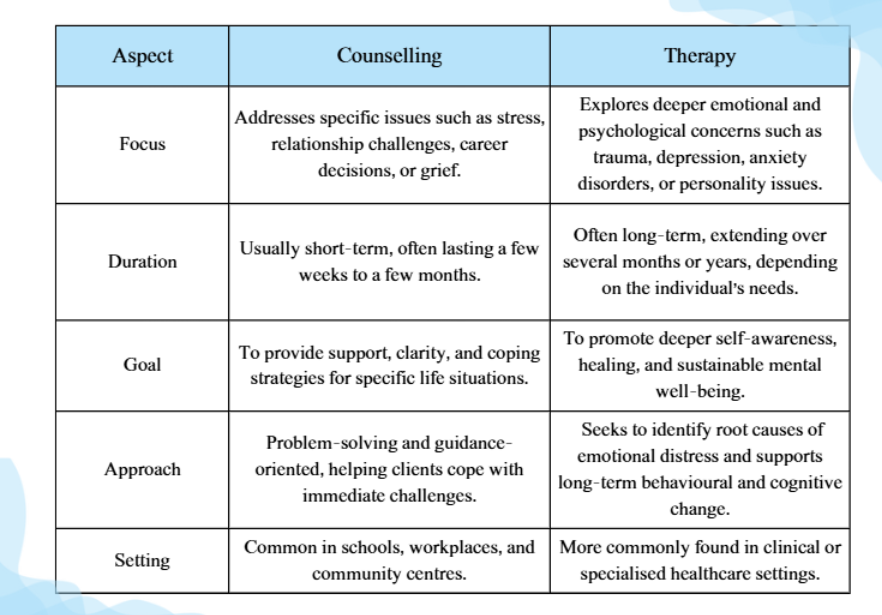
Counselling vs Therapy: A Quick Distinction
Counselling is a form of talk therapy that helps individuals address specific issues or problems. It is usually a short-term treatment, lasting anywhere from 6 to 20 sessions, depending on the severity of the problem and the professional's approach.
Therapy, on the other hand, is a broader term that encompasses many types of mental health treatment, including counselling. Therapy can be short-term, focusing on specific problems, or it can be long-term, exploring deeper, underlying issues. The goal of therapy is to help you achieve greater self-awareness and to improve your emotional and psychological well-being.
Taking the First Step
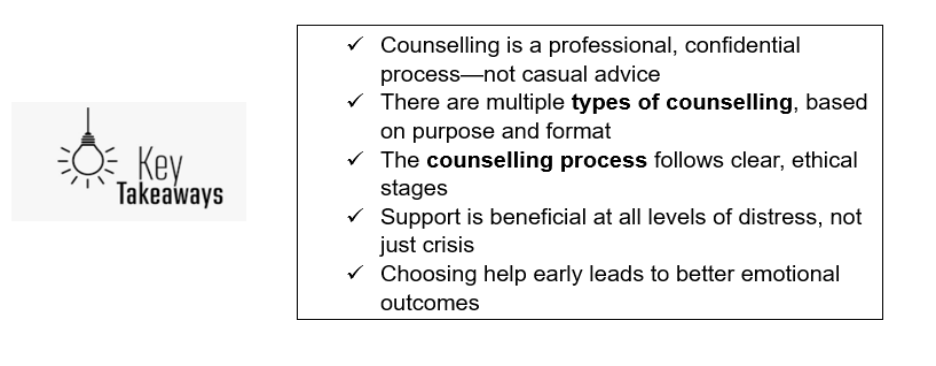
Seeking counselling is not a sign of weakness. It is an act of self-awareness and courage. Delaying support often prolongs distress, while early intervention builds resilience and clarity.
Whether through workplace EAP services or private mental health providers, reaching out can be the first step towards meaningful change.
Ready to Take the Next Step?
When emotional concerns begin to affect daily life, work performance, or relationships, professional support can make a meaningful and measurable difference. Counselling offers more than temporary relief. It provides clarity, practical tools, and a safe space to navigate challenges with confidence and care.
If you are part of an organisation that offers Employee Assistance Programme (EAP) support, connecting with qualified counsellors through that programme can be an accessible and confidential way to begin. 1to1help is a trusted emotional well-being partner in India that offers professional EAP counselling services designed to address emotional, relational, and work-related challenges with care and expertise.
Support is available. And seeking it is a powerful and proactive step towards well-being.
FAQs
Q1. What is counselling and how does it help?
Counselling is a professional and confidential process where trained counsellors help individuals understand their emotions, manage challenges, and develop healthier coping strategies. It supports emotional well-being, clarity, and personal growth.
Q2. What are the different types of counselling?
Common types include mental health counselling, individual counselling, couple or family counselling, career counselling, rehabilitation counselling, and group counselling. The right type depends on the concern being addressed and who is involved.
Q3. How long does the counselling process usually take?
Counselling can be short-term or longer-term, depending on the concern and goals. Some people benefit from a few focused sessions, while others may need ongoing support for deeper or complex issues.
Q4. Is counselling confidential?
Yes. Confidentiality is a core ethical principle in counselling. Information shared during sessions remains private, except in rare situations involving risk of harm, which are explained clearly at the start.
Q5. Can counselling be accessed through the workplace?
Yes. Many organisations offer counselling through an Employee Assistance Programme (EAP), which provides confidential one-to-one support. Services such as those offered by 1to1help make professional counselling accessible for employees and their families.
Recommended Readings
- Therapy Goal Setting That Actually Helps - https://www.findoctave.com/blog/therapy/therapy-goals
- Early Warning Signs: Recognizing When Mental Health Might Be at Risk - https://www.medanta.org/patient-education-blog/early-warning-signs-recognizing-when-mental-health-might-be-at-risk
- What Really Happens in Counselling? A Step-by-Step Guide for First-Time Clients in India - https://www.1to1help.com/blog/what-happens-in-counselling
References
- American Mental Wellness Association. (n.d.). Risk and protective factors. https://www.americanmentalwellness.org/prevention/risk-and-protective-factors/
- American Psychiatric Association. (n.d.). What is ADHD? https://www.psychiatry.org/patients-families/adhd/what-is-adhd
- Cleveland Clinic. (n.d.-a). Anxiety disorders. https://my.clevelandclinic.org/health/diseases/9536-anxiety-disorders
- Cleveland Clinic. (n.d.-b). Chronic illness. https://my.clevelandclinic.org/health/articles/4062-chronic-illness
- Cleveland Clinic. (n.d.-c). Depression. https://my.clevelandclinic.org/health/diseases/9290-depression
- Cleveland Clinic. (n.d.-d). Drug addiction (substance use disorder). https://my.clevelandclinic.org/health/diseases/16652-drug-addiction-substance-use-disorder-sud
- Cleveland Clinic. (n.d.-e). Grief. https://my.clevelandclinic.org/health/diseases/24787-grief
- Cleveland Clinic. (n.d.-f). Mental health disorders. https://my.clevelandclinic.org/health/diseases/22295-mental-health-disorders
- Cleveland Clinic. (n.d.-g). Panic attacks and panic disorder. https://my.clevelandclinic.org/health/diseases/4451-panic-attack-panic-disorder
- Counselling Tutor. (n.d.). Confidentiality in counselling. https://counsellingtutor.com/confidentiality-in-counselling/
- Edumilestones. (n.d.). What is counselling: Definition, types, process. https://www.edumilestones.com/blog/details/what-is-counselling-definition-types-process
- Healthline. (n.d.). Talk therapy. https://www.healthline.com/health/mental-health/talk-therapy
- HelpGuide. (n.d.). Stress in the workplace. https://www.helpguide.org/mental-health/stress/stress-in-the-workplace
- Infigon Futures. (n.d.). A comprehensive guide to counselling: What it is, types and process. https://www.infigonfutures.com/blogs/posts/a-comprehensive-guide-to-counselling-what-it-is-types-and-process
- Mayo Clinic. (n.d.-a). Autism spectrum disorder. https://www.mayoclinic.org/diseases-conditions/autism-spectrum-disorder/symptoms-causes/syc-20352928
- Mayo Clinic. (n.d.-b). Bipolar disorder. https://www.mayoclinic.org/diseases-conditions/bipolar-disorder/symptoms-causes/syc-20355955
- Mayo Clinic. (n.d.-c). Post-traumatic stress disorder (PTSD). https://www.mayoclinic.org/diseases-conditions/post-traumatic-stress-disorder/symptoms-causes/syc-20355967
- Mayo Clinic. (n.d.-d). Schizophrenia. https://www.mayoclinic.org/diseases-conditions/schizophrenia/symptoms-causes/syc-20354443
- MetLife. (n.d.). Legal separation vs. divorce. https://www.metlife.com/stories/legal/legal-separation-vs-divorce/
- PositivePsychology.com. (n.d.-a). Counselling process. https://positivepsychology.com/counseling-process/
- PositivePsychology.com. (n.d.-b). Systems therapy. https://positivepsychology.com/systems-therapy/
- PushFar. (n.d.). The importance of career counselling. https://www.pushfar.com/article/the-importance-of-career-counselling/
- Psychology Today. (2023). 8 ways to cope with life transitions. https://www.psychologytoday.com/us/blog/the-addiction-connection/202312/8-ways-to-cope-with-life-transitions
- Sanity Center. (n.d.). Healing conversations: Why just talking in therapy is the key to real transformation. https://www.sanitycenter.org/blog/healing-conversations-why-just-talking-in-therapy-is-the-key-to-real-transformation
- Understood.org. (n.d.). Vocational rehabilitation: What you need to know. https://www.understood.org/en/articles/vocational-rehab-what-you-need-to-know
- Verywell Mind. (n.d.-a). Empathy: What it is and why it matters. https://www.verywellmind.com/what-is-empathy-2795562
- Verywell Mind. (n.d.-b). The toll of conflict in relationships. https://www.verywellmind.com/the-toll-of-conflict-in-relationships-3144952
- World Health Organization. (n.d.-a). Stress. https://www.who.int/news-room/questions-and-answers/item/stress
- World Health Organization. (2019). Burn-out an occupational phenomenon. https://www.who.int/news/item/28-05-2019-burn-out-an-occupational-phenomenon-international-classification-of-diseases
- World Health Organization. (n.d.-b). Stress (Q&A). https://www.who.int/news-room/questions-and-answers/item/stress


.svg)
.svg)
.svg)
.svg)