Counselling helpline for employees of partner organisations


.png)
Counselling helpline for employees of partner organisations
Counselling helpline for employees of partner organisations


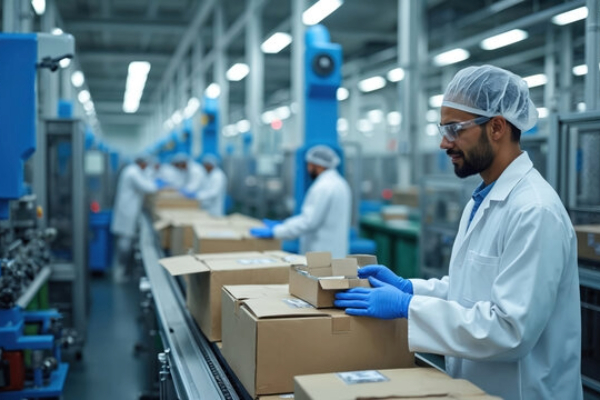
Pharma manufacturing runs around the clock, with blue-collar workers navigating shift work, strict compliance, physical demands and limited recovery time. This case study explores how organisations adapted mental wellbeing support to fit plant realities, using accessible communication, regional languages and manager involvement to make support easier to trust and use.
Key Takeaways:

India’s pharmaceutical manufacturing industry is built to deliver medicine at scale, without error and without pause. Across thousands of plants, blue-collar workers keep complex processes running through shift work, strict compliance, and physically demanding conditions that leave little room for recovery. This case study follows their everyday reality on the shop floor and the mental strain that rarely finds its way into production reports. It examines how organisations reshaped support to fit plant life, language, and supervision, and what shifted when care became part of making medicine, not something separate from it.
India’s pharmaceutical industry is one of the largest in the world, anchored by thousands of manufacturing units spread across industrial clusters and semi-urban regions. These plants produce everything from essential generics to complex formulations, operating under strict global quality and compliance standards. Production runs around the clock, driven by demand from both domestic and international markets.
At the centre of this system is a large blue-collar workforce. Operators, technicians, helpers, and contract workers form the backbone of manufacturing operations, ensuring continuity across shifts and maintaining adherence to tightly controlled processes. Their roles are physically demanding, closely supervised, and deeply embedded in the rhythms of plant life.
While the industry is known for its technical rigour and regulatory discipline, its workforce is diverse in language, education, and socio-economic background. Many blue-collar employees balance shift-based work with financial responsibility, family caregiving, and limited access to healthcare and support outside the workplace.
Over time, the demands of scale, compliance, and continuous production have intensified. Plants have become more efficient, audits more frequent, and performance expectations more exacting.
What has not always evolved at the same pace is the way organisations support the mental and emotional wellbeing of those working on the shop floor.
Within the pharma and healthcare industry, blue-collar employees form one of the 3 primary workforce cohorts, alongside field officers and R&D scientists. The average employee age falls between 30 and 40 years, a phase marked by financial responsibility and family dependence. Manufacturing units also reflect low gender diversity, with women comprising only 12% of the manufacturing workforce.
On the shop floor, daily realities include:
While physical safety protocols are embedded into operations, emotional fatigue often goes unmeasured.
Our research highlights that many blue-collar workers belong to low-income groups, compounding workplace stress with personal strain. Living conditions and social realities often include:
By the time workers report for their next shift, recovery is incomplete. Fatigue becomes cumulative.

Utilisation data from the pharma and healthcare sector reveals a clear gap between need and access:
Before the pandemic, counselling utilisation remained between 1.5% and 2.5%. During and after the pandemic, utilisation increased 2 to 5 times, indicating suppressed demand rather than new distress.
When employees do seek support, the dominant concerns recorded are:
This pattern points to a workforce that reaches out only at breaking points
We identified persistent structural challenges, particularly for blue-collar employees:
As a result, standard wellness models often fail to resonate within plant environments.
Globally, depression and anxiety cost an estimated US$1 trillion annually in lost productivity, and industrial workers consistently report higher stress levels than other occupational groups. In manufacturing settings where focus, safety, and consistency are critical, untreated mental strain increases the risk of errors, absenteeism, disengagement, and attrition.
Pharma manufacturers are not unaware of mental health. The challenge lies inbuilding manufacturing-relevant, accessible, and trusted support systems for blue-collar employees.
Until mental wellbeing is addressed with the same seriousness as quality and safety, the production line will continue to run efficiently, while the human cost quietly accumulates in the background.
The challenge was never about introducing mental health support. It was about making it work in environments defined by shifts, supervision, language diversity, and limited margin for downtime.
The approach focused on adapting support to the realities of pharma manufacturing rather than expecting employees to adapt to standard wellness models.
One of the earliest barriers identified was low awareness and strong stigma around counselling, particularly among blue-collar employees. Addressing this required repeated, visible, and familiar communication. Interventions included:
Standard corporate communication formats did not translate well to plant environments. To bridge this gap, engagement was redesigned for accessibility. This included:
.png)
These changes made support feel familiar rather than external.
Ease of access played a critical role in adoption. Employees were able to:
Beyond one-on-one sessions, the solution focused on creating multiple entry points into mental wellbeing. This included:
These formats allowed employees to engage without immediately disclosing personal concerns.
Recognising that managers are often the first to notice changes in behaviour, specific interventions were designed for leadership. These included:
To keep wellbeing visible over time, ongoing engagement was built into organisational rhythms. This included:
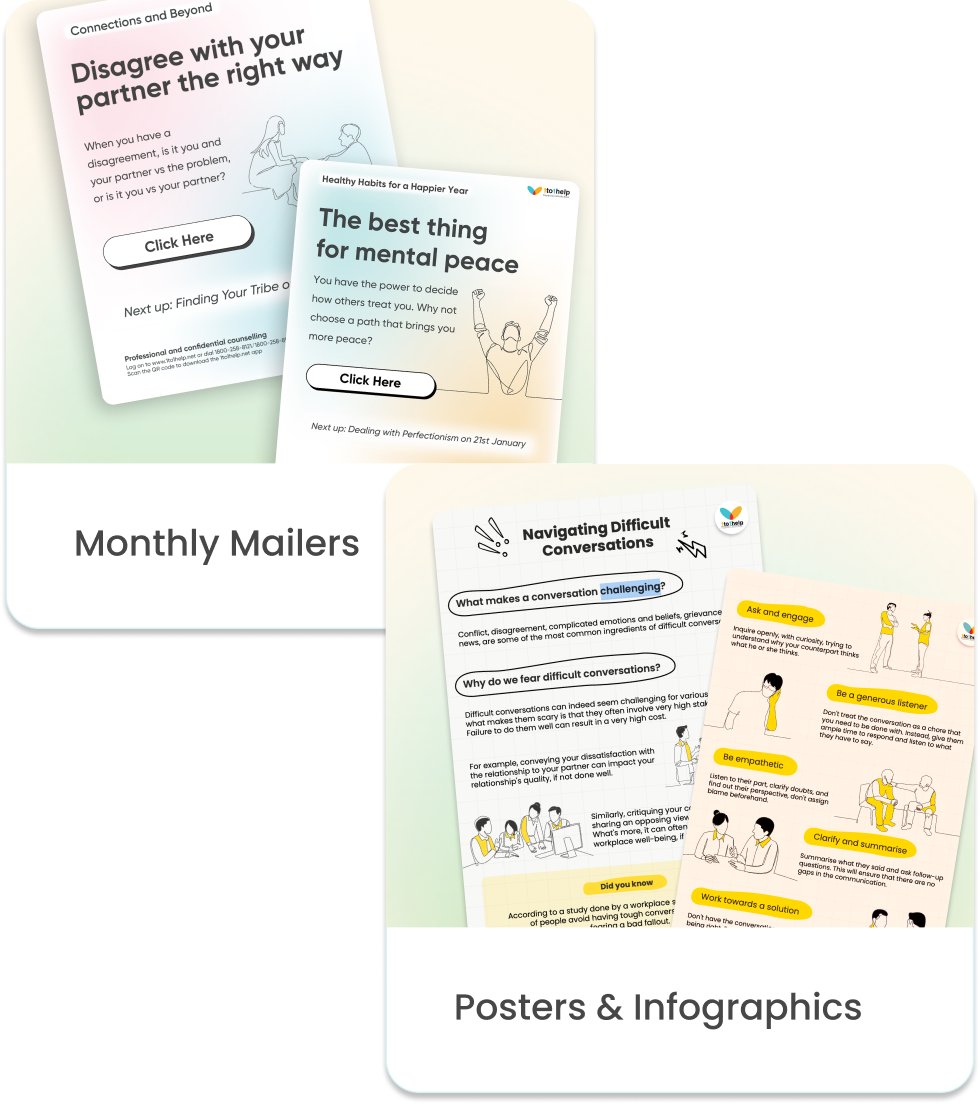
Support remained present, not episodic.
Rather than isolated programmes, the solution functioned as an integrated system combining

It worked because it respected how pharma manufacturing operates and how its people engage.
Once mental wellbeing support was put in place, the first changes were practical. They showed up in how employees used the system and how consistently they stayed engaged.
On the ground, this meant:
Employees did not limit themselves to one-on-one sessions. Usage expanded to self-help resources, assessments, and recorded webinars, showing a broader engagement with mental wellbeing tools.
This was particularly relevant in manufacturing settings where:
Mental wellbeing began to fit into existing work rhythms rather than interrupt them.
Organisations observed improvements that directly affected day-to-day operations:
For teams managing tight schedules and compliance-driven targets, these changes reduced last-minute disruptions and eased supervisory pressure.
Organisations also reported stronger positioning in recognised workplace benchmarks such as “Great Place to Work”, reinforcing the link between wellbeing initiatives and employer credibility.
What mattered most was who participated.
Blue-collar workers attended sessions when communication was in regional languages. Managers referred team members instead of avoiding difficult conversations. Employees who had stayed disengaged earlier began to show up.
The support worked because it matched how people actually live and work inside pharma manufacturing units.
That alignment is what made the difference.
Let’s explore how we can support your workforce with a customised solution.


.svg)
.svg)
.svg)
.svg)
.png)