




.png)

Parenting Challenges
How to Build Resilience in Children: 10 Practical Strategies for Indian Parents

.png)
Written by
Aarohi Parakh,
Psychologist and Content Writer

Reviewed by
Sanjana Sivaram,
Psychologist and Clinical Content Head


Introduction
Eight-year-old Aarav came home from school unusually quiet. Earlier that day, he had forgotten his lines during a class performance. A few classmates laughed, and he decided he never wanted to participate again.
His mother immediately wanted to reassure him. She thought about calling the teacher, speaking to the other children's parents, or convincing him that the performance "didn't matter". Instead, she sat beside him and simply asked, "That sounds like it was really difficult. Do you want to tell me what happened?"
Over the next few days, they spoke about disappointment, practised the lines again at home, and celebrated the courage it took to stand on stage in the first place. A month later, Aarav volunteered for another classroom activity.
The experience did not become easier because failure disappeared. It became easier because Aarav learnt that setbacks could be faced, understood and overcome.
The experience did not become easier because failure disappeared. It became easier because Aarav learnt that he could feel nervous, make mistakes and still find a way forward.
That is the heart of resilience in children.
Every child will experience disappointment at some point, whether it is a poor exam result, friendship conflicts, losing a match, moving to a new city or struggling with self-confidence. Parents cannot remove every obstacle from their child's path, nor would that necessarily prepare them for adulthood. What they can do is equip children with the emotional tools to navigate life's inevitable ups and downs.
The good news is that resilience is not something children are simply born with. Research suggests it can be nurtured through everyday interactions, supportive relationships and opportunities to learn from challenges. Small moments, such as allowing children to solve a problem independently, validating their emotions or encouraging them to try again after failure, often contribute more to resilient child development than grand parenting gestures.
In this guide, we explore how to build resilience in children through practical, evidence-based strategies tailored for Indian families. Whether you are parenting a preschooler, a teenager preparing for board exams or somewhere in between, these approaches can help your child develop confidence, emotional resilience and the ability to bounce back when life becomes difficult.
What Is Resilience in Children and Why Does It Matter?
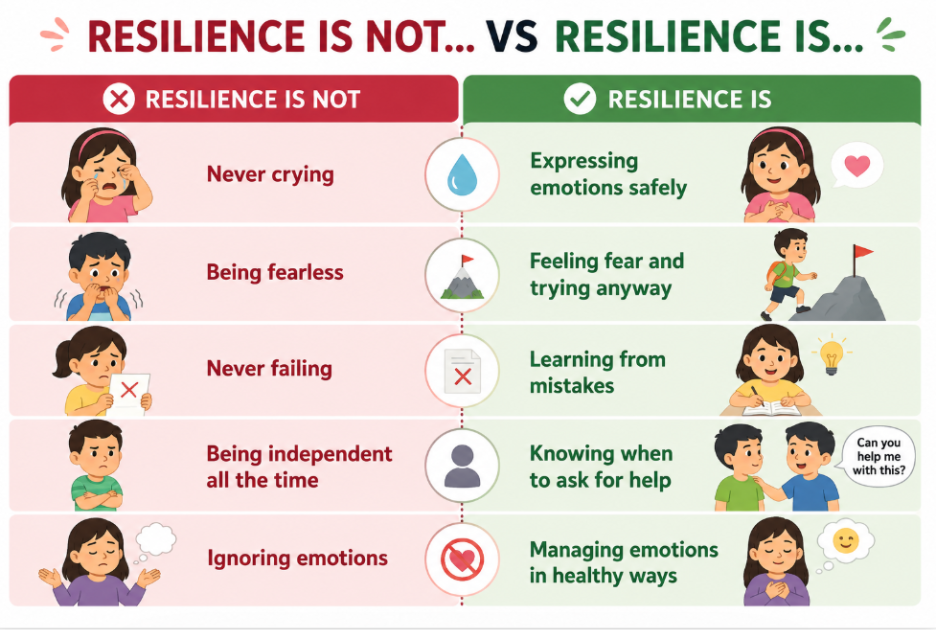
Resilience is often misunderstood. Many people assume resilient children never cry, rarely struggle or simply "stay strong" no matter what happens. In reality, resilience looks very different.
Resilience in children is the ability to adapt positively and recover from stress, adversity, disappointment or significant life challenges. It does not mean avoiding difficult emotions. Instead, it means learning how to recognise those emotions, cope with them in healthy ways and gradually move forward. Resilience is not an inherent ability that children either have or lack. It develops over time and is influenced by individual characteristics, supportive relationships and the environments in which children grow and learn.
The American Psychological Association defines resilience as the process of adapting well in the face of adversity, emotional trauma, threats or significant sources of stress. Importantly, resilience is considered a skill that develops over time rather than a fixed personality trait. This means every child has the potential to strengthen it with the right support.
A resilient child may still feel anxious before an exam, heartbroken after an argument with a friend, or upset after losing a competition. The difference is that they gradually learn that a setback does not have to determine how they see themselves or what they choose to do next. They begin to understand that setbacks are a part of life and can be worked through, rather than seeing them as evidence that they are incapable.
Research shows that resilience is associated with better emotional wellbeing, and positive adjustment in children and adolescents. Developing resilience early can also help children build coping skills to navigate future challenges.
For many Indian families, these challenges can feel particularly relevant.
Today's children are growing up in a world shaped by intense academic competition, coaching classes, entrance examinations, social media comparisons, and rapidly changing expectations. Many also juggle multiple extracurricular activities while navigating family responsibilities and digital pressures that previous generations did not experience.
In such an environment, success alone may not prepare children for adulthood. The ability to recover from disappointment, manage uncertainty, and adapt to change could become equally important.
Parents sometimes worry that allowing children to experience failure might damage their confidence. Yet, when children face manageable challenges with caring adult support, those experiences often become opportunities to build resilience rather than reasons to fear future setbacks.
Ultimately, resilience acts as a protective foundation for lifelong emotional wellbeing. Children who develop healthy coping skills today may be better equipped to navigate future relationships, workplaces, life transitions and personal challenges with greater confidence and flexibility.
💡Expert Insight: Resilience is not about raising children who never fall. It is about raising children who gradually learn that they can bounce back.
The Foundations of Resilience: What Children Need
Before exploring how to teach resilience to kids, it helps to understand what allows resilience to develop in the first place.
Psychologists often describe resilience as growing from a combination of supportive relationships, safe environments and opportunities to practise coping with challenges. Children rarely become resilient in isolation. Instead, resilience develops through repeated experiences of being supported while learning to navigate manageable difficulties.
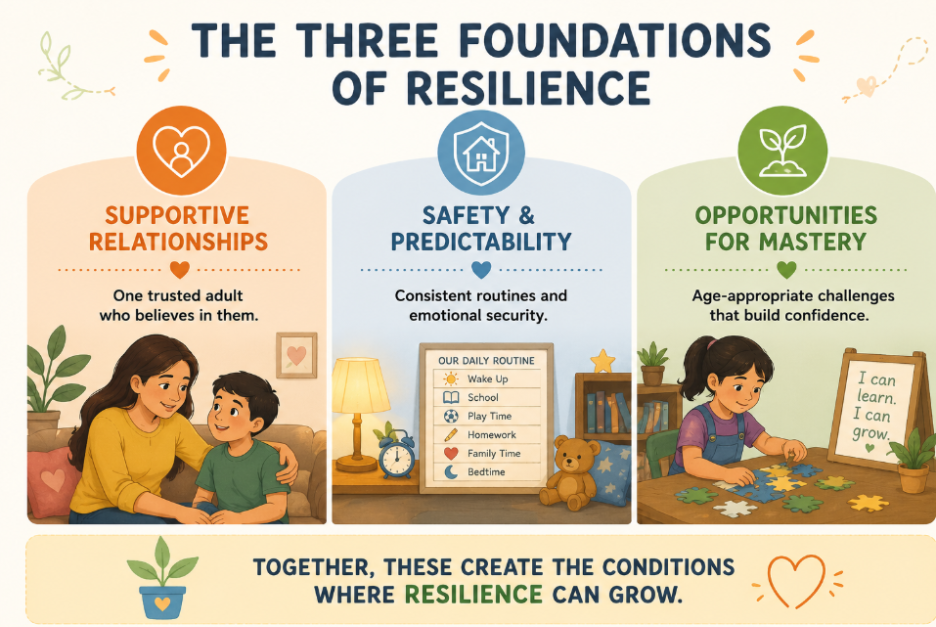
Three foundations are particularly important.
1. At Least One Stable, Supportive Relationship
Research consistently suggests that having at least one stable, supportive relationship with a caring adult is one of the most important protective factors that helps children develop resilience. Whether this adult is a parent, grandparent, teacher, or mentor, feeling supported provides children with a secure base from which they can face challenges and recover from setbacks.
What matters most is not the number of people in a child's life but the quality of at least one secure relationship where they feel accepted, heard and emotionally safe.
Simple everyday moments often strengthen this connection more than expensive experiences. Listening without immediately offering solutions, spending uninterrupted time together, asking about feelings instead of only schoolwork, or showing genuine curiosity about their day all communicate an important message:
"You are valued, even when things don't go perfectly."
2. A Sense of Safety and Predictability
Children find it easier to manage stress when they know their world feels reasonably safe and predictable.
This does not require a perfect home or conflict-free family. Rather, it means creating routines, emotional consistency and an environment where children know they can express themselves without fear of ridicule or harsh judgement.
When children constantly worry about criticism, unpredictability or emotional instability, much of their energy is spent simply feeling safe instead of learning how to cope with new challenges.
Predictable routines around meals, bedtime, family conversations and school can provide an important emotional anchor, particularly during periods of change.
3. Opportunities to Develop Mastery
One of the biggest misconceptions in parenting is that protecting children from every struggle helps them become more confident. In reality, confidence often develops after children successfully work through age-appropriate challenges.
Whether it is tying shoelaces, resolving a disagreement with a friend, learning to ride a bicycle, or preparing for an exam independently, these experiences allow children to discover that effort can lead to growth.
When adults solve every problem immediately, children may unintentionally receive the message that they are not capable of solving problems themselves.
Finding the balance between supporting and rescuing is one of the most effective ways of raising resilient kids.
The 7 Cs of Resilience
Paediatrician Dr Kenneth Ginsburg's widely recognised 7 Cs of Resilience framework, developed through the American Academy of Pediatrics, offers a practical way to understand resilient child development.
The seven building blocks are:
- Competence: Believing "I can do this."
- Confidence: Trusting one's abilities.
- Connection: Feeling supported and valued.
- Character: Acting according to positive values.
- Contribution: Feeling that one's actions matter.
- Coping: Managing stress in healthy ways.
- Control: Recognising what can and cannot be changed.
The ten practical strategies in the next section build upon these seven foundations.
Building Resilience in the Indian Context
Indian families often have unique strengths that naturally support resilience.
Joint family systems may provide children with multiple caring adults, grandparents often pass on stories of perseverance, and cultural traditions frequently emphasise community, belonging, and collective support.
At the same time, some well-intentioned parenting practices may unintentionally make resilience harder to develop. Constant comparison with siblings or classmates, solving every problem on a child's behalf, or placing excessive emphasis on marks over effort can sometimes reduce opportunities for children to develop confidence through experience.
The goal is not to expose children to unnecessary hardship. It is to create a safe environment where they can experience manageable challenges, make mistakes, learn from them, and discover that they are capable of overcoming difficulties.
When children know they are supported rather than rescued, they often begin building resilience one small challenge at a time.
10 Ways to Build Resilience in Children
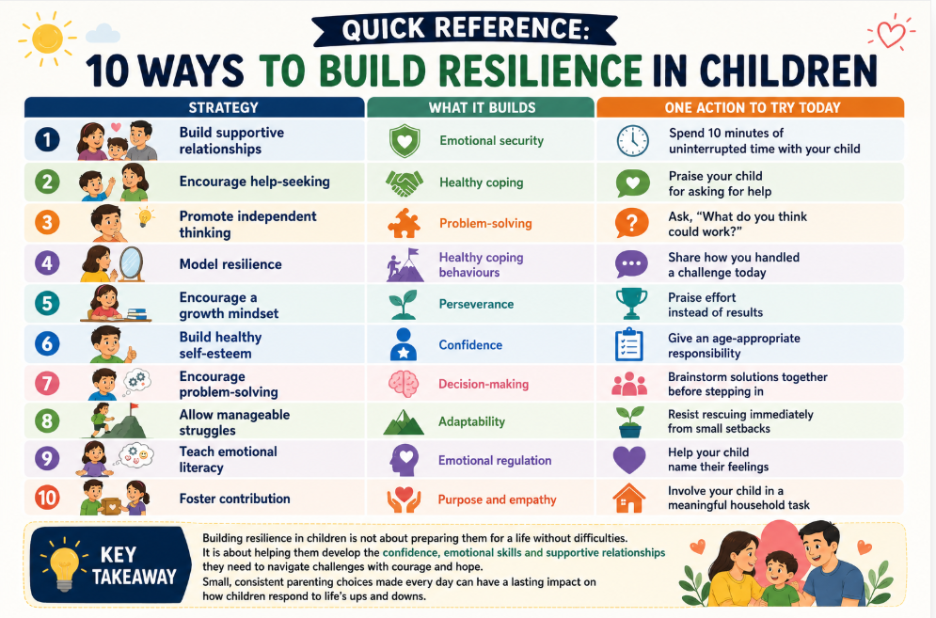
Building resilience in children does not require extraordinary parenting moments. It is often shaped by small, everyday experiences where children feel supported, encouraged, and trusted to handle age-appropriate challenges. If you are wondering how to build resilience in children, these ten practical strategies can help your child develop the confidence and coping skills needed to navigate setbacks, both now and later in life.
1. Build Strong, Supportive Relationships
Connection does not always require long conversations or dedicated family time. In a busy day, small moments of consistent connection can help children feel supported and emotionally secure.
Try to:
- Create a 10-minute check-in: Ask about one good thing, one difficult thing, and how your child is feeling before bedtime.
- Use everyday routines: Talk while travelling to school, having breakfast, or walking the dog instead of waiting for a formal conversation.
- Be fully present for small moments: Put the phone aside when your child wants to show you something, share a story, or talk about a problem.
When children know they have adults they can turn to without immediate judgement or criticism, they are more likely to seek support when challenges arise.
2. Teach Children That Asking for Help Is a Strength
Many children worry that asking for help means they have failed. Instead, help them understand that recognising when support is needed is an important life skill. Encourage them to approach a parent, teacher or trusted adult when they feel stuck. You can reinforce this by modelling help-seeking yourself, whether it is asking a colleague for advice or seeking support during a difficult time. Children often learn that everyone needs support sometimes, and that reaching out can be a sign of confidence rather than weakness. Asking for help does not mean giving up responsibility; children can seek support while still being part of finding a solution.
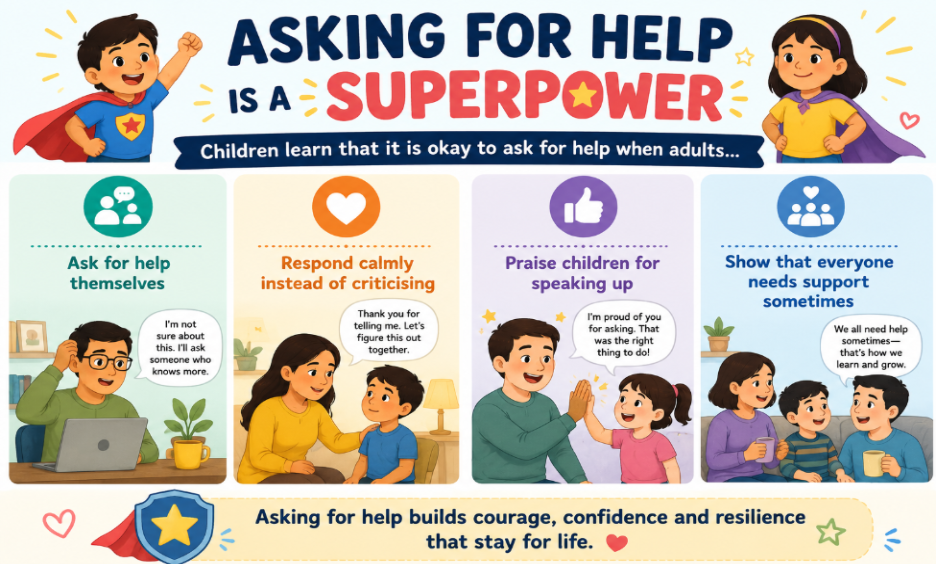
💡Pro Tip: Praise your child for speaking up when they need help, not just for solving problems independently.
3. Encourage Independent Thinking
One of the best ways to teach resilience to kids is to resist solving every problem for them. Instead of immediately offering answers, ask questions such as, "What do you think could work?" or "What would you like to try first?" This encourages children to think through challenges, weigh different options and learn from experience. Even if their solution is not perfect, the process builds confidence and problem-solving skills that are essential for resilient child development.
4. Model Resilience Through Your Own Behaviour
Children watch how adults respond to setbacks. Parents may naturally feel overwhelmed, frustrated or disappointed at times, and these emotions are a normal part of life. What can help children is seeing adults acknowledge difficult emotions and model healthy ways of responding to them.
For example, saying, “I'm really disappointed this didn't work. I need a little time to calm down, and then I'll think about what I can do next,” shows children that difficult emotions can be recognised, managed and followed by constructive action. It also demonstrates that coping does not mean staying calm all the time, but learning how to respond and recover when things feel difficult.
5. Encourage a Growth Mindset
Children who believe they can improve through effort are often more willing to keep trying after setbacks. Research by psychologist Carol Dweck highlights the value of praising persistence, strategies and effort instead of labelling children as simply "smart" or "talented". Replace phrases like "I can't do this" with "I can't do this yet." This small shift encourages children to see challenges as opportunities to learn rather than evidence of failure, supporting both confidence and emotional resilience.
6. Build Healthy Self-Esteem
Self-esteem develops when children experience genuine success through their own efforts. Give them age-appropriate responsibilities, such as organising their school bag, helping prepare a meal or caring for a plant. When offering praise, focus on specific behaviours instead of general compliments. Saying, "I noticed how patiently you kept practising," is often more meaningful than "Good job." Avoid comparing siblings or classmates, a habit that can unintentionally undermine confidence in many Indian households.
7. Encourage Creative Problem-Solving
Challenges become less intimidating when children know how to approach them step by step. Help your child define the problem, brainstorm possible solutions, consider the pros and cons of each, choose one to try, and then reflect on what they learnt. This approach works equally well for friendship disagreements, school projects or everyday family situations. Over time, children begin to see problems as situations they can influence rather than obstacles they cannot overcome.
8. Allow Age-Appropriate Struggles
It is natural to want to protect children from disappointment, but constantly stepping in may prevent them from discovering what they are capable of. Allow children to experience manageable setbacks, whether it is forgetting homework once, losing a game or resolving a disagreement with a friend. Offer encouragement without immediately rescuing them. These experiences help children learn that disappointment is temporary and that they can recover from difficult situations with support and practice.
Remember:Resilience grows in the "challenge zone", where children feel supported but still have opportunities to solve problems independently. The challenge zone is the balance allows them to practise problem-solving and build confidence without feeling left to cope alone.
9. Teach Emotional Literacy
Children who can identify and express their emotions are often better equipped to regulate them. Encourage your child to name what they are feeling instead of dismissing emotions with phrases like "Don't cry" or "It's not a big deal." You might say, "It looks like you're feeling disappointed," or "It makes sense that you're frustrated." Validating emotions does not mean agreeing with every behaviour. Rather, it helps children understand that feelings are normal and manageable, strengthening their emotional resilience over time.
10. Foster a Sense of Contribution
Children develop confidence when they feel they can make a meaningful difference. Encourage them to take on age-appropriate responsibilities, such as helping with household tasks, caring for pets or participating in community activities, while ensuring they are not made responsible for another person's wellbeing. In many Indian families, involving children in festival preparations, family traditions or acts of community service can nurture responsibility, empathy and belonging. Knowing that their actions matter often strengthens both purpose and resilience.
Resilience-Building Activities for Children
Knowing how to build resilience in children is important, but putting those ideas into practice is what helps children develop lasting coping skills. Everyday activities can teach children how to manage emotions, solve problems, adapt to change, and build confidence. The key is to choose activities that are appropriate for their age and allow them to experience both success and manageable challenges.
Ages 3–6: Building Confidence Through Play
Young children learn best through play and everyday routines. At this stage, resilience grows when children feel safe enough to explore, make mistakes and try again.
Some simple resilience activities for children include:
- Pretend play and role-play: Acting out situations, such as visiting a doctor or resolving a disagreement between toys, helps children practise empathy and problem-solving.
- Simple household chores: Putting away toys, watering plants or helping set the table builds competence and a sense of responsibility.
- Storytelling: Read books where characters overcome challenges, then ask questions like, "How do you think they felt?" or "What helped them keep going?"
- Naming emotions: Use picture books or a feelings wheel to help children recognise and express different emotions.
At this age, the goal is not perfection but helping children understand that making mistakes and trying again are both normal parts of learning.
Ages 7–12: Learning Through Challenges
As children grow, they become more capable of managing responsibilities and solving problems independently. This is an ideal stage to encourage activities that build confidence through experience.
Consider encouraging:
- Outdoor play and physical challenges, such as cycling, trekking or obstacle courses, which teach persistence and adaptability.
- Team sports or cooperative games, where children experience both winning and losing while learning teamwork and sportsmanship.
- Reflection journals, where they write about a challenge they overcame, what they learnt and what they might do differently next time.
- Learning a new skill, such as cooking, swimming, music or art, which teaches patience and the value of consistent practice.
Parents can support these experiences by focusing on effort and progress rather than only the final outcome.
Ages 13–18: Building Purpose and Independence
Adolescence often brings greater academic demands, changing friendships and questions about identity. Resilience during these years grows when teenagers are given opportunities to make decisions, contribute meaningfully and reflect on their experiences.
Helpful activities include:
- Volunteering or community service, which helps young people develop empathy, purpose and a sense of contribution.
- Goal-setting exercises, where they break larger goals into smaller, achievable steps and review their progress regularly.
- Debate, theatre or public speaking, which build confidence while teaching young people to handle constructive feedback.
- Reading widely, travelling or engaging in meaningful discussions, which expose them to different perspectives and strengthen adaptability.
Teenagers benefit when parents remain available for guidance while gradually allowing them greater independence.
Bringing Resilience into Everyday Indian Family Life
Many opportunities to build resilience already exist within Indian families. The focus is simply on recognising and using them intentionally.
For example, children can:
- Help prepare for festivals or family celebrations.
- Assist with age-appropriate household responsibilities.
- Learn family stories of perseverance from grandparents.
- Participate in classical music, dance or other creative pursuits that encourage discipline and self-expression.
- Help care for younger siblings or elderly family members, where appropriate.
These everyday experiences can help children develop confidence, responsibility, empathy and emotional resilience while strengthening their sense of belonging.
Key Insight: Resilience is not built through one activity or workshop. It develops through repeated opportunities to try, struggle, learn and succeed with the support of caring adults.
The Role of Schools and Teachers in Building Resilience
Parents play a vital role in resilient child development in India, but schools are equally important. Children spend a significant part of their day in classrooms, where they experience academic pressure, peer relationships, success, disappointment and conflict. These everyday experiences can either strengthen or weaken resilience, depending on how they are supported.
Teachers help build resilience when they create emotionally safe classrooms where mistakes are treated as opportunities to learn rather than reasons for embarrassment. Praising effort alongside achievement, encouraging collaboration instead of constant comparison and noticing when a child is struggling can all make a meaningful difference.
Positive peer relationships are another important protective factor. Schools that actively promote inclusion, empathy and anti-bullying practices create environments where children feel connected and supported.
In the Indian context, where academic performance can sometimes become a child's primary measure of self-worth, parents and schools benefit from working together. Regular conversations with teachers about both academic progress and emotional wellbeing help ensure that children receive balanced support.
Programmes such as 1to1help’s Student Assistance Programme (SAP) can further strengthen this partnership by providing confidential emotional wellbeing support, early identification of concerns and access to trained mental health professionals when needed.
Ultimately, resilience is most likely to flourish when children receive consistent messages from both home and school: mistakes are part of learning, asking for help is encouraged, and every child is valued for more than their marks.
Signs Your Child Is Developing Resilience
Resilience does not appear overnight, and it rarely develops in a linear way. Your child may cope confidently with friendship challenges but struggle with academic setbacks, or vice versa. Instead of looking for perfection, look for gradual progress.
Here are some signs of resilience in children that parents can watch for:
- They are willing to try new or difficult things, even without knowing whether they will succeed.
- They recover from setbacks over time. They may still feel disappointed, but they gradually move forward instead of staying stuck.
- They express their emotions using words rather than only through behaviour or withdrawal.
- They ask for help when needed, recognising that seeking support is part of solving problems.
- They show empathy towards others, especially friends or siblings who are struggling.
- They reflect on mistakes, thinking about what they could do differently next time instead of giving up.
- They remain hopeful, believing that difficult situations can improve with time or effort.
- They communicate worries more openly, making it easier for trusted adults to provide support.
Remember: Every child develops resilience at their own pace. The goal is not to eliminate difficult emotions but to help children become more confident in navigating them.
When to Seek Professional Support for Your Child
Building resilience and mental health in children begins at home, but sometimes children need additional support. Seeking professional help is not a sign of failed parenting. Instead, it reflects a parent's commitment to understanding and supporting their child's emotional wellbeing.
Consider consulting a child psychologist or counsellor if your child experiences:
- Persistent anxiety or fears that interfere with daily life.
- Noticeable changes in mood lasting several weeks.
- Ongoing withdrawal from friends, family or activities they previously enjoyed.
- Frequent school refusal or a sudden decline in academic engagement.
- Significant behavioural changes following a stressful or traumatic event.
- Self-harm, expressions of hopelessness or talking about wanting to disappear. These signs require immediate professional attention.
Support may include child and adolescent counselling, play therapy for younger children, family therapy or school-based mental health services.
Although awareness is improving, many families still hesitate because of the misconception that "children will grow out of it". While some challenges do improve naturally, early intervention often gives children the opportunity to develop healthier coping strategies before difficulties become more entrenched.
If your child's school offers a Student Assistance Programme (SAP), it can be a valuable source of confidential emotional wellbeing support. Where school-based services are unavailable, consulting a qualified mental health professional can help children and families navigate challenges together.
Conclusion
When Aarav stood up to speak again, nothing around him had changed. He was still nervous. He still made mistakes. But this time, he knew he could keep going.
That is the essence of resilience in children. It is not about preventing every setback, but about helping children believe they can face challenges, learn from them and move forward with confidence.
Every conversation, every opportunity to solve a problem and every moment of emotional support helps build that resilience over time.
If your child is finding it difficult to cope with life's challenges, you don't have to navigate it alone. 1to1Online counselling services provide expert support for children, adolescents and families. 1to1Parenting also provides expert guidance and tools to foster emotional wellbeing of parents and children. Through our Student Assistance Programme (SAP) and Employee Assistance Programme (EAP), we also partner with schools and organisations to promote lifelong emotional wellbeing because every child deserves the skills to bounce back, grow and thrive.
FAQs
Q1. At what age should I start teaching resilience to my child?
Resilience can begin developing in early childhood through secure relationships, opportunities for independent exploration and learning to identify emotions. Even simple everyday interactions help lay the foundation.
Q2. How can I stop overprotecting my child without feeling like a bad parent?
Start by allowing small, age-appropriate challenges while remaining emotionally available. Supporting children through difficulties often helps them build confidence more effectively than preventing every setback.
Q3. Can resilience be taught, or is it something children are born with?
While temperament may influence how children respond to stress, resilience in children is considered a skill that develops over time through supportive relationships, life experiences and healthy coping strategies.
Q4. How does failure help children build resilience?
When children experience manageable failures in a supportive environment, they learn that mistakes are opportunities to adapt, problem-solve and try again rather than reasons to give up.
Q5. What is the difference between resilience and toughness?
Toughness often implies suppressing emotions, whereas resilience involves recognising emotions, coping with them in healthy ways and gradually recovering from challenges.
Q6. How do sports and physical activities help build resilience?
Sports teach children perseverance, teamwork, emotional regulation and how to cope with both success and disappointment. They also provide opportunities to practise problem-solving and adaptability.
Q7. My child gives up easily. What can I do?
Break tasks into smaller steps, acknowledge effort rather than outcomes and celebrate progress. Encouraging a growth mindset and offering gentle support can gradually strengthen your child's confidence to keep trying.
References
- American Psychological Association. (n.d.). Resilience. https://www.apa.org/topics/resilience
- Ashland Decisions. (2018). Resilience: Helping children thrive. https://www.ashlanddecisions.org/wp-content/uploads/2018/10/Resilience-FINAL.pdf
- Brown University Health. (2024). The seven Cs of resilience and how parents can build resilient children. https://www.brownhealth.org/be-well/seven-cs-resilience-and-how-parents-can-build-resilient-children
- Child Trends. (2016). Constructs to measure child well-being. https://www.childtrends.org/wp-content/uploads/2017/03/2016-61ConstructsMeasureChildWellbeing.pdf
- Dweck, C. (n.d.). Carol Dweck: A summary of growth mindset. Farnam Street. https://fs.blog/carol-dweck-mindset/
- Ginsburg, K. R., & Jablow, M. M. (2015). Building Resilience in Children and Teens: Giving Kids Roots and Wings (3rd ed.). American Academy of Pediatrics.
- Greater Good Science Center. (2020). Four ways social support makes you more resilient. University of California, Berkeley. https://greatergood.berkeley.edu/article/item/four_ways_social_support_makes_you_more_resilient
- Growing Dreams Foundation. (n.d.). Building resilience in children. https://gdf.org.in/building-resilience-in-children/
- HealthyChildren.org. (2024). When children and teens self-harm. American Academy of Pediatrics. https://www.healthychildren.org/English/health-issues/conditions/emotional-problems/Pages/when-children-and-teens-self-harm.aspx
- Hughes, K., Bellis, M. A., Hardcastle, K. A., et al. (2021). Access to a trusted adult, resilience and the health of children and young people. BMC Public Health, 21, Article 130. https://pubmed.ncbi.nlm.nih.gov/34176519/
- Masten, A. S. (2014). Ordinary Magic: Resilience in Development. Guilford Press.
- Masten, A. S. (2018). Resilience theory and research on children and families: Past, present, and promise. Journal of Family Theory & Review, 10(1), 12-31.
- Masten, A. S. (2021). Resilience of children in the context of COVID-19. Development and Psychopathology, 33(5), 1630-1634. https://pmc.ncbi.nlm.nih.gov/articles/PMC8500371/
- Patel, V., Saxena, S., Lund, C., et al. (2024). Mental health of children and adolescents: Current evidence and future directions. https://pmc.ncbi.nlm.nih.gov/articles/PMC11104260/
- Psyra. (n.d.). 8 parenting tips to build resilience in children. AreoVeda. https://www.areoveda.in/a/blog/generic/parenting-tips


.svg)
.svg)
.svg)
.svg)