Counselling helpline for employees of partner organisations



.png)
Counselling helpline for employees of partner organisations
Counselling helpline for employees of partner organisations


Only 0.09% of India's 1.1 million registered companies have implemented an Employee Assistance Programme. Yet 80% of the Indian workforce reported at least one adverse mental health symptom, with a staggering $14 billion cost of poor mental health. Those two statistics, sitting side by side, describe the scale of a structural failure that no EAP helpline number, no annual wellness day, and no policy document can fix on its own.
This is not to suggest that Employee Assistance Programmes (EAPs) do not work. They are, in fact, a foundational and necessary part of employee mental health support. What is emerging, however, is the need to go a step further by complementing EAPs with decentralized, peer-led emotional care systems within the workplace.
The traditional model of employee emotional support concentrates care in one place: a single HR function, a single helpline, a single designated point of contact. These systems remain essential and provide employees with access to professional guidance, counselling, and structured support across a wide range of emotional and mental health concerns. However, many moments of emotional strain in workplaces occur informally and in real time, during daily interactions, team dynamics, periods of change, reduced participation, missed deadlines, or when people seem mentally and emotionally checked out.
The question that more forward-thinking HR leaders are beginning to ask is not "do we have a mental health helpline?" but rather: what if emotional care was not the responsibility of one room, but woven into the fabric of the organisation? What if support was available in every team, on every floor, from a trusted colleague who knows your context, understands your pressures, and has been trained to listen?
That is the idea behind Emotional Care Champions (ECCs): a structured, decentralised internal mental health network that 1to1help has built and is deploying across organisations in India. With 600+ active ECCs across 19+ organisations, the model has moved well beyond concept to a programme with measurable outcomes, documented impact, and a growing body of evidence that peer-level emotional care changes what is possible for both individuals and organisations.
This guide explains the why, the what, and the how in full. This blog breaks down why employee emotional care support matters, what Emotional Care Champions do, and how organisations can build an internal mental health network.
The case for building a distributed internal emotional support network begins with an honest reckoning of what the current model cannot do.
The scale problem. India has approximately 0.75 psychiatrists per 100,000 people, against a WHO-recommended minimum of 3. At the same time, workplace stress, burnout, emotional exhaustion, and disconnection continue to rise across industries. In this environment, emotional wellbeing cannot remain the responsibility of just one function or team. When the need is vast and the professional resource is scarce, the model has to evolve.
The stigma problem. According to Deloitte India's workplace mental health research, 39% of Indian employees affected by mental health issues did not seek help due to stigma. Formal professional support is the last resort for most people, not the first step. The pathway to professional help requires an intermediate layer that formal systems are currently not designed to provide.
The proximity problem. Employees are consistently more likely to turn to a trusted colleague before they reach out to HR, a helpline, or a therapist. The peer relationship can be the first point of contact for emotional distress in most Indian workplaces. Any support model that does not account for this reality is starting from the wrong place.
The detection problem. Most workplace mental health interventions in India are reactive. They respond to crises rather than catching emotional distress early. Without an internal network of emotionally aware colleagues, distress accumulates invisibly until it becomes a performance problem, a resignation, or something more serious.
The utilisation problem. Research published in Frontiers in Public Health found that only 40% of Indian organisations have a documented wellbeing plan, and EAP utilisation remains low partly because employees do not know anyone who can guide them toward the resource. Awareness of a service and confidence in using it are entirely different things.
The cultural dimension. In hierarchical Indian workplace structures, the fear of being seen as "weak" by managers, the stigma around mental health disclosure, and the social norms around self-reliance mean that the path to formal support needs a culturally trusted intermediate step. A colleague who shares your context, your pressures, and your world is that step.

In India, the first person an employee turns to in emotional distress is rarely a professional. It is a trusted colleague.
This is the gap that a trained internal peer network, an Emotional Care Champions programme, is specifically designed to fill.

Source: Made by 1to1help
An Emotional Care Champion (ECC) is a trained employee volunteer who serves as an emotionally aware, approachable peer within the organisation: someone colleagues can turn to when they are struggling, before they reach a crisis point.
The definition matters as much for what it excludes as for what it includes. An ECC is not a therapist. They are not a counsellor, a HR representative, or a clinical professional. They are an empathetic, trained colleague who listens actively, acknowledges what they hear, and guides employees toward appropriate professional support when it is needed.
The ECC model is grounded in the principle of decentralised emotional care. Rather than concentrating support infrastructure in a single HR function or EAP helpline, it distributes care capacity across teams and departments, making genuine emotional support consistently accessible at a human level, within existing working relationships.
Why peers make effective emotional first responders. Colleagues share work context, department pressures, cultural norms, and the texture of daily working life. They notice changes in behaviour earlier than HR dashboards or annual surveys do. They carry less institutional weight, which makes it significantly easier for employees to open up. A peer conversation about how you are doing does not feel like a formal disclosure. It feels like a conversation.
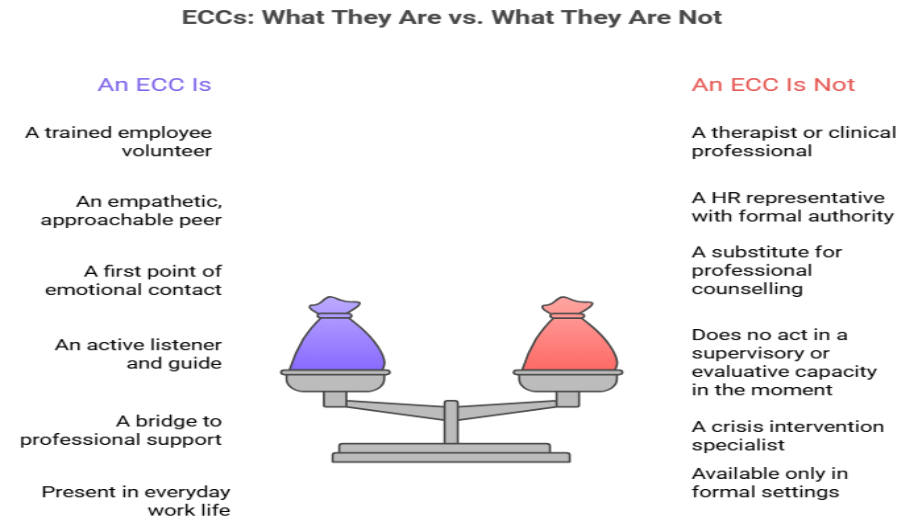
The ECC is a bridge. Between an employee who is struggling and the formal professional support, through 1to1help's Employee Assistance Programme, that they may need. ECCs reduce the psychological distance to help-seeking in the most direct way possible: through a trusted human relationship.
Source: Made by 1to1help
The scope of ECC support includes active listening, emotional acknowledgement, stigma-free conversation, early distress recognition, and guided referral to professional counselling resources.
What ECCs do not handle: clinical diagnosis, psychiatric advice, formal therapy, or performance management conversations. The boundaries are clear, are taught in the programme, and are essential to both the ECC's effectiveness and their own emotional wellbeing.
The ECC model does not ask ordinary employees to become mental health professionals. It asks them to become something arguably rarer and harder to be: a trusted, trained, approachable colleague who knows how to listen and when to refer. That combination changes what is accessible to every employee in the organisation.
The evidence for peer support as an effective workplace mental health intervention has been building consistently, and the India-specific data is particularly compelling.
Psychological safety is the foundation. Employees cannot access emotional support in an environment where vulnerability is penalised. Peer networks built on trust create the psychological safety that clinical interventions alone cannot manufacture. The Asia Society India's 2024 research on workplace mental health found that peer support programmes "increase mental wellness, self-efficacy and confidence" and reduce mental health stigma in the workplace: two outcomes that top-down policy interventions consistently struggle to achieve.
The trusted colleague effect. Research on Indian workplaces consistently shows that employees prefer to disclose emotional distress to a peer before approaching HR or a formal support service. This preference is not a barrier to overcome. It is a feature of human social behaviour that an effective wellbeing strategy should align with rather than try to redirect.
Normalisation through proximity. When an ECC is a colleague, someone in your team, your floor, your department, mental health conversations become part of normal working life rather than a formal, stigmatised event. The ordinary part of the peer relationship is what makes it powerful. It removes the sense of glorification that often makes formal help-seeking feel intimidating.
Early identification advantage. ECCs interact with colleagues frequently and can detect subtle changes in mood, energy, and engagement that are invisible to HR dashboards or quarterly surveys. The colleague who notices that someone has gone quiet, who asks a genuine question before the performance data changes, represents one of the most effective early warning mechanisms available to any organisation.
Cultural fit in India. The concept of turning to a known, trusted person within your social network before seeking external help is deeply embedded in Indian cultural norms. ECCs meet employees where they already are, culturally and relationally, rather than expecting them to navigate to a model of help-seeking that does not align with how they naturally operate.
Bridging the EAP utilisation gap. One of the most significant reasons EAPs are underutilised in India is that employees do not know how to begin. An ECC provides a human, approachable first step that bridges the gap between distress and formal professional help. They convert EAP awareness into EAP use, which is the outcome that matters.
In India, peer support is one of the most immediate ways of creating safer workplace environments, given the shortage of mental health practitioners.

Source: Made by 1to1help
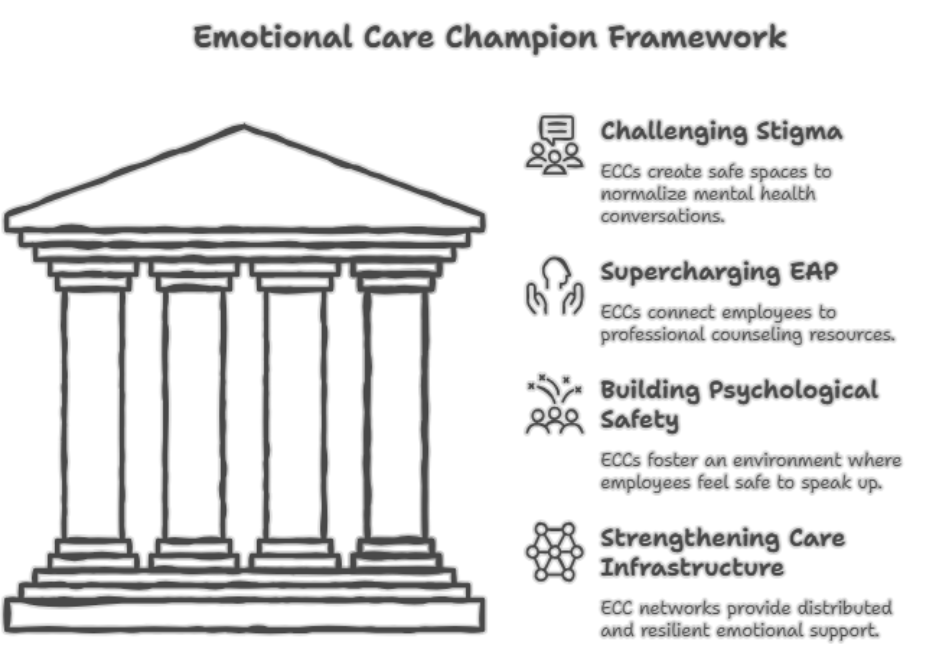
The 1to1help ECC programme is designed around four specific functions that ECCs perform within an organisation. Understanding these functions helps HR leaders see not just what ECCs do individually but what they collectively contribute to the organisation's emotional care infrastructure.
Source: Made by 1to1help
ECCs create safe, judgement-free spaces where employees can have genuine conversations about mental health. In Indian workplaces where stigma is a primary barrier to help-seeking, with Deloitte India's research indicating that 39% of employees affected by mental health issues did not seek help because of it, an ECC's presence and openness signals something important to their colleagues: that emotional conversations are acceptable here. Each ECC who speaks openly about wellbeing, who normalises the language of emotional health in day-to-day interactions, shifts the cultural temperature of their team in a way that no policy statement can replicate.
An EAP is only as effective as the number of employees who actually use it. ECCs act as the human connective tissue between 1to1help's professional counselling resources and the employees who need them. They guide colleagues through the process, explain what to expect, remove the mystery and stigma from the first step, and follow up with genuine care rather than institutional procedure. ECCs convert latent EAP awareness into active utilisation, which directly amplifies the return on investment of the professional support already in place.
For more on how 1to1help's EAP works, visit the Employee Assistance Programme page.
Psychological safety, the belief that one can speak up, take interpersonal risks, and ask for help without fear of punishment or humiliation, is consistently one of the strongest predictors of team performance and employee wellbeing. ECCs build psychological safety not through policy, but through presence. A trained, emotionally literate colleague who is visibly approachable, changes what employees believe is possible in their workplace, one conversation at a time. Research published in BMC Public Health found that psychological safety, the belief that disclosure would not be used against the employee, was the single most important factor in whether employees with mental health challenges sought help.
A single EAP helpline number may serve as a single point of care. An ECC network across departments is a care infrastructure: distributed, resilient, and scalable. As an organisation grows, its ECC network grows with it. As workplace stressors evolve, the ECC network provides consistent human-level support that complements the formal professional system. It ensures that emotional care has no single point of failure and is not constrained by geography or hierarchy.
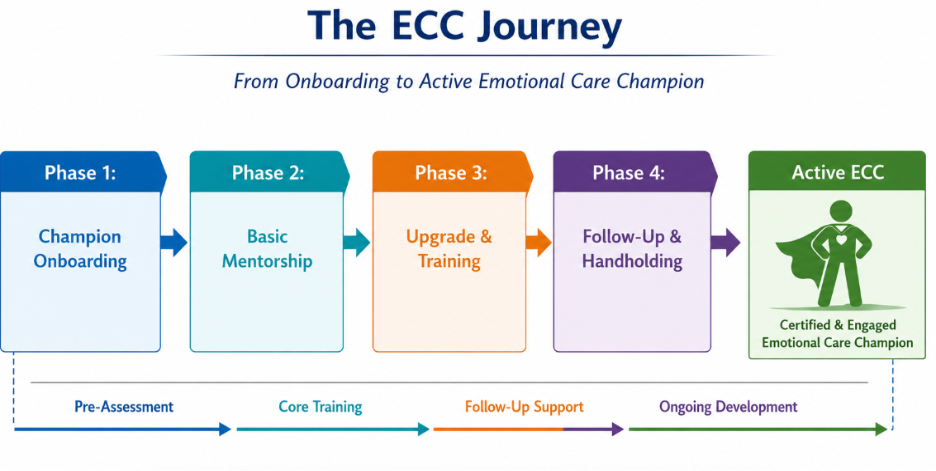
Becoming an Emotional Care Champion is not a title. It is a journey through a structured, counsellor-led programme designed by 1to1help to equip ordinary employees with the skills to provide extraordinary peer support.
The key emphasis: the programme is not about creating amateur therapists. It is about creating emotionally literate, empathetic colleagues who know when and how to listen, and when and how to refer.
Source: Made by 1to1help
HR identifies and selects employee volunteers who are genuinely motivated to support their colleagues. The selection process involves sharing basic criteria with the HR SPOC, covering suitability factors such as the ability to handle sensitive information and the bandwidth to support others. Selected volunteers are introduced to the principles of peer emotional support, confidentiality, empathetic listening, and responsible referral pathways through structured training facilitated by 1to1help professionals. The pre-assessment ensures that every ECC who enters the programme has both the motivation and the readiness to serve effectively.
Selected ECCs participate in a counsellor-led webinar session covering three core areas:
Decoding counselling: Breaking myths and reducing stigma around counselling by helping ECCs understand what actually happens in the process, challenging their own biases, and equipping them to explain counselling confidently to peers.
What makes good mental health: Building basic awareness of healthy versus poor mental health, key contributing factors, the impact of poor mental health, and simple everyday steps that support wellbeing.
Allyship to action: Preparing ECCs for their role through a practical helping framework, guidance on peer conversations, and clear boundaries around what the ECC role is and is not.
The training uses interactive and reflective learning approaches to help ECCs build confidence in supporting colleagues responsibly and empathetically.
This phase focuses on strengthening the practical skills and emotional competencies ECCs need to support colleagues effectively and safely. Topics covered include:
Stress: Understanding signs, causes, and the mental health continuum, so ECCs can recognise where a colleague sits on the spectrum.
Anxiety: Building awareness of physical, psychological, and behavioural manifestations of anxiety.
Depression: Exploring signs, the depression cycle, and how these present specifically in the workplace.
Criticality: Training on understanding risk factors and identifying signs of self-harm or suicidal ideation, with a clear support flow for managing risk situations safely.
Skills training: Interactive development of empathy, active listening (both verbal and non-verbal), questioning skills, and reflection techniques.
Self-care: The importance of self-care for the ECC themselves, including a personal self-care plan to prevent compassion fatigue.
Upon completion, ECCs receive an Emotional Care Champion badge and post-session handouts and reading materials. The workshop uses psychoeducation, role-plays, reflective exercises, and case vignettes to build practical competence rather than theoretical knowledge.
The ECC journey continues beyond the initial training through ongoing guidance, reflection, and support. Follow-up sessions gather insights on obstacles and challenges ECCs have encountered in their role, shared strategies for navigating stigma and barriers to help-seeking, and experiences of building allyship in practice. The ongoing connection with the 1to1help professional team ensures that ECCs remain supported, connected, and continually developing.
Beyond the four phases, ongoing engagement and continued learning are built into the programme design through regular check-ins, workplace wellbeing initiatives, continued capacity-building opportunities, and access to supportive learning resources.The programme is designed to be practical, sustainable, and manageable alongside employees’ existing work responsibilities.
💡Pro Tip
for HR Leaders: When selecting ECC volunteers, resist the instinct to choose the most senior or most visible people in the organisation. The most effective ECCs are often the individuals who are already the informal "go-to" people in their teams, those whose colleagues already trust them with personal conversations. They may not have formal seniority, but they have social trust, which is the asset that makes this role work.
ECCs are employee volunteers. They are not appointed by HR authority or selected based on seniority. They are chosen based on motivation, interpersonal qualities, and confirmed readiness through 1to1help's pre-assessment.
What makes a strong ECC candidate:
ECCs come from any function, level, or department within the organisation. The most effective ECC networks are diverse: reflecting the range of gender, role, office location, and department across the workforce, so that every employee has access to an ECC who feels relatable and familiar.
The effectiveness of ECCs comes from being perceived as approachable, non-judgmental, and outside formal evaluative or clinical structures. Even when ECCs are drawn from HR, management, or leadership, the role is effective only when it is enacted in a non-hierarchical, peer-like manner. The moment the interaction shifts to formal authority, the accessibility of support decreases.
The ECC pre-assessment is not a barrier. It is a protection: for the ECC themselves, who should not be placed in a role they are not emotionally ready for, and for the colleagues they will support, who deserve qualified peer care rather than well-intentioned but unprepared intervention. Qualification matters in peer support just as it does in professional practice.
The ECC model is not limited to corporate workplaces. 1to1help has extended the programme to educational institutions to address a mental health gap that is, in some ways, even more acute than in the corporate sector.
India's students aged 15 to 24 represent over 35% of all suicide deaths nationally, according to the NCRB 2023 report. The Indian Psychiatric Society's 2024 research found that 40% of Indian teenagers report stress and anxiety as primary concerns. Most schools and colleges lack trained counsellors and peer support infrastructure. The professional resource-to-student ratio makes individual clinical care impossible at scale. Peer support, in this context, is not a supplement. It is a necessity.
Student volunteers are trained to identify, respond to, and support peers who are experiencing emotional distress: on campus, in hostels, and within student communities. Student ECCs create peer-to-peer support pathways that are stigma-free, relatable, and immediately accessible in the environments where students spend most of their time. They serve as the first point of contact and a trusted bridge to the institution's formal support services, complementing 1to1help's Student Assistance Programme.
The value of the student ECC lies in their accessibility and relatability. They are not approached in a formal counseling capacity but rather as a trusted, approachable first point of contact. In some contexts, ECCs may include class representatives, student council members, hostel wardens, or even professors. In an environment where students are often reluctant to disclose distress openly, a trained fellow ECC who is approachable and non-judgemental can be the intervention that changes an outcome.
Faculty ECCs are trained to act as emotional support allies for students, empowering teachers and academic staff to notice early signs of student distress, respond with empathy, and facilitate appropriate referrals. Faculty ECCs distribute initial responsiveness across the academic community, reducing the emotional load on a small number of designated counsellors.
They also benefit personally. Faculty who are trained in emotional support consistently report greater job satisfaction and lower compassion fatigue. The training equips them with skills that improve their interactions with students across the board, not only in moments of obvious distress.
An institution where both students and faculty are trained as ECCs becomes an environment with multiple visible, accessible support touchpoints: a campus that is structurally oriented toward emotional wellbeing, not only toward academic achievement.
The most useful way to think about the ECC programme is as infrastructure: the human-level system that determines whether emotional care is actually accessible day-to-day across the organisation.
Just as an organisation invests in IT infrastructure that ensures every employee has the tools to do their job, an ECC network ensures every employee has access to emotional support when they need it, not just when HR has capacity, not only through a channel that requires overcoming significant psychological barriers to initiate.
Scalability is built into the programme design. As the organisation grows, cohorts of new ECCs can be trained. As new offices or departments open, the network expands with them. As workplace stressors evolve, follow-up training sessions address emerging needs. The programme scales because it is human-based rather than system-based.
Resilience is a structural advantage of the distributed model. Unlike a single EAP helpline or a single HR welfare officer, a network has no single point of failure. If one ECC moves teams or leaves the organisation, others remain. Care infrastructure that is distributed cannot be disrupted by individual changes.
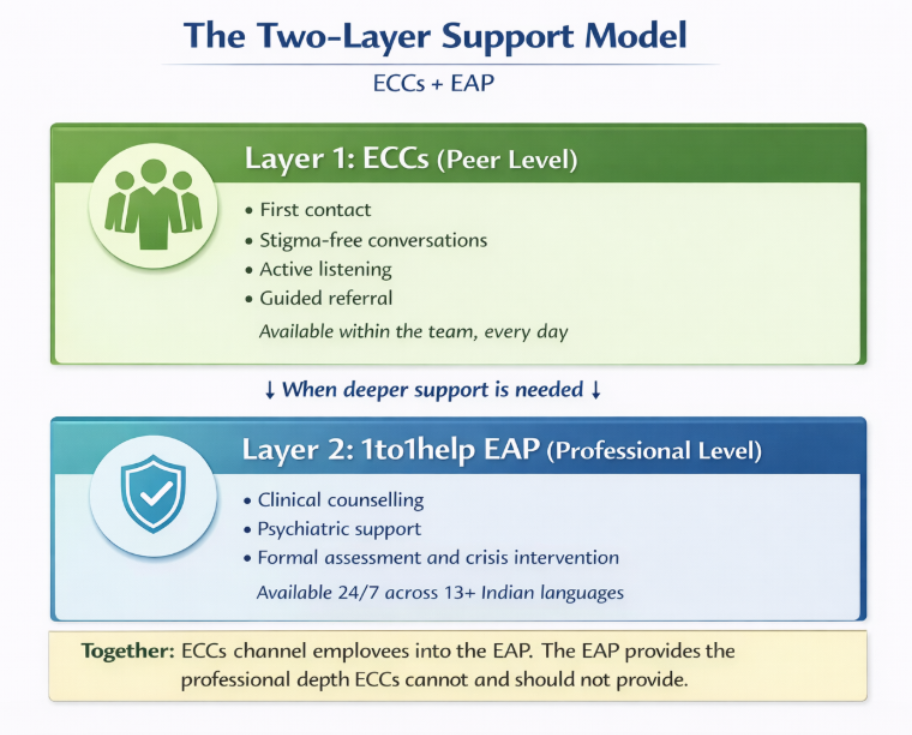
The 1to1help EAP that ECCs connect employees to is backed by 25 years of experience, 1.2 million counselling sessions, 500+ counsellors across 100+ on-site locations, ISO 9001:2015 and ISO 27001:2022 certification, and a 97%+ client satisfaction rate. The depth of professional backing behind the peer network is what makes the two-layer model genuinely robust.
Source: Made by 1to1help
Measuring the impact of an ECC network is tracked through EAP utilisation rates before and after ECC deployment, employee wellbeing survey scores, manager-reported team climate assessments, and pre- and post-analysis of situation judgement quiz completed by ECCs themselves to measure their learning and readiness. 1to1help's measurement framework is built into the programme structure, not added as an afterthought.
The business case sits within an established evidence base. Research estimates that for every dollar invested in mental health programmes, organisations see four to five dollars in returns through reduced absenteeism, lower turnover, and improved productivity. The ECC model amplifies this ROI by increasing utilisation of the professional support already in place: increased and earlier use of the EAP leads to greater return on the initial investment.
Psychological safety, the shared belief among team members that they can speak up, ask for help, acknowledge distress, or admit a mistake without fear of punishment or humiliation, is the single most important precondition for emotional care at work.
An organisation can have all the wellbeing resources in the world. An EAP. A counsellor. A helpline. A mental health policy. If employees do not feel psychologically safe, they will not access any of it. BMC Public Health research on Indian workplaces found that psychological safety was the single most significant factor in whether employees with mental health challenges sought help. Not the availability of resources. They felt safe to use them.
The ECC is a psychological safety signal. When a colleague who is an ECC openly acknowledges that emotional conversations are welcome, that distress is not weakness, and that seeking support is the right thing to do, this changes what other employees believe is possible in that environment. Not through a policy statement, but through a human relationship.
The cultural shift that ECCs create is gradual and real. Each conversation an ECC has with a colleague is, in a small way, an act of culture change. Over time, the aggregate effect is measurable: teams with active ECCs report greater openness, stronger cohesion, and a qualitatively different sense of what can be said and heard.
In India's hierarchical workplace cultures, psychological safety must often be built from the peer level upward before it can be reinforced by leadership. Waiting for leadership-driven culture change to create psychological safety in teams can mean waiting a long time. ECCs are uniquely positioned to initiate this from within the team, alongside, rather than waiting for, leadership commitment.
💡Key Insight:
Psychological safety is not a policy. It is a lived experience built through trusted human relationships at the team level.
The ECC who checks in genuinely with a colleague at lunch. The ECC who acknowledges that things feel stressful in a team meeting and means it. The ECC follows up on a difficult conversation without making it a public discussion. These are the moments when psychological safety is built: not in policy documents, but in the accumulation of small, trusted human interactions over time.
For more on the relationship between psychological safety and employee wellbeing measurement, explore 1to1help's Emotional Risk Survey, which helps organisations measure emotional risk and resilience across teams.
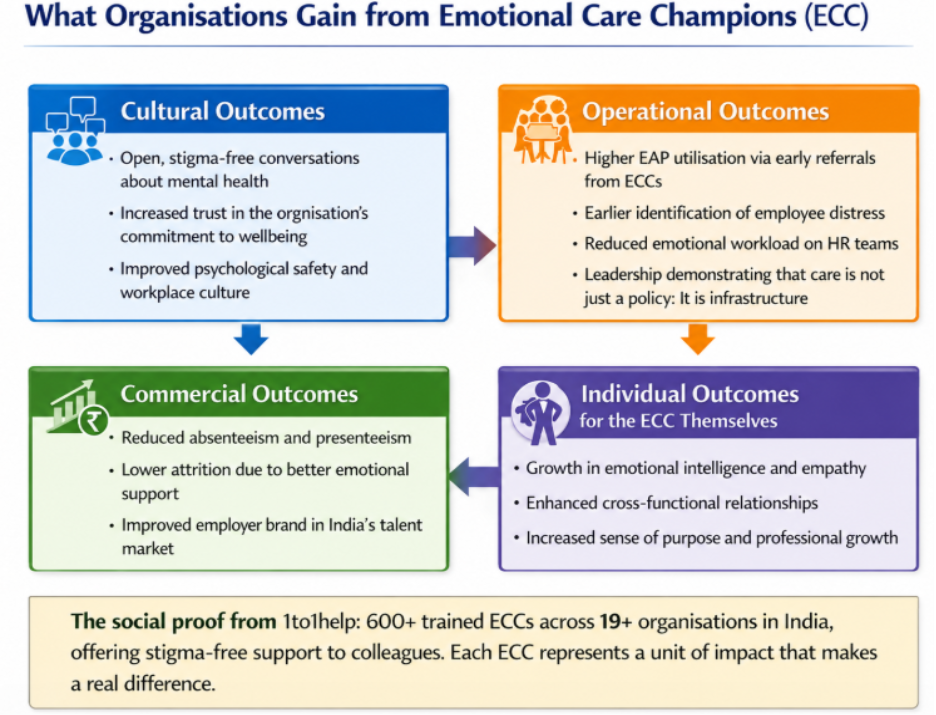
The outcomes of the ECC programme are felt across four dimensions. Understanding all four helps HR leaders build a comprehensive internal case for the investment.
Source: Made by 1to1help
For India's Gen Z workforce, who consistently cite psychological safety as a primary workplace requirement, this cultural shift has direct implications for talent attraction and retention.
The social proof from 1to1help: 600+ trained ECCs across 16+ organisations in India. Each ECC represents a team where a colleague is now more likely to feel supported, less alone, and more willing to seek help. That is the unit of impact that matters most.
💡Pro Tip:
When communicating the ECC programme internally to potential volunteers, lead with the personal development dimension rather than the service dimension. "This will make you a better listener, a more effective communicator, and a more trusted colleague" is a more compelling invitation for high-potential employees than "we need you to support others." Both are true. Lead with the one that speaks to what the individual gains.
Source: 1to1help Internal Data
India's organisations have spent a long time treating employee mental health as a policy question. The right policy is necessary but not sufficient. Policies create rules. Infrastructure creates access.
The Emotional Care Champions programme is infrastructure: the human-level system that ensures emotional support is genuinely available to every employee, not only to those who know how to navigate their way to formal services, not only in moments of acute crisis, and not only when HR has capacity.
The 600+ ECCs active across 16+ organisations in India are not a pilot. They are a proof of concept that have become a practice. They represent teams where a colleague is now more likely to feel heard, less alone, and more willing to seek help before things become overwhelming. That is not a soft outcome. It is the outcome on which everything else in a wellbeing strategy depends.
If your organisation is ready to build an emotional care infrastructure, rather than just a wellness policy, 1to1help's ECC programme is the structured, evidence-based, professionally backed way to do it.
[Request a Programme Consultation with 1to1help]
If your team also needs professional-level counselling support to complement the peer layer, explore 1to1help's Employee Assistance Programme. For organisations seeking to measure emotional risk across their workforce before or alongside EAP or ECC deployment, the Emotional Risk Survey provides the population-level data to direct your investment where it matters most.
An ECC is a trained employee volunteer who acts as a peer emotional support ally within an organisation. They are not therapists or HR representatives. They are trusted colleagues trained to listen actively, recognise emotional distress, and guide peers toward professional support when needed. The model decentralises emotional care across the organisation, making support accessible through human relationships at the team level, not just through a helpline. With 600+ ECCs active across 16+ organisations in India, peer-level care has proven to be a scalable, effective component of any employee wellbeing strategy.
Employees in distress turn to a trusted colleague before they reach a counsellor or helpline. In India, where 39% of affected employees do not seek help due to stigma, peer support removes the barrier that formal systems cannot. ECCs normalise mental health conversations, build psychological safety, and bridge the gap between distress and professional care. They are not a replacement for clinical support. They are the human pathway that makes clinical support accessible.
The programme runs across four phases: Onboarding (volunteer selection and screening quiz), Basic Mentorship (counsellor-led session on mental health basics and the allyship framework), Upgrade and Training (a 120-minute skills workshop covering active listening, stress, anxiety, depression, criticality response, and self-care), and Follow-Up at three and six months post-training. Total volunteer time commitment is approximately five hours, with ongoing engagement through quarterly discussions and monthly resources.
Any motivated employee volunteer who passes the 1to1help pre-assessment. ECCs come from any function, level, or department. The most effective networks reflect workforce diversity across gender, role, and location. ECCs effectiveness depends on being perceived as approachable, non-judgmental, and non-hierarchical. Even when drawn from HR or leadership, the role works only when enacted in a peer-like manner; once it shifts into formal authority, accessibility decreases.
They function as two layers of one system. ECCs provide peer-level first contact, active listening, and guided referral. The EAP provides professional counselling, clinical support, and formal intervention. ECCs accentuate the EAP by removing the first barrier to use: many employees know the EAP exists but do not know how to begin. An ECC is the human, approachable step that converts awareness into action.
Yes. Student volunteers are trained to support peers on campus, creating stigma-free peer pathways. Faculty ECCs are trained to recognise and respond to student distress early. In institutions where both participate, emotional wellbeing becomes a shared campus responsibility, complementing 1to1help's Student Assistance Programme.
Start with an initial consultation with 1to1help's partnerships team. After understanding your organisation's size, structure, and wellbeing goals, 1to1help designs the deployment including selection criteria, training schedule, and follow-up procedure. All four phases are delivered by 1to1help's professional team.
Visit https://www.1to1help.com/solutions/emotional-care-champions to request a programme consultation.


.svg)
.svg)
.svg)
.svg)
.png)