

.png)


.png)

Emotional Risk Survey & Mental Health Assessment in India: The Complete Guide (2026)
Table of Contents
The Shift from Mental Health Awareness to Emotional Risk Measurement in India
What Is an Emotional Risk Survey? Definition & Purpose
Why Emotional Risk Surveys Matter in India: The Mental Health Crisis
Types of Emotional Risk Surveys and Mental Health Assessments
How to Conduct an Emotional Risk Survey: A Step-by-Step Guide
How to Interpret Emotional Risk Survey Results and What to Do Next
Introducing 1to1help's Emotional Risk Survey: From Data to Meaningful Action
A Final Word
FAQs
References
The Shift from Mental Health Awareness to Emotional Risk Measurement in India
Over the past decade, India has undergone a visible transformation in how mental health is discussed and understood. What was once confined to only clinical settings is now part of mainstream discourse. Organisations speak about employee wellbeing, schools acknowledge student stress, and government initiatives such as Tele MANAS aim to expand access to care.
Despite this progress, most mental health systems in India remain reactive.
Most mental health systems in India, including those within organisations, are still built around reactive models of care. They rely on individuals recognizing distress, seeking help, and accessing services. In reality, this chain breaks down at multiple points.
Employees often normalise stress until it becomes overwhelming.
Students hesitate to disclose emotional difficulties due to stigma.
Managers may notice a decline in performance but lack the tools to understand the underlying causes.
By the time action is taken, emotional strain has often progressed into burnout, anxiety disorders, or depressive symptoms, and in many cases, may also manifest as silent quitting or eventual attrition.
This is precisely where an emotional risk survey becomes critical. It shifts the focus from diagnosing problems to identifying risk early, at a stage where intervention is more effective.

Mental health assessments answer: What is wrong right now?
Emotional risk surveys answer: Where is something likely to go wrong next?
For large organisations, this distinction has direct implications for productivity, retention, leadership effectiveness, and long-term organisational health.
What This Guide Covers
This guide explains how emotional risk surveys and mental health assessments in India can help organisations move from reactive support to proactive wellbeing.
You will learn:
- Employees: Employees can access EAP services for personal challenges, emotional difficulties, work-related stress, interpersonal conflicts, mental health concerns, grief, parenting, holistic wellbeing, work-life balance, or life transitions that affect their wellbeing or performance.
- What an emotional risk survey is and how it differs from mental health assessments
- Why emotional risk measurement matters for organisations in India
- The key types of mental health assessment tools and screening methods
- How to implement emotional risk surveys at scale
- How 1to1help’s Emotional Risk Survey (ERS) enables organisations to measure emotional risk at scale and translate insights into targeted interventions.
What Is an Emotional Risk Survey? Definition & Purpose
Most conversations about mental health begin too late. By the time someone reaches out for help, whether to a therapist, a counsellor, or even a trusted colleague, they have often been struggling in silence for months. In India, where an estimated 150 million people require mental health support but the treatment gap sits between 70% and 92%, that delay is not just common. It feels like the norm.
An emotional risk survey is a structured assessment tool designed specifically to address exactly this. Rather than waiting for distress to become a crisis, it identifies the emotional and psychological factors that put an individual at risk of developing mental health problems before those problems fully take hold. It is early detection applied to psychological health, and it is one of the most underutilised interventions available to both individuals and organisations in India today.

ERS is a comprehensive tool designed to assess and enhance the emotional well-being of employees at an organisational level. It provides insights into employee risk levels at employee, cohort, and organisational levels. ERS aims to offer proactive, data-driven interventions that ensure employee well-being and address emotional risk within organisations.
What exactly does an emotional risk survey measure?
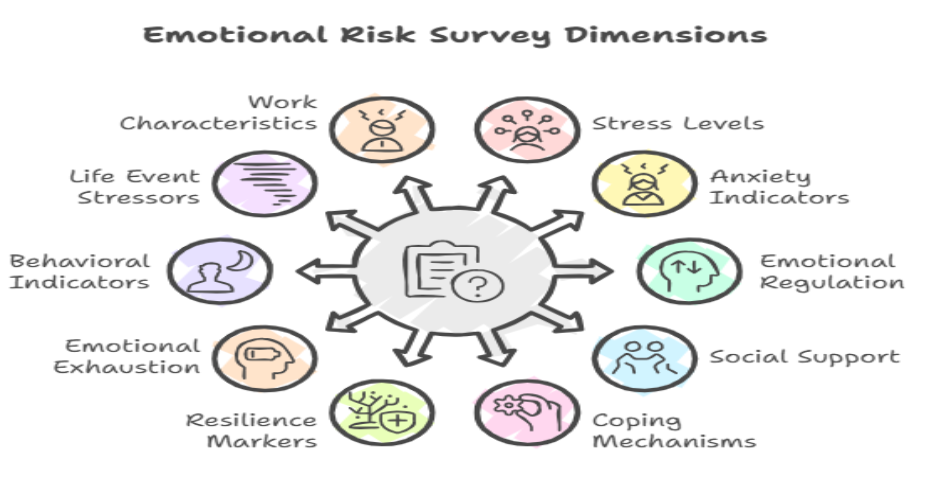
A well-designed emotional risk survey maps up to ten core dimensions of psychological vulnerability and resilience. These are not clinical diagnoses. They are risk indicators, early signals that tell you where support is needed before the situation deteriorates.
The ten dimensions are:
- Stress Levels: the volume and intensity of stressors an individual is managing, including workload, financial strain, caregiving responsibilities, or academic pressure
- Anxiety Indicators: frequency and severity of worry, including cognitive overload, physiological tension, and avoidance behaviours
- Emotional Regulation Capacity: ability to manage and process emotions; difficulties may appear as irritability, withdrawal, or impulsivity
- Social Support Systems: quality and availability of supportive relationships; increasingly relevant with changing family structures in urban India
- Coping Mechanisms: whether strategies used to manage stress are adaptive (problem-solving, seeking support) or maladaptive (avoidance, substance use)
- Resilience Markers: capacity to recover from setbacks and maintain functioning under pressure
- Emotional Exhaustion: early indicator of burnout, reflecting depletion of psychological energy
- Behavioural Indicators: sleep, physical activity, and lifestyle patterns that reflect emotional health
- Life event stressor load: cumulative impact of major life events such as illness, pandemic, financial instability, climate events, or family transitions.This dimension captures the additive effect of major stressors over time, based on concepts such as the Holmes–Rahe Stress Inventory.
- Work characteristics: workplace factors such as workload, role clarity, autonomy, managerial support, and psychological safety.
Source: Made by 1to1help
Together, these dimensions provide a meaningful, multi-dimensional picture of where a person sits on the spectrum between thriving and at risk. India's Economic Survey 2024-25 described mental wellbeing as encompassing emotional, social, cognitive, and physical functioning, and an emotional risk survey translates this into a measurable framework.
Who is an emotional risk survey for?
There are two core audiences in India.
- Individuals seeking self-awareness and early intervention, including professionals, students, and caregivers
- Organisations using emotional risk surveys at a population level across corporates, schools, universities, and hospitals.
The distinction matters because the purpose shifts slightly between these two contexts. For an individual, an emotional risk survey is a mirror: it surfaces what may otherwise remain invisible. For an organisation, it is a diagnostic instrument that reveals where systemic stressors are concentrated and where intervention resources should be directed.
Why a Multi-Dimensional Approach Matters
Emotional risk is rarely driven by a single factor. It emerges from the interaction of multiple variables.
For example, an employee with a high workload may function well if supported by strong coping mechanisms and social support. In contrast, a moderate workload combined with low support and resilience may result in high emotional risk.
A multi-dimensional emotional risk survey captures this complexity, providing a more accurate picture than single-construct tools.
💡Pro Tip:
If you are an HR professional or wellness lead considering an emotional risk survey for your organisation, the most important design principle is this: the survey must be clearly positioned as a support tool, not a performance tool. Employees need to trust that their responses will not be visible to managers or influence their career trajectory. Without that assurance, even the best-designed survey will generate responses that tell you very little.
Emotional Risk Survey vs Mental Health Assessment: Understanding the Difference
The terms "emotional risk survey" and "mental health assessment" are sometimes used interchangeably, but they serve different purposes and operate at different points in the support continuum.
An emotional risk survey identifies individuals and groups at elevated risk. A mental health assessment provides the clinical depth required to understand and address that risk.
The table below captures the key distinctions:
These tools are not alternatives but sequential layers of care, moving from early identification to informed intervention.
In the Indian context, where access to mental health professionals is limited, emotional risk surveys play a critical role as a triage mechanism, ensuring that available clinical resources are directed where they are most needed.
An emotional risk survey without a referral pathway is a diagnostic tool without a treatment plan. Before deploying a population-level survey, organisations should ensure they have a clear, accessible follow-up pathway, whether through an EAP, a partnered mental health platform, or a clinical referral network.
Why Emotional Risk Surveys Matter in India: The Mental Health Crisis
India is currently facing a mental health crisis at a scale that its healthcare system is not equipped to handle. Approximately 150 million people require mental health support, yet only 10% to 15% receive care. This is not simply a question of awareness but of access, infrastructure, and early identification.
The workforce simply is not there.
The shortage of mental health professionals remains significant. While he WHO recommends a minimum of 3 psychiatrists per 100,000 people. India has 0.75. In such a context, relying solely on clinical assessment is not viable at scale.
Emotional risk surveys and validated screening tools extend the reach of the mental health system, enabling earlier identification and more targeted use of limited resources.
The populations at risk are vast and varied.
Certain groups carry a disproportionate share of the risk, and most of them remain almost entirely outside formal mental health support systems.
- Students preparing for JEE and NEET face academic pressure that is extraordinary even by global standards. Studies reported the negative psychological effects of intense academic competition, parental expectations, and lack of emotional support on students’ wellbeing.
- India's IT sector, one of the country's most celebrated economic engines, carries some of the highest burnout rates in Asia. Sapien Labs' 2025 Mental Health Quotient (MHQ) data placed India's score at 33 out of 100, compared to a global average of 66. This represents millions of working professionals operating in a state of psychological distress that is invisible to their employers and unaddressed by their organisations.
- Healthcare workers, particularly ASHA workers, nurses, and junior doctors, have carried post-COVID exhaustion into years of continued overwork with minimal institutional support. New mothers face a postpartum depression rate of approximately 22% in India, one of the highest in Asia, yet the condition remains severely underdiagnosed because no systematic screening exists at the population level.
Each of these groups shares a common reality: their emotional risk is real, measurable, and identifiable before it reaches crisis level. What has been missing is the mechanism to identify it early enough for intervention to make a difference.
The economic case is equally compelling.
- The WHO estimates that depression and anxiety cost the global economy USD 1 trillion annually in lost productivity. The picture in Indian workplaces is consistent with the global trend and, in some respects, more acute.
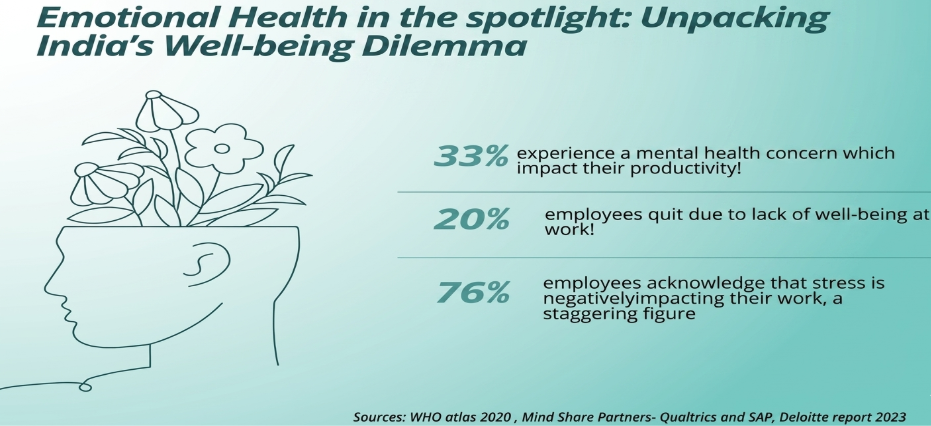
- The 2025 Indian Workforce Emotional Wellbeing Report by 1to1help shows that across 85,000+ employees surveyed, 33% are at risk of burnout, indicating rising stress and exhaustion at work. 50% of women employees report burnout symptoms, highlighting higher emotional risk, and 20% of employees struggle to regulate emotions, impacting daily focus and wellbeing.
- Within India's corporate sector specifically, a Deloitte survey of 3,995 employees found that 80% reported at least one adverse mental health symptom.
These are not marginal outliers. They make up the majority of the Indian workforce, struggling quietly while showing up each day and generating the output that India's economic growth depends on. Without structured methods to identify emotional risk early, intervention typically occurs only after performance declines or attrition occurs.
Source: 1to1help Internal Data, WHO atlas 2020, Mind Share Partners-Qualtrics and SAP,
Deloitte Report 2023
India's Economic Survey 2024-25 made an argument that resonates well beyond the academic: India's demographic dividend, the economic advantage of its large young working-age population, depends on those young people being mentally well enough to realise their potential. Systematic emotional risk measurement, therefore, becomes not only a wellbeing initiative but a strategic necessity.
💡Pro Tip: If you are a corporate HR leader, do not wait for your employees to self-identify their distress. A validated emotional risk survey deployed anonymously at the organisational level, with clear referral pathways built in, gives you the population-level picture you need to direct your wellness investment where it will make the greatest difference.
Types of Emotional Risk Surveys and Mental Health Assessments
Choosing the right tool starts with asking the right question: are you trying to identify risk before it becomes a problem, or evaluate a problem that already exists? The answer determines everything. Using a clinical diagnostic instrument for population screening, or a brief screener where a comprehensive assessment is needed, is one of the most common and costly mistakes in organisational mental health programmes.
Here are the six main categories of tools available in India today, and where each fits within the support continuum.
1. Self-Report Screening Questionnaires
Brief, validated, and designed for use without clinical oversight. The PHQ-9 screens for depression using 9 questions, producing a severity score ranging from minimal to severe (follow-up threshold: 10 or above). The GAD-7 does the same for anxiety across seven questions. The PSS (Perceived Stress Scale) captures subjective stress load at the population level. The MHI-38 offers a broader picture across five dimensions of psychological wellbeing. All four are validated for Indian populations and available in multiple Indian languages.
2. Emotional Risk Surveys (Population-Level)
Designed to map risk before clinical thresholds are reached, these tools assess vulnerability factors and resilience gaps at scale. A significant development in this space in India is the Emotional Wellness Index (EWI) by NWNT.ai, India's first patented emotional wellness screening tool. Across 55 questions, it assesses stress, anxiety, resilience, social support, emotional regulation, and coping strategies, generating both individual risk profiles and anonymised population-level reports through AI-driven analysis. It has been deployed across Indian schools, universities, and corporates. The Emotional Risk Survey (ERS), a 23-statement survey across four domains developed by 1to1help to aid corporates and individual employees on their journey of emotional wellbeing, is a niche and unique offering that assesses emotional risk and implements suitable interventions.
3. Occupational and Workplace Mental Health Assessments
Built specifically for the professional context. The Maslach Burnout Inventory (MBI) measures burnout across emotional exhaustion, depersonalisation, and reduced efficacy, and is widely used in corporate EAP settings. The NIMHANS Occupational Burnout Screening Tool is a clinically validated, India-developed equivalent designed specifically for the Indian workplace. The GHQ-28 screens for psychiatric symptoms in non-clinical working populations and is particularly useful for EAP baseline assessments.
4. Psychological Assessments (Clinical)
At the diagnostic end of the spectrum, these tools require administration by a licensed psychologist or psychiatrist and are not appropriate for use at the population level. The SCID-5 generates precise DSM-5 diagnoses across a broad range of conditions. The MMPI-2 provides a deep personality and psychopathology profile for complex clinical presentations. Both sit at the end of the referral pathway, not the beginning.
5. Digital and App-Based Emotional Assessments
Mental health platforms in the country currently embed validated screening questions in accessible digital interfaces, significantly lowering barriers to initial assessment for younger users and those in Tier 2 and Tier 3 cities. Their strength is accessibility and anonymity. Their limitation is reach: they engage those already seeking support rather than proactively identifying those who are not yet looking.
6. Population-Level Government Surveys
The National Mental Health Survey (NMHS) by NIMHANS, which uses adapted versions of the Kessler-6 and the Self-Reporting Questionnaire, is India's most significant macro-level mental health measurement exercise. NMHS-2 is currently underway, covering all 36 states and union territories, and will provide updated national prevalence data essential for policy planning.
Master Comparison: Emotional Risk and Mental Health Assessment Tools
Pro Tip: For organisations deploying an emotional risk survey for the first time, choose a tool that generates both individual feedback and anonymised population-level reporting. Individual feedback keeps employees engaged. Population-level data gives HR leadership the aggregate picture needed to act. A tool that delivers only one of the two serves either the employee or the organisation, rarely both.
How to Conduct an Emotional Risk Survey: A Step-by-Step Guide
The right process for an organisation deploying a survey across a workforce requires clarity of purpose before a single question is answered. For most companies, an emotional risk survey is the missing first step: the baseline that makes everything else evidence-based rather than anecdotal.
Step 1: Define the purpose. Are you conducting an annual wellbeing check, responding to a post-incident need, benchmarking against a previous period, or identifying high-risk cohorts for targeted intervention? Purpose shapes every subsequent decision.
Step 2: Select a validated, scalable tool. 1to1help ERS is designed for the emotional wellbeing of both individual employees and large organisations. The EWI is designed for digital deployment at scale across corporates, schools, and universities. The NIMHANS Occupational Burnout Tool is well-suited for workplace-specific assessments. PHQ-9 and GAD-7 work well for individual screening at organised health events.
Step 3: Establish confidentiality before anything else. Anonymise all results. Communicate clearly, in writing and in person, that individual scores will not be accessible to managers, teachers, or employers. Ensure data governance protocols comply with India's Digital Personal Data Protection Act 2023. Confidentiality is not a reassurance. It is the foundation of valid data.
Step 4: Train your administrators. HR teams, school counsellors, and health officers need to understand how to administer tools consistently, explain their purpose clearly, and avoid any language that could feel coercive or evaluative to respondents.
Step 5: Build referral pathways before you deploy. A survey that identifies distress without a route to support causes more harm than not surveying at all. Before launch, confirm that EAP access, iCall, Tele MANAS (14416), or equivalent referral options are available and communicated to participants.
Step 6: Analyse aggregate data by cohort. Identify departments, year groups, or teams that show elevated risk at the population level while rigorously protecting individual privacy. This is where the survey generates its most actionable organisational insight.
Step 7: Intervene at scale. Use cohort-level data to design targeted group interventions: wellbeing workshops, enhanced EAP access, manager training, or peer support programmes for high-risk segments.
Step 8: Measure and repeat. Resurvey after six to twelve months to assess whether risk indicators have shifted. Longitudinal data is what separates a one-time exercise from a genuine wellbeing strategy.
💡Pro Tip: The single most common deployment failure is launching the survey without telling employees what happens next. Before your survey goes live, publish a clear communication covering what the survey includes, how data will be handled, who can access what, and what support is available. Employees who trust the process participate honestly. Those who do not will either skip it or answer in ways that protect rather than inform.
How to Interpret Emotional Risk Survey Results and What to Do Next
A score on its own means very little without a framework for understanding it. And the most important thing to understand before reading your results is what they are not. A score is not a diagnosis. It is not a permanent label. It is not a measure of your strength, character, or ability to cope. It is a signal, one data point in time, that tells you where to focus your attention next.
The Three-Zone Interpretation Framework
Green Zone (Low Risk) Your scores fall within healthy ranges across the dimensions assessed. No immediate intervention is required. The focus here is maintenance: consistent sleep, regular physical movement, meaningful social connection, and practices that build rather than deplete your emotional reserves. Retest in six to twelve months as part of a routine emotional health check.
Amber Zone (Moderate Risk) Elevated scores in one or two dimensions indicate that your emotional resources are under strain. Self-help resources are a reasonable starting point, but a conversation with a counsellor is worth considering, particularly if the elevated areas have persisted for more than two to three weeks. Retest after four to six weeks to track whether things are improving or intensifying.
Red Zone (High Risk) Significant elevation across multiple dimensions, or any indicator of suicidal ideation, requires professional evaluation without delay. This is not a situation to manage alone or monitor for a few more weeks. Please reach out to a mental health professional or a crisis service as a first step.
If PHQ-9 item 9 (thoughts of self-harm or suicide) scores above zero at any level, treat it as Red Zone immediately, regardless of your overall total score.
For Organisations: Reading Aggregate Results
Individual scores must remain entirely confidential. What organisations should work with is anonymised, aggregate data visualised as a cohort-level risk profile by department, team, gender, age. High-risk clusters at the group level are the trigger for targeted wellbeing interventions, enhanced access to counselling, or manager support training. They are never the basis for identifying or approaching individual employees.
If you want a structured, end-to-end emotional risk survey that generates both individual zone reports and anonymised organisational heat maps, 1to1help's Emotional Risk Survey is designed precisely for this. Deployed digitally, it covers four emotional risk dimensions, produces individual and organisational reports, and provides HR and leadership with a clear population-level picture to act on, along with referral pathways and intervention plans.
Introducing 1to1help's Emotional Risk Survey: From Data to Meaningful Action
Emotionally healthy employees drive a thriving workplace. But knowing that your employees need support and knowing where, how severely, and what to do about it are entirely different things. That disconnect between good intentions and evidence-based action is precisely what 1to1help's Emotional Risk Survey (ERS) was designed to close.
The ERS is not a general wellness questionnaire. It is a comprehensive, end-to-end emotional risk management system, built in India, for India, available in 11 Indian languages, and accessible on both mobile and web. It measures emotional wellbeing across four critical domains: Emotion Regulation, Resilience, Workplace Characteristics, and Burnout, generating risk profiles at the employee, cohort, and organisational level simultaneously.
And crucially, it does not stop at measurement.
What Makes the 1to1help ERS Different: Prevention, Not Just Detection
Most assessment tools tell you what is wrong. The 1to1help ERS is designed around a preventive care philosophy, identifying emotional risk before it escalates into crisis and equipping organisations to act on that intelligence in a structured, time-bound way.
The ERS is built on four pillars of preventive care:
- proactive programmes that address potential mental health issues before they escalate,
- established emergency protocols for managing high-risk situations when they do arise,
- regular stress audits that provide targeted rather than generic interventions, and solution-focused counselling designed to deliver practical,
- outcome-oriented support for both personal and professional challenges.
Its four key objectives are equally clear:
- to assess and benchmark emotional risk across all four domains;
- to provide real-time insights and personalised interventions to both employees and organisations;
- to empower organisations to proactively manage emotional wellness through tailored intervention strategies; and
- to help organisations understand and build psychological safety as a measurable, improvable condition rather than an abstract aspiration.
What the 1to1help ERS Delivers: For Organisations and for Employees
For organisations, the ERS produces a comprehensive emotional risk profile at the organisational level, insights into potential risks to emotional wellbeing across teams and departments, an evaluation of overall emotional safety benchmarked across cohorts, and tailored, evidence-based intervention plans designed to identify, address, and mitigate the specific risk factors found in your workforce. This is not a generic report. It is a strategic document that tells HR and leadership exactly where to focus, what to prioritise, and what interventions are most likely to move the needle.
For employees, the ERS delivers something equally important: a real-time individual report that includes their personal risk profile across all four domains, a clear articulation of their emotional strengths and vulnerabilities, actionable takeaways they can act on immediately, and, where the results indicate it, a direct nudge to counselling through 1to1help's EAP, with a booking option built into the survey completion flow itself.
This dual output is what makes the ERS genuinely distinctive. The same deployment that gives your CHRO a population-level heat map also gives each employee a personalised picture of their emotional health, with a clear pathway to support if needed.
Key Features at a Glance
- The ERS survey itself takes under three minutes to complete, covering 23 carefully validated statements across the four domains.
- It is graphically designed to be accessible and non-intimidating, available across devices, and generates results in real time.
- Employees can book a counselling session directly upon completion.
- Organisations gain cohort-level insights that segment risk by gender, age, tenure, and location. And for organisations with an existing 1to1help EAP partnership, ongoing 24/7 multi-channel support (telephonic, video, and chat) is available to employees as part of the integrated follow-through.
The Phased Implementation Model: Survey, Identify, Intervene, Reassess
One of the most common failures in organisational wellness is deploying a tool without a plan for what happens next. The 1to1help ERS eliminates that risk through a structured four-phase implementation model.
Phase 1: Survey Roll-out. The ERS is shared with employees through secure, multilingual links. Real-time individual results are generated immediately, and key emotional risk areas are identified at the population level.
Phase 2: Identify. An in-depth analysis of the survey data identifies emotional risk levels at the cohort and organisational levels. Personalised recommendations are generated for individuals based on their real-time responses.
Phase 3: Intervene. Targeted interventions, including workshops, campaigns, manager training, and access to counselling, are implemented based on the specific risk profile of each cohort. These are not generic wellness activities. They are matched to the evidence.
Phase 4: Reassess. After interventions are delivered, the ERS is re-deployed to measure effectiveness, track change against the baseline, and adjust strategies for the next cycle.
This four-phase model transforms the ERS from a one-time survey into a continuous, evidence-driven wellbeing strategy. It is the difference between knowing your employees are struggling and actually doing something systematic about it.

Source: 1to1help Internal Data
💡Key Insight: The organisations that will lead on employee wellbeing in the next decade will not be the ones that ran the most events or subscribed to the most wellness apps. They will be the ones that built a measurement and intervention cycle: assess, understand, act, and reassess. The 1to1help ERS is that cycle, ready to deploy.
A Final Word
India has spent the better part of a decade getting comfortable with the language of mental health. That shift in awareness has been genuinely important. But awareness, on its own, has never healed anyone.
The next frontier is not more conversation. It is better measurement, earlier identification, and structured intervention that reaches people before distress becomes dysfunction. That is the promise of emotional risk surveys.
The disparity between the 150 million Indians who need mental health support and the 10% to 15% who receive it will not be closed by awareness campaigns alone. It will be closed by tools that meet people where they are, before they reach a point of crisis, and by organisations with the courage and the data to act on what they find.
For individuals, that means taking a few minutes to honestly assess your emotional health, understanding what your results tell you, and taking one small step towards the support they indicate.
For organisations, it means accepting that employee emotional risk is already present in your workforce, that it is measurable, and that the cost of not measuring it, in lost productivity, in attrition, in human suffering, is far higher than the cost of building a systematic response.
The tools exist. The evidence is clear. The urgency is real.
What comes next is a matter of choice.
Take the First Step Towards a Healthier, More Resilient Workforce
1to1help's Emotional Risk Survey is deployed across corporates, schools, universities, and hospitals across India. With 25 years of experience in workplace mental health, a network of over 1000+ client organisations, and data from more than 1.2 million+ counselling sessions, 1to1help brings both the measurement infrastructure and the clinical expertise to turn your ERS data into lasting, measurable change.
[Request a Demo or Speak to a 1to1help ERS Specialist Today]
FAQs
Q1: What is an emotional risk survey?
An emotional risk survey is a structured assessment tool that identifies the emotional and psychological factors placing an individual at risk of developing mental health challenges. Unlike a clinical diagnosis, it is a preventive screening mechanism, it maps stress levels, anxiety indicators, resilience, social support, coping capacity, and emotional regulation. It is designed to catch early warning signs before they escalate into clinical disorders. In India, emotional risk surveys are increasingly being deployed across schools, universities, and corporate organisations as part of a proactive mental health infrastructure — enabling early identification of at-risk individuals and populations.
Q2: How accurate are mental health assessments in India?
Validated tools like the PHQ-9 and GAD-7 have demonstrated strong accuracy in Indian settings. A 2025 study in Maharashtra (300 participants) found PHQ-9 had 89.5% sensitivity and 78.2% specificity for depression; GAD-7 showed 84.3% sensitivity and 81.7% specificity for anxiety. However, accuracy depends on using linguistically validated versions (Hindi, Tamil, and Telugu translations exist for both tools), ensuring psychological safety during administration so that respondents answer honestly, and using results as a screening indicator rather than a definitive diagnosis. India-developed tools like the 1to1help ERS and EWI (Emotional Wellness Index) are designed specifically for Indian cultural contexts.
Q3: What is the best free mental health assessment available in India?
The PHQ-9 (for depression) and GAD-7 (for anxiety) are the best-validated free mental health assessment tools available in India. Both are available in multiple Indian languages, take 2–5 minutes to complete, and are free to use. The PHQ-9 is available through NIMHANS-affiliated platforms and iCall. For stress specifically, the Perceived Stress Scale (PSS-10) is a free, validated option. For a broader emotional wellness assessment, the government's Tele MANAS platform (14416) includes an initial assessment and triage.
Q4: Can my employer see my mental health assessment results?
In a properly designed organisational emotional risk survey, individual results must be kept strictly confidential. Under India's Digital Personal Data Protection Act (DPDP Act, 2023), mental health data is classified as sensitive personal data and carries the highest level of protection. Employers should only receive anonymised, aggregated reports at team or department level, not individual scores. Before participating in any workplace mental health survey, ask your HR team: (a) Who has access to individual results? (b) Are responses anonymised? (c) What is the data retention policy? If the survey cannot guarantee individual confidentiality, your participation is voluntary and you have the right to decline.
Q5: How often should I take an emotional risk survey?
For individuals, taking an emotional risk survey every 3–6 months is a good habit for mental health monitoring, similar to tracking blood pressure or blood sugar. More frequent checks (monthly) are appropriate if you are going through a high-stress period (exam season, job change, relationship difficulty, bereavement). After starting therapy or making significant lifestyle changes, retesting every 4–8 weeks helps track progress. For organisations, best practice is a comprehensive annual emotional risk survey with shorter pulse-check surveys every quarter. Schools should conduct surveys at the start of the academic year and before high-pressure exam periods.
Q6: What happens after a mental health assessment in India?
The next steps after a mental health assessment depend on your score. Low scores (minimal or mild range) typically result in self-help recommendations, resource sharing, and a retest recommendation in 3–6 months. Moderate scores usually lead to a referral to a counsellor or psychologist — through iCall (9152987821), your corporate EAP, or a university counsellor. High scores, or any indication of suicidal ideation, trigger immediate referral to a psychiatrist. In government settings, NIMHANS outpatient, IHBAS, and Tele MANAS (14416) provide free pathways. Organisationally, aggregate results lead to targeted group interventions, policy changes, and enhanced professional support access.
Q7: Is an emotional risk survey the same as a psychological assessment?
Answer: No — they are distinct but complementary. An emotional risk survey is a brief, population-level screening tool that flags individuals who may be at risk of emotional or mental health challenges. It does not diagnose anything. A psychological assessment is a comprehensive, clinical evaluation conducted by a licensed psychologist or psychiatrist, involving standardised tests, clinical interviews, history-taking, and behavioural observation, that can establish a formal diagnosis and guide treatment. Think of an emotional risk survey as a blood pressure cuff: it flags elevated risk quickly. A psychological assessment is the full cardiological workup that follows when the reading is concerning.
References
Government & Policy Sources
- Ministry of Health and Family Welfare, Government of India. (n.d.). Tele MANAS: National Tele Mental Health Programme. https://telemanas.mohfw.gov.in/home
- Press Information Bureau. (2024). National Tele Mental Health Programme progress update. https://www.pib.gov.in/PressReleaseIframePage.aspx?PRID=2100706
- Press Information Bureau. (2025). Mental health and AI-driven solutions in India. https://www.pib.gov.in/PressReleasePage.aspx?PRID=2188003
- Press Information Bureau. (2024). Economic Survey insights on mental health in India. https://www.pib.gov.in/PressReleasePage.aspx?PRID=2097865
- Ministry of Electronics and Information Technology. (2024). Digital Personal Data Protection framework. https://www.meity.gov.in/static/uploads/2024/06/2bf1f0e9f04e6fb4f8fef35e82c42aa5.pdf
Indian Context & Epidemiology
- Indian Health Bureau. (2024). India is facing a mental health crisis of unprecedented scale. https://www.indianhealthbureau.org/post/india-is-facing-a-mental-health-crisis-of-unprecedented-scale
- The Hindu. (2024). Indian youth mental health global ranking study. https://www.thehindu.com/sci-tech/health/indian-youths-rank-60-in-84-nation-mental-health-study-older-people-perform-better/article70691375.ece
- Deloitte. (2022). Mental health and wellbeing in the workplace. https://health.economictimes.indiatimes.com/news/industry/80-per-cent-indian-workforce-reported-mental-health-issues-during-the-past-year-deloitte-survey/94078117
- The Hindu. (2022). Mental health issues cost Indian firms billions annually. https://www.thehindu.com/business/Industry/mental-health-issues-cost-indian-firms-14-bn-a-year-says-deloitte/article65866768.ece
- National Crime Records Bureau. (2023). Farmer suicides in India. https://vajiramandravi.com/current-affairs/ncrb-farmer-suicides-in-india/
- Satapathy, M. K. (2025). Mental health status of JEE and NEET aspirant students in Kota, Rajasthan. https://www.iisrr.in/mainsite/wp-content/uploads/2025/09/8.-2608.-Dr.-Mamata-Kumari-Satapathy-Mental-Health-Status-of-JEE-and-NEET-Aspirant-Students-of-Higher-Secondary-Education-in-Kota-Rajasthan-A-Study.pdf
- Mental Health First Aid India. (2025). India’s mental health landscape 2025: Key ground insights. Retrieved from https://www.mhfaindia.com/blog/indias-mental-health-landscape-insights
- National Institute of Mental Health and Neurosciences. (n.d.). National Mental Health Survey (NMHS). https://indianmhs.nimhans.ac.in/
Clinical & Conceptual Sources
- Cleveland Clinic. (n.d.). Anxiety disorders. https://my.clevelandclinic.org/health/diseases/9536-anxiety-disorders
- Cleveland Clinic. (n.d.). Depression. https://my.clevelandclinic.org/health/diseases/9290-depression
- National Health Service. (n.d.). Mental health assessments. https://www.nhs.uk/mental-health/social-care-and-your-rights/mental-health-assessments/
- UC Davis Health. (2024). Symptoms of anxiety and when to seek help. https://health.ucdavis.edu/blog/cultivating-health/symptoms-of-anxiety-and-how-to-know-when-you-need-help/2024/08
- Psychology Today. (n.d.). Emotion regulation. https://www.psychologytoday.com/us/basics/emotion-regulation
- Verywell Mind. (n.d.). Types of social support. https://www.verywellmind.com/types-of-social-support-3144960
- Verywell Health. (n.d.). Coping mechanisms. https://www.verywellhealth.com/coping-mechanisms-5272135
- Healthline. (n.d.). Emotional exhaustion. https://www.healthline.com/health/emotional-exhaustion
- Sustainability Directory. (n.d.). Resilience indicators. https://lifestyle.sustainability-directory.com/term/resilience-indicators/
- Queensland Government. (n.d.). Indicators of abuse and neglect. https://www.families.qld.gov.au/our-work/disability-services/preventing-responding-abuse-neglect-exploitation/identifying-abuse-neglect-exploitation/indicators-signs
- Holmes, T. H., & Rahe, R. H. (1967). The Social Readjustment Rating Scale. https://www.stress.org/wp-content/uploads/2024/02/Holmes-Rahe-Stress-inventory.pdf
Assessment Tools & Measures
- Kroenke, K., Spitzer, R. L., & Williams, J. B. W. (2001). The PHQ-9: Validity of a brief depression severity measure. https://uhs.fsu.edu/sites/g/files/upcbnu1651/files/docs/PHQ-9%20and%20GAD-7%20Form_a.pdf
- Cohen, S., Kamarck, T., & Mermelstein, R. (1983). Perceived Stress Scale. https://www.das.nh.gov/wellness/docs/percieved%20stress%20scale.pdf
- Veit, C. T., & Ware, J. E. (1983). Mental Health Inventory (MHI-38). https://www.amhocn.org/__data/assets/pdf_file/0007/697300/Mental-Health-Inventory.pdf
- Maslach, C., Jackson, S. E., & Leiter, M. P. (1996). Maslach Burnout Inventory. https://www.mindgarden.com/117-maslach-burnout-inventory-mbi
- NIMHANS. (n.d.). Self-assessment tools. https://www.namahnimhans.in/selfassessment
- Goldberg, D. P., & Hillier, V. F. (1979). General Health Questionnaire (GHQ-28). https://strokengine.ca/en/assessments/general-health-questionnaire-28-ghq-28/
- First, M. B., Williams, J. B. W., Karg, R. S., & Spitzer, R. L. (2015). Structured Clinical Interview for DSM-5 (SCID-5). https://apsychoserver.psychofizz.psych.arizona.edu/JJBAReprints/PSYC621/694A/SCID/SCID-5-CV.pdf
- American Psychiatric Association. (2013). Diagnostic and Statistical Manual of Mental Disorders (5th ed.). https://my.clevelandclinic.org/health/articles/24291-diagnostic-and-statistical-manual-dsm-5
- Butcher, J. N., Dahlstrom, W. G., Graham, J. R., Tellegen, A., & Kaemmer, B. (1989). Minnesota Multiphasic Personality Inventory-2 (MMPI-2). https://www.verywellmind.com/what-is-the-minnesota-multiphasic-personality-inventory-2795582
- Kessler, R. C., et al. (2002). K6 Screening Scale. https://www.hcp.med.harvard.edu/ncs/ftpdir/k6/Self%20admin_K6.pdf
Workplace & Emotional Risk
- Indeed. (n.d.). Workplace culture and its impact. https://uk.indeed.com/career-advice/career-development/what-is-workplace-culture
- Healthcare Executive. (n.d.). Emotional wellness in the workplace. https://www.healthcareexecutive.in/blog/emotional-wellness
- Boller, M. (n.d.). Assessing emotional risk in teams. https://www.linkedin.com/pulse/assessing-emotional-risk-how-team-stress-can-derail-boller-dba-pmp-f5zgc/
- TalktoAngel. (n.d.). How to conduct a company-wide emotional risk assessment. https://www.talktoangel.com/blog/how-to-conduct-a-company-wide-emotional-risk-assessment
Multimedia (Optional Citation)
- YouTube. (n.d.). Emotional risk and stress video. https://www.youtube.com/watch?v=303SMo52sRY


.svg)
.svg)
.svg)
.svg)