

.png)


.png)

The Complete Guide to Maternity Benefit Programs for Employers in India (2026)
Table of Contents
What Is a Maternity Benefit Programme?
The Emotional Reality of the Maternity Journey in India
The Business Case for Employer Investment in Maternity Support
What Genuine Comprehensive Maternity Support Looks Like
How to Evaluate a Maternity Benefit Programme for Your Organisation
Maternity Benefit Programme Pricing and ROI
Legal and Compliance Considerations for Indian Employers
Introducing 1to1Maternity: Structured Support for the Entire Journey
Programme Impact and Testimonials
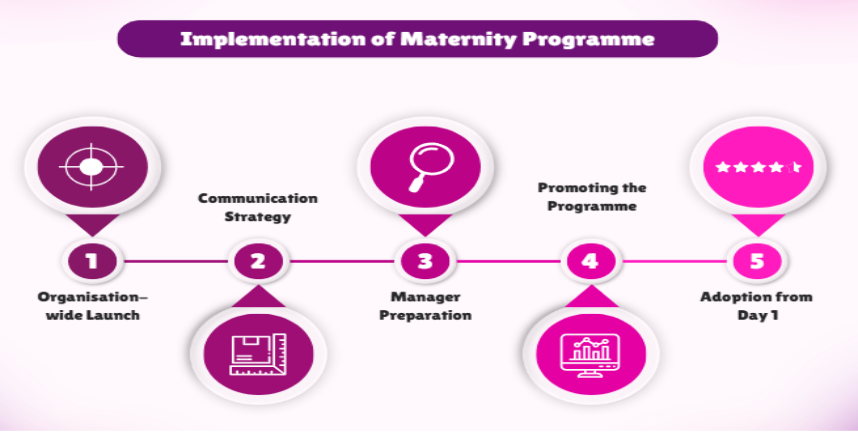
Implementing a Maternity Benefit Programme: What to Expect
Industry-Specific Trends in Maternity Benefits in India
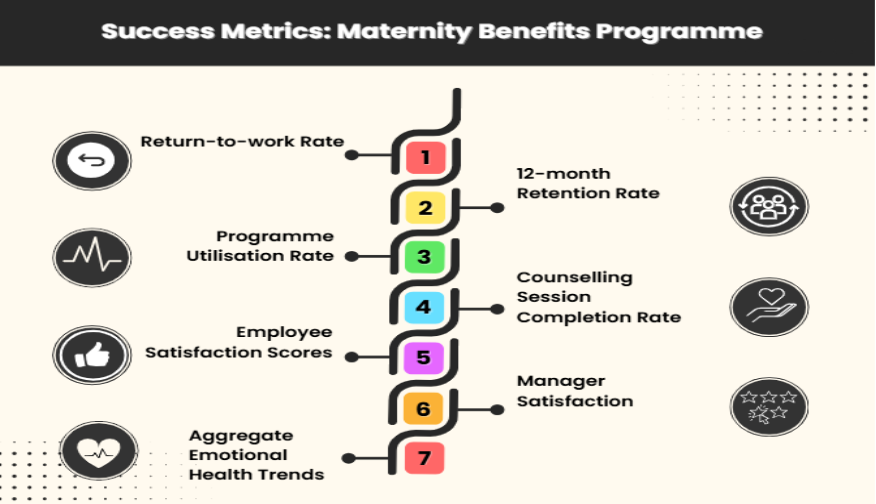
Measuring the Success of Your Maternity Benefit Programme
The Future of Maternity Benefits: 2026 and Beyond
Conclusion: The Gap Between Leave and Support Is Closable
FAQs
1to1Maternity User Engagement: Snapshot
References
Introduction
India has made meaningful strides in how we talk about employees’ emotional well-being. Parental leave policies have been extended. Health insurance coverage has improved. DEI conversations have opened space for women in leadership. And yet, there is a specific window in a woman's professional life that remains strikingly underserved: the twelve months that span pregnancy, childbirth, and the return to work.
This is not a peripheral concern. It sits at the intersection of talent retention, organisational culture, and the real human cost of attrition to navigate one of life's most demanding transitions without adequate support.
This guide is written for HR leaders, CHROs, Total Rewards managers, and anyone responsible for shaping the employee experience in an Indian organisation. It covers what maternity benefit programmes are, why they matter far more than most organisations realise, how to evaluate and choose the right approach, how to implement and measure one, and how 1to1help's 1to1Maternity programme is designed to close the gap between maternity leave as a policy and maternity support as a genuine organisational commitment.
What Is a Maternity Benefit Programme?
A maternity benefit programme is a structured, employer-sponsored support system that provides employees with guidance, counselling, and practical assistance before, during, and after pregnancy. It goes significantly beyond statutory maternity leave.
Maternity leave is a dedicated time off. A maternity benefit programme is what happens during that time and in the months surrounding it, ensuring that employees return to work feeling supported, confident, and equipped to reintegrate, rather than quietly considering whether to return at all.
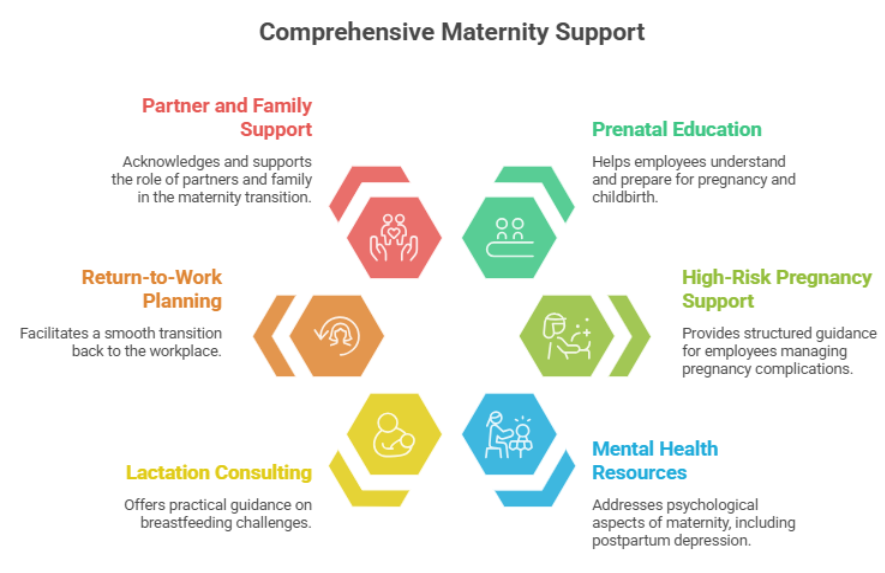
Comprehensive maternity benefit programmes cover six core service areas:
- Prenatal education and wellness coaching help employees understand what to expect physically and emotionally during pregnancy, prepare for childbirth, and manage the specific stressors that arise when professional and maternal identities begin to intersect.
- High-risk pregnancy support and care coordination provide structured guidance for employees managing complications or health conditions during pregnancy, ensuring they have access to appropriate support without having to navigate complex healthcare systems alone.
- Mental health screening and postpartum depression resources address the psychological dimensions of the maternity journey. Research indicates that 22% of postpartum women in India experience depression or anxiety, and the majority go undiagnosed and unsupported. Up to 10% of men also experience depression and/or anxiety during this period. Early screening and accessible counselling meaningfully change that outcome.
- Lactation consulting and breastfeeding support provide practical, non-judgemental guidance on one of the most commonly cited challenges of early motherhood, one that significantly affects both the mother's well-being and her experience of returning to work.
- Return-to-work transition planning and coaching is the dimension that most standard maternity provisions entirely omit. A structured return-to-work pathway, including pre-return conversations, workload recalibration, and confidence-building support, directly affects whether an employee stays or leaves.
- Partner and family support resources acknowledge that the maternity transition does not happen in isolation. Partners who are informed and supported create better conditions for the returning employee. Family inclusion, where culturally relevant, strengthens the overall support network.
The demand for comprehensive maternity support has grown substantially since the pandemic, which accelerated the blurring of home and work boundaries, intensified caregiving pressures on families, and made the inadequacy of existing maternity provisions impossible to ignore. Employers who invested in structured maternity support during and after the pandemic retained significantly more female talent than those who did not.
Source: Made by 1to1help
According to a Genpact Centre for Women's Leadership study, 50% of working women in India leave their jobs to care for their children. Only 16% of senior leadership positions in Indian companies are held by women. These two facts are not unrelated. The maternity phase is a critical juncture in career trajectories, coming precisely when women are in their late 20s and early 30s and on the cusp of their most significant professional growth. Without targeted support, organisations lose experienced, high-potential employees at exactly the point when their investment in those employees is beginning to compound.

Maternity leave is a legal entitlement. Maternity support is an organisational choice. The companies that treat it as the latter are the ones that retain the women talent they have worked hardest to develop.
The Emotional Reality of the Maternity Journey in India
Before talking about what employers can do, it helps to understand what employees are actually experiencing. The maternity journey is not simply a physical or logistical challenge. It is a profound psychological transition, and in India's socio-cultural context, it carries layers of pressure that are often invisible to employers.
During pregnancy, women commonly experience anxiety about the health of their unborn child, uncertainty about finances and career continuity, and the complex emotional labour of managing a demanding job while managing a changing body. Career aspirations quietly put on hold generate a specific kind of grief that is rarely acknowledged in professional settings. Fear, uncertainty about the future, and a sense of career identity being suspended are significant emotional burdens that most pregnant employees carry entirely alone.
After childbirth, the picture intensifies. Nearly 90% of new mothers report experiencing mum guilt, a persistent, exhausting sense that they are failing in at least one of their roles at any given time. Sleep deprivation, body image concerns, breastfeeding challenges, dietary and nutritional requirements, and the loss of personal time all arrive simultaneously. The cognitive load is immense, and for many women, the people closest to them simply do not understand what they are carrying.
At the return to work phase, the pressures compound rather than resolve. Research shows that 48% of Indian women quit their jobs within four months of returning to work after maternity leave. The reasons are not unknown: impostor syndrome, workload pressure compounded by domestic responsibilities, a lack of concession for early-infancy needs such as pumping rooms or flexible hours, and a pervasive sense that their career has already moved on without them.
India's socio-cultural context amplifies all of this. Women face stigma around the mode of birth and the gender of the child. They are expected to manage their physical recovery, resume household responsibilities, and return to professional performance simultaneously, while extended family dynamics can obstruct rather than enable their return to work. Work is often positioned as a privilege rather than a priority, a cognitive framing that makes it even harder for women to assert their professional needs.
The maternity journey also involves a significant identity shift. For many women in professional roles, becoming a mother means navigating the integration of two identities that can feel in direct conflict with each other. Without support in this process, many women resolve that tension by stepping back from one identity, most often the professional one. Loss of confidence and low self-esteem are also commonly experienced by women during this journey.
💡Pro-Tip for HR Leaders:
The return-to-work meeting is one of the most consequential moments in an employee’s maternity journey. A 30-minute conversation before the employee’s first day back, covering workload expectations, available support, and any adjustments needed, can be the difference between a confident reintegration and a quiet resignation three months later. Most managers receive no guidance on how to conduct this conversation. That gap is entirely solvable.

Source: National Public Radio (NPR)
The Business Case for Employer Investment in Maternity Support
The human case for maternity support is clear. The business case is equally compelling, and increasingly, it is the one that moves the conversation from "should we?" to "how quickly can we?"
- Retention: Organisations with comprehensive maternity benefit programmes see significantly higher return-to-work rates and longer post-maternity tenure among female employees. The cost of replacing an experienced employee, factoring in recruitment, onboarding, and the productivity ramp-up period, typically ranges from 50% to 200% of that employee's annual salary. A maternity programme that prevents even a small proportion of that attrition generates measurable financial return.
- Productivity: Employees who feel supported during significant life transitions return to work more focused, more engaged, and more loyal than those who feel they are left to manage alone. Mental health challenges that go unaddressed during maternity directly affect the quality and sustainability of an employee's post-maternity performance.
- Absenteeism reduction: Structured support during the maternity period reduces unplanned absence both immediately post-return and over the following twelve months. Organisations with active maternity programmes report 25% to 30% lower absenteeism among returning mothers compared to those without structured support.
- Employer brand: In India's competitive talent market, the organisation's approach to maternity is increasingly visible. Employees discuss it, candidates ask about it, and its absence is noticed. Companies that genuinely invest in supporting women through the maternity transition signal important values to the entire workforce.
- Gender equity outcomes. Attrition during and after maternity leave is a primary driver of the gender gap in senior leadership. Every woman who leaves during this window because she feels unsupported is one fewer woman in the leadership pipeline five years later. Maternity benefit programmes are, in this sense, a structural intervention in the gender equity conversation, not an optional benefit.
Source: Made by 1to1help
What Genuine Comprehensive Maternity Support Looks Like
Not all maternity benefit programmes are equal. The difference between a programme that genuinely supports employees and one that provides a tick-box response lies in depth, continuity, and the quality of human connection at its centre. A truly comprehensive maternity benefit programme addresses the need consistently through the full arc of the journey rather than only at specific isolated moments.
First Trimester (0–12 weeks): Uncertainty and Emotional Adjustment
This phase is often marked by anxiety, uncertainty, fatigue, and emotional fluctuations. Concerns around pregnancy viability, physical discomfort, and disclosure decisions are common.
- Emotional well-being: Anxiety, mood swings, intrusive thoughts
- Physical health: Fatigue, nausea, early body changes
- Support needed: Early access to counselling, reassurance, and reliable guidance
Second Trimester (13–27 weeks): Stabilisation and Preparation
Energy levels may improve, but new concerns emerge around medical health, body changes, and preparation for childbirth.
- Physical well-being: Nutrition, sleep, managing discomfort
- Pregnancy health: Monitoring medical conditions, navigating healthcare systems
- Support needed: Structured guidance, continued emotional support, practical planning
Third Trimester (28–40 weeks): Anticipation and Heightened Vulnerability
As childbirth approaches, anxiety often increases alongside physical strain.
- Emotional well-being: Fear of childbirth, overwhelm, anticipatory anxiety
- Physical health: Pain, sleep disruption, reduced mobility
- Support needed: Consistent reassurance, preparation support, access to expert guidance
Early Postpartum (0–6 months): Recovery and Identity Shift
This is one of the most vulnerable phases, involving physical recovery, hormonal shifts, and adjustment to a new identity.
- Emotional and mental health: Baby blues, low mood, guilt, overwhelm
- Physical recovery: Post-birth healing, sleep deprivation, self-care challenges
- Baby care: Feeding, lactation, sleep routines, developmental concerns
- Support needed: Qualified counselling, lactation and medical guidance, continuous check-ins
Late Postpartum & Return to Work (6–12 months): Reintegration and Retention Risk
This phase often determines long-term retention but is frequently under-supported.
- Work reintegration: Loss of confidence, workload pressure, boundary-setting
- Emotional health: Ongoing stress, identity conflict
- Relationships & support systems: Partner alignment, family dynamics, social isolation
- Support needed: Return-to-work coaching, managerial alignment, continued emotional support
💡Pro-Tip:
The most effective maternity programmes do not wait for employees to reach out when they are struggling. With prior consent, proactive outreach, where counsellors initiate scheduled check-ins, significantly increases early access to meaningful support before challenges escalate into crises.
How to Evaluate a Maternity Benefit Programme for Your Organisation
If you are assessing maternity benefit programme options, the following criteria provide a structured framework for making a well-informed decision. They represent the dimensions that most consistently differentiate genuinely effective programmes from superficially attractive ones.
1. Range of services: prenatal through postpartum. A programme that only covers one phase of the journey leaves significant gaps. Look for provisions that span pregnancy, childbirth, the postpartum period, and the return to work as a continuous arc rather than a series of disconnected interventions.
2. Clinical expertise and counsellor credentials. The quality of the counselling relationship is the single most important determinant of programme effectiveness. Understand who the counsellors are, what their qualifications are, and whether participants are assigned a consistent professional for the full duration or directed to a rotating pool.
3. Delivery model and accessibility. Consider how and where employees access support. Digital-first delivery, particularly via channels employees already use, significantly reduces friction and increases uptake. Consider the needs of employees in different locations, including those not based in major cities.
4. Proactivity and continuity of support. Does the programme wait for participants to reach out, or does it initiate contact with prior consent? Proactive programmes with scheduled consent-based check-ins consistently outperform reactive models in terms of outcomes and participant satisfaction.
5. Partner and manager inclusion. A maternity programme that only addresses the employee in isolation misses significant leverage points. Partner support improves employees' home environments. Manager support improves the professional reintegration. Both have measurable downstream effects on outcomes.
6. Scalability and flexible onboarding. Can the programme accommodate your organisation's size and the variability in how many employees enter maternity at any given time? Can onboarding happen at any stage of the journey, or only at the beginning of pregnancy?
7. Confidentiality architecture. Understand precisely what data the employer can access. Individual counselling content should be entirely confidential. Aggregate, anonymised reporting is appropriate for organisational purposes. If a provider cannot clearly articulate this boundary, treat it as a red flag.
8. Reporting and measurement. What data does the programme generate for the organisation? Monthly utilisation reports, participant cohort breakdowns, and outcome tracking give HR teams the evidence they need to demonstrate programme impact to leadership and finance.
9. Cultural competency and India-specific design. A programme designed for a different cultural context will not address the specific socio-cultural pressures that Indian women experience during maternity. Look for evidence that the programme's content, counsellors, and communication approach are genuinely built for the Indian context and available in Indian languages.
10. Evidence of outcomes. What do real participants say about the programme? What are the return-to-work rates among participants? Any credible provider should be able to share these metrics clearly.
The best maternity benefit programmes are not the most feature-rich ones. They are the ones with the most consistent, highest-quality human connection at their core. A counsellor who knows an employee’s story, builds trust over months, and initiates contact proactively will do more for that employee’s outcome than any suite of digital tools deployed without that relationship.
If you are working through these criteria and would like to see how a structured programme measures up against them in practice, 1to1Maternity programme by 1to1help is designed around every one of the ten dimensions above: qualified and consistently assigned counsellors, WhatsApp-native delivery accessible across India in 11 languages, proactive monthly check-ins, partner and manager inclusion, fully confidential individual data with monthly aggregate reporting for the organisation, and a documented return-to-work rate of 65% across more than 12 industries.
Source: 1to1Maternity
Maternity Benefit Programme Pricing and ROI
Understanding the cost of a maternity benefit programme and the return it generates helps HR leaders make the case internally to finance teams and senior leadership.
Common pricing structures in India include per-participant pricing, where a fixed cost per enrolled employee covers the full programme duration, tiered pricing based on the scope of support selected (individual, individual plus partner, or individual plus partner plus manager), and flat annual arrangements for organisations with consistent employee volumes.
When evaluating pricing, consider the full cost of what is included:
- the number of counselling sessions,
- the delivery infrastructure,
- the reporting and analytics, and
- any organisation-wide launch or awareness components.
Upfront costs to clarify include implementation support, any charges for extending the programme beyond the standard duration, and the cost of the manager extension component if you intend to include it.
The ROI calculation for maternity benefit programmes is anchored in three primary cost categories.
- The first is turnover cost prevention. If a typical mid-level employee costs 100% of their annual salary to replace, and a maternity programme meaningfully increases return-to-work rates, the financial value of each retained employee significantly exceeds the per-participant programme cost. At 1to1Maternity's documented return-to-work rate of 65%, even modest improvements on baseline attrition rates deliver measurable financial return.
- The second is absenteeism reduction. Supported employees who return to work healthier and more confident take fewer unplanned sick days in the twelve months post-return. A 25% reduction in absenteeism among a cohort of returning mothers, calculated against average daily salary cost, typically generates savings several times the programme cost.
- The third is productivity recovery. Employees who return to work with intact confidence and clear reintegration support reach full productivity faster than those who return feeling unsupported. Faster productivity recovery, even when measured conservatively, adds material value relative to the per-participant investment.
Industry benchmarks suggest that well-implemented maternity benefit programmes generate an ROI of 3:1 to 6:1 when all three cost categories are included. The most important step for HR leaders is to establish a baseline before the programme launch, so that improvements can be clearly demonstrated to stakeholders.
Illustrative ROI Estimation framework:
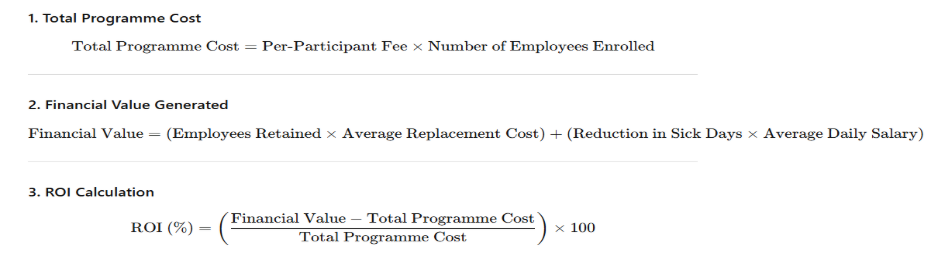
Source: This ROI framework is adapted from commonly used workplace wellbeing and HR retention ROI models (RAND, SHRM), incorporating absenteeism reduction, employee retention, and replacement cost calculations.
💡Pro Tip:
When making the case internally for a maternity benefit programme, lead with turnover data specific to your organisation. The cost of losing even two or three experienced mid-level female employees in a year will typically exceed the annual cost of running a structured maternity programme for your entire eligible cohort. That comparison, expressed in rupees, tends to move the conversation quickly.
Legal and Compliance Considerations for Indian Employers
While this guide does not constitute legal advice and employers are encouraged to consult qualified legal counsel regarding specific compliance requirements, the following provides an overview of the key legal framework under which maternity benefit programmes operate in India.
- The Maternity Benefit (Amendment) Act 2017 is the primary legislation governing maternity entitlements for working women in India. It extended paid maternity leave from 12 to 26 weeks for the first two children, mandated creche facilities for organisations with 50 or more employees, and introduced provisions for work-from-home arrangements where the nature of the work permits. The Act establishes a minimum floor. Maternity benefit programmes sit above and beyond these legal requirements, addressing the emotional, psychological, and practical dimensions that legislation alone cannot provide.
- The Mental Healthcare Act 2017 is relevant to the mental health component of maternity benefit programmes. It prohibits discrimination against individuals with mental health conditions, which extends to postpartum depression and perinatal anxiety. Employers have a responsibility not to penalise or disadvantage employees whose mental health is affected during the maternity period.
- The POSH Act 2013 (The Sexual Harassment of Women at Workplace (Prevention, Prohibition and Redressal) has an indirect but important relevance: a pregnant or recently returned employee who experiences harassment is in a significantly more vulnerable position, and the psychological harm is compounded. Robust implementation of POSH obligations is part of a maternity-supportive workplace culture.
- Data privacy under the DPDP Act 2023 (Digital Personal Data Protection Act) is directly relevant to maternity benefit programmes that collect health and personal data from participants. Employers must ensure that data collected through a maternity benefit programme is handled with explicit consent, stored securely, and used only for the purposes for which it was collected. Aggregate reporting for the organisation is permissible. Individual data must remain confidential.
Equal opportunity obligations require that maternity-related decisions not disadvantage employees in performance reviews, promotions, or compensation changes. A maternity benefit programme that includes manager training helps organisations operationalise this obligation, reducing the risk of inadvertent bias in the treatment of returning employees.
Legal compliance sets the floor for what employers must do. The organisations that stand out are those that use the legal framework as a starting point and build comprehensively beyond it, in genuine recognition of the human experience that maternity represents.
Introducing 1to1Maternity: Structured Support for the Entire Journey
1to1help's 1to1Maternity programme was built in direct response to the gap most employer maternity provisions leave: the emotional and psychological support women need throughout the maternity journey, which they rarely receive in any structured form.
The programme provides continuous, human-led, one-on-one support from pregnancy through four months post-return to work. It is built around a simple but powerful conviction: that women employees are more likely to remain engaged, supported, and retained when they feel seen as whole people rather than simply as members of the workforce on temporary leave.
- Delivered on WhatsApp. The entire programme is delivered via WhatsApp, enabling automated onboarding, stage-specific content delivery, in-built preparedness assessments, and secure chat-based counselling support. There is no app to download, no platform to learn.
- A dedicated maternity counsellor for the entire journey. Each participant is assigned a primary maternity counsellor who remains with them throughout the full programme duration. This continuity is the foundation of the trust that makes meaningful support possible.
- Proactive monthly check-ins. Counsellors reach out proactively every month rather than waiting for participants to initiate contact. This model ensures that participants who are struggling but not yet in crisis receive support before the situation deteriorates.
- One-on-one counselling sessions for the mothers and spouses/partners, diet and nutrition sessions, stage-specific wellbeing resources, physical wellbeing videos shared via WhatsApp, preparedness and return-to-work assessments, and automated onboarding with feedback loops at every stage.
- Manager support add-on. Counselling sessions for the participant's manager close one of the most significant gaps in standard maternity support: the manager who wants to do the right thing but has no guidance on what that means in practice.
Programme Impact and Testimonials
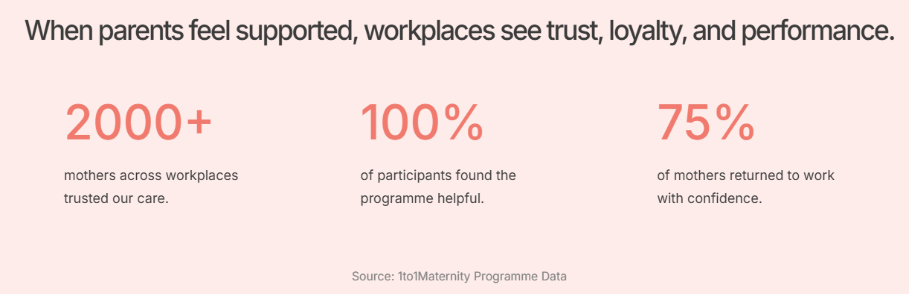
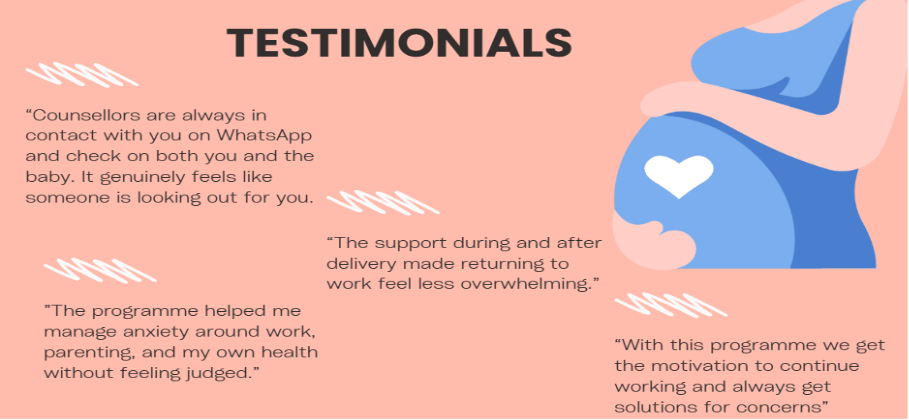
Source: 1to1help Internal Data
Implementing a Maternity Benefit Programme: What to Expect
Implementation timelines for maternity benefit programmes typically range from 30 to 60 days from contract signing to first participant onboarding, depending on the complexity of your organisation's HR infrastructure and any integration requirements.
The implementation process for 1to1Maternity includes an organisation-wide launch session delivered by a senior maternity counsellor, which introduces the programme to eligible employees, explains its contents, and establishes the confidentiality assurances that make genuine participation possible. This launch is one of the most important drivers of early uptake.
Communication strategy is a critical implementation variable. Employees are more likely to engage with support when it is introduced early, communicated consistently, and positioned as a normal part of the maternity journey rather than something to access only during moments of difficulty. This can include integration into onboarding journeys, timely programme awareness during pregnancy disclosure, and ongoing visibility through internal wellbeing communication efforts.
Manager preparation should happen in parallel with employee onboarding. Managers who understand the programme, know what it covers, and know how to refer an employee to it naturally and significantly improve uptake and the participant experience. The manager extension within 1to1Maternity provides structured support for this specific need.
Promoting the programme to employees is most effective through a multi-channel approach. This may include integration into onboarding journeys, manager sensitisation, internal wellbeing communication, and timely programme visibility during key transition points such as pregnancy disclosure. Creating ongoing awareness helps position maternity support as a normal and accessible part of employee wellbeing rather than something employees need to actively search for during difficult moments.
Measuring adoption from day one. Monthly organisational reports from 1to1Maternity provide data on engagement patterns and help identify areas where support may be needed to strengthen adoption over time. Reviewing this data quarterly gives HR teams the visibility to identify low-uptake cohorts and act proactively.
Common implementation challenges and solutions
- Low initial uptake is the most common early challenge. The solution is almost always communication frequency and leadership visibility. When senior women in the organisation openly endorse the programme, participation follows.
- Manager discomfort with the topic is a second common barrier. Structured manager briefings that normalise the maternity conversation and provide specific language for check-in conversations remove much of this resistance.
- Concerns about confidentiality need to be addressed directly and transparently in the programme launch, particularly in smaller organisations where anonymity in aggregate reports may feel uncertain.
Source: Made by 1to1help
Industry-Specific Trends in Maternity Benefits in India
The adoption and design of maternity benefit programmes varies significantly across sectors, shaped by workforce composition, cultural norms, and the competitive dynamics of talent markets.
The technology sector has led adoption in India, driven by intense competition for female talent and the sector's high visibility regarding mid-career female attrition. Many major IT employers have deployed EAP-integrated maternity support as part of broader employee wellness programmes. The challenge in this sector is often depth rather than access: digital tools without consistent human counselling deliver less than structured one-on-one support.
The BFSI sector (banking, financial services, and insurance) has seen increasing investment in maternity support, driven by regulatory expectations around employee welfare and recognition that mid-career female attrition carries disproportionate cost given the seniority of the employees typically affected.
Healthcare presents a specific paradox: the workforce most exposed to the emotional weight of maternity is often the least supported themselves. Post-COVID exhaustion has made this gap more acute. Healthcare organisations are increasingly recognising that female clinical staff need structured maternity support, not just statutory leave.
Manufacturing and blue-collar workplaces face the greatest structural challenges in reaching employees with maternity support. WhatsApp-native delivery in multiple Indian languages makes 1to1Maternity significantly more accessible for these contexts than platform-dependent alternatives.
Start-ups and smaller enterprises often assume that maternity benefit programmes are only viable at enterprise scale. This is a misconception. Per-participant pricing means that even organisations with fewer eligible employees can access structured maternity support cost-effectively, and the proportional impact on retention is arguably higher when each employee's contribution is more visible.
The trend toward family and ecosystem inclusion is growing across all sectors. The recognition that a supported partner means a more supported mother, and that managerial capability directly shapes the return-to-work experience, is shifting programme design from an individual-focused to an ecosystem-focused approach.
1to1Maternity's tiered model reflects this direction exactly.
Measuring the Success of Your Maternity Benefit Programme
A maternity benefit programme that is not measured cannot be improved, and its value cannot be demonstrated to the stakeholders whose continued investment it requires.
- Return-to-work rate is the most significant outcome metric. What percentage of employees who enrolled in the programme returned to work after maternity leave? At 1to1Maternity, the documented return-to-work rate among participants is 65%.
- 12-month retention rate tracks what happens after employees return. Return rates can look strong if employees come back but leave within six months. Tracking 12-month post-return retention gives a more complete picture of whether the programme is generating durable commitment.
- Programme utilisation rate measures the proportion of eligible employees who are actively engaging. Industry benchmarks suggest that healthy programmes achieve 60% to 80% of eligible employee participation. Rates below 40% signal communication and trust barriers worth investigating.
- The session completion rate within the counselling component indicates whether participants are engaging substantively or dropping out after initial onboarding. High session completion correlates strongly with positive outcomes.
- Employee satisfaction scores via post-programme feedback surveys capture the participant experience. At 1to1Maternity, 100% of participating members have reported the programme as helpful or very helpful.
- Manager satisfaction with return-to-work support, measured through brief surveys with line managers, tells you whether the manager-facing components are being used and whether they are making a practical difference.
- Aggregate emotional health trends, drawn from anonymised assessment data within the programme, provide a population-level picture of how participants' emotional health changes over the course of the programme, giving HR teams leading indicators rather than only lagging ones.
Source: Made by 1to1help
Review these metrics quarterly with your HR leadership team and share an annual summary with senior leadership. These data already exist within 1to1Maternity's monthly reports; using them systematically is what turns a maternity benefit programme into an evidence-based talent retention strategy.
💡Pro Tip:
Share programme insights with employees and leadership in a way that protects confidentiality. An annual internal communication that shows how many colleagues the programme supported, what outcomes it generated, and how you plan to build on those results closes the feedback loop and builds organisational trust, which increases future participation.
The Future of Maternity Benefits: 2026 and Beyond
The maternity benefits landscape in India is evolving rapidly, shaped by changing workforce demographics, legislative developments, and a growing recognition that the maternity period represents one of the most strategically important talent-retention windows an organisation manages.
- Mental health integration is accelerating. The separation between mental health support and maternity support is dissolving. Progressive organisations are building maternity support into their broader EAP and employee wellness infrastructure, ensuring that counselling access, crisis referral pathways, and mental health screening are available as a continuum rather than a one-off programme.
- Partner and family inclusion is expanding. The evidence that partner support directly affects maternal well-being is well-established. The next generation of maternity benefit programmes will increasingly include partners as standard rather than optional components, and will extend awareness and guidance to extended family networks in the Indian context.
- WhatsApp and mobile-first delivery are becoming the norm. For workforces that are geographically distributed or that include employees not based in major cities, delivery models built around accessible digital channels rather than proprietary platforms will define the next wave of maternity support adoption.
- Multilingual provision is a growing differentiator. India's linguistic diversity means that maternity support delivered only in English or Hindi is not reaching the full range of employees who need it. Programmes available in multiple Indian languages are better positioned to serve the actual diversity of the Indian workforce.
- Generational expectations are raising the bar. Gen Z employees entering the workforce have significantly higher expectations for employer support during major life transitions than preceding generations. For organisations competing for this talent, robust maternity benefits are increasingly a baseline expectation, not a differentiator.
- Legislative direction. India's maternity legislation has moved progressively toward greater employer responsibility since 2017. The likely direction of future reform is toward broader coverage, more explicit employer obligations around psychosocial support, and greater attention to the return-to-work transition. Organisations that build structured maternity support now are positioning themselves ahead of where legislation is likely to go.
Conclusion: The Gap Between Leave and Support Is Closable
Across every section of this guide, one theme has surfaced consistently: most Indian organisations are doing the bare minimum when it comes to maternity, and most employees are quietly bearing the consequences, without anyone measuring the cost.
The statistics are not abstract. They are real women making real decisions about whether to return, whether to stay, and whether their employer actually values them or simply values their output. The 48% who leave within four months of returning to work are not a workforce statistic. They are a leadership failure that compounds over the years, visible in gender diversity gaps, the absence of senior women, and organisational cultures that claim to value inclusion while leaving their most vulnerable employees to manage one of life's hardest transitions alone.
The good news is that this is a solvable problem. The interventions exist. The evidence for their effectiveness exists. The technology to deliver them at scale, accessibly, in Indian languages, to employees wherever they are, exists. What has been missing in most organisations is not awareness but commitment: the decision to move from leave as a policy to support as a practice.
That is precisely where 1to1Maternity occupies a category of its own. It is not a generic wellness programme with a maternity module added. It is not a digital app that delivers content without a human connection. It is not a reactive helpline that employees can call if they choose to. It is a structured, end-to-end support programme built specifically for the maternity journey, delivered by dedicated maternity counsellors who stay with each participant for the entire duration, available on WhatsApp in 11 Indian languages, and designed to work not just for the employee but for her partner, her manager, and through them, for her organisation.
There is no comparable offering in India designed with this level of specificity, this continuity of care, and this breadth of ecosystem support. 1to1Maternity is niche by design, because the maternity journey demands exactly that: not general wellness, but targeted, sustained, expert support at the precise moments when it makes the most difference.
For organisations that are serious about retaining their female talent, closing their gender leadership gap, and building a culture that is genuinely supportive rather than performatively so, the choice is not whether to invest in maternity support. It is whether to do it in a way that actually works.
1to1Maternity works. The data says so. The participants say so. And the 65% return-to-work rate among programme participants is the number that matters most.
[Connect with a 1to1help Specialist to Explore 1to1Maternity programme for Your Organisation]
FAQs
Q1. What does a maternity benefit programme include?
A comprehensive programme covers emotional and mental health counselling, practical guidance on postpartum health and nutrition, breastfeeding support, baby health and parenting advice, and structured return-to-work planning. 1to1Maternity also extends support to spouses or partners and, optionally, to managers, recognising that the maternity transition affects the employee's entire professional and personal ecosystem.
Q2. How is a maternity benefit programme different from maternity leave?
Maternity leave is time away from work, a legally mandated or employer-provided entitlement. A maternity benefit programme is what happens during that time and in the months surrounding it: structured counselling, proactive check-ins, practical guidance, and a supported pathway back to work. One is an absence policy. The other is a care programme.
Q3. How much does a maternity benefit programme cost?
Programme costs vary by scope and the number of participants. Pricing is typically structured per participant for the full programme duration, with different rates for different tiers of support. The most relevant comparison is the programme cost against the cost of losing experienced female employees: a replacement cost calculation that almost always demonstrates a favourable return, typically an ROI of 3:1 to 6:1 when turnover prevention, absenteeism reduction, and productivity recovery are included.
Q4. When should organisations implement a maternity benefit programme?
The most effective time to introduce the programme is before an employee's maternity leave begins, so that she can be onboarded during pregnancy and supported through the full arc of the journey. However, 1to1Maternity allows onboarding at any stage, so organisations that introduce the programme mid-journey can still deliver meaningful support.
Q5. How long does it take to implement a maternity benefit programme?
Implementation typically takes 30 to 60 days from contract signing to first participant onboarding. This includes the organisation-wide launch session, manager briefings, and employee communications. Organisations with existing EAP infrastructure can typically move faster.
Q6. How is employee data and confidentiality handled?
Individual counselling sessions and personal disclosures are fully confidential and never shared with the employer. Organisations receive monthly aggregate reports that provide population-level insights into programme utilisation and emerging themes, with all data anonymised and in compliance with confidentiality requirements.
Q7. Is the 1to1Maternity programme suitable for organisations of different sizes?
Yes. 1to1Maternity is designed to scale. Organisations can deploy it for a small cohort of expectant employees or across a large workforce. The three programme tiers offer flexibility to match the level of support to your organisation's capacity and the specific needs of your employees.
Q8. How does the programme support the return-to-work transition specifically?
Return-to-work support is built into the programme's structure. Participants receive a return-to-work assessment, counselling sessions specifically focused on reintegration anxiety and confidence, and practical guidance on boundary-setting and workload management. The manager extension option ensures that the receiving end of the return is equally prepared.
Q9. Do maternity benefit programmes improve employee retention?
Yes. Organisations with structured maternity support programmes consistently demonstrate higher return-to-work rates and longer post-return tenure among female employees. 1to1Maternity's documented return-to-work rate of 65% among participants, combined with a 100% helpfulness rating, reflects outcomes that directly translate to talent retention and the protection of the organisation's investment in its female workforce.
1to1Maternity User Engagement: Snapshot
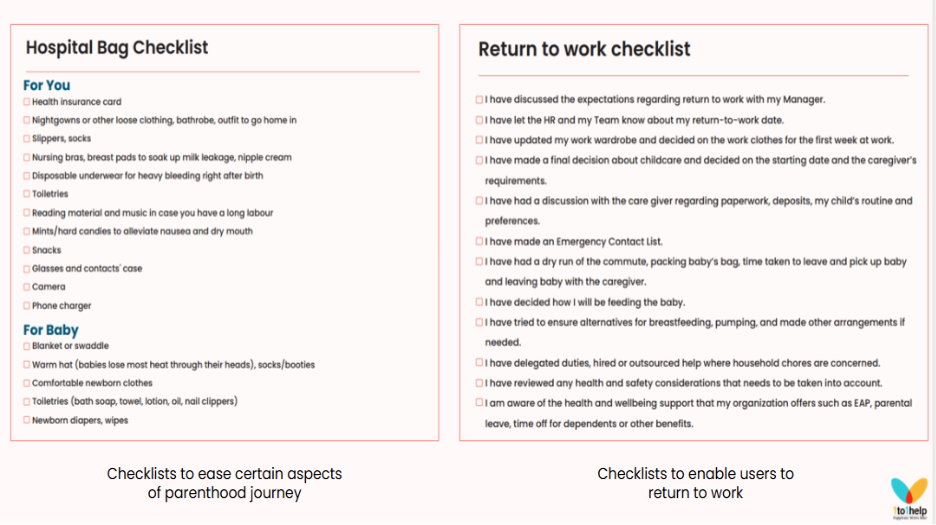
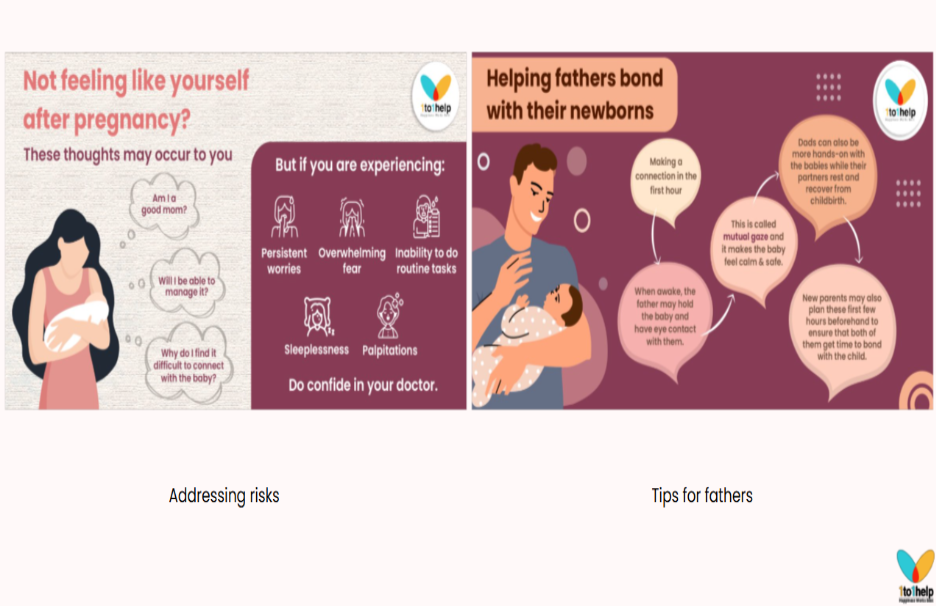
Source: 1to1help Internal Data
References
- International Institute for Management Development. (n.d.). What is DEI? Retrieved from https://www.imd.org/blog/management/what-is-dei/
- WelleMeRight. (n.d.). Pre-natal wellness coach. Retrieved from https://www.wellmeright.com/glossary/pre-natal-wellness-coach
- Cleveland Clinic. (n.d.). High-risk pregnancy. Retrieved from https://my.clevelandclinic.org/health/diseases/22190-high-risk-pregnancy
- RemoFirst. (n.d.). Maternity leave in India. Retrieved from https://www.remofirst.com/post/maternity-leave-in-india
- Shorey, S., et al. (2023). Postpartum depression: A systematic review. Retrieved from https://pmc.ncbi.nlm.nih.gov/articles/PMC10927066/
- Mayo Clinic. (n.d.). Postpartum depression: Symptoms and causes. Retrieved from https://www.mayoclinic.org/diseases-conditions/postpartum-depression/symptoms-causes/syc-20376617
- Centers for Disease Control and Prevention. (n.d.). Mental health data and resources. Retrieved from https://www.cdc.gov/mental-health/about-data/resources.html
- Cleveland Clinic. (n.d.). Lactation consultant. Retrieved from https://my.clevelandclinic.org/health/articles/22106-lactation-consultant
- Postpartum Support International. (n.d.). Creating a support system for new moms. Retrieved from https://postpartum.net/part-2-creating-a-support-system-how-partners-friends-and-family-can-support-a-new-mom/
- The Times of India. (2022). Working moms call for flexible hours and empathetic management. Retrieved from https://timesofindia.indiatimes.com/life-style/spotlight/working-moms-call-for-flexible-hours-empathetic-management-as-they-juggle-kids-and-careers/articleshow/91458509.cms
- Mid-Day. (2024). Only 16% of women are in executive roles in India. Retrieved from https://www.mid-day.com/lifestyle/culture/article/only-16-per-cent-of-women-are-in-executive-or-c-level-positions-in-india-finds-report-23403426
- Cleveland Clinic. (n.d.). Anxiety disorders. Retrieved from https://my.clevelandclinic.org/health/diseases/9536-anxiety-disorders
- National Public Radio. (2023). Pregnant? Here’s how to deal with the “new you.” Retrieved from https://www.npr.org/2023/05/10/1175190657/pregnant-heres-how-to-deal-with-the-new-you
- Caprino, K. (2026). Career grief: The hidden emotional cost of professional transitions. Forbes. Retrieved from https://www.forbes.com/sites/kathycaprino/2026/01/16/career-grief-the-hidden-emotional-cost-of-professional-transitions/
- The Healthy Mummy. (n.d.). 90% of mums admit to feeling guilty. Retrieved from https://www.healthymummy.com/90-mums-admit-constantly-feeling-guilty/
- Medical News Today. (n.d.). Breastfeeding: Benefits and challenges. Retrieved from https://www.medicalnewstoday.com/articles/249190
- NHS. (n.d.). Common breastfeeding problems. Retrieved from https://www.nhs.uk/baby/breastfeeding-and-bottle-feeding/breastfeeding-problems/common-problems/
- Clark, R. C., Nguyen, F., & Sweller, J. (2005). Cognitive load theory. Retrieved from https://theelearningcoach.com/learning/what-is-cognitive-load/
- Verywell Mind. (n.d.). Imposter syndrome and social anxiety. Retrieved from https://www.verywellmind.com/imposter-syndrome-and-social-anxiety-disorder-4156469
- Humanise. (n.d.). Breaking the news around pregnancy at work. Retrieved from https://www.humanise.co.in/posts/breaking-the-news-around-pregnancy-at-work
- YourStory. (2022). Challenges women face returning to work. Retrieved from https://yourstory.com/herstory/2022/03/challenges-women-back-work-reskilling
- Motherly. (n.d.). Matrescence and identity shift. Retrieved from https://www.mother.ly/birth/matrescence-identity-shift-motherhood/
- Verywell Mind. (n.d.). Signs of low self-esteem. Retrieved from https://www.verywellmind.com/signs-of-low-self-esteem-5185978
- LinkedIn. (n.d.). Hidden cost of employee turnover. Retrieved from https://www.linkedin.com/pulse/hidden-crisis-why-your-employee-turnover-costing-more-than-you-dmuac/
- Patel, V., et al. (2023). Maternal mental health study. Retrieved from https://pmc.ncbi.nlm.nih.gov/articles/PMC10374076/
- AIHR. (n.d.). Absenteeism in the workplace. Retrieved from https://www.aihr.com/blog/absenteeism/
- AIHR. (n.d.). Employee attrition. Retrieved from https://www.aihr.com/blog/employee-attrition/
- March of Dimes. (n.d.). Baby blues after pregnancy. Retrieved from https://www.marchofdimes.org/find-support/topics/postpartum/baby-blues-after-pregnancy
- Government of India. (2016). Maternity Benefit Act: Ready reckoner. Retrieved from https://images.assettype.com/barandbench/import/2016/03/Maternity-Benefits-Report-Ready-reckoner-Online-version-140316.pdf
- LinkedIn. (2024). Women in leadership workplace equity. Retrieved from https://www.linkedin.com/posts/florywilson_leanin-womeninleadership-workplaceequity-activity-7406434029014732801-uKzn/
- Ministry of Labour and Employment. (2025). Labour law document. Retrieved from https://www.labour.gov.in/static/uploads/2025/06/1a64517bcba2fab5650a9ff66d429080.pdf
- Government of India. (2017). The Maternity Benefit (Amendment) Act, 2017. Retrieved from https://www.indiacode.nic.in/bitstream/123456789/2249/1/A2017-10.pdf
- Department of Expenditure. (n.d.). Prevention of sexual harassment guidelines. Retrieved from https://doe.gov.in/files/inline-documents/DoE_Prevention_sexual_harassment.pdf
- Ministry of Electronics and Information Technology. (2024). Policy document. Retrieved from https://www.meity.gov.in/static/uploads/2024/06/2bf1f0e9f04e6fb4f8fef35e82c42aa5.pdf
- TalktoAngel. (n.d.). EAP services to support pregnancy and motherhood. Retrieved from https://www.talktoangel.com/blog/eap-services-to-support-pregnancy-and-motherhood-for-women-employees
- Sharma, R., et al. (2024). Maternal health research study. Retrieved from https://pmc.ncbi.nlm.nih.gov/articles/PMC10952242/
- National Center for Biotechnology Information. (n.d.). Maternal mental health overview. Retrieved from https://www.ncbi.nlm.nih.gov/books/NBK513805/
- Stanford News. (2024). What to expect from Gen Z coworkers. Retrieved from https://news.stanford.edu/stories/2024/02/8-things-expect-gen-z-coworker
- International Federation of Red Cross and Red Crescent Societies. (n.d.). Mental health and psychosocial support. Retrieved from https://epidemics.ifrc.org/volunteer/action/19-mental-health-and-psychosocial-support-mhpss


.svg)
.svg)
.svg)
.svg)