




.png)

Mental Health Concerns
Existential Crisis: Meaning, Signs, Causes, and How to Overcome It
.jpg)
.png)
Written by
Aarohi Parakh,
Psychologist and Content Writer

Reviewed by
Sanjana Sivaram,
Psychologist and Clinical Content Head


Introduction
Have you ever caught yourself wondering, "Why am I doing all this?", "What is the purpose of my life?" or "Even if I achieve everything I want, will I actually feel fulfilled?"
Questions like these are more common than many people realise. While they can arise during moments of quiet reflection, they sometimes become persistent, leaving you feeling confused, emotionally unsettled, or disconnected from the life you've built. This experience is may sometimes be described as an existential crisis.
An existential crisis is not necessarily a sign that something is wrong with you. It often emerges during periods of change, uncertainty, loss, or significant life transitions. For some people, it becomes an opportunity to reflect on their values, priorities, and sense of purpose. For others, it can feel deeply distressing, leaving them overwhelmed, anxious, or emotionally stuck. Whatever your experience, these feelings deserve understanding and, when needed, support.
Whether you're navigating your first job, questioning your career path, coping with grief, adjusting to marriage or parenthood, or simply feeling that life has lost its meaning despite outward success, you're not alone. Many people experience periods of questioning at different stages of life.
In this guide, we'll explore the existential crisis meaning, its signs and causes, how it differs from depression, and practical ways to move forward with greater clarity and purpose.

What Is an Existential Crisis? (Meaning and Definition)
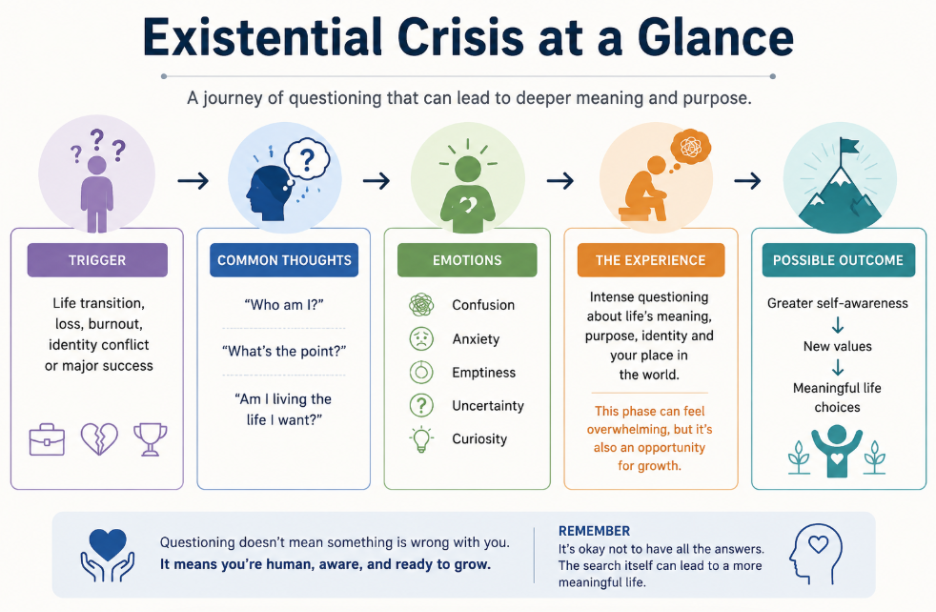
An existential crisis is a period of intense questioning about life's meaning, purpose, identity, and your place in the world. During this time, you may begin to reflect deeply on questions that don't always have straightforward answers, such as:
- Why am I here?
- Does my life have meaning?
- Am I living according to my own values?
- What happens if I fail or never achieve my goals?
- How do I know I'm making the right choices?
While these questions are part of being human, they can sometimes become overwhelming, leading to feelings of uncertainty, anxiety, or emotional exhaustion.
Simply put, the existential crisis meaning is a phase where your existing beliefs about yourself or your life no longer feel sufficient, and you're searching for a deeper sense of purpose or direction.
What Does Existential Crisis Mean in Hindi?
Many people search for the existential crisis meaning in Hindi because the experience can be difficult to describe.
Although there isn't a perfect one-word translation, it may be understood as:
"अस्तित्व का संकट" (Astitva ka Sankat)
or
"जीवन के उद्देश्य और अर्थ को लेकर गहरा मानसिक द्वंद्व"
This refers to a state where a person begins questioning their existence, life's purpose, personal identity, or the meaning behind their experiences.
Where Did the Idea of an Existential Crisis Come From?
The concept has its roots in existential philosophy, a branch of philosophy that explores human existence, freedom, responsibility, and meaning.
Thinkers such as Søren Kierkegaard, Jean-Paul Sartre, Albert Camus, and later psychiatrist Viktor Frankl explored questions about purpose, choice, uncertainty, and how people create meaning despite life's challenges.
Today, many psychologists and therapists view an existential crisis less as a philosophical debate and more as a genuine human experience that many people encounter during significant life transitions.
Rather than seeing it as something to eliminate immediately, some mental health professionals see existential questioning as an opportunity for reflection and a deeper understanding of one's values and priorities. At the same time, they recognise that the distress it brings can sometimes be significant and may require appropriate support

Existential Crisis vs Existential Dread
Although these terms are often used interchangeably, they describe different aspects of the same experience.
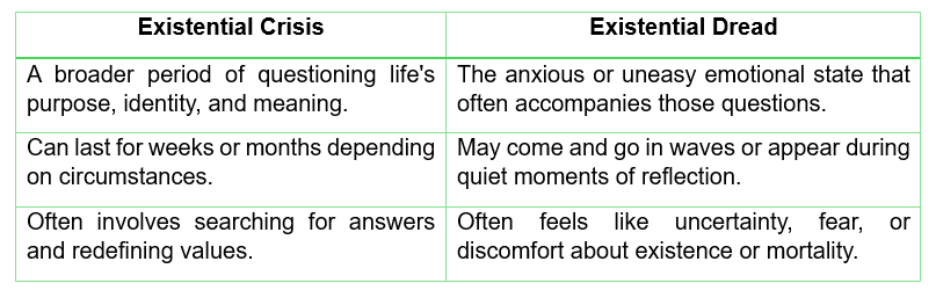
In simple terms, existential dread is often the emotional experience, while an existential crisis is the broader journey of questioning and searching for meaning.
Is an Existential Crisis the Same as Depression?
No. Although they can overlap, they are not the same.
Someone experiencing an existential crisis may continue working, maintaining relationships, and functioning in daily life while privately questioning their purpose or direction. For others, however, the distress can become more intense and begin to affect their emotional wellbeing and day-to-day functioning.
Depression, on the other hand, is a recognised mental health condition that affects mood, thinking, energy, sleep, motivation, appetite, and overall wellbeing. Some people with depression experience significant difficulties in their daily functioning, while others may continue to work, care for their families, or appear to cope outwardly despite struggling internally.
In other words, how well someone appears to function does not, by itself, distinguish an existential crisis from depression. The key difference lies in the nature of the experience. An existential crisis is primarily characterised by questions about meaning, purpose, and identity, whereas depression involves a broader pattern of persistent low mood or loss of interest, along with emotional, cognitive, and physical symptoms.
That said, prolonged existential distress may contribute to depression in some individuals, and people living with depression may also experience existential questions. Because of this overlap, it can sometimes be difficult to tell them apart without professional support.
We'll explore these differences in greater detail later in this article.
Why Existential Crises May Feel Especially Relevant in India
Although existential questions are universal, the circumstances that trigger them often differ across cultures.
In India, for some individuals, ideas around success, family responsibility, and social expectations can sometimes make these questions feel even more complex. Young adults may find themselves torn between following their own aspirations and meeting expectations around career choices, marriage, or caregiving. Others may experience an existential crisis after achieving conventional milestones, only to realise they still feel unfulfilled.
For many professionals, this can look like spending years working towards a prestigious degree or high-paying job, only to wonder whether it reflects their personal values. Others may begin questioning their identity after becoming parents, relocating to a new city, losing a loved one, or experiencing burnout.
These experiences do not necessarily indicate failure. Instead, they may signal that your priorities, values, or understanding of yourself are evolving.
As psychiatrist Irvin Yalom observed, confronting questions about meaning can be uncomfortable, but it may also open the door to greater authenticity, stronger relationships, and a more intentional way of living.
Signs and Symptoms of an Existential Crisis
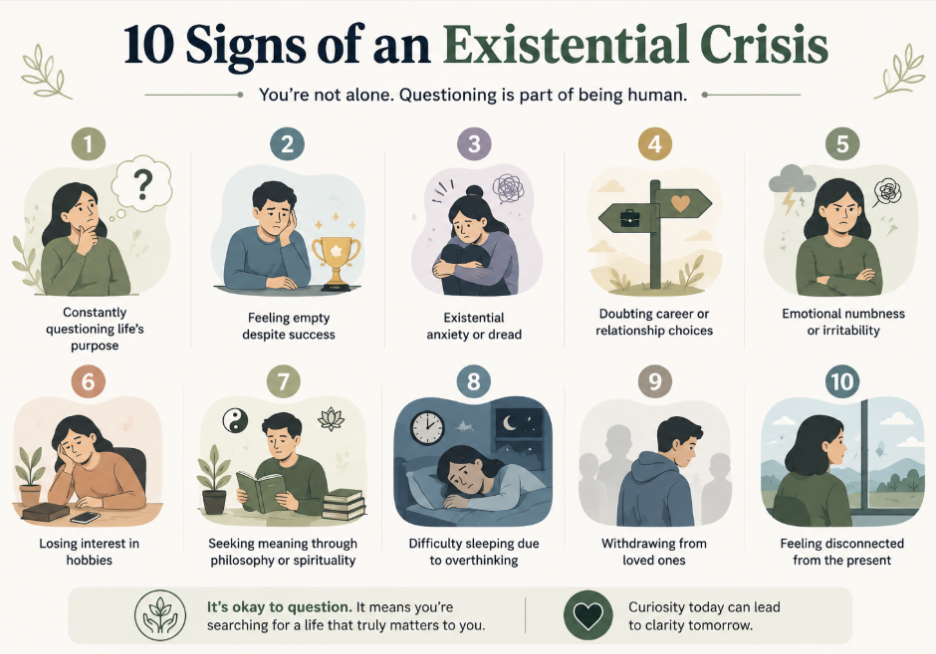
If you've ever wondered whether what you're experiencing is an existential crisis or simply a stressful period, you're not alone. One of the reasons existential crises can be confusing is that they don't look the same for everyone.
Some people find themselves constantly questioning their purpose. Others may feel emotionally detached, anxious about the future, or surprisingly empty despite outward success. These experiences can develop gradually or be triggered by a major life event.
It's important to remember that experiencing a few of these signs and symptoms of an existential crisis does not necessarily mean something is wrong with you. They may simply reflect that you're reassessing your life, values, or identity during a period of change.
10 Common Signs You May Be Experiencing an Existential Crisis
1. You constantly question the meaning or purpose of life
You may find yourself repeatedly thinking:
- Why am I here?
- Does my work really matter?
- What am I working towards?
These thoughts may become difficult to switch off and can occupy your mind even during everyday activities.
2. You feel empty despite achieving your goals
Perhaps you've completed your degree, landed your dream job, bought a home, or reached a milestone you once worked hard for. Yet instead of feeling fulfilled, you may wonder, "Is this all there is?"
This sense of emotional emptiness can often arise for many reasons, including depression, burnout, grief, chronic stress, or periods of existential questioning. If these feelings are accompanied by persistent questions about meaning, purpose, or identity, they may be part of an existential crisis.
3. You experience existential dread or anxiety
The existential dread meaning refers to the uneasy feeling that often accompanies questions about existence, mortality, freedom, or uncertainty.
You may notice yourself worrying about:
- Growing older
- Death or losing loved ones
- Whether you're making the "right" choices
- The uncertainty of the future
While these thoughts are a natural part of being human, they can become distressing if they begin to dominate your daily life. If they become overwhelming or begin interfering with sleep and daily functioning, it may be useful to seek support.
4. You begin questioning major life choices
An existential crisis often prompts people to reconsider areas of life they previously took for granted, such as:
- Career
- Relationships
- Parenthood
- Religious or spiritual beliefs
- Personal values
You may not necessarily want to change everything immediately, but you may feel compelled to ask whether your current path truly reflects who you are.
5. Your emotions feel unpredictable
Some days you may feel deeply emotional, while on others you might feel strangely numb or disconnected.
You may notice:
- Irritability
- Restlessness
- Sadness without a clear reason
- Feeling emotionally "flat"
- Increased sensitivity
These emotional shifts are not unique to an existential crisis and can occur in a range of mental health conditions and life circumstances. However, when they are accompanied by ongoing questions about meaning, purpose, or identity, they may reflect existential distress.
6. You lose interest in things you once enjoyed
Activities that previously brought excitement may begin to feel routine or meaningless.
This does not necessarily mean you've stopped enjoying them forever. Instead, it may signal that you're searching for experiences that feel more personally meaningful or aligned with your evolving priorities.
Note: If this is persistent or accompanied by low mood, hopelessness, significant sleep/appetite changes, or thoughts of self-harm, it should not automatically be attributed to an existential crisis. Speaking to a mental health professional would be helpful.
7. You're drawn towards philosophy, spirituality, or self-discovery
Many people experiencing an existential crisis become curious about:
- Psychology
- Philosophy
- Spiritual practices
- Books about meaning and purpose
An interest in these topics is common and does not necessarily indicate an existential crisis. Many people explore them out of curiosity, personal growth, or cultural and spiritual beliefs. However, during an existential crisis, people may turn to these ideas in an effort to make sense of persistent questions about meaning, purpose, identity, or their place in the world.
8. You have difficulty sleeping or relaxing
Persistent questioning can make it difficult for the mind to switch off.
You may experience:
- Racing thoughts at bedtime
- Restlessness
- Muscle tension
- Difficulty staying present
- Feeling mentally exhausted
These experiences are not unique to an existential crisis. Sleep difficulties and restlessness can occur for many reasons, including anxiety, depression, grief, chronic stress, lifestyle factors, or physical health concerns. However, if they occur alongside ongoing questions about meaning, purpose, or identity, they may be part of a broader experience of existential distress.
9. You withdraw from people around you
Friends or family may notice that you're quieter than usual or less interested in socialising.
Sometimes this happens because it feels difficult to explain what you're experiencing. At other times, you may simply want more time alone to reflect.
While occasional solitude can be healthy, prolonged isolation may increase feelings of loneliness or hopelessness.
10. You struggle to stay present
Instead of enjoying the moment, your thoughts may repeatedly drift towards the past or the future.
You might find yourself replaying old decisions, imagining different versions of your life, or worrying about what lies ahead.
This constant mental replay can make it harder to appreciate the experiences unfolding in front of you.
Quick Self-Reflection
Ask yourself:
- Have I been questioning my purpose more often lately?
- Do my achievements still feel meaningful?
- Am I living according to my own values or someone else's expectations?
- When was the last time I genuinely felt fulfilled?
These questions aren't meant to diagnose an existential crisis. Instead, they can serve as gentle prompts for self-reflection.
💡Remember: Experiencing some of these signs doesn't automatically mean you have an existential crisis. Many people encounter these feelings during periods of personal growth or major life transitions. If these experiences persist or begin interfering with daily life, speaking with a mental health professional may help.
What Can Trigger an Existential Crisis?
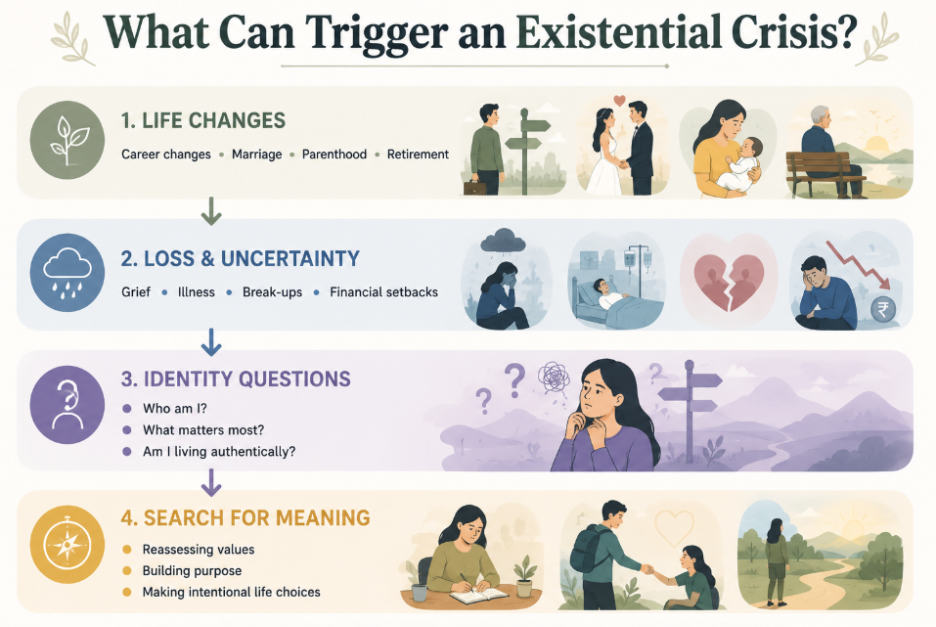
There is rarely a single reason why someone experiences an existential crisis. More often, it develops when a significant life event, personal transition, or accumulation of stress may prompt you to question your identity, priorities, or purpose.
For one person, it might begin after losing a loved one. For another, it may follow a promotion, a move abroad, or even the achievement of a lifelong goal.
Rather than asking, "What happened to me?", it can sometimes be more helpful to ask, "What has changed in the way I see myself or my life?"
Below are some of the most common triggers of existential crises.
1. Major Life Transitions
Periods of change often encourage us to reflect on who we are and where we're headed.
Common transitions include:
- Starting your first job
- Changing careers
- Marriage
- Becoming a parent
- Divorce or separation
- Retirement
- Relocating to another city or country
These moments often require us to redefine our identity, making existential questions more likely to surface.
For many young adults in India, graduating from university or preparing for competitive exams can also bring uncertainty about whether they're pursuing a path that genuinely reflects their aspirations.
2. Loss, Grief, or Unexpected Change
The death of a loved one, a serious illness, job loss, financial setbacks, or the end of an important relationship can suddenly alter our assumptions about life.
Grief often reminds us that life is uncertain and finite. While painful, it can also lead people to reconsider what truly matters and how they want to spend their time.
3. Becoming More Aware of Mortality
As we grow older, or when we witness illness or loss in those around us, thoughts about mortality may become more frequent.
Questions like:
"How much time do I really have?"
"Am I making the most of my life?"
can become increasingly significant.
Existential psychologists suggest that becoming aware of mortality is a universal human experience. While uncomfortable, it can also encourage people to live more intentionally.
4. Feeling That Life Is Outside Your Control
The COVID-19 pandemic reminded many people how quickly life can change.
Global uncertainty, economic challenges, natural disasters, or personal setbacks may leave people questioning long-held assumptions about safety, stability, and certainty.
A OnePoll survey conducted in 2020 found that 77% of Americans believed the pandemic had created a national existential crisis, highlighting how widespread these experiences became during a period of collective uncertainty.
5. Identity Conflicts
Many people experience tension between who they are and who they feel expected to become.
This may include questions around:
- Career choices
- Marriage expectations
- Family responsibilities
- Gender roles
- Religious beliefs
- Cultural identity
In India, where family and community often play an important role in life decisions, balancing personal aspirations with collective expectations can sometimes create inner conflict.
For example, someone may pursue a career that offers financial security because it aligns with family expectations, yet later realise it doesn't provide a sense of meaning or fulfilment.
6. Success Without Fulfilment
One of the more surprising existential crisis causes is achieving everything you thought you wanted.
You may have:
- Built a successful career
- Achieved financial stability
- Reached important milestones
- Earned recognition from others
Yet still feel something is missing.
Psychologists sometimes refer to this as the "arrival fallacy", the belief that reaching a particular goal will permanently make us happy. When reality doesn't match that expectation, people may begin questioning what success truly means to them.
💡Key Insight: An existential crisis isn't always triggered by something negative. Sometimes it begins after positive life events, as they prompt us to ask whether external success reflects our internal values.
Who Is Most Likely to Experience an Existential Crisis?
An existential crisis can affect anyone, regardless of age, profession, or background. However, certain life stages and circumstances may make these periods of questioning more likely.
It's worth remembering that experiencing an existential crisis doesn't mean you're weak or "broken". In many cases, it reflects a natural response to significant life changes, shifting priorities, or growing self-awareness.
Young Adults in Their 20s and 30s
An existential crisis in your 20s and 30s is becoming increasingly common, particularly as young adults navigate education, careers, relationships, and financial independence.
Many people in this age group are making some of the biggest decisions of their lives while also comparing themselves with carefully curated versions of success on social media.
Questions like these may become increasingly common:
- Am I in the right career?
- Should I already have everything figured out?
- Am I falling behind my peers?
- Is this the life I actually wanted?
In India, these questions may feel even more complex because personal aspirations often coexist with expectations regarding family responsibilities, marriage, financial stability, and caregiving.
For some, this experience overlaps with what is often referred to as a quarter-life crisis, where uncertainty about identity and purpose becomes particularly prominent.
Adults in Midlife
While younger adults often question the future, people in their 40s and 50s may begin reflecting on the past.
This period sometimes coincides with children becoming independent, ageing parents requiring care, career plateaus, or increased awareness of mortality.
Questions may shift towards:
- Have I lived according to my values?
- What do I want the next stage of my life to look like?
- Have I prioritised what truly matters?
Rather than signalling failure, these reflections may create opportunities to redefine priorities and reconnect with meaningful goals.
Professionals Experiencing Burnout
People working in demanding professions may also be more vulnerable to existential questioning.
Long working hours, chronic stress, and a disconnect between personal values and workplace expectations can gradually lead to questions such as:
"I'm successful, but why don't I feel fulfilled?"
Burnout often affects energy and motivation, while an existential crisis tends to centre on purpose and meaning. The two can sometimes occur together, making professional support particularly valuable. Burnout is specifically related to chronic workplace stress, whereas existential questioning can arise from many areas of life and may occur with or without burnout.
People Experiencing Major Life Events
Certain experiences naturally encourage reflection.
These may include:
- Bereavement
- Serious illness
- Divorce or separation
- Becoming a parent
- Retirement
- Migration or relocating
- Losing a job
Such events often disrupt familiar routines and encourage people to reconsider what matters most.
A Gentle Reminder
There is no "right" age to question your purpose.
Some people experience an existential crisis during university, while others first encounter it after retirement. Some never describe their experience using this term at all.
What matters is recognising that these questions are part of being human. With reflection and support, they may become an opportunity to build a life that feels more aligned with your values.

How to Overcome an Existential Crisis: 7 Practical Steps
Searching for answers overnight can be tempting, particularly when uncertainty feels uncomfortable. However, finding meaning is often less about discovering a single life purpose and more about gradually building a life that feels authentic, connected, and aligned with your values.
If you're wondering how to overcome an existential crisis, these evidence-informed strategies may help.
1. Accept That It's Okay Not to Have All the Answers
Our first instinct is often to solve uncertainty as quickly as possible.
However, existential questions rarely have simple or permanent answers.
Instead of trying to "fix" every uncomfortable thought, consider allowing yourself to sit with uncertainty for a while. This doesn't mean giving up. Rather, it means recognising that growth often begins with curiosity rather than certainty.
Practices such as mindfulness, deep breathing, or simply observing your thoughts without judging them may help reduce the pressure to figure everything out immediately.
Try This
The next time you notice yourself asking, "What's the point?", gently reframe the question to:
"What feels meaningful to me today?"
Small shifts in perspective can sometimes feel more manageable than searching for one definitive answer.
💡Pro Tip: You don't have to solve your entire future today. Focusing on what feels meaningful in the present moment is often a more sustainable place to begin.
2. Discover What Gives You Meaning
Many people spend years pursuing goals that reflect external expectations rather than personal values.
Take a moment to ask yourself:
- What activities make me lose track of time?
- When do I feel most like myself?
- What kind of impact do I hope to have on others?
- Which values matter most to me today?
Psychiatrist Viktor Frankl, who developed logotherapy, suggested that meaning can often be found through three broad pathways:
- Creating or contributing something meaningful
- Connecting deeply with people, nature, or experiences
- Finding purpose even during difficult circumstances
Meaning doesn't have to be extraordinary. For one person, it might be raising a family. For another, it could be mentoring others, creating art, volunteering, learning, or simply being present with loved ones.
Reflection Exercise
Complete these sentences:
- I feel most alive when...
- The people I admire usually...
- If success wasn't measured by money, I would...
You may notice patterns that point towards your deeper values.
3. Talk to Someone You Trust
Existential questions often feel isolating because many people assume they're the only ones having them. In reality, opening up to someone you trust can be surprisingly reassuring.
Whether it's a close friend, sibling, mentor, partner, or family member, sharing your thoughts may help you organise them and feel less alone.
If discussing these topics feels unfamiliar, you don't need to have all the right words.
You could simply say:
"I've been questioning a lot about my life lately, and I think I just need someone to listen."
In many Indian families, conversations about purpose or emotional wellbeing may not happen regularly. Even so, choosing one supportive person can make these conversations feel more approachable.
4. Explore Books That Encourage Reflection
Sometimes, hearing how others have wrestled with similar questions can provide reassurance and perspective. A few widely recommended books include
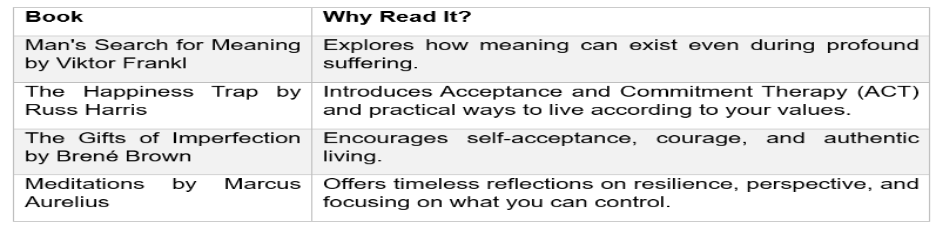
These books don't provide definitive answers, but they may help you develop a healthier relationship with uncertainty and encourage thoughtful self-reflection.
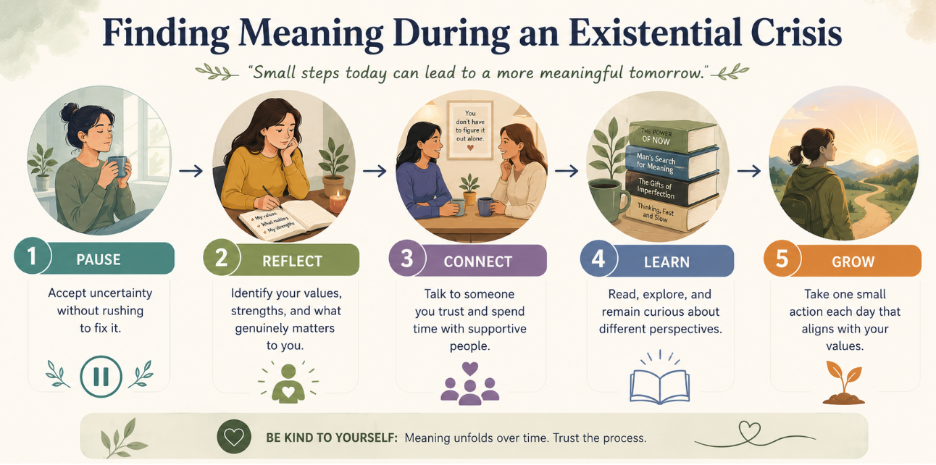
5. Engage in Activities That Feel Meaningful
When you're experiencing an existential crisis, it's easy to spend hours searching for answers in your mind. While self-reflection is valuable, meaning is often created through action rather than thought alone.
You don't need to make dramatic life changes overnight. Instead, begin with small activities that align with your values and bring a sense of purpose.
These might include:
- Volunteering for a cause you care about
- Reconnecting with a creative hobby
- Spending quality time with loved ones
- Learning something new
- Mentoring or helping someone
- Spending time in nature
- Joining a community or interest group
The goal isn't to stay busy. It's to reconnect with experiences that remind you what matters.
Try This
At the end of each day, ask yourself:
"What did I do today that felt meaningful, even in a small way?"
Over time, these small moments often become the building blocks of a more purposeful life.
6. Keep a Reflection Journal
An existential crisis often brings a flood of questions that can feel overwhelming. Writing them down can help create clarity and reduce mental overload.
Instead of searching for immediate answers, try exploring your thoughts with curiosity.
Some prompts to get started include:
- What has been on my mind lately?
- What gives me a sense of purpose?
- Which parts of my life feel most aligned with my values?
- What would I like more of in my life?
- What small step can I take this week?
You could also end each day by noting:
- One thing you're grateful for
- One thing you learnt about yourself
- One intention for tomorrow
Journalling isn't about solving everything. It's about understanding yourself a little better, one page at a time.
Note: For some people, journaling can become repetitive rumination rather than helpful reflection. If writing leaves someone feeling more distressed or stuck in the same thoughts, they may need to change the approach or seek support.
7. Consider Speaking to a Mental Health Professional
Sometimes, existential questions become difficult to navigate alone. Talking to a psychologist or counsellor can provide a safe, non-judgemental space to explore your thoughts and emotions.
Rather than giving you answers, a therapist can help you:
- clarify your values
- understand patterns in your thinking
- make sense of uncertainty
- navigate major life transitions
- develop healthier ways of coping
Depending on your concerns, approaches such as Existential Therapy, Acceptance and Commitment Therapy (ACT) and Cognitive Behavioural Therapy (CBT) may be helpful.
Seeking support doesn't mean something is wrong with you. Many people choose therapy during periods of transition, self-discovery or personal growth.
Existential Crisis vs Depression: Understanding the Difference
An existential crisis and depression can sometimes feel similar because both may involve sadness, hopelessness or a loss of direction. However, they are not the same.
An existential crisis centres on questions about meaning, purpose and identity. Depression is a recognised mental health condition that affects mood, thinking, energy and everyday functioning.
The two can occur together, which is why understanding the differences is important.
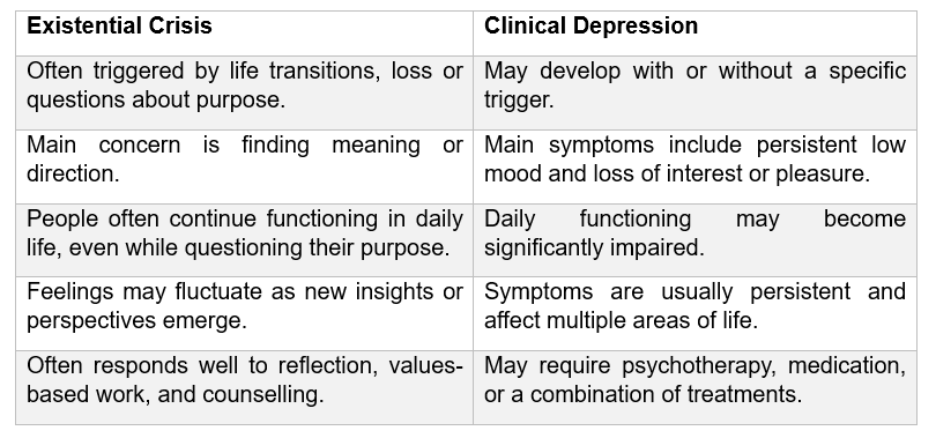
Important: An existential crisis can sometimes contribute to depression, and people living with depression may also experience existential questions. If you're unsure what you're experiencing, speaking with a mental health professional can help you understand what you're going through.
When Should You Reach Out for Professional Support?
While periods of self-reflection are a normal part of life, it's worth seeking professional support if your distress begins affecting your emotional wellbeing or day-to-day functioning.
Consider speaking to a mental health professional if:
- your thoughts about life's meaning feel overwhelming or persistent
- you're struggling at work, in your relationships, or with daily responsibilities
- you've noticed significant changes in your sleep or appetite
- you feel persistently hopeless or emotionally exhausted
- you're withdrawing from people or activities you once enjoyed
If you're experiencing these challenges, talking to a psychologist or counsellor can help you make sense of what you're going through and develop practical ways to move forward.
At 1to1help, our experienced mental health professionals provide confidential online counselling and emotional wellbeing support, helping individuals navigate life transitions, uncertainty, stress, anxiety, and questions around purpose and meaning. If your organisation partners with 1to1help's Employee Assistance Programme (EAP), you may also have access to confidential counselling services at no additional cost as part of your employee wellbeing benefits.
If you experience thoughts of self-harm or suicide, seek immediate support from a trusted person, your nearest emergency medical service, or a mental health crisis helpline like Tele-MANAS (14416). You do not have to face those thoughts alone.
Final Thoughts
Questioning your purpose can feel uncomfortable, but it isn't always a sign that something is wrong. Sometimes, it signals that your values, priorities, or understanding of yourself are changing.

Rather than trying to find all the answers immediately, focus on taking one small step towards a life that feels more meaningful and authentic. Whether that's reconnecting with loved ones, exploring a new interest, or speaking with a mental health professional, meaningful change often begins with small, intentional actions.
FAQs
Q1. How long does an existential crisis last?
There is no fixed timeline. For some people, an existential crisis lasts a few weeks, while for others it may continue for several months. The duration often depends on the trigger, the support available, and how they work through their thoughts and emotions.
Q2. Can you have an existential crisis in your 20s?
Yes. Many people experience an existential crisis in their 20s or 30s as they navigate career choices, relationships, financial independence, or shifting life goals. This is sometimes referred to as a quarter-life crisis.
Q3. Is an existential crisis a mental illness?
No. An existential crisis is not a mental illness. It is a period of questioning your purpose, identity, or direction in life. While an existential crisis itself is not a mental illness, the distress associated with it can occur alongside anxiety, depression, or other mental health concerns.
Q4. Can therapy help with an existential crisis?
Yes. Therapy provides a safe space to explore difficult questions, clarify your values, and develop healthier ways of coping with uncertainty. If your organisation partners with 1to1help's Employee Assistance Programme (EAP), you may also have access to confidential counselling through the programme. Individuals can also seek support through 1to1help's online counselling services.
Q5. What is existential dread?
Existential dread refers to feelings of fear, uncertainty, or anxiety that arise when contemplating life's meaning, mortality, or the future. It is often one part of an existential crisis rather than the entire experience.
References
- World Health Organization. Mental Health. https://www.who.int/health-topics/mental-health
- Cleveland Clinic. What Is an Existential Crisis? https://health.clevelandclinic.org
- BetterUp. What Is an Existential Crisis and How Can You Overcome It? https://www.betterup.com
- Frankl, V. E. (2006). Man's Search for Meaning. Beacon Press.
- Yalom, I. D. (1980). Existential Psychotherapy. Basic Books.
- American Psychological Association. https://www.apa.org
- PubMed. Research on meaning in life, wellbeing and existential psychotherapy. https://pubmed.ncbi.nlm.nih.gov
- OnePoll Survey commissioned by Vejo (2020). https://www.onepoll.com


.svg)
.svg)
.svg)
.svg)