

.png)


.png)

Workplace Well-Being & Support
The Complete Guide to Workplace Mental Health Training: Benefits, Implementation & Best Practices

.png)
Written by
Aarohi Parakh,
Psychologist and Content Writer

Reviewed by
Sanjana Sivaram,
Psychologist and Clinical Content Head


Introduction
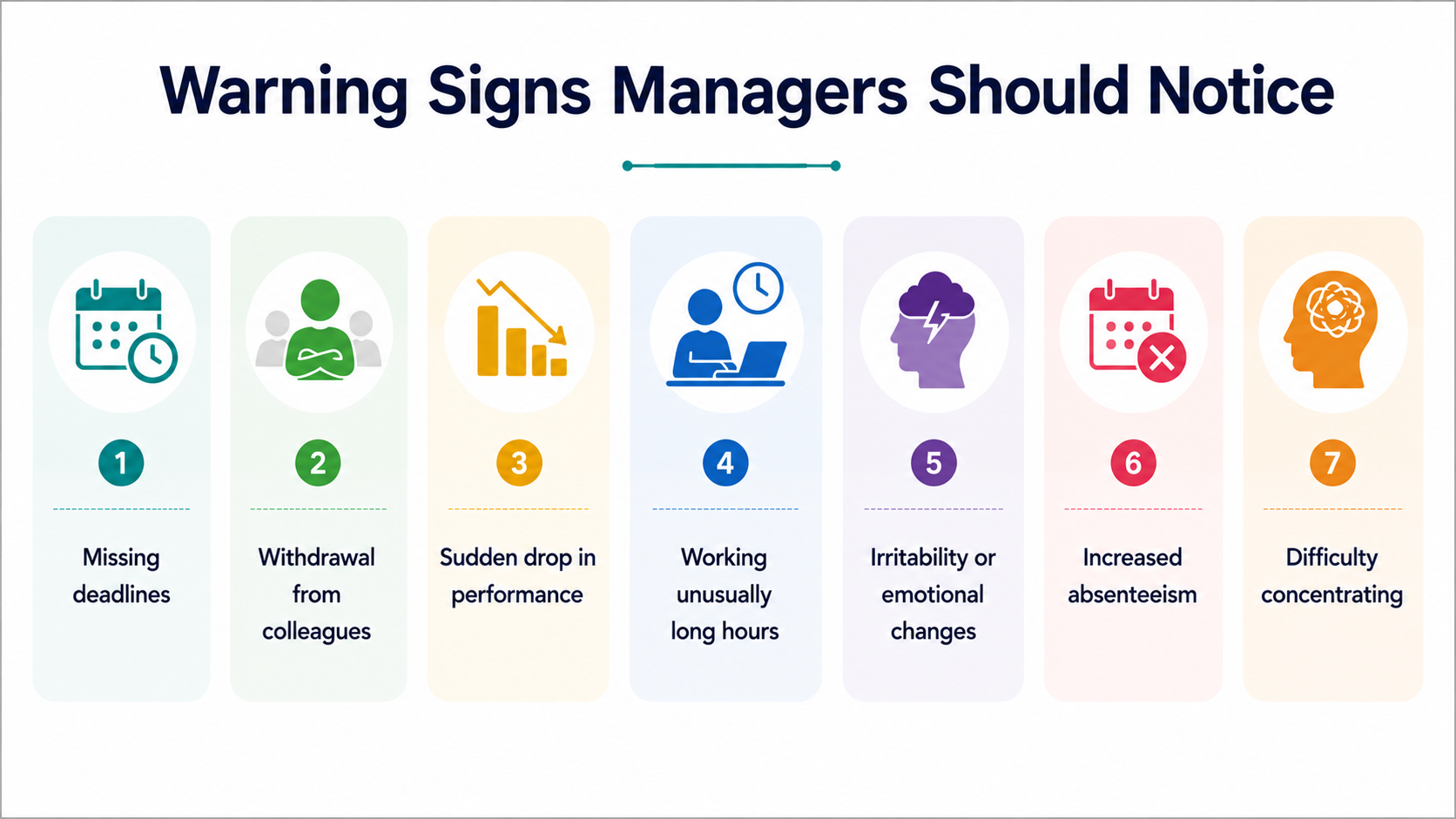
Amit manages a team of twelve at a mid-sized IT services company in Pune. He is a capable manager: technically sharp, responsive, fair. But six months ago, one of his best engineers started missing deadlines. Withdrew from team calls. Sent emails at 2 AM that read like someone trying very hard to hold things together.
Amit noticed. He did not know what to do.
He did not ask. He assumed it was a personal problem and waited for it to pass. Three months later, the engineer resigned. In the exit interview, she mentioned burnout and feeling unsupported. Amit was not a bad manager. He simply had no training for this situation.
This is the gap that workplace mental health training exists to fill.
The WHO estimates that depression and anxiety cost the global economy USD 1 trillion per year in lost productivity. India accounts for a significant share of that figure. The cost to organisations is not just financial: it shows up in attrition, in presenteeism, in teams that function below their capacity for months before anyone names what is happening.
Workplace mental health training gives managers like Amit the knowledge and skills to notice, respond, and refer. It gives employees a shared language for what they are experiencing. And it gives organisations the structural foundations they need to move from reactive crisis management to proactive mental health support.
This guide covers everything HR professionals, team leaders, and business decision-makers in India need to know: the different types of workplace mental health training programs, how to implement them, how to measure their impact, and how to make them last.
Why Workplace Mental Health Training Matters
Research suggests that approximately one in five employees globally experiences a mental health condition in any given year. In India, where mental health stigma remains high and confidential support is scarce, the proportion who experience symptoms while never disclosing them to an employer is substantially larger. The result is a workforce that manages distress privately, at personal cost, while organisations absorb the downstream impact without ever identifying the cause.
The Business Case Is Not Complicated
For every USD 1 invested in mental health programs and employee mental health training, organisations see returns of USD 4 to 6 through reduced absenteeism, lower attrition, and improved productivity. The WHO's 2016 analysis estimated that scaling up mental health treatment in the workplace could generate a return of USD 4 for every USD 1 spent.
In India's high-attrition sectors, specifically IT, BFSI, and healthcare, the cost of replacing a mid-level employee typically ranges from 50 to 200 percent of annual salary. When depression or burnout drives that attrition, and it frequently does, the organisation has absorbed a significant cost that a well-implemented mental health training program could have substantially reduced.
Presenteeism is the more invisible side of the problem. An employee with unaddressed anxiety or depression who remains at their desk but functions at 40 or 50 percent capacity generates losses that never appear in absenteeism data. Mental health awareness training helps managers identify presenteeism early, when intervention is still relatively straightforward.
The Employer's Responsibility in the Indian Context
India does not yet have a single comprehensive mental health at work legislation equivalent to the UK's Health and Safety at Work Act provisions or Australia's Safe Work framework. However, several existing frameworks create meaningful obligations.
The Mental Healthcare Act, 2017 affirms the right to mental health care and non-discrimination for people with mental health conditions. The Factories Act, the Shops and Establishments Acts, and general occupational health standards impose duties of care that courts have increasingly applied to psychosocial risks. POSH (Prevention of Sexual Harassment) compliance requirements, now a baseline for most Indian corporates, are being joined by broader psychological safety obligations in listed companies.
Beyond compliance, reputational dynamics in India's labour market are shifting. Employer branding on platforms like Glassdoor and LinkedIn increasingly reflects how organisations handle employee mental health. Workplace wellness training and visible mental health support have become factors in talent acquisition, not just retention.
Types of Workplace Mental Health Training Programs
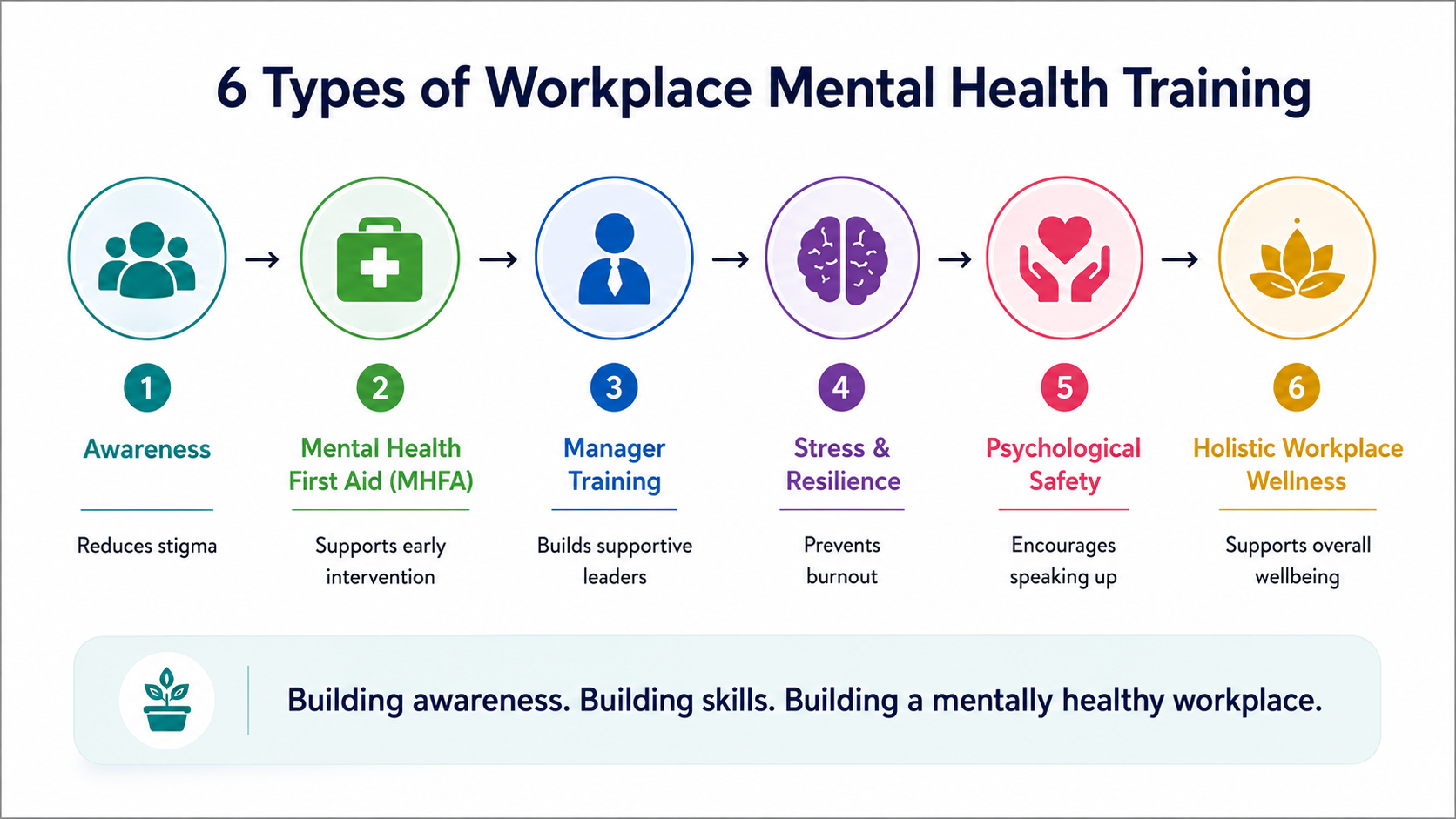
Workplace mental health programs are not interchangeable. Different training types serve different purposes, reach different audiences, and produce different outcomes. Choosing the right type depends on your organisation's size, sector, current maturity level, and the specific gaps your workforce faces.
1. Mental Health Awareness Training
Mental health awareness training is the starting point for most organisations. It aims to build a baseline level of knowledge across the workforce: what common mental health conditions are, how they present, and why stigma prevents people from seeking help.
Stigma is the central target here.
Research consistently shows that employees who fear judgment or professional consequences do not disclose mental health difficulties, do not access available support, and do not perform well as a result. Mental health awareness training addresses this by normalising conversations about mental wellbeing, using case studies and scenario-based learning to make abstract concepts concrete, and creating a shared organisational vocabulary around mental health.
Effective awareness training is not a one-hour webinar. It includes interactive elements, real-world scenarios relevant to the specific workforce, and a follow-up reinforcement plan. A single session changes knowledge; a sustained approach changes culture.
2. Mental Health First Aid Training
Mental health first aid training (MHFA) is a structured, certified program that trains employees to recognise and respond to mental health crises. The analogy to physical first aid is intentional: just as a trained first aider does not replace a doctor but can provide crucial early support, a mental health first aider does not replace a therapist but can make a decisive difference in a crisis moment.
MHFA teaches the five-step ALGEE action plan:
- A Assess for risk of suicide or harm
- L Listen non-judgmentally
- G Give reassurance and information
- E Encourage appropriate professional help
- E Encourage self-help and other support strategies
A standard MHFA certification course runs for approximately eight hours. Recertification is typically recommended every two to three years. MHFA programs are now available in India through accredited providers, and Indian corporate uptake has grown significantly post-2020. The evidence base is strong: a systematic review published in the International Journal of Mental Health Systems found that MHFA training significantly improves participants' knowledge, confidence, and willingness to support colleagues.
Unlike standard awareness training, mental health first aid training is best targeted at a specific cohort: team leads, HR personnel, and employee volunteers who serve as mental health champions within their teams.
3. Manager-Specific Mental Health Training
Managers are one of the most influential factors in any workplace mental health strategy. They are the first to observe changes in an employee's behaviour, the first point of contact for distress disclosures, and the primary architects of the day-to-day psychological environment their teams inhabit.
Mental health training for managers covers a distinct set of skills from general awareness programs:
- Recognising the early signs of anxiety, depression, and burnout in direct reports
- Holding a supportive conversation without overstepping professional or clinical boundaries
- Making reasonable adjustments for employees experiencing mental health difficulties
- Documenting concerns appropriately and making referrals to HR or EAP
- Building the habits and language that create psychological safety in a team
Indian managers face a specific context here. Hierarchical workplace culture, the expectation of stoicism, and the manager's own discomfort with vulnerability all create barriers. Manager training that does not acknowledge and work within this cultural context tends to produce knowledge without behaviour change.
4. Stress Management and Resilience Training
Corporate mental health training often includes a dedicated stress management component, and for good reason. Workplace stress and anxiety are among the most prevalent mental health challenges in Indian organisations. IT sector employees managing global client relationships across time zones, BFSI professionals under compliance and performance pressure, and healthcare workers managing patient loads that have grown without proportional staffing increases all face sustained stress that requires active management, not simply awareness.
Evidence-based stress management training covers:
- Mindfulness-based techniques: breath-focused practices, body scan meditation, and structured MBSR (Mindfulness-Based Stress Reduction) programs
- Cognitive reframing: identifying and challenging catastrophic thinking patterns
- Time management and workload prioritisation frameworks
- Boundary-setting skills: managing after-hours communication, protecting recovery time
- Burnout prevention: recognising the warning signs before the point of collapse
The key word is evidence-based. Stress management training that consists of generic advice disconnected from employees' actual work experience tends to produce scepticism rather than behaviour change. Effective training is specific to the sector, the role, and the actual stressors employees face.
5. Psychological Safety Training
Psychological safety is the shared belief within a team that it is safe to speak up: to raise concerns, acknowledge errors, ask questions, and share difficult feedback without fear of punishment or humiliation. It is not about being comfortable or conflict-free. It is about whether people can be honest without putting themselves at risk.
The research on psychological safety, developed most thoroughly by Harvard Business School's Amy Edmondson, consistently shows that teams with high psychological safety outperform those without it on virtually every performance measure. They also have lower rates of anxiety, depression, and burnout.
Psychological safety training equips leaders and team members to build and maintain this environment. It addresses the specific behaviours that undermine psychological safety (punishing dissent, taking credit unilaterally, responding to errors with blame) and the specific behaviours that build it (modelling fallibility, inviting input explicitly, responding to bad news without shooting the messenger).
For Indian organisations, where hierarchical norms can actively suppress the upward communication of problems, psychological safety training is not a luxury. It is a structural intervention.
6. Workplace Wellness Training (Holistic Programs)
Workplace wellness training takes a broader view, covering physical health, sleep, nutrition, financial wellbeing, and social connection alongside mental health. These programs work best when they complement, rather than substitute for, the more targeted training types above. The risk in India is that wellness programs (yoga sessions, nutrition webinars, fitness challenges) are deployed as a complete response to mental health challenges that require more structured intervention. Wellness training adds genuine value as part of a layered approach. It does not replace it.
How to Implement Workplace Mental Health Training: Step-by-Step
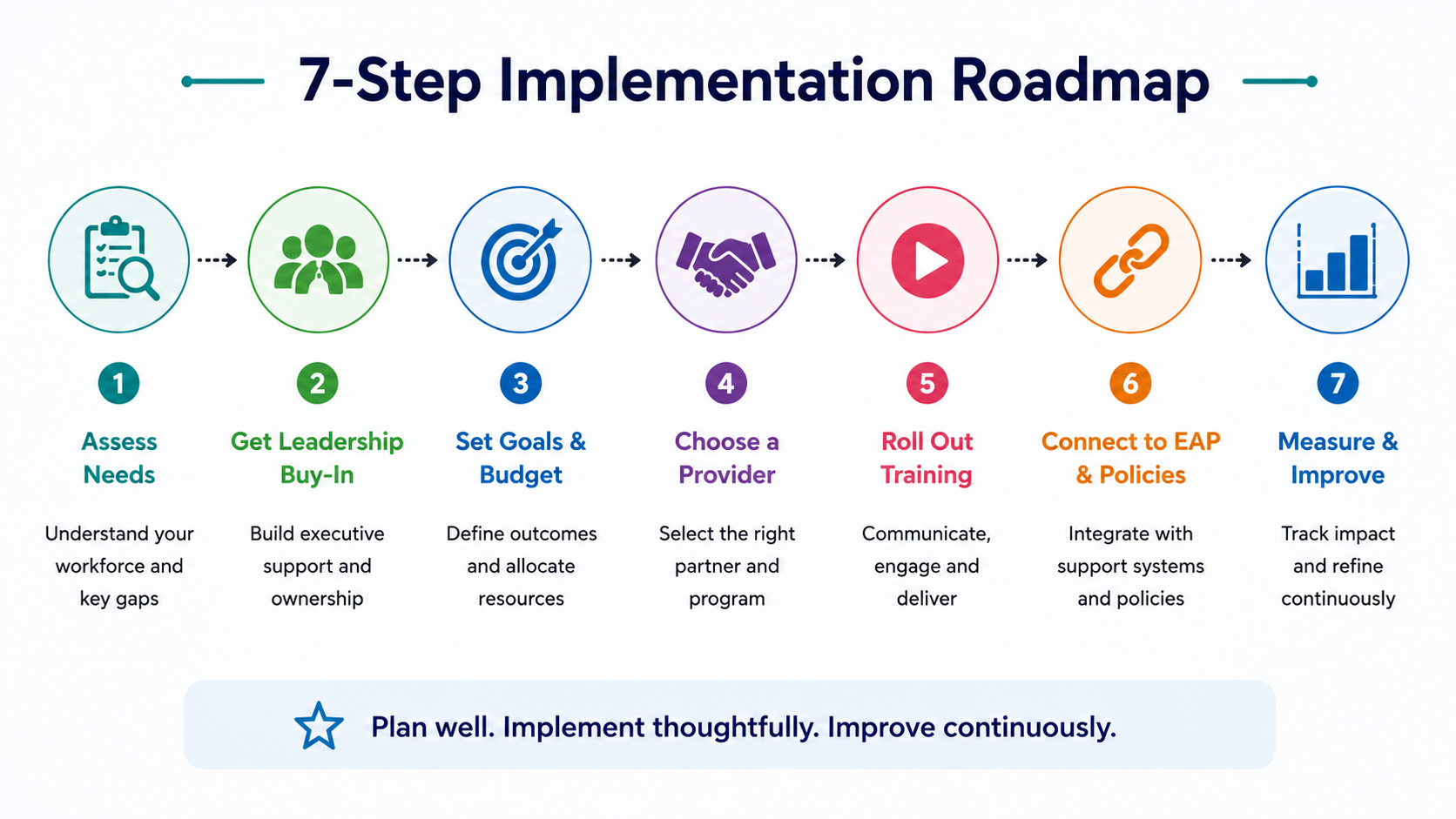
Designing a training program is straightforward. Implementing one that actually changes behaviour and sustains results over time is harder. The following roadmap reflects what tends to work particularly well in Indian organisational contexts.
Step 1: Conduct a Needs Assessment
Before selecting any program, understand your workforce's actual needs. This means more than reviewing absenteeism data (though that is useful). It means collecting anonymous employee feedback through structured surveys, conducting focus groups with willing participants, reviewing exit interview data for mental health themes, and benchmarking against your sector.
Useful assessment questions include:
- Do you feel comfortable discussing mental health concerns with your manager?
- Do you know what mental health support is available to you through your employer?
- In the past three months, have you experienced work-related stress that affected your personal life?
- Do you feel that the organisation treats mental health with the same seriousness as physical health?
The answers to these questions tell you where the gaps are, and they determine which training type to prioritise.
Step 2: Secure Executive Sponsorship
Workplace mental health programs that lack visible senior leadership commitment fail. Not always immediately, but consistently over time. Employees read executive behaviour carefully. If senior leaders do not model the values the training promotes (taking mental health leave, acknowledging stress openly, referring to EAP themselves), the program signals inconsistency and credibility erodes.
Executive sponsorship means more than budget approval. It means the CHRO or CEO visibly endorses the program, leaders participate in training themselves, and mental health is included in board-level reporting on employee wellbeing.
Step 3: Define Objectives and Budget
Set specific, measurable objectives before selecting a vendor. "Improving employee mental health" is not a measurable objective. "Reducing absenteeism attributable to mental health conditions by 15 percent over 12 months" is. "Achieving 80 percent manager participation in MHFA training by Q3" is. Clear objectives make vendor selection more rational and measurement more honest.
Budget planning should account for program design and delivery, platform or venue costs, facilitator time, and ongoing reinforcement activities. ROI projections based on your current attrition and absenteeism costs can help justify the investment to finance stakeholders.
Step 4: Select a Training Provider
Choosing the right vendor or training provider is a significant decision. Evaluate on:
- Credentials: Are facilitators qualified mental health professionals or certified MHFA trainers? Does the organisation have RCI or NMC-affiliated clinical oversight?
- India-specific experience: Does the provider understand Indian workplace culture, the specific stressors of your sector, and the cultural nuances of discussing mental health in a hierarchical context?
- Customisation: Can the content be adapted to your industry, your workforce demographics, and your existing EAP or HR infrastructure?
- Delivery options: Does the provider offer in-person, virtual, and hybrid formats? Can they accommodate shift workers or geographically dispersed teams?
- Measurement support: Does the provider offer pre- and post-training assessment tools? Can they support your evaluation process?
Red flags include providers who offer no clinical oversight, who cannot customise content for your context, or who promise culture change from a single session.
Step 5: Design the Rollout
Sequence matters. A common mistake is launching manager training after general employee training. The reverse is more effective: equip managers first so they can model the expected behaviours and field questions credibly when employee-facing training follows.
Consider:
- A phased rollout by department or seniority level
- Multiple session formats (full-day, half-day, lunch-and-learn, self-paced modules) to accommodate different roles
- Timing that avoids peak performance review periods (when anxiety is already elevated and engagement is lower)
- Voluntary participation for some components, mandatory for others (basic awareness training is typically mandated; deeper programs work better when employees opt in)
Step 6: Integrate with Existing Support Structures
Workplace mental health training works best when it connects explicitly to what already exists. This means:
- EAP integration: Every training session should include a clear, specific reference to your EAP: what it is, how to access it, and that it is confidential. Training that increases awareness without pointing to support resources generates frustration, not relief.
- HR processes: Managers who complete training should know exactly how to make a referral to HR and what happens next.
- Policy alignment: Training that promotes psychological safety should be accompanied by anti-harassment and confidentiality policies that operationalise that commitment.
Step 7: Measure, Evaluate, and Iterate
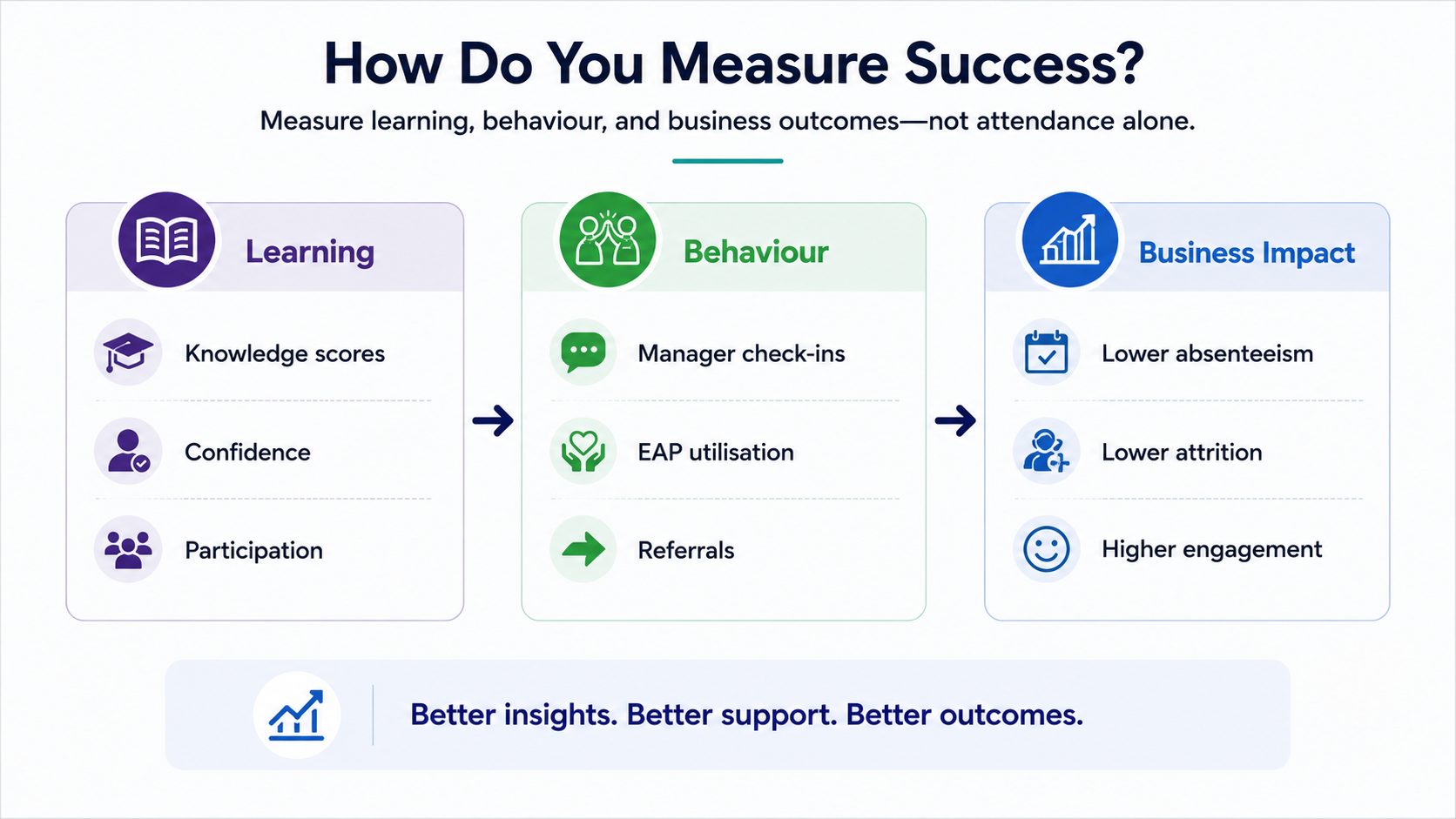
Set your measurement framework before the program launches, not after. Track:
- Participation rates by department, seniority level, and location
- Knowledge retention: pre- and post-training assessment scores
- Behaviour change: manager confidence and competence surveys, 90 days post-training
- Utilisation: EAP uptake rates before and after training (a reliable proxy for whether training is connecting people to support)
- Business metrics: absenteeism, attrition, and employee engagement scores at 6 and 12 months
No single metric tells the whole story. Use a combination of leading indicators (knowledge, confidence) and lagging indicators (absenteeism, attrition) to build a complete picture.
Best Practices for Successful Mental Health Training Programs
The gap between a workplace mental health training program that works and one that does not is rarely about the content. It is almost always about implementation, leadership behaviour, and sustainability.
Make It Ongoing, Not a One-Off
The single most common failure mode in workplace mental health programs is the annual mental health day with a motivational speaker and no follow-up. One-time training changes knowledge temporarily. Sustained change requires reinforcement: monthly mental health communications, integration into team meeting agendas, refresher training every 12 to 18 months, and peer champion programs that keep the conversation alive between formal training events.
Integrate Mental Health Support for Employees Into Onboarding
Employees who learn from day one that the organisation takes mental health seriously behave differently from those who discover the EAP three years into their tenure when they are already in crisis. Include mental health support resources, EAP details, and basic awareness content in every onboarding program.
Train Leaders to Model Vulnerability
Psychological safety is built through observed leadership behaviour more than any training content. When a senior leader references their own therapy, their own experience of burnout, or their own use of the EAP, it shifts the organisational norm in ways that a training session cannot. This does not require disclosure of private health information. It requires leaders who are willing to model openness and authenticity at work.
Adapt for a Diverse Workforce
India's corporate workforce is linguistically, generationally, and culturally diverse in ways that matter for mental health training design. Content must work across languages (or be delivered in regional languages where English is not the primary working language of a team). Generational differences in stigma, help-seeking, and communication style require different approaches for a 25-year-old and a 52-year-old.
Remote and hybrid workers need delivery formats and content adapted to their specific challenges: digital fatigue, isolation, and the dissolution of work-life boundaries in home environments.
Connect Training to Real Support
Mental health training for employees that builds awareness without connecting to accessible, confidential, professional support creates awareness of a gap that the organisation then does not fill. This is counterproductive. Every program should be designed in tandem with a robust EAP or equivalent mental health support infrastructure.
1to1help's EAP model, for example, provides employees with direct access to qualified counsellors, typically within 24 to 48 hours, with full confidentiality from the employer. Training that points employees clearly toward this kind of support dramatically increases uptake.
Hold Leaders Accountable
Include mental health indicators in manager performance reviews. Not in a punitive way: measuring whether a manager has completed their own training, whether their team's EAP utilisation is in a healthy range, and whether their team reports psychological safety in engagement surveys creates accountability without surveillance.
Common Challenges and How to Address Them
Stigma and Resistance
Stigma is the most cited barrier to mental health training uptake in Indian organisations. Employees fear that participation signals weakness. Managers fear that asking about an employee's mental health crosses a professional line. Senior leaders fear that acknowledging mental health challenges signals vulnerability about the organisation.
The most effective counter to stigma is not more content about stigma. It is leadership behaviour. When the CEO mentions their own experience with stress in a company communication, stigma among the wider workforce drops measurably.
Communication strategies matter too: framing mental health in performance language ("how we manage our mental fitness") rather than pathology language ("how we deal with mental illness") can increase initial engagement.
Low Participation
If participation rates are low, the problem is almost never that employees do not care about mental health. It is that they do not trust the employer's motives, do not believe the program is relevant to them, or cannot access it practically (timing, format, language).
Solutions: make senior leaders the visible first participants; offer multiple format options; ensure content is directly relevant to employees' actual roles and stressors; address confidentiality concerns explicitly before asking employees to engage.
Budget Constraints
Budget is a genuine constraint in many Indian organisations, particularly mid-market companies. The most effective response is phased implementation: prioritise manager training first (highest impact per rupee spent), integrate EAP referral paths into existing HR touchpoints, and use peer champion models that scale mental health support without scaling cost proportionally.
Sustaining Momentum After Launch
The energy that characterises a program launch typically dissipates within three to six months without deliberate reinforcement. Assign internal ownership clearly (not just to HR, but to a mental health champion or wellbeing committee), schedule reinforcement activities into the annual calendar before the program launches, and build mental health metrics into your regular employee engagement surveys so that progress is tracked and visible.
Measuring What Matters
Some of the most important outcomes of mental health training, such as reduced stigma, increased psychological safety, and shifts in organisational culture, are genuinely difficult to measure. Do not let the difficulty of measuring intangible outcomes push you toward measuring only what is easy. EAP utilisation rates, manager confidence scores, and qualitative feedback from focus groups tell a richer story than absenteeism data alone.
Mental Health Training for Specific Industries in India
Different industries generate different mental health risks. Training that acknowledges and addresses the specific stressors of each sector is significantly more credible and effective than generic content.
IT and Tech
India's IT sector combines high performance pressure, frequent layoffs, always-on client expectations across time zones, and rapid skill obsolescence into a sustained anxiety environment. Mental health first aid training is particularly high-value here given that engineers and developers often experience and express distress differently from client-facing roles. Burnout, imposter syndrome, and technostress require specific content. Remote and hybrid work has added isolation and digital fatigue to an already demanding context.
Healthcare
Healthcare workers face a distinct cluster of risks: burnout, compassion fatigue, secondary trauma, and moral injury (the distress that occurs when professional obligations conflict with ethical values). Workplace wellness training in healthcare must go beyond general stress management to address these specific conditions. Peer support programs, where trained healthcare workers support colleagues, have strong evidence in this sector and are well-suited to India's hospital and clinic structures.
BFSI (Banking, Financial Services, Insurance)
Performance pressure, compliance demands, and client-facing stress create high baseline anxiety in BFSI. The sales-driven culture of many BFSI organisations also creates specific risks: fear of missing targets, public performance reviews, and high-consequence decision environments. Mental health awareness training in BFSI needs to address the cultural norm of stoicism and performance identity that makes disclosing distress feel professionally dangerous.
Manufacturing and Frontline Roles
Frontline workers in manufacturing, logistics, and retail often have the least access to workplace mental health programs and the most exposure to physically and psychologically demanding conditions. Shift work, physical safety concerns, noise, and limited autonomy all increase mental health risk.
Corporate mental health training designed for knowledge workers frequently does not translate to this context. Frontline-appropriate programs are shorter, delivered in vernacular languages, and integrated into existing safety training frameworks rather than positioned as separate HR initiatives.
FAQs
1. How often should employees receive mental health training?
Annual refresher training is the minimum effective frequency for sustaining knowledge and behaviour change. For mental health first aid training specifically, recertification every two to three years is standard. However, frequency matters less than continuity: an organisation that delivers one formal training session per year but reinforces it through monthly communications, peer champion programs, and manager check-ins will achieve better outcomes than one that runs quarterly training with no follow-through in between.
2. What is the average cost of workplace mental health training in India?
Cost varies significantly with program type, provider, workforce size, and delivery format. Awareness training programs for large groups can range from INR 5,000 to INR 30,000 per session. MHFA certification programs typically range from INR 8,000 to INR 20,000 per participant. Comprehensive EAP-integrated training programs are usually structured as annual per-employee contracts, with pricing varying by headcount and service level. The relevant comparison is not the cost of training but the cost of untreated mental health conditions in your workforce: attrition, absenteeism, and productivity losses almost always exceed the investment significantly.
3. How long does mental health training take?
Mental health awareness training sessions typically run between 90 minutes and half a day. Mental health first aid certification requires approximately eight hours, usually delivered over one or two days. Manager-specific mental health training typically runs between three and six hours. Stress management and resilience programs can range from a single half-day workshop to a structured eight-week MBSR program. The right duration depends on the depth of behaviour change you are trying to produce, not on calendar convenience.
4. Is mental health training mandatory in India?
There is no single national mandate requiring workplace mental health training in India at the time of writing. However, several sector-specific and context-specific obligations apply. Organisations with POSH committees have training obligations that now often extend to psychological safety. SEBI-listed companies face growing ESG disclosure requirements that include employee wellbeing metrics. Healthcare organisations are subject to occupational health standards that increasingly include psychosocial risk. Independent of legal requirements, organisations with more than 50 employees face a practical obligation: the scale of unaddressed mental health need in any workforce of that size generates costs that are measurable and preventable.
5. What should be included in mental health training?
A comprehensive workplace mental health training program should cover: basic mental health literacy (what common conditions are and how they present), stigma reduction, mental health first aid skills for managers, stress and burnout prevention, available support resources (EAP, helplines, HR processes), and psychological safety principles. The precise mix depends on your audience. Employee mental health training emphasises awareness and self-help. Manager training emphasises identification, supportive conversation, and referral. Executive training emphasises strategy, accountability, and modelling.
6. How do you measure the success of mental health training?
Measure across three dimensions. Knowledge and confidence: pre- and post-training assessments show whether participants' understanding has changed. Behaviour: follow-up surveys 90 days post-training measure whether managers are applying what they learned, and EAP utilisation rates indicate whether employees are connecting to support. Business impact: absenteeism data, attrition rates, and employee engagement scores at 6 and 12 months provide the lagging indicators that matter most to senior stakeholders. No single metric is sufficient. A dashboard that combines all three dimensions gives the most accurate picture of whether training is producing real change.
7. Can mental health training prevent workplace incidents?
Yes, with an important qualification. Mental health training reduces the risk of crises escalating to critical incidents by equipping people to recognise warning signs early and respond appropriately. Mental health first aid training specifically trains participants to assess suicide risk, respond to acute distress, and make appropriate referrals. It does not eliminate risk entirely, and it does not replace professional mental health care. Organisations that combine MHFA training with accessible EAP services, clear crisis protocols, and psychologically safe team cultures see the most significant reductions in severe incidents.
Final Note
Amit's story does not end with that resignation. Six months later, his company piloted a manager mental health training program. Amit was in the second cohort. The session on recognising burnout in direct reports stopped him mid-scenario. He recognised his own team. He recognised himself.
After the training, he started having brief, structured check-ins with each team member. Not performance reviews: human conversations. Within four months, one team member disclosed anxiety that had been affecting her work for a year. Amit knew what to say, and more importantly, he knew what not to say. He referred her to the company EAP. She accessed counselling. She is still with the organisation.
That is what workplace mental health training makes possible at the individual level.
At the organisational level, it makes possible something larger: a workforce where mental health support for employees is not a crisis response but a structural commitment. Where employee mental health training is not an annual checkbox but an ongoing investment. Where corporate mental health training programs are evaluated with the same rigour as technical skills development, and where the results, lower attrition, higher engagement, fewer crises, are visible and attributed correctly.
The case for workplace mental health programs in India has never been stronger. The gap between what most organisations currently offer and what their employees actually need has never been more visible. Mental health first aid training, awareness programs, manager capability building, psychological safety frameworks, EAP integration: all of these can be implemented effectively with the right planning and support.
The first step is the most important one: deciding that the wellbeing of your workforce is worth measuring, investing in, and taking seriously. Everything in this guide follows from that decision.
If you want to understand what a structured workplace mental health training program could look like for your organisation, [request a demo with 1to1help].
Where to Get Support
- 1to1help EAP: Confidential counselling for employees through your organisation's Employee Assistance Programme.
- Tele MANAS: 14416 (free, 24/7, government-supported mental health helpline)
- iCall: 9152987821 (TISS-backed confidential counselling)
References
- World Health Organization. (2022). Mental health at work [Fact sheet]. https://www.who.int/news-room/fact-sheets/detail/mental-health-at-work
- World Health Organization. (2016, April 13). Investing in treatment for depression and anxiety leads to fourfold return [Press release]. https://www.who.int/news/item/13-04-2016-investing-in-treatment-for-depression-and-anxiety-leads-to-fourfold-return
- World Health Organization & World Bank Group. (2016, April 13). Investing in treatment for depression and anxiety leads to fourfold return [Press release]. https://www.worldbank.org/en/news/press-release/2016/04/13/investing-in-treatment-for-depression-anxiety-leads-to-fourfold-return
- World Health Organization. (2022). Guidelines on mental health at work. https://www.who.int/publications/i/item/9789240053052
- Gururaj, G., Varghese, M., Benegal, V., et al. (2016). National Mental Health Survey of India, 2015-16: Prevalence, patterns and outcomes. NIMHANS Publication No. 129. https://indianmhs.nimhans.ac.in/phase1/Docs/Report2.pdf
- Edmondson, A. C. (1999). Psychological safety and learning behavior in work teams. Administrative Science Quarterly, 44(2), 350-383. https://dash.harvard.edu/entities/publication/13a7b031-0fdd-45ec-a7e0-2b80e2bc679f
- Morgan, A. J., Ross, A., & Reavley, N. J. (2018). Systematic review and meta-analysis of Mental Health First Aid training: Effects on knowledge, stigma, and helping behaviour. PLOS ONE, 13(5), e0197102. https://journals.plos.org/plosone/article?id=10.1371/journal.pone.0197102
- Ministry of Law and Justice, Government of India. (2017). The Mental Healthcare Act, 2017. https://www.indiacode.nic.in/bitstream/123456789/2249/1/A2017-10.pdf
- iCall, Tata Institute of Social Sciences. https://icallhelpline.org
- Tele MANAS, Ministry of Health and Family Welfare, Government of India. https://telemanas.mohfw.gov.in


.svg)
.svg)
.svg)
.svg)