

.png)


.png)

Mental Health Concerns
Burnout: Meaning, Symptoms, Stages & How to Recover: India Guide 2026

.png)
Written by
Aarohi Parakh,
Psychologist and Content Writer

Reviewed by
Sanjana Sivaram,
Psychologist and Clinical Content Head


Introduction
It is 11 PM on a Wednesday. Priyank, a 29-year-old marketing executive in Delhi, is still online. Not because there is a genuine emergency, but because being online has become his default state. He cannot remember the last time he felt genuinely rested. He completed his campaign goals this week, but felt nothing. Not proud, not relieved. Just depleted. He is not lazy. He is not depressed. He is burned out.
Priyank's experience is not unusual. It is not even remarkable by the standards of India's current working culture. What is remarkable is how rarely it is named, addressed, or taken seriously before it becomes a full collapse.
This guide covers everything you need to understand about burnout: what it means, how to recognise it across its 3 stages and 12 progressive phases, why India's workplaces are particularly vulnerable, how to recover, and how managers and organisations can prevent it from taking a strong hold in the first place.

What is Burnout? Meaning & Definition
Burnout meaning, in its most direct definition: burnout is a state of chronic physical and emotional exhaustion caused by prolonged, unmanaged workplace stress. It is not the same as having a bad week. It is what happens when the accumulation of weeks and months of overdemand finally empties a person out.
The World Health Organisation defines burnout as an occupational phenomenon — not a medical condition, characterised by three dimensions: exhaustion (complete depletion of emotional and physical energy), cynicism or depersonalisation (detachment and indifference toward work), and reduced professional efficacy (the feeling that nothing you do makes a difference). In 2019, WHO formally included burnout in ICD-11 as 'QD85 Burn-out', giving it clinical recognition as an occupational syndrome for the first time.
Burnout vs Stress vs Depression: Key Differences
These three conditions are frequently confused, and that confusion matters because the interventions differ. Misidentifying burnout as stress leads to quick fixes or fast solutions (a long weekend, a motivational talk) that do not address what is actually happening.

India-specific context: Sapien Labs' Global Mind Health Report 2025 found that Indian youth aged 18-34 score an average of 33 on the Mental Health Quotient (MHQ) scale, against a global average of 66. This gap reflects the structural nature of mental health strain in India's young, high-pressure workforce, and burnout is a significant contributor.
💡Pro-tip: If you are unsure whether what you are experiencing is stress or burnout, ask yourself: would a four-day weekend help? If the answer is yes, it is likely stress. If a month off sounds exhausting too, or you cannot imagine feeling motivated again regardless of the break, that points toward burnout. Accurate identification matters because it determines the right recovery approach.
The 3 Stages & 12 Phases of Burnout: Where Are You At?
Most people think of burnout as a sudden crash or something that happens quickly. In reality, it is a slow, progressive erosion. Understanding the stages enables early identification, which dramatically improves recovery time and outcomes.
Maslach's 3 Dimensions of Burnout
Christina Maslach, a psychologist at University of California, Berkeley, played a pivotal role in bringing burnout into mainstream scientific and public discourse. Although the term had been used informally before the 1970s, her work gave it a formal definition, outlined its key risk factors, and led to the development of the most widely used instrument for assessing burnout.
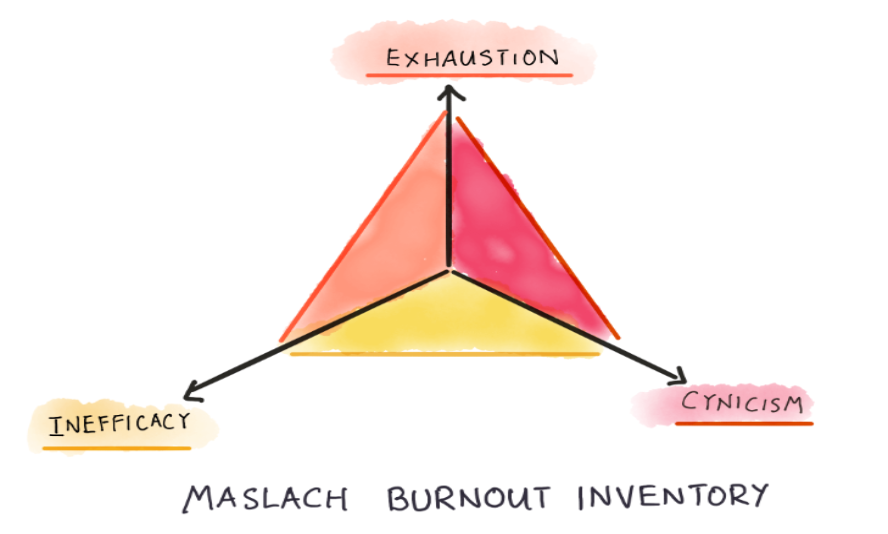
The Maslach Burnout Inventory (MBI), available via Mind Garden, is the gold-standard psychometric tool used by occupational psychologists and HR professionals worldwide to measure burnout severity across three dimensions:
- Emotional Exhaustion: feeling completely drained; dreading the start of each day; having nothing left to give to colleagues or clients
- Depersonalisation (Cynicism): emotional distancing from your work and the people in it; treating clients, colleagues, or tasks with indifference or contempt
- Reduced Personal Accomplishment (Inefficacy): the growing conviction that your efforts do not matter and your work has no value
MBI exists in three versions: MBI-Human Services Survey (for healthcare and social work professionals), MBI-Educators Survey, and MBI-General Survey (for all other occupational groups). HR professionals in India who want a clinical baseline measure of team burnout can access the MBI through Mind Garden. For individual self-assessment, free, adapted versions are available online, though they should be interpreted alongside professional guidance.
Interestingly, Maslach notes that feelings of cynicism was the greatest predictor of turnover; early development models of burnout modelled the process as three stages:
a) job stressors (an imbalance between work demands and individual resources),
b) individual strain (an emotional response of exhaustion and anxiety), and
c) defensive coping (changes in attitudes and behavior, such as greater cynicism).
Put simply: your work begins to demand more than you can sustain, leading to anxiety and emotional exhaustion; you then distance yourself by becoming cynical about your job, and eventually, you disengage or leave altogether.
The 12 Phases of Burnout: A Progressive Map
Herbert Freudenberger and Gail North conceptualised burnout as a gradual, multi-stage process rather than a sudden breakdown. The model traces how early overcommitment can evolve into emotional, behavioural, and physical exhaustion over time.
Below is the progression, with each phase illustrated through an Indian workplace lens for practical understanding:
1. Compulsion to Prove Oneself
- This describes a seemingly positive drive to perform well at work. Strong internal pressure to demonstrate value and commitment
- Example: Volunteering for extra tasks, replying to emails or Teams messages late at night to appear dedicated
2. Working Harder
- Increasing effort with diminishing boundaries. Taking on more work than you can deliver.
- Example: Taking on multiple projects simultaneously, skipping lunch breaks, avoiding leave despite entitlement
3. Neglecting Personal Needs
- Basic self-care begins to erode. Personal needs come second, or even third, to your work.
- Example: Skipping meals, reduced sleep, no time for exercise or family, saying “I’ll rest after this deadline”
4. Displacing Conflict
- Stress is redirected outward instead of being acknowledged. Instead of looking inward to see what you could do differently or considering what changes you could make, you become anxious and threatened.
- Example: Irritability at home, snapping at colleagues, blaming others rather than recognising work pressure
5. Revision of Values
- Shift in priorities where work dominates life. At this stage, you may change or alter your personal values in order to better meet your work obligations and ambitions.
- Example: Cancelling personal plans repeatedly, valuing appraisals and targets over health or relationships
6. Denying Emerging Problems
- Minimising or dismissing early warning signs. Behavioral changes become more apparent to others around you, though you may still deny there’s an issue.
- Example: Saying “I’m just tired” or “This is normal in our field,” despite clear exhaustion
7. Withdrawal
- Social disengagement and emotional distancing. Workplace stress continues to mount as your support system diminishes. At this stage, susceptibility to substance use coping mechanisms may increase.
- Example: Avoiding team calls, eating lunch alone, becoming inactive in office WhatsApp groups
8. Observable Behavioural Changes
- Noticeable decline in performance and consistency. You may even start to fail to adhere to personal responsibilities.
- Example: Missing deadlines, making errors in routine tasks, reduced productivity despite long hours
9. Depersonalisation
- Emotional detachment and mechanical functioning. You fail to see yourself or your relationships as valuable and start to make it through each day on ‘autopilot’.
- Example: Feeling robotic at work, not caring about quality, disconnecting from colleagues or clients
10. Inner Emptiness
- Persistent sense of void leading to coping through escape. Physical symptoms typically worsen, and your productivity continues to decline. At this stage, individuals are very vulnerable to the use of substances or engaging in other forms of addiction as a way to cope with stress or simply to “feel something.
- Example: Excessive scrolling, binge-watching, increased alcohol use, or emotional eating after work
11. Depression
- Here this term is used colloquially as opposed to a clinical form of depression (though this may follow if healthy coping mechanisms are not implemented). You may feel completely exhausted emotionally, mentally, and physically. At this stage, you may become unable to function as you normally would in many aspects of life.
- Example: Sleep disturbances, low mood, tearfulness, difficulty concentrating, struggling to get through the workday
12. Full Burnout Syndrome
- Complete physical and psychological exhaustion. Medical attention may be required, and many find they now need to take extended leave from work to adequately recover.
- Example: Inability to continue working, frequent sick leaves, or needing to step away from work entirely
How to Read This Map
Burnout does not always follow a perfectly linear path, and individuals may move back and forth between phases. However, the progression highlights a critical insight. Burnout does not start with collapse. Burnout typically begins with over-involvement, not disengagement. What looks like dedication in the early phases can gradually shift into exhaustion, detachment, and reduced functioning when recovery is consistently postponed.
💡Key Insight: Most people who eventually reach full burnout (Phase 12) can, on reflection, identify clear signals from Phases 3-6 that they ignored or dismissed. Building a habit of regular self-check-ins, particularly around neglect of personal needs and emotional flatness at work, creates the early warning system that prevents later collapse.

Burnout in India: The IT Sector, Startups, Healthcare & Beyond
Indian workplace culture, stress, and burnout are not marginal phenomena. It is a structural feature of how significant portions of the Indian economy operate. The sectors below each present distinct burnout pathways, but share a common root: a culture that treats exhaustion as a sign of commitment rather than a warning sign.
IT and Tech: The 60-Hour Default
India's IT sector employs over 6 million people. Research documents project delivery phases involving an average 50-hour working week, with after-hours availability via WhatsApp and Teams treated as an implicit job requirement. The 2023-24 tech layoff wave added job insecurity as a further stressor. The result is an entire sector operating in a state of chronic hypervigilance, precisely the conditions Maslach identified as the primary driver of burnout.
For an in-depth look at how burnout manifests in Indian workplaces and how organisations can respond, see our companion guide on employee burnout in India: signs, causes, recovery, and prevention.
Startup Culture: When Hustle Becomes Harmful
India's startup ecosystem has built a cultural mythology around overwork. 'Hustle culture' is not just tolerated in early-stage companies; it is celebrated. Founders and early employees in particular, operate without the role clarity, boundary structures, or emotional support that established organisations at least nominally provide. When the company struggles, the personal identity of those inside it often struggles with equal severity.
Teaching: India's Most Under-Documented Burnout Crisis
Teacher burnout in India is widespread and nearly invisible in policy discussions. Underpaid, managing class sizes of 40-60 students, navigating increasingly demanding parents and administrative compliance requirements, and lacking access to any mental health support infrastructure, India's teachers represent one of the largest unaddressed burnout populations in the country.
Healthcare Workers: The Post-COVID Residue
The pandemic produced a generation of healthcare professionals operating well beyond any sustainable limit. Research suggests the presence of clinically significant burnout symptoms among doctors, nurses, and ASHA workers in India's public health system. Unlike IT burnout, healthcare burnout frequently carries compassion fatigue as an additional layer: the particular exhaustion that comes from caring deeply for people in distress, over and over, without recovery time.
Gig Workers: Burnout Without the Safety Net
India's 7.7 million gig workers, delivery executives, cab drivers, and platform freelancers face a form of burnout that receives the least attention. There are no EAPs, no mental health policies, no HR departments. The burnout is physical, financial, and social simultaneously. Ratings and income targets keep people in a constant cycle with no real break.
Social Media Burnout: The Always-On Audience
For content creators, social media managers, and personal users with high usage, social media burnout is real and growing. Constant comparison, the pressure to post consistently, and the physiological effect of dopamine-driven scrolling all produce exhaustion patterns that mirror occupational burnout.
Strategies for managing it: schedule fixed, limited social media windows (20 minutes twice daily), turn off all notifications, conduct a 7-day full digital detox, and curate your feed to remove accounts that trigger comparison or anxiety.
Burnout Symptoms: Physical, Emotional, Cognitive & Behavioural Signs
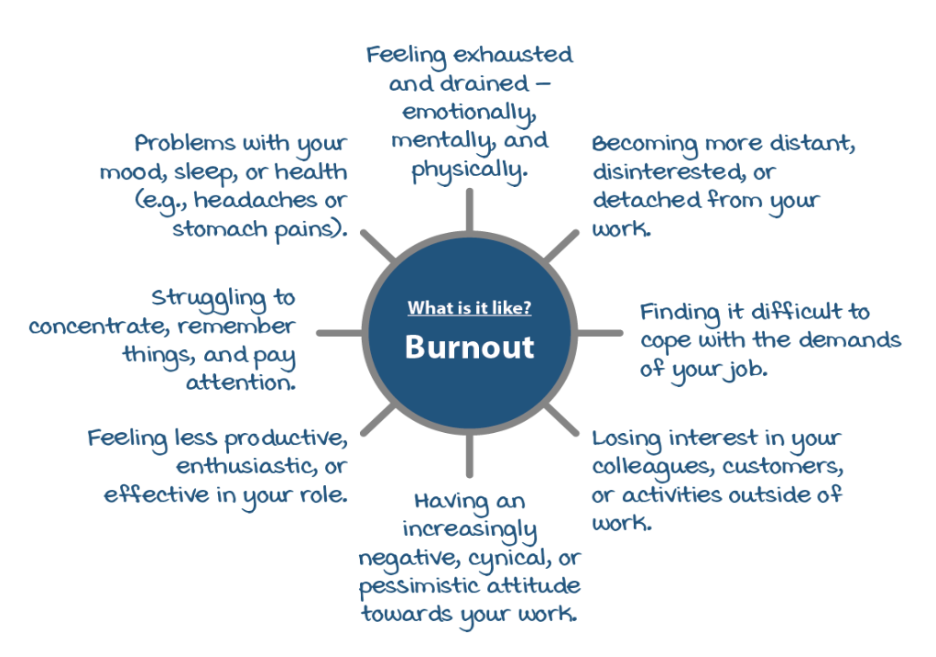
Burnout does not announce itself with a single dramatic event. It accumulates across every dimension of a person's functioning. The table below maps burnout symptoms by category, making it easier to identify the pattern rather than dismissing individual symptoms as isolated incidents.
Physical
Chronic fatigue that does not improve with rest or sleep; frequent colds and infections; persistent headaches; muscle tension or pain; sleep disruption (insomnia or hypersomnia); appetite changes; gastrointestinal issues
Emotional
Cynicism and detachment from work and colleagues; loss of satisfaction in tasks you once enjoyed; emotional numbness; dread before the working week; irritability disproportionate to triggers; sense of helplessness
Cognitive
Difficulty concentrating on routine tasks; forgetfulness; reduced creativity and problem-solving capacity; indecisiveness; brain fog; errors in work that was previously effortless
Behavioural
Declining productivity despite longer hours; increased absenteeism; presenteeism (physically at desk, mentally absent); social withdrawal from colleagues; procrastination on even simple tasks; reliance on caffeine, alcohol, or screens to cope
Relational
Snapping at family members; withdrawal from friendships; inability to be emotionally present; increased domestic conflict driven by work-related frustration
10 Early Warning Signs: A Self-Check
If you are ticking more than five of the following, it is worth taking your experience seriously:
- Dreading the start of the working week from Sunday afternoon
- Feeling emotionally flat, even in situations that used to energise you
- Cynicism about colleagues, management, or the organisation's purpose
- Work quality declining despite the same or more hours invested
- Persistent fatigue that a weekend does not resolve
- Difficulty remembering tasks that used to be automatic
- Withdrawing from team conversations and social invitations
- Increasing reliance on caffeine, alcohol, or screens to function or unwind
- Physical symptoms with no clear medical cause: headaches, stomach issues, recurring colds
- A growing feeling that nothing you do makes a difference
Disclaimer: This checklist can be used for personal reflection on burnout symptoms and is not a diagnostic tool. For concerns about burnout or mental health, consult a qualified mental health professional.
Burnout Self-Assessment Checklist
Burnout Self-Assessment_MindTools, Burnout Self-Assessment_Psychology Today
Disclaimer: This checklist can be used for personal reflection on burnout symptoms and is not a diagnostic tool. For concerns about burnout or mental health, consult a qualified mental health professional.
Emotional Burnout vs Physical Burnout vs Compassion Fatigue
- Emotional burnout: primarily characterised by emotional exhaustion and cynicism; most common in roles with high interpersonal demand (sales, service, management)
- Physical burnout: predominantly bodily symptoms; more common in physically demanding or sleep-disrupting roles (healthcare night shifts, logistics, construction)
- Compassion fatigue: specific to roles involving sustained emotional care for others (social workers, nurses, teachers, counsellors); the depletion of empathic capacity through repeated exposure to others' suffering
Important Note: Burnout and depression share significant symptom overlap. If you are experiencing persistent hopelessness, inability to function in daily life outside of work, or thoughts of self-harm, please reach out to a mental health professional rather than treating it as burnout alone.
How to Recover from Burnout: A Step-by-Step Guide for Indians
Recovery from burnout is not a single conversation or a long weekend. It is a deliberate, staged process that addresses both the symptoms and the root cause. The timeline depends on severity: mild burnout may resolve in 2-4 weeks of deliberate recovery; moderate burnout typically requires 1-3 months and professional support; severe burnout can take 6 months to a year and may involve a career change or extended leave.

Burnout Recovery Plan
https://www.choosingtherapy.com/therapy-worksheets/burnout-recovery-plan/
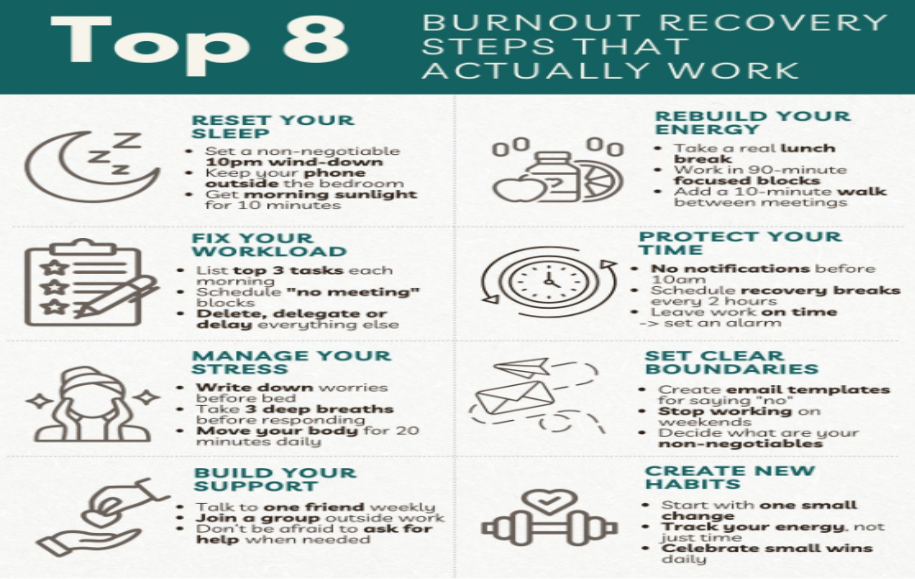
How to Manage Emotional Burnout Specifically
Emotional burnout responds particularly well to approaches that create distance between the self and the emotion:
- Journalling: 10 minutes of unfiltered writing at the end of the working day creates psychological decompression and reduces the mental 'overflow' that fuels emotional exhaustion
- Body scan meditation: a daily 10-15 minute practice of moving attention through the body, noticing and releasing tension, reduces the physical residue of emotional overload
- Emotional labelling: naming what you feel ('I am feeling overwhelmed', 'I am feeling resentful') reduces the amygdala's stress response; research by Dr Matthew Lieberman at UCLA shows affect labelling (the act of putting feelings into words) reduces emotional intensity measurably
- Deliberate social connection: loneliness amplifies emotional burnout; scheduling even brief, genuine connection with trusted people (not networking, not work socialising) provides meaningful buffer
💡Pro-tip: One of the most effective and underused tools for burnout recovery in India is planned use of earned leave, as research consistently shows that recovery requires psychological detachment and time away from chronic work stressors. India's professional workforce averages 15-21 earned leave days per year, yet SHRM India research suggests many employees use fewer than half of those days. Using leave before you need it medically is not an indulgence. It is occupational hygiene.
How to Deal with Employee Burnout as a Manager
If someone on your team shows burnout signs:
(1) have a private, empathetic conversation focused on how they are doing rather than their performance;
(2) ask directly what their workload feels like without penalising the honest answer;
(3) explore a temporary reduction in responsibilities or flexible hours;
(4) refer to your company's EAP if available;
(5) follow up. A single check-in is not support. Sustained, visible concern is.
For a detailed framework on how organisations can respond to employee burnout across the prevention, intervention, and recovery continuum, see our guide on employee burnout in India: signs, causes, recovery and prevention.
Burnout Prevention: Building a Resilient Work Culture in India
Recovery addresses burnout after it has taken hold. Prevention is what stops it from developing in the first place. The most effective prevention operates at three levels: individual, manager, and organisational.
Individual Level
- Sustainable work rhythms: protect non-negotiable recovery time daily, not just on weekends
- Energy management (not just time management): schedule demanding tasks when energy is highest; protect recovery time as deliberately as meeting time
- Regular digital detox: one full day per week without work notifications is minimum; a phone-free evening daily is more protective
- Maintain identity outside work: the employee whose entire identity is their job has no buffer when the job becomes untenable
Manager Level
- Regular 1:1s with genuine psychological safety: not just performance check-ins, but genuine 'how are you' conversations
- Realistic goal-setting: stretch goals that consistently require 50+ hours per week are not ambitious, they can be exploitative
- Recognition and appreciation: acknowledged effort reduces the 'reduced efficacy' dimension of burnout measurably
- Model healthy boundaries: managers who openly set limits on after-hours availability give their teams permission to do the same
Organisational Level
Forward-looking Indian organisations are adopting ISO 45003 (Psychological Safety at Work), implementing right-to-disconnect policies, and investing in Employee Assistance Programmes (EAPs) as standard infrastructure rather than exceptional provision. India's National Mental Health Programme also provides a policy framework that progressive employers are beginning to align with.
To translate intent into impact, organisations need structured, confidential, and scalable support systems. Partnering with established EAP providers such as 1to1help enables companies to offer employees access to professional counselling, crisis support, and preventive mental health resources. This ensures that support is not only available but also accessible, stigma-free, and integrated into everyday workplace culture.
For organisations looking to proactively address burnout, investing in a robust EAP is no longer optional. It is a strategic component of employee well-being, retention, and sustained performance.
💡Key Insight: The single most protective factor against burnout at the organisational level is not the EAP, the wellness app, or the mindfulness session. It is the manager's behaviour. A manager who notices, asks, adjusts, and follows through prevents more burnout than any programme that runs alongside a culture of overdemand.
A Final Word
Priyank, the marketing executive from our opening, eventually took three weeks of earned leave. He did not check his laptop once. He slept, cooked, and frequently walked in a nearby park. He came back not fixed, but less empty. The process took months, not weeks. But it started with one honest acknowledgement: this is burnout, and I need to do something different.
That acknowledgement is where every recovery begins. You cannot address what you are unable to name.
If you are a manager or HR professional looking to understand and address burnout at the organisational level, our companion guide on employee burnout in India: signs, causes, recovery and prevention provides a full framework from identification through to systemic prevention.
Ready to Address Burnout in Your Workplace?
If your organisation is seeing signs of employee burnout, a structured and confidential EAP can play a critical role in both prevention and recovery while supporting overall performance.
1to1help offers:
- Confidential counselling for stress, burnout, and emotional concerns
- Multi-channel access including in-person, telephonic, and digital support
- Preventive care as well as crisis intervention
- Solutions tailored to Indian workplace realities and pressures
With insights from over 100,000 counselling sessions annually, their programmes show measurable impact, including meaningful reductions in burnout-related symptoms such as anxiety and low mood within a few sessions.
Addressing burnout is not just about offering support, it is about making sure employees can access it early, easily, and without hesitation.
FAQs
Q1. What does burnout mean?
Burnout is a state of chronic physical and emotional exhaustion caused by prolonged, unmanaged workplace stress. The World Health Organisation defines it as an occupational phenomenon with three dimensions: exhaustion (feeling completely drained), cynicism (detachment and indifference toward work), and reduced efficacy (doubting your ability to make a difference). Unlike everyday stress, burnout does not improve with a single rest day. It requires sustained recovery and, in moderate-to-severe cases, professional support. In India, burnout is increasingly prevalent in IT, healthcare, education, and startup sectors, driven by long work hours, poor boundaries, and a culture that glorifies overwork.
Q2. What are the early signs of burnout?
Early signs of burnout include dreading work on Sunday evenings, feeling emotionally flat even during activities you used to enjoy, declining work quality despite the same hours, increasing cynicism about your colleagues or organisation, and a growing sense that your efforts do not matter. Physical signs include persistent fatigue that does not resolve with sleep, frequent headaches, and recurring illness. Cognitive signs include difficulty concentrating and forgetting tasks that used to be automatic. A Maslach Burnout Inventory assessment provides a clinical measure if self-assessment is uncertain.
Q3. How long does it take to recover from burnout?
Recovery time depends on severity. Mild burnout may take 2-4 weeks of deliberate rest, boundary-setting, and lifestyle adjustment. Moderate burnout typically takes 1-3 months and benefits significantly from professional support. Severe burnout, where complete depletion has occurred, and depression may be co-present, can take 6 months to a year or longer and may require extended leave, therapy, and sometimes a career change. The most important factor is addressing the root cause: if the work environment is the problem, rest alone will not provide lasting relief.
Q4. Is burnout a mental illness?
Burnout is not classified as a mental illness in the traditional diagnostic sense, but it is included in ICD-11 as an occupational syndrome — a recognised clinical condition arising from the workplace context. While burnout itself is occupational and context-specific, it is closely linked to depression and anxiety disorders. Untreated burnout frequently develops into clinical depression, at which point professional mental health treatment (not just recovery strategies) becomes necessary. The distinction matters because burnout can be addressed through workplace changes and lifestyle interventions, while co-occurring depression requires clinical care.
Q5. What is the Maslach Burnout Inventory?
The Maslach Burnout Inventory (MBI), developed by Dr Christina Maslach, is the gold-standard psychometric tool for measuring occupational burnout. It assesses three dimensions: emotional exhaustion, depersonalisation (cynicism), and personal accomplishment (reversed). It is available via Mind Garden in versions tailored for healthcare workers, educators, and general workers. HR professionals and occupational psychologists in India increasingly use the MBI in workplace wellness assessments to quantify burnout severity and guide intervention planning at both individual and organisational levels.
Q6. How to handle social media burnout?
Social media burnout occurs when constant scrolling, comparison, and pressure to post leave you emotionally exhausted and anxious. Effective strategies include scheduling fixed, brief social media windows (20 minutes maximum, twice daily), disabling all push notifications, taking a 7-day complete digital detox to reset your baseline, and deliberately curating your feed to remove accounts that trigger comparison or anxiety. If you create content professionally, batch-produce and schedule in advance to remove the pressure of daily publishing. If social media anxiety persists beyond a digital detox, it is worth speaking with a psychologist.
Q7. How can managers help employees with burnout in India?
Managers are the most critical variable in preventing and recovering from burnout. Practical steps: conduct regular 1:1s focused on wellbeing, not only performance; ask directly about workload without penalising honest answers; reduce unnecessary meetings; recognise contributions publicly; and create genuine psychological safety. When burnout signs appear, offer flexible hours or a temporary workload reduction before waiting for sick leave. Refer to your company's EAP. In India specifically, managers who openly discuss their own stress and model healthy limits significantly normalise help-seeking in their teams.
Related Articles You May Find Helpful
References
- American Psychological Association. (n.d.). Burnout research. https://www.apa.org/members/content/burnout-research
- BBC Worklife. (2023). Hustle culture: Is this the end of rise and grind? https://www.bbc.com/worklife/article/20230417-hustle-culture-is-this-the-end-of-rise-and-grind
- Centers for Disease Control and Prevention. (n.d.). Myalgic encephalomyelitis/chronic fatigue syndrome (ME/CFS). https://www.cdc.gov/me-cfs/about/index.html
- Cleveland Clinic. (n.d.). Anxiety disorders. https://my.clevelandclinic.org/health/diseases/9536-anxiety-disorders
- Cleveland Clinic. (n.d.). Depression. https://my.clevelandclinic.org/health/diseases/9290-depression
- Cleveland Clinic. (n.d.). Stress. https://my.clevelandclinic.org/health/diseases/11874-stress
- Cleveland Clinic. (n.d.). Substance use disorder. https://my.clevelandclinic.org/health/diseases/16652-drug-addiction-substance-use-disorder-sud
- Cleveland Clinic. (n.d.). Brain fog. https://my.clevelandclinic.org/health/symptoms/brain-fog
- Cleveland Clinic. (n.d.). Gastrointestinal diseases. https://my.clevelandclinic.org/health/articles/7040-gastrointestinal-diseases
- Clinicles Alpes. (n.d.). The 12 stages of burnout. https://cliniclesalpes.com/blog/the-12-stages-of-burnout/
- Commoncog. (n.d.). A nuanced take on preventing burnout. https://commoncog.com/nuanced-take-on-preventing-burnout/
- Devaraj, R., & Gopalakrishnan, B. N. (2025, June 15). The burnout epidemic: Is it time for a right to mental health leave? MarketExpress Media Network.
- Emerald Publishing. (n.d.). Changing workplace demographics and the gig economy. https://www.emerald.com/er/article-abstract/47/6/862/1278939
- Forbes India. (2026). Economic Survey warns India’s gig economy rests on unstable work. https://www.forbesindia.com/article/budget-2026/economic-survey-warns-indias-booming-gig-economy-rests-on-unstable-work/2990824/1
- Healthline. (n.d.). Insomnia vs hypersomnia. https://www.healthline.com/health/insomnia/insomnia-vs-hypersomnia
- Healthline. (n.d.). Body scan meditation. https://www.healthline.com/health/body-scan-meditation
- Indian Express. (2025). India youth mental health ranking global report. https://indianexpress.com/article/health-wellness/india-youth-mental-health-ranking-global-report-10552827/
- Investopedia. (n.d.). Presenteeism. https://www.investopedia.com/terms/p/presenteeism.asp
- Journal Press India. (n.d.). Burnout among teachers and interventions. https://www.journalpressindia.com/gbs-impact-journal-of-multi-disciplinary-research/doi/10.58419/gbs.v10i2.1022416
- Make Headway. (n.d.). 12 stages of burnout. https://makeheadway.com/blog/12-stages-of-burnout/
- McKinsey Health Institute. (2023). Employee mental health and burnout in Asia: A time to act. https://www.mckinsey.com/featured-insights/future-of-asia/employee-mental-health-and-burnout-in-asia-a-time-to-act
- Mind Garden. (n.d.). Maslach Burnout Inventory (MBI). https://www.mindgarden.com/117-maslach-burnout-inventory-mbi
- Ministry of Health and Family Welfare, Government of India. (n.d.). National Mental Health Programme. https://dghs.mohfw.gov.in/national-mental-health-programme.php
- NASSCOM. (2026). Technology sector in India: Strategic review 2026. https://nasscom.in/knowledge-center/publications/technology-sector-india-strategic-review-2026
- Positive Psychology. (n.d.). Benefits of journaling. https://positivepsychology.com/benefits-of-journaling/
- Providence Treatment. (n.d.). The 12 stages of burnout: Identification, prevention, treatment. https://www.providencetreatment.com/addiction-blog/the-12-stages-of-burnout-identification-prevention-treatment/
- Psychology Today. (n.d.). Burnout test. https://www.psychologytoday.com/us/tests/career/burnout-at-work
- Psychology Today. (n.d.). Compassion fatigue. https://www.psychologytoday.com/us/basics/compassion-fatigue
- Psychology Today. (n.d.). Procrastination. https://www.psychologytoday.com/us/basics/procrastination
- Scott H. Young. (2026). Manage energy, not time. https://www.scotthyoung.com/blog/2026/01/14/manage-energy-not-time/
- The Live Love Laugh Foundation. (n.d.). Social media and youth mental health in India. https://www.thelivelovelaughfoundation.org/blog/others/social-media-and-youth-s-mental-health-in-india
- Times of India. (2023). Indian IT employees working 50 hours a week. https://timesofindia.indiatimes.com/business/india-business/average-to-poor-work-life-balance-indian-it-sector-employees-forced-to-work-50-hours-a-week/articleshow/105348271.cms
- Verywell Mind. (n.d.). Emotional numbing symptoms. https://www.verywellmind.com/emotional-numbing-symptoms-2797372
- World Health Organization. (2019, May 28). Burn-out an occupational phenomenon (ICD-11). https://www.who.int/news/item/28-05-2019-burn-out-an-occupational-phenomenon-international-classification-of-diseases


.svg)
.svg)
.svg)
.svg)