


.png)


.png)

Personal Growth & Well Being
How to Control Your Mind: 11 Science-Backed Techniques to Master Your Thoughts

.png)
Written by
Aarohi Parakh,
Psychologist and Content Writer

Reviewed by
Sanjana Sivaram,
Psychologist and Clinical Content Head


Introduction: Why Your Mind Feels Out of Control (And Why That's Normal)
You have just finished a long day at the office in Mumbai, Bengaluru, or Hyderabad. You are home, dinner is done, and you finally sit down to rest. Then the cycle starts. Your mind replays that email you sent to your manager. It fast-forwards to the presentation due next Friday. It loops back to something you said in a team meeting three weeks ago. Or your mind races to the different possible versions of the conversation with your partner. By the time you notice it, your body is technically resting, but your brain is behaving like it has consumed three coffees. Sound familiar?
This is not a personal failing. It is simply how the human brain works by default. Research from Harvard University (Killingsworth and Gilbert, 2010) found that our minds wander roughly 47% of the time, and that mind-wandering is associated with lower happiness. According to the National Science Foundation, the average person has about 12,000 to 60,000 thoughts per day. Of those, 80% are negative, and 95% are repetitive in nature.
The brain has a structure called the Default Mode Network (DMN), which switches on whenever you are not actively focused on a task. It is essentially the brain's autopilot, generating ruminating thoughts about the past and anxiety about the future. In a demanding work environment, whether you are managing targets in a sales role, navigating office politics, or juggling a hybrid schedule, this autopilot is on overdrive.
Here is the key distinction that changes everything: the goal of learning to control your mind is not to create a blank, thought-free state. That is neither possible nor desirable. The real goal is to reduce the power that unwanted thoughts have over your mood, behaviour, and decisions. You are not trying to silence your mind. You are learning to be its manager, not its hostage.
💡Key Insight: You cannot stop thoughts from arising. What you can control is your relationship to those thoughts. That shift in perspective is where genuine mental freedom begins.
This guide explores science-backed techniques to stop overthinking, manage negative thoughts, regulate emotions, and take greater control of your mind and thought patterns. If your mind consistently feels chaotic despite your best efforts, it may be connected to underlying anxiety, burnout, or unresolved stress. These are conditions where professional support can make a measurable difference.
The Science of Mind Control — Why Your Brain Resists and How It Can Change
Before we get into techniques, it helps to understand what psychology actually tells us about how the mind works, and why some instinctive responses (like trying harder to push a thought away) can backfire completely.
Thoughts are not Facts
This is perhaps the most important psychological insight in this entire article. Your thoughts are temporary mental events. They are automatic, often irrational, and occasionally brilliant. But they are not facts, and they are not you. Acceptance and Commitment Therapy (ACT), developed by psychologist Steven C. Hayes, describes this as the difference between cognitive fusion and cognitive defusion.
Cognitive fusion is when you get entangled in your thoughts and treat them as literal reality. "I made a mistake in that report" becomes "I am incompetent." Cognitive defusion is the act of stepping back and observing a thought as just a thought. The defused version sounds like: "I am having the thought that I am incompetent." That subtle language shift changes your entire relationship to the thought without requiring you to fight it.
Cognitive Fusion vs. Cognitive Defusion
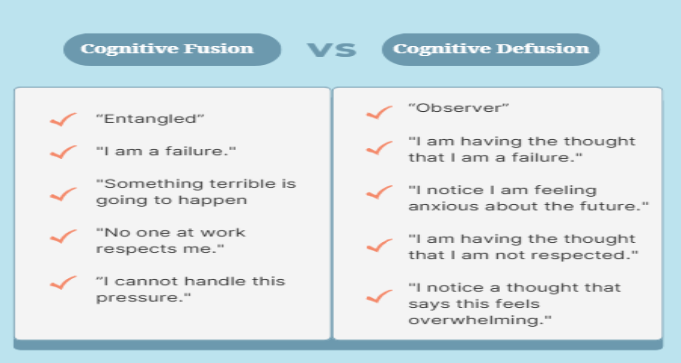
It is important to note that the thought content does not change. Your relationship to it does. And that can be a game-changer in how you perceive situations.
The Suppression Paradox
In 1987, social psychologist Daniel Wegner conducted a now-famous experiment. He asked participants not to think about a white bear. Within minutes, nearly everyone was thinking about white bears compulsively. This became known as the "ironic process theory" or the white bear experiment.
The research is clear: suppressing unwanted thoughts makes them more frequent and more intense. Trying not to think of something reliably increases how often you think of it. The counterintuitive answer is acceptance, not suppression. Let thoughts exist without fighting them, and they lose the charge that resistance creates.
Neuroplasticity: Your Brain Can Be Retrained
The hopeful science here is neuroplasticity. The brain is not a fixed structure. Consistent mental practice, including meditation, cognitive reappraisal, and journalling, physically strengthens the prefrontal cortex (the brain's executive control and rational decision-making centre) and reduces the dominance of the amygdala (the brain's emotional alarm system).
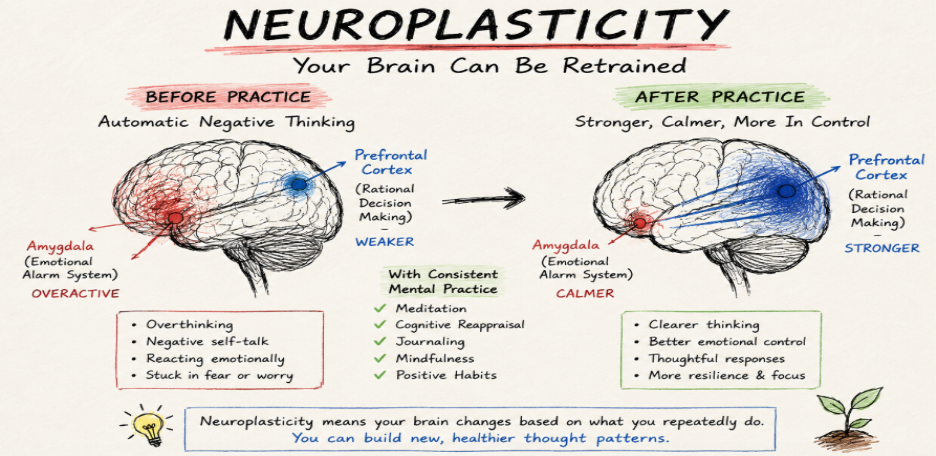
For example, someone who constantly spirals into thoughts like “What if I fail?” or “Something bad will happen” may automatically react with anxiety and overthinking. But when they repeatedly practise reframing those thoughts into “I can handle challenges as they come” or “This is uncertainty, not danger,” the brain gradually begins building stronger pathways for calmer, more balanced responses. Over time, the mind becomes less reactive because it learns to respond with perspective rather than automatically shifting into panic or fear.
💡Neuroplasticity Principle: Every mindful redirect, every time you notice a thought and choose how to respond, is a "psychological push-up" that literally rewires neural circuits over time. The mind is trainable. That is not just motivation. It is neuroscience.
The Mind-Body Connection
The brain and body function as a single integrated regulatory system rather than two separate entities. Physiological states such as breathing rate, muscle tension, posture, heart rate, and movement continuously send signals to the brain, influencing emotional processing, threat perception, attention, and thought patterns. Similarly, mental states such as stress, anxiety, or calmness produce measurable physiological changes throughout the body.
This two-way feedback loop is why body-based interventions like controlled breathing, exercise, grounding, and posture regulation can rapidly alter mental states. In many cases, regulating the body first reduces nervous system activation faster than attempting to reason with thoughts alone.
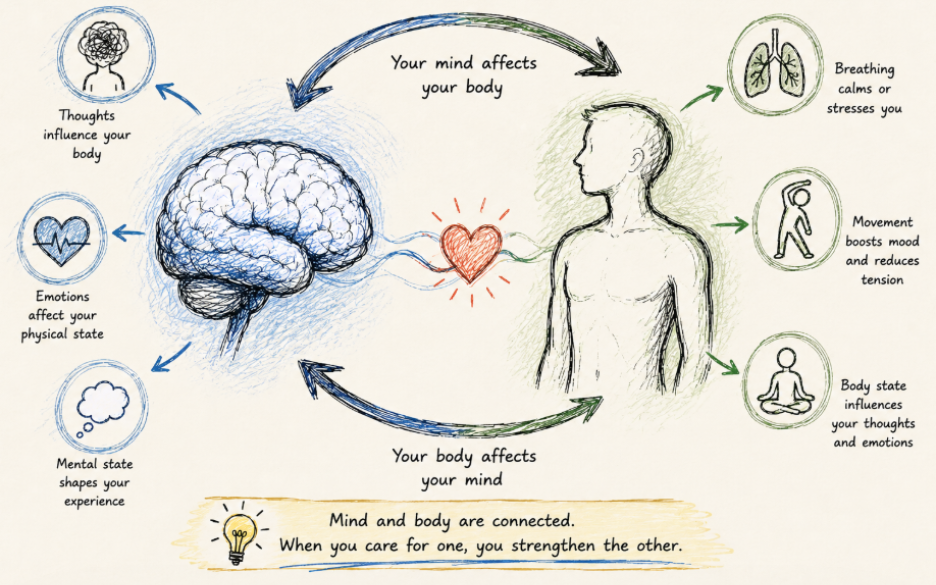
Benefits of Learning to Control Your Mind
The practical payoff of mastering your thoughts goes well beyond feeling calmer. Here is what research and clinical practice consistently show:
- Emotional regulation: the ability to respond rather than react. Controlled minds handle setbacks, difficult colleagues, and professional disappointment with greater composure.
- Reduced anxiety and stress: cognitive control techniques have been shown to reduce cortisol levels and improve stress resilience, particularly in high-pressure work environments.
- Better decision-making: mental flooding impairs the prefrontal cortex. A calmer mind makes more rational, values-aligned choices, particularly important in Indian workplaces where pressure and pace are relentless.
- Improved focus and productivity: mental chatter is the primary source of distraction. Controlling the mind means controlling attention, which is the foundation of all sustained, high-quality work.
- Stronger relationships: emotional reactivity driven by uncontrolled thoughts damages how we communicate with family, friends, and colleagues. Mental discipline improves empathy and conflict resolution.
- Greater self-confidence: when you are no longer at the mercy of your inner critic, you develop a more stable, grounded relationship with yourself.
- Better mental health outcomes: consistently shown to reduce symptoms of depression, anxiety, and overthinking, the three most common reasons people seek counselling support in India
How to Control Your Mind from Overthinking — Breaking the Rumination Loop
Overthinking is not just a bad habit. It is one of the most searched mental health concerns in India, and for good reason. The experience of lying awake at 2 a.m. running through every possible outcome of a difficult conversation, or spending three days mentally rehearsing how to handle a performance review, is exhausting in a way that is genuinely hard to explain to someone who has not felt it.
Overthinking is repeated, excessive focus on a problem or worry without moving towards resolution. Rumination is the specific pattern of dwelling on past events or perceived failures, replaying what happened, what you said, and what you should have done differently. Both involve the same brain mechanism (activation of the default mode network) and respond to the same interventions.
Why does overthinking feel so uncontrollable?
Because the brain interprets repeated thought as important. The more you engage with a thought, even to argue against it, the more you strengthen the neural pathway. "Just stop thinking about it" is genuinely not helpful advice, not because you are weak, but because it goes against how the brain actually works.
💡Indian Workplace Context: In many Indian corporate environments, the culture of being "always on," managing expectations across time zones, navigating hierarchical dynamics, and the stigma around appearing uncertain can fuel chronic overthinking. Recognising this as a systemic issue, not a personal weakness, is the first step.
4 Techniques to Stop Overthinking Right Now
- Name it and notice it
Label the thought pattern as "overthinking happening." Saying "there is a worry thought" creates immediate psychological distance. This is metacognitive awareness, i.e. conscious awareness of one’s thoughts, and it works because you become the observer, not the subject.
- The 5-minute worry window
Set aside a fixed “worry time” each day, such as 5 minutes at 6 p.m. Whenever an anxious thought shows up outside that window, mentally acknowledge it and postpone it until your designated worry time. Over time, this helps train the brain to contain intrusive thoughts instead of allowing them to spiral throughout the day.
- Physical interruption
Stand up, stretch, take 5 deep breaths, or walk to another room. Physical movement breaks the neurological loop of rumination by shifting the brain's attention to body sensations. It sounds simple. It works.
Name 5 things you can see, 4 you can touch, 3 you can hear, 2 you can smell, 1 you can taste. This forces sensory engagement with the present moment and breaks the cycle of overthinking by making the here and now feel more real than the imagined future.
Persistent overthinking is often a symptom of underlying anxiety, not just a thinking style. If these techniques feel insufficient, a counsellor can help you identify the deeper patterns driving your rumination.

How to Control Negative Thoughts — From Inner Critic to Inner Coach
There is an important distinction to make before we begin: occasional negative thinking is normal and human. It becomes problematic when negative thoughts are automatic, habitual, and self-directed. That inner voice that says "you are not good enough," "you are going to mess this up," or "everyone noticed that mistake" is what psychologists call the inner critic, and it is driven by identifiable thought patterns.
Cognitive Behavioural Therapy (CBT) has mapped these patterns in detail. They are called cognitive distortions, and recognising them is the first step to dismantling them.
Common Cognitive Distortions (and What They Sound Like)
All-or-Nothing Thinking
Seeing situations in extreme black-and-white categories with no middle ground, where one mistake feels like total failure. Example: “I made one mistake, so I’m terrible at my job.”
Catastrophising
Automatically assuming the worst possible outcome and treating small problems as major disasters. Example: “This one setback is going to ruin everything.”
Mind-Reading
Believing you know what others think about you without actual evidence, usually assuming the worst. Example: “They probably think I sound incompetent.”
Personalisation
Taking excessive responsibility for events and blaming yourself for outcomes beyond your full control. Example: “The whole situation went badly because of me.”
If you saw yourself in any of those, you are not alone. These are quite common. The good news is that they are also learnable, recognisable, and manageable. The following techniques are designed to help interrupt the cycle of overthinking and bring your mind back to a calmer, more grounded state.
Technique 1: Thought Labelling
When a negative thought arises, name the distortion type. "That is an all-or-nothing thought" or "that is catastrophising." This single act reduces the thought's perceived truth value. You are no longer inside the thought; you are looking at it.
Technique 2: The Cognitive Restructuring Challenge
Ask three questions of any negative thought: Is this thought based on fact or feeling? What is the evidence for it and against it? What would I say to a close friend who had this same thought? This is the core of CBT-based negative thought management, and it is one of the most researched and effective psychological tools available.
Technique 3: Self-Talk Reframing
Language shapes neural pathways. Replace "I cannot handle this" with "I am capable of managing this moment." Replace "I always fail" with "I sometimes struggle, and I learn from it." These are not toxic positivity scripts. They are accurate recalibrations of distorted thinking.
💡Pro-Tip: Indian professionals often face a double burden: high-pressure external expectations and an equally demanding internal critic. Treating yourself with the same professionalism and fair-mindedness you would extend to a colleague is not a weakness. It is a practical skill.
Technique 4: Gratitude Practice
A five-minute daily gratitude journal helps train the mind to focus less on negativity and more on positive experiences. Research consistently shows that gratitude journalling reduces symptoms of depression and increases subjective wellbeing over time. Even three specific, genuine entries per day, written rather than just thought, create measurable change.
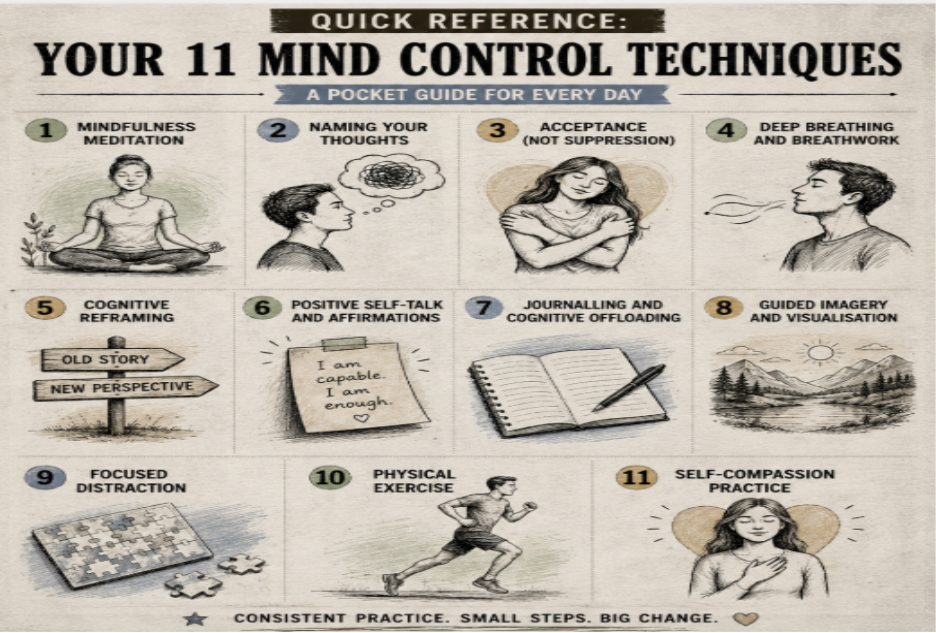
11 Techniques to Control Your Mind and Master Your Thoughts
These techniques are science-backed and drawn from clinical psychology, neuroscience, and mindfulness research. They are numbered deliberately because that structure matters for practice: it creates a menu you can return to, adapt, and build on over time.
1. Mindfulness Meditation
Mindfulness trains meta-awareness: the ability to observe thoughts without being consumed by them. Rather than attempting to clear the mind, you notice what arises, acknowledge it without judgement, and return attention to the present. Breath is the most common anchor, but body sensations, sounds, or a visual point of focus all work.
Even 10 minutes of daily mindfulness meditation measurably reduces rumination, anxiety, and emotional reactivity. Mindfulness-Based Stress Reduction (MBSR) consistently shows improvements across multiple meta-analyses. The practical entry point: try the Insight Timer app (free), or guided mindfulness sessions on YouTube. For Indian readers, yoga and pranayama are mindfulness practices that are culturally familiar, well supported by evidence, and equally effective.
Example: Instead of getting carried away by thoughts like “I’ll never finish all this work,” you notice the thought, return your attention to your breath, and ground yourself in the present moment.
Five minutes is a meaningful start. The goal is consistency, not duration.
2. Naming Your Thoughts
Silently label the category of thought as it arises: "worrying," "planning," "criticising," "replaying." This process helps the rational part of the brain become more active and reduces emotional reactivity.
Research from UCLA (Lieberman et al., 2007) showed that labelling emotions and thoughts reduces their subjective intensity. Neuroscientist and child psychiatrist Dr Dan Siegel coined the memorable phrase: "name it to tame it." It is not a gimmick. It is backed by neuroimaging data.
Example: During a late-night spiral about an upcoming appraisal, you pause and label the thought: “This is worrying” or “This is catastrophising.”
3. Acceptance (Not Suppression)
Acceptance is not agreement. It is not resignation. It is the willingness to let a thought exist without fighting it. When you stop resisting an unwanted thought, it loses the charge that resistance creates. This is one of the hardest techniques to grasp conceptually and one of the most powerful in practice.
Example: Before a presentation, instead of fighting thoughts like “What if I embarrass myself?”, you acknowledge the anxiety and continue preparing anyway.
A practical script: "I notice I am having the thought that [X]. I do not have to act on it. I do not have to believe it. I can let it be here without letting it run my day."
Research by Ford et al. (2018) found that accepting negative emotions, rather than suppressing or judging them, was associated with better psychological health.
4. Deep Breathing and Breathwork
Controlled breathing directly intervenes in the stress response by activating the parasympathetic nervous system, the body's rest-and-digest mode. When the body calms, the mind follows. This is one of the fastest-acting techniques available because it operates at a physiological level, not just a cognitive one.
Three techniques to try:
- 4-7-8 breathing (inhale for 4 counts, hold for 7, exhale for 8);
- box breathing (inhale 4, hold 4, exhale 4, hold 4); or
- simply 5 slow, deliberate diaphragmatic breaths.
Example: Right before joining a stressful Zoom meeting, you take five slow breaths and notice your body calming down slightly.
Pranayama practices like anulom vilom (alternate nostril breathing) are particularly effective and accessible for Indian practitioners.
5. Cognitive reframing (shifting perspective)
The same event can be interpreted through multiple lenses. Cognitive reframing asks: what else could this mean? Is there another way to see this that is equally valid? This is not toxic positivity. You are not pretending a situation is fine. You are questioning whether your first interpretation is the only valid one.
Example: “My manager gave me feedback because I’m failing” becomes “My manager believes I’m capable of improving.” The situation has not changed. The story you tell yourself about it has. That story shapes your next action.
6. Positive self-talk and affirmations
Your internal dialogue shapes how the mind processes experience. Replacing self-critical language with compassionate, accurate language is not self-deception. It is calibration. Effective affirmations are specific and believable: not "I am perfect," but "I am learning and growing." They shift neural pathways gradually through consistent repetition.
Example: Replacing “I always mess things up” with “I’m learning and improving with experience.”
A practical exercise: Identify your three most common negative self-talk patterns, and write one honest counterargument for each. Use them when those patterns arise. Specificity matters more than enthusiasm.
7. Journalling (cognitive offloading)
Writing externalises mental noise. It transforms abstract, swirling thoughts into visible, manageable words. This process, called "cognitive offloading," reduces the brain's working memory load and creates psychological space. It is particularly useful before sleep, when the mind tends to escalate unresolved thoughts.
A five-minute nightly brain dump: write every thought, worry, or unresolved feeling without editing or judgement. Follow it with three things that went well today and why. This combination addresses negative thought clearing and positive attention training in one sitting.
Example: Instead of replaying the same worries in bed, you write them down before sleeping and notice your mind feels lighter afterwards.
💡Pro-Tip: If you find journalling hard to maintain, try voice notes. Many Indian professionals find it easier to speak thoughts aloud during a commute than to write them down. The cognitive offloading effect is similar.
8. Guided imagery and visualisation
Deliberate mental imagery activates the same brain regions as actual experience. Visualising calm, confidence, or a successful outcome creates a physiological response that corresponds to those states. Research from 2014 found that guided imagery promotes a more positive mood and reduces stress and anxiety.
Example: Before an interview, you mentally picture yourself answering questions calmly and confidently instead of imagining everything going wrong.
A simple practice: Close your eyes, take three deep breaths, and mentally enter a specific peaceful scene, engaging all five senses. Spend three to five minutes. This works particularly well before a high-stakes meeting, presentation, or exam, or at bedtime when the mind tends to run.
9. Focused distraction
Sometimes the mind needs a genuine redirect rather than a direct confrontation. Engaging in an absorbing activity, calling a friend, going for an evening walk, cooking, or reading, breaks the loop of unhelpful thoughts by occupying attention with something real and present.
The important distinction: healthy distraction is temporary and chosen. Avoidance is using distraction to permanently escape from something that needs attention. The former is a valid mind-control technique. The latter compounds problems over time. Know which one you are using.
Example: Rather than endlessly replaying an awkward conversation, you go for a walk, cook dinner, or call a friend to interrupt the thought loop.
10. Physical exercise
Exercise releases endorphins (related to the feeling of pain), reduces cortisol (related to stress), and improves prefrontal cortex function. Regular aerobic exercise, even 20 to 30 minutes three times a week, has been shown to reduce anxiety, depression, and rumination as effectively as some medications in mild-to-moderate cases. This is one of the most underused mind-control tools available.
For Indian professionals with packed schedules, the barrier is often time, not motivation. Evening walks, yoga at home, using the office staircase, or a lunchtime stretching routine all count. The mind-body connection means that when the body is regulated, the mind is significantly easier to manage.
Example: After a stressful workday, even a 20-minute evening walk helps your mind feel less heavy and overstimulated.
11. Self-compassion practice
Dr Kristin Neff's research on self-compassion demonstrates that treating yourself with the same kindness you would offer a struggling friend significantly improves emotional regulation and reduces self-criticism. This is not about lowering your standards. It is about removing the unnecessary psychological tax of self-punishment.
Self-compassion has three components: self-kindness (rather than self-judgement), common humanity (recognising that struggle is part of being human, not evidence of personal failure), and mindfulness (holding thoughts in balanced awareness rather than over-identifying with them).
When a self-critical thought arises, ask yourself: "What would I say to a close friend having this exact thought?" Then say that to yourself. The gentleness is not weakness. It is precision.
Example: Instead of telling yourself “I’m so useless for making that mistake,” you respond the way you would to a friend: “You’re stressed and trying your best.”
💡Indian Context: In a culture where high achievement is often expected and self-criticism is normalised as "drive," self-compassion can feel counterintuitive. Research shows it actually improves performance by reducing the paralysing effects of fear of failure, not lowering the bar.
How to Control Your Mind and Emotions Together
Thoughts and emotions are not separate systems in humans. They form feedback loops that continuously feed into each other. A thought triggers an emotion ("this will go badly" creates anxiety). That emotion triggers more thoughts ("I feel anxious, so something must be wrong"). Learning to control your mind means understanding this loop and learning where to intervene.
The goal of emotional regulation is not to stop feeling. Emotions are important signals. The goal is to regulate their intensity so they do not overwhelm rational decision-making.
This involves three key skills:
- Identifying the emotion accurately ("I am not just stressed, I am afraid of being judged by my manager");
- accepting it without judgement; and
- Choosing your response rather than reacting automatically.
The STOP Technique for Emotional Flooding
Used in Dialectical Behaviour Therapy (DBT) and mindfulness-based approaches, the STOP technique is a four-step intervention for moments when emotions peak.

For example, imagine you send a message to your manager and do not receive a reply for several hours. Your mind immediately jumps to:
“Did I say something wrong?”
“Are they upset with me?”
“What if I messed up?”
Within minutes, anxiety escalates, and your brain begins creating worst-case scenarios. This is where the STOP technique can help interrupt the emotional spiral before it takes over.
- S — Stop: Pause before reacting impulsively.
- T — Take a breath: Slow your breathing to calm the nervous system.
- O — Observe: Notice what you are thinking, feeling, and assuming in that moment.
- P — Proceed mindfully: Respond intentionally rather than emotionally reacting.
Physical regulation first: When emotional intensity is very high, cognitive techniques are largely inaccessible. The prefrontal cortex (rational thinking) becomes less active when the amygdala (emotional reactivity) is dominant. This is why trying to "think your way out" of an intense emotional state rarely works. Physiological grounding must come first: slow breathing, splashing cold water on the face, or physical movement. Once the nervous system is calmer, the STOP technique and cognitive approaches become available.
When Your Mind Feels Genuinely Out of Control — Seeking Professional Support
The techniques in this article are evidence-based and effective for managing typical levels of mental chatter, overthinking, and negative self-talk. For most people, consistent practice leads to meaningful improvement within weeks. However, there is a real difference between everyday mental noise and a genuinely dysregulated mind driven by an underlying mental health condition.
Knowing when to seek professional support is a sign of self-awareness, not weakness.
Signs that professional support is worth considering
- Intrusive thoughts that feel violent, disturbing, or at odds with your values (these may indicate OCD or an anxiety disorder)
- Persistent inability to stop overthinking despite consistent effort with self-help techniques
- Racing thoughts accompanied by elevated energy, reduced need for sleep, or impulsive behaviour (may indicate bipolar disorder or hypomania)
- Persistent negative thoughts accompanied by low mood, loss of interest in things you used to enjoy, or hopelessness (may indicate depression)
- Feeling dissociated or "not quite in control" of your own thoughts or actions (warrants clinical assessment)
- Using substances, overworking, or other avoidance behaviours to manage mental distress
What Does Professional Support Look Like?
There are several well-established, evidence-based therapeutic approaches that specifically address thought management:
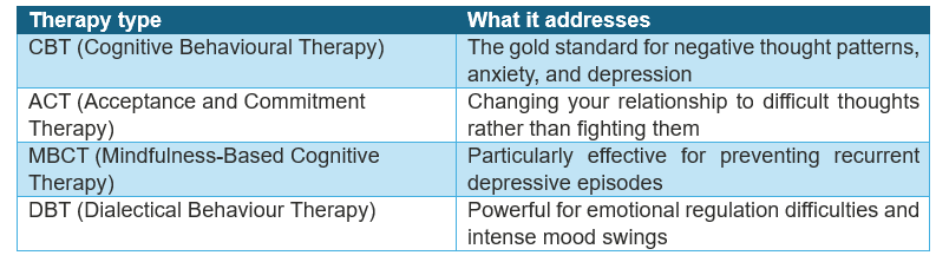
Ready to Get Professional Support?
If you or someone you know is struggling with overthinking or rumination, help is available:
- Access confidential counselling through Employee Assistance Programme (EAP) providers such as 1to1help (check with your HR on enrolled EAP services)
- For immediate support, contact Tele MANAS 14416 (free, 24/7, multiple Indian languages)
- Private therapists in major cities and online platforms
Conclusion
You cannot completely stop thoughts from appearing, but you can learn to stop them from controlling your emotions, behaviour, and decisions. That is what true mental control looks like. With consistent practice, techniques like mindfulness, reframing, grounding, breathwork, and self-compassion can help you build a calmer, more focused, and emotionally balanced mind over time.
If overthinking, intrusive thoughts, anxiety, or emotional overwhelm continue to interfere with your daily life, professional support can help you understand and manage the deeper patterns driving them.
Your mind is trainable. Small, consistent shifts in how you respond to your thoughts can create powerful long-term change.
FAQs
Q1. Can you actually control your own mind?
Yes, but the goal is management, not elimination. You cannot stop thoughts from arising. The mind generates thoughts automatically and continuously. What you can control is your relationship to those thoughts: whether you engage with them, amplify them, or let them pass. Research from Acceptance and Commitment Therapy and cognitive neuroscience confirms that with consistent practice, people can significantly improve their ability to redirect attention, reduce the intensity of unwanted thoughts, and respond rather than react to difficult emotions. Think of it less as "turning thoughts off" and more as becoming a skilled observer of your own mental activity.
Q2. How do I control my mind from unwanted thoughts?
The most effective approach combines three things: acceptance (stop fighting the thought; fighting makes it stronger), cognitive defusion (observe the thought as "just a thought," not a fact or command), and redirection (actively shift attention to a chosen focus using breath, body awareness, or grounding). Techniques like naming thoughts, the 5-minute worry window, and mindfulness meditation all work through these mechanisms. The most important thing to avoid is suppression. Research shows that trying not to think of something reliably increases how often you think of it.
Q3. What is the difference between controlling your mind and suppressing emotions?
They are opposite strategies. Suppression means pushing feelings away or pretending they do not exist. This backfires psychologically by increasing the intensity of the suppressed emotion over time and raising the risk of anxiety and depression. Genuine mind control means acknowledging thoughts and emotions as they arise, accepting their presence without judgement, and then choosing how to respond rather than automatically reacting. The goal is regulation, feeling the emotion without being overwhelmed by it, rather than suppression.
Q4. How can I control my mind when I am very angry or emotional?
When emotional intensity is high, cognitive techniques are largely inaccessible because the prefrontal cortex becomes less active when the amygdala is dominant. Start physiologically: slow breathing (inhale 4 counts, exhale 6 counts), cold water on the face, or physical movement. These body-based interventions calm the nervous system within minutes. Once physiologically settled, use the STOP technique: Stop what you are doing, Take a breath, Observe what you are thinking and feeling, Proceed with intention. If you need to respond to someone or make a decision, delay until this calm has been restored.
Q5. How do I control my subconscious mind?
The subconscious operates largely outside conscious awareness, but it is shaped by what you repeatedly expose it to. Techniques for influencing it include consistent repetition of positive self-talk and affirmations (which gradually reshape automatic thought patterns); daily visualisation (the subconscious responds to vivid mental imagery as if it were real experience); mindfulness practice (which brings subconscious patterns into conscious awareness); and intentional sleep routines (the subconscious is most active during sleep, so what you expose your mind to before bed shapes nocturnal processing). Change is gradual but measurable.
Q6. How long does it take to gain control of your mind?
Most research on meditation and cognitive training shows measurable changes in neural circuitry, specifically strengthened prefrontal cortex activity and reduced amygdala reactivity, within 8 weeks of consistent daily practice. Noticeable improvements in emotional regulation and thought management can begin within 2 to 4 weeks. That said, mind control is an ongoing practice, not a destination. Consistency matters far more than intensity. Ten minutes daily is more effective than an hour on weekends. Life stressors will continue to test your practice. The skill is in returning to it, not in never losing it.
Q7. When should I see a professional for help with controlling my mind?
Seek professional support if your mind feels genuinely out of control despite consistent self-help efforts; if unwanted thoughts are intrusive, distressing, or feel alien to your values; if you are experiencing persistent low mood, anxiety, or emotional overwhelm that affects daily functioning; if overthinking or rumination is severely disrupting your sleep, work, or relationships; or if you are using substances or unhealthy behaviours to manage mental distress. A counsellor trained in CBT, ACT, or mindfulness-based approaches can provide structured, evidence-based support that significantly accelerates the process. At 1to1help, our counsellors offer confidential, professional support tailored to your specific situation.
References
- American Psychiatric Association. (n.d.). Rumination: A cycle of negative thinking. https://www.psychiatry.org/news-room/apa-blogs/rumination-a-cycle-of-negative-thinking
- Art of Living. (n.d.). Yoga and pranayama breathing techniques. https://www.artofliving.org/yoga/breathing-techniques/yoga-and-pranayama
- BetterUp. (n.d.). How to control your mind. https://www.betterup.com/blog/how-to-control-your-mind
- Calm. (n.d.). 5-4-3-2-1: A simple exercise to calm the mind. https://www.calm.com/blog/5-4-3-2-1-a-simple-exercise-to-calm-the-mind
- Cleveland Clinic. (n.d.). Amygdala. https://my.clevelandclinic.org/health/body/24894-amygdala
- Cleveland Clinic. (n.d.). Cognitive behavioral therapy (CBT). https://my.clevelandclinic.org/health/treatments/21208-cognitive-behavioral-therapy-cbt
- Cleveland Clinic. (n.d.). Diaphragmatic breathing. https://my.clevelandclinic.org/health/articles/9445-diaphragmatic-breathing
- Cleveland Clinic. (n.d.). Endorphins. https://my.clevelandclinic.org/health/body/23040-endorphins
- Cleveland Clinic. (n.d.). Parasympathetic nervous system. https://my.clevelandclinic.org/health/body/23266-parasympathetic-nervous-system-psns
- Cleveland Clinic. (n.d.). Prefrontal cortex. https://my.clevelandclinic.org/health/body/prefrontal-cortex
- CogniFit. (n.d.). Why the brain resists change. https://blog.cognifit.com/why-brain-resists-change/
- DBT Tools. (n.d.). STOP skill. https://dbt.tools/emotional_regulation/stop.php
- Ford, B. Q., Lam, P., John, O. P., & Mauss, I. B. (2018). The psychological health benefits of accepting negative emotions and thoughts: Laboratory, diary, and longitudinal evidence. Journal of Personality and Social Psychology, 115(6), 1075–1092. https://pmc.ncbi.nlm.nih.gov/articles/PMC5767148/
- Harvard Gazette. (2010, November 12). Wandering mind not a happy mind. https://news.harvard.edu/gazette/story/2010/11/wandering-mind-not-a-happy-mind/
- Hayes, S. C. (n.d.). Steven C. Hayes official website. https://stevenchayes.com/
- Insight Timer. (n.d.). Insight Timer. https://insighttimer.com/
- Killingsworth, M. A., & Gilbert, D. T. (2010). A wandering mind is an unhappy mind. Science, 330(6006), 932. https://doi.org/10.1126/science.1192439
- Lieberman, M. D., Eisenberger, N. I., Crockett, M. J., Tom, S. M., Pfeifer, J. H., & Way, B. M. (2007). Putting feelings into words: Affect labeling disrupts amygdala activity in response to affective stimuli. Psychological Science, 18(5), 421–428. https://pubmed.ncbi.nlm.nih.gov/17576282/
- MasterClass. (n.d.). What is metacognition? https://www.masterclass.com/articles/what-is-metacognition
- Mayo Clinic. (n.d.). Meditation: A simple, fast way to reduce stress. https://www.mayoclinic.org/tests-procedures/meditation/in-depth/meditation/art-20045858
- Medical News Today. (2019). What are affirmations and do they work? https://www.medicalnewstoday.com/articles/324417
- Mindful. (n.d.). An introduction to mindful gratitude. https://www.mindful.org/an-introduction-to-mindful-gratitude/
- PositivePsychology.com. (n.d.). Cognitive distortions: Examples and interventions. https://positivepsychology.com/cognitive-distortions/
- Psychology Today. (n.d.). Cognitive reappraisal. https://www.psychologytoday.com/us/basics/cognitive-reappraisal
- Psychology Today. (n.d.). Default mode network. https://www.psychologytoday.com/us/basics/default-mode-network
- Psychology Today. (n.d.). Negative self-talk: Don’t let it overwhelm you. https://www.psychologytoday.com/us/blog/family-affair/201712/negative-self-talk-dont-let-it-overwhelm-you
- Psychology Today. (n.d.). Neuroplasticity. https://www.psychologytoday.com/us/basics/neuroplasticity
- Psychology Today. (2022). Name it to tame it: The emotions underlying your triggers. https://www.psychologytoday.com/us/blog/compassion-matters/202202/name-it-to-tame-it-the-emotions-underlying-your-triggers
- Self-Compassion.org. (n.d.). Self-compassion. https://self-compassion.org/
- Tele MANAS. (n.d.). Tele Mental Health Assistance and Networking Across States. https://telemanas.mohfw.gov.in/home
- Verywell Mind. (n.d.). Benefits of mindfulness-based stress reduction. https://www.verywellmind.com/benefits-of-mindfulness-based-stress-reduction-88861
- WebMD. (n.d.). What is box breathing? https://www.webmd.com/balance/what-is-box-breathing
- Wegner, D. M., Schneider, D. J., Carter, S. R., III, & White, T. L. (1987). Paradoxical effects of thought suppression. Journal of Personality and Social Psychology, 53(1), 5–13. https://psycnet.apa.org/doiLanding?doi=10.1037%2F0022-3514.53.1.5


.svg)
.svg)
.svg)
.svg)