

.png)


.png)

Mental Health Concerns
The Complete Process of Employee Counselling: A Step-by-Step Guide for HR Professionals

.png)
Written by
Aarohi Parakh,
Psychologist and Content Writer

Reviewed by
Sanjana Sivaram,
Psychologist and Clinical Content Head


A Scenario That Will Feel Familiar
Picture this! Arjun is a mid-level project manager at a Bengaluru-based technology firm. In the past three months, he has missed two important deadlines, snapped at a junior team member in front of the group, and called in sick six times. His manager, Priya, notices this pattern. She suspects something is wrong, but has no idea how to raise it. She is worried that if she says the wrong thing, Arjun might shut down, refuse to collaborate, resents the manager for overstepping, or resign. So she says nothing. His performance continues to deteriorate. Eventually, Arjun resigns, citing personal reasons.
This scenario plays out across Indian workplaces every day. Not because managers do not care, but because they do not know what to do. They lack a structured, humane, and professionally grounded process for addressing employee distress before it leads to resignation.
That process is employee counselling. And done well, it is one of the most powerful tools in an HR professional's toolkit.
This guide walks through the complete process of employee counselling from the first step of identification to follow-up, with practical guidance at every stage for HR professionals, people managers, and organisational leaders who want to do this right.
What Is Employee Counselling and Why It Matters
Employee counselling is a structured, confidential, professional process through which a trained counsellor helps an employee explore personal or work-related challenges, develop insight into their situation, and identify practical steps forward. At its core, employee counseling involves providing guidance, support, and resources to help individuals navigate through difficult situations and develop effective coping mechanisms.
This may include addressing issues such as stress, anxiety, burnout, family conflicts, and other personal problems that could impact their work performance and productivity.
By offering employee assistance programmes (EAPs) and confidential counseling sessions, organisations can empower their workforce to address personal issues, manage stress, and achieve a healthy work-life balance.
It is worth being precise about what it is and what it is not. Employee counseling is not disciplinary action. It is not performance management in disguise. It is not therapy in the clinical sense. And it is not an informal chat with a sympathetic manager. It is a structured professional interaction with a specific purpose: to support the employee's wellbeing and, through that support, to enable better functioning at work.
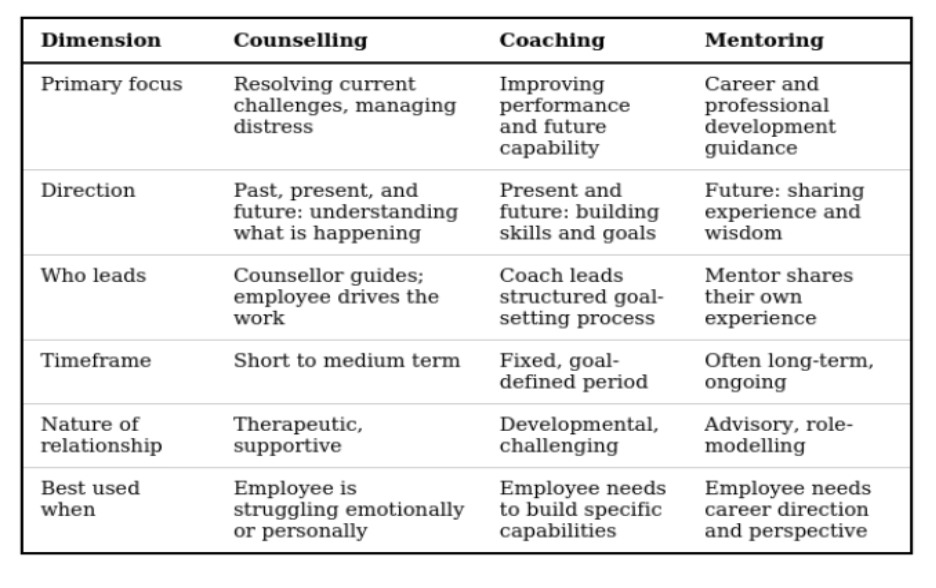
The distinction from coaching and mentoring is equally important.
Counselling vs Coaching vs Mentoring
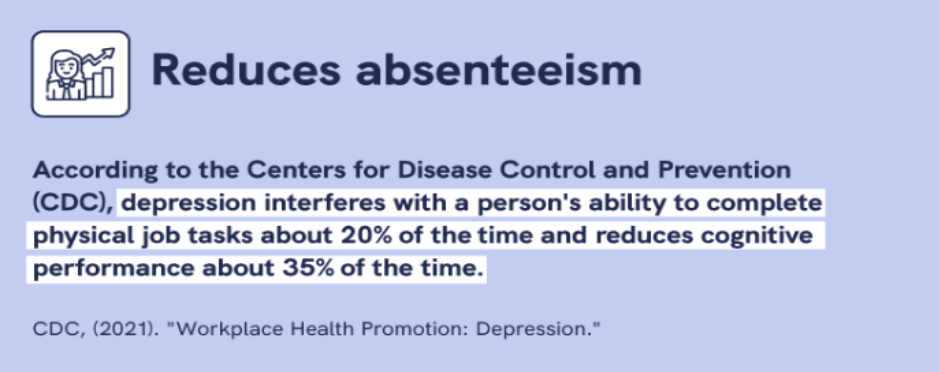
The evidence base for employee counselling as an organisational investment is strong.
- Research shows that well-implemented counselling programmes reduce absenteeism by up to 25%.
- The WHO estimates that depression and anxiety cost the global economy USD 1 trillion annually in lost productivity, much of which is preventable through early intervention.
- Organisations with structured employee counselling programmes report lower voluntary attrition, higher engagement scores, and measurably better mental health outcomes among participating employees.
- Counselling initiatives contribute to a positive workplace culture where employees feel comfortable seeking help and openly discussing their concerns.
For Indian organisations specifically, the business case is amplified by the scale of unmet need. With a treatment gap of 70% to 92% for mental health conditions and a workplace culture that historically stigmatises help-seeking, structured employer-led counselling is often the only route through which employees in distress receive any support at all.
💡Key Insight: Employee counselling is not a welfare concession. It is a business intervention with measurable returns. The cost of not providing it shows up in turnover, healthcare claims, and the gradual accumulation of disengagement across teams.
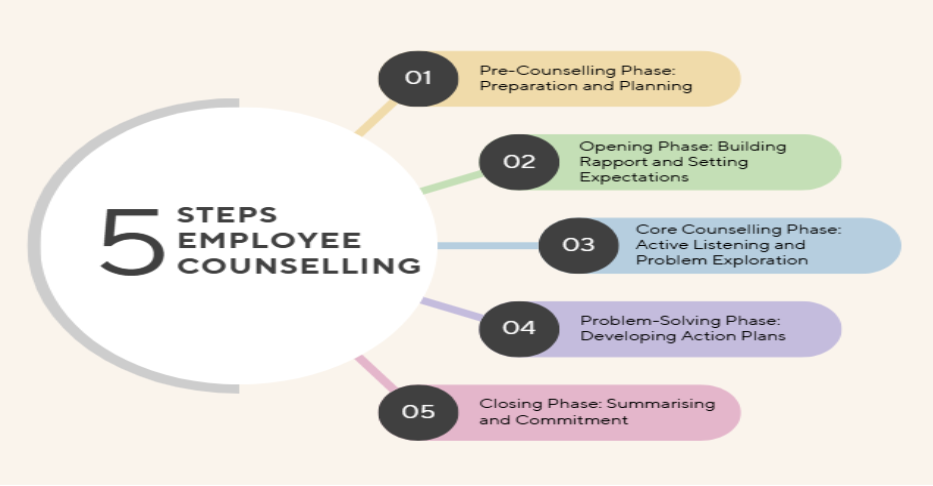
Step 1- Pre-Counselling Phase: Preparation and Planning
The quality of a counselling session is largely determined before it begins. Preparation is not an administrative formality. It is the foundation for a productive, safe, and outcome-oriented session.
Identifying the Need for Counselling
The first step is recognising when counselling is appropriate. The trigger may come from a manager who has noticed a change in an employee's behaviour, from an employee who has self-referred, or from an HR review of attendance and performance data.
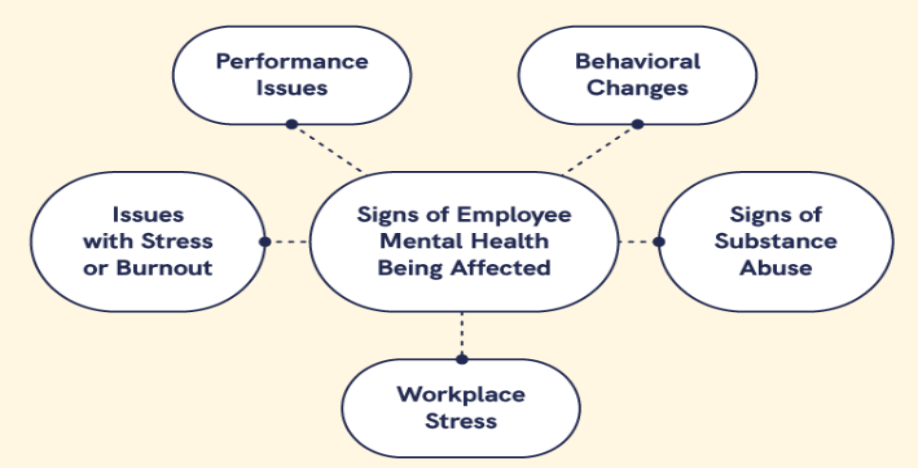
Warning signs that indicate counselling may be needed:
Performance signals: a sustained decline in output quality, missed deadlines, difficulty concentrating, or uncharacteristic errors.
Behavioural signals: withdrawal from colleagues, increased conflict, irritability, loss of initiative, or noticeable changes in how the employee communicates.
Attendance signals: increased unplanned absence, frequent lateness, or patterns of absence around specific days or periods.
Personal disclosures: an employee mentioning bereavement, relationship difficulties, financial stress, health concerns, or family pressures.
In the Indian workplace context, it is worth noting that cultural norms around stoicism, family honour, and professional image mean that many employees will not self-refer even when they are clearly struggling. Managers and HR professionals need to be trained to look for the signals rather than wait for explicit disclosure.
💡Pro Tip: Distinguish between a counselling trigger and a disciplinary trigger. If an employee's performance has declined, the question before any formal action should always be: is this a capability or conduct issue, or is it a wellbeing issue? If the answer is wellbeing, counselling precedes performance management, not follows it.
Setting Up the Counselling Environment
The environment in which counselling takes place sends a signal before a single word is spoken. The ideal physical space is private, free from interruptions, reasonably comfortable, and arranged so that neither the counsellor nor the employee is positioned in a way that implies hierarchy. Two chairs at a slight angle, rather than across a desk, changes the quality of the conversation.
If the session is virtual, which is increasingly common in India's hybrid working environment, the same principles apply: a private space for both parties, a stable connection, camera on, notifications silenced, and a clear agreement that the session will not be interrupted.
Duration should be planned and communicated in advance. Most counselling sessions run between 45 and 60 minutes. The employee should know this before the session begins so they can manage their own preparation.
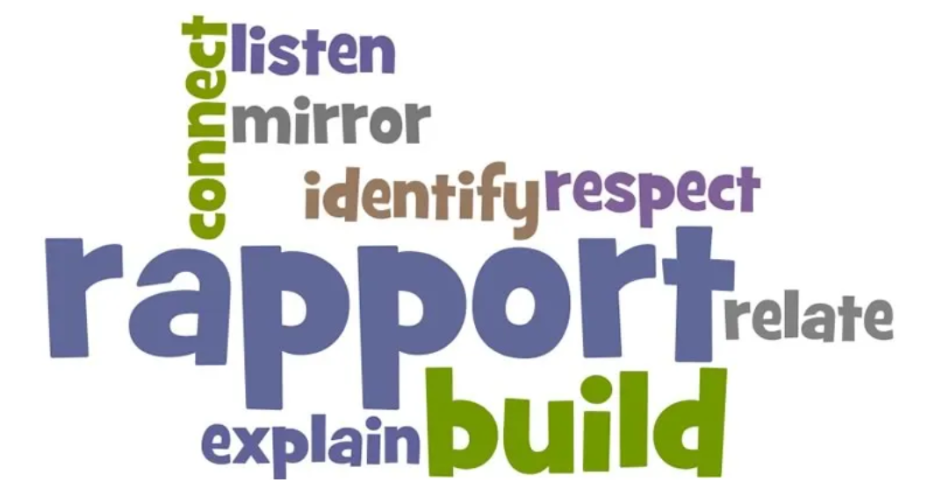
Step 2- Opening Phase: Building Rapport and Setting Expectations
The first ten minutes of a counselling session are the most consequential. How the counsellor opens the conversation determines whether the employee feels safe enough to be honest, or whether they will spend the session managing a performance rather than sharing a reality.
Opening the Conversation
A good opening is warm, non-threatening, and transparent. It establishes what the session is for, how it will be conducted, and the confidentiality boundaries. It does not rush to the problem.
Sample opening language that tends to work in the Indian workplace context:
"Thank you for taking the time to come in today. I want to start by saying that this conversation is completely confidential within the boundaries I'll explain in a moment. There's no fixed agenda: this is your space to share whatever feels relevant. I'm here to listen."
"I am glad you reached out. I'm not here to assess or judge. I wanted to create a space where we could talk openly about how things are going for you."
What makes these openings effective is not their exact wording but their tone: they position the counsellor as a listener rather than a judge, they acknowledge the employee's potential anxiety, and they establish confidentiality before asking the employee to share anything personal.
Confidentiality: Getting It Right
Confidentiality is the cornerstone of effective counselling. Without it, employees will not share anything of substance. But confidentiality in employee counselling is not absolute, and the limits must be communicated clearly at the outset.
What remains confidential: the content of the conversation, the specific issues discussed, and anything the employee shares about their personal life or work experience.
What is not confidential: situations where there is a risk of serious harm to the employee or others; situations involving illegal activity; situations where the organisation has a legal duty to act. These limits should be clearly and compassionately named before the conversation begins.
💡Pro Tip: In India's hierarchical workplace cultures, many employees fear that anything shared with HR will eventually reach their manager or affect their career. Address this fear directly and early. A clear, explicit statement that individual session content will not be shared with line managers or used in performance evaluations dramatically increases the likelihood of genuine engagement.
Setting Session Goals
Before moving into the main body of the conversation, spend a few minutes establishing what the employee hopes to get from the session. This does not need to be elaborate. A simple question: "What would it feel like to leave today's conversation having found it useful?" often surfaces the most important thing the employee needs.
Step 3- Core Counselling Phase: Active Listening and Problem Exploration
For a detailed guide to what the counselling journey looks like from the employee's perspective, including the five stages of the counselling process, see our companion article: What Really Happens in Counselling: A Step-by-Step Guide for First-Time Clients in India
From the HR and organisational perspective, the core counselling phase is where the professional skills of the counsellor are most visible and most consequential.
Active Listening: The Foundation
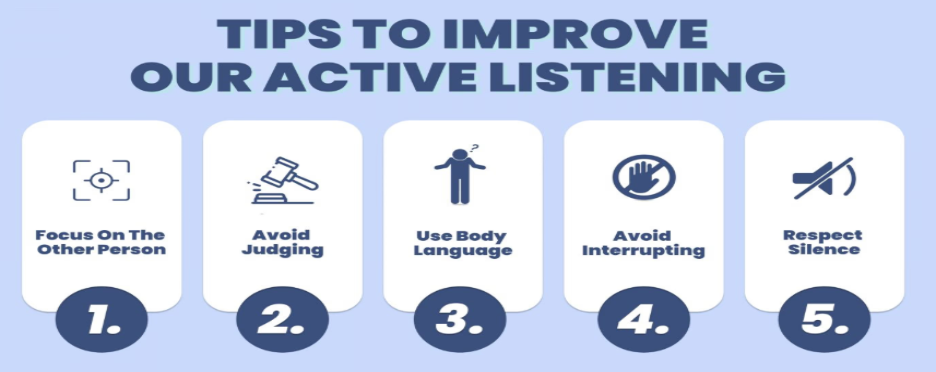
Active listening is not passive silence. It is a set of specific, learnable skills that signal genuine attention, create a sense of safety, and help the employee gain clarity about their situation.
The core techniques are:
Paraphrasing: reflecting back the essence of what the employee has said in slightly different words. "So what I'm hearing is that the pressure has been building for a few months, and the recent re-organisation made it feel unmanageable. Is that right?"
Reflecting emotions: naming what you are observing emotionally. "It sounds like you're feeling quite alone in this situation."
Summarising: periodically drawing together what has been shared to check understanding and give the conversation structure. "Let me check I've understood what you've shared so far..."
Open-ended questioning: questions that cannot be answered with yes or no, which invite elaboration and reflection. "What does that feel like for you?" "Can you tell me more about when this started?" "What has been the hardest part of managing this?"
💡What to avoid: giving advice before understanding the full picture, offering reassurance that minimises the employee's experience ("I'm sure it will work out"), asking multiple questions at once, or expressing judgement in any form.
A Note on Cultural Sensitivity in India
In many Indian workplaces, employees are not accustomed to being asked how they feel, and may initially respond to open-ended emotional questions with factual, professional answers. A skilled counsellor recognises this pattern and is patient with it. The emotional layer often emerges only once sufficient trust has been established, which may take most of the first session or subsequent sessions.
Counsellors working with Indian employees should also be aware of the specific pressures that shape the experience of distress in this context: family expectations, financial obligations to extended families, the social weight of professional status, migration, and the complex gender dynamics that shape how men and women in different cultural contexts feel permitted to express difficulty.
Identifying Root Causes
Surface-level problems in the workplace almost always have roots that run deeper. An employee who presents as struggling with workload may actually be dealing with grief, relationship breakdown, financial anxiety, or a health concern that they have not yet disclosed. A counsellor who accepts the presenting problem at face value and moves straight to solutions risks addressing a symptom while the underlying cause continues to grow.
The 5 Whys technique, adapted from quality management, can be applied more effectively in counselling by replacing “why” questions with open, exploratory prompts such as “what” and “how.” Each response is gently explored further to uncover underlying factors. The pattern of answers typically reveals the deeper structure of the problem within a few iterations, without making the individual feel questioned or judged.
A workplace example: “I’m finding it hard to focus.” “What feels most difficult about focusing right now?” “I’m not sleeping well.” “What has your sleep been like recently?”
“I’m worrying all night.” “What kinds of things have been on your mind?” “About money, mainly.” “What about your financial situation feels stressful at the moment?” “I took on a loan to support my family and I’m not sure how I’m going to repay it.”
The presenting problem was concentration. The underlying concern was financial stress.
Without that understanding, any workload adjustment or time management advice would have been addressing the wrong thing entirely.
Step 4- Problem-Solving Phase: Developing Action Plans
The shift from problem exploration to problem-solving is one of the most delicate transitions in the counselling process. Moving too quickly to solutions before the employee feels genuinely heard creates resistance. Moving too slowly and remaining in exploration indefinitely produces insight without change.
The counsellor's role in this phase is to facilitate rather than prescribe. The solutions that an employee generates themselves are significantly more likely to be implemented than those suggested by the counsellor.
Collaborative Brainstorming
A productive approach is to open the solution space with a question: "Given what you've shared, what feels like a possible first step?" Even if the employee's initial ideas are impractical, beginning with their ideas before introducing options of your own establishes ownership.
From there, the conversation evaluates options against a simple framework: what is within the employee's control? What requires support from others? What would need to change in the working environment? What practical resources are available?
SMART Goals for Action Planning
Once a direction is agreed, goals need to be specific enough to be actionable. The SMART framework (Specific, Measurable, Achievable, Relevant, Time-bound) is a useful structure for this.
Vague goal: "I'll try to manage my stress better."
SMART equivalent: "I will take a 10-minute walk outside during my lunch break at least four times this week, and I will book a session with my EAP counsellor before Friday."
The difference is not academic. Vague goals dissolve by the following week. SMART goals create specific accountability.
Action Plan Template
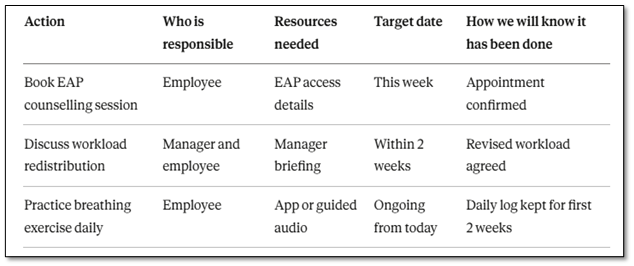
💡Key Insight: The most effective action plans are those that contain at least one step the employee can take before the next working day. Early action creates momentum. It also signals to the employee that the session was not just a conversation: it was the beginning of something different.
Step 5- Closing Phase: Summarising and Commitment
A strong close is as important as a strong opening. The closing phase consolidates what has been covered, confirms what has been agreed, and leaves the employee with a clear sense of the path forward.
A structured closing typically covers four elements:
Summary of the session: a brief, compassionate recap of what was shared and what was understood. "Today we talked about the pressure you've been under since the restructuring, and we identified some specific steps that might help."
Confirmation of action items: reading back the agreed actions clearly, checking understanding, and addressing any uncertainty. "You mentioned you'd like to book an EAP session this week. Do you have what you need to do that, or would it help if I shared the contact details again?"
Reinforcing confidentiality: reminding the employee, briefly and without fanfare, that the conversation remains confidential within the agreed limits.
Empowering close: ending with a statement that affirms the employee's capacity. "You've shown a lot of courage in coming in today and thinking honestly about this. I'm confident in your ability to work through this." In Indian workplaces, where employees often feel judged for seeking support, an explicit affirmation at the close can meaningfully shift their sense of having participated.
Sample closing language: "Before we finish, I want to check: is there anything we've covered today that you'd like to revisit? And is there anything you're still carrying that didn't get addressed today?"
Post-Counselling Phase: Follow-Up and Monitoring
The session itself is only part of the process. What happens in the weeks following is where counselling either delivers lasting change or fades into good intentions.
Follow-Up Schedule
A recommended timeline for post-counselling follow-up:
One to two weeks post-session: a brief, low-key check-in. This does not need to be another formal session. A five-minute conversation to ask how things are going, whether the agreed actions have been started, and whether any new challenges have emerged.
One month post-session: a more structured review of progress against the agreed action plan. What has changed? What has been harder than expected? Does the plan need adjusting?
Three months post-session: a broader review of overall wellbeing and functioning. Are the improvements sustained? Is further support needed? Is the employee ready to move forward without continued check-ins?
Note: It is important to highlight that if after follow-ups also the client/employee does not provide any response, such cases would have to be considered as closed.
Measuring Counselling Effectiveness
Outcome measurement closes the loop between investment and impact. Key indicators include changes in attendance patterns, improvement in performance metrics, the employee's self-reported wellbeing score before and after the process. In cases of manager referral, additional insight may be drwn from manager-reported observations of the employee's engagement and output.
Qualitative feedback, collected through a short, anonymous post-process survey, captures dimensions that quantitative data cannot: whether the employee felt heard, whether they found the process useful, and whether they would recommend it to a colleague.
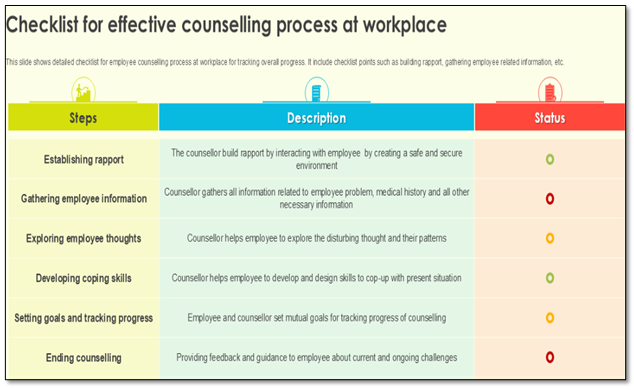
Knowing When to Refer
Some situations require expertise beyond what a counselling process can provide. Warning signs that a professional referral is needed include disclosure of active suicidal ideation, signs of serious mental health conditions such as psychosis or severe depression, substance dependency, domestic violence, or complex trauma.
Referral should be handled with the same care as the counselling itself: explained clearly, offered not imposed, and followed up to ensure the employee has successfully connected with the new resource.
Common Challenges and How to Handle Them
The Resistant Employee
An employee who has been referred to counselling by their manager, rather than self-referring, may arrive defensive, suspicious, or completely closed. This is understandable. Being referred to HR counselling can feel like a precursor to disciplinary action, regardless of how it is framed.
The response is not to push through the resistance but to name it directly and compassionately. "I can imagine this might feel like an unusual or uncomfortable conversation to be having. That's completely understandable. There's no agenda here other than to see if I can be helpful. Would you like to continue, or would you prefer to pause or take this in a different direction?”
Indian workplace scenario: Kavitha, a 35-year-old operations lead, is referred to counselling by her manager after her team begins complaining about her management style. She arrives defensive, framing every question as an accusation. The counsellor's response: "I'm not here to tell you what's wrong or to take sides. I'm here because your manager is concerned and wants to support you. What would be most useful for you to get from today?"
That reframe: from "you have a problem" to "someone is concerned about you," changes the emotional register of the conversation entirely.
Managing Strong Emotions
Employees in counselling sometimes cry, feel angry, or fall into extended silence. All of these are normal responses to discussing genuinely difficult things. The counsellor's role is to tolerate these responses without rushing to resolve them.
When an employee cries: pause, offer a tissue if available, allow silence, and then gently: "Take your time. There's no rush here." When an employee becomes angry: validate the feeling without validating any aggression. "It sounds like you're really frustrated. That makes sense. Can you tell me more about what's driving that?" When an employee is silent: do not fill the silence immediately. Often, the most important things are said just after a long pause.
If an employee discloses something that suggests they are at risk of harming themselves or others, move immediately into the referral pathway and do not leave the employee alone until appropriate professional support has been arranged.
Complex or Multi-Layered Issues
Some employees present with concerns that are not singular or clearly defined. Work stress may be intertwined with family pressures, financial strain, or long-standing mental health concerns. Attempting to solve everything within one session can overwhelm both the employee and the counsellor.
The appropriate response is to prioritise and pace the conversation. Focus on what feels most immediate or distressing to the employee, while acknowledging that other aspects can be addressed over time.
Example: An employee initially presents with workload stress but gradually reveals caregiving responsibilities at home and sleep difficulties. The counsellor may respond, "It sounds like several things are contributing here. Where would you like us to begin today?"
This helps structure the session without minimising the complexity of the situation.
Time Constraints and Workplace Pressure
Employees may feel rushed, distracted, or unable to fully engage due to workload demands or organisational culture. Similarly, organisations may expect quick resolutions from counselling conversations.
Counsellors must reinforce that meaningful counselling requires space and continuity. If time is limited, the session can be used to establish immediate support and schedule a follow-up.
Example: "We may not be able to cover everything today, but we can start with what feels most important and plan the next step together."
This maintains momentum without compromising depth or quality.
Low Awareness or Stigma Around Counselling
In the Indian context, many employees may hesitate to engage with counselling due to stigma, lack of awareness, or fear of judgement. Counselling may be perceived as something only needed in severe situations.
The response is normalisation and psychoeducation. Counsellors can gently reframe counselling as a space for everyday concerns, not just crises.
Example: "Many people use these sessions to talk through stress, work challenges, or decisions. It does not have to be something very serious."
This reduces perceived barriers and increases engagement.
Best Practices for Effective Employee Counselling
Ensure timely referral to the EAP: The effectiveness of employee counselling depends on how early employees are connected to professional support. Managers and HR should focus on identifying concerns and facilitating referrals rather than attempting to counsel directly.
Protect confidentiality through external delivery: EAP-led counselling ensures a clear separation between organisational processes and personal disclosures. Employees are more likely to engage honestly when counselling is conducted by independent, qualified professionals.
Position counselling as support, not escalation: Communication around EAP services should consistently reinforce that counselling is voluntary, confidential, and designed to support wellbeing, not evaluate performance or trigger disciplinary action.
Build awareness and accessibility: Employees should know how to access the EAP at any time through multiple channels such as phone, app, or web. Normalising usage through leadership communication and regular reminders improves uptake.
Strengthen cultural relevance: In the Indian workplace context, counselling must be sensitive to factors such as hierarchy, gender dynamics, family expectations, and social stigma. Partnering with an EAP provider experienced in local contexts improves effectiveness.
Encourage early use, not crisis-only access: EAP services should be positioned as a resource for everyday stress, relationship concerns, and work challenges, not just severe mental health issues. Early engagement leads to better outcomes.
Use insights to inform organisational strategy: While maintaining individual confidentiality, aggregated EAP data can help organisations identify trends, inform wellbeing initiatives, and proactively address systemic concerns.
Support managers as emotional care champions, not counsellors: Managers should be trained to recognise warning signs, respond empathetically, and guide employees to the EAP without stepping into a counselling role. Programmes like 1to1help’s Emotional Care Champions (ECC) build this capacity internally by training managers/employees to act as mental health allies.
Final Word: Process Is What Makes It Professional
Employee counselling is most effective when it is structured, confidential, and delivered by trained professionals. Many workplace situations escalate not because of lack of intent, but because there is no clear, professional support pathway.
A well-defined process, combined with a robust EAP, ensures that employees receive the right level of care while organisations maintain appropriate boundaries.
If your organisation is looking to build a reliable and scalable employee counselling framework, partnering with an experienced EAP provider is the most critical step.
Ready to Build a Mentally Healthier Workplace?
If you are an employer looking to take the next step, 1to1help's Employee Assistance Programme is India's most trusted EAP, with over 25 years of experience supporting employees across more than 700 organisations nationwide. From confidential counselling and crisis support to manager training and organisational well-being assessments, 1to1help offers a comprehensive, culturally sensitive, and multilingual solution tailored to the Indian workplace.
With data from over 100,000 counselling sessions annually and outcomes that include a 53% reduction in depression symptoms and a 48% reduction in anxiety within just a few sessions, 1to1help's programmes are evidence-based, scalable, and designed to meet your employees where they are, whether they are in a metro office, working remotely, or based in a Tier 2 city.
Because the best time to invest in your employees' mental health was yesterday. The next best time is now.
FAQs
Q1. What is the first step in employee counselling?
Identifying the need and referring the employee to the EAP. This can happen through manager observation, HR review, or employee self-referral via confidential EAP access channels.
Q2. How long does a counselling session last?
Typically 45 to 60 minutes for an initial session conducted by an EAP counsellor. Follow-up sessions are scheduled based on clinical need and may vary in duration.
Q3. What should be kept confidential in employee counselling?
All personal disclosures, session content, and individual concerns remain strictly confidential within the EAP. Only anonymised and aggregated insights may be shared with the organisation.
Q4. How often should follow-up counselling occur?
This is determined by the EAP counsellor based on the employee’s needs. Sessions may be scheduled weekly, fortnightly, or at longer intervals depending on the situation.
Q5. What is the difference between employee counselling and discipline?
Employee counselling through an EAP is voluntary, confidential, and supportive. Discipline is a formal organisational process related to conduct or performance. The two must remain completely separate.
Q6. Can employees refuse counselling?
Yes. EAP counselling is entirely voluntary. Employees can choose whether or not to engage, and meaningful outcomes depend on voluntary participation.
Q7. What qualifications do employee counsellors need?
EAP counselling is delivered by qualified mental health professionals, typically with postgraduate training in psychology along with specialised counselling certifications and supervised clinical experience.
Recommended Readings & Resources
- Therapy Goal Setting That Actually Helps: https://www.findoctave.com/blog/therapy/therapy-goals
- Early Warning Signs: Recognizing When Mental Health Might Be at Risk: https://www.medanta.org/patient-education-blog/early-warning-signs-recognizing-when-mental-health-might-be-at-risk
- Checklist: “How to Prepare for Your First Counselling Session” - Check Here
- Journal Prompt: “My Goals for Counselling”- Check Here
- SMART Goals Action Template - Check Here
References
- Better Health Channel. (n.d.). Family conflict.
https://www.betterhealth.vic.gov.au/health/healthyliving/family-conflict
- Cleveland Clinic. (n.d.). Anxiety disorders.
https://my.clevelandclinic.org/health/diseases/9536-anxiety-disorders
- Cleveland Clinic. (n.d.). Stress.
https://my.clevelandclinic.org/health/diseases/11874-stress
- Counselling Tutor. (n.d.). Confidentiality in counselling.
https://counsellingtutor.com/confidentiality-in-counselling/
- CultureMonkey. (n.d.). Employee counseling: A complete guide.
https://www.culturemonkey.io/employee-engagement/employee-counseling/
- CultureMonkey. (n.d.). Positive work environment.
https://www.culturemonkey.io/employee-engagement/positive-work-environment/
- CultureMonkey. (n.d.). Employee burnout signs.
https://www.culturemonkey.io/employee-engagement/employee-burnout-signs/
- Daily Stoic. (n.d.). What is Stoicism?
https://dailystoic.com/what-is-stoicism-a-definition-3-stoic-exercises-to-get-you-started/
- Economics Discussion. (n.d.). Employee counselling: Meaning, concept, types, benefits and challenges.
https://www.economicsdiscussion.net/human-resource-management/employee-counselling/employee-counselling-meaning-concept-types-benefits-and-challenges/31639
- Lean Enterprise Institute. (n.d.). 5 Whys.
https://www.lean.org/lexicon-terms/5-whys/
- Massachusetts Institute of Technology Human Resources. (n.d.). What is coaching?
https://hr.mit.edu/learning-topics/leading/articles/what-is-coaching
- Ministry of Health and Family Welfare, Government of India. (n.d.). Press release.
https://www.mohfw.gov.in/?q=en/pressrelease-206
- Piktochart. (n.d.). Employee counseling guide.
https://piktochart.com/blog/employee-counseling/
- PubMed Central. (2020). Workplace mental health study.
https://pmc.ncbi.nlm.nih.gov/articles/PMC7142489/
- SlideTeam. (n.d.). Employee counselling templates.
https://www.slideteam.net/blog/top-10-employee-counselling-templates-with-examples-and-samples
- Talent Development Association. (n.d.). What is mentoring?
https://www.td.org/talent-development-glossary-terms/what-is-mentoring
- Training Connection. (n.d.). Building rapport.
https://www.trainingconnection.com/business-communication/building-rapport.php
- Verywell Mind. (n.d.). Active listening.
https://www.verywellmind.com/what-is-active-listening-3024343
- Verywell Mind. (n.d.). Psychoeducation.
https://www.verywellmind.com/what-is-psychoeducation-5323831
- World Health Organization. (n.d.). Mental health at work.
https://www.who.int/news-room/fact-sheets/detail/mental-health-at-work
- Association for Talent Development. (n.d.). What is mentoring?
https://www.td.org/talent-development-glossary-terms/what-is-mentoring
- Journal of Occupational and Environmental Medicine. (n.d.). Journal homepage.
https://journals.lww.com/joem/pages/default.aspx


.svg)
.svg)
.svg)
.svg)