

.png)


.png)

Mental Health Concerns
Common Issues in Employee Counselling: Challenges & Solutions

.png)
Written by
Aarohi Parakh,
Psychologist and Content Writer

Reviewed by
Sanjana Sivaram,
Psychologist and Clinical Content Head


Introduction
Mayur is a senior HR manager at a mid-sized IT services firm in Hyderabad. His company launched an employee counselling programme eighteen months ago. On paper, it looks impressive: a contracted EAP provider, a helpline number on every payslip, and a wellness policy approved by the board. In practice? Only eleven employees have used it. That is 2.4% of the workforce.
Mayur knows something is wrong. He just cannot put his finger on what. Is it the stigma? The scheduling? The fact that most employees believe HR will find out what they said? He suspects it is all three, and he has no framework for fixing any of them.
This is the lived reality of issues in employee counselling across Indian organisations. The intent is often there. The infrastructure sometimes exists. But a cluster of persistent, predictable challenges keeps programmes from delivering meaningful impact.

This guide examines the top five issues in employee counselling with honesty, specificity, and solutions that HR professionals can actually implement. For each issue, we include a real-world scenario from the Indian workplace, so it does not remain an abstract theory.
Understanding Employee Counselling and Its Importance
Employee counselling is a structured, confidential, professional process through which a trained counsellor helps an employee explore personal or work-related challenges, develop insight into their situation, and identify practical steps forward. It is delivered primarily through Employee Assistance Programmes (EAPs), which serve as the operational backbone of HR support and wellness infrastructure in most organised workplaces.
It is worth being clear about what employee counselling is not.
It is not a disciplinary process in disguise. It is not therapy in the clinical sense. It is not a one-off conversation with a sympathetic manager. And it is most definitely not an optional HR box-ticking exercise.
Research consistently shows that organisations with structured counselling programmes see a 25-30% improvement in employee retention alongside measurable reductions in absenteeism, presenteeism, and healthcare costs. The WHO's 2022 Mental Health at Work report estimates that every USD 1 invested in mental health support yields a return of USD 4 in improved productivity.
Employee Counselling for Professional Development
Beyond crisis intervention, counselling supports career growth in practical ways. When employees work with counsellors on goal-setting, interpersonal dynamics, and resilience, they develop skills that translate directly into workplace performance.
A marketing professional struggling with imposter syndrome, for example, may use counselling to rebuild confidence before a performance review, resulting in a more productive appraisal conversation and a clearer development plan.
To understand how counselling fits within the broader support ecosystem alongside coaching and mentoring, refer to our related guide on the complete process of employee counselling, which outlines the step-by-step framework from identification to follow-up.
Benefits of Employee Counselling Programmes
- Reduced absenteeism: organisations report up to 27% fewer unplanned leave days following EAP introduction
- Lower attrition: confidential support reduces resignation driven by unaddressed personal distress
- Improved workplace culture: employees in counselling-friendly environments report higher psychological safety
- Legal and compliance benefits: structured wellness programmes reduce employer liability in cases of workplace mental health incidents

Top 5 Major Issues in Employee Counselling
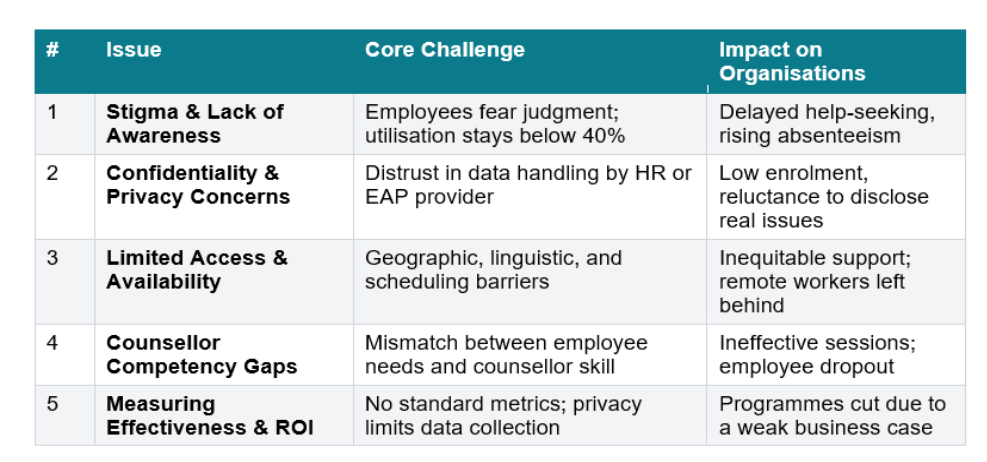
Before we examine each issue in depth, here is a structured overview of the five most significant barriers to employee counselling that organisations encounter. These are not hypothetical obstacles. They appear consistently across research conducted by SHRM, NIH, and workplace mental health researchers worldwide.
Each of these issues affects both programme design and individual utilisation. The sections below examine them in turn, with Indian workplace case examples and practical solutions for each.
Issue 1: Stigma and Lack of Employee Awareness
Of all the issues in employee counselling, stigma is simultaneously the most widespread and the hardest to quantify. Research indicates that only 30-40% of employees who have access to counselling services actually use them. The primary reason given, consistently and across cultures, is fear of judgment.
In the Indian workplace, stigma around mental health carries additional weight. Cultural norms around stoicism, the professional image of "coping well", family honour, and fear of questioning authority figures mean that employees are doubly reluctant to seek help. Seeking counselling can feel like admitting failure, not just personally but to one's team, one's manager, and one's family.
Case Example:
Vikram is a 32-year-old team lead at a Pune-based manufacturing firm. His company launched an EAP eight months ago. Vikram has been experiencing severe burnout and has had two panic attacks in the past month. He knows the helpline number. He does not want to call it. He is convinced his manager will find out. He is also convinced that calling a counsellor means he "cannot handle the job". He says nothing. His team picks up the slack. The cycle continues.
Why Employees Avoid Workplace Counselling
It is understandable that employees hesitate. The barriers are real and, for many, rational given their workplace context:
- Fear of judgment from peers or direct managers
- Concerns that information shared will reach HR or leadership
- Worry about career impact, particularly around performance reviews or promotion cycles
- Perception that needing counselling signals inability to cope
- Cultural and religious considerations that frame professional help-seeking as inappropriate
According to SHRM research on employee counselling trends, stigma-related barriers account for nearly half of all non-utilisation in EAP-enabled organisations.
Reducing Mental Health Stigma at Work
The most effective interventions busting stigma share a common feature: they are led from the top. When a senior leader speaks openly about using counselling support, utilisation increases measurably across the team. Leadership communication is not a nice-to-have here. It is the mechanism.
- Awareness campaigns: run regular, visible mental health awareness months with real employee stories (anonymised with consent)
- Peer ambassador programmes: train volunteers to speak casually and positively about counselling access
- Normalise usage in team briefings: mention the EAP helpline in the same breath as other benefits
- Offer genuinely anonymous access: ensure the first point of contact with counselling is not through HR
💡Pro-tip: Position your EAP not as a crisis-only resource but as a performance and wellbeing tool. Use language like "support for everyday pressures" in your internal communications rather than "help if you are struggling". This framing shift reduces stigma significantly without misrepresenting the service.
For a practical framework on building psychological safety in teams alongside counselling access, see our guide on building a psychologically safe workplace.
Issue 2: Confidentiality and Privacy Concerns
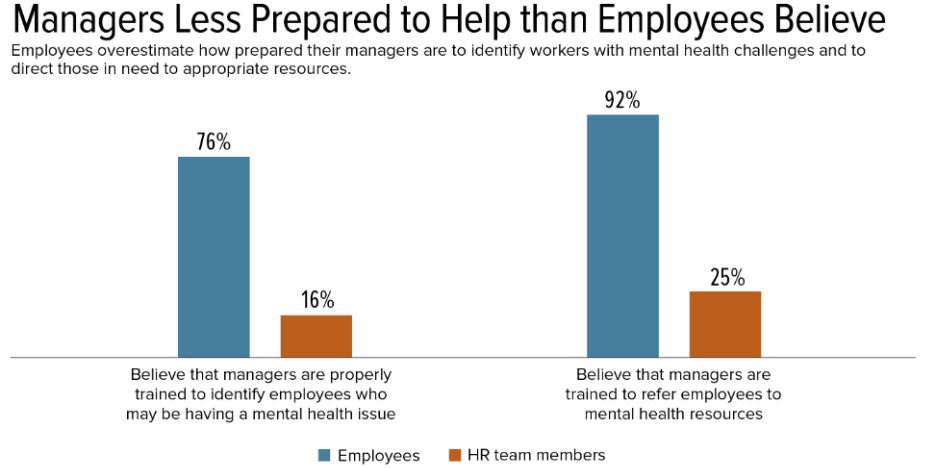
Confidentiality is the bedrock of effective employee counselling. Without it, nothing else works. Employees who do not trust that their disclosures are protected will not disclose anything meaningful, and a counselling session in which nothing meaningful is shared is not counselling at all.
Despite legal frameworks requiring confidentiality, many employees in India remain sceptical. The concern is not irrational. In smaller organisations where HR and the EAP provider are in frequent contact, the boundary between support and monitoring can feel blurry. In organisations where managers have informally learned about an employee's counselling use, the damage to trust has been significant and sometimes irreversible.
Case Example:
Nandini works in the finance department of a Delhi-based FMCG company. She used the company's counselling service after a difficult divorce. Two months later, she was passed over for a project she had been expecting to lead. Her manager remarked that the team needed someone “stable and focused right now,” and referred to her recent personal situation in a way that reflected details shared only in counselling. For Nandini, this indicated a clear breach of confidentiality. She stopped using the service, and when she shared her experience, three of her colleagues chose not to use it either.
HIPAA Compliance and Employee Counselling
In India, the relevant framework is the Digital Personal Data Protection Act 2023 alongside existing labour laws. Internationally operating companies also navigate HIPAA confidentiality requirements where applicable. Key employer responsibilities include:
- Maintaining strict separation between EAP records and employee HR files
- Ensuring EAP providers use encrypted, access-controlled platforms for session data
- Briefing managers clearly on what they are and are not permitted to know
- Documenting and communicating the limits of confidentiality (mandatory reporting in cases of imminent harm)
Penalties for confidentiality breaches extend beyond legal consequences. The reputational damage to an organisation's culture of trust can take years to repair.
Employee Counselling Privacy Policies: What Good Looks Like
Effective privacy management in employee counselling requires active communication, not just legal compliance. Employees should receive, at the point of EAP enrolment:
- A written plain-language explanation of what is and is not shared with the employer
- A clear statement of the mandatory reporting exceptions (harm to self or others)
- Confirmation that their manager will not be notified of their participation
- Contact details for raising a data concern independently of HR
💡Pro-tip: Use a third-party EAP provider rather than an in-house counsellor for organisations where anonymity concerns are high. The structural separation between the EAP and the employer significantly increases employee trust and utilisation rates. The process of employee counselling, when delivered externally, signals that the organisation has genuinely invested in independent support rather than internal monitoring.
Issue 3: Limited Access and Availability
Even when stigma is addressed and confidentiality is communicated clearly, employee counselling access barriers can keep employees from reaching support. These barriers are structural rather than psychological, but they are no less consequential.
In India specifically, access challenges are amplified by geography, language diversity, and the vast range of work arrangements that now exist in the post-pandemic landscape. A garment worker on a factory floor in Tirupur, a software engineer working from home in Lucknow, and a bank teller in a branch in Patna all have radically different access needs. Most EAP programmes are designed with the metro-based office worker in mind.
Case Example:
Rajan works at a logistics firm in Nagpur. His company's EAP is excellent on paper: six free sessions per year, 24/7 helpline, online booking. The problem? The booking platform is only in English. The counsellors available on the helpline all operate out of Bengaluru or Mumbai and are not familiar with the specific pressures of Vidarbha's agrarian crisis context, which deeply affects many employees' families. Rajan calls once. He does not feel understood. He does not call again.
Virtual Employee Counselling Challenges
The shift to virtual counselling has expanded access for many employees, but it has introduced a new set of barriers:
- Technology barriers: not all employees especially from lower income groups have a smartphone or reliable internet connection in remote areas
- Home privacy concerns: employees in joint families or shared accommodation cannot guarantee a private conversation
- Platform security concerns: employees worry about who can access video call data
- Lack of in-person connection: some employees find virtual rapport harder to build, particularly for serious disclosures
Improving Employee Counselling Access: A Practical Framework
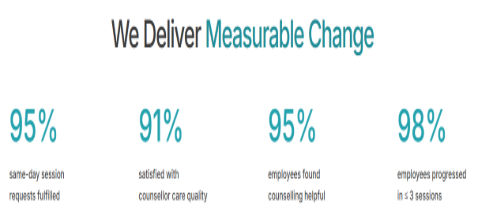
Improving access to employee counselling requires addressing practical, on-ground barriers that limit utilisation. The following framework outlines key challenges and scalable solutions tailored for the Indian workplace context.
1. Geographic Distance → Telehealth / Video Counselling via EAP Apps
- Deploy secure tele-counselling platforms to reach employees beyond metro cities
- Enable video + audio + chat-based sessions for flexibility
- Partner with EAP providers that have pan-India clinician networks
- Ensure low-bandwidth compatibility for Tier 2 and Tier 3 regions
- India Applicability: High — especially for distributed workforces and field employees
2. Language Barriers → Multilingual Counsellors
- Offer counselling in regional languages (Hindi, Tamil, Bengali, Marathi, Telugu, etc.)
- Match employees with counsellors based on language preference
- Build culturally sensitive counselling frameworks (not just translation)
- Use vernacular content for awareness campaigns
- India Applicability: Critical — essential for inclusivity in diverse workforces
3. Scheduling Conflicts → Real-Time + 24/7 Support
- Introduce chat-based or real-time counselling for flexibility
- Provide 24/7 helplines for immediate emotional support
- Allow employees to book sessions outside standard work hours
- Integrate counselling access within shift schedules (especially for BPOs, healthcare)
- India Applicability: Essential — particularly for shift workers and frontline roles
4. Remote / Hybrid Workforce → Mobile-First EAP Platforms
- Ensure EAP access via mobile apps (not just desktop portals)
- Use push notifications for reminders, check-ins, and nudges
- Enable self-assessment tools (PHQ-9, GAD-7) within the app
- Maintain seamless access regardless of location or time zone
- India Applicability: High — aligns with post-pandemic hybrid work models
5. Cost Constraints (MSMEs) → Group EAP Models
- Adopt shared or group EAP subscriptions to reduce per-employee cost
- Explore scalable pricing models based on utilization
- Leverage industry bodies and HR networks for pooled solutions
- Prioritise high-impact, low-cost services (helplines, webinars, basic counselling)
- India Applicability: Strong — especially relevant for MSMEs with limited HR budgets
💡Pro-tip: If your organisation has employees in Tier 2 or Tier 3 cities, or in manufacturing or logistics roles, conduct a simple access audit before assuming your EAP is working. Ask: can an employee in our most geographically remote location access a counsellor in their preferred language within 48 hours? If the answer is no, your access design needs adjustment.
Issue 4: Counsellor Competency and Specialisation Gaps
The quality of employee counselling is only as good as the counsellor delivering it. Workplace counselling problems frequently trace back not to the programme design, but to a mismatch between what employees need and what the available counsellor can competently provide.
This is particularly acute in the Indian context, where the field of workplace mental health is still maturing. Training standards vary enormously. Cultural competency, awareness of organisational dynamics, and knowledge of industry-specific stressors (burnout in IT, agrarian stress in employees from farming families, gender-specific pressures in male-dominated industries) are not universally present among counsellors working with EAPs.
Case Example:
Deepa, a 28-year-old software developer in Chennai is experiencing severe burnout. She is referred to the company's EAP counsellor, who is qualified and well-intentioned but whose entire background is in relationship counselling. The sessions focus almost entirely on interpersonal dynamics rather than on the structural overwork driving Deepa's exhaustion. After three sessions, Deepa feels unheard. She disengages. Her burnout worsens. The counsellor marks the case as closed.
Workplace Counselling Skills Gaps: What to Watch For
When vetting an EAP provider or selecting in-house counsellors, organisations should specifically probe for:
- Organisational psychology knowledge: do counsellors understand workplace dynamics, hierarchy, and performance pressure?
- Cultural and diversity competency: can counsellors navigate caste dynamics, gender expectations, and regional cultural norms in India?
- Crisis intervention training: are counsellors equipped to respond to acute distress, suicidal ideation, or domestic violence disclosures?
- Industry-specific awareness: does the counsellor understand the pressures specific to your sector?
Selecting Qualified Employee Counsellors: A Practical Checklist for HR
- Verify RCI registration (India) or equivalent credential for all counsellors
- Request evidence of supervised clinical hours in workplace settings
- Ask for specialisation matching across key areas: burnout, grief, leadership transitions, trauma
- Enquire about continuing education requirements and how frequently counsellors update training
- Establish a client feedback mechanism and review satisfaction scores quarterly
- Request anonymised outcome data on session effectiveness from your EAP provider
Counsellor Qualifications and Certifications: A Comparison

For a definitive standard on counsellor qualifications, refer to the American Counseling Association's professional standards and the RCI (Rehabilitation Council of India) requirements for licensed practitioners in India.
💡Pro-tip: During EAP procurement, ask potential providers: what percentage of your counsellors have specific training in workplace mental health? What languages do they operate in? What is your process when an employee needs a specialisation you do not have in-house? The answers reveal whether you are purchasing genuine expertise or a call centre with a wellness label.
Issue 5: Measuring Effectiveness and ROI
This is the issue that most often gets employee counselling programmes discontinued. When HR cannot demonstrate measurable impact, the programme is vulnerable to budget reviews. And given that the benefits of counselling (reduced distress, improved decision-making, better relationships) are by nature qualitative and individual, building a compelling business case requires deliberate design from the start.
The difficulty is compounded by privacy. You cannot survey employees about counselling use without risking identification. You cannot pull session notes for analysis. The very confidentiality that makes counselling effective also limits the data it generates.
Case Example:
Preeti is an HR director at a mid-sized pharma company in Mumbai. Her EAP has been running for two years. When the CFO asks for evidence of impact at the annual budget review, Preeti can offer utilisation numbers (14%) and a satisfaction score from post-session surveys (82% positive). The CFO wants to know the return on investment. Preeti cannot answer. The programme's budget is cut by 40% the following quarter.
Employee Counselling KPIs and Metrics
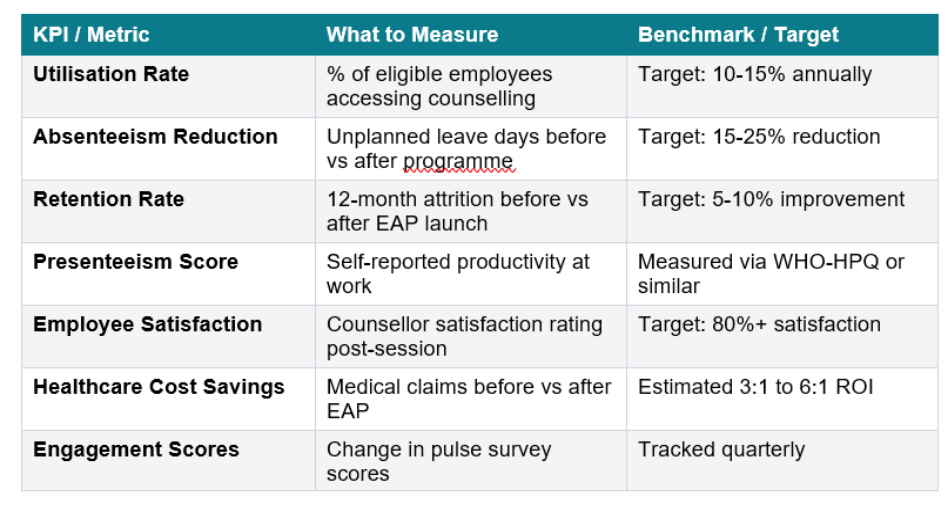
A peer-reviewed study published in the Journal of Occupational and Environmental Medicine found that organisations measuring EAP outcomes with structured KPIs were three times more likely to sustain programme funding over a five-year period than those relying on anecdotal evidence alone.
Measuring Employee Counselling ROI: A Practical Framework
Build your measurement approach before the programme launches, not after:
- Establish baseline metrics: collect absenteeism rates, attrition, engagement scores, and healthcare claim data before launch
- Run anonymous post-session surveys: ask only about session quality and perceived helpfulness, not personal disclosure content
- Benchmark against industry standards: SHRM publishes annual benchmarks for EAP utilisation and ROI
- Report quarterly to leadership: use aggregated, privacy-compliant data in a standard dashboard format
- Run an annual cost-benefit analysis: calculate cost-per-session against avoided attrition and reduced absenteeism costs
💡Pro-tip: When presenting ROI to leadership, use cost-avoidance language rather than direct return language. Replacing one entry level employee typically costs 50-75% of their annual salary. If your EAP helped retain even three employees who would otherwise have resigned, calculate that saving explicitly. This framing lands with CFOs in a way that "improved wellbeing" does not.
Additional Challenges: Resistance and Engagement Issues
Beyond the top five issues, two further employee counselling challenges consistently undermine programme success: manager resistance and low employee participation. These are often downstream symptoms of the five issues above, but they are worth addressing directly.
Manager Resistance to Employee Counselling Referrals
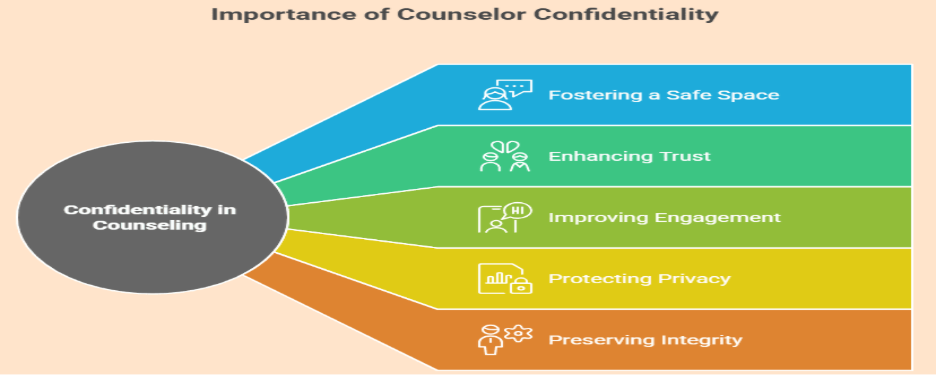
Managers are the most critical referral pathway in any counselling programme. When a manager notices a struggling employee and does not know what to do, or does not feel comfortable making a referral, the employee goes unsupported. This happens more often than most organisations recognise.
- Managers fear overstepping or appearing to invade an employee's personal life
- Many managers have not been trained to recognise the signals that indicate counselling need
- Some managers worry that making a referral creates a liability if the employee's situation worsens
- In hierarchical Indian workplace cultures, managers may dismiss mental health concerns as personal weakness
The solution is structured manager training combined with clear referral protocols. Leaders Programme under 1to1help Cohort-based programme that specifically develop manager capability in recognising and responding to distress have been shown to increase EAP referral rates significantly.
Improving Employee Counselling Participation Rates
- Proactive outreach: do not rely on employees finding the EAP themselves; send regular, visible reminders
- Peer testimonials: with consent, share anonymised stories of employees who found counselling helpful
- Remove structural friction: the simpler the access route (one number, one click), the higher the uptake
- Create psychological safety: employees participate when they believe the culture genuinely supports help-seeking
- Regular programme promotion: feature the EAP in onboarding, team meetings, and quarterly all-hands, not just at launch

A Final Word
Mayur, the HR manager we met at the start of this article, does not have an unsolvable problem. He has five well-documented, well-researched challenges that have practical solutions. The issues in employee counselling that keep programmes from working are not mysteries. They are patterns.
What organisations that succeed with employee counselling have in common is not a bigger budget or a fancier EAP platform. It is an HR function and leadership that understands the specific barriers in their own context, and that has built the programme design, communication strategy, and measurement framework to address those barriers systematically.
If you are building or reviewing an employee counselling programme and want to understand the full delivery framework, our guide on the complete process of employee counselling provides a step-by-step walkthrough from identification and referral through to follow-up and closure.
Ready to Build a Mentally Healthier Workplace?
If your organisation is looking to build or strengthen its employee counselling programme, partnering with an experienced EAP provider like 1to1help is the most impactful single step you can take.
1to1help's Employee Assistance Programme is India's most trusted EAP, with over 25 years of experience supporting employees across more than 700 organisations nationwide. From confidential counselling and crisis support to manager training and organisational well-being assessments, 1to1help offers a comprehensive, culturally sensitive, and multilingual solution tailored to the Indian workplace.
With data from over 100,000 counselling sessions annually and outcomes that include a 53% reduction in depression symptoms and a 48% reduction in anxiety within just a few sessions, 1to1help's programmes are evidence-based, scalable, and designed to meet your employees where they are, whether they are in a metro office, working remotely, or based in a Tier 2 city.
Because the best time to invest in your employees' mental health was yesterday. The next best time is now.
The best investment isn’t just in employee counselling, it’s in making sure employees can actually use it.
FAQs
Q1. What are the main barriers to employee counselling?
The five most significant barriers are stigma and fear of judgment, confidentiality concerns, limited access and availability, counsellor competency gaps, and inability to measure ROI. In the Indian workplace, stigma and confidentiality concerns are particularly acute, compounded by cultural norms around stoicism and professional image.
Q2. How can organisations improve counselling utilisation?
Utilisation improves when leadership models help-seeking behaviours, when access is genuinely easy (one click or one call), and when confidentiality is communicated clearly and credibly. For a step-by-step approach to building a counselling programme that employees actually use, see our guide on the complete process of employee counselling.
Q3. What qualifications should employee counsellors have?
At minimum, a postgraduate qualification in psychology or counselling, RCI registration for clinical psychologists in India, and supervised clinical experience. For workplace-specific programmes, look for counsellors with demonstrated training in organisational psychology, crisis intervention, and cultural competency relevant to your workforce's demographics.
Q4. How do you measure the success of employee counselling?
Track a combination of utilisation rates, post-session satisfaction scores, absenteeism trends, attrition data, and healthcare claims. Establish baseline metrics before programme launch. Use anonymous feedback surveys for qualitative data. Present findings quarterly using cost-avoidance language to build the business case for continued investment.
Q5. Is employee counselling confidential?
Yes, when properly structured. Counsellors are bound by professional ethics to maintain confidentiality. The only exceptions are mandatory reporting situations: imminent risk of harm to the employee or another person. Employers receive only anonymised, aggregated data from EAP providers, never individual session content. Communicating this clearly to employees is essential for uptake.
Q6. What is the difference between counselling and coaching?
Counselling focuses on resolving current psychological and emotional challenges, typically drawing on the past and present to address distress or dysfunction. Coaching focuses on performance and future capability. Mentoring shares experience and wisdom for long-term career development. All three have a role in a comprehensive employee wellness strategy, but they are not interchangeable. For a full breakdown with a comparison table, see our related article on the complete process of employee counselling.
Q7. How can remote employees access counselling services?
Through telehealth video sessions, phone-based helplines, and asynchronous messaging platforms offered by modern EAPs. Critically, remote employees need the same access to multilingual counsellors and the same confidentiality assurances as on-site employees. Home privacy (the ability to have a confidential conversation) should be assessed as part of remote EAP design.
Related Articles You May Find Useful
References
- Meditopia. (n.d.). EAP statistics and utilization rates. https://meditopia.com/en/forwork/articles/eap-statistics-and-utilization-rates
- Meditopia. (n.d.). Benefits of employee assistance programs (EAP). https://meditopia.com/en/forwork/articles/benefits-of-eap
- World Health Organization. (n.d.). Mental health at work. https://www.who.int/news-room/fact-sheets/detail/mental-health-at-work
- World Health Organization. (2003). The World Health Organization Health and Work Performance Questionnaire (HPQ). https://www.researchgate.net/publication/10866955
- Frontiers Media. (2025). Workplace mental health outcomes and public health implications. https://www.frontiersin.org/journals/public-health/articles/10.3389/fpubh.2025.1552981/full
- Deloitte. (2019). Workplace mental health and ROI report. https://asm-localdetrabalho.pt/wp-content/uploads/2024/05/2019_recursos_deloitte.pdf
- WorkLife. (n.d.). Workplace wellbeing programs deliver high ROI. https://work.life/blog/workplace-wellbeing-programs-470-percent-roi-returns/
- Economics Discussion. (n.d.). Employee counselling: Meaning, concept, types, benefits and challenges. https://www.economicsdiscussion.net/human-resource-management/employee-counselling/employee-counselling-meaning-concept-types-benefits-and-challenges/31639
- International Institute of Social and Economic Sciences. (n.d.). Employee counselling and career development. https://www.iises.net/employee-counselling-and-career-development.html
- Counselling Directory. (n.d.). How to create SMART therapy goals in counselling. https://www.counselling-directory.org.uk/articles/how-to-create-smart-therapy-goals-in-counselling
- American Psychological Association. (n.d.). Imposter syndrome. https://www.psychologytoday.com/us/basics/imposter-syndrome
- AIHR. (n.d.). Absenteeism in the workplace. https://www.aihr.com/blog/absenteeism/
- National Center for Biotechnology Information. (2023). Workplace mental health interventions study. https://pmc.ncbi.nlm.nih.gov/articles/PMC10102824/
- National Center for Biotechnology Information. (2021). Workplace mental health and productivity study. https://pmc.ncbi.nlm.nih.gov/articles/PMC8064731/
- Society for Human Resource Management. (n.d.). Are organizations all talk and no walk when it comes to mental health? https://www.shrm.org/in/topics-tools/news/employee-relations/are-organizations-all-talk-and-no-walk-when-it-comes-to-mental-h
- Society for Human Resource Management. (n.d.). Employers fight stigma around mental health care. https://www.shrm.org/in/topics-tools/news/benefits-compensation/employers-fight-stigma-around-mental-health-care
- VisitApp. (n.d.). Confidential employee counseling and workplace trust. https://getvisitapp.com/blog/mental-health/confidential-employee-counseling-workplace-mental-health-trust/
- U.S. Department of Health & Human Services. (n.d.). HIPAA privacy rule. https://www.hhs.gov/hipaa/for-professionals/privacy/laws-regulations/index.html
- Ministry of Electronics and Information Technology. (2024). Digital health and data governance guidelines. https://www.meity.gov.in/static/uploads/2024/06/2bf1f0e9f04e6fb4f8fef35e82c42aa5.pdf
- Wikipedia contributors. (n.d.). Telephone counseling. https://en.wikipedia.org/wiki/Telephone_counseling
- Truworth Wellness. (n.d.). EAP confidentiality in the workplace. https://www.truworthwellness.com/blog/employee-assistance-program-eap-confidentiality/
- Florida State University. (n.d.). PHQ-9 and GAD-7 forms. https://uhs.fsu.edu/sites/g/files/upcbnu1651/files/docs/PHQ-9%20and%20GAD-7%20Form_a.pdf
- American Counseling Association. (n.d.). Code of ethics. https://www.counseling.org/resources/ethics
- Indian Counselling Services. (n.d.). RCI new guidelines for counselling practice. https://www.indiancounsellingservices.com/blog/rci-new-guidelines/
- Journal of Occupational and Environmental Medicine. (2026). Key performance indicators in workplace health programs. https://journals.lww.com/joem/fulltext/2026/01000/key_performance_indicators_in_workplace_health.23.aspx
- Daily Stoic. (n.d.). What is stoicism? https://dailystoic.com/what-is-stoicism-a-definition-3-stoic-exercises-to-get-you-started/
- Mayo Clinic. (n.d.). Panic attacks: Symptoms and causes. https://www.mayoclinic.org/diseases-conditions/panic-attacks/symptoms-causes/syc-20376021


.svg)
.svg)
.svg)
.svg)