

.png)


.png)

Mental Health Concerns
Workplace Anxiety & Depression in India: Signs, Causes & How to Manage It

.png)
Written by
Aarohi Parakh,
Psychologist and Content Writer

Reviewed by
Sanjana Sivaram,
Psychologist and Clinical Content Head


Introduction
Priya is a 31-year-old product manager at a Bengaluru tech firm. She is good at her job. Her manager trusts her. But every Sunday evening, something shifts. A heaviness settles in around 7 PM that she cannot shake. She checks her work WhatsApp. Then checks it again. By 10 PM, she is rehearsing Monday's standup in her head, convinced something will go wrong.
She sleeps badly. She wakes early. By the time she reaches her desk, she is already exhausted.
Priya does not think of this as a mental health issue. She thinks of it as being "the anxious type." She has never told her manager. She has never told HR. She has told herself, more times than she can count, that this is just what the job demands.
Workplace anxiety and workplace depression affect millions of Indian professionals, and most of them manage it exactly the way Priya does: alone, and in silence. This guide explains what workplace anxiety and depression actually are, what causes them in the Indian context, and what genuinely helps.
What Is Workplace Anxiety? Signs, Symptoms & When It Becomes a Disorder
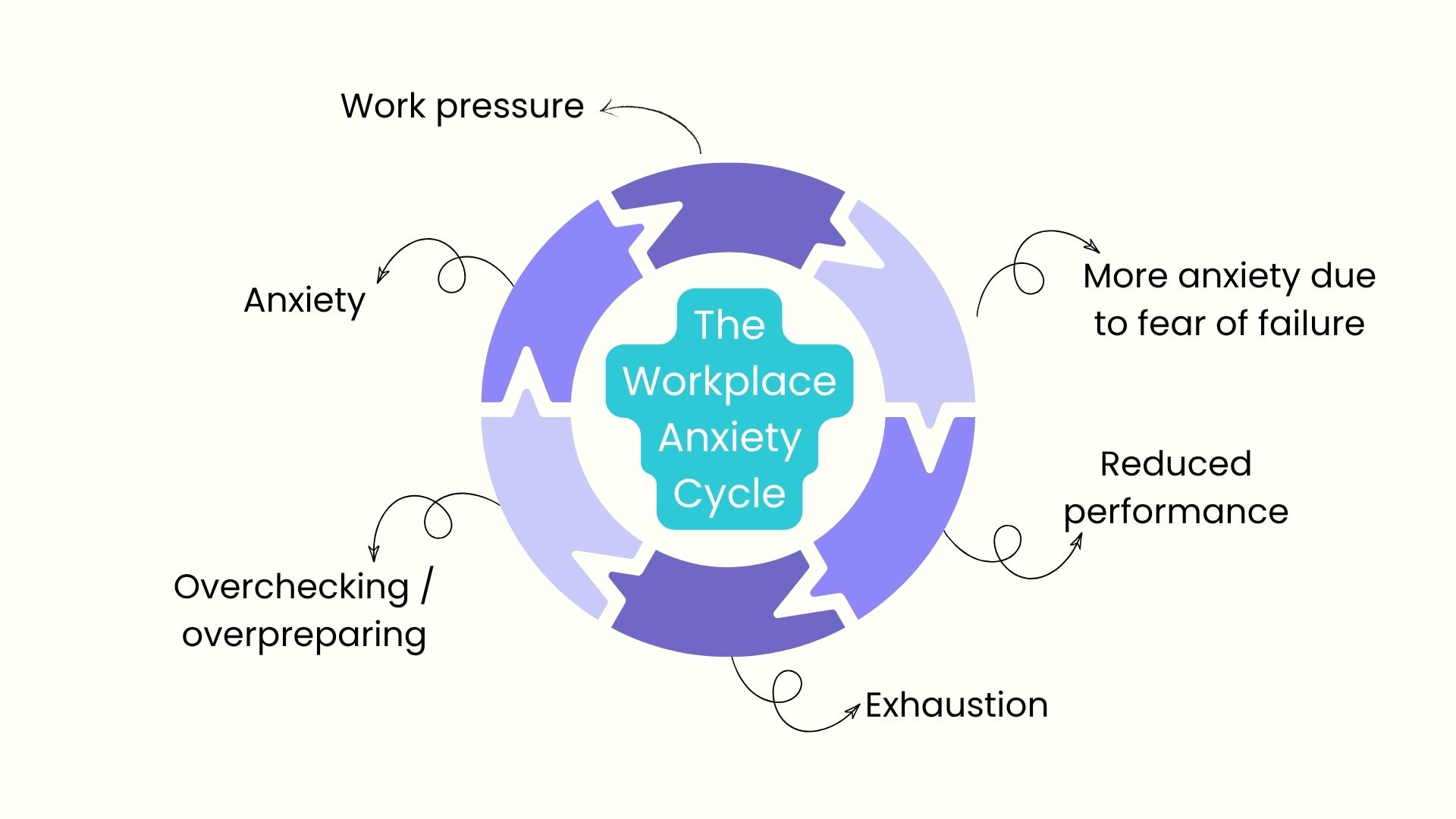
Workplace anxiety is not the same as being nervous before a big presentation. Most people feel some tension before high-stakes moments at work. That is a normal, even useful response. Workplace anxiety is different: it is persistent, disproportionate fear or dread that is directly triggered by work situations, and it does not go away when the immediate stressor passes.
Common triggers include performance evaluations, meetings with senior leaders, job insecurity, conflict with colleagues, and workload that feels impossible to manage. The mind begins associating these situations with threat and amplifies their perceived risk.
Workplace Anxiety Symptoms to Know
Workplace anxiety shows up in several distinct ways:
Emotional and cognitive symptoms:
- Dread before meetings, presentations, or performance reviews that feels out of proportion to the actual stakes
- Procrastination driven by fear of failure rather than laziness
- Difficulty concentrating; the mind going blank exactly at the moments when clarity is needed most
- Sunday dread: anxiety escalating as the workweek approaches, often peaking Sunday evening
Physical symptoms at work:
- Sweating, trembling, racing heart, or nausea before or during high-pressure situations
- Chronic fatigue that sleep does not fix
- Tension headaches, tight shoulders, digestive discomfort
Behavioural symptoms:
- Avoidance: calling in sick to sidestep a dreaded situation, avoiding the floor where a particular manager sits
- Over-preparing to the point of paralysis
- Compulsive checking of emails or messages for signs of disapproval
When Does Workplace Anxiety Become a Disorder?
The clinical threshold matters here. Workplace anxiety becomes a workplace anxiety disorder when:
- The fear has persisted for three months or more
- The fear is disproportionate to the actual threat (a frown from your manager does not mean termination)
- The anxiety significantly impairs your performance, your wellbeing, or both
At that point, it is not a personality trait. It has a strong possibility of developing into a clinical condition, and it responds well to treatment.
The India-Specific Layer
India's workplace culture amplifies anxiety in ways that are worth naming directly. Hierarchical management structures create acute anxiety around senior authority figures. Annual appraisal culture, where a single performance rating can determine a year's trajectory, generates sustained dread in the months leading up to it. The post-2023 IT layoff cycle has introduced genuine job insecurity into sectors that previously felt stable. These are structural pressures, not personal failings.
Workplace Depression in India: The Hidden Crisis
Depression at work takes a different shape from anxiety. Where workplace anxiety activates and agitates, workplace depression drains. It is characterised by a persistent low mood that does not lift even on good days, a gradual withdrawal from colleagues, a decline in the quality of work that the person themselves often notices and cannot stop, and a creeping sense that things will not improve.
Signs of Workplace Depression
- Persistent low mood that does not respond to good news, positive feedback, or weekends
- Withdrawing from colleagues: declining team lunches, going quiet in group chats, avoiding informal conversation
- Presenteeism: physically at the desk, but unable to function at anything close to normal capacity
- Chronic absenteeism, often explained as physical illness
- A decline in the care given to work that was previously a source of pride
Why Indian Employees Rarely Disclose Depression
The barriers to disclosure in Indian workplaces are real and significant. Fear of job loss is primary: disclosing depression can feel like admitting to unreliability. Stigma remains deeply embedded in many corporate cultures. Confidential mental health support is unavailable at the majority of Indian employers. And even where it exists, many employees do not know it is there.
The result is that depression operates underground in Indian workplaces. People push through it, self-medicate with overwork or withdrawal, and seek help only when the situation has deteriorated substantially.
The Economic Scale of the Problem
The WHO estimates that depression and anxiety cost India's economy approximately USD 1 trillion in lost productivity between 2012 and 2030. That figure represents a systemic failure: the cost of untreated mental health conditions at scale. Behind that number are individual people who are struggling, performing below their capability, and receiving no support.
What Triggers Workplace Depression
Toxic management is one of the most consistently cited causes: micromanagement, public humiliation, and favouritism create environments where depression becomes an understandable psychological response to sustained dehumanisation. Job insecurity, lack of recognition for good work, a mismatch between an employee's values and the organisation's behaviour, and the loneliness of remote work all contribute. Depression is not a character flaw. It is often a reasonable response to unreasonable conditions.
For a deeper understanding of symptoms, causes, and treatment options, read our comprehensive guide on depression.
Causes of Anxiety and Depression at Work in India
Understanding the roots of workplace stress and anxiety is important because it separates what can be changed individually from what requires organisational action. Both types of change matter.
Workload and Always-On Culture
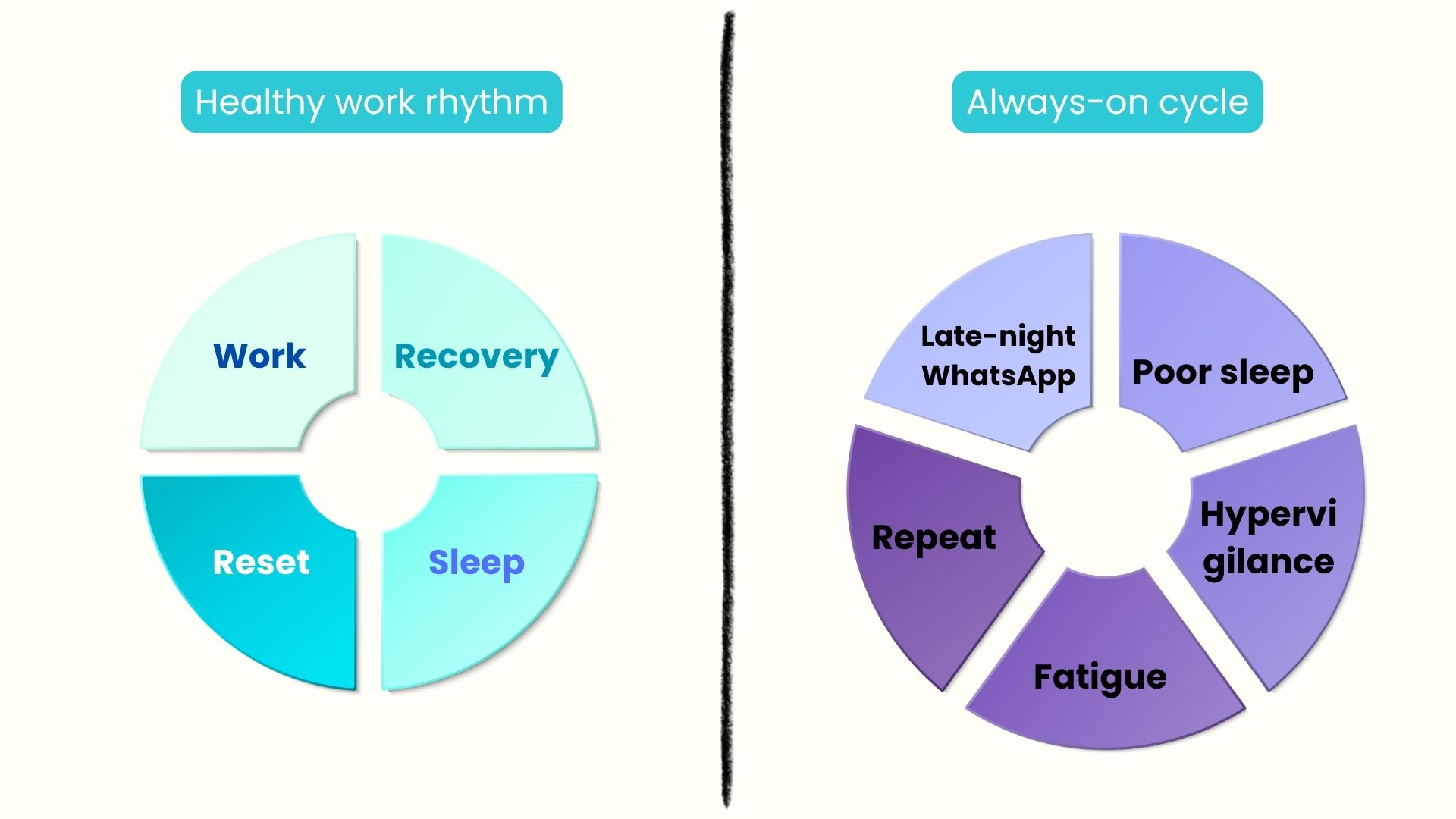
Unrealistic deadlines, chronic understaffing, and the expectation of availability beyond working hours combine to create sustained physiological stress. The WhatsApp work group that pings at 11 PM is not a minor inconvenience: it is a structural invasion of rest time that prevents the nervous system from recovering. India has no legal right to disconnect, which means this pressure is entirely unregulated.
Job Insecurity
India's IT sector has experienced significant layoffs since 2022. The gig economy offers work with no security, no benefits, and no predictability. In this environment, workplace anxiety is not an irrational response: it is a response to actual precarity. Acknowledging this matters because it prevents individuals from pathologising what is, in part, a structural problem.
Toxic Management
Micromanagement, public humiliation, favouritism, and the unpredictable anger of authoritarian managers are among the most potent triggers for both workplace anxiety and workplace depression. India's hierarchical workplace culture means that employees often have little recourse when a manager behaves destructively. The power differential is steep, and the cultural expectation is deference.
Lack of Control and Autonomy
Research consistently shows that employees with little control over how they work develop anxiety and depression faster than those with autonomy. When every task requires approval, every idea is overridden, and every decision is reversed by someone above, the result is learned helplessness: a state that is strongly associated to depression.
Workplace Conflict and Harassment
Interpersonal conflict, bullying, and harassment create sustained anxiety in anyone who experiences them. India's legal framework around workplace harassment focuses primarily on sexual harassment (the POSH Act). Broader anti-bullying protections are weak or absent. Employees who face persistent harassment often have no formal route to address it.
Remote Work and Isolation
Working from home removes the incidental social contact that supports mental health: the brief conversations, the shared lunch, the non-verbal reassurance that you are part of a team. Loneliness-driven depression is growing among India's remote and hybrid workforce. The solution is not simply returning everyone to the office: it is consciously building social connection into distributed work arrangements.
Work-Life Imbalance
When work encroaches on personal time consistently and without limit, the body and mind lose the recovery period they require. Sustained overwork is not ambition. At a physiological level, it is a chronic stress state. Over time, it produces exactly the symptoms that characterise workplace anxiety disorder: sleep disruption, hypervigilance, emotional dysregulation, and exhaustion.
How to Reduce and Manage Workplace Anxiety
Managing workplace anxiety works best when it combines individual strategies with a clear understanding of when escalation is needed. The goal is not to eliminate anxiety entirely. The goal is to reduce it to a level where it no longer controls behaviour.
1. Identify your specific triggers.
Keep a brief journal for two weeks, noting which situations spike your anxiety. Meetings with a particular person? Emails with certain subjects? Performance feedback? Specificity helps. Vague anxiety is harder to address than named anxiety.
2. Challenge catastrophic thinking.
Workplace anxiety thrives on worst-case narratives. When the thought is "my manager is ignoring my message, they must be furious with me," the helpful response is to test it against evidence. Is there another explanation? Almost always, yes. This is a skill, not a personality trait, and it can be practised.
3. Prepare thoroughly.
Anxiety grows in uncertainty. For presentations, meetings, or performance reviews, preparation is one of the most direct anxiety interventions available. Not obsessive over-preparation, which often increases anxiety, but enough preparation to feel competent and ready.
4. Set clear boundaries around communication.
Decide when work WhatsApp and email stop for the day, and hold that boundary. Use Do Not Disturb settings on your phone. The evidence is clear: after-hours accessibility increases anxiety and reduces recovery. Protecting rest time is not laziness. It is a clinical necessity.
5. Use breathing techniques before high-anxiety situations.
Box breathing (inhale for 4 counts, hold for 4, exhale for 4, hold for 4) activates the parasympathetic nervous system and reduces the physiological intensity of anxiety within minutes. Practise it before meetings you dread, before you check a message you are nervous about, before any situation you know triggers anxiety.
6. Build at least one trusted social connection at work.
A colleague who you can speak to honestly, even briefly, acts as a significant anxiety buffer. Social support does not need to be formal or extensive. A five-minute honest conversation is often enough to interrupt an anxiety spiral.
Which Mindfulness Practice Works Best for Workplace Anxiety?
This question gets asked often enough that it deserves a direct answer.
The most evidence-based practices for calming anxiety in the workplace are:
- Body scan meditation (5 to 10 minutes before a high-stakes situation): Progressively direct attention to each part of the body, releasing held tension. This works particularly well before presentations or difficult meetings.
- Breath-focused mindfulness (1 to 2 minutes at your desk): Close your eyes. Focus entirely on the sensation of breathing: the rise of the chest, the brief pause, the release. When the mind wanders, bring it back without judgment. This is a brief intervention that can help interrupt an anxiety spiral.
- Walking meditation during breaks: Ten minutes of deliberate walking, attention on each step, each breath, the ground beneath your feet. This combines movement with mindfulness, both of which independently reduce anxiety.
For sustained anxiety reduction, Mindfulness-Based Stress Reduction (MBSR) has the strongest clinical evidence. It is an eight-week structured programme that is now available online in India, making it accessible beyond metropolitan centres. Apps like Headspace and Calm also offer structured workplace mindfulness programmes with Indian rupee pricing.
When to Escalate
Speak to HR if the anxiety is caused by harassment, an unrealistic workload that has been raised and ignored, or a toxic manager. Document everything before you escalate: dates, incidents, communications. This documentation protects you and makes any formal complaint more actionable.
Seek professional help if:
- Anxiety has persisted for three months or more
- It is significantly affecting your performance, your sleep, or your relationships outside work
- You have tried individual strategies and they are not enough
What Organisations Can Do: Employer Responsibilities
The individual burden of managing workplace anxiety and workplace depression cannot sit entirely with employees. The evidence is unambiguous: the most effective interventions are structural, not individual. Yoga sessions and mindfulness apps do not fix toxic management or unrealistic workloads. They help at the margins. The systemic changes matter more.
Employee Assistance Programmes (EAPs)
EAPs provide confidential counselling for employees, typically through an external provider so that the employer does not have access to what is discussed. Large Indian corporates increasingly offer EAPs, but uptake remains low because employees either do not know the service exists or do not trust that it is genuinely confidential. Active communication about EAP availability, and explicit assurances of confidentiality, are necessary for uptake to improve.
Mental Health Leave
Normalising mental health leave, without requiring a medical certificate or detailed explanation, reduces one of the primary barriers to recovery: the inability to rest. An employee who needs a day to manage acute anxiety should not have to fabricate a physical illness to take it.
Manager Training
Managers are the first point of contact for employees in distress, and most are entirely untrained for this role. Training managers to recognise signs of anxiety and depression, to respond without overstepping professional boundaries, and to refer appropriately to EAP or HR is one of the highest-impact investments an organisation can make.
Psychological Safety
Psychological safety is the condition in which employees can speak up about concerns, errors, and disagreements without fear of punishment. Organisations with high psychological safety have lower rates of anxiety, depression, and burnout. Building it requires consistent leadership behaviour: leaders who welcome disagreement, who do not punish honest feedback, and who model fallibility.
Workload Management
The most direct intervention for workplace anxiety is reducing unrealistic demands. This requires managers to make active decisions about what is achievable, to push back on scope creep from above, and to protect their teams from the always-on culture that erodes mental health over time.
Anti-Harassment Enforcement
Beyond the POSH Act, organisations need broader anti-bullying policies with real enforcement mechanisms. Setting up a policy won’t help if reported incidents are ignored or managed internally in ways that protect the perpetrator rather than the person who raised the concern.
ISO 45003
ISO 45003 is the international standard for psychological health and safety at work. India's IT and BFSI sectors are seeing growing adoption. Organisations pursuing ISO 45003 certification commit to systematic identification and management of psychosocial risks, which places workplace mental health on the same footing as physical safety.
If workplace exhaustion feels constant and emotionally draining, read our guide on workplace burnout and recovery.
Where to Get Support
- 1to1help EAP: Confidential counselling for employees through your organisation's Employee Assistance Programme. Speak to your HR team or visit 1to1help.com.
- Tele MANAS: 14416 (free, 24/7, government-supported mental health helpline)
- iCall: 9152987821 (TISS-backed confidential counselling)
FAQs
1. What is workplace anxiety?
Workplace anxiety is persistent, disproportionate fear or dread specifically triggered by work situations: performance evaluations, presentations, conflict with colleagues, job insecurity, or workloads that feel impossible to manage. While occasional nervousness at work is normal, workplace anxiety becomes a clinical concern when it lasts three or more months, is disproportionate to the actual threat, and significantly impairs performance or wellbeing. In India, hierarchical workplace cultures, job insecurity in the IT sector, and always-on work expectations all amplify it. Workplace anxiety is treatable with CBT, mindfulness-based approaches, boundary-setting, and where needed, medication.
2. How do I manage anxiety at work?
Managing workplace anxiety combines immediate techniques with longer-term strategies. Before high-anxiety situations, box breathing (4 counts in, hold, 4 out, hold) activates the body's relaxation response within minutes. Identifying specific triggers helps you prepare rather than react. Challenging catastrophic thoughts ("my manager is frowning so I am going to be fired") with realistic evidence reduces anxiety's grip. Setting firm limits around after-hours work communication prevents anxiety from extending into personal time. If anxiety is moderate to severe, CBT with a qualified therapist is highly effective. In India, iCall (9152987821) and platforms like YourDOST offer accessible professional support.
3. Which mindfulness practice is most effective for calming anxiety in the workplace?
The most evidence-based mindfulness practices for workplace anxiety are body scan meditation (5 to 10 minutes before stressful situations), breath-focused mindfulness (1 to 2 minutes at your desk before a difficult meeting), and walking meditation (10 minutes during a lunch break). For sustained anxiety reduction, Mindfulness-Based Stress Reduction (MBSR) has the strongest clinical evidence: it is an eight-week structured programme now available online in India. Apps like Headspace and Calm also offer structured workplace mindfulness programmes with Indian rupee pricing.
4. Is it normal to feel anxious at work in India?
Some workplace stress is normal and even adaptive. It keeps people engaged and motivated. But chronic workplace anxiety that causes significant distress, impairs performance, disrupts sleep, or affects relationships outside work is not something anyone simply has to tolerate. India's workplace culture creates real conditions for anxiety: hierarchical management, high job insecurity, always-on communication norms, and intense performance pressure. The fact that anxiety at work is common does not make it inevitable or acceptable. Effective help is available, and people who seek it consistently see improvement.
5. What should I do if my workplace is causing my depression?
Start by separating what you can and cannot control. Document specific incidents (toxic management, unrealistic demands, harassment) with dates and detail. This documentation matters if you later need to escalate to HR or take legal action. Speak to HR confidentially about workload or management concerns. Access your company's EAP if one is available. Seek professional mental health support: a therapist can help you make sense of the situation and decide whether to stay, change roles internally, or leave. Do not make major decisions, including resignation, while depression is at its worst. Wait until you have more stability. If the environment is genuinely toxic and change is not possible, protecting your mental health may ultimately require a job change.
Final Note
Priya still works at the same firm in Bengaluru. The difference is that she stopped treating Sunday dread as evidence of personal weakness and started treating it as information. She identified the specific triggers: a particular weekly review meeting, and the habit of checking work WhatsApp after 9 PM. She set a boundary around the messages. She prepared more deliberately for the meeting. She spoke to a therapist through her company's EAP, which she had not known existed until a colleague mentioned it offhand.
The anxiety did not disappear. But it stopped running her Sundays.
That is what managing anxiety in the workplace actually looks like. It is not a dramatic transformation. It is a series of small, deliberate shifts that accumulate into a life that is less organised around fear.
Anxiety at workplace is one of the most underreported mental health challenges in India. The barriers are cultural: the belief that stress is simply the price of ambition, that disclosing difficulty invites professional consequences, that asking for help signals weakness. None of those beliefs are true, and all of them cost people years of unnecessary suffering.
If you are wondering how to reduce stress and anxiety in the workplace, the honest answer is: it depends on what is driving it. If the cause is structural, such as toxic management, unrealistic workloads, or harassment, individual strategies will only go so far. Structural problems require structural solutions, and organisations have a responsibility to provide them. If the cause is partly in how you are relating to normal workplace pressures, then CBT, mindfulness, boundary-setting, and social support can make a real and lasting difference.
Most often, it is both.
Anxiety in workplace settings in India is not a niche problem. It sits behind the presenteeism numbers, the attrition rates, the productivity losses that organisations measure but rarely trace back to mental health. It also sits behind the exhaustion that individual professionals carry home every evening and mistake for a character defect.
Reducing anxiety in the workplace starts with naming it accurately. Not "I am the anxious type." Not "this is just how the job is." Workplace anxiety is a clinical condition. Workplace depression is a clinical condition. Both are diagnosable, both are treatable, and both respond well to the right intervention when caught before they become entrenched.
The question is not whether workplace stress and anxiety are real. They are. The question is whether you treat them, or whether you wait until waiting is no longer an option.
Ready to Build a Mentally Healthy Workplace?
1to1help has worked with over 1,000 organisations across India to design and deliver workplace mental health training programs, EAP services, and manager capability building. If you want to understand what a structured program could look like for your workforce, our team can walk you through it.
References
- World Health Organization. (2022). Mental health at work [Fact sheet]. https://www.who.int/news-room/fact-sheets/detail/mental-health-at-work
- World Health Organization. (2016, April 13). Investing in treatment for depression and anxiety leads to fourfold return [Press release]. https://www.who.int/news/item/13-04-2016-investing-in-treatment-for-depression-and-anxiety-leads-to-fourfold-return
- World Health Organization & World Bank Group. (2016, April 13). Investing in treatment for depression and anxiety leads to fourfold return [Press release]. https://www.worldbank.org/en/news/press-release/2016/04/13/investing-in-treatment-for-depression-anxiety-leads-to-fourfold-return
- World Health Organization. (2022). Guidelines on mental health at work. https://www.who.int/publications/i/item/9789240053052
- Gururaj, G., Varghese, M., Benegal, V., et al. (2016). National Mental Health Survey of India, 2015-16: Prevalence, patterns and outcomes. NIMHANS Publication No. 129. https://indianmhs.nimhans.ac.in/phase1/Docs/Report2.pdf
- Edmondson, A. C. (1999). Psychological safety and learning behavior in work teams. Administrative Science Quarterly, 44(2), 350-383. https://dash.harvard.edu/entities/publication/13a7b031-0fdd-45ec-a7e0-2b80e2bc679f
- Morgan, A. J., Ross, A., & Reavley, N. J. (2018). Systematic review and meta-analysis of Mental Health First Aid training: Effects on knowledge, stigma, and helping behaviour. PLOS ONE, 13(5), e0197102. https://journals.plos.org/plosone/article?id=10.1371/journal.pone.0197102
- Ministry of Law and Justice, Government of India. (2017). The Mental Healthcare Act, 2017. https://www.indiacode.nic.in/bitstream/123456789/2249/1/A2017-10.pdf
- iCall, Tata Institute of Social Sciences. https://icallhelpline.org
- Tele MANAS, Ministry of Health and Family Welfare, Government of India. https://telemanas.mohfw.gov.in


.svg)
.svg)
.svg)
.svg)