

.png)


.png)

Personal Life & Relationships
Arranged Marriage vs Love Marriage: Pros, Cons, Success Rates & How to Choose (2026)
.jpg)
.png)
Written by
Aarohi Parakh,
Psychologist and Content Writer

Reviewed by
Sanjana Sivaram,
Psychologist and Clinical Content Head


Introduction

Picture this: Neha, 27, is a product designer in Bengaluru. She has been on three family-approved dates through Shaadi.com and is also secretly texting someone she met at a friend's wedding. Her mother wants her to 'decide already.' Her best friend thinks she should follow her heart. Her cousin had an arranged marriage, seems genuinely happy, and has no idea what all the fuss is about.
Sound familiar? If you are somewhere between 24 and 35 and Indian, there is a good chance some version of this is your reality. The arranged marriage vs love marriage conversation is not just a philosophical discussion. For millions of people in India, it is a very real, very personal, very pressured life decision.

This guide will not tell you what to do. What it will do is give you the honest data, the psychological research, and a realistic framework to help you figure out what is right for you. Whether you are team arranged, team love, or firmly in the 'I have no idea yet' camp, read on.
What Is Arranged Marriage? The Indian Reality in 2026
Let us start with what arranged marriage actually looks like today, because the version in your grandmother's stories is probably not the version being practised in most Indian families right now.
The classic definition: a union in which families, parents, relatives, or matchmakers take the lead in identifying and vetting a suitable life partner, typically based on factors like caste, religion, education, profession, and family background. Historically, an individual's choice in arranged marriage was often more limited.
But that picture has changed significantly. In many urban setups, this model is becoming less common, though experiences still vary significantly across families and communities. In modern India, arranged marriages often exist on a spectrum, with varying levels of family involvement and individual choice:
1. Fully Family-Led Arranged Marriages
In this traditional format, parents and extended family members take the lead in identifying, evaluating, and finalising a potential match. The individual may have limited opportunity to reject or independently assess the partner.
This model is more commonly seen in:
- Rural communities
- Highly conservative families
- Strongly tradition-oriented households
Level of individual choice: Low to minimal
2. Semi-Arranged Marriages (Most Common Today)
This is now one of the most common forms of arranged marriage in urban and semi-urban India. Families may introduce potential partners through social networks, matrimonial platforms, or relatives, but the individuals themselves usually spend time interacting before making a decision.
Typically:
- Families shortlist compatible matches
- The couple meets independently
- Conversations continue over weeks or months
- The final decision rests with the individuals involved
This model is common among:
- Urban professionals
- Middle-class families
- Educated younger generations
Level of individual choice: High
3. Love-Cum-Arranged Marriages
In a love-cum-arranged marriage, individuals choose their partner independently through college, work, friendships, or dating. Families are later involved for approval, support, and ceremonial participation.
This model blends:
- Personal choice
- Emotional compatibility
- Family acceptance
It is especially common in:
- Metropolitan cities
- Educated professionals
- Intercultural or inter-regional relationships
Level of individual choice: Full, with family involvement added later
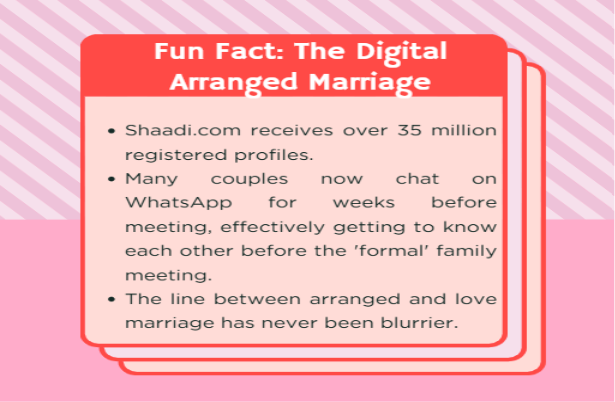
According to a Statista survey, over 90 percent of marriages in India are still arranged or semi-arranged. But 'arranged' now often means the family does the shortlisting while you do the choosing. Platforms like Shaadi.com, jeevansaathi, and BharatMatrimony have transformed the process into something that looks a lot more like structured dating with family involvement than a transaction.
Many modern relationships combine elements of both arranged and love marriage, balancing individual compatibility with family support and cultural expectations.
What Is Love Marriage? Trends, Acceptance, and the Changing Landscape
Love marriage: two people meet, develop feelings for each other, decide they want to spend their lives together, and then (often nervously) tell their families. Family approval follows the decision rather than preceding it.
Love marriages account for approximately 10 to 15 percent of all marriages in India, according to BBC reporting. That percentage is small in absolute terms but growing rapidly, particularly among urban millennials and Gen Z. In Delhi, Mumbai, Bengaluru, Hyderabad, and Pune, love marriages are increasingly normalised.
How are people meeting their partners? The methods are shifting fast.
- College and university: still the most common meeting ground for love marriages in India
- Workplaces: particularly in corporate, startup, and tech environments
- Mutual friends and social circles: gatherings, parties, and group travel
- Dating apps: Bumble, Hinge, and even Tinder are now mainstream among urban Indians aged 22 to 35
- Matrimonial platforms (surprisingly): individuals connecting directly on Shaadi.com, jeevansathi or BharatMatrimony before involving family
The ongoing challenge is that inter-caste and inter-religion love marriages can still face significant family resistance. Data suggests nearly 1 in 3 urban Indian marriages are inter-caste, signalling real change in norms, but these marriages also report higher initial stress due to family friction.
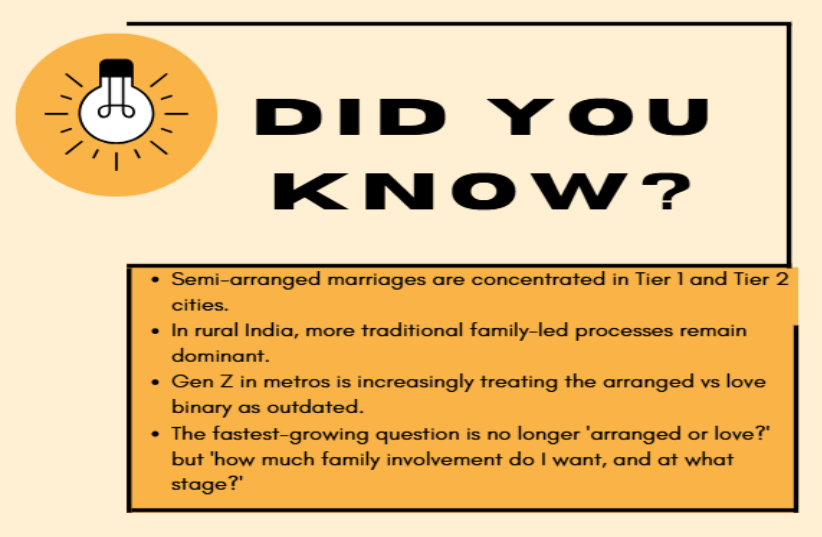
And then there is Generation Z, who increasingly refuse to be put in a box. They use dating apps and are also open to meeting someone through family. For them, the arranged vs love binary is beginning to feel outdated. More on that in the semi-arranged section below.
Arranged Marriage vs Love Marriage: Key Differences at a Glance
If you are wondering how arranged and love marriages compare in real life, this quick breakdown clearly and honestly covers the major differences.
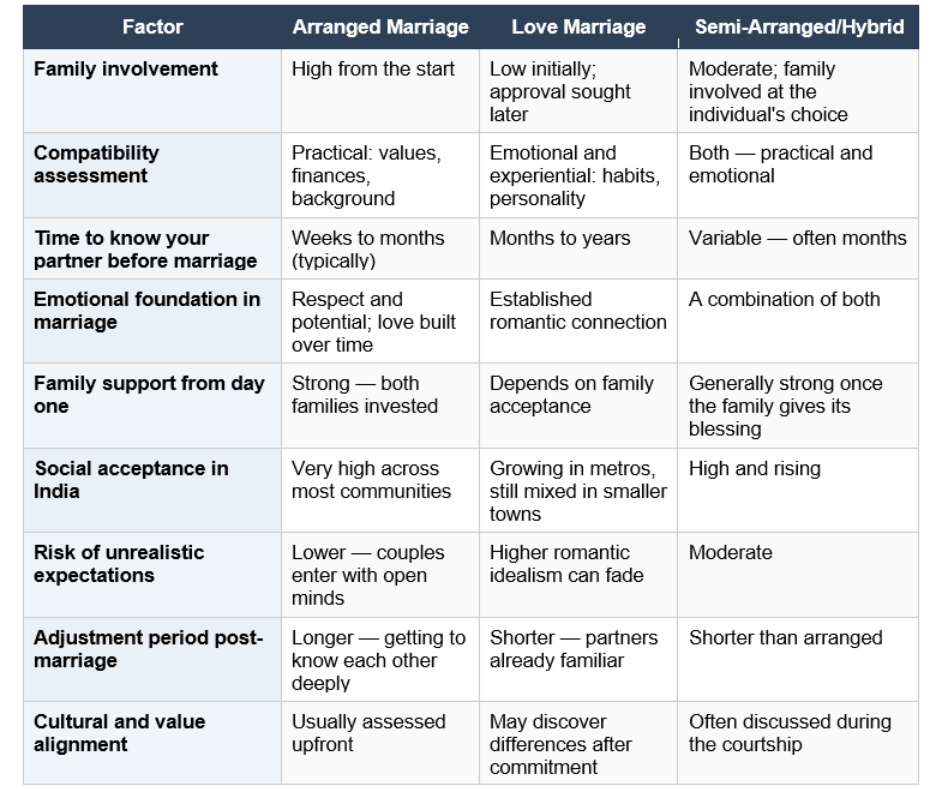
A note on nuance: these are generalisations, not rules. Real marriages exist on a spectrum. A couple in an 'arranged' marriage may have been texting for six months before the first family meeting. A couple in a 'love' marriage may have known each other for three weeks. The categories are useful for conversation, not for predicting outcomes. It should also be noted that in reality, many modern marriages include elements of both approaches, making these distinctions increasingly fluid.
Pros and Cons of Arranged Marriage
Arranged marriages can offer stability, family support, and shared cultural alignment, but they can also come with emotional and personal challenges. The experience varies greatly depending on the people involved, the family dynamics, and the level of individual choice.
Pros of Arranged Marriage
✓ Strong Family Support System: In many arranged marriages, both families are actively involved and invested in helping the relationship succeed. This can create a strong support network during difficult phases of married life.
✓ Practical Compatibility Is Considered Early: Factors such as financial stability, cultural values, religion, lifestyle expectations, and long-term goals are often discussed before marriage, which may reduce future conflicts around these areas.
✓ Expectations May Be More Realistic: Many couples enter arranged marriages understanding that emotional intimacy and love will develop gradually over time rather than expecting instant perfection.
✓ Guidance From Family Experience: Parents and elders may bring practical insight while evaluating long-term compatibility, family values, and stability.
✓ Greater emotional stability beyond Short-Term Infatuation: Decision-making may feel more grounded because it is often based on long-term suitability rather than only emotional attraction or chemistry.
✓ Established Social and Community Support: Couples may begin married life with stronger integration into family and community networks, which can provide emotional and practical support.
Cons of Arranged Marriage
✗ Limited Time to Know Your Partner Deeply: Some couples may have only a short time to understand each other's personalities, habits, emotional needs, and communication styles before marriage.
✗ Risk of Family Pressure: In more traditional or conservative settings, individuals may feel pressured to prioritise family expectations over their own preferences.
✗ Emotional Chemistry May Take Time: Unlike love marriages, emotional and physical compatibility may take longer to develop in some arranged marriages, and it may not happen naturally for every couple
✗ Reduced Individual Autonomy in Some Contexts: In certain families or communities, personal choice and independence may be limited, especially regarding career, lifestyle, or relationship decisions.
✗ Practical Compatibility Does Not Guarantee Emotional Compatibility: Even when families, education, finances, and values align well on paper, personality differences and emotional disconnect can still emerge later.
The psychology behind it: Research by Dr Robert Epstein (Psychology Today, 2013) found that couples in arranged marriages can develop love over time that is as deep — and in some cases deeper — than those in love marriages. The explanation lies in what psychologists call the 'low initial expectations' effect: when you enter a marriage without idealised romantic expectations, you are more likely to be genuinely and pleasantly surprised by the real person you discover.
Pros and Cons of Love Marriage
Love marriages are often associated with emotional connection, personal choice, and romantic compatibility. At the same time, they can also bring unique pressures and challenges that couples may not fully anticipate before marriage.
Pros of Love Marriage
✓ Strong Emotional Connection Before Marriage: Couples usually enter the marriage with an existing emotional bond, mutual affection, and understanding built through shared experiences.
✓ Better Potential of Understanding Your Partner: Partners often have more time to observe each other’s personality, habits, communication style, strengths, and flaws before making a long-term commitment.
✓ Romantic and Physical Compatibility: Love marriages often begin with emotional attraction and physical chemistry already established, which can strengthen intimacy early in the relationship.
✓ Greater Individual Choice and Autonomy: Individuals choose their partner independently, allowing personal preferences, emotional compatibility, and shared values to guide the decision.
✓ Shared Interests and Lifestyle Alignment: Couples may already know whether they align in areas such as hobbies, lifestyle, career goals, social preferences, and long-term aspirations.
Cons of Love Marriage
✗ Possibility of Family Resistance: Some couples, especially in inter-caste, inter-religion, or intercultural relationships, may face opposition or lack of acceptance from family members.
✗ Practical Compatibility Can Be Overlooked: In the early stages of romance, important factors such as financial expectations, family dynamics, responsibilities, and long-term life goals may not receive enough attention.
✗ Romantic Expectations May Become Unrealistic: Strong romantic ideals can create pressure to maintain constant emotional intensity, which can be difficult in everyday married life.
✗ Reduced Family Support During Conflict: If families were initially unsupportive of the relationship, couples may have fewer emotional or practical support systems during periods of conflict.
✗ Attraction Alone is not Conducive to a Long-Term Partnership: The excitement and emotional intensity of the early relationship phase naturally change over time. Like any marriage, long-term success still depends on communication, compromise, trust, and emotional maturity.
The psychology behind it: Psychologists describe limerence (profound romantic infatuation, first defined in the 1970s by psychologist Dorothy Tennov) as typically lasting 18 to 36 months. After that, the intense excitement and emotional intensity of early romantic love diminishes and what sustains the relationship are the same factors that determine success in arranged marriages: communication, mutual respect, shared values, and commitment. Love marriage provides a strong starting point, but it is not a substitute for the ongoing work that every marriage requires.
Arranged Marriage vs Love Marriage: Success Rate and Divorce Rate in India
When people debate arranged marriage vs love marriage, the conversation almost always comes down to one question: which one actually lasts? While statistics can offer insight, the reality is far more nuanced than simple success or divorce rates.

Note: These figures should be interpreted cautiously. India does not maintain comprehensive nationwide divorce statistics separated by marriage type, and many available estimates come from surveys, regional datasets, or smaller analytical studies rather than official government records.
What the Numbers Actually Mean
India has one of the lowest divorce rates in the world at approximately 1 percent. Within this, love marriages account for a disproportionate share of divorces — some estimates place the love marriage divorce rate at 20 to 30 percent versus 1 to 2 percent for arranged marriages.
Here is the critical context that most articles leave out: India's low overall divorce rate is heavily shaped by social stigma, financial dependency (particularly for women), and family pressure to stay in a marriage regardless of personal happiness. A low divorce rate does not automatically mean happy marriages. It often means people remain in unhappy marriages because leaving is not socially or financially viable.
A 2025 data analysis of 10,000 Indian marriages (Medium) found that divorce rates between arranged and love marriages are now converging significantly. As Indian society modernises, the gap is also narrowing.
What Actually Predicts Whether a Marriage Works
Research is consistent on this. The Psychology Today study of Indian adults in the US found no significant differences in love, satisfaction, or commitment between arranged- and love-marriage participants. The type of marriage was not the decisive variable. What mattered was:
- Communication quality: the ability to express needs, disagree respectfully, and repair after conflict
- Shared values and life goals: alignment on children, money, careers, and lifestyle
- Commitment: the choice to show up, work through difficulties, and keep choosing each other
- Financial compatibility: one of the most common and underestimated sources of marital conflict
- Quality of family relationships: how in-laws relate to the couple significantly affects marital satisfaction
- Access to support: including professional counselling (pre-marital or marital) when needed
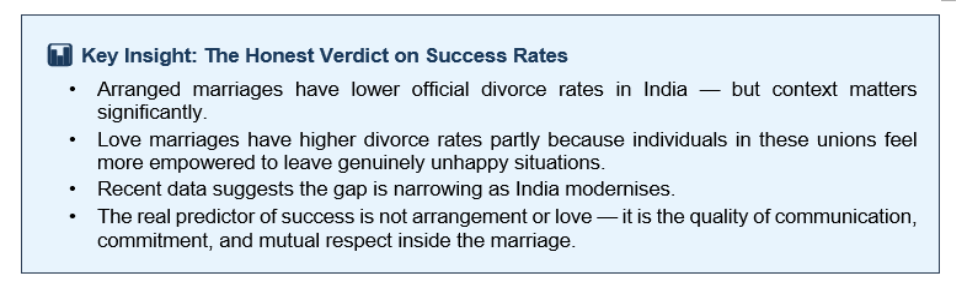
The research shows that the differences in love between arranged and love marriages tend to disappear over time. The critical factor is not how the marriage began; it is what both people put into it.
Love Marriage vs Arranged Marriage: Debate Points
The debate between love marriage and arranged marriage is rarely straightforward. Both sides have compelling arguments, shaped by personal values, emotional needs, cultural expectations, and lived experiences.
Family Experience vs Individual Choice
▶ Supporters of arranged marriage often believe families bring maturity, life experience, and practical perspective that younger individuals may not yet have.
▶ On the other hand, supporters of love marriage argue that choosing a life partner is one of the most personal decisions a person can make and individual autonomy should remain central.
Practical Compatibility vs Emotional Compatibility
▶ One of the strongest arguments for arranged marriage is that practical aspects such as finances, values, religion, lifestyle, and long-term expectations are evaluated early before emotional attachment influences judgement.
▶ In contrast, advocates of love marriage believe emotional connection, chemistry, and genuine understanding cannot be assessed through family-led matching alone.
Family Support vs Personal Freedom
▶ Arranged marriages often begin with strong involvement and support from both families, which can provide stability during difficult phases of married life.
▶ Love marriages, however, are seen by many as allowing individuals to build relationships based on personal choice rather than external expectations or pressure.
Stability vs Romantic Idealism
▶ Supporters of arranged marriage sometimes argue that the process reduces the risk of confusing temporary attraction or infatuation with long-term compatibility.
▶ Meanwhile, supporters of love marriage believe spending significant time with a partner before marriage helps reveal personality traits, habits, communication styles, and potential incompatibilities more realistically.
Cultural Values vs Changing Social Norms
▶ For many Indians, involving family in marriage decisions is viewed not as a restriction but as an important cultural and emotional value tied to community and shared responsibility.
▶ At the same time, love marriages are becoming increasingly accepted in urban India and globally, especially among younger generations who prioritise emotional compatibility and personal independence.
Commitment vs the Freedom to Leave
▶ Some people believe arranged marriages encourage stronger commitment because families are deeply invested in helping the relationship succeed.
▶ Others argue that the ability to leave an unhealthy or unsuitable relationship without overwhelming social or family pressure reflects emotional well-being and personal agency rather than failure.
The balanced conclusion: Ultimately, the debate between arranged marriage and love marriage is less about proving one approach superior and more about understanding what creates trust, compatibility, emotional safety, and long-term partnership for different individuals.
A relationship counsellor can help couples on both paths navigate the specific challenges of their marriage structure, whether that is building emotional intimacy quickly in an arranged marriage or managing family pressure in a love marriage.
The Rise of Semi-Arranged Marriage: India's Modern Third Way
A new relationship concept is increasingly shaping how many young Indians approach marriage, blending personal choice with family involvement rather than fitting into strictly traditional categories.
Semi-arranged marriage (also called 'love-cum-arranged') is exactly what it sounds like: the individual finds and chooses their partner, then brings the family in for their blessing. The family is involved, but the individual has full decision-making authority from the beginning. This is now the most common marriage format in urban and semi-urban India.
Why is this format growing so fast? Because it solves the tension that most modern Indians actually feel.
- You get to choose someone you genuinely connect with: your call, your chemistry, your values match
- Your family is still involved, which matters deeply in a culture where family harmony holds great emotional significance
- You avoid both the 'complete stranger' anxiety of a fully arranged marriage and the 'going against everyone I love' stress of a love marriage with family resistance
Matrimonial platforms have accelerated this trend. Many young Indians now browse these platforms independently, connect directly, build genuine rapport over weeks or months, and then introduce families. The 'arranged' label technically applies, but the emotional dynamic is much closer to a love marriage.
If you are a younger reader, you may already be in this category without having a name for it. You swiped right on someone, talked for months, fell for them, and are now figuring out how to tell your parents. That is not a love marriage gone wrong. That is the new normal.
How to Choose: Which Type of Marriage Is Right for You?
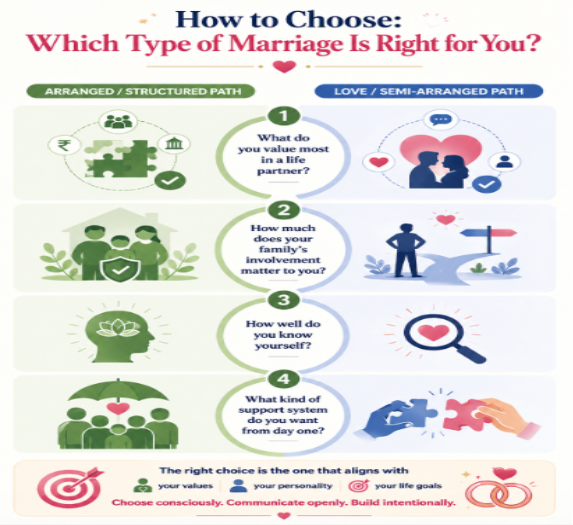
There is no universal right answer here. But there are better and worse ways to think about this decision. Instead of asking 'which type of marriage is more successful statistically', try asking yourself these four questions.
- What do you value most in a life partner? If shared cultural values, family harmony, and practical compatibility feel non-negotiable to you, a structured, arranged marriage process may serve you well. If deep emotional connection, personal chemistry, and knowing your partner intimately before committing are your priorities, you are probably better suited to a love or semi-arranged path.
- How much does your family's involvement matter to you? Be honest. If family harmony matters deeply and you genuinely value their wisdom in the process, build that in from the start. If you feel you need to make this decision yourself and earn their approval over time, a love marriage framework suits your personality better. Neither answer is wrong.
- How well do you know yourself? Arranged marriages require trust in the process and confidence in your ability to build an emotional connection over time. Love marriages require honest self-awareness: can you distinguish genuine long-term compatibility from infatuation? Have you had enough experience to know what you actually need in a partner versus what you are attracted to in the short term?
- What kind of support system do you want from day one? Arranged marriages typically come with family investment embedded from the beginning; both families are rooting for the marriage. Love marriages, particularly those with initial family resistance, may require more deliberate effort to build that external support network. This is not a small thing. The quality of your support system during conflict genuinely affects marital outcomes.
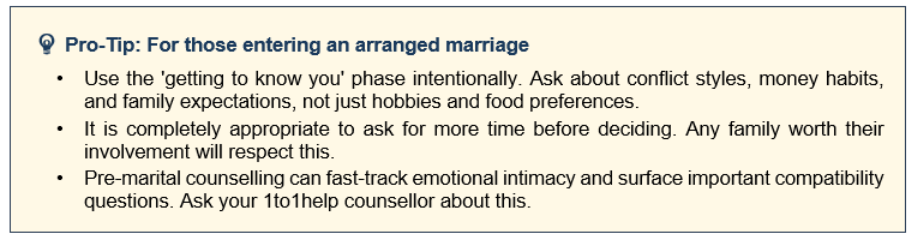
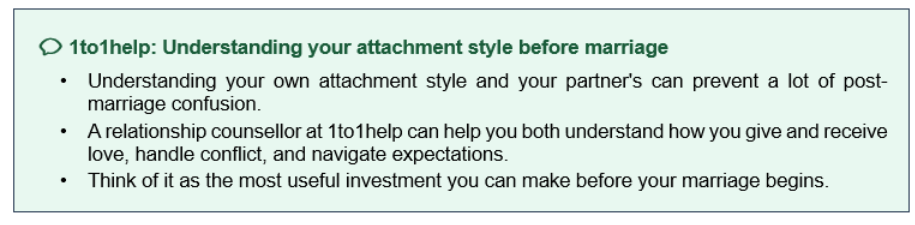
A note on pressure: if you are making this decision under significant family, social, or time pressure, acknowledge that pressure directly before making a choice of this magnitude. Talking to a relationship counsellor at 1to1help before you decide can help you separate your own values and needs from the external noise.
Love Marriage vs Arranged Marriage: Quotes That Say More Than Statistics Ever Could
Not every truth about relationships can be measured through success rates and data. Sometimes a single perspective captures the emotional reality of marriage more honestly than numbers do.
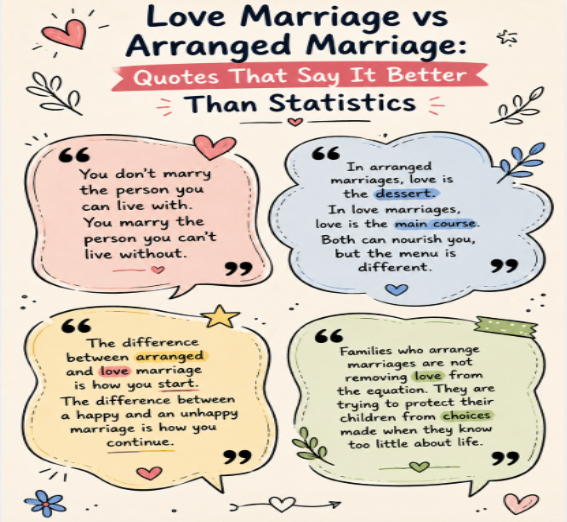
Whether love comes before marriage or grows within it, long-term happiness usually depends on the same foundations: communication, respect, adaptability, and shared commitment.
The Bottom Line
Arranged marriage. Love marriage. Semi-arranged. Love-cum-arranged. The labels matter far less than people often assume. What matters more is who you choose, why you choose them, and what both of you are willing to invest in the relationship after the decision is made. Regardless of how a marriage begins, emotional safety, mutual respect, consent, and the ability to communicate openly remain essential foundations of a healthy relationship
India’s marriage landscape is evolving rapidly. The lines between arranged and love marriages are becoming increasingly blurred, especially among younger generations navigating modern relationships alongside family expectations. What research consistently shows is this: no single type of marriage guarantees happiness, emotional fulfilment, or long-term success.
Back to Neha from our opening story. Eventually, she had an honest conversation with her mother. She explained what she needed: more time, more agency in the decision, and the freedom to understand what felt right for her. To her surprise, her mother listened. The conversation was uncomfortable at first, but it opened the door to understanding instead of conflict.
These conversations are possible. And for many individuals, couples, and families, they are necessary.
If you are navigating confusion, family pressure, relationship uncertainty, compatibility concerns, or difficult conversations around marriage, professional guidance can help create clarity without judgement.
Through 1to1help’s Employee Assistance Programme (EAP), employees and their families can access confidential relationship counselling and emotional wellness support from trained mental health professionals. Whether you are exploring a relationship, preparing for marriage, or struggling within one, having a neutral and informed space to talk can make a meaningful difference.
FAQs
Q1. Which is better, arranged marriage or love marriage in India?
Genuinely, neither is objectively better. Both types can lead to deeply fulfilling, lasting relationships, and both can fail. Research, including a Psychology Today study of Indian adults, found no significant differences in love, satisfaction, or commitment between arranged- and love-marriage participants. What determines success is not how the marriage was arranged. It is communication quality, shared values, mutual respect, and both people's willingness to keep working on the relationship. A relationship counsellor can help both types of couples build this foundation.
Q2. Is arranged marriage more successful than love marriage in India?
Arranged marriages in India show lower official divorce rates (approximately 1 to 2 percent) compared to love marriages (estimated 20 to 30 percent in some studies). However, this difference is significantly shaped by social stigma around divorce and financial dependency, not necessarily by greater happiness. A 2025 analysis of 10,000 Indian marriages found divorce rates between the two types are now converging. The type of marriage alone is not the decisive factor, the quality of the individuals in it is.
Q3. Can an arranged marriage lead to genuine love?
Absolutely, and research clearly backs this up. Dr Robert Epstein's 2013 research found that arranged marriages can develop deep, passionate love over time. Psychologists explain this through the 'low expectations' effect: when couples enter without idealised romantic preconceptions, they are more likely to be genuinely surprised by the real connection that develops. Many couples in arranged marriages report that their love deepens significantly in the years after marriage as they navigate life together.
Q4. What are the main disadvantages of love marriage in India?
The main challenges include the potential for family resistance, particularly in inter-caste or inter-religion unions, which can create sustained external stress. High romantic expectations, built during the dating phase, can be difficult to maintain once daily life sets in and infatuation fades, typically within 18 to 36 months. Practical compatibility around finances, family dynamics, and life goals can be overlooked when couples are in the early romantic phase. Lack of initial family support can also mean fewer external resources during marital conflict.
Q5. What is the success rate of love marriage in India?
Love marriages in India have an estimated divorce rate of 20 to 30 percent versus 1 to 2 percent for arranged marriages, but this comparison needs context. India's very low overall divorce rate is heavily influenced by social norms, financial dependency, and stigma that discourage separation. Many unhappy arranged marriages persist due to external pressure. The most recent data suggest the gap between the two types is narrowing as India modernises and individuals feel increasingly empowered to prioritise personal happiness.
Q6. How do I know which type of marriage is right for me?
Reflect on what you value most in a partner, how much family involvement feels right to you, and how well you know yourself and your own patterns in relationships. If family harmony and cultural alignment are non-negotiable, an arranged framework may resonate. If personal autonomy and emotional connection are your priority, a love or semi-arranged path may feel more authentic. Many modern Indians are choosing a hybrid: finding their own partner while still involving family for blessing and support. A relationship counsellor at 1to1help can help you clarify your values and approach this decision with greater self-awareness.
Q7. Can couples counselling help both arranged and love marriages?
Yes, and it significantly improves outcomes in both. Pre-marital counselling benefits both types of marriage by building communication skills, aligning expectations, and identifying potential conflict areas before they become entrenched problems. In arranged marriages, counselling helps couples who may not know each other well build trust and emotional intimacy quickly. In love marriages, it helps manage the transition from romantic idealism to sustainable partnership. 1to1help's relationship counsellors (via its EAP offering) work with couples across all marriage structures — arranged, love, semi-arranged, inter-caste, and inter-religion.
Recommended Reading
References
- BBC News. (2021, December 7). Why India’s divorce rate is rising. BBC News. BBC News article
- Blessings Matrimonials. (n.d.). Love vs arranged marriage: Which has a higher success rate in India? Blessings Matrimonials article
- Jodi4Ever. (n.d.). Love vs arranged marriage: Which one works better in India? Jodi4Ever article
- Living With Limerence. (n.d.). What is limerence? Living With Limerence article
- Medium. (n.d.). Do love marriages really end more often? A deep dive into India’s marriage data. Medium article
- Medium. (n.d.). Side effects of love-cum-arranged marriages. Medium article
- Medium. (n.d.). The indignities of an arranged marriage. Medium article
- Nithra Matrimony. (n.d.). Are arranged marriages outdated? Nithra Matrimony article
- Prime Legal. (2024). Divorce rate in India: Statistics, trends and legal insights. Prime Legal article
- Psychology Today. (2003, January 1). The love project. Psychology Today article
- Psychology Today. (2012, August 20). Arranged vs. love-based marriages in the U.S.: How different are they? Psychology Today article
- Qazi, A. A. (2021). Marriage and divorce trends in India. International Journal of Law, Policy and the Family, 35(1). Oxford Academic article
- Verywell Mind. (2023). Infatuation vs. love: What’s the difference? Verywell Mind article
- Verywell Mind. (2023). What you need to know about relationship counseling. Verywell Mind article
- WedKnott. (n.d.). Arranged marriage vs love marriage: What studies say. WedKnott article
- WedKnott. (n.d.). Love marriage success rate in India: Trends and facts. WedKnott article


.svg)
.svg)
.svg)
.svg)