


.png)


.png)

Personal Life & Relationships
How to Re-Energize Your Relationship: 7 Research-Backed Strategies for Couples

.png)
Written by
Aarohi Parakh,
Psychologist and Content Writer

Reviewed by
Sanjana Sivaram,
Psychologist and Clinical Content Head


Introduction: When Relationships Go Quiet and What You Can Do About It
There is a particular kind of distance that can develop in long-term relationships. Nothing dramatic may have happened. There may not have been a major argument or betrayal. Life simply becomes busy. Work, bills, family responsibilities, children, ageing parents, social commitments and endless WhatsApp notifications gradually take up the space that once belonged to long conversations and unplanned affection.
For many couples, this does not necessarily mean they have fallen out of love. They may have simply drifted into a relationship that functions well on the outside but feels quieter on the inside.
This is where thoughtful relationship advice for couples can be useful. If you have been wondering how to improve your relationship, or even how to re-energize a relationship that has gone quiet, the answer may not be a dramatic romantic gesture. It may involve returning to some very ordinary behaviours that help partners feel noticed, valued and emotionally safe.
Research on relationship maintenance has identified behaviours such as positivity, openness, assurance, shared social networks and sharing tasks as important ways couples maintain relational quality.
For couples in India, these behaviours can become particularly relevant when work pressure intersects with expectations around marriage, extended family, caregiving and household responsibilities.
This guide looks beyond date-night ideas. It explores seven research-informed strategies that may help couples rebuild connection, communicate more effectively and bring some energy back into their relationship.
What Does Re-Energizing a Relationship Actually Mean?
When people search for how to rekindle a relationship, they often imagine returning to the beginning: more excitement, butterflies, spontaneous plans and endless conversation.
But re-energizing a relationship does not necessarily mean recreating the honeymoon phase. Early romantic relationships often contain considerable novelty and uncertainty. Over time, familiarity naturally increases. In its place can develop a deeper form of intimacy built around trust, shared history, and knowing one another more fully.
Relationship maintenance research provides a useful framework here. Stafford and Canary identified five broad maintenance strategies: positivity, openness, assurances, social networks and sharing tasks. Later research has continued to examine how these behaviours relate to satisfaction, commitment and other aspects of relationship quality.
There is also an important difference between doing things together and deliberately maintaining the relationship. Cooking dinner, paying bills or picking up groceries may help a household function, but intentional relational maintenance involves recognising that these actions can also communicate care, commitment and partnership.
So, how to strengthen a relationship is rarely about one perfect technique. It is more likely to involve noticing which part of the relationship has become neglected and responding to it consistently.
For one couple, that might mean better conflict management. For another, it could mean more emotional openness or a fairer division of responsibilities.
The goal is not to fix everything at once. It is to identify where the relationship feels thinnest and begin there.
Signs Your Relationship Needs Attention
A relationship can need attention without being unhealthy. In fact, many couples may recognise these signs during particularly demanding periods of life.
The more useful question may be: Has this become our normal, or is this simply a difficult season?
Here are some signs worth noticing:
Sign 1: Differences Are Creating More Negative Feelings
Disagreements are expected in close relationships. The concern may arise when differences repeatedly leave one or both partners feeling criticised, dismissed or resentful.
Over time, unresolved resentment can make even small issues feel disproportionately threatening.
Sign 2: Certain Topics Are Avoided to Prevent Another Argument
Avoiding a difficult conversation can feel like keeping the peace. Yet when important subjects remain permanently off-limits, emotional distance can gradually increase.
The issue may still be present, but now it carries the weight of everything that hasn't been discussed.
Sign 3: Positive Interactions Have Become Less Frequent
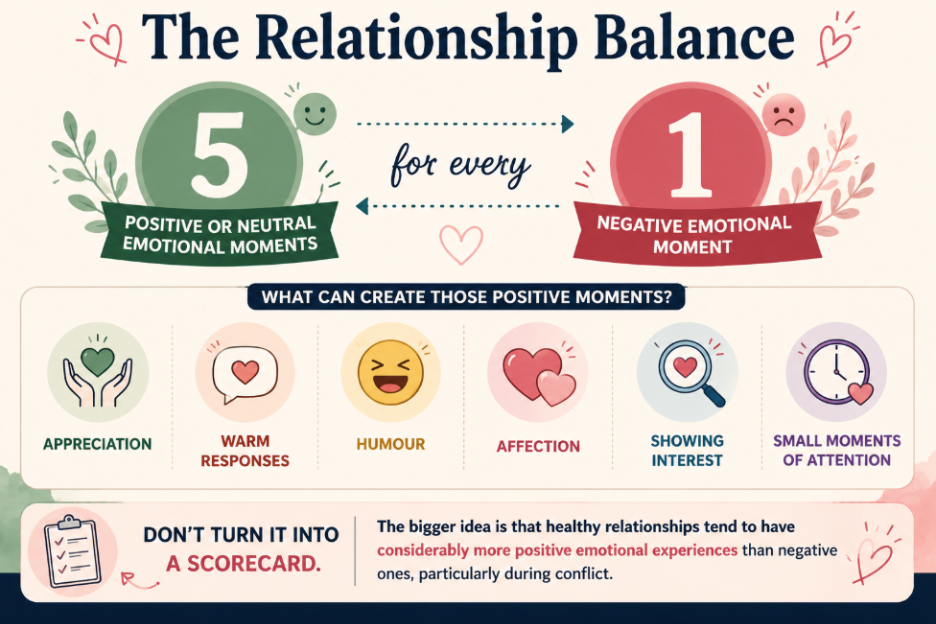
John Gottman's research has highlighted the importance of balancing positive and negative emotional interactions, particularly during conflict. His well-known 5:1 finding refers to stable couples maintaining considerably more positive or neutral emotional interactions than negative ones during conflict.
It is not a scorecard couples need to obsessively track. It is better understood as a reminder that relationships need regular deposits of warmth, appreciation and goodwill.
Sign 4: Communication Is Mostly Logistical
"Did you pay the electricity bill?"
"What time are you leaving?"
"Who is picking up the children?"
Practical communication is necessary, but if almost every conversation revolves around responsibilities, the emotional relationship can start to feel neglected.
Sign 5: Fun Happens Everywhere Except Together
Friends, colleagues, hobbies and family can all provide meaningful connection. But if partners rarely laugh, explore or enjoy anything together anymore, the relationship may have lost an important source of positive energy.
Sign 6: Physical Affection Has Noticeably Reduced
A decrease in hugs, hand-holding, cuddling or other forms of affectionate touch may sometimes accompany emotional distance. This does not necessarily indicate a problem on its own, particularly during stressful periods, but it can be worth noticing.
Sign 7: You Feel More Like Co-Managers Than Partners
This can be particularly familiar to married couples balancing careers, children, and extended family responsibilities.
You may still work extremely well as a team, but rarely pause to ask, "How are we doing?"
If you have been wondering how to improve your relationship with your partner, or how to improve your relationship more generally, this distinction can be useful. A functional household and a connected relationship are related, but not quite the same.
7 Strategies to Re-Energize Your Relationship
There is no universal formula for how to improve a relationship. The strategies below draw on relationship research and practical principles used in relationship counselling. Think of them as starting points rather than a checklist you need to complete perfectly.
Strategy 1: Give Assurance and Build Emotional Security
Feeling secure with a partner is not necessarily something that gets permanently achieved and then maintained automatically. It can be reinforced through everyday interactions.
Attachment research suggests that security in close relationships is linked with how people respond to stress, conflict, and emotional needs.
Assurance can therefore be quite simple. It can sound like "I am with you", "We will work this out" or "I appreciate what you are doing".
Try:
- Expressing affection without waiting for a special occasion.
- Talking occasionally about your shared future.
- Reassuring your partner during stressful periods.
- Noticing effort rather than only outcomes.
- Offering practical care when your partner is overwhelmed.
In an Indian family context, this might mean acknowledging the invisible work involved in caring for parents, managing family events or supporting a partner through an intense period at work.
💡PRO TIP: Ask yourself: "Does my partner know that I value them, or am I assuming they already know?"
Sometimes making the implicit explicit can be surprisingly powerful.
Strategy 2: Manage Conflict by Becoming Responsive, Not Reactive
Healthy relationships are not conflict-free relationships. What matters more may be what happens when disagreement begins.
Gottman's research identifies four destructive conflict patterns, often called the Four Horsemen: criticism, contempt, defensiveness and stonewalling. The model also identifies healthier alternatives to these patterns.
Instead of:
"You never help around the house."
Try:
"I have been feeling overwhelmed by the amount I am managing and I need more support."
Instead of defending immediately, consider acknowledging the part that may be valid.
Instead of continuing an argument when both people are highly activated, take a break. A pause can help prevent a conversation from becoming increasingly reactive.
Try to:
- Use "I" statements rather than character attacks.
- Discuss one issue at a time.
- Let each person finish before responding.
- Avoid sarcasm, insults and degrading language.
- Take a break when the conversation becomes too heated.
- Agree to return to the conversation rather than leaving it unresolved indefinitely.
A break should ideally be a pause, not a disappearance. The aim is to regulate and return, not to avoid the issue permanently.
CONFLICT RESET
Pause → Regulate → Return → Listen → Respond
A temporary pause can create enough emotional space for a difficult conversation to become more constructive.
Strategy 3: Practise Openness and Notice Bids for Connection
Emotional openness does not necessarily mean having profound conversations every night. It can begin with sharing something small that you might otherwise keep to yourself.
Research by Reis and Shaver conceptualised intimacy as a process in which one person shares something personally meaningful and the other responds in a way that helps the person feel understood, validated and cared for.
Gottman's work adds another useful idea: bids for connection. A bid might be a question, a sigh, a joke, a touch, or a small comment that is really an invitation to connect. Responding positively to these moments can help build emotional closeness.
Try:
- Asking about a difficult conversation your partner had at work.
- Saying, "You seem tired today. Do you want to talk?"
- Sharing something you are looking forward to.
- Asking about a worry rather than assuming everything is fine.
- Putting your phone down when your partner is trying to tell you something.
For couples wondering how to be emotionally open with your partner, the starting point may simply be becoming curious again.
Strategy 4: Prioritise Positive Moments
Relationships can sometimes become problem-focused. Conversations revolve around what needs fixing, what went wrong, and what has not been done.
Positive moments help create a different emotional climate.
Gottman's research on the 5:1 ratio suggests that successful couples tend to experience substantially more positive or neutral emotional states than negative ones during conflict.
Shared novelty may also help. Research by Aron and colleagues found that couples who participated together in novel and arousing activities experienced improvements in relationship quality compared with more mundane activities.
This does not mean booking an expensive holiday every month.
Try:
- Cooking a new recipe together.
- Exploring a neighbourhood neither of you knows well.
- Taking a short evening walk without phones.
- Trying a new class or hobby.
- Revisiting an old shared interest.
- Having ten minutes of uninterrupted conversation.
The important part may be genuine presence. Being physically together while both people are answering emails or scrolling through Instagram may not create the same sense of connection as actually paying attention to each other.
💡KEY INSIGHT: SMALL THINGS OFTEN
A relationship may benefit more from frequent, ordinary moments of attention than from occasional grand romantic gestures.
Strategy 5: Understand Each Other's Love Language
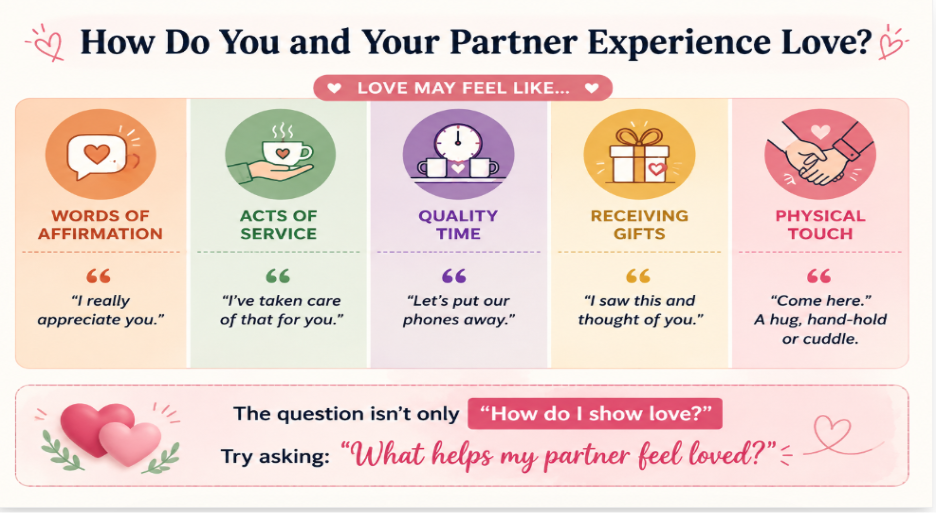
Gary Chapman's Five Love Languages framework is a popular tool for discussing how partners may prefer to experience and express care and affection. It describes five commonly discussed ways of experiencing love: Words of Affirmation, Acts of Service, Receiving Gifts, Quality Time and Physical Touch.
The framework can be a useful conversation starter for couples, particularly when exploring how each person prefers to give and receive affection. However, it is not an established psychological framework, and research does not strongly support the idea that each person has one fixed primary "love language". It may therefore be more helpful to use the framework as a prompt for conversation rather than as a way of categorising partners or explaining relationship dynamics.
Consider a simple example.
One partner may think, "I made dinner, so obviously I showed that I care."
The other may be thinking, "I wish you would just sit with me and talk."
Both may be expressing love, but in different forms.
In an Indian context, Acts of Service might involve managing a parent's doctor's appointment or taking over school responsibilities during a partner's busy week. Quality Time might simply mean putting the phone away during dinner.
The most useful question may not be "What is my love language?" but "What helps my partner feel loved?"
Try the official Five Love Languages framework and quiz
Strategy 6: Maintain a Shared Social Circle
A couple does not necessarily need to do everything together. In fact, having friends, family, and independent interests can provide healthy sources of support outside the relationship.
Research on relationship maintenance identifies social networks as one of the ways couples can support relational stability and quality.
In India, this can become slightly more complicated because a shared social network may include extended family. Family gatherings can create connection, but they can also create tension if boundaries or expectations are unclear.
Try to create both:
- Shared friendships and social activities.
- Individual friendships and interests.
- Couple time away from extended family.
- Opportunities to support each other socially.
- Clear conversations about family boundaries when needed.
The aim is not to make the couple self-sufficient in every way. Healthy relationships can benefit from a wider ecosystem of connection.
Strategy 7: Share Responsibilities Fairly
Few things drain romantic energy quite like feeling that you are carrying the relationship alone.
This is why sharing tasks matters. Relationship maintenance research specifically identifies task sharing as one of the five major maintenance strategies.
Fairness does not necessarily mean doing exactly 50 percent of everything. One partner may work longer hours while the other handles more household responsibilities. Another family may divide things differently.
The important question is whether the arrangement feels fair to both people and whether it can be discussed openly.
Try a monthly relationship check-in:
What is working?
What feels unfair?
What has become too much?
What could we change this month?
For dual-income couples, particularly where traditional expectations around household or caregiving roles remain strong, these conversations may need to be more explicit.
Fairness is easier to adjust when it is discussed before resentment has had months to build.
Read more about how to keep romance alive in marriage
Explore what makes a marriage work long-term
Rebuilding Emotional Intimacy: Going Deeper Than the Surface
Emotional intimacy is the experience of feeling known, understood and accepted by another person. It involves being able to share vulnerabilities, fears, hopes and uncertainties without constantly worrying that they will be dismissed, criticised or used against you.
It is also different from physical intimacy.
A couple can have affection, sex and companionship while still feeling emotionally distant. Equally, two people can experience a temporary reduction in physical intimacy while remaining emotionally close.
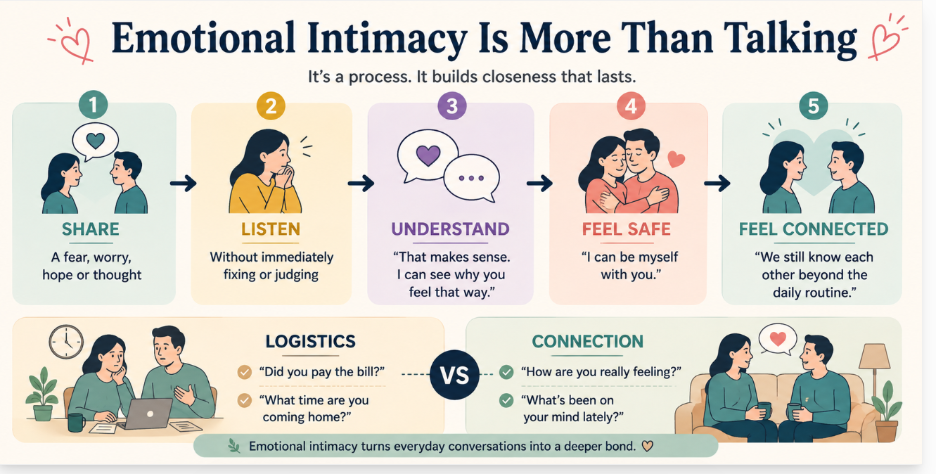
So, how to rebuild emotional intimacy in a long-term relationship often begins with creating opportunities for emotional sharing again.
Busyness is one obvious obstacle. When careers, children, finances, and extended family responsibilities compete for attention, couples can become highly efficient at managing life together while becoming less practiced at talking about how life actually feels.
Try creating small openings:
- Ask, "What has been on your mind lately?"
- Share one thing you have been worried about.
- Talk about a meaningful memory from your relationship.
- Ask what your partner is looking forward to.
- Discuss something you have been afraid to say.
- Create a short daily ritual that is about the two of you, not household administration.
Gottman's work also emphasises small moments of turning towards a partner's bids for connection. In one longitudinal study discussed by the Gottman Institute, couples who remained married were more likely to turn towards each other's bids than couples who later divorced.
Physical affection can also be part of rebuilding closeness when it feels comfortable and welcome for both partners, particularly when it is not treated as something that must lead to sex. A hug, holding hands, or sitting close can sometimes communicate safety and care when words feel difficult.
A COUNSELLOR'S PERSPECTIVE
Emotional intimacy is not necessarily a skill people learn automatically. Couples may care deeply about one another and still struggle to communicate vulnerability, listen without becoming defensive, or ask for what they need. These are skills you can develop.
If you are also exploring relationship advice for newly married couples, building these habits early may make it easier to navigate later transitions.
Read relationship advice for newly married couples
When to Seek Professional Support: The Role of Couples Counselling
Couples counselling does not necessarily need to be reserved for relationships in crisis.
It can be useful when partners have tried to resolve an issue themselves but keep returning to the same pattern. It can also provide a structured space when both people care about the relationship but cannot seem to communicate without becoming defensive, withdrawn or overwhelmed.
You might consider professional support if:
- The same argument keeps happening without resolution.
- You increasingly feel like roommates rather than romantic partners.
- Trust has been significantly damaged.
- A major transition is putting pressure on the relationship.
- Parenting, relocation, bereavement or work changes have created distance.
- One partner's emotional or mental health difficulties are affecting the relationship.
- You want to improve the relationship before problems become more entrenched.
Seeking help does not mean a relationship has failed. For some couples, it can simply mean that they would like guidance while they still have enough goodwill and motivation to make changes. However, where there is fear, intimidation, coercive control or abuse in the relationship, couples counselling may not be the appropriate first step. In such situations, safety and individual support should be prioritised.
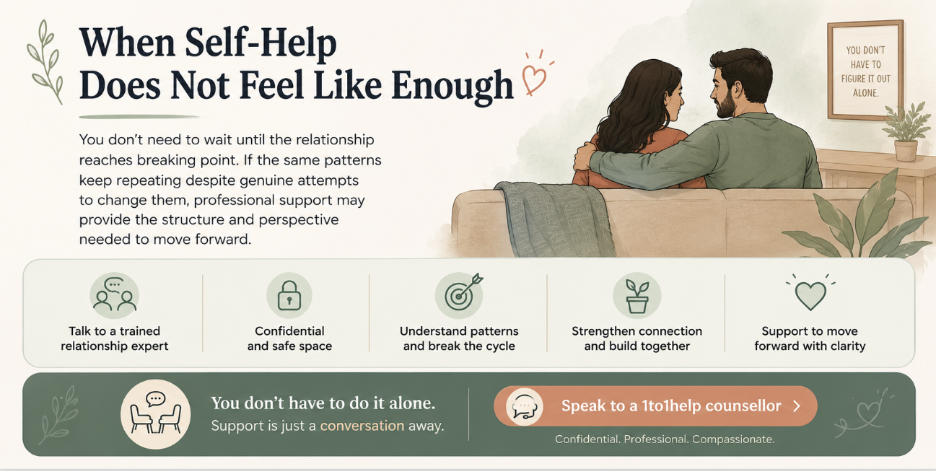
1to1help offers confidential online counselling, including relationship and couples support. Its current online counselling service offers 45 to 60 minute sessions, tele or video appointments, and access in 13+ languages. The intake team says it contacts people within 12 to 15 hours of receiving their details.
Choosing Investment Over Inertia
Relationships do not necessarily stay connected simply because two people love each other.
Over time, connection can require small, repeated choices: reassuring one another, listening differently during conflict, noticing bids for attention, sharing responsibilities more fairly and making room for enjoyment.
The seven strategies in this guide are not a checklist for a perfect relationship. Different couples will need different things at different stages. For one couple, the priority may be conflict. For another, it may be emotional intimacy or simply finding their way back to enjoying each other's company.
The useful question may therefore be less "What is wrong with us?" and more "What part of our relationship needs our attention right now?"
If you would like support navigating that question, whether individually or as a couple, 1to1help's trained counsellors can provide a confidential space to explore what is happening and what could change. With 25 years of experience and more than 11 million lives covered, 1to1help offers online counselling across 13+ languages.
Speak to a 1to1help counsellor
FAQs
Q1. How do you re-energize a relationship that has gone flat?
Start with one small, deliberate change rather than trying to overhaul the entire relationship. You might begin with a short daily emotional check-in, one new shared experience every couple of weeks or more specific expressions of appreciation. The aim is consistency rather than intensity. Research on relationship maintenance suggests that behaviours such as positivity, openness, assurance, shared social networks and task sharing can contribute to relationship quality. A relationship may not feel different overnight, but one genuine act of attention can start a new pattern.
Q2. What causes a relationship to lose its spark?
Familiarity, routine, stress, and reduced novelty can all contribute to a relationship feeling less exciting. This does not necessarily mean love has disappeared. Research on shared novel activities has found that couples can improve relationship quality when they participate in new, stimulating activities together. Emotional distance can also develop when communication becomes primarily logistical or when partners stop responding to everyday bids for connection. Routine itself is not necessarily the problem. A lack of intentional connection within the routine may matter more.
Q3. How can I communicate better with my partner?
Try moving from reactive communication towards responsive communication. Before responding, pause long enough to identify what you are actually feeling and what you need. Using "I" statements can help reduce the sense that your partner is being personally attacked. It can also help to choose a time when neither person is already exhausted or highly stressed. During difficult conversations, take turns speaking and try summarising what you heard before explaining your own perspective. Gottman's research also highlights the importance of avoiding criticism, contempt, defensiveness and stonewalling during conflict.
Q4. Is it normal for couples to go through flat periods?
Yes. Many long-term relationships go through periods when excitement feels less intense. The early stage of a relationship contains considerable novelty, while long-term relationships involve familiarity, shared responsibilities and established routines. A quieter period does not necessarily mean the relationship is unhealthy. It may simply signal that the couple needs to reconnect intentionally. The concern may be greater when emotional distance becomes persistent, communication stops, affection disappears, or repeated attempts to reconnect fail. In those situations, a conversation about the relationship or support from a counsellor may be worth considering.
Q5. When should a couple see a counsellor?
There is no single point at which couples counselling becomes necessary. Some couples seek help when they notice recurring conflict, emotional distance or trust concerns. Others use counselling proactively during major transitions such as marriage, parenthood, relocation or significant changes in work or family circumstances. It can be especially useful when partners have tried to resolve the same issue repeatedly without making progress. If the relationship matters to both people but the current pattern does not feel sustainable, that alone can be a reasonable reason to seek support. 1to1help provides confidential online counselling and currently offers sessions in 13+ languages.
References
Peer-Reviewed Research
- Aron, A., Norman, C. C., Aron, E. N., McKenna, C., & Heyman, R. E. (2000). Couples' shared participation in novel and arousing activities and experienced relationship quality. Journal of Personality and Social Psychology, 78(2), 273–284. https://doi.org/10.1037/0022-3514.78.2.273
- Canary, D. J., Stafford, L., Hause, K. S., & Wallace, L. A. (1993). An inductive analysis of relational maintenance strategies: Comparisons among lovers, relatives, friends, and others. Communication Research Reports, 10(1), 3–14. https://doi.org/10.1080/08824099309359913
- Laurenceau, J.-P., Barrett, L. F., & Pietromonaco, P. R. (1998). Intimacy as an interpersonal process: The importance of self-disclosure, partner disclosure, and perceived partner responsiveness in interpersonal exchanges. Journal of Personality and Social Psychology, 74(5), 1238–1251. https://doi.org/10.1037/0022-3514.74.5.1238
- Simpson, J. A., & Rholes, W. S. (2017). Adult attachment, stress, and romantic relationships. Current Opinion in Psychology, 13, 19–24. https://doi.org/10.1016/j.copsyc.2016.04.006
Authoritative Relationship and Mental Health Sources
- Cleveland Clinic. (2025, November 21). What are the 5 love languages? https://health.clevelandclinic.org/love-languages
- The Gottman Institute. (2026). The four horsemen: Criticism, contempt, defensiveness, and stonewalling. https://www.gottman.com/blog/the-four-horsemen-recognizing-criticism-contempt-defensiveness-and-stonewalling/
- The Gottman Institute. (2026). The magic ratio: The key to relationship satisfaction. https://www.gottman.com/blog/the-magic-ratio-the-key-to-relationship-satisfaction/
- The Gottman Institute. (2026). Turn towards instead of away. https://www.gottman.com/blog/turn-toward-instead-of-away/
- The Gottman Institute. (2026). Want to improve your relationship? Start paying more attention to bids. https://www.gottman.com/blog/want-to-improve-your-relationship-start-paying-more-attention-to-bids/
- The Gottman Institute. (2026). How to improve your relationship in 24 hours. https://www.gottman.com/blog/how-to-improve-your-relationship-in-24-hours/
- The 5 Love Languages. (n.d.). What are the 5 love languages? https://5lovelanguages.com/learn
Supporting Editorial Sources
- Chamlou, N. (2022, August 19). Losing the spark? 7 simple ways to rekindle your relationship. Psych Central. https://psychcentral.com/relationships/how-to-rekindle-a-relationship
- Gould, W. R. (2024, November 4). Here's how to strengthen your relationship with your partner. The Knot. https://www.theknot.com/content/how-to-strengthen-your-relationship
- HelpGuide. (n.d.). Love & friendship. https://www.helpguide.org/relationships/social-connection
- Tony Robbins. (n.d.). How to rekindle a relationship. https://www.tonyrobbins.com/fr/blog/5-ways-to-rekindle-a-relationship


.svg)
.svg)
.svg)
.svg)