


.png)


.png)

Personal Life & Relationships
Romance in Marriage: How to Keep the Spark Alive (and Bring It Back When It Fades)

.png)
Written by
Aarohi Parakh,
Psychologist and Content Writer

Reviewed by
Sanjana Sivaram,
Psychologist and Clinical Content Head


Introduction
Remember when a simple text from your partner could make you smile at your phone? Or when getting ready for a date felt exciting, even if you were only going out for coffee?
Then marriage settles into everyday life.
There are bills to pay, meals to plan, work deadlines to meet, children to care for, parents to check on, and an endless list of things that somehow need doing. Somewhere between “Did you pay the electricity bill?” and “What time will you be home?”, romance can quietly move further down the list.
If that sounds familiar, it does not necessarily mean something is wrong with your marriage.
Romance after marriage often changes rather than simply disappearing. The excitement of a new relationship may gradually give way to familiarity, security and companionship as couples build a life together. At other times, romance may feel more distant because of prolonged stress, burnout, unresolved conflict, major life transitions or emotional experiences that have not had the space to heal. These shifts do not necessarily mean that love has faded, but they can make it harder to feel connected. When couples stop intentionally nurturing their relationship, familiarity can sometimes begin to feel like emotional distance.
The good news is that keeping romance in marriage alive does not have to mean expensive holidays, elaborate surprises or recreating the honeymoon phase. Often, it is built through much smaller things: attention, affection, curiosity, appreciation and making space to experience each other as partners rather than only as co-managers of daily life.
Whether your relationship still feels close and you want to protect that connection, or the spark has faded and you are wondering how to bring romance back in marriage, there are practical ways to begin reconnecting.
Why Romance Fades in Marriage and Why That Can Be Normal
The beginning of romantic love can feel unusually intense. You may think about the other person constantly, feel energised by seeing them and experience even ordinary moments together as exciting.
There is a biological reason why this early phase can feel so powerful.
Research on romantic love suggests that brain systems associated with reward, motivation and attachment, including dopamine-rich pathways and hormones such as oxytocin, are involved in romantic bonding. Early-stage love has also been associated with changes in other neurochemical systems, including serotonin and cortisol.
Over time, however, novelty naturally decreases. Your partner is no longer an unpredictable new person you are discovering. Their habits become familiar, routines form, and life becomes more settled. The intense emotional state associated with early romance may gradually evolve into a calmer form of attachment built around trust, companionship, shared history, and emotional security.
This shift does not automatically mean that love has weakened.
What can become more challenging is what happens around that shift.
The “roommate trap”
Work. Children. School schedules. Ageing parents. EMIs. Groceries. Household chores.
Without intending to, couples can gradually become excellent at running a life together while spending very little time experiencing that life together.
Conversations become:
“Did you order the groceries?”
“Can you pick up the kids?”
“What time is your meeting tomorrow?”
This is sometimes described as the roommate trap, where partners function efficiently as a team but romantic and emotional connection receives less attention.
However, practical responsibilities are not the only reason couples drift apart. Unresolved conflict, lingering resentment, grief, anxiety, burnout, or major life transitions can also create emotional distance. Even when partners care deeply about each other, these experiences can make it harder to be emotionally available, affectionate or playful, causing romance to quietly take a back seat.
💡Key Insight: Romance often does not disappear because couples stop loving each other. It may fade because logistics repeatedly receive attention while connection repeatedly gets postponed. Many couples also become roommates because they're emotionally exhausted rather than simply busy.
That pattern can often be changed.
Long-term romance may depend less on recreating the chemical intensity of falling in love and more on deliberately creating opportunities for attention, novelty, affection, and shared experiences.
One interesting example comes from a 2022 Honeyfund survey of 1,000 married Americans. Among respondents who rated their marital satisfaction as “excellent”, 84% reported travelling together regularly. The finding do not prove that travel causes happier marriages, but it highlights something relationship research often points towards: intentionally creating shared experiences may help couples continue seeing themselves as partners, not simply people managing responsibilities together.
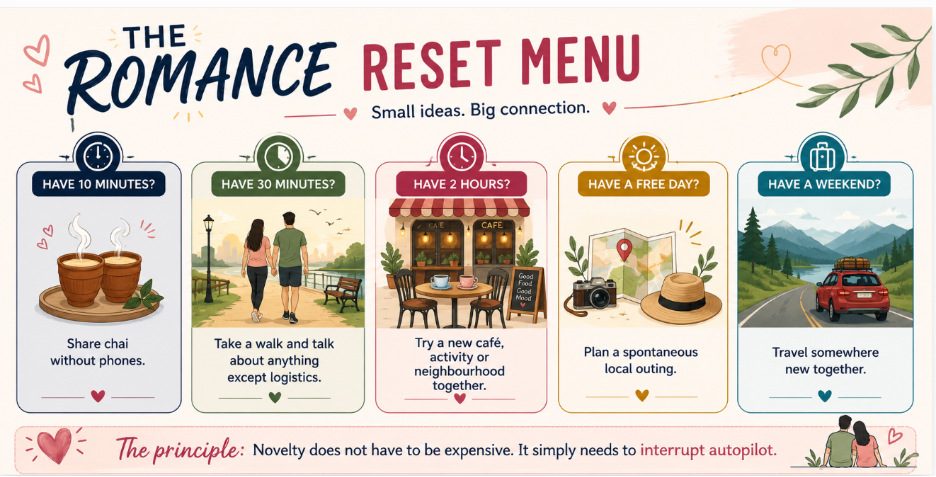
And shared experiences do not need to mean an international holiday. A Sunday breakfast outside, an evening walk without phones, or exploring a new neighbourhood together can create the same underlying opportunity: time in which the relationship itself gets attention.
💡PRO TIP: Ask a different question
Instead of asking, “Why don’t we feel like we used to?”, try:
“What have we stopped doing that once helped us feel close?”
The answer may offer a more useful starting point for rebuilding romance.
Why Romance Matters: The Science of Intimacy in Marriage
Romance is sometimes treated as an optional extra in marriage. Something lovely during courtship, perhaps, but less important once “real life” begins.
Yet romance is not only about candlelit dinners or surprise gifts. At its heart, it is the one way couples communicate something much more fundamental:
I still notice you. I still value you. I still choose this relationship.
That is closely connected with intimacy in marriage, which can include emotional closeness, affection, vulnerability, companionship and sexual connection.
Emotional intimacy: knowing the person behind the routine
When couples have been together for years, it can be easy to assume they already know everything about each other.
But people keep changing.
Your partner at 35 may have different fears, ambitions and needs from the person you married at 27. Emotional intimacy grows when couples remain curious enough to keep discovering these changes.
That might mean asking:
“What has been taking up most of your headspace lately?”
“Is there something you wish you had more time for?”
“What are you excited about right now?”
“What has felt difficult this week?”
The Gottman Institute’s relationship framework places friendship and knowledge of each other’s inner worlds among the foundations of a strong relationship. Research from Gottman and colleagues has also highlighted the importance of friendship quality in understanding how couples navigate their relationships.
In everyday terms, this means intimacy is often built in conversations that go beyond schedules, chores and responsibilities.
Physical affection matters too
Touch can be another important pathway to connection.
Holding hands, hugging, kissing, cuddling or simply sitting close can communicate warmth and reassurance without requiring a conversation. Research on romantic attachment has linked oxytocin with pair bonding and attachment processes, although human relationships are far more complex than any single “love hormone”.
Importantly, physical intimacy in marriage is broader than sex.
A couple may have a fulfilling sexual relationship but little everyday affection, while another couple may feel deeply connected through touch even when sexual frequency changes because of stress, parenting, health, ageing or other circumstances.
There is no single amount of physical or sexual intimacy that every healthy marriage “should” have. It is natural and common that partners have different libidos in long-term relationships, and it's not an indicator of declining affection
A widely cited study published in Social Psychological and Personality Science found that, among people in romantic relationships, the association between sexual frequency and wellbeing levelled off at around once a week on average. This does not mean once a week is a prescription or target. Rather, it challenges the assumption that more sex automatically means a happier relationship.
What may matter more is whether both partners experience their intimate relationship as mutual, emotionally safe, consensual and satisfying.
Romance and intimacy can reinforce each other
Romance, communication and intimacy often work as a feedback loop.
When partners feel emotionally connected, affection may come more naturally. When they feel appreciated, they may be more willing to share openly. When physical closeness feels safe and mutually wanted, it may strengthen feelings of connection.
And when couples regularly turn towards each other in small ways, those moments can accumulate.
THE INTIMACY LOOP
Attention → Appreciation → Emotional Safety → Affection → Deeper Connection → More Attention
You do not necessarily need a dramatic romantic gesture to enter this loop.
Sometimes it begins with putting down your phone when your partner starts talking.
This is why maintaining romance in marriage is less about being romantic all the time and more about preventing the relationship from becoming emotionally invisible within everyday life.
A marriage can be stable and still need more connection. It can be loving and still need more romance. And if intimacy has become quieter over time, that does not necessarily mean it is gone.
Often, the more useful question is: What small things could help us start turning towards each other again?
10 Practical Ways to Keep Romance Alive in Your Marriage
Keeping romance in marriage alive rarely requires constantly planning elaborate dates or making grand gestures. More often, it comes down to small behaviours that repeatedly communicate: You still matter to me.
If you are wondering how to keep romance alive in marriage, these practical strategies can help make connection part of everyday life rather than something reserved for anniversaries and holidays.
Disclaimer: These suggestions apply to relationships that are fundamentally safe. If there is emotional abuse, coercive control, intimidation, or violence, the focus should be on safety and appropriate support rather than rebuilding romance.
Tip 1: Protect Couple Time
When calendars become crowded, couple time is often the first thing to disappear. Try setting aside regular time when you can be partners rather than parents, professionals or household managers.
A date does not have to mean an expensive dinner. It could be breakfast at a favourite café, cooking together after the children sleep or taking an evening walk without discussing the to-do list.
The important part is intentional, undistracted time together. Even 10–15 minutes of uninterrupted attention can make a meaningful difference.
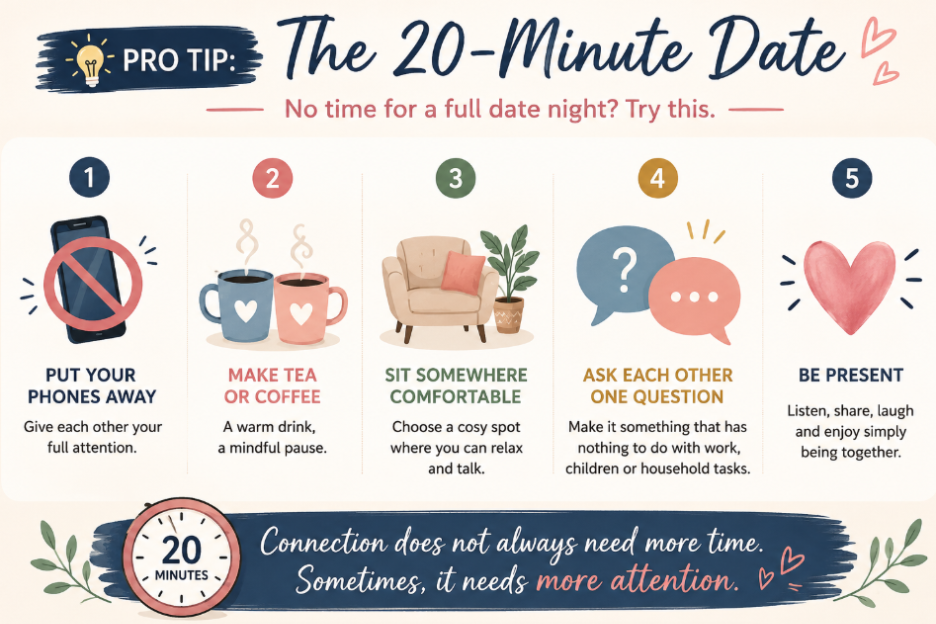
Ask each other one question that has nothing to do with work, children, or household tasks.
Connection does not always need more time. Sometimes, it needs more attention.
Tip 2: Learn How Your Partner Experiences Love
Not everyone recognises love in the same way.
Gary Chapman’s popular Five Love Languages framework describes five broad ways people may experience affection: words of affirmation, acts of service, receiving gifts, quality time and physical touch.
Although love languages are best viewed as a practical communication framework rather than a scientifically established personality system, they can prompt a useful question:
“What actually makes my partner feel cared for?”
This can be particularly relevant in Indian families, where love may sometimes be expressed more through actions than words. Making your partner’s favourite meal, handling an errand when they are exhausted or saving them the last piece of dessert may communicate affection just as meaningfully as saying “I love you”.
Try not to assume that the way you express love is automatically the way your partner most easily receives it.
Tip 3: Make Appreciation Specific
“You’re amazing” is lovely.
But:
“I noticed how patiently you handled that difficult conversation with my family. I really appreciated it.”
often feels more personal.
Specific appreciation tells your partner that you are still paying attention to who they are and what they contribute.
Try noticing one small thing each day. Thank them for making tea, acknowledge how they supported you during a stressful week, or tell them something you continue to admire about them.
Over time, appreciation can help counter a common relationship pattern where couples become highly aware of what is missing while overlooking what is quietly going right.
Tip 4: Introduce Something New
Remember how many “firsts” happen early in a relationship?
First date. First trip. First festival together. First meeting with friends. First inside joke.
Novelty naturally decreases as relationships become established, but couples can intentionally bring some of it back.
Try a restaurant neither of you has visited, take a pottery class, explore another part of your city, cook a completely unfamiliar dish, or switch your usual Saturday routine.
Novel experiences engage reward and attention systems associated with excitement and can help partners encounter each other outside familiar roles.
Tip 5: Keep Affection Alive Outside the Bedroom
Physical intimacy is not limited to sex.
A goodbye kiss, holding hands in the car, sitting close while watching television, or hugging your partner after a difficult day can all reinforce warmth and connection.
Many couples do not consciously decide to stop touching. Casual affection may simply become less frequent as routines become busier.
If that has happened, try gently bringing back small, mutually comfortable forms of touch without making every affectionate moment an expectation for sex.
This can make physical closeness feel safer, more spontaneous and more connected to everyday affection.
Tip 6: Flirt With Your Spouse
Marriage does not have to mean retiring the version of yourself that once flirted.
Send the unexpected text.
Give your partner a compliment that has nothing to do with their parenting or productivity.
Bring back an old nickname. Make the joke only the two of you understand. Tell them they look good before they leave for work.
Playfulness can remind both partners that beneath all the practical roles they occupy, they are still two people who chose each other.
Tip 7: Talk About More Than Logistics
“How was your day?”
“Fine.”
“What should we order?”
“Anything.”
Technically, you are communicating. Emotionally, however, you may not be connecting.
In many relationships today, conversations also compete with constant distractions. Work notifications, endless scrolling and the habit of checking phones during shared moments can leave couples physically together but mentally elsewhere. Even a few minutes of uninterrupted attention can make a meaningful difference.
Try asking questions that invite your partner’s inner world into the conversation:
- “What has been on your mind lately?”
- “What are you looking forward to?”
- “What has been draining you?”
- “Is there something you wish we did more often together?”
Consider making these conversations phone-free, even if it's only for 10 to 15 minutes at the end of the day. Regular curiosity can strengthen emotional intimacy in marriage because it it reminds both partners that they are still learning about each other, rather than assuming they already know everything.
Tip 8: Create Small Rituals of Connection
Romance does not always live in big moments. Often, it is hidden inside repetition.
- Morning tea together.
- A kiss before leaving home.
- A lunchtime message.
- Ten minutes talking before bed.
- A Saturday breakfast ritual.
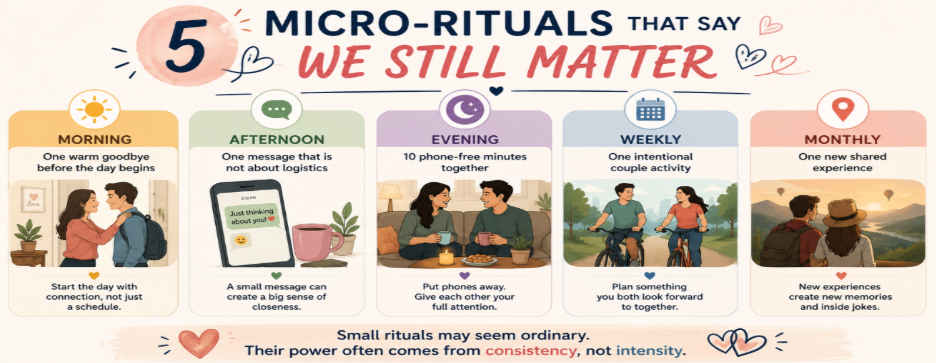
These small habits create predictable moments when the relationship receives attention.
Tip 9: Celebrate Your Partner’s Good News
How you respond when your partner shares something positive can matter more than it seems.
Research by relationship researchers Shelly Gable and colleagues suggests that active, constructive responses to a partner’s good news are associated with better relationship wellbeing.
Imagine your partner says, “My manager loved my presentation.”
Compare: “That’s nice. What are we doing for dinner?”
with: “That’s brilliant! What did they say? You worked so hard on that presentation.”
The second response joins your partner in their happiness.
Put down your phone. Ask a follow-up question. Celebrate the small wins as well as the big ones.
Romance is not only about supporting each other when life is difficult. It can also be about communicating: your joy matters to me too.
Tip 10: Address Disconnection Before It Becomes the New Normal
If you have noticed that you feel more like roommates than romantic partners, try not to wait until frustration becomes resentment.
Start gently.
Instead of: “You never make any effort anymore.”
Try: “I feel like we’ve been in logistics mode for a while. I miss feeling close to you. Could we find some time for us?”
One invites defensiveness. The other opens a door.
If you have been wondering how to bring romance back in marriage, naming the distance with warmth can be an important first step.
Sometimes, however, couples try repeatedly to reconnect and still find themselves stuck in the same patterns. There may be unresolved hurt, communication difficulties, resentment, or differences around intimacy beneath the loss of romance.
In such situations, couples or relationship counselling can offer a neutral, structured space to understand what has changed and explore ways of rebuilding connection together.
The goal is not necessarily to recreate the relationship exactly as it was when you first met.
It may be to build something more realistic and meaningful: a relationship in which familiarity and romance can coexist.
Recommended Reading:
Reigniting Romance When It Has Faded: Practical Advice for Indian Couples
Knowing how to bring romance back in marriage can feel challenging when the problem is not a lack of love, but a lack of privacy, time, or energy.
For couples living in joint or multigenerational families, spontaneous couple time may be harder to find. Creating intentional privacy can help. This might mean treating the bedroom as a protected couple space where possible, taking regular walks together or setting aside time that family members understand is not to be interrupted. This is not about excluding family. It is about protecting the couple relationship that forms an important part of the wider family system.
Cultural expectations can play a role too. Some Indian adults may grow up absorbing the message that romance belongs to films, courtship or the early stages of a relationship, while “real” married life is expected to become practical. Challenging this belief can be important. Wanting romance after marriage is not immature. Affection, playfulness and intentional couple time can remain meaningful at every stage of a relationship.
Career and financial pressures can create another barrier. For dual-career couples, particularly in busy cities, waiting until life becomes less exhausting may mean waiting indefinitely. Instead, romance can be scaled to fit real life. A 20-minute walk after dinner, chai without phones or an occasional breakfast together can create small but protected moments of connection.
If romance in marriage has faded significantly, try naming the distance without blame: “I feel like we’ve been in logistics mode lately, and I miss feeling close to you.”
When disconnection persists or has begun turning into resentment, couples counselling may help. With over 25 years of experience in India, 1to1help’s relationship counsellors understand how family dynamics, cultural expectations, career pressures and changing intimacy can intersect within Indian marriages. Rather than deciding who is right or wrong, therapy helps couples understand the patterns keeping them stuck, improve communication, repair emotional injuries, rebuild trust where needed and reconnect in ways that feel meaningful to both partners. Seeking support early can create space to understand what has changed and begin rebuilding connection together.
Conclusion: Keeping the Spark Alive, One Small Moment at a Time
Romance does not have to disappear once marriage becomes familiar. It may simply begin to look different.
Over time, the spark may live less in grand gestures and more in everyday moments: making your partner’s chai exactly how they like it, putting your phone away when they speak, sharing an inside joke or reaching for their hand after a difficult day.
Keeping romance in marriage alive is not about recreating the honeymoon phase forever. It is about continuing to notice, appreciate and choose each other as life changes.
And if the distance between you feels difficult to bridge alone, support is available. 1to1help Online Counselling offers a confidential space where couples can explore relationship concerns with trained counsellors, understand patterns contributing to disconnection and work towards rebuilding emotional and relational intimacy.
You do not have to wait for a relationship to reach breaking point before seeking support. Sometimes, asking for help can be the first step towards finding your way back to each other.
FAQs
Q1. Why does romance fade in long-term marriages and relationships?
Romance can change as novelty decreases and everyday responsibilities take over. Work, children, finances and routines may leave less space for couple connection. This does not necessarily mean love has disappeared. Intentional affection, attention and shared experiences can help rebuild closeness.
Q2. What are the best ways to keep romance alive in a marriage?
Prioritise regular couple time, express appreciation, maintain physical affection, try new experiences together and stay curious about each other’s inner world. Small, consistent gestures often feel more sustainable than occasional grand romantic efforts.
Q3. How important is physical intimacy in a marriage?
Physical intimacy can support closeness, but it is broader than sex. Hugging, kissing, holding hands and affectionate touch can also strengthen connection. What feels right varies between couples, so mutual comfort, consent and open communication matter more than meeting a particular frequency.
Q4. What are some romantic ideas for married couples at home?
Try cooking together, having chai without phones, planning an at-home date, watching a favourite film, looking through old photographs or asking each other meaningful questions. The aim is less about the activity itself and more about giving each other undistracted attention.
Q5. How do you bring romance back into a marriage that has become routine?
Start by noticing what has disappeared. Perhaps you have stopped dating, flirting, touching affectionately or talking beyond logistics. Reintroduce one small habit consistently and talk openly about wanting to reconnect without blaming each other.
Q6. Can couples counselling help reignite romance?
Yes, particularly when emotional distance is linked to unresolved hurt, resentment, communication difficulties or concerns around intimacy. Counselling can provide a structured space to understand recurring patterns and explore healthier ways of reconnecting.
Q7. How do you keep romance alive in an Indian joint family setting?
Create intentional couple time and privacy where possible. This could include protected bedroom time, evening walks or regular outings together. Couple time does not have to mean distancing yourself from family. It can simply give the relationship the space it needs to stay connected.
References
- Acevedo, B. P., Poulin, M. J., Collins, N. L., & Brown, L. L. (2020). After the honeymoon: Neural and genetic correlates of romantic love in newlywed marriages. Frontiers in Psychology, 11, 634. https://doi.org/10.3389/fpsyg.2020.00634
PubMed Central
- Cleveland Clinic. (2022, March 18). Serotonin: What it is, function & levels.
Cleveland Clinic
- Cleveland Clinic. (2022). Cortisol: What it is, function, symptoms & levels.
Cleveland Clinic
- Cleveland Clinic. (2022, February 3). What is the honeymoon phase and how long does it last?
Cleveland Clinic
- Gable, S. L., Reis, H. T., Impett, E. A., & Asher, E. R. (2004). What do you do when things go right? The intrapersonal and interpersonal benefits of sharing positive events. Journal of Personality and Social Psychology, 87(2), 228–245. https://doi.org/10.1037/0022-3514.87.2.228
PubMed
- Honeyfund. (2022). National Honeymoon Day: The honeymoon effect.
Honeyfund
- Muise, A., Schimmack, U., & Impett, E. A. (2016). Sexual frequency predicts greater well-being, but more is not always better. Social Psychological and Personality Science, 7(4), 295–302. https://doi.org/10.1177/1948550615616462
SAGE Journals
- Raypole, C. (2024). What are the five love languages? Verywell Mind.
Verywell Mind
- Schneiderman, I., Zagoory-Sharon, O., Leckman, J. F., & Feldman, R. (2012). Oxytocin during the initial stages of romantic attachment: Relations to couples’ interactive reciprocity. Psychoneuroendocrinology, 37(8), 1277–1285. https://doi.org/10.1016/j.psyneuen.2011.12.021
PubMed Central
- The Gottman Institute. (n.d.). Marriage and couples research.
The Gottman Institute
- Willis, D. (2018, September 10). The roommate trap. MarriageToday.
The Roommate Trap


.svg)
.svg)
.svg)
.svg)