


.png)


.png)

Personal Life & Relationships
The Formula for a Happy Marriage: 10 Science-Backed Secrets That Actually Work

.png)
Written by
Aarohi Parakh,
Psychologist and Content Writer

Reviewed by
Sanjana Sivaram,
Psychologist and Clinical Content Head


Introduction
There is no single formula for a happy marriage. Every relationship is shaped by the personalities of the two people involved, their circumstances, values, and the challenges they face together. What works well for one couple may not work in exactly the same way for another.
That said, decades of relationship research have identified certain patterns that tend to be associated with happier, more satisfying, and longer-lasting marriages. These are rarely grand romantic gestures. More often, they are the small, consistent ways couples communicate, resolve conflict, express appreciation, and support one another through everyday life.
This article brings together 10 science-backed happy marriage tips drawn from psychological research and the work of leading relationship experts. It also considers realities that many global relationship guides overlook, including joint family dynamics, career pressures, financial responsibilities, and the unique experiences of both arranged and love marriages in India. Towards the end, you'll also find a collection of happy marriage quotes for those moments when a few thoughtful words can offer perspective, encouragement, or simply remind us what makes relationships worth investing in.
What Research Actually Says About Happy Marriages
Before getting into specific tips, it helps to understand the broader research landscape that most of them are drawn from.
The Central Finding: Gottman's 5:1 Ratio
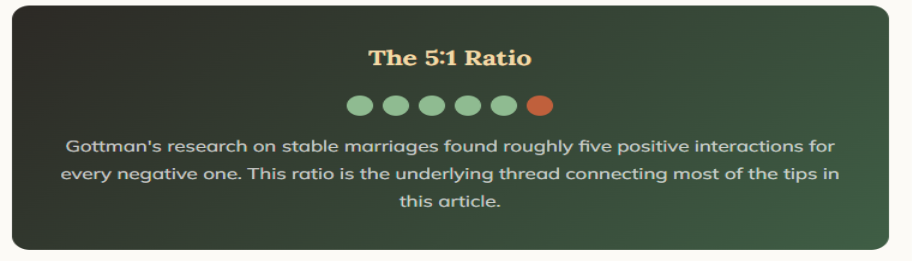
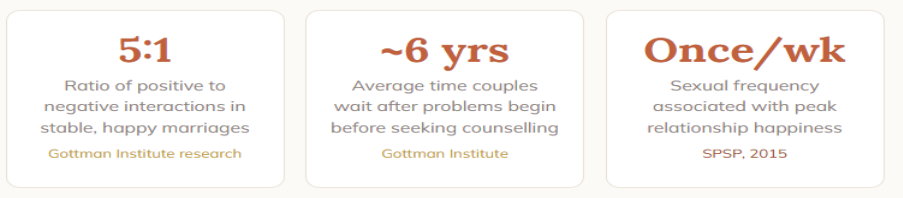
Longitudinal research led by Dr. Gottman and Robert Levenson found that in stable, happy relationships, positive interactions tend to outnumber negative ones by at least 5 to 1. This is one of the most replicated findings in marriage research, and it offers a useful lens for thinking about most of the tips that follow. The goal is not to avoid conflict entirely, since all couples experience friction, but to ensure that warmth, appreciation, and goodwill consistently outweigh it by a meaningful margin.
A second, somewhat less well-known finding comes from researchers Shelly Gable and Harry Reis at UCLA, sometimes called the capitalisation research. Their work suggests that how couples respond to each other's good news may matter even more to long-term relationship satisfaction than how they navigate bad news. Actively, enthusiastically celebrating small daily wins, not just major life milestones, appears to be a fairly robust predictor of marital happiness.
A 2004 study in the Journal of Personality and Social Psychology adds an interesting nuance here. Couples who held high expectations of their relationship, paired with the actual skills to meet those expectations, reported the highest marital satisfaction of all groups studied. High expectations, in other words, are not inherently a problem. They tend to become a problem only when they are not matched by genuine effort and relational skill.
Perhaps the most quietly important finding of all comes from Gottman's broader body of work on friendship. As he puts it, the determining factor in whether wives feel satisfied with the sex, romance, and passion in their marriage tends to be whether they experience their husband as a genuine best friend. Marital satisfaction, in this view, is driven less by external circumstances and more by the depth of friendship between two people, how well they actually know each other's inner world.
10 Proven Secrets to a Happy Marriage
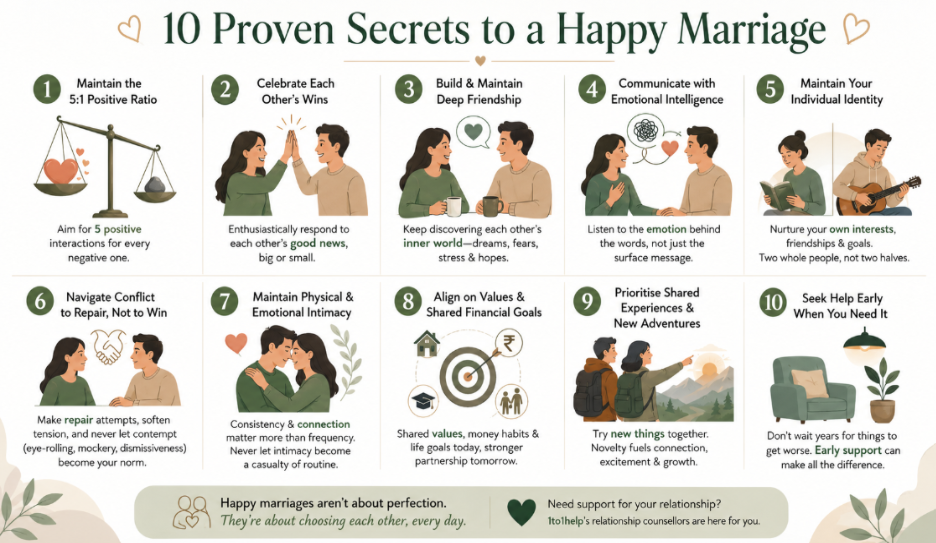
With that research as a backdrop, here are ten specific, practical things that seem to consistently distinguish happy, lasting marriages from struggling ones.
Tip 1: Maintain the 5:1 Positive Ratio
Consciously cultivating positive interactions, appreciation, affection, laughter, genuine curiosity about your partner's day, tends to matter more than people expect. For every criticism or negative exchange, try to ensure there are roughly five genuinely positive ones. This is not about suppressing real conflict. It is about making sure the relationship's emotional reserves stay well in surplus, so that conflict, when it happens, does not feel as threatening.
Example: After disagreeing over household chores, don't let the conversation end there. Later in the day, thank your partner for making tea, share a laugh over dinner, or send a thoughtful message during work. Small positive moments can help restore emotional balance.
Tip 2: Celebrate Each Other's Wins, Not Just Hardships
The capitalisation research from Gable and Reis suggests that couples who respond enthusiastically to each other's good news, even small daily wins, tend to report higher commitment, trust, and satisfaction. How you respond to "I got the project!" may matter just as much, over time, as how you show up during a genuine crisis.
Example: Your spouse gets recognised at work or finally clears a competitive exam. Instead of a quick "That's nice," pause to celebrate with their favourite dessert or plan a small dinner together. Showing genuine enthusiasm strengthens connection.
Tip 3: Build And Maintain Deep Friendship
Gottman's concept of "Love Maps", genuinely knowing your partner's inner world, their fears, hopes, dreams, and current stressors, tends to form the foundation of lasting intimacy. It can help to schedule regular conversations that go beyond logistics like kids, money, and the household, into the more personal and reflective territory.
Example: Instead of only discussing EMIs, children's homework, or grocery lists, spend 15 minutes before bed asking questions like, "What's been on your mind lately?" or "What's something you're looking forward to this month?"
Tip 4: Communicate With Emotional Intelligence
The emotional message underneath someone's words is often quite different from the literal content. When a partner criticises you for not spending enough time together, the underlying message may really be "I miss you, and I'm worried I'm not a priority for you." Responding to that emotional message, rather than only the surface words, can transform a moment of conflict into one of genuine connection.
Example: When your partner says, "You're always busy with work," they may not be criticising your career but expressing that they miss spending time with you. Responding to that feeling rather than becoming defensive can change the conversation.
Tip 5: Maintain Your Individual Identity
Healthy marriages tend to need two whole people, rather than two halves trying to complete each other. Continuing to invest in your own personal friendships, interests, and goals matters more than it might seem. Over-reliance on a partner to meet all your emotional, social, and practical needs can create a weight that no single relationship can realistically carry over the long term.
Example: Even after marriage, continue pursuing hobbies, meeting friends, or taking that weekend pottery or fitness class. Having fulfilling individual lives often gives couples more to share with each other.
Tip 6: Navigate Conflict To Repair, Not to Win
Every couple disagrees. What seems to distinguish happier couples is that they make and genuinely accept repair attempts: the small moments when one person reaches out to soften tension, acknowledge hurt, or simply reconnect. Contempt, whether expressed through eye-rolling, mockery, sarcasm, or dismissiveness, has consistently been identified in relationship research as one of the strongest predictors of marital distress and divorce. Recognising and addressing these patterns early may help couples navigate conflict more constructively.
Example: During an argument about finances or family responsibilities, one partner says, "Let's take five minutes and come back to this," or reaches out with, "I know we're upset, but we're on the same team." These small repair attempts can help de-escalate conflict.
Tip 7: Maintain Physical and Emotional Intimacy Deliberately
A widely cited 2015 study published through the Society for Personality and Social Psychology found that couples having sex around once a week reported the highest happiness, with the link to wellbeing levelling off beyond that frequency. It should be noted that there is no ideal frequency that applies to all couples. The takeaway is less about a specific number and more about consistency and emotional connection mattering more than sheer frequency. Physical affection more broadly, touch, holding hands, a hug at the end of a long day, appears to release oxytocin, which may help reduce cortisol and strengthen bonding. It is worth not letting intimacy quietly become a casualty of routine.
Example: Between long commutes, parenting responsibilities, and caring for ageing parents, intimacy can easily slip down the priority list. Holding hands during an evening walk or setting aside uninterrupted couple time each week can help maintain closeness.
Tip 8: Align On Values and Shared Financial Goals
Research from Brigham Young University has found that higher levels of materialism are associated with lower marital satisfaction. A 2019 Pew Research study found separately that couples who share core values report meaningfully higher satisfaction than those who do not. It can help to explicitly discuss, and periodically revisit, your shared values, financial priorities, and life goals, since these tend to shift over the years in ways that are easy to miss if you never check in.
Example: Before making major decisions like buying a home, supporting parents financially, or planning children's education, discuss not only the budget but also what matters most to both of you. Shared priorities often reduce future conflict.
Tip 9: Prioritise Shared Experiences and New Adventures
Research suggests that couples who regularly engage in novel, exciting activities together, rather than only comfortable routines, tend to report meaningfully higher relationship satisfaction. The novelty appears to activate some of the same dopamine pathways associated with early-stage romantic attraction. Planning experiences that are genuinely new, rather than simply pleasant and familiar, seems to matter here.
Example: Instead of spending every weekend running errands, try something different together, explore a nearby fort, take a cooking class, go on a spontaneous road trip, or even discover a new café in your city.
Tip 10: Seek Help Early When You Need It
Research from the Gottman Institute suggests couples often wait an average of six years after problems begin before seeking professional support. By that point, contempt and emotional withdrawal have often had time to settle in. Relationship counselling tends to be most effective when accessed early, before patterns calcify into something harder to shift. Early professional support can help interrupt repetitive patterns before resentment deepens.
1to1help's relationship counsellors offer confidential support for couples at any stage, not only in crisis.
Example: If the same arguments about communication, in-laws, parenting, or finances keep repeating for months, consider speaking to a relationship counsellor before resentment builds. Seeking support early is often easier than repairing years of accumulated hurt.
The India-Specific Formula: What's Different About Indian Marriages
Most relationship research is conducted with Western couples in mind, and a fair amount of it simply does not translate distinctly to Indian marriages, where joint families, career pressure, and the arranged or love marriage dynamic add layers that global advice rarely addresses.
Navigating joint family life
Managing in-law relationships while still maintaining a strong couple identity is one of the most common sources of marital strain in India. A principle that many counsellors find genuinely useful: present a united front to both families, and disagree privately rather than in front of relatives.
It also tends to help if each partner takes primary responsibility for managing boundaries with their own family of origin, rather than asking their spouse to do this on their behalf.
Please note: Situations involving abuse, manipulation, or coercive control require more specialised boundary work and support.
Career and financial pressure
Dual-career couples in Indian metros often face genuinely intense external pressure: long commutes, demanding work hours, and the financial weight of EMIs, children's education, and supporting parents. Explicitly protecting “couple time” from career demands matters here.
A weekly date night that is treated as genuinely non-negotiable, rather than the first thing to be cancelled when work gets busy, can create a protected space the relationship needs.
Communication within hierarchical households
In many Indian households, direct communication between spouses about needs and conflicts can be complicated by the proximity of extended family and hierarchical norms about who speaks to whom and when.
Building a private couple communication channel, even something as simple as a daily fifteen-minute check-in after the rest of the household has gone to bed, can be disproportionately powerful relative to how little time it takes.
💡Arranged vs love marriage: Both arranged and love marriages face their own particular challenges. Couples in arranged marriages may need to invest more deliberately in friendship-building during the early years, since the relationship often begins with less existing personal history. Couples in love marriages, by contrast, may face more external family pressure, requiring active, ongoing boundary-setting. Both tend to benefit genuinely from couples counselling, not only as a response to crisis, but as a proactive investment in the relationship's long-term health.
Note: Each couple’s relational dynamics are shaped more by communication patterns, attachment styles, and family systems than by marriage type alone.
- Recommended Reading: Formula For A Great Relationship
Happy Marriage Quotes
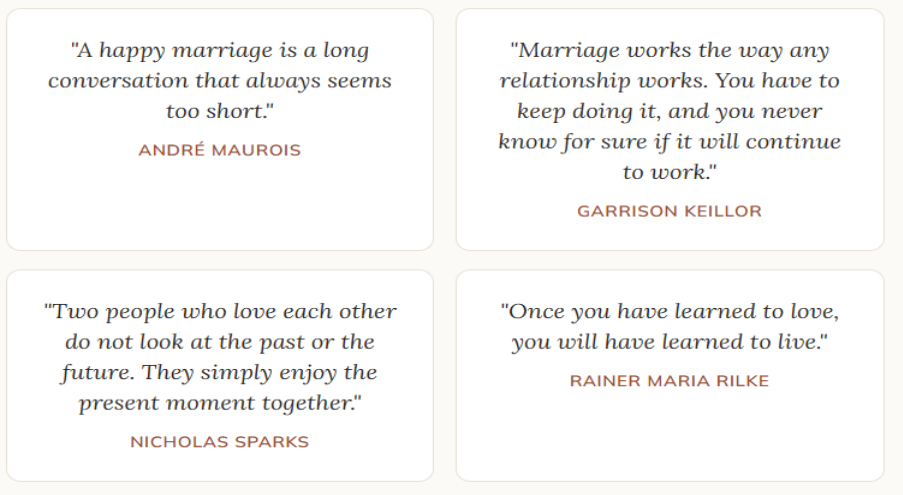
Sometimes the wisest things about marriage are not found in research papers. They are found in the quiet observations of those who have lived it well.
On Communication and Understanding

On Friendship and Partnership

On Long-Lasting Love
A Final Thought
None of the research summarised here suggests that happy marriages happen by accident or by finding some perfect, conflict-free match. They tend to be built gradually and imperfectly through consistent small choices: celebrating a small win, repairing after a disagreement, asking a genuine question about your partner's day, and protecting time for each other amid the genuine pressures of work and family.

If your marriage is going through a difficult patch, that does not mean it has failed. It may simply mean it is time for some support.
FAQs
Q1. What is the formula for a happy marriage according to research?
Research does not point to a single magic ingredient, but a few findings consistently surface across decades of marriage research. John Gottman's work suggests stable, happy marriages tend to maintain at least five positive interactions for every negative one. Research from UCLA suggests how couples respond to each other's good news matters significantly to long-term satisfaction. And Gottman's broader research suggests that deep friendship, genuinely knowing your partner's inner world, tends to be the foundation underneath satisfaction in other areas of the relationship, including romance and intimacy. Taken together, the closest thing to a formula seems to be consistent warmth, genuine friendship, and the skill to repair conflict well.
Q2. How do you maintain a happy marriage after years together?
Long marriages tend to need active maintenance rather than simply coasting on early momentum. Couples who continue to invest in novelty, trying new experiences together rather than only relying on comfortable routines, tend to report higher satisfaction over time, since novelty appears to activate some of the same neural pathways associated with early romantic attraction. Continuing to ask questions about your partner's inner world, since people genuinely change over years and decades, also seems to matter. Many long, happy marriages also include periods of proactive counselling, not because something is wrong, but as a way of keeping the relationship's foundations in good repair.
Q3. What are the most important qualities in a happy marriage?
Based on the research summarised in this article, a few qualities tend to stand out repeatedly: genuine friendship and curiosity about your partner's inner life, the ability to repair after conflict rather than win it, a roughly five-to-one ratio of positive to negative interactions, and shared core values around money, family, and life priorities. Individual identity also matters more than people sometimes expect, since healthy marriages tend to involve two whole people rather than two people trying to complete each other entirely.
Q4. How often should married couples talk to stay happy?
There is no single research-backed number for frequency, but quality and consistency both seem to matter more than any specific count. Many relationship counsellors suggest a short, protected daily check-in, even fifteen minutes after a busy day, alongside longer, less logistics-focused conversations on a more regular basis, weekly or so, that go beyond the practical details of running a household and into more personal territory: hopes, worries, and what is actually going on beneath the surface for each person.
Q5. Can counselling help improve a marriage that is struggling?
Yes, and research suggests earlier is generally better than later. The Gottman Institute's research found that couples often wait an average of six years after problems begin before seeking professional support, by which point patterns like contempt and emotional withdrawal have often had time to take hold and become harder to shift. Counselling tends to be most effective when accessed while a relationship is still fundamentally workable, rather than only as a last resort once things feel close to breaking down. 1to1help's relationship counsellors offer confidential support for couples at any stage of difficulty, not only in crisis.
Q6. What are some happy marriage quotes that capture what love feels like?
Some widely loved examples include Dave Meurer's observation that a great marriage is not when the perfect couple comes together, but when an imperfect couple learns to enjoy their differences, and John Gottman's finding that a wife's satisfaction with romance and passion is closely tied to whether she experiences her husband as a genuine best friend. André Maurois described a happy marriage as a long conversation that always seems too short, while Antoine de Saint-Exupéry's line about love being two people looking in the same direction together captures the partnership dimension well. A fuller collection of quotes, organised by theme, appears earlier in this article.
Q7. How do you maintain a happy marriage in a joint family in India?
A few principles tend to help consistently. Presenting a united front to both families, while disagreeing privately rather than in front of relatives, protects the couple's sense of partnership. Each partner taking primary responsibility for managing their own family of origin, rather than expecting their spouse to navigate it on their behalf, tends to reduce resentment over time. Building a small, protected window of private couple time, even a short daily check-in after the household has settled for the night, can matter disproportionately given how little space joint family life sometimes leaves for the couple relationship specifically. Couples counselling, used proactively rather than only in crisis, can also help navigate these dynamics with more clarity.
References
- Aron, A., Norman, C. C., Aron, E. N., McKenna, C., & Heyman, R. E. (2000). Couples' shared participation in novel and arousing activities and experienced relationship quality. Journal of Personality and Social Psychology, 78(2), 273–284.
- Brigham Young University. (2013, January 30). Study: Materialism in marriage linked to devaluation of marriage. https://news.byu.edu/news/study-materialism-marriage-linked-devaluation-marriage
- Cleveland Clinic. (2022). Dopamine: What it is & what it does. https://my.clevelandclinic.org/health/articles/22581-dopamine
- Gable, S. L., Reis, H. T., Impett, E. A., & Asher, E. R. (2004). What do you do when things go right? The intrapersonal and interpersonal benefits of sharing positive events. Journal of Personality and Social Psychology, 87(2), 228–245. https://doi.org/10.1037/0022-3514.87.2.228
- Gottman Institute. (n.d.). Conflict is normal (and natural). https://www.gottman.com/blog/conflict-normal-natural-part-happily-ever/
- Gottman Institute. (n.d.). The Four Horsemen: Contempt. https://www.gottman.com/blog/the-four-horsemen-contempt/
- Gottman Institute. (n.d.). The magic relationship ratio, according to science. https://www.gottman.com/blog/the-magic-relationship-ratio-according-science/
- Gottman Institute. (n.d.). The Sound Relationship House: Build love maps. https://www.gottman.com/blog/the-sound-relationship-house-build-love-maps/
- Gottman Institute. (n.d.). Timing is everything when it comes to marriage counseling. https://www.gottman.com/blog/timing-is-everything-when-it-comes-to-marriage-counseling/
- Muise, A., Schimmack, U., & Impett, E. A. (2016). Sexual frequency predicts greater well-being, but more is not always better. Social Psychological and Personality Science, 7(4), 295–302.
- Pew Research Center. (2019, November 6). How married and cohabiting adults see their relationships. https://www.pewresearch.org/social-trends/2019/11/06/how-married-and-cohabiting-adults-see-their-relationships/
- Reis, H. T., & Gable, S. L. (2015). Responsiveness. Current Opinion in Psychology, 1, 67–71.
- Utah State University Extension. (n.d.). Just married... or just married? https://extension.usu.edu/archive/just-married_or_just-married
- (Optional background reading)
- Marital Expectations. (n.d.). Scribd. https://www.scribd.com/document/742242091/Marital-Expectations


.svg)
.svg)
.svg)
.svg)