


.png)


.png)

Personal Life & Relationships
Signs I Am in Love: 15 Psychological Signs You've Truly Fallen for Someone (and How to Know for Sure)

.png)
Written by
Aarohi Parakh,
Psychologist and Content Writer

Reviewed by
Sanjana Sivaram,
Psychologist and Clinical Content Head


The Question Everyone Asks — “Am I Actually in Love?”
“Am I in love, or am I just emotionally attached?”
It is one of the most common and most confusing questions people ask themselves. Despite how often love is written about in movies, songs, poetry, and social media, recognising it in real life is rarely straightforward. Many people spend weeks or even months trying to decode their own feelings, searching for signs that they are in love, because what they feel seems both obvious and impossible to define at once.
Perhaps you find yourself thinking about one person constantly. Perhaps their texts affect your mood more than you want to admit. Or perhaps you are lying awake at night wondering, “How do I know if what I feel is real love or just infatuation?”
Take Riya, a 27 year old marketing professional from Pune. She initially assumed her feelings for a colleague were simply excitement. But over time, she noticed something deeper. She cared about his wellbeing even when it had nothing to do with romance. She felt emotionally calm around him rather than anxious. She began imagining future decisions with him naturally included in the picture. What confused her was that it did not feel dramatic in the way films portrayed love. It felt quieter, steadier, and more emotionally grounding.
That confusion is completely normal.
Romantic feelings exist on a spectrum. The shift from “I like this person” to “I am falling for them” to “I love them” is often gradual rather than sudden. Many people only recognise the depth of their feelings in retrospect.
In India, this question can feel even more layered. Many people experience love within cultural environments where emotional openness, dating, or conversations about relationships are still approached cautiously. Whether your relationship developed independently or within a more traditional framework, your feelings deserve understanding rather than dismissal.
This article explores the psychology and neuroscience of falling in love, the 15 psychological signs of true love, the difference between love and infatuation, and how to know if your feelings reflect a genuine emotional connection.
The Science of Falling in Love — What’s Actually Happening in Your Brain and Body
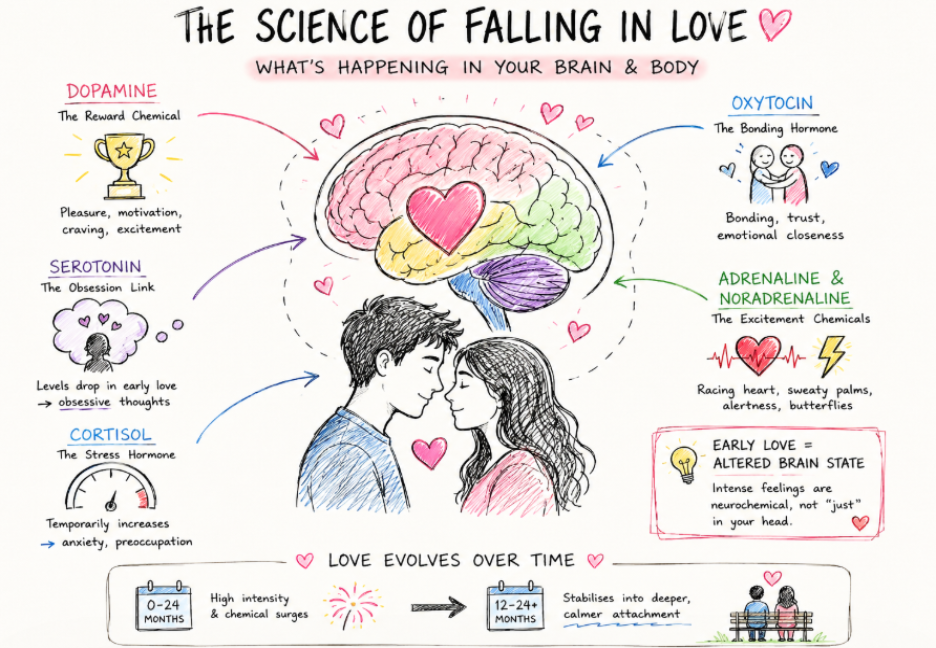
If you have ever wondered, “Am I in love, or am I just overwhelmed?”, science offers an interesting answer: early romantic love genuinely changes the brain and body.
Many of the signs of falling in love are not “just in your head” emotionally. They are also neurological and biochemical. Researchers studying romantic attachment have found that the brain in early love behaves differently from the brain in ordinary emotional states.
Anthropologist and researcher Helen Fisher used fMRI brain scans at Rutgers University to study people who identified themselves as deeply in love. Her research found heightened activity in the brain’s reward system, particularly areas associated with motivation, craving, and pleasure. Interestingly, some of these same pathways are activated in addictive behaviours, which helps explain why new love can feel consuming and difficult to “switch off”.
Dopamine: The Reward Chemical
Dopamine is one of the primary chemicals involved in attraction and romantic excitement. It is released when you think about, interact with, or receive attention from the person you love.
This creates the euphoric, energised quality often associated with the early signs you are in love. You may notice yourself replaying conversations, feeling unusually motivated, or constantly craving contact with the person.
A 2016 study published in Frontiers in Psychology found that individuals in early romantic love spent more than 85% of their waking hours thinking about their partner. That level of mental preoccupation is not simply imagination. Your brain is intensely focused on the relationship.
Oxytocin: The Bonding Hormone
Oxytocin is released through physical affection, eye contact, emotional intimacy, and closeness. Often called the “bonding hormone,” oxytocin strengthens trust, attachment, and emotional safety.
This is one reason genuine love often feels calmer and more emotionally secure over time. The relationship gradually shifts from excitement alone to emotional grounding and connection.
Why Love Can Feel Obsessive
One of the lesser-known findings about romantic love is that serotonin levels temporarily decrease during the early stages of intense attraction. Researchers have compared this pattern to what is sometimes seen in obsessive thought patterns.
This helps explain why many people experiencing the signs of falling in love feel unable to stop thinking about someone, even during work, study, or everyday routines.
Supporting this, a 2013 published study found that passionate love can reduce performance on cognitive tasks because attention becomes heavily occupied by romantic thoughts.
Your Body Feels Love Too
Love is not only emotional or cognitive. It is physical, too.
Adrenaline and noradrenaline contribute to the racing heart, sweaty palms, nervous excitement, and heightened alertness people often feel around someone they are deeply attracted to. Cortisol, the body’s stress hormone, also rises temporarily in early romantic attachment, which is why love can sometimes feel both thrilling and anxiety-provoking simultaneously.
Love Evolves Rather Than Disappears
One important misconception is that if intense excitement settles down, love must be fading. In reality, healthy long-term love often evolves from high-intensity passion into deeper emotional attachment.
Research published in Social Cognitive and Affective Neuroscience in 2012 by Fisher and colleagues found that some long-term couples still showed strong activation in reward and attachment centres years into their relationships. Love does not necessarily disappear with time. It changes form.
That means the calmer, steadier feelings that emerge later can still be very real signs you are in love. In many cases, they reflect emotional depth rather than emotional loss.
15 Signs You Are in Love — What Psychology and Research Tell Us
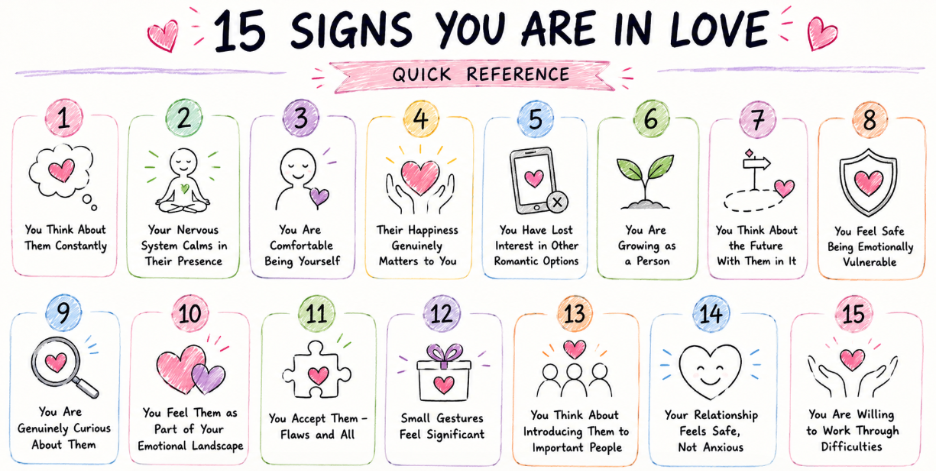
If you have been wondering “am I in love?”, psychology suggests that genuine love is usually not defined by one dramatic moment or overwhelming feeling. More often, it shows up through emotional patterns, small behavioural changes, feelings of comfort and attachment, and the way someone gradually starts becoming important in your everyday life. These signs often develop slowly, which is why many people only recognise them clearly in hindsight.
Sign 1 — You Think About Them Constantly
One of the clearest signs of falling in love is cognitive preoccupation. They enter your thoughts unexpectedly during meetings, meals, conversations, or even mundane daily tasks. Small things remind you of them, and your first instinct is often, “I should tell them this later.”
Research published in Frontiers in Psychology (2016) found that people in early romantic love reported frequent and persistent thoughts about their partner, sometimes occupying a large portion of their daily mental attention. Dopamine, the brain’s reward chemical, plays a major role here. Your brain begins tagging this person as emotionally significant and repeatedly returns to them.
This is why early love can feel mildly obsessive rather than entirely rational.
Sign 2 —Your Nervous System Calms in Their Presence
Many people assume love always feels intense and dramatic. In reality, one of the strongest signs you are in love is emotional regulation.
When you are around them, your breathing slows, your body relaxes, and your mind feels quieter. Their presence feels grounding rather than destabilising. This calming effect is strongly connected to oxytocin, the hormone involved in bonding and attachment.
A 2014 study found that even viewing a photograph of a romantic partner reduced perceived physical pain during stressful experiments. Genuine love often creates emotional safety, not just excitement.
💡Key Insight: Attraction often creates excitement and desire. Healthy love tends to create increasing emotional steadiness and safety over time.
Sign 3 — You Are Comfortable Being Yourself
In the early stages of attraction, many people try to present the best version of themselves. They overthink texts, hide awkward habits, or carefully filter what they say.
One of the deeper signs of true love is when that performance gradually disappears. Your urge to rehearse texts may reduce. You reveal embarrassing stories. You allow them to see your contradictions, vulnerabilities, and imperfections without excessive fear.
According to discussions in Psychology Today, healthy love often creates a feeling of emotional acceptance rather than constant evaluation.
Sign 4 — Their Happiness Genuinely Matters to You
Infatuation often focuses on how someone makes you feel. Love shifts the focus outward.
You care about their stress levels, ambitions, wellbeing, and emotional state even when there is no direct benefit to you. Their happiness feels meaningful to you, and their struggles affect you emotionally.
Psychologists describe this as empathic concern, in which emotional attention extends beyond the self. This shift from self-centred attraction to mutual care is one of the strongest signs of being in love.
Sign 5 — You Have Lost Interest in Other Romantic Options
Other romantic prospects you may have had previously may begin to feel less emotionally compelling because your attention and emotional investment has become more focused on one person. Dating apps feel less appealing. Flirting with others loses emotional energy.
This does not necessarily happen because of obligation or insecurity. Rather, your emotional focus narrows naturally toward one person. Research on romantic attachment suggests the brain gradually begins prioritising one emotional connection over other romantic possibilities.
PsychCentral describes this as intentionally focusing emotional energy on one meaningful attachment rather than spreading it across multiple possibilities.
Sign 6 — You Are Growing as a Person
Healthy love expands identity rather than shrinking it. Relationships rooted in genuine connection tend to encourage psychological growth rather than emotional restriction. At the same time, it allows space for individuality, boundaries, and personal identity outside the relationship.
Research on self-expansion theory shows that falling in love often motivates people to explore new experiences, perspectives, and parts of themselves. You may become more adventurous, more emotionally open, more reflective, or more willing to step out of your comfort zone.
Perhaps you try activities you never considered before. Perhaps you become better at communicating or expressing emotions.
💡Pro Tip: One of the healthiest signs you are falling in love is that your world expands rather than becomes emotionally smaller.
Sign 7 — You Think About the Future With Them in It
One of the biggest differences between love and temporary attraction is the ability to think about the future.
When you are falling in love, you naturally begin imagining them in future plans and everyday routines. You picture future trips, celebrations, ordinary weekends, or even simple daily habits with them included.
Importantly, this usually feels natural rather than forced. They slowly begin feeling emotionally woven into your future.
Sign 8 — You Feel Safe Being Emotionally Vulnerable
Emotional vulnerability requires trust.
If you find yourself sharing fears, insecurities, disappointments, grief, or personal struggles that you usually keep hidden, it often signals that an emotional attachment is deepening into love. Your nervous system has begun identifying this person as psychologically safe.
Relationship researcher Sue Johnson, author of “Hold Me Tight”, identifies emotional safety as one of the foundations of lasting romantic love.
Real intimacy is not only physical closeness. It is feeling safe enough to say, “This is who I really am,” without constantly fearing rejection.
Sign 9 —You Are Genuinely Curious About Them
Love is sustained curiosity.
You want to know what shaped them, what comforts them, what scares them, what they dreamed about growing up, and what kind of life they want for themselves.
Conversations feel emotionally meaningful because you genuinely want to understand them more deeply. At the same time, you also want them to know the real you.
This emotional curiosity creates intimacy that goes beyond surface-level attraction.
Sign 10 —You Feel Them as Part of Your Emotional Landscape
Their emotional state begins to matter deeply to you emotionally, while still allowing room for your own emotional boundaries.
When they are hurting, you feel concern instinctively. When they succeed, their happiness feels personally meaningful. Their wellbeing becomes emotionally intertwined with your own.
This is one of the defining signs of true love because it reflects emotional integration rather than temporary attraction. Infatuation is often centred around excitement and validation. Love involves shared emotional investment.
Sign 11 —You Accept Them — Flaws and All
Infatuation idealises. Love sees clearly.
You become aware of their imperfections, yet continue to choose them consciously. Perhaps they are messy, emotionally guarded, anxious, impatient, or flawed in ordinary human ways.
Love does not mean ignoring problems or unhealthy behaviour. It means accepting that nobody is perfectly polished all the time.
According to PsychCentral, accepting a partner’s quirks and emotional complexity is one of the strongest signs of mature romantic attachment.
Sign 12 — Small Gestures Feel Significant
Love changes the emotional meaning of small actions.
A thoughtful text during a stressful day. Remembering your coffee order. Checking whether you reached home safely. Noticing that something feels “off” before you even say it aloud.
These moments feel meaningful because they communicate attention, care, and emotional attunement.
In healthy love, feeling emotionally seen often matters as much as grand romantic gestures.
Sign 13 — You Think About Introducing Them to Important People
When someone matters deeply, you begin imagining them entering your wider emotional world.
You think about introducing them to close friends, siblings, or family members. In India especially, introducing a romantic partner to parents often carries significant emotional meaning because relationships are rarely viewed as entirely individual experiences.
If you are imagining this step seriously, or actively moving toward it, it often reflects emotional commitment rather than casual attraction.
Sign 14 — Your Relationship Feels Safe, Not Anxious
One of the biggest misconceptions about love is that it should constantly feel uncertain or emotionally turbulent.
Healthy love generally creates steadiness. You do not spend every day questioning whether they care about you. You feel emotionally valued without needing endless reassurance or performance.
Psychologists often describe this as secure attachment. It allows emotional closeness without chronic fear of abandonment.
If a relationship creates constant anxiety, unpredictability, or emotional instability, that does not automatically mean the feelings are deeper. Sometimes it signals insecurity rather than love.
Sign 15 — You Are Willing to Work Through Difficulties
Conflict reveals the difference between infatuation and love more clearly than romance does.
Infatuation can collapse quickly when things become difficult because it relies heavily on emotional highs and idealisation. Love motivates repair.
Even when hurt or frustrated, you still want to understand each other, communicate honestly, and rebuild connection.
This does not mean tolerating unhealthy behaviour or ignoring boundaries. It means the relationship feels worth working through rather than disposable at the first sign of discomfort.
One of the strongest signs you are in love is not simply how you feel during happy moments, but how willing you are to remain emotionally engaged during difficult ones.
Love vs Infatuation — How to Tell the Difference
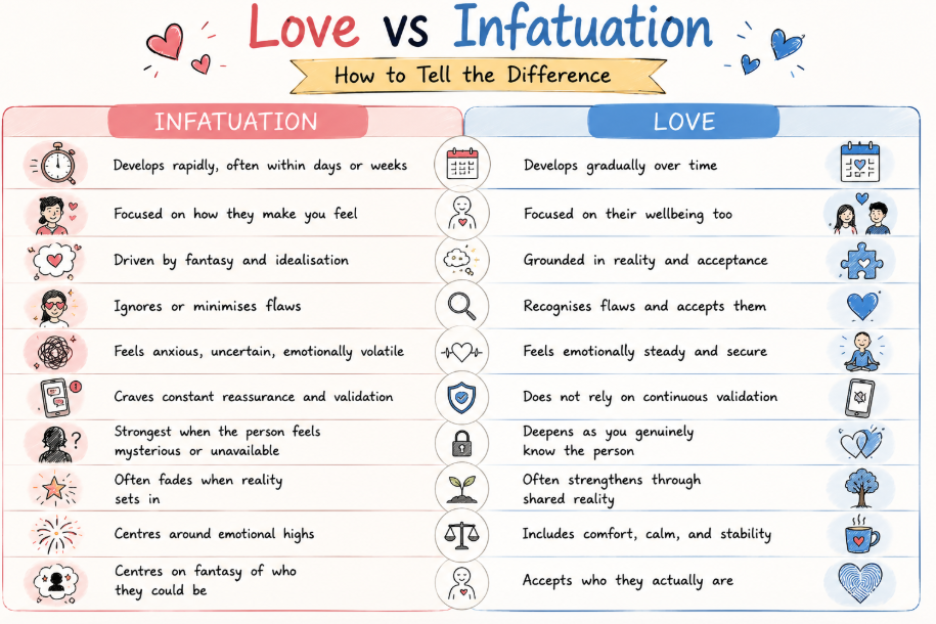
One of the hardest emotional questions people ask themselves is this: “Am I in love, or am I simply infatuated?”
The confusion makes sense because infatuation can feel incredibly intense. Your thoughts become consumed by someone. Your mood depends on their attention. You feel euphoric when they respond and distressed when they pull away. Many people interpret this intensity as proof of love.
But psychologically, the difference between love and infatuation matters enormously.
Infatuation, sometimes called limerence in psychology, is an intense emotional and neurological fixation on another person. It is fuelled heavily by dopamine, adrenaline, fantasy, and uncertainty. It should be noted that not all infatuation is limerence, the key is in the intensity. Love, by contrast, develops through emotional safety, consistency, trust, and deeper attachment over time.
Both experiences are real. Both can feel powerful. But they function very differently.
The Limerence Trap
One reason people struggle to distinguish between these experiences is that infatuation can feel overwhelming. The adrenaline, uncertainty, and emotional highs create a sense of urgency and intensity that people often interpret as deep love.
But intensity alone is not evidence of emotional depth.
In many cases, infatuation weakens once idealisation breaks down. As the other person becomes more human and less mysterious, the emotional high fades. Love tends to move in the opposite direction. The more you understand someone, including their fears, habits, imperfections, and difficult parts, the deeper the connection becomes.
💡Key Insight: If your feelings deepen with reality, it is likely love. If they depended heavily on fantasy, it may have been infatuation.
Am I in Love or Just Emotionally Attached?
There is also a third possibility worth acknowledging: emotional dependency.
Sometimes what feels like love is actually fear of loneliness, fear of abandonment, or dependence on someone for emotional validation. In these situations, the attachment may feel intense, but the relationship itself may not be healthy, secure, or genuinely mutual.
A useful question to ask yourself is: “Do I love this person for who they are, or do I primarily need them to fill an emotional void in me?”
That distinction can be difficult to recognise alone, especially when attachment patterns, past heartbreak, or low self-worth are involved. Speaking with a relationship counsellor can help untangle whether what you are experiencing is love, infatuation, emotional dependency, or a combination of all three.
Ultimately, healthy love tends to feel less like emotional chaos and more like emotional clarity.
Am I Falling in Love? — Early Signs of Developing Feelings
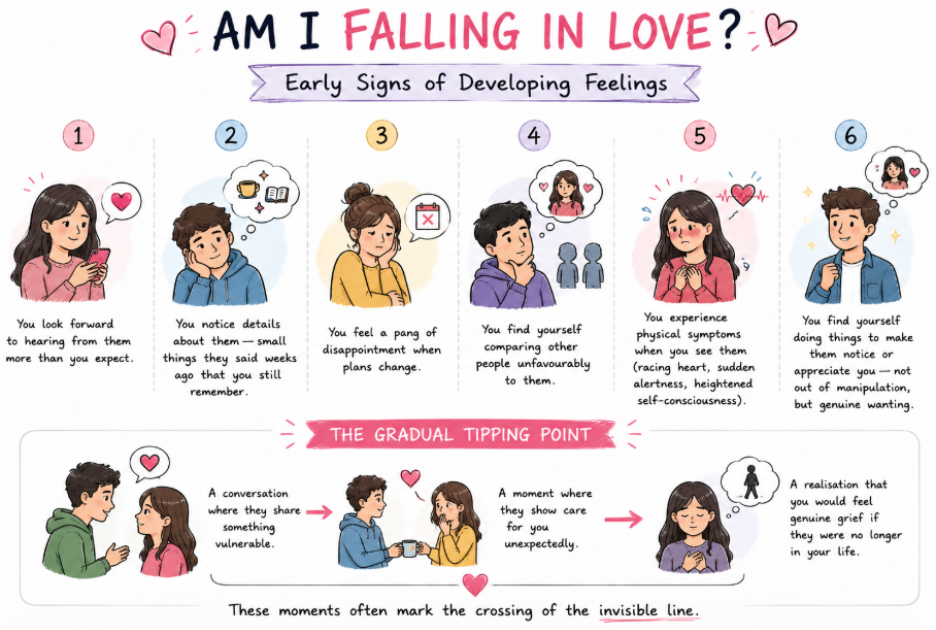
One of the reasons people struggle to answer the question “am I falling in love?” is because love rarely arrives as a single dramatic moment. More often, it begins quietly through a series of subtle emotional shifts that slowly become impossible to ignore.
The early signs of falling in love usually appear before certainty does:
- You may notice yourself looking forward to hearing from them more than you expected. A message from them instantly changes your mood.
- You remember small details they mentioned casually weeks ago, including stories, preferences, or passing comments that somehow stayed with you.
- You may also notice emotional reactions becoming stronger. Cancelled plans disappoint you more deeply than they should. Their approval matters. Their attention feels meaningful. Other people begin to seem less emotionally interesting by comparison.
- Physically, your body may respond too. Many people experiencing the signs of falling in love notice a racing heart, sudden self-consciousness, heightened awareness, or nervous excitement around the person. These reactions are connected to adrenaline, dopamine, and the brain’s reward system, which becomes increasingly sensitive to emotionally important people.
- Another early sign is effort. You may find yourself wanting to impress them, make them laugh, support them, or become someone they value. Not out of manipulation, but because their opinion genuinely matters to you emotionally.
The Gradual Tipping Point
The transition from “I really like this person” to “I think I love them” often happens through emotional intimacy rather than attraction alone.
It may be a vulnerable conversation where they open up about something deeply personal. It may be a moment when they care for you unexpectedly when you are stressed or overwhelmed. Or it may simply be the sudden realisation that losing this person would genuinely hurt.
That is often the invisible emotional line where attachment begins transforming into deeper love.
💡Key Insight: Attraction creates excitement. Emotional intimacy creates attachment.
If you are actively asking yourself, “How do I know if I love someone?” that reflection itself matters. Casual attraction rarely produces deep introspection. Love often does, precisely because the emotional stakes begin feeling real.
The uncertainty you feel is not evidence that your emotions are invalid. In many cases, it is evidence that your feelings are becoming more meaningful than they were before.
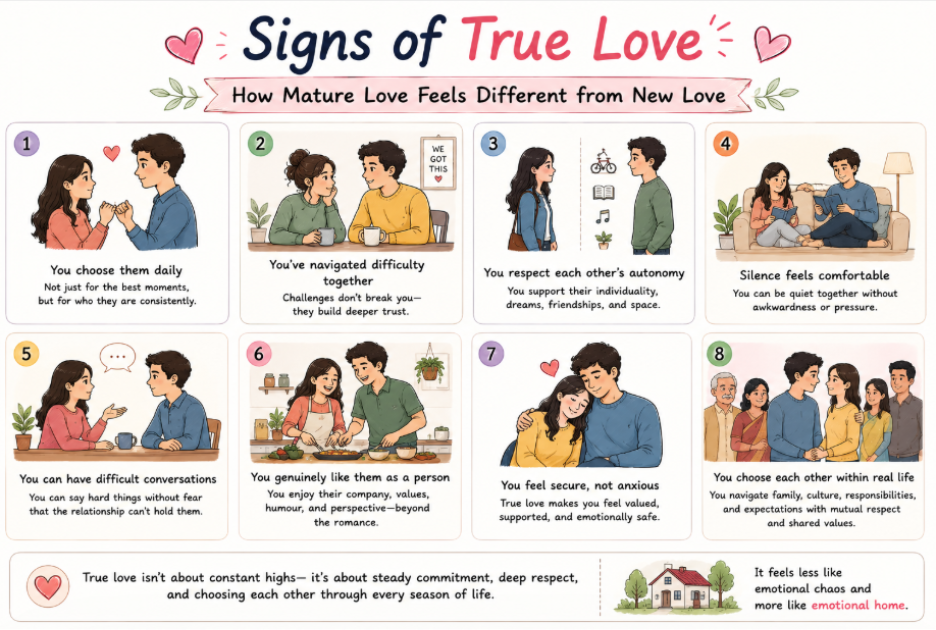
Signs of True Love — How Mature Love Feels Different from New Love
One of the biggest misconceptions about relationships is the belief that if intense butterflies and constant excitement settle down, love must be fading. In reality, what often disappears is not love itself, but the heightened neurochemical state of early attraction.
New love is typically fuelled by dopamine, adrenaline, and elevated cortisol. It feels exciting, consuming, and emotionally intense. Mature love feels different. It is calmer, steadier, and psychologically grounding. Rather than constant emotional highs, it creates consistency, trust, and emotional safety.
Research on romantic attachment shows that the “honeymoon phase” usually stabilises within 12 to 24 months. This is not necessarily a sign that the relationship has weakened. In healthy relationships, it often means love is evolving from infatuation into deeper attachment and partnership.
So, what are the signs of true love in a relationship?
You Choose Each Other Consistently
True love is not only about how someone makes you feel during perfect moments. It is also about who they are across ordinary days, stressful periods, disagreements, and life transitions. You continue choosing them not because the relationship is always easy, but because the connection feels meaningful and emotionally safe. This does not mean tolerating repeated disrespect, emotional harm, or incompatible values.
You Can Handle Difficulty Without Constant Threat of Collapse
One of the clearest signs of true love is emotional resilience.
You can disagree, have difficult conversations, or move through stressful situations without feeling like the relationship will immediately fall apart. There is trust beneath the conflict. Repair feels possible. Healthy love does not avoid problems entirely. It develops the capacity to work through them together.
You Respect Each Other’s Autonomy
Possessiveness is often mistaken for love, but emotionally mature love allows space for individuality. You support each other’s friendships, ambitions, family relationships, personal interests, and independence without needing constant control or reassurance. Genuine love values connection without ownership.
💡Key Insight: Love seeks closeness. Control seeks certainty.
Silence Feels Comfortable, Not Threatening
In early attraction, many people feel pressure to constantly impress or entertain each other. Mature love feels less performative. You can sit quietly together, share ordinary routines, or spend time in comfortable silence without anxiety. Emotional safety replaces the need for constant stimulation.
You Genuinely Like Each Other as People
One of the most overlooked signs of being in love is simple friendship. Beyond attraction and romance, you genuinely enjoy who they are as a human being. You respect their character, humour, values, perspective, and emotional presence. You would still admire them even outside the romantic relationship itself.
According to Psychology Today, healthy love tends to create security rather than chronic anxiety. You stop constantly questioning where you stand because the relationship consistently communicates care, support, and emotional stability.
Indian Context: In India, true love often develops within additional layers of family expectations, social obligations, cultural norms, and practical realities. Couples who navigate these pressures with mutual respect, honest communication, and shared values often build relationships that are not only emotionally fulfilling but also deeply sustainable over time.
Ultimately, how do you know you love someone deeply? Often, it is when the relationship begins feeling less like emotional chaos and more like a safe home.
When to Reflect — Love, Attachment, and When to Seek Relationship Support
Not all intense feelings are healthy love. For Riya, from our opening, the real turning point was realising that the relationship made her feel emotionally calmer and more secure over time, rather than more anxious or consumed. That distinction often helps people recognise the difference between healthy love and unhealthy attachment.
Sometimes what we label as love is actually anxiety-driven attachment, emotional dependency, or trauma bonding. The distinction matters because each experience affects emotional wellbeing differently and requires a different response. It is also important to remember that people with anxious, avoidant, or insecure attachment styles are still fully capable of genuine love. Attachment wounds can affect how love is expressed or experienced, but they do not make someone incapable of a healthy connection. Self-awareness, communication, and support can help relationships become more secure over time.
- Healthy love generally feels emotionally safe, supportive, and growth-oriented. Even during conflict, there is trust, respect, and emotional steadiness underneath the relationship. You feel connected to the person, but you do not lose your identity within the relationship.
- Unhealthy attachment often feels fear-driven. You may constantly worry about abandonment, overanalyse texts or behaviour, or feel emotionally unstable when the other person becomes distant. The relationship feels consuming rather than grounding.
- Emotional dependency is slightly different. Here, the focus shifts less from who the person genuinely is and more to what they provide emotionally, such as validation, reassurance, distraction from loneliness, or a sense of self-worth.
- Trauma bonding is more complex. It typically develops in relationships involving emotional inconsistency, intermittent reinforcement, power imbalance, manipulation, or repeated cycles of hurt followed by affection or reassurance. Over time, this pattern can create a strong emotional dependency where the person feels deeply attached to someone who is also causing them distress. The intensity of the bond can make it feel like “I cannot live without them,” even when the relationship is emotionally unhealthy or harmful.
💡Key Insight: Intensity is not always a sign of healthy love.
Signs It May Be Helpful to Seek Relationship Support
Professional support may help if:
- You feel unable to leave a relationship despite being consistently unhappy
- Your feelings are causing severe anxiety or obsession
- Your relationship is interfering with daily functioning or mental health
- People close to you have expressed concern
- Your self-worth feels entirely dependent on one person’s approval
- You struggle to distinguish between loving someone and needing them
Relationship counselling is not only for couples in crisis. It can also help individuals better understand their emotional patterns, attachment styles, and relationship choices.
At 1to1help, counsellors support individuals navigating questions exactly like these, whether you are trying to understand if what you feel is love, attachment, or something more complicated. Employees can also access 1to1help services through their organisation’s Employee Assistance Programme (EAP), so it may be worth checking with your HR team about the mental health and counselling support available to you.
If you find yourself uncertain about your feelings or relationship patterns, speaking with a relationship counsellor can bring clarity in a confidential, professional, and judgement-free space.
FAQs
Q1: How do I know if I am in love or just very attracted to someone?
Attraction is primarily physical and immediate. It is a response to appearance, presence, and chemistry. Love incorporates attraction but extends far beyond it. The key test: does your feeling for this person grow as you know them better, including their imperfections, struggles, and ordinary moments? If yes, you are likely moving toward love. If your feeling was strongest when they were most unknown or idealised, that may be infatuation or attraction. Love is characterised by genuine interest in who they are as a person, care for their wellbeing, and a sense of psychological safety in their presence, not just physical excitement.
Q2: Can you be in love with someone you have just met?
“Love at first sight” is a real experience, but what it typically describes is intense attraction and infatuation, not love in the full psychological sense. Love requires knowledge of another person, and knowledge takes time. What happens very quickly can be a powerful initial connection, a sense of recognition or resonance, that creates the conditions for love to develop. The intense feelings of early connection are real and meaningful. They simply need time to develop into the more complex, knowledge-based love that research identifies. If those feelings deepen as you learn more about the real person, love is developing.
Q3: Is constantly thinking about someone a sign of being in love?
Yes, and it is neurologically explained. Research found people in early love spend more than 85% of waking hours thinking about their partner (Frontiers in Psychology, 2016). This is driven by dopamine. The brain’s reward system keeps returning to the source of its pleasure. However, obsessive thinking can also accompany infatuation, anxiety, and unhealthy attachment, not only love. The distinction: in love, thinking about someone feels joyful and grounding. In anxiety-driven attachment, thinking about them feels urgent, fearful, and difficult to control. The emotional quality of the preoccupation matters as much as its frequency.
Q4: How long does it take to fall in love?
There is no fixed timeline. It varies significantly by individual and relationship. Research suggests that people report feeling love at widely different points: some within weeks, others after years of friendship. What matters more than speed is the quality of the connection. Sometimes, rushing to label intense feelings as love may reflect infatuation or emotional urgency rather than deeper attachment. Being slow to acknowledge genuine love can be a form of avoidance. If you find yourself noticing the signs described in this article, emotional safety, consistent care, and acceptance of who they actually are, trust those signs more than the calendar.
Q5: What does falling in love feel like physically?
The physical experience of falling in love includes an elevated heart rate in their presence, heightened alertness and energy, difficulty sleeping because your mind keeps returning to them, changes in appetite, a sense of nervous excitement before seeing them, and relief and physical calm when you are with them. These are all neurochemical responses. Adrenaline and noradrenaline in early love create the excitement, while oxytocin creates the calm when you are together. Over time, the anxious excitement typically stabilises and the oxytocin-mediated warmth becomes more prominent.
Q6: Is loving someone the same as being in love with someone?
Not exactly. “Loving someone” often describes a broad category of deep care for a family member, a close friend, or a long-term partner in whose relationship the “in love” intensity has evolved into something calmer and more stable. “Being in love” typically describes a more specific romantic, often physically charged state characterised by preoccupation, longing, and intense emotional investment. Long-term partners can be deeply “in love” years into a relationship, but it tends to look different from early romantic love. Both are real and valuable. They simply occupy different registers of emotional experience.
Q7: Can you fall in love more than once?
Yes, definitely. The capacity to fall in love is not diminished by having loved before. Research and clinical experience consistently show that people can experience genuine, deep love with multiple partners over a lifetime, though each love is shaped by what came before. Past love can make us more self-aware, more capable of recognising what we need, and, if we have done the emotional work, more open and trusting. Grief from a previous relationship is real, but it does not permanently close the capacity for love. A relationship counsellor can help navigate the complexity of moving forward.
Recommended Reading
11 Tips for a Newly Married Couple for a Happy Married Life
References
- Acevedo, B. P., Aron, A., Fisher, H. E., & Brown, L. L. (2012). Neural correlates of long-term intense romantic love. Social Cognitive and Affective Neuroscience, 7(2), 145–159. https://doi.org/10.1093/scan/nsq092
- American Psychological Association. (n.d.). Your brain on love. https://www.apa.org/topics/marriage-relationships/brain-on-love
- Attachment Project. (n.d.). The honeymoon phase and attachment. https://www.attachmentproject.com/love/honeymoon-phase-attachment/
- Cleveland Clinic. (2022). Cortisol: What it is and how it affects your body. https://my.clevelandclinic.org/health/articles/22187-cortisol
- Cleveland Clinic. (2022). Dopamine: What it is and how it works. https://my.clevelandclinic.org/health/articles/22581-dopamine
- Cleveland Clinic. (2022). Oxytocin: What it is and how it works. https://my.clevelandclinic.org/health/articles/22618-oxytocin
- Cleveland Clinic. (2022). Serotonin: What it is and how it works. https://my.clevelandclinic.org/health/articles/22572-serotonin
- Edge Foundation. (n.d.). What is love? https://www.edge.org/response-detail/27176
- Fisher, H. E. (2000). Lust, attraction, and attachment in mammalian reproduction. Human Nature, 9(1), 23–52. https://pubmed.ncbi.nlm.nih.gov/10405096/
- HelpGuide. (n.d.). Trauma bonding: Why you stay in unhealthy relationships. https://www.helpguide.org/mental-health/ptsd-trauma/trauma-bonding
- Harvard Medical School. (2021). Love and the brain. https://hms.harvard.edu/news-events/publications-archive/brain/love-brain
- PsychCentral. (2022). How do you know if you’re in love? https://psychcentral.com/relationships/how-do-you-know-if-youre-in-love
- PsychCentral. (2022). Emotional attraction: What it is and why it matters. https://psychcentral.com/relationships/emotional-attraction
- PsychCentral. (2021). What is attachment and why is it important? https://psychcentral.com/lib/what-is-attachment-and-why-is-it-important#1
- Psychology Today. (2021). 5 ways to tell that it’s love and not just infatuation. https://www.psychologytoday.com/us/blog/in-flux/202106/5-ways-to-tell-that-its-love-and-not-just-infatuation
- Psychology Today. (2021). The difference between healthy and unhealthy love. https://www.psychologytoday.com/us/blog/addiction-and-recovery/202106/the-difference-between-healthy-and-unhealthy-love
- Psychology Today. (n.d.). Limerence. https://www.psychologytoday.com/us/basics/limerence
- Psychology Today. (2019). Finding security in relationships. https://www.psychologytoday.com/us/blog/stronger-at-the-broken-places/201907/finding-security-in-relationships
- ScienceDaily. (2013, November 11). Passionate love impacts thinking and self-control. https://www.sciencedaily.com/releases/2013/11/131111091355.htm
- Verywell Mind. (2023). Infatuation vs. love: How to tell the difference. https://www.verywellmind.com/infatuation-vs-love-7372960
- Verywell Mind. (2024). Secure attachment: Signs, benefits, and how to cultivate it. https://www.verywellmind.com/secure-attachment-signs-benefits-and-how-to-cultivate-it-8628802
- WebMD. (n.d.). Difference between epinephrine and norepinephrine. https://www.webmd.com/brain/difference-between-epinephrine-and-norepinephrine
- Xu, X., Aron, A., Brown, L., Cao, G., Feng, T., & Weng, X. (2011). Reward and motivation systems: A brain mapping study of early-stage intense romantic love in Chinese participants. Human Brain Mapping, 32(2), 249–257. https://pmc.ncbi.nlm.nih.gov/articles/PMC2954158/
- Zsok, F., Haucke, M., De Wit, C. Y., & Barelds, D. P. H. (2017). What kind of love is love at first sight? An empirical investigation. Frontiers in Psychology, 7, 687. https://doi.org/10.3389/fpsyg.2016.00687


.svg)
.svg)
.svg)
.svg)