

.png)


.png)

Mental Health Concerns
Emotional Crisis: What It Is, What to Do & How to Get Help in India

.png)
Written by
Aarohi Parakh,
Psychologist and Content Writer

Reviewed by
Sanjana Sivaram,
Psychologist and Clinical Content Head


If You Are in Crisis Right Now – Help is Available

Vikram is a 31-year-old software engineer in Pune. Three weeks ago, he learned his name was in a round of layoffs. He has not told his family yet. He has not slept properly since. Yesterday, sitting at his desk at 2 AM, he opened a browser window and typed something he had never said out loud.
He is not alone. Across India, in competitive offices and quiet hostel rooms, after exam results, financial shocks, and relationship collapses, emotional crises unfold in silence. Most of the people experiencing them do not have a name for what is happening. Most do not know who to call.
This guide explains what an emotional crisis is, how to recognise one, what to do in the moment, and how to seek support. It is written with the Indian context in mind, where triggers, cultural pressures, and access to care can differ.
What Is an Emotional Crisis? Meaning and Definition
Emotional crisis meaning: an emotional crisis is a state of intense psychological distress in which a person's usual coping mechanisms are overwhelmed, making it difficult to function normally. It occurs when life demands, whether from a sudden event (relationship breakup, a loss, or a traumatic incident) or ongoing stress (family conflict, academic pressure, chronic illness, or work-related stress), exceed a person’s ability to manage. Unlike everyday stress, an emotional crisis significantly disrupts thinking, emotions, and behaviour.
An emotional crisis is not a sign of weakness. It is not a character flaw. It is what happens when human beings reach a limit or breaking point. That limit is different for everyone, and reaching it can happen to anyone regardless of how composed they appear, how senior their role is, or how able they are under normal conditions.
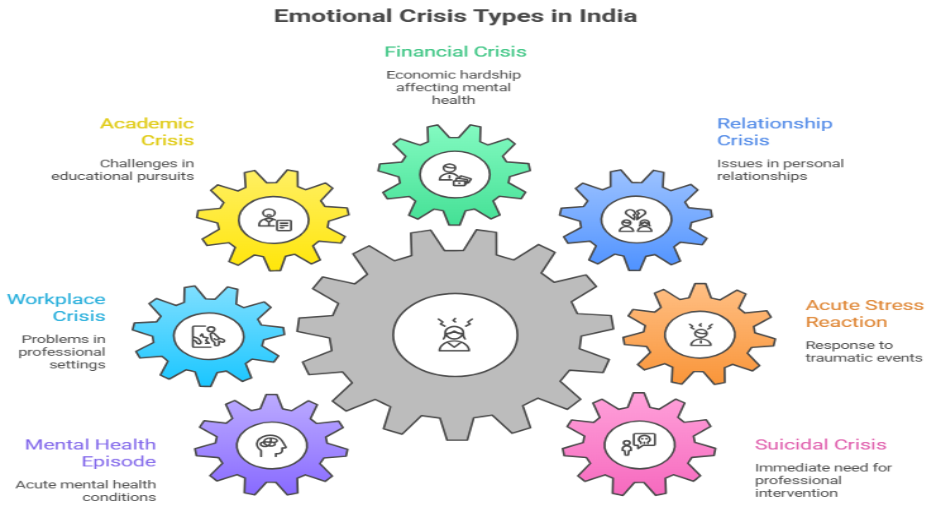
Types of Emotional Crisis Common in India
• Suicidal crisis: thoughts of ending one's life, the most acute and urgent type; requires immediate professional intervention
In India, this may emerge in the context of overwhelming academic pressure, financial distress, or family expectations. Individuals may not openly express suicidal thoughts due to stigma, but may show warning signs such as withdrawal, giving away belongings, or expressing hopelessness.
• Acute stress reaction: following a sudden traumatic event such as an accident, assault, or sudden bereavement
This can occur after events like road traffic accidents, experiencing theft or violence, or the sudden loss of a family member or a loved one. Given the close-knit nature of many Indian families, such events can feel destabilising not just to individuals but to the entire family ecosystem.
• Relationship crisis: separation, infidelity, domestic violence, or a sudden family rupture
In the Indian context, relationship crises often involve multiple layers such as family involvement, societal expectations, or stigma around separation or divorce. Situations like marital conflict, inter-caste or inter-faith relationship challenges, or domestic violence can escalate into emotional crises.
• Financial crisis-triggered breakdown: loan default, job loss, business failure; particularly common in India's entrepreneurial and farming communities
Financial instability can have a profound psychological impact, especially where identity and self-worth are closely tied to earning and providing. This may be seen in small-business owners facing losses, farmers dealing with crop failures, or individuals navigating sudden unemployment.
• Academic crisis: exam failure, JEE or NEET rejection, board exam results; high-stakes in a culture where academic performance carries enormous family weight
Academic setbacks can feel catastrophic in environments where success is narrowly defined within a box. Students may experience intense shame, fear of disappointing family, or comparison with peers, particularly around competitive exams like JEE, NEET, or board results.
• Workplace crisis: sudden termination, public humiliation by a senior in a hierarchical organisation, post-harassment complaint isolation
Workplace hierarchies in India can make it difficult to seek support. Experiences such as job loss, toxic work environments, or isolation after raising concerns (e.g., harassment complaints) can trigger significant emotional distress.
• Mental health episode: acute episode of depression, bipolar disorder, or psychosis, sometimes without prior diagnosis.
In some cases, a crisis may arise from an underlying mental health condition that has not yet been identified. Due to stigma and low awareness, individuals may not recognise early symptoms, and families may interpret them as behavioural issues rather than signs of a clinical condition.
ICD-11 Code for Emotional Crisis
There is no single ICD-11 diagnosis for “emotional crisis” as a standalone condition. Instead, mental health professionals understand it as a state of distress and diagnose the underlying condition based on a person’s symptoms.
The most commonly related diagnoses include:
- Adjustment Disorder (6B43): Difficulty coping with a major life change or stressful event, leading to distress and problems in daily functioning. Most directly aligned with crisis states.
- Depressive Episode (6A70-6A7Z): Persistent low mood, loss of interest, and reduced energy
- Generalised Anxiety Disorder (6B00): Ongoing, excessive worry that is hard to control
- Acute Stress Reaction (QE84): A short-term response to a highly stressful or traumatic event
In ICD-11, Adjustment Disorder (6B43) is defined as a difficulty coping with a significant life stressor, characterised by persistent distress (such as excessive worry or rumination) and difficulty adapting, leading to impairment in daily functioning.
For accurate clinical documentation, a psychiatrist or qualified mental health professional must assess the individual’s symptoms and assign the most appropriate diagnosis.
A Note on Crisis of Conscience and Emotional Intelligence
While emotional crises are often driven by overwhelming stress or trauma, some people experience distress rooted in internal moral conflict, known as a crisis of conscience. Emotional intelligence can help meaningfully in such situations.
A crisis of conscience is a situation where a person feels deeply conflicted between their actions and their moral or ethical values. It often involves guilt, doubt, and difficulty deciding what is the “right” thing to do.
Emotional intelligence is the ability to recognise, understand, and manage your emotions, as well as consider the feelings of others. In difficult moral situations, it helps you pause, understand your feelings, and avoid impulsive decisions driven by distress.
It supports:
- Self-awareness: noticing emotions like guilt, fear, or confusion that may be influencing your judgment
- Emotional regulation: staying calm enough to think clearly instead of reacting
- Empathy: considering how your decision may affect others
This makes it easier to respond thoughtfully and in line with your values, rather than acting in the heat of the moment.
India Focus: India's NCRB data consistently shows that financial distress, mental health conditions, and relationship issues are among the leading stressors associated with suicide. Board exam results and competitive entrance exam outcomes also create a predictable calendar of crisis risk for Indian students. Any organisation, school, or family that takes this seriously and builds proactive support around it saves lives.
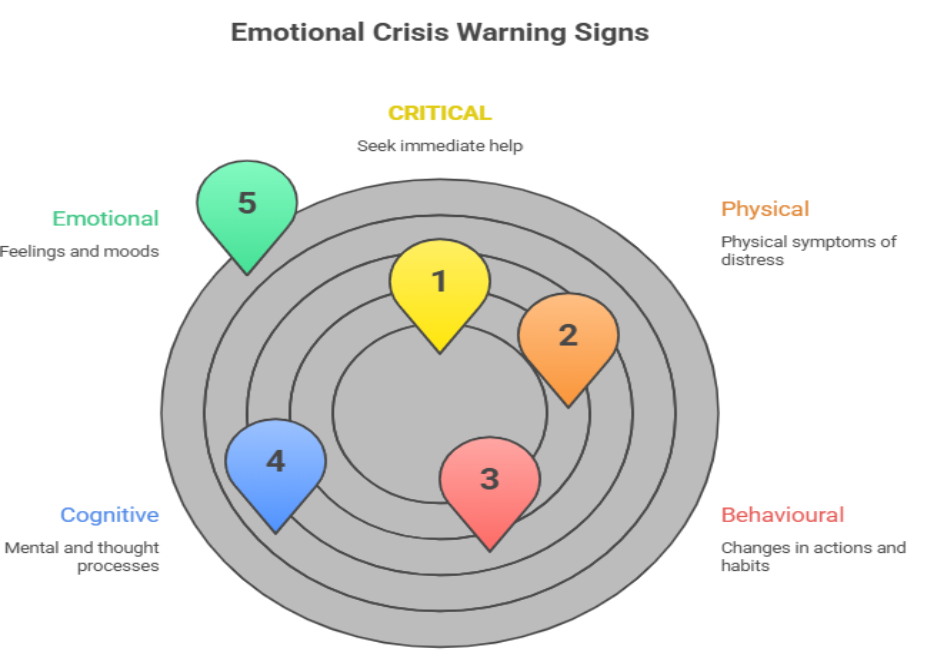
Warning Signs of an Emotional Crisis
Recognising an emotional crisis, in yourself or someone else, is the first step toward getting support.
Emotional signs
- Overwhelming despair or hopelessness
- Uncontrollable crying or emotional shutdown
- Feeling numb, empty, or disconnected
- Feeling trapped or stuck with no way out
- Intense anger or distress without a clear cause
Cognitive signs
- Difficulty concentrating or reduced mental clarity
- Racing or intrusive thoughts
- Confusion or feeling mentally “foggy”
- Dissociation (feeling unreal or detached from surroundings)
- Struggling to make even simple decisions
Behavioural signs
- Withdrawing from friends, family, or colleagues
- Avoiding calls, messages, or social interaction
- Reckless or impulsive behaviour
- Difficulty carrying out daily tasks (eating, bathing, working)
- Giving away valued possessions (serious warning sign)
Physical signs
- Panic attacks or constant anxiety
- Inability to sleep or eat for extended periods
- Self-harm behaviours
- Increased use of alcohol or substances to cope
- Extreme fatigue or physical collapse
Critical warning signs – seek immediate help
- Making a plan to end one’s life
- Saying goodbye in a way that feels final
- Expressing complete hopelessness about the future
- Actively seeking means to harm oneself
If any of these critical signs are present, call Tele MANAS 14416 immediately. Do not wait for the phase to pass.
Workplace Warning Signs: What an Emotional Crisis Looks Like at Work
Emotional crises in the workplace are often not immediately visible. Employees may continue functioning while experiencing significant distress.
Signs to watch for
- Noticeable change in communication style (e.g., from engaged to withdrawn or minimal responses)
- Increased absenteeism or frequent lateness in a previously reliable employee
- Sudden disengagement from teamwork or collaboration
- Decline in focus, productivity, or consistency
- Visible changes in appearance or energy levels
- Expressing that things are “not okay,” even indirectly
For managers and HR
- Approach with empathy, not judgement
- Start a private, supportive conversation
- Avoid focusing only on performance
- Encourage professional support without forcing disclosure
When to Seek Professional Help
Recognising signs is important. Knowing when to move from observation to action is critical.
Seek professional help if:
- The distress is persisting beyond a few days or becoming more intense
- Daily functioning is noticeably affected (work, relationships, basic routines)
- The person feels unable to cope using usual strategies
- There is increasing reliance on unhealthy coping (substances, isolation, avoidance)
- Others have started to notice and express concern
In a workplace context, act early if:
- Changes in behaviour or performance continue despite support or feedback
- The employee appears to be struggling to sustain basic work functioning
- Conversations indicate emotional overwhelm, even if not explicitly stated
At this stage, the goal is not to diagnose, but to connect the person to the right support.
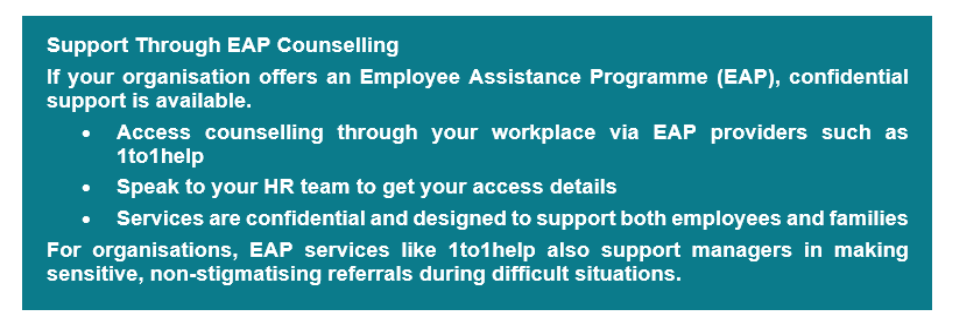
- Access confidential counselling through EAP providers such as 1to1help
- For immediate support, contact Tele MANAS 14416 (free, 24/7)
Common Emotional Crisis Triggers in India
Understanding what triggers emotional crises in the Indian context matters because the triggers shape both the form the crisis takes and the most effective way to respond to it.
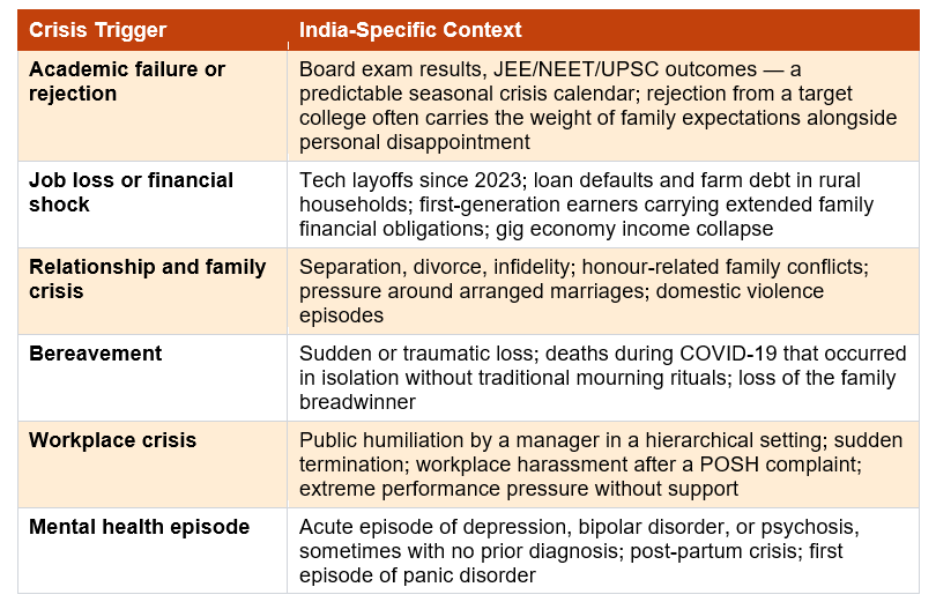
India’s National Suicide Prevention Strategy (NSPS), launched by the Ministry of Health and Family Welfare, identifies financial distress, mental health conditions, and relationship or family conflicts as key risk areas. While academic pressure is not explicitly listed, it is widely recognised as a significant contributor to distress in India, particularly among students and young adults. Tele MANAS, the government’s flagship free mental health programme, is designed to provide immediate, accessible support to individuals experiencing these types of crises.
Additional Risk Context
Some groups may face a higher risk of emotional crisis due to structural and social pressures:
- Students and young adults: high academic pressure and identity transition
- LGBTQ+ individuals: stigma, lack of family acceptance, and limited access to affirming support
- First-generation earners: financial responsibility toward extended family alongside personal stress
- Gig and informal workers: income instability and lack of formal support systems
These factors do not cause crisis on their own, but they can increase vulnerability, especially when combined with major life stressors.
💡Pro-Tip: If you are a manager, teacher, parent, or colleague in India, knowing the seasonal calendar of crisis risk is practical knowledge. Board results in May and June, JEE/NEET outcomes in July and August, and the post-Diwali financial pressure in November are recurring peaks. Reaching out proactively in these periods, not waiting for a crisis to be declared, is the most protective action a trusted person can take.
What to Do During an Emotional Crisis
An emotional crisis can feel overwhelming, but clear steps can help you get through the moment safely.
If You Are in Crisis
- Call Tele MANAS at 14416 immediately for free, 24/7 support
- Reach out to a trusted person such as a friend, family member, or colleague
- Move to a safe place if you feel at risk
- Use simple grounding techniques:
- Name 5 things you can see
- Focus on slow breathing
- Splash cold water on your face
- Avoid making major decisions while overwhelmed (resigning, ending relationships, sending critical messages)
- If you are having thoughts of self-harm, move away from anything you could use to hurt yourself and seek help immediately
- If available, access confidential counselling through EAP providers such as 1to1help via your workplace
If Someone You Know Is in Crisis
- Stay calm and do not leave them alone
- Listen without judgement; avoid dismissive statements like “it will pass” or “others have it worse”
- Ask directly if needed: “Are you thinking about hurting yourself?”
- Offer to call Tele MANAS (14416) together or on their behalf
- If there is immediate danger, call emergency services (112) and stay with them
- After the situation stabilises, help them connect to EAP counselling (such as 1to1help) or a mental health professional. EAP counselling can support recovery after the crisis phase.
Important to Note: You do not need to wait until things feel unbearable to seek help. If you are unsure, that is reason enough to reach out.
India's Government Crisis Support Infrastructure: What Exists and How to Use It
India has built significant public infrastructure for crisis support, though awareness of it remains low. The Tele MANAS programme (14416), launched by the Ministry of Health and Family Welfare in 2022 and operated under the National Mental Health Programme, provides free 24/7 multilingual crisis counselling and referral support across all 36 states and union territories. It operates through a two-tier system: Tier 1 (state counsellors and clinical psychologists for immediate support) and Tier 2 (specialist care referral through NIMHANS, AIIMS, and the District Mental Health Programme network).
The District Mental Health Programme (DMHP), currently operational in 767+ districts, provides community-level mental health services including crisis response as part of the broader NMHP framework. These services are free, and they are available outside of metro cities, a critical fact for employees and students in Tier 2 and Tier 3 locations who often assume that support only exists in urban centres.

After the Crisis: Recovery and Professional Support
An emotional crisis is not only a moment of collapse. It is also, if supported well, a turning point. The crisis reveals that something in a person's situation, their coping resources, their support network, their workload, or their unexpressed pain, has needed attention for longer than the crisis made visible. Recovery is not about returning to exactly where you were before. It is about building something more resilient than what was there.
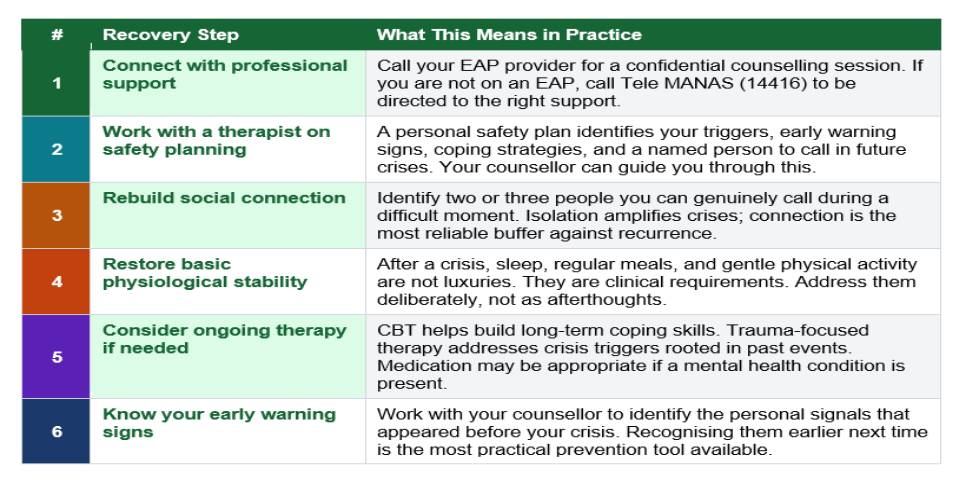
India's NIMHANS outpatient services provide post-crisis psychiatric and psychological care for those in the Bengaluru region. Across India Tele MANAS (14416) can connect individuals to ongoing professional support regardless of location. For employees on EAP, structured post-crisis counselling sessions are available as part of the programme, including safety planning and therapist-supported recovery work.
💡Key Insight: Safety planning is one of the most evidence-supported tools in crisis recovery. A personal safety plan is a written, co-created document that names your early warning signs, your personal coping strategies, the people you will contact before reaching crisis again, and the professional number you will call. Having it written, rather than just intended, is what makes it effective under pressure. Your counsellor can help you build one.
Recommended Resource: Oxford Health NHS Safety Planning Guidance
A Final Word
Vikram, the engineer from our opening, eventually called 14416 at 2 AM. The counsellor spoke to him in Hindi. He was on the phone for 40 minutes. He slept for the first time in three weeks that night. He did not resign. He did not do anything irreversible.
He just talked to someone who listened.
Over the next few weeks, Vikram also accessed counselling through his workplace EAP. Having a confidential space to talk regularly helped him stabilise, understand what he was experiencing, and gradually regain a sense of control at work and in his personal life.
One conversation created space. Continued support helped him recover.
If you or someone you know are going through something similar, you do not have to wait.
- Call Tele MANAS at 14416 for immediate, free, 24/7 support
- Access confidential counselling through EAP providers such as 1to1help via your workplace
Reaching out is not a last step. It is the first one.
FAQs
Q1. What is an emotional crisis?
An emotional crisis is a period of intense psychological distress in which a person's normal coping mechanisms are completely overwhelmed, making it difficult or impossible to function. It can be triggered by a traumatic event, accumulated stress, a mental health episode, or a sudden life shock such as exam failure, job loss, relationship breakdown, or bereavement. In India, emotional crises among students peak predictably around board exam results and entrance exam season. An emotional crisis is not a sign of weakness: it is a signal that professional support is needed.
Q2. What should I do if I am in emotional crisis?
The most important step is to not try to manage it alone. Call Tele MANAS at 14416 (free, 24/7, 20 Indian languages). If you are employed at a company with an EAP provider such as 1to1help, your HR team can give you a dedicated access number for immediate confidential support. Ground yourself with simple techniques: slow breathing, cold water on your face, or naming five things you can see around you. Avoid making major irreversible decisions while in crisis. If you have thoughts of self-harm, move away from any means and call for help immediately.
Q3. What is the ICD-11 code for emotional crisis?
There is no single ICD-11 diagnosis for “emotional crisis” as a standalone condition. Instead, clinicians classify the presentation based on the underlying symptoms and context.
The most clinically relevant ICD-11 categories include:
- 6B43 – Adjustment Disorder (most closely aligned with crisis states linked to identifiable stressors)
- 6A70–6A7Z – Depressive Episode
- 6B00 – Generalised Anxiety Disorder
- QE84 – Acute Stress Reaction
In ICD-11, Adjustment Disorder (6B43) is defined as a maladaptive response to a significant life stressor, characterised by persistent distress and difficulty adapting, leading to impairment in daily functioning.
The correct classification depends on the individual’s presentation and should be assigned by a qualified psychiatrist or mental health professional after assessment.
Q4. How can emotional intelligence help during a crisis of conscience?
Emotional intelligence (EI) significantly helps in moral dilemmas. Self-awareness allows you to recognise the emotions (guilt, fear, shame) shaping your decisions. Emotional regulation prevents reactive choices made purely in distress. Empathy enables you to consider the impact of your decision on others. Social skills allow you to seek guidance without shutting down the conversation. Research consistently finds that people with higher EI make more ethically coherent decisions under pressure because they can separate their emotional state from their values-based reasoning process.
Q5. How do I help someone in emotional crisis?
Stay calm and stay with them. Listen without judgment. Ask directly: 'Are you thinking about hurting yourself?' Asking does not plant the idea; it opens a safe conversation. What not to do: Do not leave someone who is suicidal alone. Do not dismiss or minimise their feelings (for example, “it’s not that bad” or “others have it worse”), as this can increase isolation and shame. Avoid giving quick fixes, ultimatums, or trying to “solve” the situation; your role is to support and ensure safety, not to force solutions.
Offer to call Tele MANAS at 14416 together, or call on their behalf. If they are in immediate danger, call 112. After the acute crisis, help them connect with ongoing professional support. If they are employed at a EAP-enrolled organisation, you can tell them that confidential counselling is available and that their employer will not know they have accessed it.
References
- American Psychological Association. (n.d.). Psychological distress. https://dictionary.apa.org/psychological-distress
- Better Health Channel. (n.d.). Family conflict. https://www.betterhealth.vic.gov.au/health/healthyliving/family-conflict
- Better Health Channel. (n.d.). Work-related stress. https://www.betterhealth.vic.gov.au/health/healthyliving/work-related-stress
- Cleveland Clinic. (n.d.). Brain fog. https://my.clevelandclinic.org/health/symptoms/brain-fog
- Cleveland Clinic. (n.d.). Chronic illness. https://my.clevelandclinic.org/health/articles/4062-chronic-illness
- Cleveland Clinic. (n.d.). Depression. https://my.clevelandclinic.org/health/diseases/9290-depression
- Cleveland Clinic. (n.d.). Psychosis. https://my.clevelandclinic.org/health/symptoms/23012-psychosis
- Cleveland Clinic. (n.d.). Self-harm. https://my.clevelandclinic.org/health/diseases/12201-self-harm
- Cleveland Clinic. (n.d.). Substance use disorder. https://my.clevelandclinic.org/health/diseases/16652-drug-addiction-substance-use-disorder-sud
- Cleveland Clinic. (n.d.). Suicidal ideation. https://my.clevelandclinic.org/health/symptoms/suicidal-ideation
- Clockwise. (n.d.). The hidden trauma of financial instability. https://www.clockwise.coop/the-hidden-trauma-of-financial-instability-that-no-one-is-talking-about/
- Find-A-Code. (n.d.). ICD-11 code QE84 Acute stress reaction. https://www.findacode.com/icd-11/code-1712535455.html
- Find-A-Code. (n.d.). ICD-11 code 6B43 Adjustment disorder. https://www.findacode.com/icd-11/code-264310751.html
- Find-A-Code. (n.d.). ICD-11 code 6B00 Generalised anxiety disorder. https://www.findacode.com/icd-11/code-505909942.html
- Fuquay Varina Counseling Services. (n.d.). Surviving emotional crisis: Therapy and medication. https://fuquay-varinanccounseling.carolinacounselingservices.com/surviving-emotional-crisis-therapy-medication-durham-nc/
- Health Assured. (n.d.). Signs of stress at work. https://www.healthassured.org/ie/blog/signs-of-stress-at-work/
- Healthline. (n.d.). Grounding techniques. https://www.healthline.com/health/grounding-techniques
- Healthline. (n.d.). Traumatic events. https://www.healthline.com/health/traumatic-events
- HelpGuide.org. (n.d.). Coping with grief and loss. https://www.helpguide.org/mental-health/grief/coping-with-grief-and-loss
- HelpGuide.org. (n.d.). Dealing with a breakup or divorce. https://www.helpguide.org/mental-health/grief/dealing-with-a-breakup-or-divorce
- HelpGuide.org. (n.d.). Domestic violence and abuse. https://www.helpguide.org/relationships/domestic-abuse/domestic-violence-and-abuse
- Luc University. (n.d.). Guide to identifying emotional crisis. https://www.luc.edu/wellness/mentalhealth/suicideprevention/guidetoidentifyingemotionalcrisis/
- Mayo Clinic. (n.d.). Bipolar disorder: Symptoms and causes. https://www.mayoclinic.org/diseases-conditions/bipolar-disorder/symptoms-causes/syc-20355955
- Mayo Clinic. (n.d.). Panic attacks. https://www.mayoclinic.org/diseases-conditions/panic-attacks/symptoms-causes/syc-20376021
- Mental Health Center Kids. (n.d.). Academic pressure. https://mentalhealthcenterkids.com/blogs/articles/academic-pressure
- Ministry of Health and Family Welfare. (n.d.). Tele MANAS. https://telemanas.mohfw.gov.in/home
- National Health Mission. (n.d.). District Mental Health Programme. https://nhm.gov.in/index1.php?lang=1&level=2&sublinkid=1043&lid=359
- National Crime Records Bureau. (2023). Suicide data insights. https://cmhlp.org/imho/blog/takeaways-from-the-ncrb-data-on-suicide-for-2023-what-has-changed/
- NHS Foundation Trust. (n.d.). Safety planning guidance. https://www.rcpsych.ac.uk/docs/default-source/improving-care/nccmh/suicide-prevention/monthly-clinic/ohft-safety-planning-guidance.pdf
- Pabau. (n.d.). ICD-11 6A71 recurrent depressive disorder. https://pabau.com/diagnostic-codes/icd-11-6a71-recurrent-depressive-disorder-diagnosis-coding-guide/
- Penn Foundation. (n.d.). Warning signs of a mental health crisis. https://www.pennfoundation.org/news-events/articles-of-interest/warning-signs-of-a-mental-health-crisis-and-how-to-respond/
- Psychology Today. (n.d.). Infidelity. https://www.psychologytoday.com/us/basics/infidelity
- Verywell Mind. (n.d.). Bereavement. https://www.verywellmind.com/bereavement-definition-symptoms-causes-traits-treatment-5197038
- Verywell Mind. (n.d.). Hopelessness. https://www.verywellmind.com/9-things-to-do-if-you-feel-hopeless-5081877
- Verywell Mind. (n.d.). Toxic work environment. https://www.verywellmind.com/how-a-toxic-work-environment-may-affect-mental-health-4165338
- World Health Organization. (n.d.). Suicide worldwide. https://www.who.int/news-room/fact-sheets/detail/suicide


.svg)
.svg)
.svg)
.svg)