


.png)


.png)

Personal Life & Relationships
11 Tips for a Newly Married Couple for a Happy Married Life

.png)
Written by
Aarohi Parakh,
Psychologist and Content Writer

Reviewed by
Sanjana Sivaram,
Psychologist and Clinical Content Head


Introduction
There is a reason the wedding day gets so much attention. The flowers, the rituals, the photographs, the relatives who flew in from everywhere. It is a beautiful moment. But for many couples, reality quietly begins a few days later.
Maybe it is the first disagreement about finances on the honeymoon. Or the awkwardness of adjusting to each other’s routines. One partner likes silence after work while the other wants to talk. One family expects daily calls while the other values more independence. Small things begin to surface that no amount of wedding planning prepares you for.
Take Rohan and Aditi, for example. A few weeks after their wedding, they found themselves arguing over something seemingly trivial: how much time to spend with extended family on weekends. What surprised them was not the disagreement itself, but how emotionally charged it became. Both quietly wondered, “Are we already having problems?” In reality, they were experiencing something almost every newly married couple goes through: the shift from celebrating a relationship to learning how to build a shared life.
Whether yours is a love marriage or an arranged one, the marriage advice in this article draws on insights from 25 years of working with individuals, couples, and families across India in the area of relationships, emotional wellbeing and mental health. What is seen, again and again, is that the couples who thrive are not those who never argue or never struggle. They are the ones who build small, consistent habits early and approach the inevitable rough patches with curiosity rather than alarm.
This article provides 11 practical marriage tips to help you build exactly that kind of foundation.
Tip 1: Accepting Differences in Marriage: Why It Gets Harder After the Wedding
Every couple enters marriage knowing, intellectually, that they are two different people. What surprises most newly married couples is how much more visible those differences become when you are sharing a home, a budget, a schedule, and a life.
He squeezes the toothpaste from the middle. She needs the kitchen tidied before bed. He processes difficult conversations out loud. She needs an hour of quiet before she can discuss anything. These are not character flaws. They are habits, formed over decades of conditioning, that were invisible when you were dating but are suddenly everywhere when you live together.
In arranged marriages, this adjustment happens even faster. Partners who have had limited premarital interaction find themselves in a discovery phase compressed into the first few months of living together. This is not a disadvantage. It is simply a different kind of journey, and it deserves the same patience and grace as any meaningful learning.
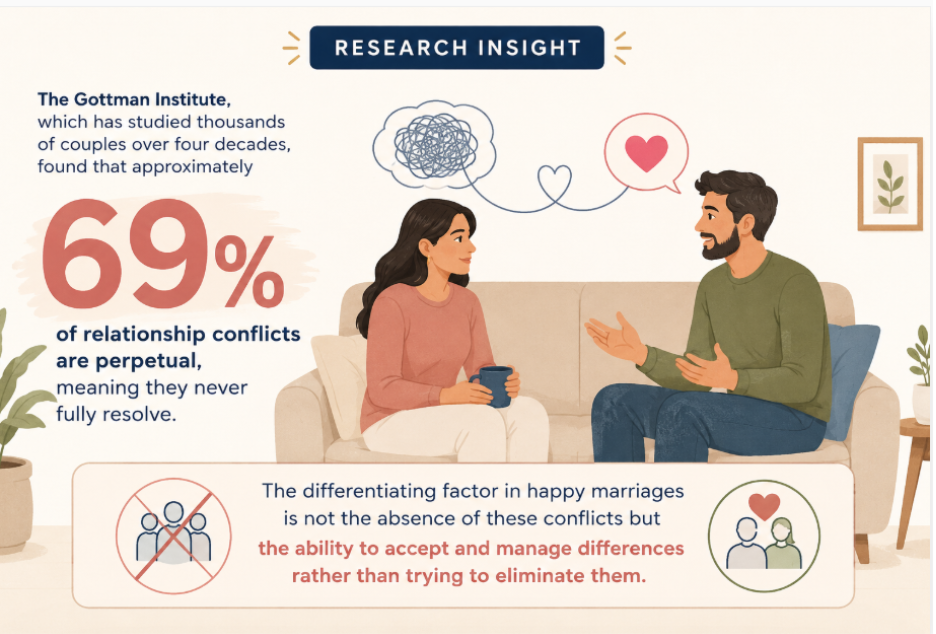
A useful framework: Take a sheet of paper and draw two columns. In the first, list the differences you can accept and work around. In the second, list the things that genuinely conflict with your core values or wellbeing and need a real conversation. You will likely find that the first column is much longer than you expected. That matters.
💡Key Insight: The goal of a happy married life is not to find someone who is exactly like you. It is to build a relationship in which two different people feel genuinely safe and genuinely seen.
Tip 2: Balancing Individuality in Marriage
One of the less talked-about adjustments of early marriage is the shift from "I" to "we." It is necessary. It is also, if handled without care, one of the ways people quietly begin to lose themselves.
Every person who enters marriage brings with them a distinct identity: their friendships, their interests, the ways they recharge, and the dreams they hold that are distinct from their relationship. A healthy marriage makes room for all of this. A marriage that requires total synthesis, where every evening is shared, every decision is joint, every friend is a couple-friend, tends to produce a specific kind of tiredness that is hard to name but easy to feel.
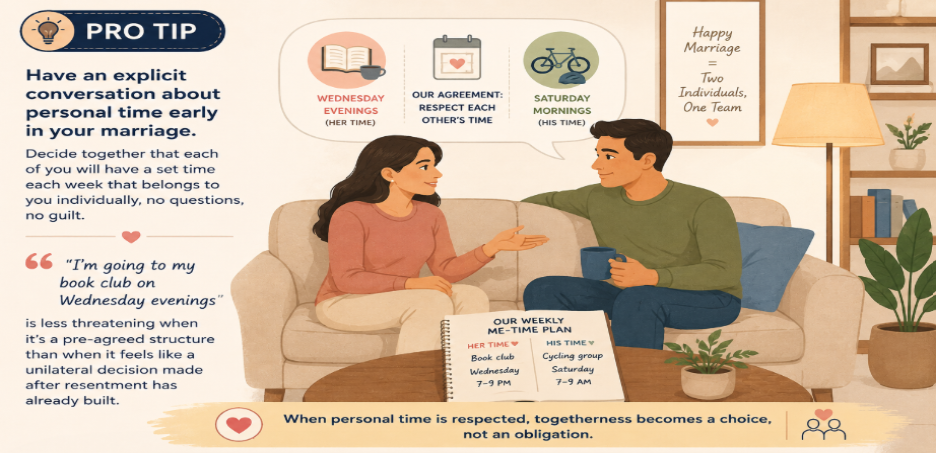
In joint family or extended family living situations, which remain common across urban and semi-urban India, this compression of individual space is amplified. There is often very little room that belongs only to you. And when one partner reaches for that room, through an evening out with friends, a solo hobby, or a work trip, it can be misread by family members or even a spouse as distance or rejection.
💡Key Insight: The couples with the happiest married life are not those who are inseparable. They are those who have built a relationship strong enough to hold two whole people.
Tip 3: Building a Relationship with In-Laws: The Indian Reality
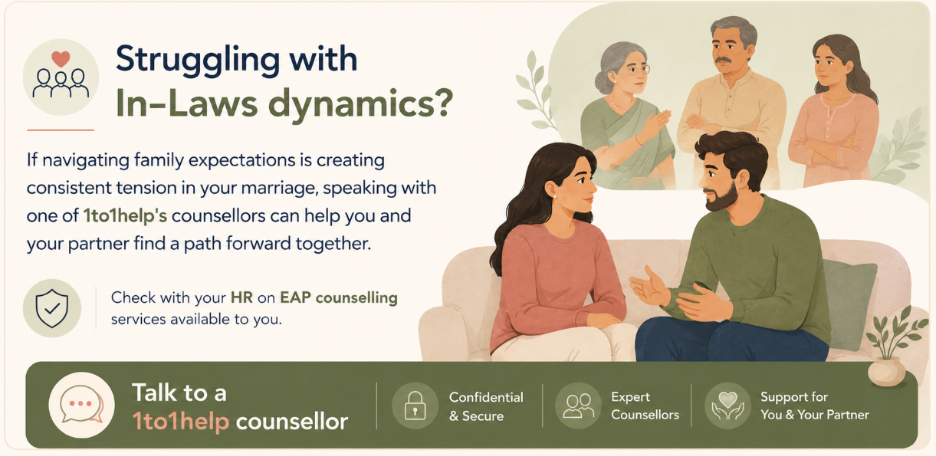
Let us be honest about something that most marriage tips articles skip over: in-laws dynamics are one of the most common sources of conflict in Indian marriages in the first year. This is not a judgment. It is a structural reality of a culture in which family involvement in marriage is high, expectations are deeply held, and boundaries are rarely discussed openly before the wedding happens.
Both partners feel this in different ways. The tension of feeling pulled between your family of origin and your new marriage, the guilt of seeming disloyal, the frustration of decisions being made by people who are not in the marriage, these are extraordinarily common experiences. They are not signs that the marriage is failing.
The "You Manage Your Family" Rule
One of the most effective frameworks in counselling is this: In many marriages, it helps when each partner takes primary responsibility for difficult conversations with their own family of origin, while still supporting each other as a team. If your mother has concerns about a household decision, you have that conversation with her. If his parents have expectations about where you spend certain festivals, he addresses that with them. This prevents the dynamic in which one partner is always the "bad person" to the other's family, and it distributes the emotional labour more fairly.
Decisions about your marriage, your home, your finances, and your children are made by the two of you. Together. First.
Love Marriage vs Arranged Marriage Dynamics
In arranged marriages, families have often been involved from the very beginning of the process. This is a beautiful thing in many ways, but it can also create an expectation that the same level of family involvement will continue into the marriage itself. Couples in arranged marriages sometimes find it harder to assert boundaries precisely because the marriage began in a context of family consensus. Recognising this pattern is the first step towards gently and respectfully shifting it.
At the same time, it is important to remember that neither love marriages nor arranged marriages are inherently more successful or healthier than the other. Over time, the quality of any marriage is shaped far more by factors such as communication, compatibility, emotional maturity, mutual respect, and both partners' willingness to grow together.
Recommended Reading: Arranged Marriage vs Love Marriage: Pros, Cons, Success Rates & How to Choose (2026)
A Framework for Navigating In-Laws Boundaries
- Agree privately first. Before any family conversation, the two of you decide your position together. Never negotiate your marriage in real time in front of family members.
- Each partner manages their own family. You speak to your parents. They speak to theirs. This removes the burden of one partner always playing the role of enforcer with the other's family.
- Be consistent, not confrontational. Boundaries work through consistent, calm repetition, not through ultimatums or dramatic statements. Say the same thing, gently, each time.
- Get support if it keeps escalating. If in-law conflict is a source of ongoing distress, relationship counselling provides a neutral space for both partners to work through it without it becoming a competition for loyalty.
Tip 4: Setting Expectations and Sharing Responsibilities
The word "expectations" gets a slightly unfair reputation in marriage conversations. Having expectations is not the problem. Having unspoken, unexamined expectations is.
Most of the resentment that accumulates in a new marriage does not come from dramatic events. It comes from the slow accumulation of small, repeated experiences of feeling that the arrangement is unfair. Who makes the morning chai? Who does the grocery run? Who handles the family WhatsApp group that seems to require diplomatic management every other day?
In urban India, dual-income couples now form the majority. The assumption that domestic responsibilities automatically fall to one partner, typically the wife, is a primary driver of resentment in new marriages, particularly when both partners are managing demanding careers.
The Household Audit
A practical exercise: Sit down together and list every recurring household task you can think of. Then, without making assumptions, divide them by preference, time availability, and practical capacity. Revisit the arrangement every three months, because life changes.
On Finances
Money conversations belong in the expectations discussion, too.
- Who pays which bills?
- Are you working towards a joint account, separate accounts, or a combination?
- Who makes decisions about significant purchases?
- What does saving look like for your household?
These conversations can feel uncomfortable at first, but far less so than the conflicts that arise when they are avoided.
Tip 5: Discussing Mutual Goals and Values
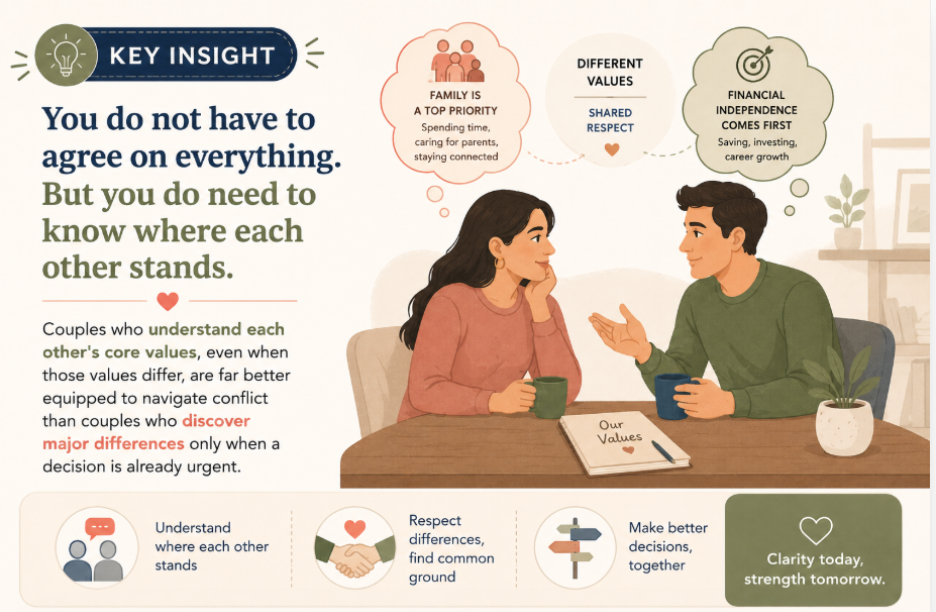
You fell in love with a person. Now you are building a life. Those are related but different projects, and they require different kinds of conversations.
Career goals are one of the most emotionally heavy aspects in modern Indian marriages. When one partner gets an opportunity for a transfer, a promotion, or further education, the question of whose career takes priority can surface for the first time. Having this conversation before the situation forces it is significantly less painful than having it under pressure.
Children, too, deserve an explicit conversation early in the marriage. If you have not already discussed whether and when you want children, how you would approach parenting differently, what your childcare philosophy looks like, and how responsibility would be shared, that conversation belongs in the first year.
In India, there are specific value-level conversations that matter, but many couples avoid them due to discomfort. Religious practices in households where partners come from different traditions. Money philosophy, specifically, one partner's tendency to save vs the other's inclination to spend. Family obligations, how much financial or practical support you are expected to provide to extended family. In inter-caste marriages, caste dynamics and their appearance in extended family interactions, traditions, social expectations, and differing cultural norms make open communication and boundary-setting especially important.
Tip 6: Communication in Marriage: The Foundation of Everything
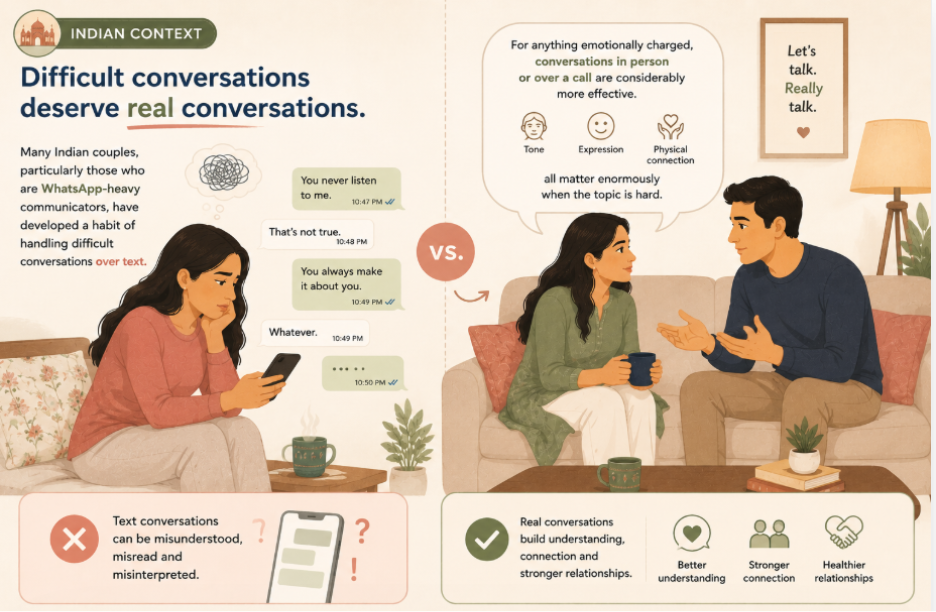
If there is one area we would expand in almost every new marriage, it is communication. Not talking. Communicating. These are different things, and the gap between them is where most relationship problems quietly grow.
Many couples talk constantly without actually communicating needs, fears, or desires. The conversations are about logistics: what is for dinner, who is picking up the dry cleaning, and what time does the function start? These conversations are necessary. They are simply not enough to sustain emotional closeness over time.
The Four Horsemen (and What to Do Instead)
The good news is that communication is a skill that can be learned and improved. One of the most well-known frameworks in relationship psychology comes from The Gottman Institute, which identified four communication patterns strongly linked to relationship distress. They called them the “Four Horsemen.”
Importantly, the research does not suggest that healthy couples never fall into these patterns. Most people do occasionally, especially during stress, exhaustion, or conflict. What matters more is recognising these habits early and learning healthier ways to respond before conversations escalate.
1. CRITICISM
Criticism occurs when frustration turns into an attack on a partner’s character rather than addressing a specific issue.
Instead of: “You never help with anything around the house.”
Try: “I feel overwhelmed when I manage everything alone. Can we talk about sharing this differently?”
2. CONTEMPT
Contempt includes eye-rolling, sarcasm, mockery, or speaking with disrespect. Over time, it can seriously damage emotional safety in a relationship.
The antidote is intentionally expressing appreciation, respect, and acknowledgment, even during disagreements.
3. DEFENSIVENESS
Defensiveness often looks like denying responsibility, making excuses, or counter-blaming instead of listening openly.
Instead of: “That’s not my fault, you never told me what you needed.”
Try: “I can see why that upset you. I could have handled that better.”
Taking responsibility for even a small part of the issue can significantly soften conflict.
4. STONEWALLING
Stonewalling happens when one partner emotionally shuts down, withdraws, or stops engaging during conflict, often because they feel overwhelmed. Instead of shutting down completely or giving the silent treatment, it helps to clearly communicate the need for a pause.
Example: “I need 20 minutes to calm down. I will come back and talk this through.”
A pause meant for calming down is very different from emotionally abandoning the conversation.
"I" statements vs "You" statements
Small shifts in wording can completely change how a conversation feels.
“I feel unsupported when decisions are made without me” lands very differently from “You always leave me out of decisions.”
The first invites conversation. The second invites defensiveness.
This is not about communicating perfectly all the time. It is about learning how to express difficult emotions honestly while still protecting the connection between both partners.
Tip 7: Choosing Happiness over Being Right
There is a certain kind of argument that both partners leave having technically won and emotionally exhausted. The points were made. The evidence was presented. Nobody budged. And now there is a quiet, cold distance that neither person quite knows how to cross.
Choosing happiness over being right does not mean suppressing legitimate concerns or accepting genuinely unfair treatment. It means learning to distinguish between the arguments that matter and the ones that simply feed the ego.
In Indian marriages, cultural gender dynamics can make this harder. There is sometimes an unspoken rule that backing down is the same as losing face. Reframing this as emotional maturity rather than weakness is one of the more practically useful things couples can do.
💡Key Insight: The question worth asking yourself before you escalate any disagreement is this: Do I want to be right in this moment, or do I want to protect the connection while still addressing the issue constructively? In a good marriage, you will rarely be able to fully have both.
Tip 8: Dealing with Conflict in Marriage: How to Fight Well
Here is something that surprises many newly married couples: learning to fight well is one of the most important skills in a happy married life. Not to avoid fighting. To fight well.
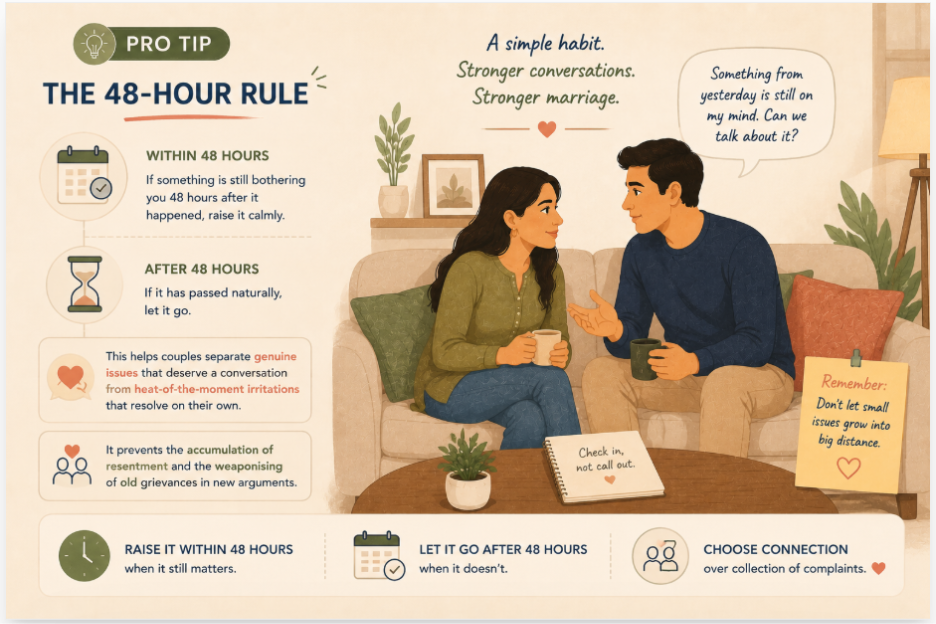
Every couple has conflict. The question is whether your conflicts move you closer to understanding or further into entrenched positions. The difference lies in the habits you build around disagreement.
The Repair Attempt
Gottman's research identified something called the "repair attempt": a brief moment during conflict when one partner tries to ease tension before things escalate. It could be humour, a gentle touch, an acknowledgment, or even a simple “I understand why you are upset.” Couples in healthy relationships tend to make these attempts often and, equally importantly, are willing to receive them even when they are imperfect.
Practical tool
Agree on a "not now" signal that you both respect. When one partner uses it, it means "I need to pause this conversation before I say something I will regret, not that I am abandoning it." This prevents the kind of escalation that occurs when conversations take place while someone is tired, hungry, or overwhelmed. Decide in advance that asking for a pause is not the same as stonewalling.
There is also an important pattern to notice: when the same argument keeps repeating without resolution, the surface issue is often not the real issue. An argument about forgetting to call the caterer, for example, may actually reflect deeper feelings of being unappreciated, unseen, unsupported, or emotionally overburdened. Understanding these underlying emotions is often what helps couples move forward more meaningfully.
At the same time, it is important to recognise that healthy conflict is very different from repeated disrespect, intimidation, manipulation, emotional abuse, or fear within the relationship. Feeling emotionally unsafe should never be dismissed as a normal part of marital adjustment or “just how relationships are.”
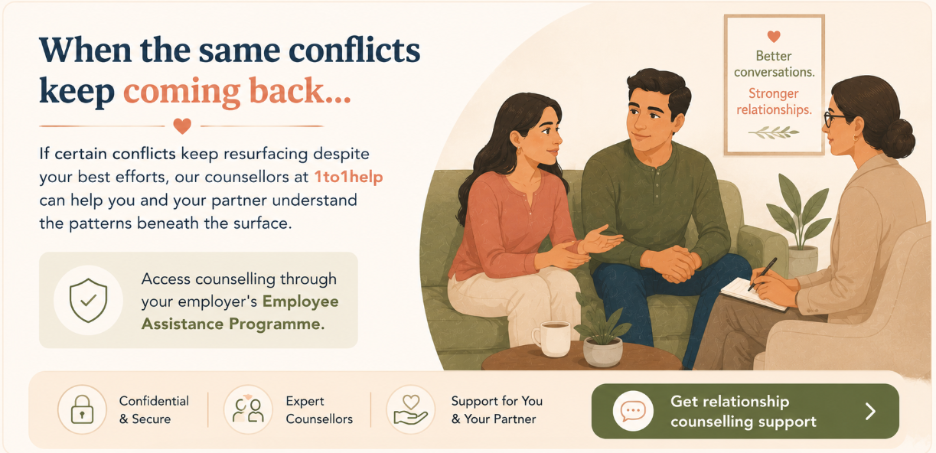
If recurring conflicts are creating real distance in your marriage, speaking with a relationship counsellor is not a sign of failure. It is a practical investment in a relationship you clearly care about.
Tip 9: Giving Each Other Space
Paradoxically, one of the things that sustains closeness in a long-term relationship is a healthy degree of separateness. Relationship therapist Esther Perel, in her widely read work Mating in Captivity, argues that desire and intimacy in long-term relationships thrive on a degree of mystery and independence between partners. Couples who merge entirely into a single identity often find that the quality of their intimacy diminishes over time, even when their affection is genuine.
Healthy space in marriage means maintaining individuality while staying emotionally connected to each other. It means maintaining the parts of yourself that existed before the marriage: your friendships, your interests, your way of spending a Sunday morning that has nothing to do with your partner.
Newly married Indian couples often face an external expectation to be together constantly, at family gatherings, social events, work functions. Every invitation is addressed to both. Every absence of one is noted. Normalising independence from this expectation, and explaining it gently to the extended family when necessary, is one of the quieter but important acts of protecting your marriage.
💡Key Insight: Space is not the opposite of intimacy. When given and received with trust, it is one of the things that keeps intimacy alive. The goal is "together and separate," not "together always" or "separate often."
Tip 10: Carving Out Quality Time Together
It sounds almost absurdly simple: spend time together. Yet many couples arrive in counselling with the unsettling realisation that, despite living under the same roof, they have not had a meaningful conversation in weeks. Over time, work demands grow, family responsibilities increase, and routines take over. The quality time a couple needs slowly starts to disappear into the background because, unlike work or family obligations, it often has no fixed schedule or accountability. And once that habit fades, rebuilding it intentionally can take effort.
Research consistently shows that couples who maintain regular intentional time together, even just two hours a week, report significantly higher relationship satisfaction over time. It does not need to be a candlelit dinner. A walk, a shared meal without phones, an evening of cooking together, an hour of watching something you both actually want to watch. What matters is that the time is protected and present.
Indian Context: In joint households, creating couple time can feel logistically complicated, particularly when living space is shared, and privacy is limited. Making couple time a priority requires intentionally creating space for it and treating it as an important part of nurturing the relationship, even amidst family responsibilities and other commitments. A weekly evening that belongs to the two of you, even if it is simply a walk in the neighbourhood, is worth defending.
💡Key Insight: The "date night habit," i.e., regular couple time, even in simple ways, strengthens emotional connection over time. Start it early, before life has filled in all the gaps
Tip 11: Keeping the Romance Alive
Romance in a long marriage is not the same thing as romance at the beginning of a relationship. The early rush of a new attraction is largely neurochemical: dopamine and noradrenaline create a heightened state of attention and excitement that makes everything feel significant. That phase does not last forever in any relationship. That is not a problem to solve. It is simply how human neurology works.
What sustains romance over the long term is something quieter and more deliberate. Physical affection, small daily gestures of connection, a hug in the morning, holding hands during a walk, a brief moment of warmth in a busy day, maintains what neuroscience calls the oxytocin bond. Couples who sustain physical affection outside of the sexual relationship consistently report higher satisfaction in both areas.
Novelty also matters more than most couples realise. Trying something genuinely new together, a cuisine neither of you has eaten, a weekend trip somewhere unfamiliar, a shared class or hobby, activates the brain's reward system in ways that echo the early-stage experience of attraction. The brain responds to shared novelty as connection.
Indian Context: Romance in Indian marriages is often expressed privately. Social and family contexts can suppress affectionate expression between partners, and joint-family living can leave very little space just for the two of you. Finding and protecting those private moments, a shared cup of tea before the household wakes up, a late evening on the balcony, is one of the ways couples sustain their connection within a fuller family context.

What to Expect in the First Year of Marriage
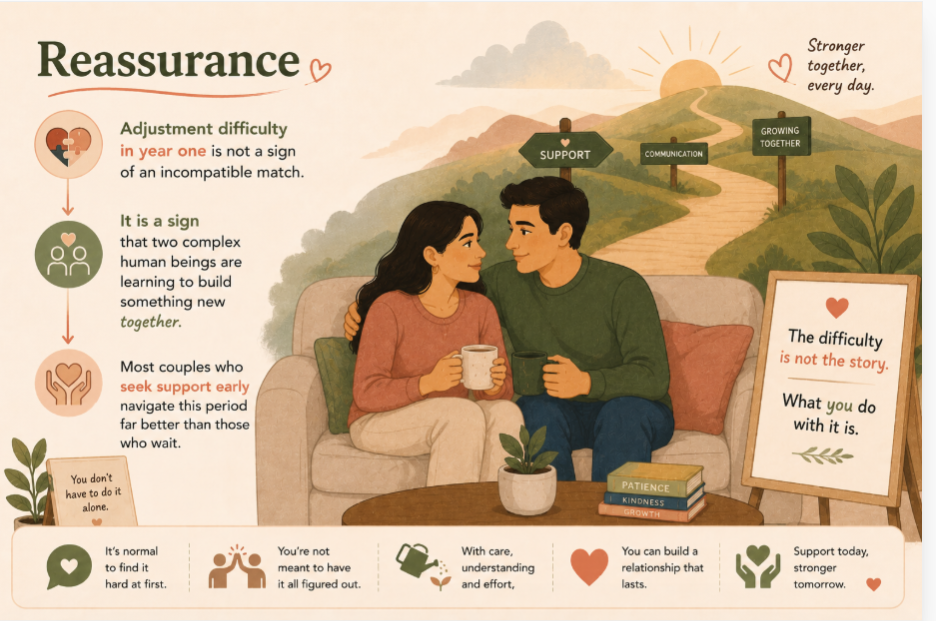
The first year of marriage has been described, memorably, as the "wet cement year." The good news is that these patterns can always be revisited, repaired, and reshaped with awareness and effort. This is not a cause for anxiety. It is a cause for intention.
What Does the First Year of Marriage Typically Look Like?
Months 1-2
The honeymoon period and its tail. High warmth and goodwill are normal early on. The neurochemical excitement of new intimacy remains. Enjoy it, and do not assume this level of ease is permanent.
Months 3-4
First real friction. Living habits surface. Differences that were manageable in dating become daily realities. First real disagreements happen. This is normal and not a sign of incompatibility.
Months 5-8
Re-evaluating expectations. Both partners reassess what they assumed marriage would feel like vs what it actually feels like. In-law dynamics, financial realities, and career pressures become more visible.
Months 9-12
Finding your rhythm. Couples who have communicated openly begin to settle into patterns that work for them. Those who have avoided difficult conversations may feel a growing distance. Both paths are still recoverable.
What is Not Normal in Year One
Adjustment difficulty is normal. Certain experiences, however, are signals worth taking seriously: persistent contempt or belittling from either partner; emotional withdrawal that lasts for weeks; any form of physical intimidation or control; feeling consistently unheard across every kind of conversation; one-sidedness in all compromises, always. These are not features of the adjustment period. They are signs that professional support would be genuinely valuable, and the earlier it is sought, the more space there is to build something healthy.
India-specific pressures
Indian couples in the first year often face a specific constellation of pressures that Western marriage guides do not address:
- joint-family integration,
- early pressure to have children,
- navigating new financial realities as a combined household, and
- managing their professional identity as married employees in workplaces where marriage status still carries assumptions.
You are not imagining these pressures. They are real. And knowing they are common makes them slightly easier to carry.
Happy Married Life: Wishes, Quotes and What It Really Takes
When we wish someone a happy married life, what are we actually wishing them? Not, we hope, the absence of difficulty. Not a life without disagreement, without change, without the inevitable seasons of distance and return. What we wish for them is the capacity to navigate all of that and still choose each other.
A happy married life is not a state that arrives on the wedding day and persists automatically. It is built. In small, daily choices. In the decision to say "I hear you" before "but." In the habit of noticing what your partner does well, not just what they get wrong. In showing up for each other when it costs you something.
If you are looking for the right words to wish a newly married couple, here are some that carry real meaning.

What The Research Tells Us: Couples who describe their marriage as happy rarely say it is because nothing ever went wrong. They say it because they built the habits, over months and years, to navigate what did. Happiness in marriage is not a feeling that persists. It is a practice that compounds.
Final Thoughts
Remember Rohan and Aditi from the beginning of this article? The couple who found themselves emotionally overwhelmed by what seemed like a simple disagreement about weekends and family time? What mattered was not that they argued. What mattered was whether they learned to understand the deeper needs underlying the argument and to respond to each other as teammates rather than opponents.
That is what marriage often becomes over time: not the absence of conflict, but the gradual building of emotional safety, mutual understanding, and the ability to return to each other after difficult moments. Every couple, no matter how well-matched, moves through seasons of closeness and friction, certainty and doubt, feeling deeply connected and occasionally misunderstood. This is not a sign that something is wrong. It is the reality of building a life with another human being.
The marriage tips in this article are not a one-time checklist. They are habits that are practised repeatedly through ordinary days, stressful phases, and changing circumstances. Small conversations, moments of repair, expressions of affection, and intentional effort often shape the strength of a marriage far more than grand gestures do.
And if you find that certain challenges continue to resurface despite your best efforts, whether around communication, conflict, intimacy, family expectations, or adjustment, seeking support early can make a meaningful difference. Support can come through multiple routes. Many organisations in India now offer confidential counselling through Employee Assistance Programmes (EAPs) such as 1to1help. Individuals and couples may also choose to work with private relationship therapists, either in person or online, depending on what feels most accessible and comfortable for them.
At 1to1help, our counsellors have expertise and years of experience in supporting individuals and couples through exactly these transitions. Reach out through your employer's Employee Assistance Programme (EAP) at 1to1help.
FAQs
Q1. What are the most important tips for a newly married couple?
The most important tips for a newly married couple centre on three core pillars: communication, expectations, and respect for individuality. Open and honest communication, not just talking but actively listening, is the foundation of a healthy marriage. Setting clear expectations early, about household roles, finances, career goals, and family involvement, prevents the resentment that builds when assumptions go unexamined. Maintaining your individual identity while building a shared life keeps both partners engaged and fulfilled. For Indian couples specifically, navigating in-law boundaries as a united front, with each partner managing their own family of origin, reduces one of the most common sources of early-marriage conflict. Approach the first year as a learning period rather than a test of compatibility.
Q2. How do you wish someone a happy married life?
Wishing someone a happy married life warmly and meaningfully goes beyond "congratulations." Try phrases that acknowledge the journey ahead: "Wishing you a lifetime of love, laughter, and partnership." "As you begin this beautiful chapter together, may you always find strength in each other." "Congratulations on your marriage. May you grow together, laugh together, and always choose each other." For close friends or family, personalise the wish by referencing something that makes their relationship unique. In Indian wedding culture, wishes often invoke blessings for health, prosperity, and companionship. "Khush raho, khush rakho" conveys this beautifully in spirit.
Q3. What are common marriage problems in the first year?
The most common marriage problems in the first year fall into predictable categories. Communication gaps appear when partners who talked easily while dating discover that daily living brings to light communication styles they had not previously encountered. Household role conflicts arise, particularly in dual-income couples or joint families, when expectations about who does what go unstated until friction builds. In-law boundary issues are especially common in Indian contexts where family involvement is high. Financial disagreements surface when differing money philosophies become apparent in shared decisions about bills, savings, and spending. Intimacy adjustment occurs as physical and emotional intimacy change during the transition from dating to living together. None of these are an incompatible match. They are normal, addressable challenges.
Q4. How important is communication in a marriage?
Communication is the single most important skill in marriage. Every other challenge, including conflict, intimacy, finances, and in-laws, is navigated through it. Research from the Gottman Institute, based on 40-plus years of studying couples, consistently shows that how couples communicate, not what they fight about, predicts relationship longevity. Developing the habit of using "I" statements, listening to understand rather than to respond, and making repair attempts during conflict are learnable skills. For couples who find communication genuinely difficult, sessions with a counsellor provide structured support, and addressing this early is far easier than waiting until patterns have hardened.
Q5. When should a newly married couple seek counselling?
A newly married couple should consider marriage counselling whenever they feel stuck in patterns they cannot break alone: recurring arguments about the same issues, growing emotional distance, difficulty navigating in-law conflicts, or persistent feelings of being unheard or unseen. Counselling is not a sign that a marriage is failing. It is a sign that both partners are committed to making it work. In India, the stigma around seeking professional help for relationship challenges is gradually reducing. Couples today can access support through several formats, including private therapists in clinics, online relationship counselling platforms, and Employee Assistance Programmes (EAPs) offered through workplaces. The earlier couples seek support, the more room there is to build healthy patterns before difficult ones become entrenched.
Recommended Reading
References
- Gottman, J. (n.d.). Managing vs. resolving conflict in relationships. The Gottman Institute
- Gottman, J. (n.d.). The Four Horsemen: Criticism, contempt, defensiveness, and stonewalling. The Gottman Institute
- Gottman, J. (n.d.). R is for repair. The Gottman Institute
- Manson, M. (n.d.). Relationship advice that actually works. Mark Manson
- Marriage.com Editorial Team. (n.d.). Balancing individuality in marriage. Marriage.com
- Marriage Missions International. (n.d.). Accepting differences in marriage. Marriage Missions International
- Perel, E. (2006). Mating in captivity: Unlocking erotic intelligence. HarperCollins. Discussed in Thomas H. Brand Blog
- Sharma, M. (2023, February 14). Dealing with in-laws: A major source of relationship conflict in modern Indian marriages. The Swaddle
- Singh, A. (2022, August 18). Setting boundaries in an Indian family: Tips and advice. Tweak India
- Uvais, N. A., & Sreeraj, V. S. (2021). Marital satisfaction and mental health among married couples: A systematic review. Journal of Family Medicine and Primary Care, 10(7), 2489–2495. PubMed Central


.svg)
.svg)
.svg)
.svg)