


.png)


.png)

Personal Life & Relationships
What Makes a Healthy Relationship? Key Elements, Signs, and Tips for Lasting Love
.jpg)
.png)
Written by
Aarohi Parakh,
Psychologist and Content Writer

Reviewed by
Sanjana Sivaram,
Psychologist and Clinical Content Head


Introduction
Imagine This...
After another busy weekday, Aditi and Rohan finally sit down for dinner. They exchange the usual questions.
"How was work?"
"Busy."
"Anything else?"
"Not really."
The conversation ends there.
It is not that they have stopped loving each other. They still share responsibilities, celebrate birthdays and remember to pick up groceries. But somewhere between demanding careers, family responsibilities and endless scrolling on their phones, they have started feeling more like housemates than partners.
Many couples experience phases like this. A relationship does not usually become unhealthy overnight. More often, it changes gradually through small moments of emotional distance, unspoken expectations, and conversations that never happen.
The reassuring part is that difficult phases are a normal part of many relationships and do not necessarily mean that something is wrong. What matters is how couples respond to these changes. With awareness, consistent effort, and healthy habits, many couples can rebuild, maintain, or strengthen connection and strengthen their bond over time. Every relationship has moments of closeness and moments of distance. What often makes the difference is not the absence of challenges, but how couples respond to them.
In the sections ahead, we'll look at what a healthy relationship really means, the habits that help relationships grow stronger, the signs of a supportive partnership, common unhealthy patterns, and simple ways to nurture lasting love.
What Is a Healthy Relationship?
A healthy relationship is one where both people feel respected, emotionally safe, and valued. While every relationship looks different, healthy relationships are often built on mutual trust, honest communication, shared responsibility and a willingness to grow together. They also allow both people to express their needs, boundaries and differences openly. Feeling safe does not mean there is never disagreement; it means there is room to navigate differences without fear, humiliation or retaliation.
Although this article focuses on romantic relationships, these qualities also matter in close friendships, family relationships and other meaningful connections. At its heart, a healthy relationship is less about perfection and more about creating a space where both people can be themselves while supporting each other's wellbeing.
Relationships naturally go through different phases. The excitement of a new relationship may eventually make way for routine, changing responsibilities, or unexpected life challenges. Disagreements are also normal. What often matters more is how couples navigate these moments together, rather than whether conflict exists at all.
Research over several decades by psychologist Dr John Gottman suggests that lasting relationships tend to share certain predictable characteristics. Couples who thrive are not necessarily those who never argue, but those who communicate with respect, repair conflicts effectively and continue nurturing emotional connection over time.
Healthy relationships are also closely linked to emotional wellbeing. Feeling emotionally supported by a partner may help people cope better with stress, while persistent conflict, criticism or emotional distance can contribute to anxiety, low mood and burnout. This is why investing in relationship health is not only good for the relationship itself, but also for individual wellbeing.
There is no universal formula that guarantees a successful relationship. However, research and clinical experience consistently point towards a few foundational qualities that help relationships stay resilient through life's inevitable ups and downs.
💡Key Insight: Healthy relationships are not built by avoiding problems. They are built by learning how to face challenges together with trust, respect and open communication.
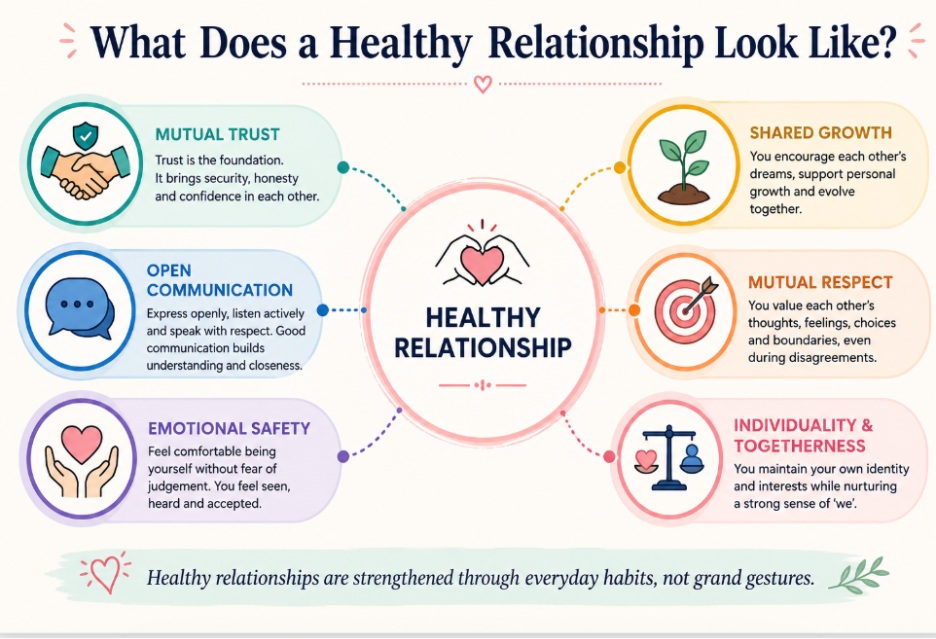
The Core Building Blocks of a Healthy Relationship
Healthy relationships rarely thrive by chance. While every couple's journey is unique, research and clinical experience suggest that strong relationships are built on a set of skills and habits that can be nurtured over time.
At 1to1help, we often think of these as three interconnected building blocks: cohesion, flexibility, and communication. Together, they create the foundation for trust, emotional security, and resilience, helping couples navigate both joyful moments and life's inevitable challenges.
Cohesion: Creating a Strong Sense of "We"
At the heart of every healthy relationship is cohesion, or the feeling of being a team. It is the sense that, despite individual differences, both partners are committed to building a shared life together.
Cohesion does not mean spending every waking moment together or agreeing on everything. Healthy couples usually maintain their own interests, friendships and ambitions while also investing in their relationship. In family systems theory, this balance is often referred to as differentiation, which means being able to stay connected to your partner while also maintaining a sense of identity, independence, and personal boundaries. It allows each person to remain true to themselves without becoming emotionally distant or overly dependent on their partner.
One of the simplest ways to strengthen cohesion is through shared experiences. They do not have to be expensive or elaborate. What often matters more is the quality of attention you give each other.
This could include:
- Eating dinner together without distractions
- Going for an evening walk
- Trying a new hobby or recipe together
- Travelling or exploring a new neighbourhood
- Exercising as a couple
- Creating small traditions, such as Sunday breakfasts or monthly date nights
These seemingly ordinary moments create memories, inside jokes and rituals that strengthen a couple's sense of connection.
For many couples today, however, cohesion can quietly erode. Long working hours, caregiving responsibilities, demanding commutes, and constant digital distractions often leave little room for meaningful interaction. It is possible to spend hours in the same room while barely connecting emotionally.
Rather than waiting for a weekend getaway or anniversary celebration, small daily rituals can make a meaningful difference. A ten-minute conversation before bed, a shared morning cup of tea, or simply asking, "How are you really feeling today?" can help partners stay emotionally connected even during busy periods.
Healthy relationships also thrive when both partners have a strong sense of self. Investing in building self-confidence in relationships can help reduce insecurity, encourage healthier boundaries, and support deeper emotional intimacy. When both individuals feel secure in who they are, it often becomes easier to contribute positively to the relationship without relying solely on a partner for validation.
Flexibility: Growing Together Through Change
No relationship remains exactly the same over time. Careers evolve, families expand, health changes, financial circumstances shift, and unexpected life events can alter priorities. One of the qualities of a good relationship is the ability to adapt together rather than becoming stuck in rigid expectations.
Flexibility means responding to change with openness and teamwork. It is not about giving up your values or compromising your identity. Instead, it involves recognising that what worked at one stage of life may need to evolve in another.
Flexibility often shows up in three important ways.
- Role Flexibility
Responsibilities within a relationship naturally shift over time.
One partner may temporarily take on more household responsibilities while the other prepares for an important examination, manages a demanding project at work or recovers from an illness. Parenthood, caring for ageing parents or relocating to a new city may also require couples to renegotiate expectations.
Rather than keeping score, healthy couples often ask, "What does our relationship need from each of us right now?"
- Cognitive Flexibility
During disagreements, it is easy to assume our own perspective is the only valid one.
Cognitive flexibility involves pausing long enough to stay curious about how your partner may be experiencing a situation, rather than immediately assuming you know what they think or feel. You can try to understand their perspective without having to agree with it, excuse hurtful behaviour or abandon your own point of view. This curiosity can create more space for constructive conversations.
- Emotional Flexibility
Many people develop automatic emotional responses based on past experiences. Some withdraw when conflict arises, while others may become defensive or seek immediate reassurance. These responses can be understandable attempts to cope with emotional activation, while still recognising that they may not always be helpful
Emotional flexibility means learning to recognise these patterns and responding more intentionally rather than reacting impulsively.
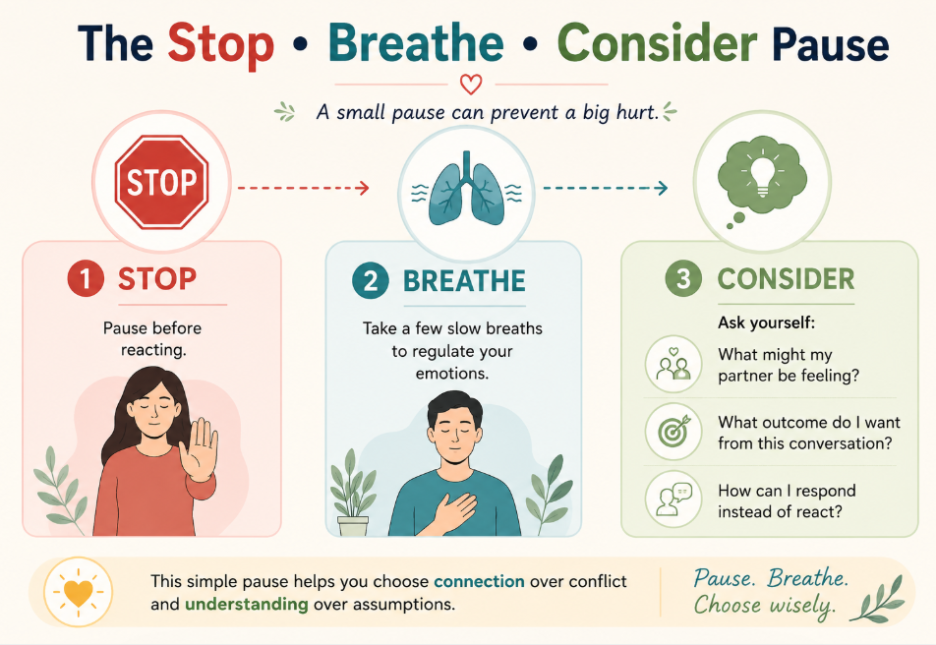
One practical strategy is the Stop, Breathe, Consider technique:
- Stop before reacting.
- Breathe to calm your body's stress response.
- Consider your partner's perspective before responding.
This short pause can often prevent a difficult conversation from escalating unnecessarily.
For many Indian couples, flexibility can also involve navigating changing gender roles, joint family dynamics, financial pressures and cultural expectations. There is rarely one right way to balance these influences. What often matters is that both partners feel heard and work together to find solutions that respect their shared values.
Note: Taking a pause works best when couples agree to return to the conversation rather than using the pause to avoid the issue.
Communication in a Relationship: The Bridge That Connects Everything
If cohesion creates connection and flexibility helps relationships adapt, communication in a relationship is what keeps both alive.
Communication is far more than talking. It is about helping your partner feel understood, respected, and emotionally safe. This also means learning to distinguish between stonewalling and taking a healthy pause. Stepping away from a difficult conversation to regulate is not necessarily stonewalling, provided the person communicates that they need a break and intends to return to the conversation. Stonewalling, by contrast, involves shutting down or withdrawing without creating a path back to the conversation.
Many people grow up without seeing healthy communication modelled at home, so it is entirely normal for this to be a skill that develops over time.
Healthy communication involves several interconnected dimensions.
- Everyday Conversations Matter
Strong relationships are built through everyday interactions, not only serious discussions.
Checking in after work, sharing something that made you laugh, or talking about your hopes for the weekend helps partners stay connected even during busy periods.
- Conflict Can Sometimes Strengthen Relationships
Disagreements are a normal part of any close relationship. What often matters is how they are handled.
Psychologist Dr John Gottman's research has identified four communication patterns that are strongly associated with relationship distress. He calls them the Four Horsemen:
- Criticism: Attacking your partner's character instead of discussing a specific behaviour.
- Contempt: Eye rolling, sarcasm, ridicule or speaking with disrespect.
- Defensiveness: Focusing on self-protection rather than listening.
- Stonewalling: Emotionally withdrawing or refusing to engage.
The healthier alternative is to address concerns respectfully, take responsibility where appropriate and return to difficult conversations once both partners feel calmer.
- Emotional Vulnerability Builds Intimacy
Trust in a relationship often grows when partners feel able to express difficult emotions without fear of being criticised or dismissed. Over time, this willingness to be open and respond with understanding can foster emotional intimacy, helping partners feel more deeply known, accepted and connected.
Saying, "I've been feeling overwhelmed lately," or "I need some reassurance today," can create opportunities for deeper emotional connection.
- Listening Is Just as Important as Speaking
Many people listen with the intention of replying rather than understanding.
One helpful technique is reflective listening.
Instead of immediately offering advice, try saying: "What I hear you saying is that you've been feeling unsupported this week. Have I understood you correctly?"
Following this with validation such as,
"That makes sense. I can understand why you would feel that way," can help partners feel genuinely heard, even when opinions differ.
- Digital Communication Needs Boundaries Too
Much of modern communication now happens through text messages, WhatsApp, and social media. While technology helps couples stay connected, misunderstandings can arise when tone is misinterpreted, or phones become a constant distraction.
Setting simple expectations around screen-free meals, uninterrupted conversations or avoiding important discussions over text may help create more meaningful face-to-face interactions.
💡Key Takeaway: Healthy communication is not about saying the perfect thing. It is about creating an environment where both partners feel safe enough to speak honestly and compassionate enough to listen openly.
Additional Pillars of a Great Relationship
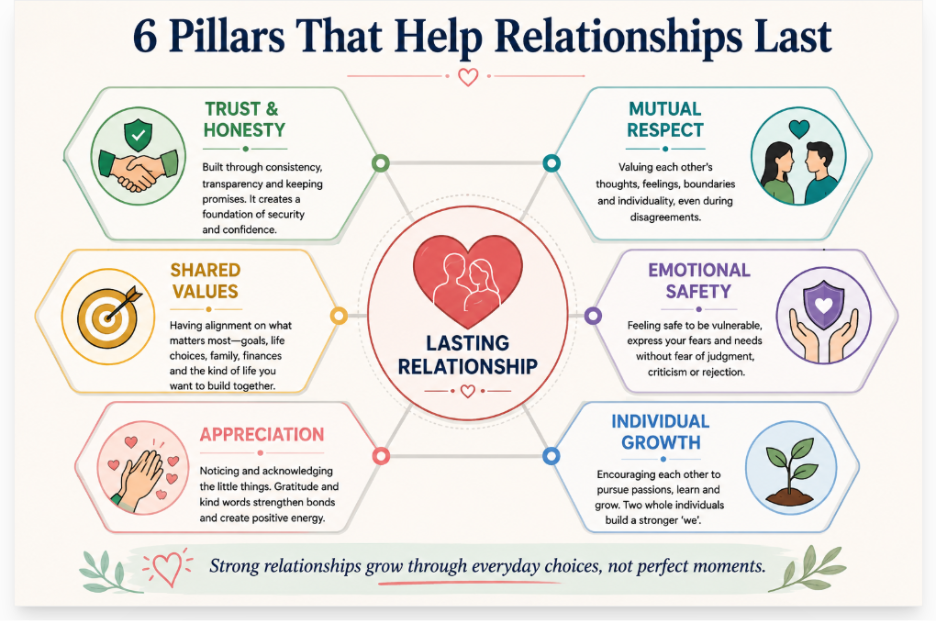
While cohesion, flexibility, and communication provide a strong foundation, lasting relationships are also shaped by several other qualities that influence how partners connect, grow, and navigate life's challenges together. These qualities often develop gradually through everyday interactions rather than dramatic gestures, and together they help answer an important question many couples ask: what makes a relationship work over the long term?
Trust and Honesty: The Foundation Beneath Everything
Trust is one of the most important qualities of a good relationship. It develops through consistency rather than promises alone. Keeping commitments, being honest about mistakes, and showing up for one another during both ordinary and difficult moments all contribute to building trust over time.
Trust does not mean never experiencing doubt or disappointment. Instead, it means believing that your partner will generally act with honesty, care and respect, even when disagreements arise.
When trust is broken, rebuilding it often takes patience and consistent effort from both partners. Open conversations, accountability and a willingness to acknowledge hurt can gradually help restore emotional safety. In some situations, professional relationship counselling may also provide valuable support during this process.
Mutual Respect: Valuing Each Other as Equals
Love and respect often go hand in hand, but they are not the same. Respect means valuing your partner's opinions, boundaries, aspirations, and individuality, even when you do not always agree.
Respect is often reflected in small, everyday behaviours:
- Listening without interrupting
- Speaking kindly during disagreements
- Respecting personal boundaries and privacy
- Supporting differences instead of trying to change them
- Avoiding sarcasm, ridicule or belittling remarks
On the other hand, repeated criticism, dismissiveness, or public humiliation can slowly weaken emotional connection. Even subtle behaviours such as eye rolling or mocking a partner's feelings may create distance over time if they become habitual.
Shared Values and Common Goals
Couples do not need identical personalities or interests to build a fulfilling relationship. In fact, differences can add richness and new perspectives. What often matters more is having enough alignment on the values that shape everyday life.
These conversations may include:
- Financial priorities
- Career aspirations
- Parenting approaches
- Relationships with extended family
- Lifestyle preferences
- Long-term goals
For many couples in India, navigating expectations around careers, caregiving responsibilities and family involvement can be particularly important. Discussing these topics openly before they become sources of conflict may help both partners make decisions that reflect their shared priorities.
Emotional Safety: Feeling Safe to Be Yourself
A healthy relationship creates space for vulnerability. Emotional safety means feeling able to express fears, disappointments, hopes and needs without worrying that they will be dismissed, ridiculed or used against you later. It also means being able to say “no”, set boundaries and disagree without fear of punishment, intimidation or retaliation.
When emotional safety is present, partners are often more willing to apologise, ask for support and have difficult conversations honestly.
Creating this environment does not require always saying the perfect thing. More often, it involves responding with curiosity rather than judgement and making an effort to understand before offering solutions.
Developing emotional safety also begins with recognising and expressing emotions effectively. If you find it difficult to put your feelings into words, our guide to understanding your emotions in a relationship offers practical strategies to help you communicate with greater clarity and empathy.
Appreciation and Individual Growth
One of the simplest ways to strengthen a relationship is to notice what is going well.
Research from the Gottman Institute suggests that stable, happy couples tend to experience many more positive interactions than negative ones. Small expressions of appreciation, such as thanking your partner for preparing dinner, recognising their effort after a busy day or acknowledging a thoughtful gesture, can reinforce emotional connection over time.
Equally important is supporting each other's personal growth. Healthy relationships encourage both partners to pursue their interests, friendships, careers and aspirations while continuing to invest in the relationship. This balance allows couples to build a strong sense of "we" without losing their individual identities.
As people grow and evolve, relationships often benefit when both partners continue learning about themselves and each other.
💡Key Takeaway: Lasting relationships are rarely sustained by love alone. Trust, respect, shared values, emotional safety, appreciation, and personal growth often work together to create a partnership where both individuals and the relationship can flourish.
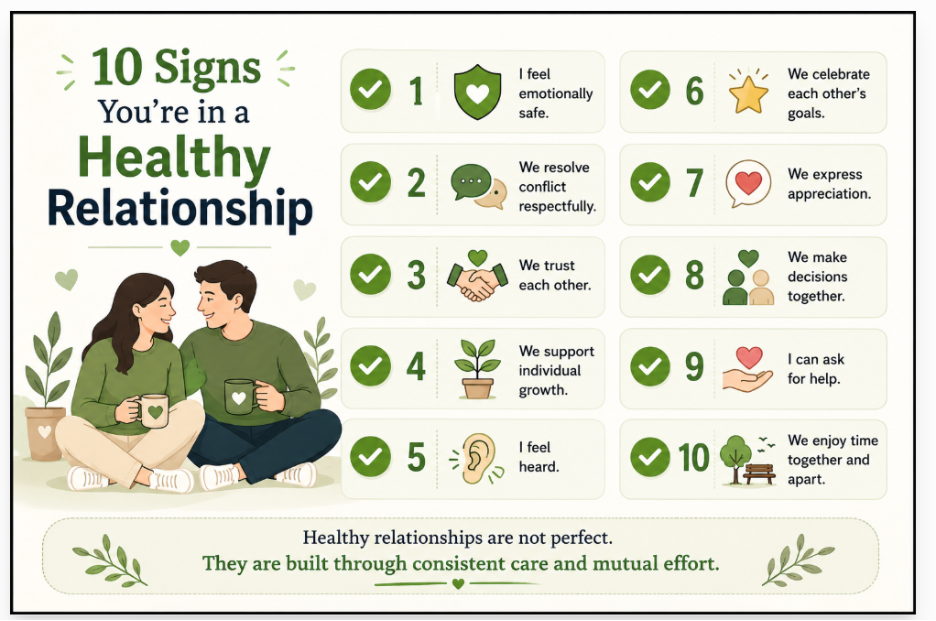
10 Signs of a Healthy Relationship
Wondering whether your relationship is on the right track? There is no perfect checklist that every couple will meet all the time. Relationships naturally go through different seasons, and occasional disagreements or periods of stress are entirely normal. However, there are certain signs of a healthy relationship that often indicate a strong and supportive partnership.
1. You Feel Emotionally Safe
You feel comfortable sharing your thoughts, feelings and concerns without worrying about being judged, ridiculed or ignored. Even during disagreements, there is a sense of psychological safety that allows both partners to be authentic.
2. Conflict Is Constructive, Not Destructive
Healthy couples disagree too. The difference is that they focus on resolving the issue rather than attacking each other personally. Difficult conversations are approached with respect, curiosity, and a willingness to repair misunderstandings.
3. Trust Is Built on Consistency
You trust each other without feeling the need to constantly check phones, monitor whereabouts, or seek repeated reassurance. Trust develops through honesty, reliability and following through on commitments.
4. You Support Each Other's Individuality
A healthy relationship creates room for both partners to maintain friendships, hobbies, careers and personal goals. Growing together does not mean losing your individual identity.
5. You Feel Heard and Understood
Your partner listens to understand rather than simply waiting to respond. Even when opinions differ, both people make an effort to acknowledge each other's experiences and emotions.
6. You Encourage Each Other's Growth
Whether it is pursuing a new career opportunity, learning a skill or prioritising wellbeing, healthy partners celebrate each other's achievements and provide encouragement during setbacks.
7. Appreciation Is Expressed Regularly
Small expressions of gratitude, affection and encouragement help strengthen emotional connection. Feeling appreciated in everyday moments often matters more than occasional grand romantic gestures.
8. Decisions Are Made Together
Important decisions about finances, family, careers, or future plans are discussed openly. Both partners have a voice, even if compromises are sometimes needed.
9. You Can Ask for Help Without Fear
Everyone experiences moments of stress or vulnerability. In a healthy relationship, asking for emotional or practical support is generally met with compassion rather than criticism or dismissal.
If reaching out for support feels difficult, building a strong emotional support network can benefit both your relationship and your overall emotional well-being.
10. You Enjoy Spending Time Together and Apart
Healthy couples value quality time together while also respecting each other's need for personal space. Time apart is not automatically seen as a threat to the relationship but as an opportunity for both individuals to recharge and grow.
💡Remember: No relationship demonstrates all these signs every day. Relationships evolve over time, and challenging periods are a normal part of life. What often matters most is the willingness of both partners to keep showing up, communicating openly and working through difficulties together.
Healthy vs. Unhealthy Relationship Patterns
Every relationship experiences challenges from time to time. Disagreements, misunderstandings, and periods of emotional distance are part of being human. The difference often lies not in whether problems arise, but in how they are handled.
Understanding the difference between a healthy vs. unhealthy relationship can help you recognise patterns that strengthen your connection, as well as those that may benefit from attention and support.
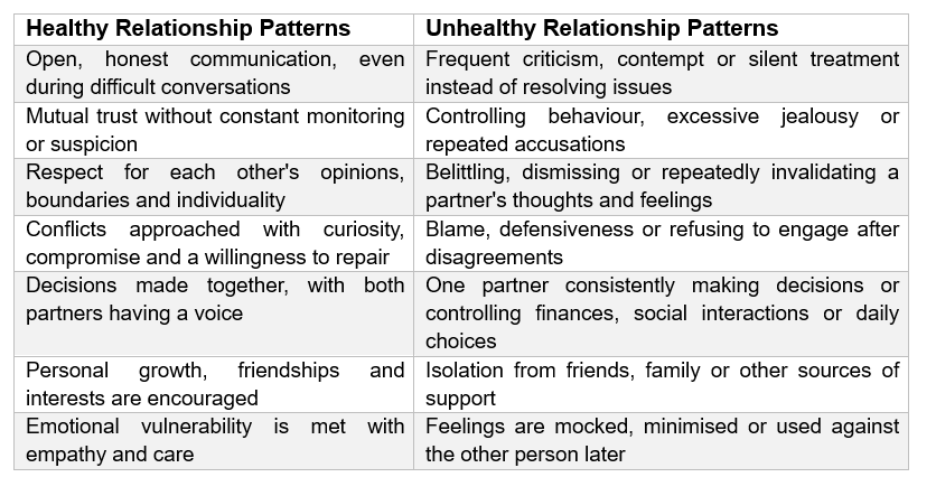
It is important to remember that relationships rarely fit neatly into one category. Many couples may recognise a few unhealthy patterns while also having several healthy ones. What matters is noticing these patterns early and making intentional efforts to strengthen healthier ways of relating.
In India, certain behaviours such as possessiveness being described as "proof of love", the silent treatment being dismissed as "normal after a fight", or excessive financial control being framed as protection may sometimes become normalised. While cultural values and family dynamics differ across households, it can be helpful to reflect on whether these behaviours promote mutual respect, trust and emotional safety.
If unhealthy patterns continue despite repeated efforts to address them, seeking professional support can be a positive step rather than a sign of failure.
If you are looking for personalised guidance, relationship counselling at 1to1Online Counselling can help individuals and couples navigate relationship challenges with evidence-based support tailored to their unique circumstances.
Practical Tips to Strengthen Your Relationship
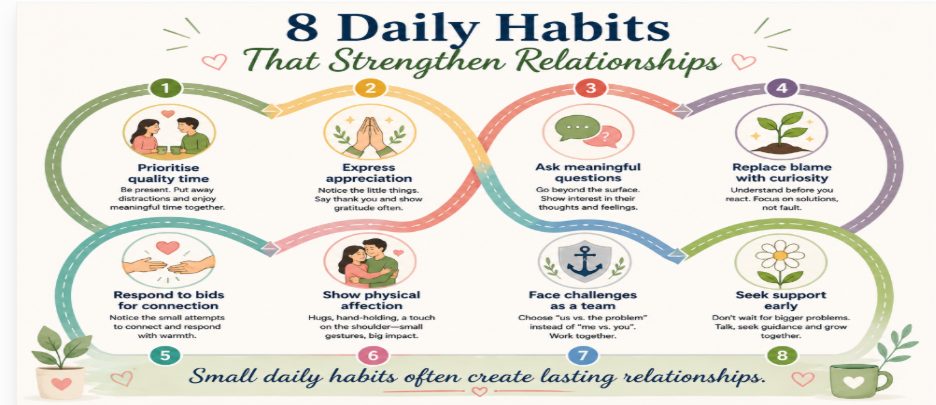
Knowing what makes a healthy relationship is only the first step. The real difference often lies in the small, consistent actions that couples take every day. If you're wondering how to improve your relationship, these practical, research-backed strategies can help strengthen connection over time.
Tip 1: Make Quality Time a Priority
Spending time together does not have to involve expensive holidays or elaborate date nights. A walk after dinner, cooking a meal together, or simply having tea without phones can create opportunities to reconnect.
What often matters most is giving each other your full attention, even if only for a few minutes each day.
Tip 2: Express Appreciation More Often Than Criticism
It is easy to notice what your partner forgot to do, but healthy relationships also make space for recognising what is going well.
Research from the Gottman Institute suggests that stable relationships tend to have many more positive interactions than negative ones. Looking for opportunities to say "thank you", acknowledge effort, or express affection can help reinforce emotional connection over time.
Tip 3: Ask Questions That Build Connection
Many conversations become limited to daily logistics.
Instead of only asking, "How was your day?", try questions such as:
- What made you smile today?
- Is there anything that's been on your mind lately?
- How can I support you this week?
These questions often encourage deeper conversations and help partners stay emotionally connected.
Tip 4: Replace Blame with Curiosity
During disagreements, the words we choose can either build understanding or create distance.
Instead of saying, "You never listen to me."
try,
"I feel unheard when our conversations end abruptly because I need us both to understand each other."
This approach, inspired by Nonviolent Communication (NVC), focuses on expressing feelings and needs rather than assigning blame, making constructive conversations more likely.
Tip 5: Notice and Respond to Bids for Connection
Relationship researcher Dr John Gottman describes bids for connection as the small moments when one partner reaches out for attention, affection, or conversation.
A comment about your day, sharing a funny video, or asking for a hug may all be bids for connection.
Responding warmly to these moments, even briefly, helps build trust and emotional closeness. Repeatedly ignoring or dismissing them can gradually create emotional distance.
Tip 6: Don't Underestimate the Power of Physical Affection
Affection does not always have to be grand or intensely romantic. Holding hands during a walk, a reassuring hug after a difficult day, or sitting close while watching a film can all help reinforce feelings of comfort and connection.
The key is ensuring that affection is welcomed and comfortable for both partners.
Tip 7: Face Challenges as a Team
Rather than seeing each other as the problem, try framing difficult situations as "us versus the problem." This shift in perspective often encourages collaboration instead of blame, particularly during stressful periods.
For many Indian couples, balancing career aspirations alongside family responsibilities may require ongoing conversations and shared problem-solving.
Tip 8: Seek Support Before Problems Feel Overwhelming
Many people believe counselling should only be considered when a relationship is close to breaking down. In reality, professional support can also be valuable for improving communication, rebuilding trust or navigating life transitions before difficulties become deeply entrenched.
If you're exploring healthy relationship tips for couples in India, or recurring challenges continue despite your efforts, 1to1Online Counselling offers confidential, evidence-based support for individuals and couples.
Conclusion
Remember Aditi and Rohan from the beginning of this article?
Their relationship did not change overnight, and neither did it improve overnight. Like many couples, they discovered that lasting love was not about avoiding disagreements or finding the perfect formula. It was about making small, intentional choices every day to listen, appreciate, adapt and reconnect.
The same is true for most healthy relationships. They are not built through grand romantic gestures, but through everyday moments of trust, respect, communication and care.
If your relationship feels strong, these habits can help it grow even stronger. If it feels strained, know that seeking support is not a sign of failure. It is often the first step towards understanding each other better and building a healthier future together.
Need Support?
Whether you're looking to strengthen your relationship, navigate a challenging phase or improve communication, you don't have to do it alone.
1to1help's Online Counselling offers confidential, evidence-based support from experienced mental health professionals, helping individuals and couples build healthier, more fulfilling relationships.
For organisations, 1to1help's Employee Assistance Programme (EAP) provides employees and their families with access to professional counselling and wellbeing services, recognising that healthy relationships contribute to healthier lives, both at home and at work.
FAQs
Q1. What are the most important elements of a healthy relationship?
The most important elements of a healthy relationship include trust, open communication, mutual respect, emotional safety and shared commitment. Together, these qualities help couples navigate challenges, resolve conflicts constructively and grow together over time.
Q2. How can I tell if my relationship is healthy or unhealthy?
A healthy relationship is one where you feel respected, heard, and emotionally safe. While disagreements are normal, they are handled with honesty and mutual respect. In contrast, repeated criticism, controlling behaviour, fear, disrespect or emotional withdrawal may indicate unhealthy relationship patterns.
Q3. What is the single most important quality in a lasting relationship?
There is no single quality that guarantees a successful relationship. Healthy, lasting relationships are usually shaped by several qualities working together, including trust, respect, emotional safety, open communication, and mutual commitment. These qualities develop over time through honesty, consistency, consideration for each other's needs, and a willingness to work through challenges together.
Q4. How do I build trust in a relationship?
Trust grows through consistent actions rather than promises. Being honest, following through on commitments, taking responsibility for mistakes and communicating openly can all help strengthen trust. If trust has been damaged, rebuilding it often requires patience, accountability and time.
Q5. Can a relationship be saved after a major conflict or betrayal?
In many cases, yes. While rebuilding a relationship after a serious conflict or betrayal can be challenging, it is possible when both partners are willing to take responsibility, communicate honestly and work towards repairing trust. Professional relationship counselling may also help guide the healing process.
Q6. How can my partner and I communicate better during disagreements?
Focus on understanding rather than winning the argument. Use "I" statements instead of blame, listen actively, validate each other's feelings and take a pause if emotions become overwhelming. Returning to the conversation calmly often leads to more productive outcomes.
Q7. When should couples consider seeking professional relationship counselling?
Couples do not need to wait until a relationship is in crisis. Counselling can be helpful when communication becomes difficult, trust has been affected, conflicts keep repeating or major life transitions create stress. Professional support may help couples address concerns earlier, but there is no guarantee that counselling will prevent problems from becoming more serious.
References
- American Psychological Association. (n.d.). Healthy relationships. https://www.apa.org/topics/relationships
- Ackerman, C. E. (2023). Nonviolent communication: A guide to compassionate communication. PositivePsychology.com. https://positivepsychology.com/non-violent-communication/
- Gottman, J. M., & Silver, N. (2015). The seven principles for making marriage work (Revised ed.). Harmony Books.
- The Gottman Institute. (n.d.). The Four Horsemen: Recognizing criticism, contempt, defensiveness, and stonewalling. https://www.gottman.com/blog/the-four-horsemen-recognizing-criticism-contempt-defensiveness-and-stonewalling/
- The Gottman Institute. (n.d.). The magic ratio: The key to relationship satisfaction. https://www.gottman.com/blog/the-magic-ratio-the-key-to-relationship-satisfaction/
- The Gottman Institute. (n.d.). Turning against bids: The ultimate relationship killer. https://www.gottman.com/blog/turning-against-bids-the-ultimate-relationship-killer/
- The Gottman Institute. (n.d.). What to look for in a long-term partner. https://www.gottman.com/blog/what-to-look-for-in-a-long-term-partner/
- Miller, S. (2022, August 2). 8 elements of a healthy relationship. Psychology Today. https://www.psychologytoday.com/us/blog/invisible-bruises/202208/8-elements-of-a-healthy-relationship
- WebMD Editorial Contributors. (n.d.). Healthy vs. unhealthy relationships. WebMD. https://www.webmd.com/sex-relationships/healthy-vs-unhealthy-relationships


.svg)
.svg)
.svg)
.svg)