


.png)


.png)

Personal Growth & Wellbeing
The Truth About Goal Setting and Motivation: Why Your Drive Fades and How to Build It Again

.png)
Written by
Aarohi Parakh,
Psychologist and Content Writer

Reviewed by
Sanjana Sivaram,
Psychologist and Clinical Content Head


Introduction
The problem isn't that you don't set goals. It's that motivation that disappears about two weeks after you do.
Perhaps you've experienced it yourself. You start a new fitness routine, commit to learning a skill, or decide this will finally be the year you improve your work-life balance. The first few days feel exciting. Progress comes easily. Then life gets busy, your enthusiasm fades, and gradually the goal slips into the background.
If this sounds familiar, you're far from alone. Research consistently shows that motivation naturally fluctuates over time. While some aspects of motivation reflect relatively stable personality traits, your day-to-day motivation can vary. It is influenced by your environment, emotional capacity, mental wellbeing, and the meaning you attach to your goals.
This guide takes a different approach. Rather than offering another checklist for setting SMART goals, it explores the psychology behind why motivation rises, why it falls, and what actually helps people stay committed over the long term. Whether you're setting a new goal or trying to reconnect with one you've left behind, you'll find practical, evidence-based strategies to help you move forward with greater consistency and self-compassion.
What Goal Setting and Motivation Actually Mean
Most people use goal setting and motivation interchangeably, but they are not the same thing.
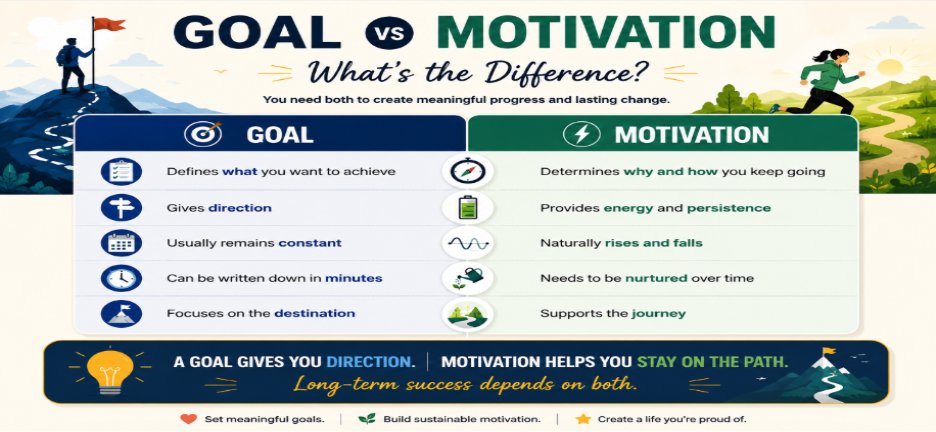
Goal setting is the process of deciding what you want to achieve. Motivation is the psychological drive that helps you take action towards that goal. One gives you direction, while the other provides the energy to keep moving. Goal-setting theory explains that clear, specific goals improve performance by providing direction and focus.
Think of it this way. A goal is your destination, but motivation is the fuel that powers the journey. You need both to make meaningful progress.
Many people believe they lack motivation because they struggle to stay consistent. In reality, the problem often lies elsewhere. They may have set a goal that does not genuinely matter to them, underestimated the effort required, or relied solely on willpower rather than creating systems that support long-term success.
Understanding this distinction is the first step towards setting goals that are not only ambitious but also sustainable.
The Motivation Myth: It's Not a Personality Trait
Have you ever looked at someone who exercises regularly, learns new skills, or consistently achieves their goals and thought, They're just naturally motivated?
Psychology suggests otherwise.
Motivation is not something people either possess or lack. It is a dynamic psychological state that changes over time. Your motivation is influenced by factors such as your physical and emotional wellbeing, stress levels, environment, relationships, sense of purpose, and even the amount of sleep you've had.
Rather than being driven by willpower alone, your motivation is closely tied to your current capacity. When people are emotionally exhausted, overwhelmed by competing demands, or experiencing burnout, their capacity to take action decreases, even if they genuinely care about their goals.
In other words, struggling to stay motivated does not mean you are lazy or undisciplined. It may simply mean your mind and body are asking for more support than pressure.
This shift in perspective can be incredibly liberating. Instead of asking, "Why can't I stay motivated?" ask yourself:
"What is reducing my capacity to follow through right now?"
Why Goals Without the Right Motivation Collapse
Setting a goal is relatively easy. Staying committed when the excitement fades is where the real challenge begins.
Many goals are built around outcomes. Getting promoted. Losing weight. Saving more money. Finishing a professional certification. While these are worthwhile aspirations, they often depend on external rewards. Once the initial excitement wears off or progress slows, the brain begins to question whether the effort is worth it.
This is why so many well-intentioned goals lose momentum after a few weeks. The destination remains the same, but the fuel begins to run out. Sustainable goal setting and motivation require more than enthusiasm. They require a deeper connection between the goal and what truly matters to you.
For example, compare these two goals:
- Goal A: "I want to exercise because I need to lose weight."
- Goal B: "I want to exercise because I want the energy to play with my children, manage stress better, and stay healthy as I grow older."
Both involve the same behaviour, but the second is rooted in personal meaning rather than external expectations. Research based on Self-Determination Theory shows that goals connected to personal values are far more likely to be sustained over time because they satisfy our psychological need for autonomy, competence and relatedness.
The good news is that motivation is not something you have to wait for. It is something you can cultivate by understanding how your brain works, designing supportive habits, and choosing goals that reflect your values rather than someone else's expectations.
The next section explores exactly what separates lasting motivation from motivation that disappears after the initial excitement wears off.
The Motivation That Lasts vs. The Motivation That Fades
If you've ever wondered why some goals become lifelong habits while others disappear after a few weeks, the answer often lies in why you're pursuing them in the first place.
One of the most influential psychological frameworks for understanding goal setting and motivation is Self-Determination Theory (SDT), developed by psychologists Edward Deci and Richard Ryan. According to the theory, the quality of your motivation matters just as much as the quantity. In simple terms, not all motivation is created equal.
Some motivation comes from within because the goal feels meaningful and aligned with who you are. Other motivation comes from external pressures such as deadlines, rewards, praise, or the fear of disappointing others.
While both types can help you take action, only one is likely to sustain your efforts over the long term. SDT also recognises that external motivation exists on a spectrum. Some externally driven goals can become deeply internalised when they align with personal values and identity.
Intrinsic Motivation: When the Goal Matters to You
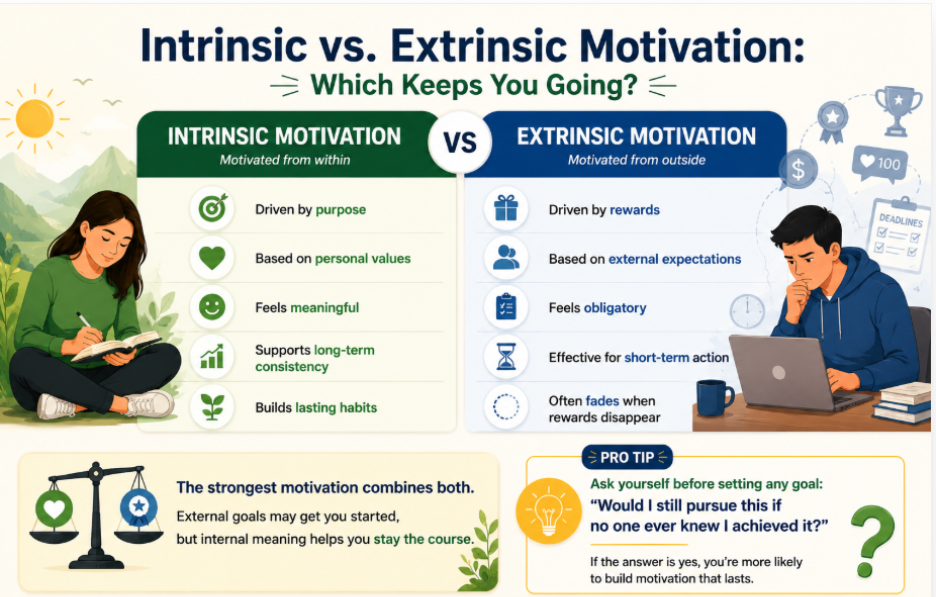
Intrinsic motivation is the desire to do something because it is personally rewarding.
You pursue the goal because you enjoy the process, value the outcome, or believe it contributes to your growth. The satisfaction comes from the activity itself rather than from external recognition.
For example:
- Reading because you're genuinely curious about a subject.
- Exercising because it helps you feel healthier and more energised.
- Learning a new skill because it challenges and excites you.
- Saving money because financial security gives you peace of mind.
When goals are driven by curiosity, purpose, or personal values, they are more likely to survive setbacks. Even if progress is slow, the goal continues to feel worthwhile because the motivation comes from within.
Research on Self-Determination Theory has consistently found that intrinsic motivation is associated with greater persistence, improved wellbeing, and higher long-term achievement.
Extrinsic Motivation: Helpful, But Often Short-Lived
Extrinsic motivation comes from outside the individual.
You act because of a reward, a consequence, or the expectations of others. There is nothing inherently wrong with this. In fact, external motivation can be highly effective when you need an immediate push or are working towards a clear deadline.
Examples include:
- Studying to pass an examination.
- Working late to earn a bonus.
- Exercising before a holiday to look fitter.
- Completing a project to gain recognition from your manager.
The challenge is that once the reward disappears, motivation often fades with it.
This is one reason why many ambitious goals lose momentum. The goal may have been exciting at first, but if it is driven primarily by external validation, it becomes difficult to sustain when life gets busy or obstacles arise.
Why Most New Year's Resolutions Don't Last
Every January, millions of people set ambitious goals with the best intentions.
They promise to lose weight, earn more money, exercise every day, or become more productive. Yet by February, many of these resolutions have already been abandoned.
The problem is rarely a lack of discipline. More often, these goals are framed around external outcomes rather than personal meaning.
Consider the difference:
- "I want to lose weight so people think I look better."
- "I want to improve my health so I have more energy for the people and activities I love."
The behaviour may be identical, but the emotional foundation is completely different. When a goal reflects your personal values and supports the life you want to build, it becomes easier to stay committed even when motivation naturally fluctuates.
One Question That Can Transform Your Goals
Before committing to any new goal, pause and ask yourself one simple question:
Would I still pursue this if no one ever knew I achieved it?
It's a powerful filter. If your answer is yes, there's a good chance your goal is connected to something meaningful.
If your answer is no, it doesn't necessarily mean the goal is wrong. It simply suggests that external rewards may be doing most of the motivational work.
The more your goals reflect your own values rather than other people's expectations, the more resilient your motivation is likely to become.
From External Pressure to Personal Purpose
Many real-world goals begin with an external reason, and that's perfectly normal. A promotion, a salary increase, or positive feedback from others can all be healthy motivators.
The key is to connect those external outcomes with an internal reason that genuinely matters to you.
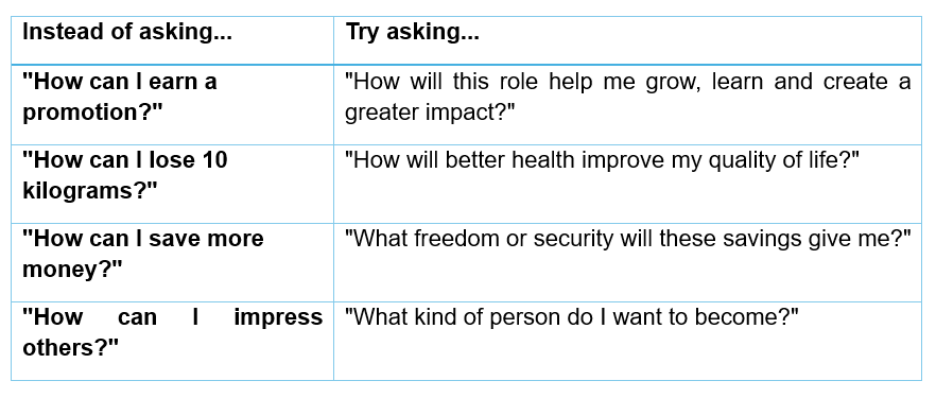
This subtle shift doesn't change the goal. It changes your relationship with it. When external success is supported by personal meaning, motivation becomes more resilient because you're no longer relying solely on rewards to keep going.
As you'll see in the next section, even meaningful goals experience periods where motivation drops. Understanding why this happens is essential because losing motivation is not a sign that you've chosen the wrong goal. It's often a completely normal part of how the brain responds to progress and effort.
- Recommended Reading: Team Motivation: Definition, Proven Strategies & Insights for Indian Workplaces
Why Motivation Crashes After You Set the Goal
One of the biggest misconceptions about goal setting and motivation is that motivation should stay high until the goal is achieved. In reality, motivation naturally rises and falls, and that isn't a sign of failure.
When you set a new goal, it feels exciting because your brain releases dopamine, a neurotransmitter associated with anticipation and reward. As the novelty wears off and the reward becomes routine, the excitement fades. This shift is completely normal, but many people mistake it for a lack of discipline.
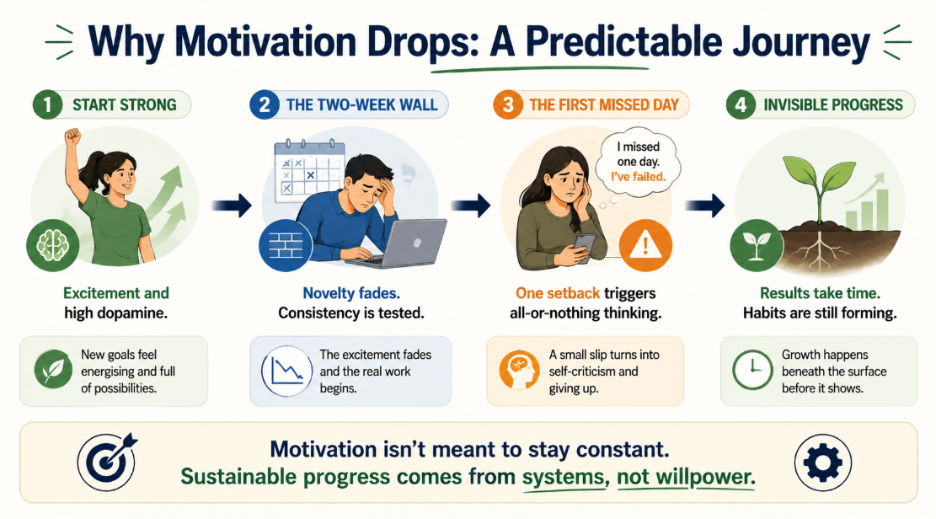
Here are three common stages where motivation tends to dip.
The Two-Week Wall
The first few days of a new goal feel exciting because everything is new. After a couple of weeks, however, the work feels harder, and progress seems slower. This is often the point where enthusiasm fades and consistency becomes more important than motivation.
The First Missed Day
Missing one workout, one study session, or one healthy meal won't derail your progress. What often does is all-or-nothing thinking. Believing that one setback means you've failed can quickly turn a temporary lapse into giving up altogether.
The Invisible Progress Problem
Meaningful change often happens before you can see it. Whether you're building healthier habits or developing a new skill, results may take time to become visible. Without immediate rewards, the brain may begin to deprioritise the goal, making it harder to stay motivated.
This is why relying on willpower alone rarely works. Willpower is affected by stress, fatigue, decision overload, and emotional strain, which can make self-control feel harder on some days than others.
The solution is not to wait for motivation to return. It's to build systems that help you take action even when motivation is low. That's where effective goal setting and motivation come together.
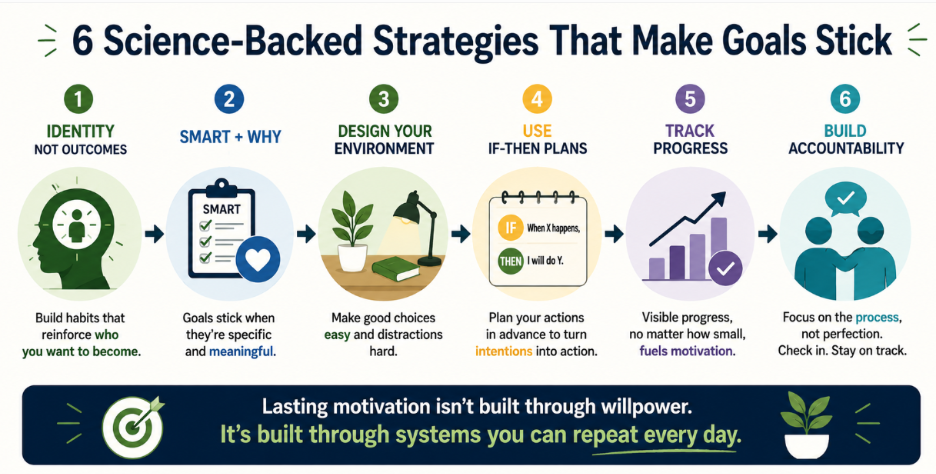
6 Strategies for Sustainable Goal Setting and Motivation
Motivation may get you started, but systems are what keep you going. The good news is that sustainable goal setting and motivation aren't about becoming more disciplined. They're about making it easier to take consistent action, even on days when motivation is low.
1. Start with Identity, Not Outcomes
Goals focused only on outcomes often lose their appeal once progress slows. Instead, focus on the kind of person you want to become.
Rather than saying, "I want to run a 5K," tell yourself, "I'm someone who moves my body regularly." Every workout then becomes evidence of your identity, not just a step towards a finish line.
Example: Instead of aiming to "read 20 books this year", become "someone who reads every day."
Try this: Complete the sentence: "I want to become someone who..." Then choose one small action that reinforces that identity today.
Note: It can help to hold identity lightly by using it as a resource for direction rather than a rigid label, so that occasional setbacks do not turn into self-criticism.
2. Set the Right Kind of Goals, Not Just SMART Goals
SMART goals help make your objectives specific and measurable, but they don't explain why the goal matters. That's where many people lose motivation.
Try the SMART + Why approach. Along with defining what you want to achieve, identify the personal value behind it.
Example: "I want to complete a professional certification by September because it will help me grow in my career and feel more confident in my abilities."
A meaningful goal is far easier to stick with than one driven only by external rewards.
Try this: Write your goal in one sentence, then add a second sentence beginning with "This matters to me because..."
3. Design Your Environment, Not Just Your Willpower
Your environment shapes your behaviour more than you realise. If healthy choices are difficult and distractions are easy, motivation has to work much harder.
Reduce friction by making the desired behaviour the easiest option.
Example: Want to exercise in the morning? Lay out your workout clothes the night before. Trying to reduce screen time? Keep your phone out of reach while working. Hoping to spend more quality time with family? Schedule device-free dinners into your week.
Small environmental changes reduce the number of decisions you have to make, making consistency much easier.
Try this: Identify one obstacle that regularly gets in the way of your goal and remove it before tomorrow.
4. Use Implementation Intentions
One of the simplest ways to improve follow-through is to decide in advance when, where, and how you'll take action.
Psychologists call these implementation intentions, often framed as "When X happens, I will do Y."
Example: "When I finish my morning coffee, I will spend 15 minutes working on my certification course."
This simple plan removes uncertainty and makes it easier to turn intentions into action.
Try this: Create one "If-Then" statement for your goal today and place it somewhere you'll see it.
5. Make Your Progress Visible
Progress is one of the most powerful sources of motivation. According to researcher Teresa Amabile's Progress Principle, even small wins can increase motivation when they're recognised.
Waiting for major milestones can make goals feel distant. Instead, celebrate the small steps that show you're moving in the right direction.
Example: Use a habit tracker, tick off completed workouts on a calendar, or keep a journal of daily wins. Watching your streak grow can be surprisingly motivating.
Try this: Choose one simple way to track your progress and update it every day, even if the step feels small.
6. Build Accountability the Right Way
Telling someone about your goal can be motivating, but lasting accountability goes beyond making an announcement.
Instead of asking, "Did I achieve my goal?" ask, "Did I do the work that moves me closer to it?"
This is known as process accountability, and it keeps the focus on consistent effort rather than perfect outcomes.
Example: Rather than reporting how much weight you've lost, check in weekly with a friend about whether you completed your planned workouts.
Try this: Find an accountability partner and schedule a 10-minute weekly check-in focused on actions, not results.
None of these strategies is complicated on its own. Together, however, they create a system that supports sustainable goal setting and motivation, making it easier to keep moving forward even when motivation naturally fluctuates.
A Restart Protocol When You Fall Off Track
Falling off track isn't a sign that you've failed. It's one of the most predictable parts of pursuing any meaningful goal. What matters isn't whether you stumble, but how quickly you choose to restart.
1. Audit Without Judgement
Before giving up, ask yourself: What actually happened? Was the goal unrealistic? Was the timing difficult? Or did your system fail to support you?
Treat setbacks as feedback, not evidence that you're incapable.
2. Shrink Before You Quit
When motivation is low, reduce the goal instead of abandoning it. A smaller action keeps momentum alive.
Example: Instead of skipping your workout entirely, commit to a 10-minute walk. Instead of reading a chapter, read one page. Consistency matters more than intensity during difficult periods.
3. Recommit to Today
Avoid thinking about the next month or even the next week. Focus on today.
Ask yourself, "What's one action I can take today that moves me closer to my goal?" Small wins rebuild confidence and make it easier to regain momentum.
Finally, remember the "Never Miss Twice" principle. Missing one day is human. Missing two days can become a pattern. Aim to get back on track with your very next opportunity.
Every person who has achieved a meaningful goal has experienced setbacks. Success isn't about never stopping. It's about choosing to start again.
When Low Motivation Is a Signal, Not a Character Flaw
Sometimes, low motivation isn't about poor goal setting and motivation strategies. It's your mind and body signalling that something deeper needs attention.
If your lack of motivation is persistent and accompanied by any of the following, it may be worth looking beyond productivity techniques:
Signs It May Be More Than Low Motivation
- You feel constantly tired, even after adequate rest.
- Activities you once enjoyed no longer feel meaningful.
- Goals that once excited you now seem overwhelming or pointless.
- You find yourself caught in a cycle of self-blame for "not doing enough."
- You're functioning on the surface but feel emotionally drained or disconnected.
These experiences don't automatically mean something more serious is going on. However, persistent difficulties with motivation can sometimes be linked to conditions such as depression, anxiety, ADHD, executive functioning difficulties, burnout, or chronic stress overload.
If low motivation is affecting your work, relationships, or overall wellbeing, speaking to a trained mental health professional can make a meaningful difference. 1to1help's online counselling connects you with a qualified counsellor within 12 to 15 hours, offering confidential support in your preferred language, without the need to visit a clinic.
Sometimes, the most productive step you can take is asking for help.
How to Know Your Approach Is Working
Progress with goal setting and motivation is often invisible at first. Instead of focusing only on big milestones, look for these signs that you're building lasting change.
Green Flags You're on the Right Track
- The goal feels less effortful on some days than it did when you started.
- You recover from missed days more quickly instead of giving up.
- The goal is beginning to feel like part of your identity, not just another task on your to-do list.
- You find yourself making choices that support your goal without having to think about them.
- You feel a quiet sense of satisfaction from showing up consistently, even before you achieve the final outcome.
These are powerful indicators that your habits are becoming more automatic, and your motivation is becoming more sustainable.
Remember, motivation isn't something you either have or don't have. It's something you strengthen through small, repeated acts of showing up. Every action, no matter how small, reinforces the person you're becoming and brings you one step closer to your goal.
The biggest measure of success isn't perfection. It's your willingness to keep going.
Conclusion
The hardest part was never setting the goal. It was staying connected to its reason after the initial excitement faded.
The good news is that motivation isn't a personality trait. It's a skill that can be understood, strengthened, and rebuilt through meaningful goals, supportive systems, and consistent action. While some phases of life make pursuing goals genuinely harder, that isn't a sign of weakness. It's part of being human.
Whether you're trying to find motivation for the first time or rebuild it after a challenging period, you don't have to do it alone. For individuals, 1to1help's online counselling offers confidential support from qualified mental health professionals. For organisations, 1to1help's Employee Assistance Programme (EAP) helps employees build resilience, improve wellbeing, and stay engaged at work. Having supported over 11 million people across India, 1to1help is committed to helping individuals and workplaces thrive, one meaningful step at a time.
References
- American Psychological Association. (n.d.). Motivation. APA Dictionary of Psychology. https://dictionary.apa.org/motivation
- American Psychological Association. (2020). The science of willpower. https://www.apa.org/pubs/highlights/spotlight/issue-101
- Cleveland Clinic. (2022). What is dopamine? https://my.clevelandclinic.org/health/articles/22581-dopamine
- Clear, J. (2019). The science of delayed gratification. https://jamesclear.com/delayed-gratification
- Gollwitzer, P. M. (1999). Implementation intentions: Strong effects of simple plans. American Psychologist, 54(7), 493-503. https://www.researchgate.net/publication/232586066_Implementation_Intentions
- Harvard Business School. (2011). The progress principle. https://www.hbs.edu/faculty/Pages/item.aspx?num=40692
- Harvard Graduate School of Arts and Sciences. (2024). Be well: New Year's resolutions for lasting change. https://gsas.harvard.edu/news/be-well-new-years-resolutions-lasting-change
- Harvard Health Publishing. (2023). Why it's hard to change unhealthy behavior and why you should keep trying. https://www.health.harvard.edu/mind-and-mood/why-its-hard-to-change-unhealthy-behavior-and-why-you-should-keep-trying
- Locke, E. A., & Latham, G. P. (1990). A theory of goal setting and task performance. Prentice Hall.
- Ryan, R. M., & Deci, E. L. (2000). Self-determination theory and the facilitation of intrinsic motivation, social development, and well-being. American Psychologist, 55(1), 68-78. https://selfdeterminationtheory.org/SDT/documents/2000_RyanDeci_SDT.pdf
- Vohs, K. D., Baumeister, R. F., & Schmeichel, B. J. (2012). Motivation, personal beliefs, and limited resources all contribute to self-control. Journal of Experimental Social Psychology. https://pubmed.ncbi.nlm.nih.gov/23244747/


.svg)
.svg)
.svg)
.svg)