


.png)


.png)

Mental Health Concerns
Depression in Men: Signs, Symptoms & How to Get Help
.png)
Written by
Aarohi Parakh,
Psychologist and Content Writer

Reviewed by
Sanjana Sivaram,
Psychologist and Clinical Content Head


Introduction
Arjun is 38 years old. He runs a mid-sized business in Pune, has two children, and by most accounts, is holding everything together. But he is not sleeping well. He has started drinking more than he used to. His wife notices that he has become irritable in a new way: short-tempered over small things, present in the house but absent in every way that matters. When she asks if he is okay, he says he is just stressed with work.
He is not lying. He genuinely does not think of what he is experiencing as depression. Depression, in his understanding, means crying. It means being unable to get out of bed. It means something is broken. He goes to work every day. He is not broken.
He is also not fine.
This is one of the most important things to understand about the signs of depression in men: it frequently does not look the way people expect it to. In India, where cultural norms around masculinity run deep, the gap between what depression actually looks like in men and what men believe depression should look like is wide enough that millions of men go undiagnosed, sometimes for years.
This guide exists to address that gap.
Why Men Experience Depression Differently in India
Depression is the same clinical condition regardless of who it affects. The diagnosis, the underlying neurobiology, the treatability: none of this change. But the way depression is expressed, the way it is perceived, and the way it is responded to can differ significantly between men and women. In India, the cultural layer amplifies those differences.
From childhood, Indian men absorb a clear message: emotional distress belongs in private, if anywhere. "Mard ko dard nahi hota." Men don't feel pain. Strength is defined as stoicism; vulnerability as weakness. The result is that Indian men tend not to report sadness or emotional pain, even to themselves. Instead, they externalise. The distress comes out as irritability, as anger, as a need to stay busy, as reaching for a drink at the end of the day, as working until there is nothing left to feel.
The consequences of this are serious. According to NCRB data from 2023, Indian males account for 72.8% of all suicides in India, giving the country one of the widest gender suicide ratios in the world. Depression is one of the most significant underlying risk factors associated with many of these deaths.
Men searching for the signs of depression in men or symptoms of depression in men are doing something quietly important: they are reaching past the cultural conditioning to ask whether what they are experiencing has a name. That question deserves a clear, direct answer.
The Male Loneliness Epidemic: A Crisis No One Is Talking About
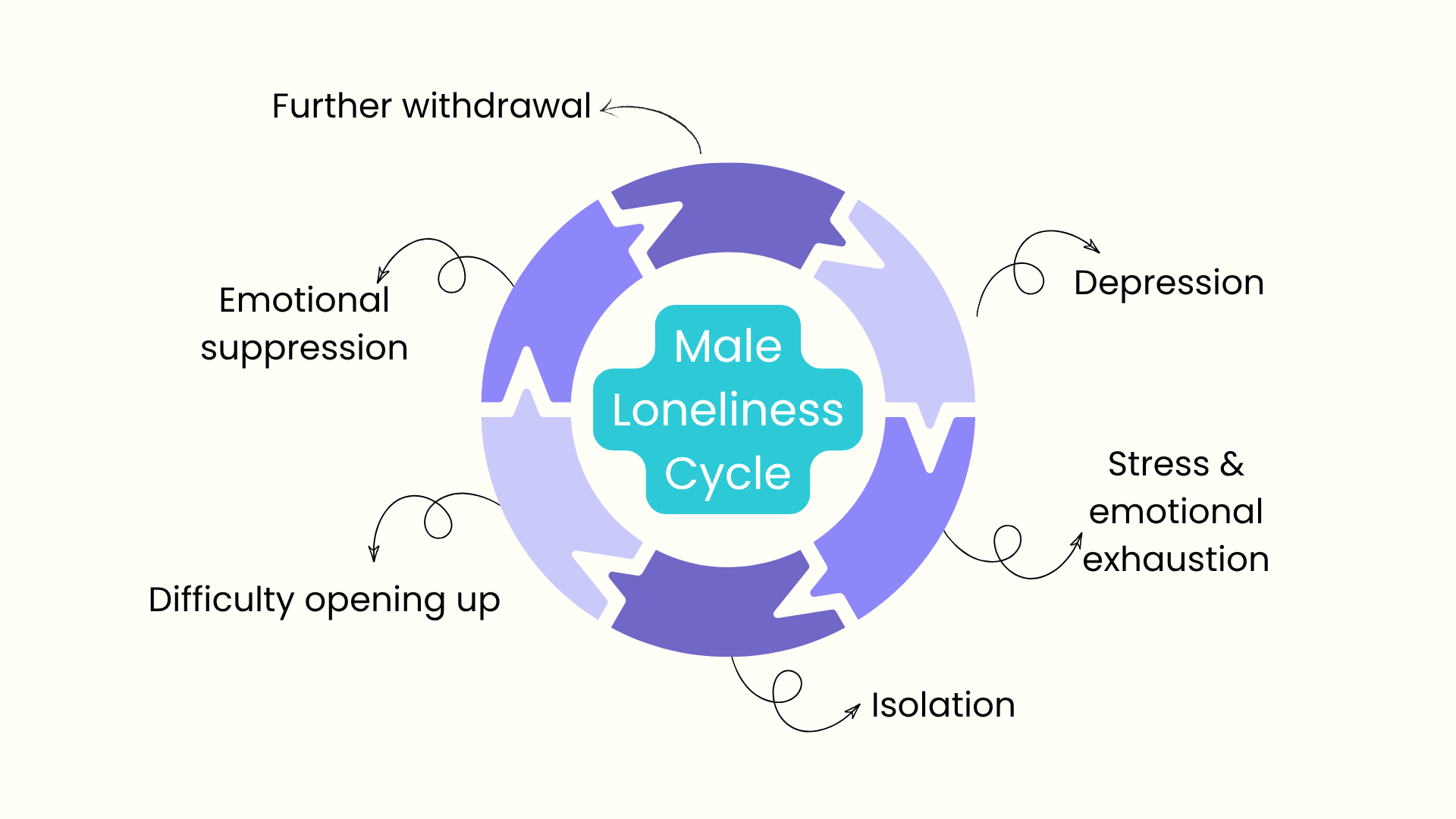
Before getting to the signs of depression in men, it is worth naming one of its most powerful and least discussed drivers: loneliness.
There is a reason this matters for depression specifically. Loneliness is not just the feeling of being alone. It is the experience of having no one who really knows you. No one to call, no one to confide in, no one to absorb the weight of the day. Over time, that experience corrodes mental health in ways that are now well-documented. And for Indian men, the structure of that isolation often goes unexamined.
A 2021 survey found that men have, on average, 50% fewer close friendships than women, and the number of close male friendships has dropped sharply over the last two decades. By 2024, only 26% of men reported having six or more close friends, compared to 55% in 1990 (Survey Center on American Life). Globally, 17% of men now report having no close friends at all, a figure that has increased fivefold since the early 1990s.
In India, the picture is equally concerning. One in five unmarried Indian men reports having no close friends. Among men under 30, one in four says the same (Indian Express, 2024). Young Indian men, especially Gen Z, are twice as likely as women to feel lonely due to their gender, with nearly half saying they need safe spaces to talk about emotions and identity (Indian Express, 2024).
Why are men so isolated?
The reasons are structural, cultural, and often invisible.
Men in India build most of their social world around shared activity: work, cricket, college. These contexts provide a framework for being together without anyone having to talk about how they are actually doing. When those frameworks dissolve, when a man moves cities for a job, when school friendships scatter, when marriage and children swallow evenings, there is often nothing to replace them.
Women tend to maintain friendships more actively through direct emotional contact. Men frequently do not have that skill or habit, not because they do not need connection, but because they were never taught to pursue it that way.
The workplace fills some of the gap, but only partially. Data from our State of Emotional Wellbeing Report 2025 shows that men sought counselling for friendship concerns at a higher rate than women (22% vs. 19%). Men in the 25-30 age group, the largest cohort seeking social support, reported difficulty making new connections, fitting in, and finding support in social circles. These concerns are far from trivial. They are the architecture of isolation.
The Pew Research Center's 2025 study on social connections found that 74% of men would turn first to a spouse or partner for emotional support, ahead of friends and family members. For single men, that primary anchor does not exist. The result is that 20% of single men report having no one to turn to at all.
Over time, this level of prolonged isolation can significantly increase the risk of depression. The relationship between loneliness and depression is not metaphorical. Loneliness changes the brain's stress response, raises cortisol levels, disrupts sleep, and produces a sustained low-grade state of hypervigilance that, over time, becomes clinical. In men who already suppress emotional expression, this process tends to accelerate without anyone noticing.
Our report also found that men who sought counselling for mental health concerns were significantly more likely than women to report that these concerns impacted their work: 14% of men versus 8% of women. Men most commonly raised issues of low self-confidence, financial stress, difficulty making decisions, and substance use. These are not the language of emotional pain, but they are its symptoms. Loneliness runs beneath most of them.
The male loneliness epidemic is not a separate problem from the signs of depression in men. It is often where depression begins.
Signs of Depression in Men: What to Actually Look For
The textbook picture of depression (persistent sadness, tearfulness, visible emotional distress) is less common in men than in women. The signs of depression in men are real and often severe, but they tend to be expressed differently. Knowing what to look for matters, both for men themselves and for the people who care about them.
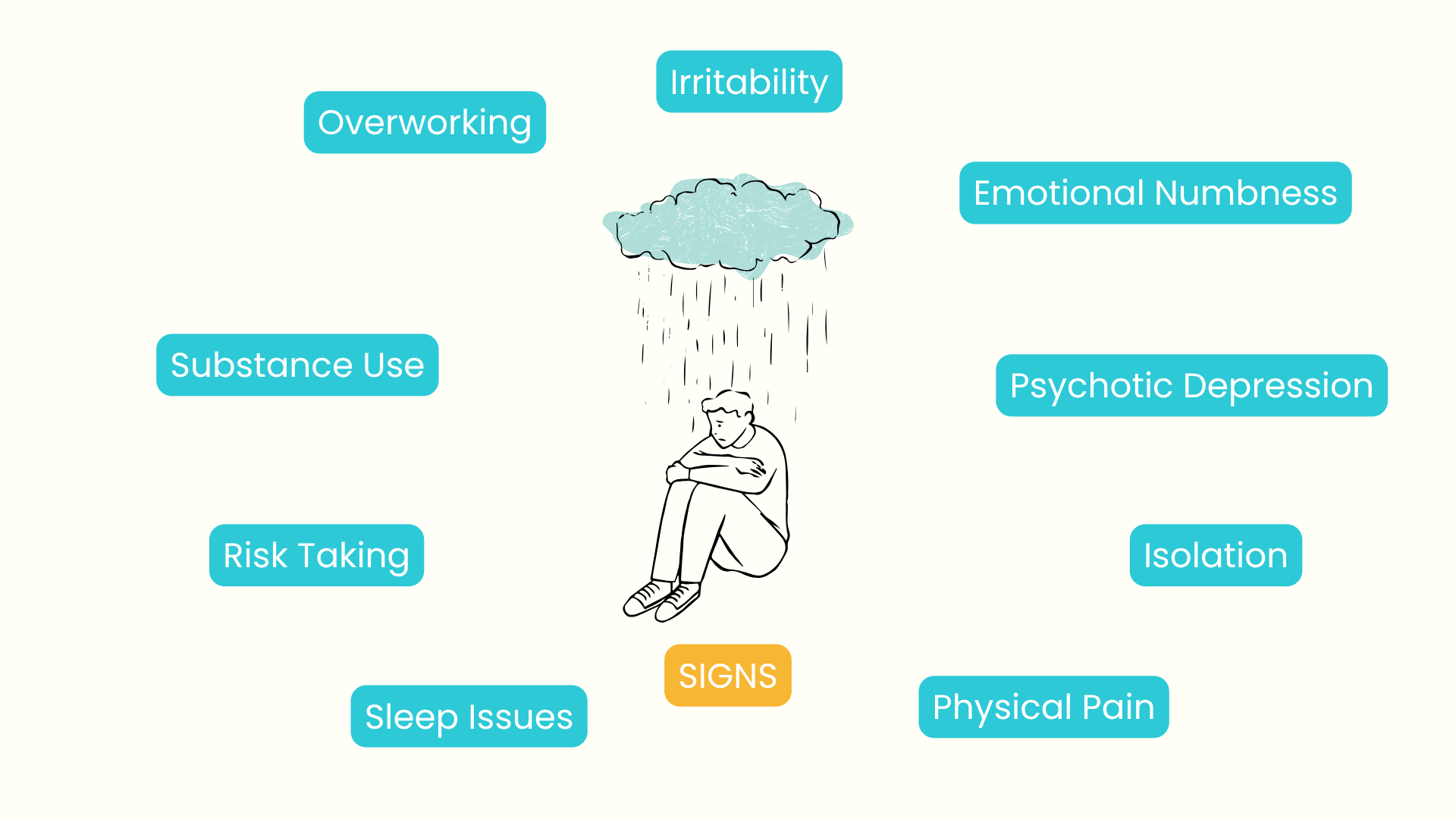
Emotional Signs (Often Disguised)
- Irritability and anger: One of the most common and least recognised signs of depression in men. What looks like a short temper or chronic frustration may actually be depression expressing itself through the emotional channel that feels most culturally acceptable.
- Emotional numbness or emptiness: Not sadness, but a flatness: a sense that things that used to matter no longer do.
- Loss of interest: In hobbies, sport, sex, friendships, or activities that previously brought pleasure. Clinically, this is called anhedonia, and it is a core feature of depression.
- Feeling like a burden: A persistent sense that family and friends would be better off without you. This thought pattern warrants immediate attention.
- Hopelessness: A belief that things will not improve. Not a passing pessimism, but a settled, heavy conviction that sits in the background of every day.
Cognitive Signs
- Difficulty concentrating or making decisions
- Memory problems, particularly working memory
- Negative self-talk that runs constantly in the background: "I'm a failure," "I can't do anything right"
- Slowed thinking, a sense that the mind is working through fog
Behavioural Signs (Most Visible in Indian Men)
- Increased alcohol or substance use: One of the clearest warning signs in Indian men. Alcohol use that rises steadily, that feels like it is "taking the edge off," is often self-medication for untreated depression.
- The workaholic escape: Using work to avoid feeling: staying late, taking on more, staying busy so there is no space for the distress to surface.
- Withdrawal from people: Gradually disappearing from family life, friendships, and social situations without a clear external reason.
- Risky behaviour: Reckless driving, gambling, or other risk-taking. This is less commonly discussed as a depression symptom but is well-documented in male presentations.
- Aggression or volatility: Disproportionate reactions to minor frustrations, particularly at home.
- Numbing through screens: Excessive TV, gaming, or scrolling as a way to stay absent from one's own experience.
Physical Symptoms of Depression in Men
Yes, depression absolutely causes physical symptoms. This matters enormously in India, where many men are more comfortable acknowledging a physical complaint than an emotional one.
Men presenting to a general practitioner with unexplained fatigue, persistent headaches, or back pain they cannot account for may be experiencing depression that has not yet been named. When physical investigations come back normal and the symptoms persist, a mental health assessment is the next step.
The physical symptoms of depression in men include:
- Persistent fatigue and low energy: Not the tiredness that resolves with sleep. A bone-deep exhaustion that sleep does not fix, what many describe as a "lead blanket" feeling that makes ordinary tasks feel effortful.
- Sleep disturbances: Either insomnia (difficulty falling asleep, waking at 3 or 4 AM and unable to return to sleep) or hypersomnia (sleeping far more than usual but still feeling exhausted). Both can occur as part of depressive disorders.
- Appetite and weight changes: Loss of appetite, or a shift toward increased eating. Weight loss or gain without any intentional change in diet or exercise.
- Unexplained physical pain: Headaches, back pain, joint pain, and digestive complaints with no clear medical cause. Depression is associated with lowered pain tolerance and heightened pain perception. Physical pain that does not respond to usual treatment may have a depressive component.
- Psychomotor changes: Either slowing down (speaking, moving, and thinking more slowly than usual) or the reverse: agitation, restlessness, an inability to sit still.
- Sexual dysfunction: Loss of libido and erectile dysfunction are strongly linked to depression in men. In India, this connection is rarely made. Men presenting with sexual dysfunction are frequently not screened for depression. When the issue is psychological rather than physiological, treating the depression often resolves it.
- Weakened immune system: Frequent illness, or slower-than-usual recovery from illness, during a depressive episode.
When Depression and Anxiety Co-Occur
When anxiety and depression occur together, which is particularly common in Indian working-age men, physical symptoms tend to be more pronounced and more distressing. Chest tightness, palpitations, nausea, and chronic physical tension all intensify when anxiety is part of the picture. This combination responds well to treatment; identifying it correctly is the first step.
Depression at Different Life Stages
The triggers, presentation, and risk level of depression shift across different phases of a man's life. Recognising these patterns enables earlier identification.
Young Men (18–30)
Often triggered by academic failure, romantic rejection, unemployment, or the gap between expectations and the reality of adult life. Depression in this age group tends to show up as anger, social withdrawal, and substance use rather than visible distress.
Young Indian men face particularly high suicide risk, and depression in this group is frequently missed because it does not look sad. The 1to1help 2025 report shows that young people under 25 showed the highest prevalence of suicide and self-harm risk, with that risk increasing from 2024 to 2025.
Middle-Aged Men (30–50)
Career pressure, financial stress, relationship strain, and the weight of being the family's primary support system all converge here. The man who maintains a composed, capable exterior while deteriorating internally is a common pattern in this group. Depression in middle-aged Indian men is frequently misread as a "midlife crisis," a framing that delays appropriate help.
Older Men (60+)
Loss of professional identity after retirement, the death of a spouse or close friends, physical health decline, and shrinking social networks create significant depression risk in elderly Indian men. This group is severely underdiagnosed; depressive symptoms in older men are routinely attributed to "just getting older" rather than recognised as a treatable condition.
A Note on Farmers and Rural Men
Depression among rural Indian men, particularly farmers facing crop failure, debt, and climate instability, deserves specific mention. India's farmer suicide rates are among the highest in the world, and depression is the primary underlying factor. Access to mental health support in rural areas remains critically limited.
How to Help a Man with Depression in India
If you are worried about a man in your life, whether a partner, brother, father, or friend, this section is for you.
- Start the conversation without triggering shame. Do not say "you seem depressed." For most Indian men, that framing lands as an accusation. Instead, try: "I've noticed you seem exhausted lately, and I'm a bit worried about you. I'm here if you want to talk." This opens a door without putting him on the defensive.
- Avoid certain phrases entirely. "Man up." "Just think positive." "Others have it worse." These responses, however well-intentioned, cause men to shut down entirely. Minimising the experience does not reduce it. It ensures he will not bring it up again.
- What actually helps. Listen without immediately trying to fix. Acknowledge his experience without rushing to solutions. Stay in contact, because depression isolates, and knowing someone is consistently checking in matters more than most people realise. Offer concrete help: "Can I come with you to speak to a doctor?" is more useful than general encouragement.
- For wives and partners. Partners are often the first to notice the signs: the drinking, the withdrawal, the volatility. They frequently carry the emotional weight of a depressed spouse without support for themselves. Your observation matters. Framing a GP visit as a routine "check-up" can help with men who resist the mental health framing.
In an emergency. If a man makes any comment about death, feeling like a burden, or not wanting to be around: treat it seriously immediately. Call Tele MANAS (14416) or iCall (9152987821). Do not wait to see if he was joking. In Indian men, these comments often precede action without further warning.
How to Get Help as an Indian Man
Seeking help for depression is not weakness. It is the same decision as seeing a cardiologist for chest pain. You are dealing with a medical condition that has effective treatment.
- Start with a GP if needed. If you are not ready to see a mental health professional, start with your general practitioner. A GP can rule out physical causes for your symptoms (thyroid issues, testosterone levels, vitamin D deficiency) and make a referral from there. This framing feels more familiar for many Indian men and removes the barrier of having to identify as someone with a mental health problem.
- Therapy works. Cognitive Behavioural Therapy (CBT) works particularly well for how many Indian men prefer to approach problems: structured, goal-oriented, focused on practical change. It has a strong evidence base for depression and typically involves 10 to 16 sessions.
- Medication is an option. SSRIs are effective for depression in men and women equally. If sexual side effects are a concern, which is a common reason Indian men avoid or stop antidepressants, this is manageable through dose adjustment or switching to an alternative medication. Raise it openly with your psychiatrist; it is a routine clinical conversation.
- Online therapy reduces the barrier. Platforms like iCall and YourDOST offer confidential therapy that does not require walking into a clinic where someone might recognise you. For Indian men who feel the social exposure of an in-person visit, this is a meaningful option.
Free resources available right now:
- Tele MANAS: 14416. Free, 24/7, available in 20 languages. Government-supported.
- iCall (TISS): 9152987821. Trained counsellors, confidential.
- Vandrevala Foundation: 1860-2662-345. 24/7 crisis support.
Recovery from depression is not a question of willpower. It is a question of getting the right support. The biggest hurdle is almost always the first call or appointment. After that, most men find it significantly easier to continue than they expected.
FAQs
1. What are the signs of depression in men?
Depression in men often looks different from the textbook picture of sadness. In Indian men, the most common signs of depression in men are irritability, anger, and emotional numbness rather than visible sadness or crying. Other signs include withdrawing from family and friends, losing interest in hobbies or sex, working excessively to avoid feelings, increased alcohol or substance use, risk-taking behaviour, persistent fatigue, unexplained physical pain, and sleep disturbances. Watch for any statements about feeling like a burden, death, or "everyone would be better off without me." In men, these often precede suicidal action without prior disclosure.
2. Can depression cause physical symptoms in men?
Yes, absolutely. Depression is not just an emotional condition. It produces well-documented physical symptoms. These include persistent fatigue that sleep does not fix, unexplained pain (headaches, backaches, joint pain) with no clear medical cause, sleep problems (either insomnia or sleeping too much), appetite and weight changes, and sexual dysfunction including loss of libido and erectile dysfunction. Many Indian men first notice these physical symptoms without connecting them to depression. When a general practitioner cannot find a physical cause, a mental health assessment is warranted. Treating the underlying depression often resolves these physical complaints.
3. Why do men not recognise depression?
Men, particularly in India, are socialised from childhood not to express emotional vulnerability. Cultural frameworks like "mard ko dard nahi hota" create an environment where acknowledging emotional distress feels like a failure of masculinity. As a result, men often lack the vocabulary or the permission to recognise their own depression. They interpret the symptoms as tiredness, work stress, or just "being in a bad mood." Depression also distorts cognition in ways that make it harder to see that help is available or that things can improve. This is why external support from family members plays such a critical role.
4. What is the difference between male depression and general depression?
Male depression and female depression are the same clinical condition, Major Depressive Disorder, but they tend to manifest differently due to biological and sociocultural factors. Women more commonly present with visible sadness, crying, and emotional expression. Men more commonly present with irritability, anger, risk-taking, substance use, and physical complaints. Men are also significantly less likely to seek help, which means depression often goes undiagnosed for years. In India, the cultural context amplifies these gender differences considerably. Treatment works equally well for both. The challenge is getting Indian men to recognise the signs of depression in men and reach out.
5. How do I know if I am depressed or just stressed?
Stress is typically linked to a specific, identifiable stressor (a deadline, a conflict, a financial problem) and usually improves when the stressor resolves. Depression persists even when the stressor is removed. It lasts for two or more weeks, affects multiple areas of functioning (sleep, appetite, concentration, motivation, interest in life), and involves a pervasive low mood or emotional numbness that does not lift. If you have felt persistently flat, irritable, or empty for more than two weeks, even during moments that should be enjoyable, that is worth taking seriously. A free depression screening tool (PHQ-9) is widely available online and gives a reliable initial sense of severity. Tele MANAS (14416) can help you understand the next steps.
6. How do I help a man who is depressed in India?
Helping a depressed man in India requires sensitivity to cultural norms around masculinity. Avoid framing it as depression initially. Express concern instead: "You seem exhausted lately; I'm worried about you." Listen without trying to immediately solve the problem. Do not dismiss his experience with phrases like "man up" or "others have it worse," as these cause men to shut down entirely. Offer practical help: offer to go with him to a doctor, or to look up therapists together. If he resists therapy, encourage him to start with a GP who can rule out physical causes and make a referral. If there is any risk of suicide, call Tele MANAS (14416) immediately.
7. Is depression in men treatable?
Yes, depression in men is as treatable as it is in anyone else. Both therapy (particularly CBT) and medication (SSRIs) are highly effective. Men often respond well to CBT because it is structured, problem-solving-focused, and goal-oriented. If sexual side effects from antidepressants are a concern, these are manageable through dose adjustment or by switching medications. Speak to your psychiatrist openly. Online therapy platforms like iCall and YourDOST offer the kind of confidentiality that reduces the barrier for Indian men who fear being seen at a clinic. Recovery from depression is very achievable. The largest obstacle is almost always reaching out for the first time. Tele MANAS (14416) is free, confidential, and available right now.
Final Note
Most Indian men reading this will not have searched for "depression." They will have searched for the signs of depression in men, the depression symptoms in men, what the depression signs in men actually look like in practice, or simply whether depression in men symptoms can show up without any visible sadness. Because the clinical word does not feel like it applies to them. They are still going to work. They are not visibly falling apart.
That gap between the word and the lived experience is exactly where depression in men takes root and stays.
The signs and symptoms of depression in males are often physical before they are emotional. The depression physical symptoms come first: the fatigue, the disrupted sleep, the back pain that investigations cannot explain, the low libido that nobody connects to mental health. Men who want to know what are the physical symptoms of depression, or whether physical symptoms depression without visible sadness is possible, are already asking the right question. Yes, it is possible. In many Indian men, it is the norm.
Male depression symptoms also show up in behaviour before language. Increased drinking. Working longer hours. Pulling back from friends and family. These are among the most common signs of depression men and their families overlook, precisely because they read as ordinary stress rather than illness. For men dealing with anxiety alongside depression, male depression and anxiety symptoms layer on top of each other, producing a kind of chronic, grinding tension that men learn to live around rather than address.
The depression signs in men often become clearer once you know what to look for. The signs of male depression do not require a breakdown to become serious. And the symptoms of male depression respond well to treatment, CBT, medication, or both, when they are caught.
If any part of this guide felt familiar, that is worth sitting with. Not because something is broken, but because something is treatable.
References
- National Crime Records Bureau. (2025). Accidental deaths and suicides in India 2023. Ministry of Home Affairs, Government of India. https://www.ncrb.gov.in/accidental-deaths-suicides-in-india-adsi.html
- National Institute of Mental Health and Neurosciences. (2016). National mental health survey of India, 2015–16: Prevalence, patterns and outcomes. NIMHANS. https://nimhans.ac.in/wp-content/uploads/2019/07/1.NMHS-2015-16MentalHealthSystems1.pdf
- 1to1help. (2025). State of emotional wellbeing report 2025: Indian workforce. 1to1help.net Private Limited. https://www.1to1help.com/report/state-of-emotional-wellbeing-2025
- American Psychiatric Association. (2013). Diagnostic and statistical manual of mental disorders (5th ed.). APA. https://www.psychiatry.org/psychiatrists/practice/dsm
- Cox, D. A. (2021). The state of American friendship: Change, challenges, and loss. Survey Center on American Life, American Enterprise Institute. https://www.americansurveycenter.org/research/the-state-of-american-friendship-change-challenges-and-loss/
- Goddard, I., & Parker, K. (2025, January 16). Men, women and social connections. Pew Research Center. https://www.pewresearch.org/social-trends/2025/01/16/men-women-and-social-connections/
- Equimundo. (2023). State of American men 2023: From crisis and confusion to hope. Equimundo: Center for Masculinities and Social Justice. https://www.equimundo.org/resources/state-of-american-men/
- Indian Express. (2024, February 14). Indian men are facing a loneliness epidemic and we're not talking about it enough. The Indian Express. https://indianexpress.com/article/lifestyle/life-style/indian-men-loneliness-epidemic-9137641/
- American Psychological Association. (n.d.). Men and depression. APA. https://www.apa.org/topics/men/depression
- Ministry of Health and Family Welfare, Government of India. (n.d.). Tele MANAS: National tele mental health programme of India. https://telemanas.mohfw.gov.in
- iCall, Tata Institute of Social Sciences. (n.d.). iCall psychosocial helpline. https://icallhelpline.org


.svg)
.svg)
.svg)
.svg)