


.png)


.png)

Mental Health Concerns
Loneliness: Meaning, Causes, Quotes & How to Overcome It — India Guide 2026

.png)
Written by
Aarohi Parakh,
Psychologist and Content Writer

Reviewed by
Sanjana Sivaram,
Psychologist and Clinical Content Head


Introduction

Vikrant is a 28-year-old product manager at a tech company in Hyderabad. He has 847 followers on Instagram, a WhatsApp group for his college friends, and a team of twelve people he manages every day. On most evenings, he eats dinner alone in his flat and cannot quite name what it is he is feeling.
It is not sadness, exactly. It is not that his life is going badly. It is something quieter and more persistent: the feeling that nobody really knows him. That his conversations stay at the surface. That when something genuinely difficult happens, he is not sure who he would reach out to.
Vikrant’s situation is not unusual. He is part of a growing, largely invisible crisis. Referred to as “loneliness”, this experience is one of the most common and least acknowledged forms of distress in urban India today. In November 2023, the World Health Organization declared social isolation and loneliness a ‘global public health concern’, with significant health risks comparable to other well-established risk factors such as smoking, obesity, and physical inactivity.
This guide covers the meaning, causes, quotes, and evidence-based strategies for overcoming loneliness, with specific attention to how loneliness is experienced and expressed in India.
What Is Loneliness? Meaning and Why It Matters
Loneliness is the painful, subjective feeling of social disconnection. It is not simply about being physically alone. It is the gap between the social connection you want and the social connection you actually have. A person can feel profoundly lonely in a marriage, in a packed office, or at a family gathering. Equally, a person living alone may not feel lonely at all if their connections feel genuine and nourishing.
This distinction is important: loneliness is not the same as solitude. Solitude is chosen, restorative aloneness that can support creativity, reflection, and wellbeing. Loneliness is unwanted isolation, the ache of feeling unseen, unheard, or disconnected from others. One is a resource. The other is a signal that something needs to change.
The health consequences of loneliness are more serious than most people realise. Research by Professor Julianne Holt-Lunstad of Brigham Young University, published in PLOS Medicine, found that chronic loneliness is as damaging to long-term health as smoking 15 cigarettes a day. It increases the risk of heart disease, stroke, dementia, depression, and premature death. Loneliness is not a lifestyle inconvenience. It is a serious health condition.

In India, the picture carries additional complexity. Studies suggest that 20 to 40 percent of urban Indians report significant loneliness, yet the condition is rarely named or discussed. Cultural frameworks tend to frame isolation as something to be ashamed of, or simply as a feature of modern life to be endured. Elderly Indians are particularly affected: with adult children migrating to other cities or abroad, many older people lose both daily companionship and the social structure that came with an extended household.
Causes of Loneliness in India
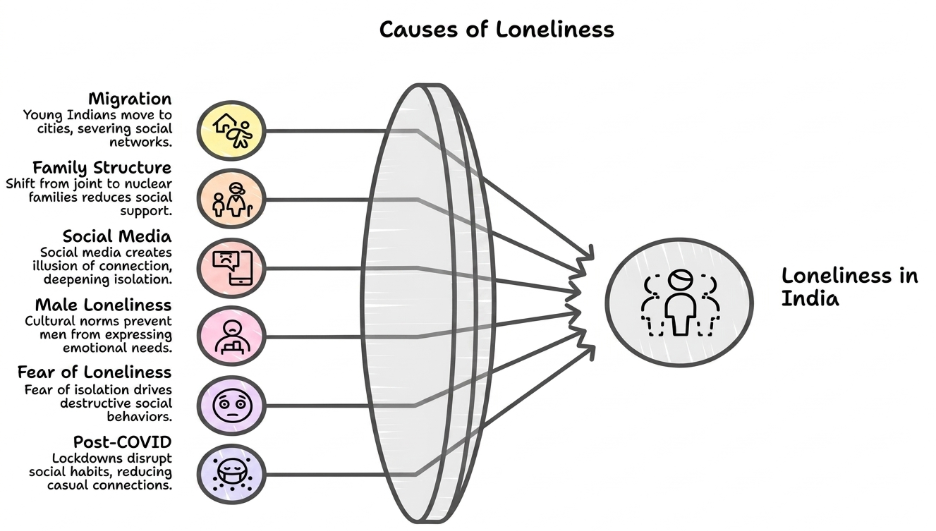
Loneliness rarely has a single cause. In India, it develops through a combination of structural, cultural, and psychological factors that are distinct from those shaping loneliness in Western contexts.
Migration and Urban Isolation
Every year, millions of young Indians move from smaller towns and cities to metros such as Mumbai, Delhi, Bengaluru, Hyderabad, and Pune for education and work. For those moving away from home to study, a college-backed Student Assistance Programme offers confidential counselling and crisis support during exactly this kind of transition.
This migration, however, disconnects the social networks that sustained them: family, childhood friends, local community, and the casual familiarity of a neighborhood where everyone knew their name. The move is usually framed as “progress” or “growth”. The loneliness that accompanies it is rarely discussed. City loneliness is a distinctive Indian phenomenon, and it is growing.
The Shift from Joint to Nuclear Families
For centuries, the joint family system functioned as a built-in social infrastructure. Multiple generations under one roof meant that aloneness was rare, and that practical and emotional support was structurally available. The shift to nuclear family structures, driven by urbanisation and economic mobility, has removed this cushion. Young parents raise children without the support of extended family. Elderly parents live alone after children move away. These are not individual failures; they are structural changes with real social costs.
The Social Media Paradox
India has over 500 million social media users, and yet loneliness is rising. The paradox is well-documented: platforms like Instagram and WhatsApp create an illusion of connection while often deepening actual disconnection. Comparison culture, where everyone else's life appears richer, more sociable, and more meaningful, makes loneliness worse. The curated highlight reel of others' lives amplifies the sense of being left out. Social media use that substitutes for rather than supplements real-world connections consistently worsens mental health.
Male Loneliness in India
Male loneliness deserves specific attention because it is among the least acknowledged and most consequential forms of loneliness in India. A study conducted by the Indian Psychiatric Society found that over 20% of Indian men report experiencing loneliness. Cultural norms of masculinity, captured in phrases like mard ko dard nahi hota (men do not feel pain), actively prevent Indian men from expressing emotional needs, forming intimate friendships, or acknowledging vulnerability.
Many men are never taught the language of emotional pain in the first place. They learn how to provide, perform, achieve, and “handle things”, but not how to say I feel lonely, I’m struggling, or I need support. Emotional expression is often treated as a weakness rather than a normal part of being human.
Male friendships in India tend to be activity-based, structured around cricket, gaming, or drinking, rather than being emotionally vulnerable. After marriage, men's social worlds often narrow significantly as work and family obligations crowd out friendships. The result is that many Indian men have no one they speak honestly to about loneliness, fear, or sadness. This is not a minor oversight; it can play a role in India’s high male suicide rate, which continues to be a significant concern.
Fear of Loneliness
Some people experience not just loneliness but an active fear of being alone, clinically related to autophobia or monophobia, which refers to an intense fear or anxiety around being by oneself, even for short periods of time. This fear can drive people into destructive relationship choices, compulsive social engagement, or persistent people-pleasing, all of which paradoxically deepen the sense of disconnection. The fear of loneliness is distinct from loneliness itself: it is an anticipatory anxiety about isolation that can significantly distort decision-making. Loneliness is about feeling disconnected or emotionally unfulfilled in your relationships. Autophobia is the fear of being alone, even if you have people in your life; being by yourself can still feel scary or overwhelming.
Post-COVID Loneliness
The COVID-19 lockdowns created lasting disruptions to social habits. People lost the daily rhythms that structured social contact: commuting, office conversations, after-work plans, weekend outings. For many, those rhythms never fully returned. Remote work, while productive in many ways, has reduced the casual connection that workplaces generate. Young people who were in formative social years during lockdowns often report that they never rebuilt the social confidence and networks that were disrupted.
Elderly Loneliness
Elderly Indians represent the most acutely affected group. Although ageing is a necessary part of life, it often brings about significant changes that can lead to social isolation. Many live alone or with a spouse, with adult children in other cities or countries. Retirement removes the primary social structure of work. Mobility limitations reduce participation in community life. And unlike younger generations, older Indians often lack digital literacy tools that could bridge physical distance. This combination of social loss, spatial isolation, and reduced mobility creates conditions for severe and sustained loneliness.
💡 Indian Workplace Context
- Remote and hybrid work has increased loneliness significantly among young professionals who previously relied on office interaction for social contact.
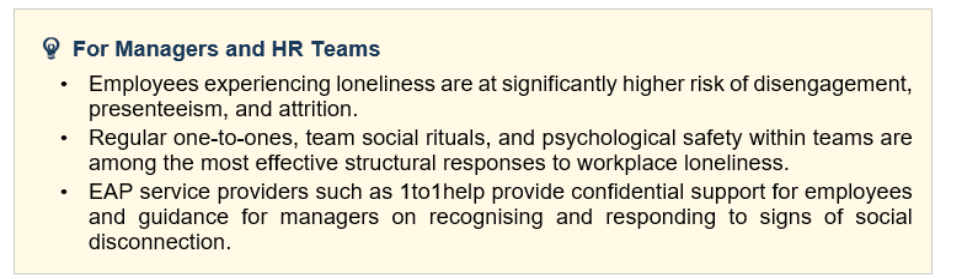
- Loneliness is one of the most common underlying concerns raised in Employee Assistance Programme (EAP) counselling sessions in Indian organisations, often presenting as stress, disengagement, or low motivation. Group-based support through 1to1help's Cohort-based wellbeing programmes tackles this directly — bringing together employees with shared roles and experiences, such as field sales or fresh graduates, reduces isolation in a way a one-off webinar cannot.
Managers who notice social withdrawal, reduced participation, or declining engagement in team members may be observing loneliness, not attitude problems
Loneliness Quotes: Words That Capture the Feeling

Whether you are searching for loneliness quotes or short quotes on loneliness to share or simply to feel less alone in what you are experiencing, words from those who have thought deeply about this feeling can be genuinely comforting. They remind us that loneliness is not a personal failing. It is one of the oldest and most universal human experiences.

There is something comforting about the word quest. It reminds us that the desire for connection is not weakness. It is part of being human.

Rumi's verse, drawn from the Sufi tradition, is not advice to suppress the need for connection; it is an invitation to cultivate a relationship with oneself as a starting point.


Not all aloneness feels the same. Loneliness feels empty and painful. Solitude, when chosen, can feel peaceful and grounding. Learning the difference is part of healing.
Sterne offers a useful reframing for those beginning to work through loneliness: that time alone, when approached intentionally, can build inner resources rather than erode them.

Mother Teresa worked closely with suffering and deprivation in Kolkata. For her to describe loneliness this way shows how deeply human the need for connection really is.
Tagore's Bengali verse, written in 1905 and popularised by Mahatma Gandhi, is not about glorifying loneliness. They are about courage. Sometimes healing begins with taking the first step, even before support arrives.

Welles' quote is unsentimental. The word 'illusion' might seem harsh, but there is a different reading to it: that the creation of connection, however impermanent, is one of the most meaningful things human beings do.
📊 On Celebrities and Loneliness
- Many public figures have spoken openly about experiencing deep loneliness despite outward success.
- Lady Gaga has discussed chronic loneliness despite fame. Princess Diana famously spoke of loneliness within the royal family. Actor Deepika Padukone has been vocal about mental health struggles, including social disconnection.
These disclosures matter because they challenge the assumption that social success or visibility equates to inner connection. Loneliness does not discriminate by status.
How to Overcome Loneliness: Practical Steps for Indians
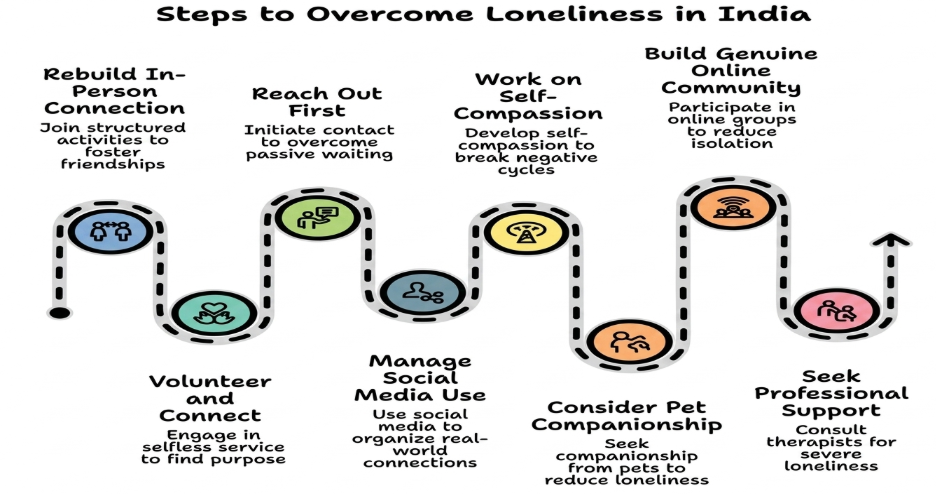
Whether you are looking for ways to overcome loneliness, deal with loneliness, or simply beat the persistent feeling of disconnection, the most important thing to know is this: loneliness is not permanent, and it responds to deliberate action. The following steps are evidence-based and adapted to the Indian context.
1. Rebuild In-Person Connection Through Structured Activities
Friendship rarely develops through intention alone. It develops through repeated, low-pressure exposure to the same people over time. Joining a structured activity, whether a yoga class, a book club, a religious community, a sport, a language class, or a volunteering group, creates the conditions for connection to develop naturally. The key is consistency: showing up repeatedly to the same space with the same people is how acquaintances become friends.
2. Volunteer and Connect Through Service
Volunteering is one of the most reliably effective antidotes to loneliness. It redirects attention outward, connects you to a community of people with shared values, and generates a sense of purpose. In India, seva (selfless service) is a culturally embedded concept with deep meaning across Hindu, Sikh, and Jain traditions. Engaging with community service is not just effective; for many Indians, it is already a meaningful framework.
3. Reach Out First
One of the most common patterns in loneliness is passive waiting: waiting for others to initiate, assuming that silence from the other side means disinterest. In reality, most people are waiting too. Making the first move, sending a message, suggesting a meeting, or asking a colleague to lunch costs relatively little and has a disproportionately large effect on social connection. Practice being the one who reaches out.
4. Manage Social Media Use Intentionally
Reducing passive scrolling and using social platforms actively and purposefully makes a meaningful difference. The goal is to use social media to organise real-world connections rather than as a substitute for them. Set limits on scrolling time. Mute accounts that consistently trigger comparison. Use messaging apps to plan meetings, not to replace them. The link between social media use and mental health is well-established: intentional use supports connection, passive consumption undermines it.
5. Work on Self-Compassion
Loneliness is frequently accompanied by shame: the belief that being lonely means being unlikeable, boring, or fundamentally flawed. This inner narrative makes it harder to reach out and easier to withdraw further. Working on self-compassion, through journaling, therapy, or mindfulness practice, can interrupt this cycle. The relationship between self-criticism and mental health is significant: reducing harsh self-judgement creates the psychological safety needed to reconnect with others.
6. Consider Pet Companionship
Research consistently shows that pet ownership reduces loneliness and improves wellbeing through both companionship and the oxytocin-releasing effects of human-animal bonding. In India, where dogs, cats, and even birds are common household companions, this is an accessible option for many. For older Indians living alone in particular, a pet can provide daily purpose, routine, and a form of unconditional connection. A pet is not to replace human support, and caring for one requires emotional and financial readiness.
7. Build a Genuine Online Community
When geographic isolation, health limitations, or disability make in-person connection difficult, genuine online communities, forums, shared interest groups, or professional networks can meaningfully reduce loneliness. The distinction between genuine community and passive scrolling matters: active participation in a group with shared interests or a common purpose fosters connection; watching other people's content does not.
8. Seek Professional Support When Needed
When loneliness is severe, persistent, or accompanied by depression or anxiety, professional support makes a significant difference. A therapist can help break the reinforcing cycle in which loneliness leads to withdrawal, which deepens loneliness further. In India, EAP counselling through providers such as 1to1help, Tele MANAS (14416), and private therapists offers accessible entry points.
📊 The UCLA Loneliness Scale
- The UCLA Loneliness Scale is a validated 20-item tool widely used to measure the severity of loneliness. A short 3-item version asks: How often do you feel you lack companionship? How often do you feel left out? How often do you feel isolated?
- If your answers are 'often' or 'always' across these questions, it is worth speaking to a mental health professional.
The scale is not a diagnosis but a useful indicator of whether loneliness has reached a level that warrants structured support.
Loneliness and Mental Health: The Connection
Loneliness and mental health are bidirectionally linked, meaning each can make the other worse. Loneliness can significantly increase the likelihood of depression and anxiety by reducing the social reinforcement, emotional regulation support, and sense of belonging that buffer against psychological distress. Depression and anxiety, in turn, cause social withdrawal, making it harder to reach out and easier to retreat, which worsens loneliness further. This reinforcing cycle is one of the primary reasons loneliness can become deeply entrenched.
At a physiological level, research shows that chronic loneliness elevates cortisol (the primary stress hormone), disrupts sleep architecture, weakens immune function, and increases cardiovascular risk. The body registers loneliness as a threat state, activating the same stress pathways as those triggered by physical danger. Over months and years, this has measurable consequences for physical health, not just psychological wellbeing.
In India, the connection between loneliness and mental health is rarely acknowledged because loneliness is not widely understood as a mental health issue. It is seen as 'just part of life', something to be endured rather than addressed. This framing delays help-seeking and allows loneliness to deepen into something more clinically significant. Normalising the conversation around loneliness, naming it as a real and serious experience, is the first step toward reducing its impact.
When to Seek Professional Help
Consider reaching out for professional support if you notice:
- Loneliness that persists for several months
It doesn’t ease even after changes in routine, social efforts, or time.
- Co-occurring emotional difficulties
Feelings of loneliness are accompanied by symptoms of
- depression (low mood, loss of interest, fatigue)
- anxiety (constant worry, restlessness)
- social anxiety (fear of judgment, avoidance of interactions)
- Withdrawal or functional impact
You are increasingly avoiding people, work, or daily responsibilities, and it is affecting your routine or relationships.
- Negative thought patterns
Persistent beliefs like “I don’t belong,” “No one understands me,” or “I’ll always be alone.”
- Thoughts of self-harm or hopelessness
Any thoughts of harming yourself, feeling like a burden, or believing things won’t improve require immediate attention.
If you or someone you know is struggling with loneliness, help is available:
- Access confidential counselling through EAP providers such as 1to1help (check with your HR on enrolled EAP services)
- For immediate support, contact Tele MANAS 14416 (free, 24/7, multiple Indian languages)
- Private therapists in major cities and online platforms
Conclusion
Vikrant still has 847 followers. His WhatsApp groups are still active. His calendar is still full.
But somewhere along the way, he begins to notice something different.
He sends a message first instead of waiting. He stays back after work for a conversation instead of rushing home. He joins a weekend football group, awkward at first, then familiar. He starts naming what he feels, even if it’s just to himself: this is loneliness. Not failure. Not weakness. Just a signal.
Nothing changes overnight. But slowly, the quality of his connections begins to shift. One conversation becomes a little more honest. One person starts to feel safer reaching out to. The silence becomes less heavy.
This is how loneliness changes, not through one big solution, but through small, repeated acts of connection.
If Vikrant’s story feels familiar, it’s because it is. Across cities, workplaces, and homes in India, many people are quietly living versions of it.
What matters is how we respond to that signal.
Loneliness is not a character flaw. It is not evidence that you are unlovable or that your relationships are broken. It is a signal, like physical pain, that something in your social world needs attention. And like any signal, it can be responded to, with small steps, with intention, and sometimes, with support.
If this feels overwhelming right now, you can reach out. Call Tele-MANAS (14416) for immediate, free support, or access EAP counselling services such as 1to1help for a confidential space to talk.
You do not have to go through this alone.
FAQs
Q1. What is loneliness, and why do I feel lonely?
Loneliness is the painful feeling of social disconnection: the gap between the social connection you want and what you actually have. It is entirely possible to feel lonely in a crowd, in a marriage, or surrounded by colleagues. You might feel lonely because you have moved to a new city, lost a relationship, grown apart from friends, or because your relationships feel superficial rather than meaningful. In India, loneliness is growing rapidly as urbanisation, nuclear family structures, and social media reduce the depth of real human connection for many people. Feeling lonely does not mean something is wrong with you. It is one of the most common and most human of experiences.
Q2. How to deal with loneliness in India?
Overcoming loneliness takes deliberate action, not passive waiting. Start by joining a structured activity where you will repeatedly encounter the same people: a yoga class, a book club, a religious community, or a sports team. Volunteer for something you care about, as service connects you to the community and to purpose. Practise being the one who initiates contact. Reduce passive social media scrolling and use platforms to organise real-world meetings instead. If loneliness is accompanied by depression or anxiety, speaking with a therapist or accessing EAP counselling at your workplace can break the reinforcing cycle. For immediate distress, call Tele MANAS at 14416, free and available in your language.
Q3. Is loneliness a mental health problem?
Loneliness itself is not a mental health disorder; it is a universal human emotion. However, chronic loneliness is a serious health risk and is closely linked to depression, anxiety, and poor physical health. The WHO declared loneliness a global public health concern in 2023. Research by Holt-Lunstad shows that prolonged loneliness is as harmful to health as smoking 15 cigarettes a day. When loneliness persists for months and is accompanied by depression, social anxiety, or hopelessness, professional support is recommended. In India, cultural shame around loneliness often prevents people from seeking help, but therapy and community connection can significantly reduce its impact.
Q4. What are some meaningful loneliness quotes?
Some of the most resonant quotes on loneliness include: 'The most terrible poverty is loneliness and the feeling of being unloved' by Mother Teresa. 'Do not be lonely. The entire universe is inside you' by Rumi. 'Loneliness is the poverty of self; solitude is the richness of self' by May Sarton. Tagore's 'Ekla cholo re', meaning walk alone if no one responds to your call, carries particular significance in the Indian context. These quotes remind us that loneliness is a universal human experience and that reaching towards others, and towards oneself, is both possible and transformative.
Q5. Why are men particularly lonely in India?
Indian men often experience deep loneliness that goes unacknowledged and unnamed. Cultural norms of masculinity prevent men from expressing emotional needs or seeking genuine closeness in friendships. Male friendships in India are often centred around shared activities like cricket, gaming, or work, with emotional vulnerability being less commonly expressed. After marriage, men's social worlds often narrow as friendships fall away and work and family obligations take over. Workplace competition can erode collegial bonds. The result is that many Indian men have no one they can speak honestly to about loneliness, sadness, or fear. This contributes to India's high male suicide rate. Opening up to even one trusted person, or speaking to a counsellor through Tele MANAS at 14416 or an EAP service, is a powerful and underused first step.
Additional Resources
- Loneliness-Discussion Questions by Therapist Aid- https://www.therapistaid.com/worksheets/loneliness-discussion-questions
- Help and advice on how to cope with loneliness and improve your mental health: Mental Health Foundation- https://www.mentalhealth.org.uk/sites/default/files/2022-06/MHAW22-Loneliness-Help-and-Advice.pdf
Recommended Reading
References
- World Health Organization. (n.d.). Social isolation and loneliness. https://www.who.int/teams/social-determinants-of-health/demographic-change-and-healthy-ageing/social-isolation-and-loneliness
- Psychology Today. (n.d.). Loneliness. https://www.psychologytoday.com/us/basics/loneliness
- Verywell Mind. (n.d.). Loneliness: Causes, effects, and treatments. https://www.verywellmind.com/loneliness-causes-effects-and-treatments-2795749
- National Health Service. (n.d.). Feeling lonely. https://www.nhs.uk/mental-health/feelings-symptoms-behaviours/feelings-and-symptoms/feeling-lonely/
- Harvard Graduate School of Education. (2024). What is causing our epidemic of loneliness and how can we fix it? https://www.gse.harvard.edu/ideas/usable-knowledge/24/10/what-causing-our-epidemic-loneliness-and-how-can-we-fix-it
- Mind. (n.d.). Loneliness. https://www.mind.org.uk/information-support/tips-for-everyday-living/loneliness/about-loneliness/
- The Positive Psychology People. (n.d.). Loneliness or solitude? It depends on your point of view. https://www.thepositivepsychologypeople.com/loneliness-or-solitude-it-depends-on-your-point-of-view/
- Holt-Lunstad, J. (n.d.). Loneliness and social isolation as risk factors for mortality. https://www.julianneholtlunstad.com/15-cigarettes
- Mayo Clinic. (n.d.). Heart disease. https://www.mayoclinic.org/diseases-conditions/heart-disease/symptoms-causes/syc-20353118
- Mayo Clinic. (n.d.). Stroke. https://www.mayoclinic.org/diseases-conditions/stroke/symptoms-causes/syc-20350113
- Cleveland Clinic. (n.d.). Dementia. https://my.clevelandclinic.org/health/diseases/9170-dementia
- World Health Organization. (n.d.). Obesity and overweight. https://www.who.int/news-room/fact-sheets/detail/obesity-and-overweight
- Scroll.in. (2024). Loneliness in a crowd: Why so many Indians are struggling silently. https://scroll.in/article/1084332/loneliness-in-a-crowd-why-so-many-indians-are-struggling-silently
- Indian Journal of Psychiatry. (n.d.). Loneliness, depression, suicidal ideation, and… https://journals.lww.com/aips/fulltext/9900/loneliness,_depression,_suicidal_ideation,_and.201.aspx
- Reuters. (2026, January 29). India’s vast internet and social media apps market. https://www.reuters.com/business/media-telecom/indias-vast-internet-social-media-apps-market-2026-01-29/
- The Times of India. (2024). Beyond patriarchy: How the duty men created became their greatest source of isolation. https://timesofindia.indiatimes.com/india/beyond-patriarchy-how-the-duty-men-created-became-their-greatest-source-of-isolation/articleshow/128075729.cms
- Juniper Publishers. (n.d.). Loneliness and mental health. https://juniperpublishers.com/pbsij/pdf/PBSIJ.MS.ID.556117.pdf
- Cleveland Clinic. (n.d.). Autophobia (fear of being alone). https://my.clevelandclinic.org/health/diseases/22578-autophobia-monophobia-fear-of-being-alone
- HelpAge India. (n.d.). Loneliness in older adults and its impact on mental health. https://www.helpageindia.org/blog/loneliness-in-older-adults-and-its-impact-on-mental-health
- Fetzer Institute. (n.d.). Loneliness and interpersonal problems scale. https://backend.fetzer.org/sites/default/files/images/stories/pdf/selfmeasures/Self_Measures_for_Love_and_Compassion_Research_LONELINESS_AND_INTERPERSONAL_PROBLEMS.pdf
- Recovery.com. (n.d.). The psychology of self-criticism. https://recovery.com/resources/the-psychology-of-self-criticism-why-we-tear-ourselves-down-and-what-to-do-about-it/
- Neff, K. (n.d.). Self-compassion. https://self-compassion.org/
- PositivePsychology.com. (n.d.). Benefits of journaling. https://positivepsychology.com/benefits-of-journaling/
- Mindful. (n.d.). Mindfulness: Getting started. https://www.mindful.org/meditation/mindfulness-getting-started/
- Cleveland Clinic. (n.d.). Self-harm. https://my.clevelandclinic.org/health/diseases/12201-self-harm
- Cleveland Clinic. (n.d.). What happens in your body when you’re lonely. https://health.clevelandclinic.org/what-happens-in-your-body-when-youre-lonely
- National Center for Biotechnology Information. (2024). Loneliness and health outcomes. https://pmc.ncbi.nlm.nih.gov/articles/PMC11403199/
- Cleveland Clinic. (n.d.). Social anxiety disorder. https://my.clevelandclinic.org/health/diseases/22709-social-anxiety
- Verywell Mind. (n.d.). What to do if you feel hopeless. https://www.verywellmind.com/9-things-to-do-if-you-feel-hopeless-5081877
- Government of India, Ministry of Health and Family Welfare. (n.d.). Tele-MANAS. https://telemanas.mohfw.gov.in/home


.svg)
.svg)
.svg)
.svg)