

.png)


.png)

Life Transitions
Signs It's Time to Let Go of Your Relationship: 15 Signs You Can't Ignore (And How to Move On)
.jpg)
.png)
Written by
Aarohi Parakh,
Psychologist and Content Writer

Reviewed by
Sanjana Sivaram,
Psychologist and Clinical Content Head


Introduction: The Hardest Question — Is It Time to Let Go?
You still love them. That is what makes this so hard. If you did not care, you would probably have already walked away. But here you are, maybe reading this at 2am, going through the same thoughts you have had a hundred times, wondering if what you are feeling is a sign, or just fear. Perhaps you keep asking yourself, "How do I know when to let go of a relationship?" or hoping that things might somehow return to how they once were.
Letting go of someone you love is one of the most emotionally complex decisions a person can face. It is not a failure of love. Sometimes, it is one of the truest expressions of it. Choosing to leave does not always mean the love has disappeared. Sometimes, it means recognising that love alone cannot sustain a relationship that no longer feels safe, respectful, or fulfilling.
One reason this decision feels so difficult is something psychologists call the sunk cost fallacy. Research suggests that people often stay in relationships because of the time, energy, memories, and emotional investment they have already made, even when those relationships are no longer meeting their needs. The longer you have been together, the harder it can feel to walk away, not because staying is healthier, but because leaving can feel like losing everything you have built.
For many people in India, the decision carries additional layers of complexity. Family expectations, social pressure, financial dependence, shared responsibilities, and the belief that relationships should be preserved at all costs can make it incredibly difficult to recognise when to let go of a relationship. Many people remain in unhealthy relationships not because they want to, but because the emotional, practical, and social cost of leaving feels overwhelming.
This article is here to help you recognise the signs with greater clarity and compassion. It will help you understand the difference between a relationship going through a difficult phase and one that may have run its course, recognise common toxic relationship patterns, and explore healthy ways of letting go and moving forward. Whether your next step is an honest conversation, couples counselling, separation, or simply giving yourself permission to heal, there is no judgement here. Only an attempt to help you hear what you might already know.
Why Letting Go Is So Hard: The Psychology Behind Staying
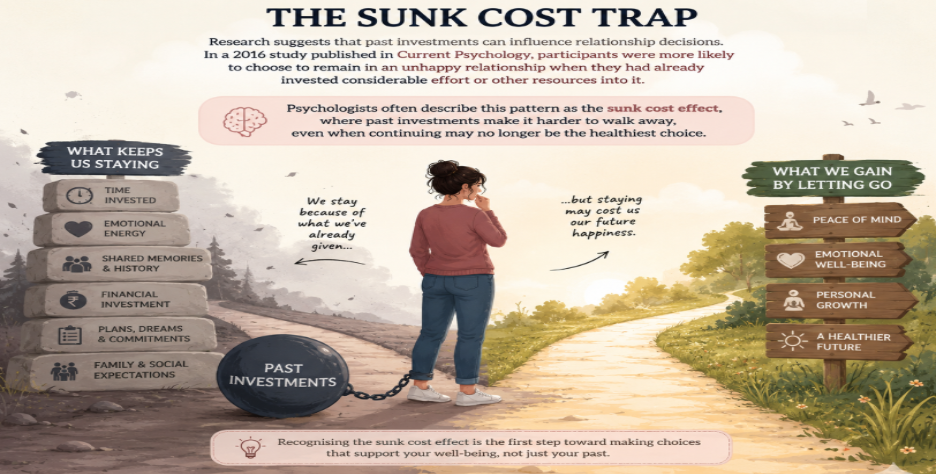
If knowing were enough, more people would leave relationships that hurt them. But knowing and leaving are different things, and there are real psychological reasons the gap between them can feel so wide.
Fear of loneliness can feel more overwhelming than the reality of staying in an unhappy relationship. In India particularly, where being single can carry social stigma and living alone is not always culturally normalised, this fear can become a powerful anchor that has little to do with how the relationship actually feels.
Care for your partner is another quiet reason people stay. A 2018 study published in the Journal of Social and Personal Relationships suggests that people sometimes remain in unfulfilling relationships not only because of their own feelings, but also because they worry about how leaving might affect their partner's wellbeing or believe their partner depends heavily on the relationship. It is worth asking yourself gently: is feeling responsible for someone's wellbeing the same as loving them well?
Hope for change keeps many people holding on. Hope itself is not a flaw. But when hope persists for years without any real evidence of change, it can quietly become a way of avoiding a difficult truth rather than a reasonable expectation.
Emotional enmeshment in a relationship occurs when a person's sense of self begins to revolve around the relationship rather than their own individual identity. Ending the relationship can then feel less like losing a partner and more like losing a part of yourself. This can make it especially difficult to leave, even when the relationship is no longer healthy.
The India-specific layer adds real weight here. Family and community pressure to stay together can feel overwhelming, particularly when parents arranged the marriage, relatives celebrated the union, and a culture sometimes equates endurance with virtue. Leaving can feel, mistakenly, like betrayal rather than self-care.
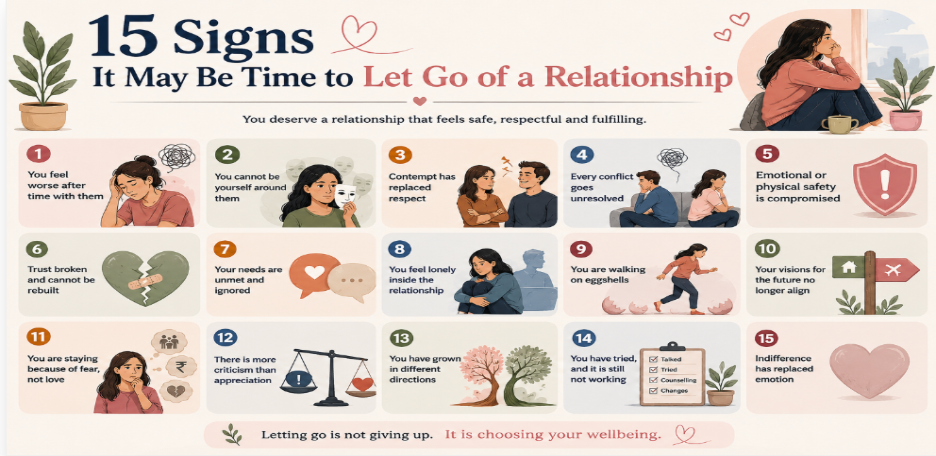
15 Signs It's Time to Let Go of Your Relationship
Not every difficult relationship is over. But certain patterns, when sustained rather than occasional, tend to point towards a relationship that may have run its course. Read through these gently, and notice which ones feel familiar rather than forcing all of them to fit.
SIGN 1 — YOU CONSISTENTLY FEEL WORSE AFTER TIME WITH THEM
While all relationships go through periods of stress and conflict, healthy relationships are characterised by an overall sense of emotional safety, support, and mutual respect. If you consistently leave interactions feeling drained, anxious, small, or empty rather than restored, this is a meaningful signal worth paying attention to. Of course, there may be periods, such as during illness, caregiving, grief, or other major life stressors, when even healthy relationships can feel emotionally draining. What matters is whether this has become the ongoing pattern rather than a temporary phase. Love should not be a sustained source of depletion.
Example: You come home from a family gathering where you were together and feel a wave of relief when they leave the room, rather than missing their company.
SIGN 2 — YOU CANNOT BE YOURSELF AROUND THEM
A relationship where you must perform, edit, or suppress who you are to avoid criticism or conflict is unlikely to be a safe space for your authentic self. If you find yourself consistently hiding opinions, feelings, or parts of your personality, not occasionally, which is normal, but as a sustained pattern, this is worth examining honestly.
Example: You avoid talking about your career ambitions, hobbies, or even your opinions because they dismiss them as "immature" or "not practical." Over time, you stop sharing parts of yourself just to keep the peace.
SIGN 3 — CONTEMPT HAS REPLACED RESPECT
According to the Gottman Institute's decades of research, contempt, expressed through eye-rolling, sarcasm, mockery, or belittling, is one of the most reliable predictors of relationship breakdown. Contempt is different from anger. Anger says "I am hurt." Contempt says "I see you as beneath me." Relationships can often recover from anger. Recovering from sustained contempt is considerably harder.
Example: During a disagreement in front of friends or family, they laugh at your opinion, roll their eyes, or make comments like, "You never understand anything," leaving you feeling humiliated rather than heard.
SIGN 4 — EVERY CONFLICT GOES UNRESOLVED
All couples disagree or argue. What seems to distinguish healthier relationships is not the absence of conflict but the ability to make a genuine attempt at repair and have it received with an open mind. In Gottman's research, it is the failure of repair attempts, more than the conflict itself, that predicts a relationship's end. If your disagreements consistently end in withdrawal or the same unresolved loop, this is worth noticing.
Example: Every conversation about finances, household responsibilities, or spending weekends with each other's families ends exactly the same way—with one of you walking away, giving the silent treatment, or pretending nothing happened until the next argument.
SIGN 5 — EMOTIONAL OR PHYSICAL SAFETY IS COMPROMISED
This is the most urgent sign, and it needs to be named directly. If your relationship involves any form of emotional, verbal, or physical abuse, controlling behaviour, intimidation, humiliation, threats, or physical harm, prioritising your safety becomes necessary. While leaving may ultimately be the right decision, it is not always the safest first step. In many abusive relationships, the period around separation can carry the greatest risk. Reaching out to trusted people, domestic violence services, or mental health professionals and developing a safety plan can help you navigate the situation more safely. You deserve safety as a baseline, not as something to be earned through good behaviour.
Example: They repeatedly check your phone, control who you speak to, threaten to leave or harm themselves if you disagree, or make you feel afraid of how they might react after a disagreement.
If this applies to you: 24x7 helplines such as Tele MANAS (14416) and the National Commission for Women (14490) are available to support you.
SIGN 6 — TRUST HAS BEEN BROKEN AND CANNOT BE REBUILT
Trust is the infrastructure of intimacy. When it breaks, through infidelity, repeated lies, or betrayal, it can sometimes be rebuilt, but generally only if both partners are genuinely committed and the person who broke it takes full accountability without minimising what happened. If denial, justification, or repetition continues despite real effort on your part, the relationship may not be repairable.
Example: Months after discovering repeated lies or infidelity, you still find yourself checking their messages or location—not because you want to, but because trust has never truly been rebuilt despite repeated promises.
SIGN 7 — YOUR NEEDS ARE CONSISTENTLY UNMET AND UNCOMMUNICATED ABOUT
Every person brings needs to a relationship, for emotional presence, intimacy, communication, support, space. A healthy relationship involves both people advocating for their needs and genuinely trying to meet each other's. If you have clearly communicated a need and your partner consistently cannot or will not meet it, or dismisses it as unimportant, this may point to a fundamental incompatibility rather than a passing rough patch.
Example: You have explained several times that you need more emotional support during stressful periods at work, but every conversation ends with your concerns being dismissed as "overthinking" or "being too sensitive."
SIGN 8 — YOU FEEL LONELY INSIDE THE RELATIONSHIP
One of the most painful experiences in an unhealthy relationship is feeling profoundly alone, not because your partner is physically absent, but because genuine emotional connection has been lost. You share space but not inner worlds. You speak but do not feel truly heard. This loneliness within connection is often, according to Gottman's longitudinal research, one of the later signals of a relationship coming apart.
Example: You spend evenings sitting in the same room, each scrolling on your own phone. Days go by without a meaningful conversation, and you feel more emotionally connected to a close friend than to your partner.
SIGN 9 — YOU ARE WALKING ON EGGSHELLS
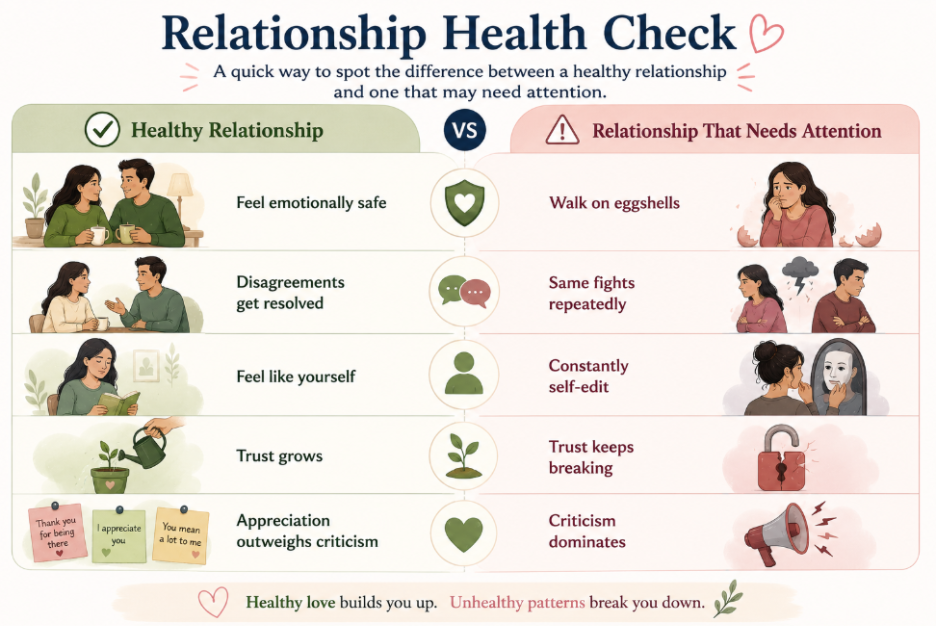
If you find yourself constantly monitoring your words and behaviour to avoid triggering anger, withdrawal, or criticism, and if you have developed an inner radar for their mood and consistently reshape your behaviour around it, this tends to be a sign of chronic anxiety and control within the relationship. You should not have to earn peace inside your own relationship.
Example: Before bringing up something as simple as visiting your parents or making weekend plans, you mentally rehearse the conversation because you are worried about triggering anger, criticism, or hours of silence.
SIGN 10 — YOUR VISIONS FOR THE FUTURE NO LONGER ALIGN
At the beginning, couples often focus on connection in the present and defer deeper questions about compatibility. Over time, diverging life goals can become harder to overlook. If you want fundamentally different things, about children, where to live, financial priorities, values, and neither person is genuinely willing to meet in the middle, the relationship may require one or both of you to suppress something important indefinitely. That tends not to be sustainable.
Example: One partner dreams of settling abroad while the other wants to stay close to ageing parents in their hometown. Or one wants children while the other is certain they do not. Neither vision is wrong, but they may no longer fit together.
SIGN 11 — YOU ARE STAYING BECAUSE OF FEAR, NOT LOVE
There is a meaningful difference between staying because a relationship is genuinely fulfilling, and staying because you are afraid, of being alone, of financial instability, of family judgement, of starting over. Fear-based staying is particularly common in India, where financial dependence, joint family structures, and social stigma around separation create powerful external reasons to remain. If you stripped away all the fear, would you still choose this person? That is the honest question worth sitting with.
Example: You imagine ending the relationship but immediately think about what your parents, relatives, or neighbours might say. The fear of disappointing others feels stronger than the hope of building a healthier future for yourself.
SIGN 12 — THERE IS MORE CRITICISM THAN APPRECIATION
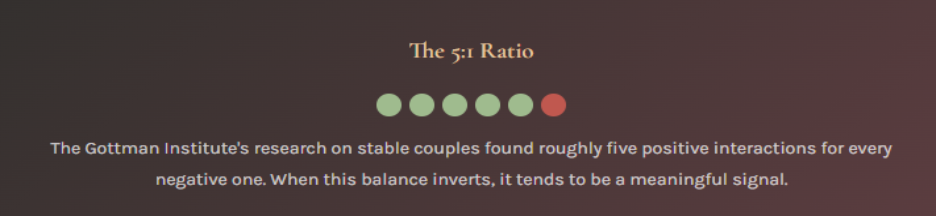
According to the Gottman Institute's research, couples in stable relationships generally experience a higher ratio of positive to negative interactions, often around 5:1 during conflict. While this is not a fixed rule, a persistent imbalance where criticism outweighs appreciation can gradually erode relationship satisfaction.
Example: Conversations have become a running list of complaints; how you dress, cook, spend money, or manage work, while genuine compliments, gratitude, or affection have become rare.
SIGN 13 — YOU HAVE GROWN IN DIFFERENT DIRECTIONS
People change, and healthy relationships often grow together through that change. But sometimes people grow in genuinely different directions. The values, interests, and outlook that aligned at the start can diverge over years into something that feels like two separate lives. This is not always anyone's fault. It may simply mean the relationship has reached its natural end. Growth is not a betrayal.
Example: When you first met, you shared similar goals and interests. Years later, one of you values stability and family life while the other prioritises adventure, career growth, or a completely different lifestyle, making it harder to envision a shared future.
SIGN 14 — YOU HAVE TRIED, AND IT IS STILL NOT WORKING
There is no prize for staying in a relationship that is causing both people sustained pain, despite genuine, documented effort to change things. If you have had honest conversations, sought counselling, made personal changes, and given real time to recovery, and the relationship remains unsafe, unhappy, or fundamentally unfulfilling, this is not failure. It is information Sometimes, the next step is not immediately choosing to stay or leave. Establishing healthier boundaries, taking a period of structured separation, or creating space for reflection can also provide clarity. And sometimes, the most compassionate choice for both people is to acknowledge that the relationship has run its course.
Example: You have attended couples counselling, read relationship books, had difficult conversations, and made genuine efforts to change unhealthy patterns. Yet months later, you find yourselves repeating the same painful cycle with little lasting change.
SIGN 15 — INDIFFERENCE HAS REPLACED EMOTION
Paradoxically, the end of love is not always marked by anger or dramatic conflict. Gottman describes emotional indifference, no more fights, no more reaching out, just flat distance, as one of the final stages of a relationship coming apart. If you have stopped caring enough to argue, to try, or to reach out, if you feel numb rather than hurt, this may be the clearest sign of all.
Example: They come home late and you no longer feel worried or upset—you simply do not care. Birthdays, anniversaries, and important milestones pass with little emotion because the relationship has begun to feel emotionally distant rather than loving.
If several of these signs feel familiar, that recognition alone can be disorienting and overwhelming. Speaking with a 1to1help relationship counsellor can offer a steady, confidential space to make sense of what you are noticing, without pressure to decide anything immediately.
Signs of a Toxic Relationship: When Unhealthy Becomes Harmful
Not all unhealthy relationships are abusive, but toxic relationships tend to consistently harm one or both partners' physical health, mental health, or sense of self. The key difference from a rough patch is pattern and direction. Rough patches are usually temporary and improve with time and effort. Toxic dynamics tend to be sustained and often worsen.
Please note: “Toxic relationship” is a popular term, not a formal psychological diagnosis, but it is commonly used to describe patterns that repeatedly harm wellbeing.
Sometimes, what begins as love can gradually change into patterns of control, fear, or emotional harm. Understanding when love becomes something else can make it easier to recognise unhealthy dynamics before they become deeply entrenched.
Early Signs of a Toxic Relationship
- Love bombing: Excessive early attention and affection that can quietly establish dependency before deeper compatibility has been tested.
- Isolation: Gradual distancing from friends and family, often framed as wanting more time together rather than control.
- Constant checking: Persistent monitoring of your location, messages, or activities, sometimes disguised as care or concern.
- Guilt around independence: Being made to feel guilty for spending time with others, or for having a life outside the relationship.
Escalating Toxic Patterns
- Gaslighting: Being made to doubt your own memory and perception of events, often after raising a legitimate concern.
- Emotional withdrawal as punishment: Affection withheld deliberately as a consequence, rather than communicated disagreement.
- Controlling behaviour: Control exerted around finances, social life, or appearance, often framed as preference or practicality.
- Idealisation and devaluation cycles: Alternating between intense affection and harsh criticism, which can keep a partner emotionally off balance.
If you are experiencing physical, sexual, or severe psychological abuse, please reach out: Tele MANAS (14416) and the National Commission for Women (14490), or the One Stop Centre scheme (181), available across Indian states.
Letting Go in the Indian Context: Why It's Harder Here
This section exists because the decision to let go of a relationship does not happen in a vacuum, and in India, the surrounding context tends to carry particular weight.
The Family Dimension
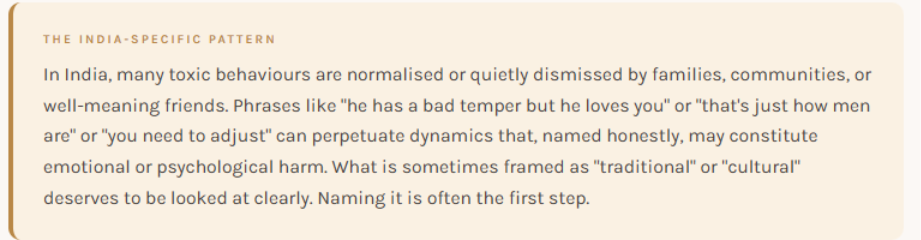
In India, relationships, marriages in particular, are rarely just between two individuals. They are often between families. Ending a relationship, especially an arranged one, can feel like betraying the families who were involved, the relatives who attended the ceremony, and the parents who trusted the process. This family dimension adds a layer of guilt and social obligation to an already difficult individual decision.
Whether a relationship began through an arranged marriage or a love marriage, relationship decisions in the Indian context are often shaped by family expectations, cultural values, and community norms as much as by the relationship itself.
Financial Dependence
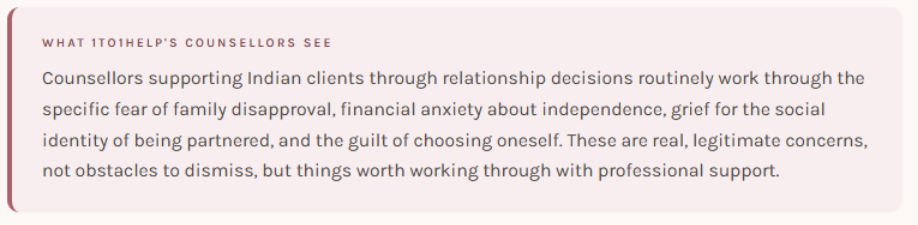
Many Indian women remain in unhealthy relationships due to genuine financial dependence, the absence of independent income, a separate bank account, personal savings, or access to credit. This is not a personal failing. It reflects structural inequality. If financial dependence is part of what is keeping you in an unhealthy relationship, accessing legal and financial guidance through organisations like Tele MANAS or Employee Assistance Programme (EAP) at your workplace can be an important first step.
Social stigma Around Separation
India's divorce rate remains low, not because relationships here are uniformly happy, but because the social cost of separation can be high. "Log kya kahenge" (what will people say) is a genuine force that keeps people in relationships that are not serving them. Separation can affect children's matrimonial prospects, parents' social standing, and an individual's personal and professional life in ways that feel uniquely intense within Indian society.
Cultural Messaging Around Endurance
Indian culture often frames relationship endurance as a virtue in itself. "Adjust karo," "sab theek ho jayega" (everything will be fine), and the celebration of long marriages regardless of their quality, send a message that staying is always more admirable than leaving. This messaging, while sometimes well-intentioned, can quietly trap people in relationships that are genuinely harming them.
How to Let Go of a Relationship — A Compassionate Step-by-Step Guide
Letting go is rarely a single decision. It is usually a series of smaller ones, repeated until they add up to something different. Here is a gentle structure to hold onto.
Accept What Is, Not What You Wish It Were
One of the most painful parts of letting go is the gap between the relationship you have and the one you hoped for. True acceptance means grieving the loss of the future you imagined, not only the present you are leaving. This grief is real and valid. Try to allow it, rather than rushing past it.
Allow Yourself To Grieve
Ending a relationship, even an unhealthy one, involves genuine loss: of daily routine, of shared plans, of the person you loved, even if they changed. Grief is not a sign of weakness or regret. It is a natural response to real loss. Give yourself permission to feel it fully, rather than numbing it with constant activity.
Rebuild Clear Boundaries
After a relationship ends, especially a toxic one, clear, well-maintained boundaries tend to matter for healing. This may mean limiting or pausing contact for a period, not as punishment, but as protection for your own recovery. In the Indian context, where mutual friends and family connections often blur lines, this may require honest, explicit conversations with people in your social circle.4
Reconnect With Yourself
Long relationships, especially controlling or emotionally exhausting ones, can leave you uncertain of who you are independently. Try to reconnect deliberately with your interests, friendships, and aspirations. What did you set aside in this relationship? What do you want your life to look like now? Healing often begins with rediscovering the best version of yourself, reconnecting with the values, interests, and relationships that make you who you are beyond the partnership.
Lean On Trusted Support
Loneliness is one of the most painful parts of ending a relationship. Rather than enduring it alone, reach out to trusted friends, supportive family members, or a professional counsellor. You do not need to process this in isolation. Social support is often one of the strongest predictors of recovery after a relationship ends.
Seek Professional Support If You Need It
If you are struggling to make the decision, processing a particularly painful or difficult relationship, or finding that grief is significantly affecting your daily life, speaking with a relationship counsellor can be one of the most practical steps you take. A counsellor does not make the decision for you. They help you hear your own clarity beneath the fear and grief.
Before You Let Go: When to Try Relationship Counselling First
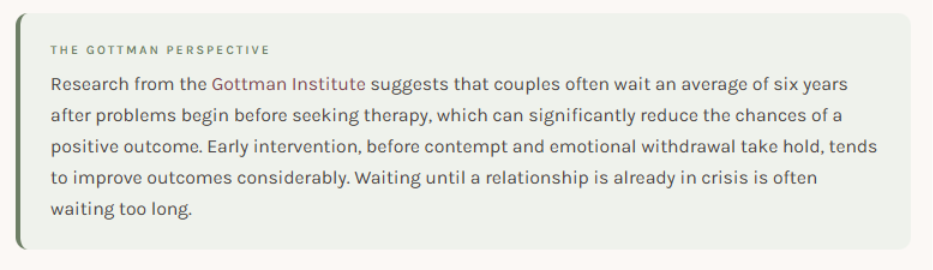
Not every struggling relationship is over. All relationships move through difficult periods, grief, financial stress, new parenthood, career transitions, relocation. External stressors create internal strain, and during these periods, a fundamentally healthy relationship may temporarily exhibit some of the signs described above. Context genuinely matters before the fate of any relationship is decided.
Signs That Counselling Could Help
- Both partners still care and genuinely want it to work.
- The conflict is specific and addressable, communication style, financial disagreements, intimacy mismatches, rather than a fundamental incompatibility of values.
- Trust has been broken, but the person responsible is showing real accountability.
- There is no pattern of abuse present.
Signs That Counselling May Not Be Enough
- One partner refuses to attend or engage genuinely.
- The relationship involves ongoing abuse, in which case counselling is not appropriate while the abuse remains active.
- There is a fundamental values incompatibility, such as one person wanting children and the other not, that neither person can genuinely move on.
- One person has already emotionally and mentally left the relationship.
If you are unsure whether to try counselling or whether it is time to let go, a 1to1help relationship counsellor can help you find some clarity. Sessions are confidential, free of judgement, and available in Indian languages.
End of Relationship Quotes: Words That Might Help You Heal
Sometimes what we most need in pain is to know someone else has felt exactly this, and found words for it. Save these, and send them to someone who needs to hear them today.
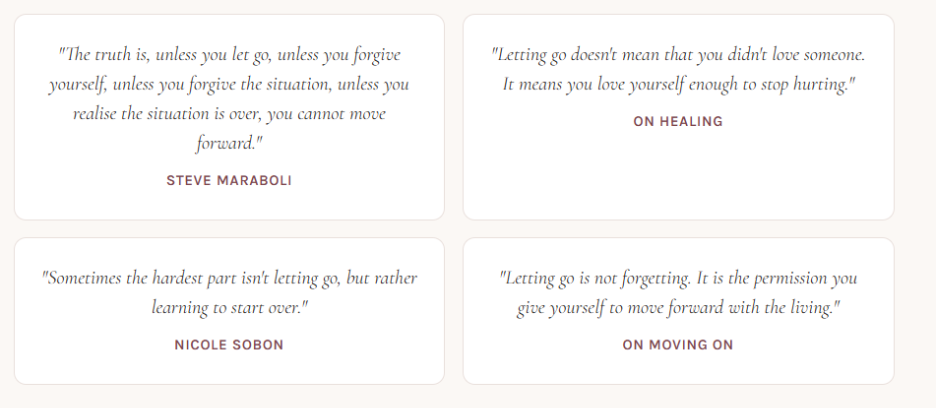
On Letting Go
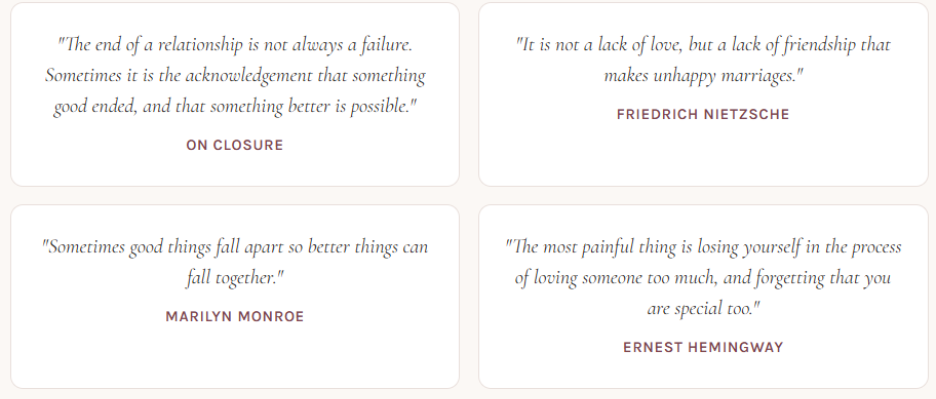
On the End of a Relationship
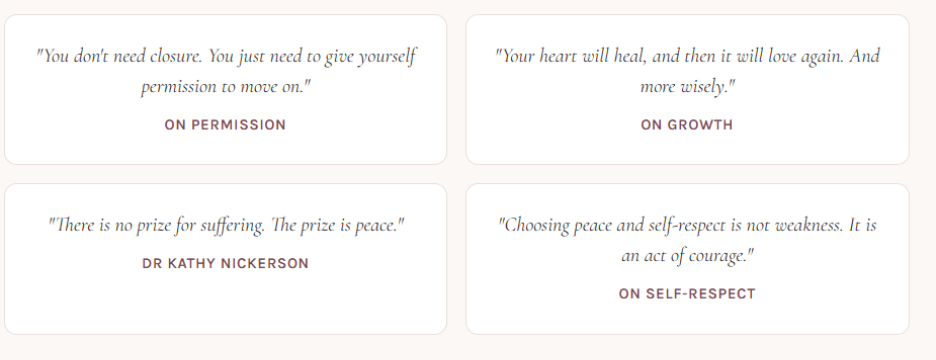
On Healing and Moving Forward
A Final Thought
If you have read this far, some part of you is probably looking for permission, or perhaps just for someone to confirm that what you are feeling makes sense. It does. Recognising that a relationship may have run its course is not a failure of love, patience, or commitment. It is often the result of paying honest attention to something you may have been avoiding for a long time, out of love, out of fear, out of hope.
Whatever you decide, you do not have to decide it alone.
FAQs
Q1. How do I know if it's time to let go or keep trying?
There is no single sign that settles this on its own, but a useful question to sit with is whether the relationship's difficulties are temporary and improving, or sustained and worsening. Rough patches caused by external stress, grief, career changes, financial pressure, tend to ease with time and effort from both people. Patterns like contempt, broken trust without accountability, unmet needs that go uncommunicated about for years, or feeling unsafe tend to point towards something more fundamental. If you have made genuine, sustained effort and the relationship still leaves you feeling depleted rather than supported, that is meaningful information, not a verdict on your commitment.
Q2. What are the most important signs of a toxic relationship?
The patterns most worth paying attention to are control disguised as care (constant checking, isolation from friends and family), emotional manipulation (gaslighting, guilt, withdrawal of affection as punishment), and cycles of idealisation followed by devaluation, where intense affection alternates with harsh criticism. Unlike difficult phases, these patterns tend to be sustained and escalate rather than resolve. If you notice yourself shrinking, doubting your own perceptions, or feeling controlled rather than cared for, these are signs worth taking seriously, ideally with support from someone outside the relationship.
Q3. Is it okay to leave a relationship you still love?
Yes. Love and rightness are not always the same thing. It is entirely possible to love someone and still recognise that the relationship is not healthy, sustainable, or right for either of you. Many people stay far longer than is good for them because they mistake the presence of love for a workable relationship. Letting go while still loving someone is one of the hardest things a person can do, and it does not make the love any less real or the decision any less valid.
Q4. How long should I wait before leaving an unhealthy relationship?
There is no fixed timeline, and anyone offering you one specific number is probably oversimplifying. What matters more than time elapsed is whether there is genuine, sustained change happening, not promises of change, but actual different behaviour over a meaningful period. If you are in immediate physical or emotional danger, this question does not apply: leaving safely becomes the priority regardless of how long you have been together. For non-abusive but unhealthy patterns, many counsellors suggest giving honest effort, including couples counselling, a genuine window of a few months, while paying close attention to whether anything is actually shifting.
Q5. Can a toxic relationship be fixed?
Sometimes, but it depends heavily on specific conditions. Both people need to genuinely acknowledge the toxic patterns, rather than one person doing all the work of naming and changing them. The person responsible for harmful behaviour needs to take real accountability without minimising or blaming the other person. Professional support, often individual counselling alongside couples work, tends to be necessary rather than optional. If there is active abuse, the relationship is not safe to work on while the abuse continues; safety has to come first. Many toxic patterns can shift with sustained, professionally supported effort from both partners, but this requires real willingness on both sides, not just good intentions.
Q6. What is the first step to leaving an unhealthy relationship in India?
The first step is often simply naming what is happening honestly to yourself, separate from family opinions or social expectations, since the Indian context often makes this harder than it might seem. From there, practical steps tend to include building a support system of people who will not pressure you either way, understanding your financial position and resources (organisations like Tele MANAS can help with guidance here), and considering professional counselling, which can help you think through the decision itself as well as the practical steps that follow. If safety is a concern, contacting the National Commission for Women helpline or your local One Stop Centre is an important early step, not a last resort.
Q7. How do I support a friend who is in an unhealthy relationship?
Listen without judgement, and resist the urge to give an ultimatum or insist they leave immediately, even if that feels like the obviously right advice. People in unhealthy relationships often already feel judged or unheard, and pressure can sometimes push them to withdraw or defend the relationship more. Stay consistently present and available, share concerns honestly but gently, and remind them, repeatedly if needed, that support is there whenever they are ready. If there is a safety concern, gently share helpline information (Tele MANAS, NCW) without forcing the conversation. Your steady presence over time often matters more than any single conversation.
References
- Dr. Kathy Nickerson. (n.d.). How to know when it's time to let go of your relationship. https://drkathynickerson.com/blogs/relationship/how-to-know-when-it-s-time-to-let-go-of-your-relationship
- EBSCO Information Services. (n.d.). Identity fusion. EBSCO Research Starters. https://www.ebsco.com/research-starters/psychology/identity-fusion
- Empathi. (n.d.). Enmeshment: What it is, signs, and how to heal. https://empathi.com/blog/enmeshment/
- Gottman Institute. (n.d.). I'm lonely in my relationship. https://www.gottman.com/blog/im-lonely-in-my-relationship/
- Gottman Institute. (n.d.). The Four Horsemen: Recognizing criticism, contempt, defensiveness, and stonewalling. https://www.gottman.com/blog/the-four-horsemen-recognizing-criticism-contempt-defensiveness-and-stonewalling/
- Healthline. (n.d.). Toxic relationship: Signs and how to cope. https://www.healthline.com/health/toxic-relationship
- Impossible Psychological Services. (2024, November 28). Understanding the sunk cost fallacy in relationships. https://www.impossiblepsychservices.com.sg/our-resources/articles/2024/11/28/understanding-the-sunk-cost-fallacy-in-relationships/
- Marriage.com. (n.d.). When to let go of a relationship. https://www.marriage.com/advice/relationship/when-to-let-go-of-a-relationship/
- MindBodyGreen. (n.d.). Signs it's time to let go of your relationship. https://www.mindbodygreen.com/articles/signs-its-time-to-let-go-of-your-relationship
- Ministry of Health and Family Welfare, Government of India. (n.d.). Tele MANAS. https://telemanas.mohfw.gov.in/about
- Ministry of Women and Child Development, Government of India. (n.d.). Mission Shakti. https://missionshakti.wcd.gov.in/contact
- Mud Coaching. (2025, February 18). Yes, it's time to leave: When to walk away. https://www.mudcoaching.com/blog/2025/02/18/yes-its-time-to-leave-when-to-walk-away
- National Commission for Women. (n.d.). National Commission for Women. https://www.ncw.gov.in/
- Psychology Today. (n.d.). Gaslighting. https://www.psychologytoday.com/us/basics/gaslighting
- Rego, S., Arantes, J., & Magalhães, P. (2017). Is there a sunk cost effect in committed relationships? Current Psychology, 36(4), 782–788. https://doi.org/10.1007/s12144-016-9529-9
- Relationships Actually. (n.d.). 7 reasons why people stay in unhappy relationships. https://www.relationshipsactually.org/post/7-reasons-why-people-stay-in-unhappy-relationships
- Rhoades, G. K., Stanley, S. M., Markman, H. J., & Whitton, S. W. (2018). How interdependent are stay/leave decisions? On staying in the relationship for the sake of the romantic partner. https://www.researchgate.net/publication/326566650_How_Interdependent_Are_StayLeave_Decisions_On_Staying_in_the_Relationship_for_the_Sake_of_the_Romantic_Partner
- Roger K. Allen & Associates. (n.d.). Toxic relationship patterns that kill love. https://www.rogerkallen.com/toxic-relationship-patterns-that-kill-love/
- Varma, G. (2018, April 26). Does India's low rank on global divorce rate indexes mean happy marriages or social pressure? ThePrint. https://theprint.in/talk-point/does-indias-low-rank-on-global-divorce-rate-indexes-mean-happy-marriages-or-social-pressure/187180/
- Verywell Mind. (n.d.). What is love bombing? https://www.verywellmind.com/what-is-love-bombing-5223611


.svg)
.svg)
.svg)
.svg)