Counselling helpline for employees of partner organisations


.png)
Counselling helpline for employees of partner organisations
Counselling helpline for employees of partner organisations


A Case Study on the People, Pressure, and Emotional Labour Behind India’s Hospitality Industry

India’s hospitality industry is built around consistency, speed, and service that never appears to break. Across hotels, restaurants, resorts, and guest-facing environments, frontline employees keep operations running through long shifts, emotional labour, constant customer interaction, and the pressure to remain composed regardless of what happens behind the scenes.
This case study explores the realities of hospitality work beyond the guest experience and the emotional strain that often remains invisible within service environments. It examines how support systems were adapted to fit the operational intensity of hospitality work, and what began to shift when emotional wellbeing became easier to access within one of India’s most people-dependent industries.
Hospitality is one of the few industries where the work never really stops.
Someone is always checking in late. A room needs to be turned around before the next guest arrives. A banquet team is setting up for a wedding while the breakfast shift is winding down. A chef is still on the line long after service hours. A front office executive is managing an upset guest while housekeeping is already racing against the clock upstairs.
That is what the industry looks like in practice. Fast-moving, people-heavy, and deeply operational.
In India, hospitality has grown far beyond hotels alone. Today, the industry stretches across hotels, restaurants, cafés, resorts, cloud kitchens, medical stays, pilgrimage tourism, destination weddings, and corporate travel
.png)
Growth has accelerated sharply over the last few years. Rising domestic travel, higher disposable incomes, business mobility, and experience-led spending have transformed hospitality into one of India’s fastest-growing service sectors. India’s hospitality market, estimated at around USD 247billion in 2024, is projected to almost double over the next decade.
That growth is visible on the ground.
India currently has over 180,000 branded hotel rooms, with thousands more being added across business hubs, leisure destinations, pilgrimage circuits, and tier-2 cities. In 2025, the country recorded one of the largest hotel development pipelines in the Asia-Pacific region, with close to 89,000 rooms under development
The industry runs on a layered workforce operating together in real time:
.png)
Unlike many industries where work happens behind screens, hospitality plays out live, in front of the customer, every single day.
Employees are expected to remain calm, attentive, and solution-oriented regardless of long shifts, demanding guests, or operational pressure. At the same time, customer expectations have changed dramatically. Online reviews, digital visibility, and service reputation now influence business as much as pricing or location.
And yet, despite its scale and intensity, hospitality remains one of India’s most human industries. Because at its core, the business is not simply about rooms, food, or bookings. It is about making people feel looked after.
Hospitality is built around consistency. Regardless of occupancy levels, difficult guests, staffing gaps, delayed check-ins, or peak-season rush, service is expected to remain seamless at all times. That constant expectation places immense pressure on hospitality employees, where emotional labour, irregular schedules, and continuous guest-facing interactions have been consistently linked to emotional exhaustion and burnout across the industry.
One of the biggest contributors is the nature of the work itself. Hospitality employees are expected to remain calm, attentive, and emotionally available regardless of workload, customer behaviour, or shift timings. Over time, continuously managing emotions as part of the job can become mentally exhausting.
The pressure is further intensified by operational realities that are deeply embedded into hospitality work:
.png)
The industry also continues to face high attrition, particularly in customer-facing operational roles. Organised hospitality and F&B businesses have reported attrition levels ranging between 35% and70%, reflecting the strain many teams continue to operate under.

Beyond industry-wide research, several of these patterns also emerged consistently through our own engagement with hospitality workforces.
One recurring challenge was accessibility. Because operational employees spend most of their shifts attending to guests and service areas, meaningful onsite engagement opportunities remained limited. In many locations, the only realistic interaction windows were short meal breaks, where employees were often rushing to return to operations
Another visible trend was demographic. In one hospitality workforce we engaged with, nearly75% of employees belonged to Gen Z age groups. Managers frequently observed a strong need among younger employees to constantly demonstrate productivity and responsiveness, often leading to overextension and eventual burnout
Supporting hospitality employees required far more than introducing a standard wellbeing programme. The challenge was not simply providing support, but making support accessible within one of the country’s most operationally demanding industries.
Our approach focused on building a layered and accessible support ecosystem that could function within the rhythm of hospitality operations rather than outside it.
This included a combination of emotional wellbeing support, preventive interventions, manager enablement, onsite engagement, and digital accessibility models designed specifically for operational workforces.
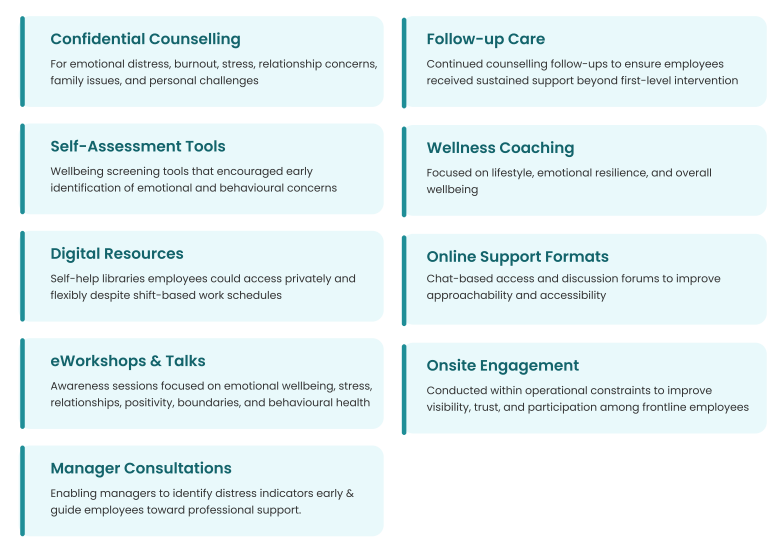
The interventions were not limited to crisis management alone. A significant focus was placed on normalising conversations around emotional wellbeing within hospitality environments where emotional fatigue often remains invisible behind service expectations.
Importantly, the approach also had to account for workforce realities unique to hospitality operations:
Over time, the engagement evolved into a more integrated wellbeing ecosystem that combined emotional support, preventive care, awareness-building, and leadership involvement within the operational realities of hospitality work.
.png)
These interventions were brought to life within one of India’s leading hospitality organisations, offering a closer look at how emotional wellbeing support can function at workforce scale.
Within one of India’s largest hospitality workforces, the wellbeing ecosystem saw strong adoption across counselling, awareness, preventive support, and digital wellbeing initiatives, despite the challenges of shift-based schedules, guest-facing responsibilities, and limited employee downtime. In just one year alone:
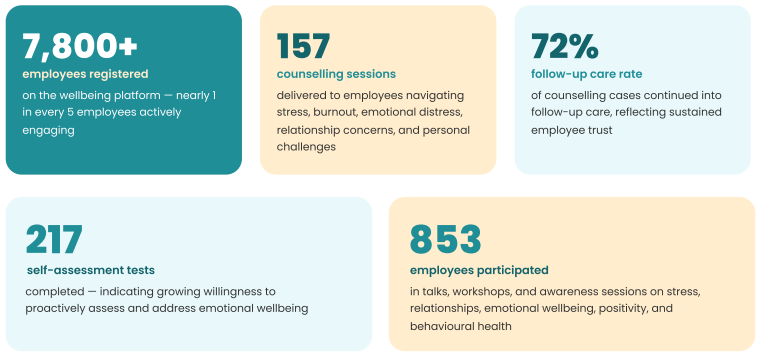
The engagement also enabled managers and leadership teams to play a more active role in identifying distress indicators and guiding employees toward appropriate support systems. Importantly, the interventions succeeded within an industry environment where employees are rarely stationary for long periods of time. Much of the engagement had to be built around operational realities, with interactions often happening between shifts, during short meal breaks, or through flexible digital access models.
What emerged over time was not just programme participation, but a gradual normalisation of emotional wellbeing conversations within frontline hospitality environments.
The scale of engagement seen over the year reflects growing openness among hospitality employees to actively seek support, access preventive resources, and continue care journey seven within one of the country’s most operationally demanding industries.
The future of hospitality will be shaped not just by how guests are treated, but by how the people behind the experience are cared for.
.png)
To support employees across countries, cultures, and contexts through structured EAP services, connect with 1to1help


.svg)
.svg)
.svg)
.svg)
.png)