Counselling helpline for employees of partner organisations


Counselling helpline for employees of partner organisations
.png)
Counselling helpline for employees of partner organisations
Counselling helpline for employees of partner organisations


Retail employees navigate sales targets, long shifts, changing schedules and constant customer interactions, often with little room to pause. This case study explores how organisations integrated mental health support into the workday, making it more accessible to frontline teams and helping employees seek support earlier.
Key Takeaways:

India’s retail industry is built around constant interaction. Every day, employees move between customers, counters, stockrooms, and screens, managing demand that can change by the hour. Across stores and formats, the work is visible, fast-paced, and shaped by expectations that keep rising, both in person and online.
This case study looks at what that experience is like for teams on the floor, and the strain that often stays unspoken behind everyday transactions. It explores how organisations integrated mental health support into the workday, and the measurable changes in employee wellbeing, utilisation, and retention.
Retail doesn’t start on the shop floor. It starts with people walking in with different needs, moods, and expectations, all at once.
Spend a few minutes inside any store and the rhythm becomes clear. There is no fixed pace. A quiet afternoon can turn into a rush within minutes. Even today, close to 80% of retail transactions globally still happen in physical stores. Which means the experience depends heavily on frontline teams who are constantly responding, adjusting, and staying present with customers.
At the same time, retail is no longer just physical.
E-commerce now makes up a significant and growing share of how people shop. A product might be discovered on an app, checked in-store, and purchased later through a marketplace. For employees, this changes the nature of the job. They are not just assisting a customer in front of them, but also meeting expectations shaped by fast delivery, endless choice, and seamless digital experiences.
In India, this mix becomes even more layered. Nearly 88% of retail is still unorganised, built on over 13 million kirana and neighbourhood stores. These are not just points of sale. They run on familiarity, informal credit, and everyday relationships with customers.
At the same time, organised retail and digital platforms are expanding quickly, bringing in scale, consistency, and rising expectations. Both worlds exist side by side, often serving the same customer in different moments of their day.
Growth is also coming from beyond the metros. Tier II and Tier III cities are adding a large share of new consumers, each with their own context and pace of adoption. For organisations, this means operating across very different realities at once.
All of this plays out through people.

Retail teams are largely frontline, customer facing, and working around changing schedules and peak hours. The work can be repetitive, unpredictable, and always visible. Attrition is high, not because people do not care, but because the demands rarely pause.
This is retail today. A constant mix of physical stores, digital journeys, and neighbourhood relationships. And at the centre of it are frontline employees holding everything together, one interaction at a time.
Retail looks active, energetic, even straightforward from the outside.
But underneath, there’s aconstant strain that rarely gets acknowledged.
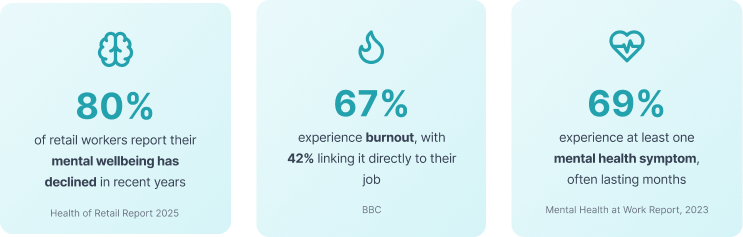

Retail employees are expected to stay calm, helpful, and present regardless of the situation.
Unlike other industries, this is often treated as routine, not as something that needs intervention.
Research (Society of Occupational Medicine) shows that this kind of instability is strongly linkedto distress, fatigue, and poor overall wellbeing.
This mismatch is a known driver of stress in occupational health research.
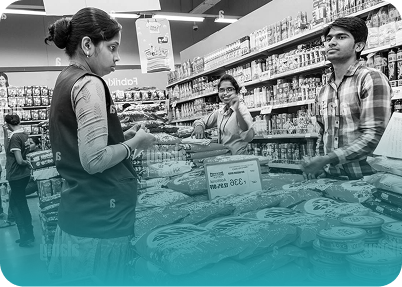
This is not just about individual stress. It shows up in ways that are very specific to retail operations:
Retail runs on frontline consistency. But the environment they operate in makes consistency hard to sustain. That is the core tension the industry is dealing with today.
To address these challenges, the organisation, part of a large, structured retail chain with multiple store locations, partnered with us to introduce an Employee Assistance Programme (EAP) as a foundational layer of support.
At its core, the approach was simple: make support accessible, familiar, and easy to reach for a workforce that is constantly on the move.




Alongside this, communication played a key role. The focus was on consistently reminding employees that support exists and can be accessed without friction or judgement.
The intent was not to overhaul the system overnight, but to introduce a reliable, professional support layer that employees could turn to when needed. A starting point that fits into the reality of retail, rather than disrupting it.
Given the distributed nature of the workforce, efforts were designed to reach employees across roles and locations. The shift wasn’t dramatic or instant. It showed up in smaller, more everyday ways.
In a workplace where most people are used to “just managing,” the first change was this: people started reaching out. Not always for big issues. Sometimes just to talk things through before it built up
.png)
What stood out was not volume, but intent. People were engaging earlier, and more willingly.
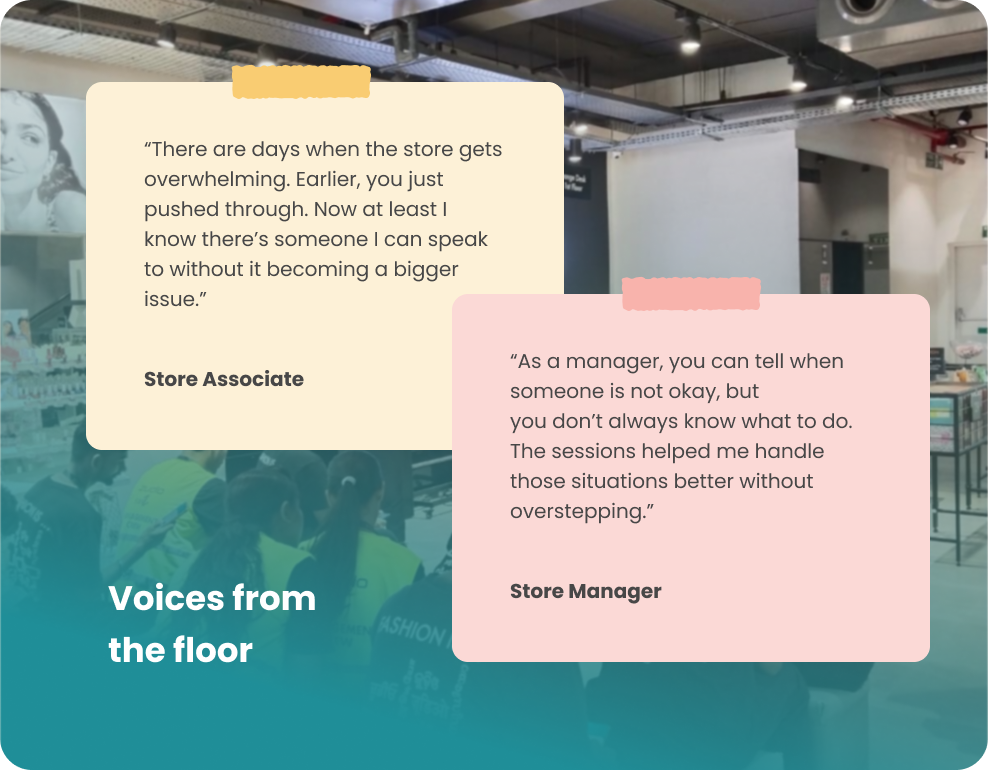
This is what early impact looks like in retail.
Not immediate transformation, but a gradual shift in how people experience and respond to pressure. And in an environment where stress is constant, even small shifts like these begin to matter.
If you’re looking to build this kind of support, schedule a demo and we’ll walk you through what it could look like for your teams.


.svg)
.svg)
.svg)
.svg)
.png)