Counselling helpline for employees of partner organisations


.png)
Counselling helpline for employees of partner organisations
Counselling helpline for employees of partner organisations


A Case Study on Mental Wellbeing in India's Real Estate Workforce

Somewhere in this country, a building is going up right now. A mason is laying bricks in the afternoon heat. A site engineer is on a call, managing a delay no one planned for. A sales executive is walking a family through a flat they have been saving for years to afford. And a project manager is trying to hold a timeline together with fewer people than the job actually needs.
This is India's real estate sector. It does not stop. It does not slow down between quarters orbetween projects. And the people inside it rarely get a moment to ask how they are really doing.
This case study looks at who makes up this workforce, what the daily weight of this industry feels like from the inside, and how organisations began to build mental wellbeing support that fit the reality of people's lives rather than sitting outside it.
Every city in India is mid-construction. Cranes punctuate the skyline. New townships come up on what was farmland five years ago. Office parks fill up faster than they are built. The demand is real, the pace is relentless, and the industry feeding all of it is the second-largest employer in the country.
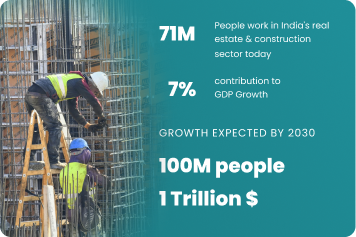
Over 71 million people work in India's real estate and construction sector today. That number is expected to cross 100 million by 2030. The sector contributes approximately 7% to GDP and is on track to reach a market size of USD 1trillion by 2030.
Behind those numbers is an enormous range of people doing very different kinds of work —often in the same project, sometimes in the same building, but in entirely different worlds.
The real estate workforce is not one cohort. It spans:
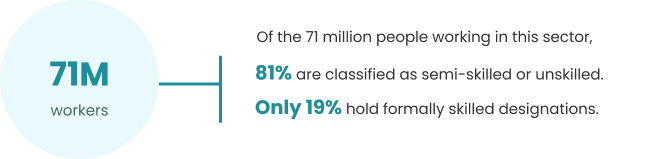
The blue-collar workforce — site workers, helpers, masons, electricians, plumbers — forms the backbone of every project. They are also the least likely to have access to formal employee benefits, grievance mechanisms, or any kind of wellbeing support.
Women remain a small presence at the site level, though their numbers are growing in sales and corporate roles. Many workers, particularly those in construction, are migrant labour — away from their families, living in site accommodation, and working in conditions that offer little separation between work and rest.
Real estate is project driven. Everything moves in cycles: land acquisition, approvals, launches, construction, possession. Employment intensifies during construction phases and project launches, and every quarter end brings its own pressure spike.
Gross leasing across India's top seven cities crossed 60 million sq ft for the first time in recent years, a 26% jump year-on-year. Residential demand has remained strong, with India's housing market ranking among the fastest-growing globally. This growth has not slowed the pace. If anything, it has raised expectations further.
For most people in this sector, there is no off-season.
The pressures in real estate are not invisible. They are structural. They are written into how the industry is designed to operate.
For blue-collar workers, the physical environment is the first layer of stress. Long working hours in outdoor conditions, exposure to dust and chemicals, noise, heat, and repetitive physical labour are daily realities. Safety protocols exist, but enforcement is uneven. Injuries, when they happen, often go unreported.
Most site workers are migrants. They have left their families behind, sometimes travelling hundreds of kilometres, to work on a project they may never see through from start to finish. They live in site accommodation, often cramped, shared, and far from anything familiar. They send most of what they earn back home. Financial pressure is constant. Job security is not guaranteed— many are hired through contractors, which means a project delay or a change in scope can mean no work, and no pay, overnight.
There is very little room in this life for emotional recovery. After a twelve-hour shift in the heat, there is no quiet space to decompress, no one trained to notice if something is wrong, and often no language — literal or cultural — to describe what they might be feeling. Substance use, typically alcohol, becomes a way to cope rather than a choice.
When they come back to the site the next morning, the fatigue from the day before has not fully cleared. It accumulates — and over weeks and months, it starts to show up in their behaviour, their concentration, and their health.
Sales professionals carry a different kind of load. Targets are set monthly. Incentive structures mean that income itself is variable. Market cycles, regulatory shifts, and project delays are outside their control, but the pressure to close deals is not.
Client relationships are emotionally demanding. Buyers are making large, often life-defining financial decisions, and the emotional weight of those conversations lands on the person sitting across from them. When a deal falls through after months of effort, there is rarely a structure in place to process that.
Attrition in sales is high. The churn has become normalised. But what drives it — stress, burnout, disillusionment — rarely gets addressed before someone leaves.
Middle management in real estate exists at the intersection of upward pressure and team delivery. They absorb expectations from above and try to protect their teams from the worst of it — often while dealing with the same pressures themselves. Manager wellbeing tends to be the most overlooked. They are expected to be the support structure for others. Rarely is anyone asking how they are doing.
Across all cohorts, stress does not end when the shift does. For blue-collar workers, financial anxiety, family separation, and limited access to healthcare persist outside working hours. For salaried employees, long commutes, housing costs in urban centres, and family responsibilities compound the pressure they absorb at work.
Workplace stress costs Indian businesses an estimated USD 14 billion annually in lost productivity. Among those most affected are workers under 30, who report the highest levels of anxiety and depression across industries. Real estate is not an exception.
In many ways, it is an extreme case.

Across real estate clients, the picture that emerged from counselling data was consistent.
Most people sought support for:

Within work-related concerns, the most common issues were work-life imbalance, career anxiety, and strained workplace relationships. Substance use appeared as a coping response, particularly among male employees in site and field roles, reflecting patterns seen more broadly in blue-collar populations.
The barriers to seeking support were also consistent. Low awareness of what was available. Strongstigma, especially among male workers and on-site employees for whom seeking help felt likeadmitting weakness. Mistrust of formal systems. And in many cases, simply not knowing how toaccess support or believing it was meant for someone else.
Most employees waited until they were in acute distress before reaching out. By that point, theissue had often already affected their work, their relationships, and their health.
The challenge was not convincing organisations that mental health mattered. Most already understood that it did. The challenge was building something that actually worked for a workforce as varied and geographically dispersed as real estate — a workforce that included both a site labourer in Agartala and a sales manager in Gurgaon. The approach adapted to the industry rather than asking employees to adapt to a standard wellness model.
Employees registered with a company code. No approval process, no manager referral required.Sessions were available by phone, video, or chat. For site workers and field employees with limitedsmartphone access, telephone remained the primary and most trusted channel
Support extended beyond apps and intranet pages through:
To address stigma — particularly among blue-collar and male employees — awareness wasintegrated into the employee experience through:
Group sessions, webinars, and self-help resources allowed employees to engage without immediately seeking one-on-one support.
Topics reflected real industry concerns, including financial pressure, family strain, uncertainty, and fatigue.
Managers on construction sites and in sales teams are often the first to observe a change in a colleague's behaviour.
Training focused on:
This reduced the gap between a problem appearing and someone getting help.
Wellbeing was not treated as a campaign. Weekly newsletters, monthly mailers, and ongoing communication kept the topic present. Support was available between crises, not only during them.
The first signs of change appeared in how employees used the system and whether they stayed engaged after the first contact.
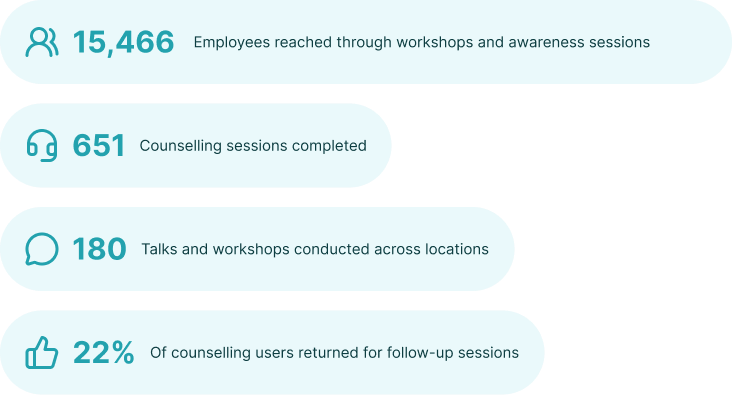
One of the most significant shifts happened at the site level. Following a 6-month pilot across multiple project locations, our client launched SAHYOG — a dedicated mental health initiative for construction workers — now active across79 construction sites nationwide, with the potential to reach close to 30,000 workers across Mumbai, Delhi NCR, Bengaluru, Chennai, Pune, Hyderabad, Kolkata, Gujarat, and Chhattisgarh.
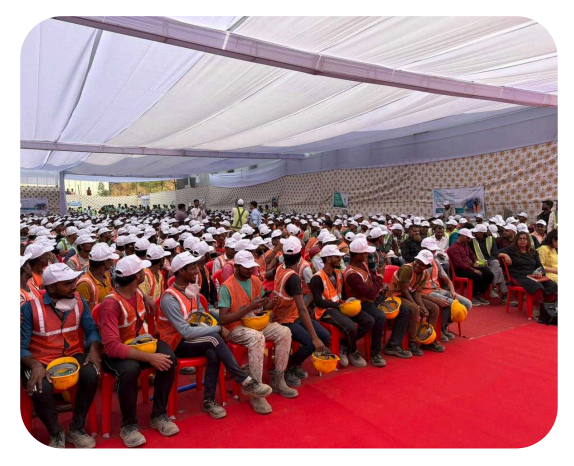
The pilot tested what actually worked on the ground: regular on-site group sessions, confidential one-on-one counselling, and a24-hour audio-visual helpline. What it proved was that when support is physically present, culturally familiar, and available in the workers' own language, blue-collar employees do engage. Trust is not impossible to build. It just requires consistency and proximity, not just a helpline number on a poster.
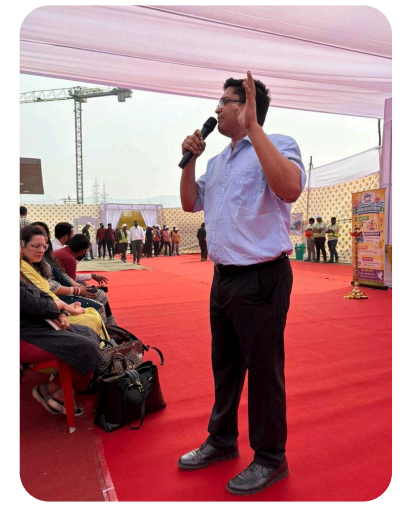
The age profile of users across the broader programme told its own story. Over 80% were between 20 and 39 years old — the demographic that tends to be hardest to reach and most resistant to formal support. Male employees made up the majority of users, a meaningful shift in a sector and a culture where male help-seeking behaviour has historically been low.
India's real estate sector is growing at a pace that demands more from its workforce every year. The ambition is real. So is the pressure it creates — for the engineer on a night shift, the sales executive chasing a month-end target, the migrant worker far from his family, and the manager holding it all together. Mental wellbeing cannot be an afterthought in an industry built this way. It has to be designed into how organisations take care of their people — across every level, every role, and every location. That design is what makes the difference between support that exists and support that works.
Explore what a customised solution could look like for your workforce.
Connect with us at 1to1help


.svg)
.svg)
.svg)
.svg)
.png)