
Examining how employee support is understood, accessed, and experienced across international teams and diverse work environments

As organisations expand across geographies, managing employee wellbeing becomes increasingly complex. Teams are spread across countries, cultures, and time zones—each with different expectations, local systems, and access to support. What works in one region does not always translate seamlessly to another, making it difficult to offer a consistent and meaningful employee experience globally.
For organisations, this often creates a fragmented landscape of support. Employees may not know where to turn, managers may lack clarity on available resources, and HR teams are left navigating multiple vendors, varying standards of care, and limited visibility into what support actually looks like on the ground.
In such environments, global EAPs are often introduced to bring structure and consistency to employee support. Through our partnership with ComPsych, these programmes are extended across international teams—offering access to local providers, multilingual services, and round-the-clock support.
This case study looks at how this model was implemented across organisations with distributed teams, and what it revealed about delivering support at a global scale.
As organisations expand across geographies, teams are no longer sitting in the same office, oreven the same time zone. Work is now spread across countries, cultures, and contexts. Nearly onethird of all working days globally are remote, and over 90% of employees say they prefer hybrid orremote work (Wikipedia; Neat, 2024).
On the surface, this shift works. Teams are more flexible. Talent pools are wider. Work continuesacross time zones. But underneath, the experience of work has started to change in ways that are harder tosee. Managing distributed teams is not as seamless as it appears
.png)
.png)
For HR and leadership, this often means holding together systems that were not designed to stretch this far. For employees, the challenge feels different. Work continues, but connection does not always follow.
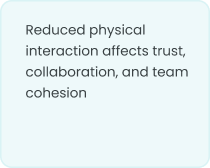
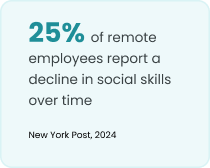
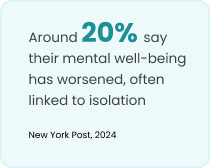
There is also a growing pressure on those expected to hold teams together.
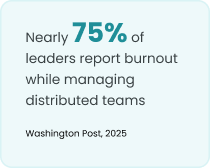
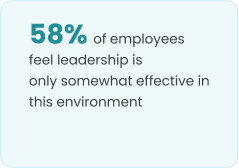
At the same time, the experience of support itself is not consistent.
What an employee has access to, how they seek help, and what feels acceptable varies across regions. Work experiences differ significantly across countries, roles, and local contexts
So while organisations have successfully built global teams, what employees experience within those teams is far from uniform.
Across the organisations we work with, these patterns became more visible through ongoing programme reviews and the way support was implemented and managed across regions.
What stood out was not the absence of support, but how that support was experienced.
Employees already had access to a wide range of services. Counselling, financial and legal consultations, and work-life support were available across regions, often delivered throughlocal providers and adapted to different cultural contexts.
On paper, this created a comprehensive ecosystem of care.
Yet, when viewed over time and across organisations, a different picture began to emerge.
The presence of multiple services did not always translate into a clear or consistent experience for employees. The way support was understood, accessed, and prioritised varied across geographies, roles, and moments in time.
Employee needs were also rarely one-dimensional. Emotional concerns often existed alongside practical challenges such as financial stress, family responsibilities, or relocation. But these needs were not always experienced as part of a connected system of support.
To address the complexities of supporting teams across geographies, organisations introduced a structured global EAP model through 1to1help in partnership with ComPsych.
The intent was to move away from fragmented, region-specific solutions and establish a more consistent approach to employee support across locations.
This included adapting the programme to organisational structures, regional contexts, and employee needs, rather than applying a uniform approach across locations.
Employees across countries were provided access to support through multiple channels, including phone, chat, and digital platforms.
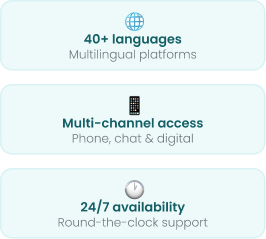
Services were available 24/7 and delivered in local languages, supported by digital platforms accessible in over 40+ languages such as English, Chinese, French, German, Japanese, and Spanish and adapted to country-specific contexts.
Support extended beyond counselling alone. The programme included:
🧠Emotional & Behavioural Health
Short-term counselling for personal and workplace concerns
💰Financial Consultations
Planning, debt management, and personal finance guidance
⚖️Legal Guidance
Family law, tenancy, civil matters, and legal consultation
🏠Work-Life Support
Childcare, eldercare, relocation assistance, and logistics
🚨Critical Incident Stress Management (CISM)
Dedicated support during high-impact events: organisational changes, crises, or unforeseen incidents affecting teams.
This created a broader support system that reflected the range of challenges employees were navigating, both personal and professional.
The model also ensured that support was not limited by geography.
A global network of providers enabled access to care within local contexts, while maintaining a consistent structure across regions. This allowed employees to engage with services that were both culturally relevant and aligned with organisational standards.
This was supported by close coordination between 1to1help, India-based teams, and in country partners, ensuring that the programme remained aligned across regions while adapting to local contexts. Alongside service delivery, organisations were supported with:
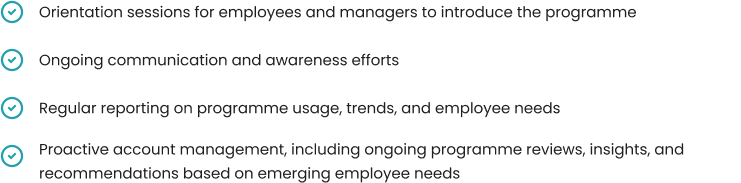
These elements were intended to ensure that the programme was not only available, but also visible and understood within the organisation.
Over time, this created a unified framework through which organisations could extend support to employees across geographies, while retaining the flexibility to respond to local needs.
While engagement varied across organisations and time periods, there were clear moments where support translated into meaningful action. At its strongest, theprogramme demonstrated what effective engagement could look like when employees recognised, trusted, and used the support available to them.
Across organisations, some of the highest levels of engagement observed included:
In these instances, employees did not just have access to support. They engaged with it.
They reached out.
They used multiple services.
They returned when needed.
These moments were not constant, but they were consistent enough to highlight an important shift. When support is visible, relevant, and easy to access, employees respond.
These patterns were not consistent across organisations or even across time within the same organisation. In some quarters, engagement was concentrated within small groups. In others, the same systems saw little to no activity. What remained consistent, however, was this contrast.
Support systems were already in place, often comprehensive and locally adapted. But their presence alone did not determine whether they would be used. What emerged from these observations was not a question of availability, but of how support was experienced in different contexts, and at different moments. This is where the difference between having a global system in place and having one that is actively used begins to show.
To support employees across countries, cultures, and contexts through structured EAP services, connect with 1to1help.


.svg)
.svg)
.svg)
.svg)
.png)