


.png)


.png)

Personal Growth & Well Being
10 Science-Backed Benefits of Waking Up Early — And How to Actually Do It
.jpg)
.png)
Written by
Aarohi Parakh,
Psychologist and Content Writer

Reviewed by
Sanjana Sivaram,
Psychologist and Clinical Content Head


Introduction
There is a particular kind of quiet that exists only in the early morning, before notifications start, before the household wakes, before the day asks anything of you. Many of the benefits of waking up early seem to come from that quiet itself, as much as from the early hour.
This is not a piece about moral superiority or the idea that early risers are somehow better people. It is simply true that waking up earlier, when it suits your life and your body, tends to come with a fairly consistent set of advantages: better focus, steadier mood, more time for things that matter, and, according to a growing body of research, a meaningfully lower risk of anxiety and depression.
This guide walks through the science behind why early rising seems to work, ten specific benefits worth knowing about, a dedicated look at what this means for students, and a realistic, gradual guide for actually shifting your schedule, while recognizing that not everyone is a morning person.
Why Waking Up Early Actually Works: The Science
The benefits of early rising are not just folklore or productivity culture. There is a fairly clear biological story behind why mornings tend to work in our favour.
Your Circadian Rhythm and the Suprachiasmatic Nucleus
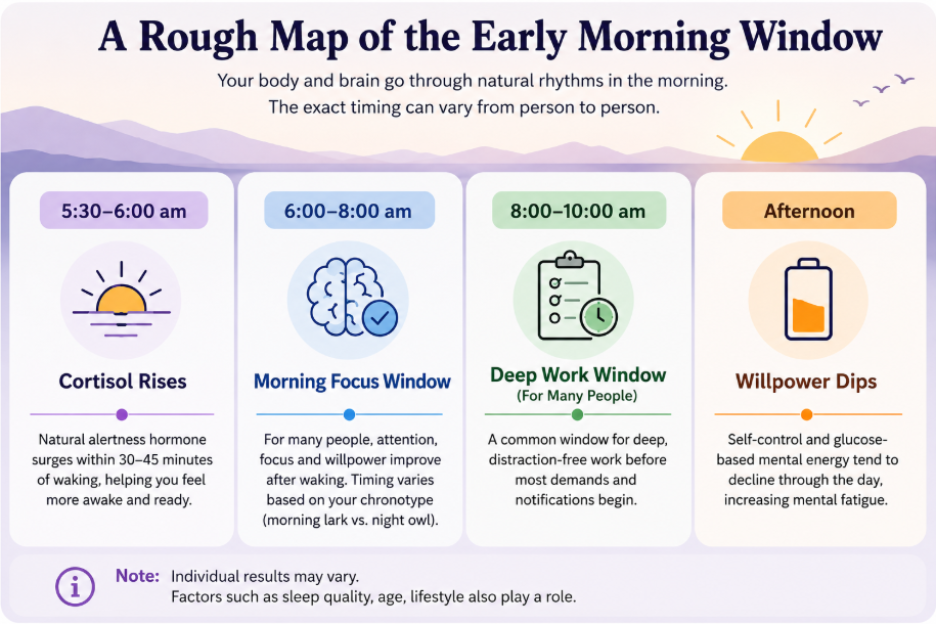
Deep in the hypothalamus (or the body’s master coordination center) sits a cluster of around 20,000 neurons called the suprachiasmatic nucleus, or SCN. This small structure functions as the body's master clock, regulating the sleep-wake cycle across roughly 24 hours. Morning light exposure appears to reset the SCN each day, triggering a release of cortisol that promotes alertness while suppressing melatonin, the hormone that makes you feel sleepy. People who wake with or shortly after natural morning light tend to have better circadian alignment than those who wake well after sunrise, which may explain why early mornings often feel less groggy once the habit settles in.
The Prefrontal Cortex Advantage
Executive functions such as planning, decision-making, and self-control, which are largely supported by the prefrontal cortex, fluctuate throughout the day in response to circadian rhythms and sleep. For many individuals, these functions may be strongest earlier in the day following adequate sleep, although this varies considerably depending on chronotype, sleep quality, and individual differences. Rather than running out of “willpower,” our capacity for focused attention and self-regulation is influenced by factors such as mental fatigue, sleep, stress, and our internal body clock. After a day of continuous decision-making and cognitive effort, many people find it harder to stay focused or make deliberate choices, though this varies from person to person. In practical terms, the morning may genuinely be your cognitive peak, which is worth knowing if you have important decisions or difficult tasks ahead of you.
The Cortisol Awakening Response
Within the first 30 to 45 minutes after waking, cortisol surges to its daily peak in what researchers call the Cortisol Awakening Response (CAR), a natural and healthy spike that supports energy and alertness. Early risers who use this window for physical activity, sunlight exposure, or a purposeful morning routine tend to get more benefit from this natural surge than those who spend the same window scrolling in bed.
10 Benefits of Waking Up Early
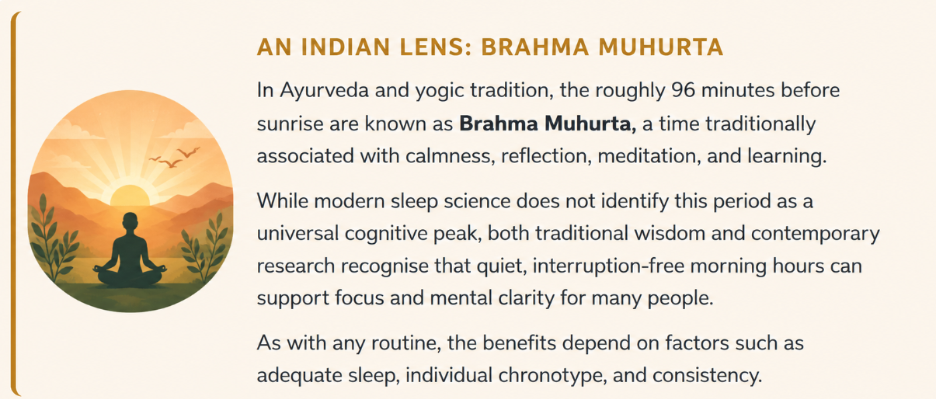
Some of these benefits are about biology, some are about the simple mathematics of time, and a few are quite specific to life in India. Here they are, in roughly the order most people may notice them.
Benefit 1: Better Mental Health
Research published in JAMA Psychiatry in 2021 examined genetic data from over 840,000 people and found that a one-hour earlier shift in sleep timing was associated with around a 23% lower likelihood of major depression. However, this does not mean that waking up earlier is beneficial for everyone. People's natural chronotypes differ, and forcing an early schedule that conflicts with one's biological rhythm may not improve mental health. Additionally, depression itself can lead to delayed sleep timing, making it difficult to determine the direction of the relationship. These findings suggest an association rather than proving that simply waking up earlier will prevent depression. Morning light exposure helps regulate the body's circadian rhythm (internal body clock). A well-aligned circadian rhythm is associated with healthier serotonin activity, which supports mood regulation and emotional well-being. This was a large genetic study rather than a behavioural trial, so it points to association rather than guaranteed cause and effect, but it is one of the more compelling pieces of evidence in this space.
Benefit 2: Higher Productivity And Focus
With the prefrontal cortex at its most active and the household or office still quiet, early risers often get genuinely distraction-free hours for deep work. This window tends to align with when your brain is naturally best equipped for concentration, which may explain why so many writers, founders, and researchers protect their early mornings so carefully.
Benefit 3: Better Sleep Quality Overall
Somewhat counter-intuitively, waking up earlier consistently tends to improve sleep quality rather than reduce it. Regular wake times help strengthen circadian entrainment, the process by which your body learns to expect sleep and wakefulness at consistent times, which can reduce the time it takes to fall asleep and increase the proportion of deep, restorative sleep you get each night.
Benefit 4: More Realistic Time for Exercise
Morning workouts tend to bypass the most common barrier to exercise: the competing demands that pile up later in the day. Morning movement also releases endorphins and BDNF (brain-derived neurotrophic factor), which research associates with improved mood, memory, and energy for the rest of the day.
Indian context: Morning yoga, pranayama, and walks are among the most culturally familiar early routines
Benefit 5: A More Proactive Mindset and Lower Stress
For many people, waking up earlier creates uninterrupted time before work, school or family responsibilities begin. This quiet period can be used to plan the day, exercise, meditate, or simply ease into the morning without feeling rushed. Research suggests that having greater control over one's time and daily routine is associated with lower perceived stress and better psychological well-being. However, these benefits are linked to how the extra time is used rather than to waking up early itself.
Benefit 6: Time For a Proper Breakfast
An earlier start to the day may make it easier for some people to fit in a relaxed, balanced breakfast, rather than skipping it in a rush. While the evidence on breakfast is mixed, its potential benefits depend on what is eaten, individual metabolism, hunger cues, and overall dietary patterns. Rather than waking up early itself, having enough time to make intentional food choices may be the more meaningful advantage. Skipping breakfast, more common among late risers rushing out the door, has been associated with afternoon energy crashes and reduced concentration.
Benefit 7: Better Skin Health
Healthy skin depends on many factors, including genetics, nutrition, hydration, sun protection and good-quality sleep. During sleep, the body carries out many repair processes, including collagen production and recovery from daily oxidative stress (i.e. imbalance of antioxidants in the body leading to cell damage) all of which support healthy skin. For some people, adopting an earlier and more consistent sleep schedule may make it easier to get sufficient, high-quality sleep and establish healthy morning habits, such as cleansing and applying sunscreen. However, the skin benefits are primarily linked to adequate, restorative sleep, rather than waking up early itself.
Benefit 8: Quieter, More Intentional Mornings
Early morning is one of the few reliably quiet windows in a day, no WhatsApp notifications, no emails, no social obligations yet. This quiet creates genuine space for journalling, meditation, planning, or creative work that can be hard to find at any other point in the day.
Indian context: In joint households or busy metro cities, early morning is often the only reliably private time of the day.
Benefit 9: Avoiding Peak-Hour Traffic
India's major metro cities, Bengaluru, Mumbai, Delhi, and Hyderabad among them, have some of the longest average commute times in the world. Leaving home even 30 to 45 minutes earlier can meaningfully reduce time spent in traffic. Research also associates prolonged exposure to heavy traffic with elevated blood pressure and cortisol levels, so an earlier departure may offer a genuine health benefit alongside the time saved.
Benefit 10: A Stronger Sense of Self-Discipline
For some people, consistently waking up early can become a positive daily habit that reinforces a sense of self-discipline. Author Charles Duhigg describes habits like this as "keystone habits," routines that can create positive ripple effects in other areas of life. Sticking to a regular wake-up routine may also strengthen self-efficacy, or the belief in your ability to follow through on your intentions. That said, the benefit comes less from waking up at a specific hour and more from maintaining a routine that is consistent and sustainable for you.
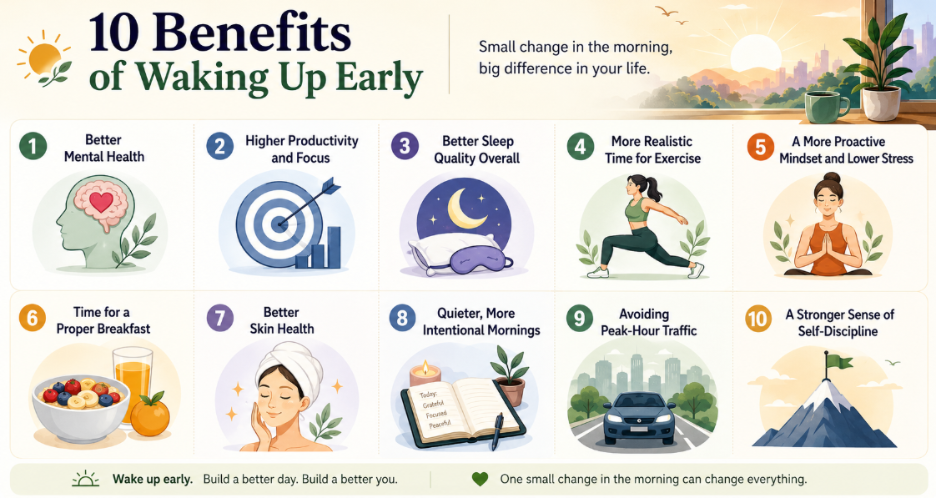
Why Waking Up Early Can Be an Advantage in the Indian Workplace
For many working professionals in India, the value of waking up early extends beyond biology. It can also create a practical buffer against the demands of increasingly fast-paced work lives.
The modern Indian workplace is characterised by long commutes, hybrid work schedules, global teams across time zones, and a constant stream of emails, meetings, and instant messages. By the time many employees begin their workday, they are already responding to competing demands. An earlier start can provide uninterrupted time to exercise, plan the day, complete focused work, or simply begin the morning without immediately reacting to notifications.
For professionals working with international teams, an intentional morning routine may also help create a healthier boundary before late-evening calls or extended work hours. Rather than sacrificing personal wellbeing, starting the day with time for movement, breakfast, or reflection can help maintain energy and emotional balance throughout demanding workdays.
That said, waking up early is not a productivity requirement or a measure of professional commitment. Industries such as healthcare, hospitality, customer support, manufacturing, and IT operations often involve shift work or non-traditional schedules, making an early morning routine impractical. In these situations, maintaining a consistent sleep schedule and getting sufficient, high-quality sleep are likely to matter more than the specific time shown on the clock.
Ultimately, the goal is not to wake up earlier for its own sake, but to create a routine that supports sustained performance, better emotional wellbeing, and healthier work-life boundaries.
Benefits of Waking Up Early for Students
For students, several of the benefits above apply with particular force, and there are a few additional reasons why an early start can genuinely support academic performance.
The prefrontal cortex, most active in the morning, is also responsible for the executive functions that matter most for academic work: working memory, sustained concentration, logical reasoning, and information retention. For students with morning routines, study sessions in the mornings may support better concentration and recall. However, adolescents often have naturally delayed sleep cycles, so evening study may work better for some.
Mornings before school or college begin also tend to be free of social media activity and friend group messaging, creating a study window that is harder to find later in the day. Reviewing material studied the previous evening during this morning window can also take advantage of memory consolidation, the process by which sleep helps move information from short-term to longer-term memory, so testing yourself in the morning on what you covered the night before tends to be a genuinely efficient way to study.
Morning exercise before school has also been linked, in research summarised in John Ratey's work on exercise and the brain, to improved classroom attention and same-day academic performance.
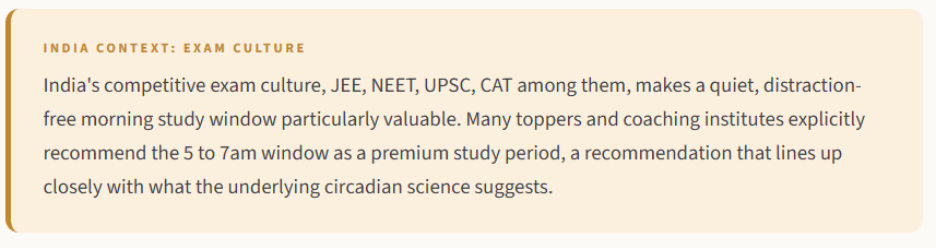
A note of balance: While many people find mornings ideal for focused learning, there is no universally "best" time to study. Your chronotype (whether you're naturally a morning or evening person), sleep quality, and consistency of your routine all influence when you perform best cognitively. The key is to study during your peak alertness while ensuring you get sufficient, high-quality sleep.
How to Wake Up Early: A Practical Transition Guide
Knowing the benefits is one thing. Actually shifting your schedule, especially if mornings have never been your strength, is another. Here is a realistic, gradual approach to how to wake up early without making yourself miserable in the process.
Step 1: Shift Gradually, Not Abruptly
Move your alarm back by 15 minutes every two to three days rather than attempting a sudden one- or two-hour jump. A hard reset can lead to sleep deprivation, making it harder to sustain an earlier routine. For many people, gradual adjustments like these make it possible to shift their wake time by about an hour over the course of a few to several weeks.
Step 2: Manage Your Light Environment Deliberately
Bright light exposure within the first 30 minutes of waking is one of the most powerful tools for resetting the circadian clock. Open your curtains immediately, step outside briefly, or use a light therapy box if natural light is limited. In the evening, the reverse matters too: dim your lights and reduce screen brightness 60 to 90 minutes before bed.
Step 3: Move Your Bedtime First, Not Just Your Alarm
Waking up earlier is genuinely beneficial only when paired with an earlier bedtime, not a shorter night. Most adults need 7 to 9 hours of sleep. If your target wake time is 6 am, your target bedtime is realistically 10 to 11 pm. Shifting the whole window matters more than shifting just one end.
Step 4: Anchor The Morning to Something You Actually Want
Attach one genuinely enjoyable activity exclusively to your early morning, a coffee you savour slowly and alone, a favourite podcast, a run, time in the garden. This creates a behavioural pull that makes waking up easier than relying on willpower alone. Habit-stacking research, discussed by both Charles Duhigg and James Clear, confirms that pairing a new habit with something you already look forward to tends to make it stick.
Step 5: Address Your Evening Environment, Not Just Your Morning
Scrolling on social media, late-night news consumption, stimulating content, and blue light exposure all tend to delay melatonin onset and push your actual sleep time later, regardless of when your alarm is set. A simple 30-minute wind-down routine, light reading, journalling, and gentle stretching tends to be one of the single most effective changes you can make to support an earlier wake time.
A Final Thought
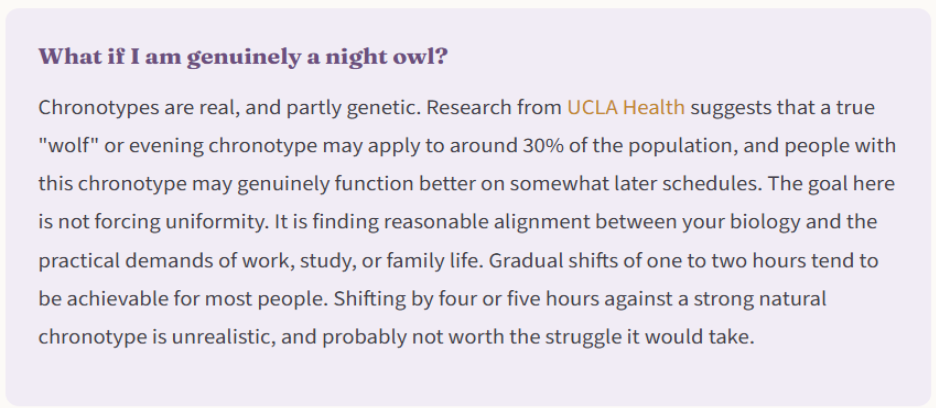
None of this is about becoming a different person, or proving something to yourself through sheer discipline. It is simply that the early morning, for many people, tends to offer a quieter, more biologically favourable window than the rest of the day provides. If shifting your schedule even slightly earlier feels worth trying, a gradual, gentle approach is far more likely to last than a dramatic overnight change.
And if sleep itself, rather than just timing, feels like a genuine struggle, that is worth a conversation with a professional, not something to push through alone.
Whether you're a working professional or a student, you don't have to navigate sleep challenges, stress, or emotional wellbeing on your own. Through its Employee Assistance Programme (EAP) and Student Assistance Programme (SAP), 1to1help provides confidential counselling, emotional wellbeing support, and expert guidance to help individuals build healthier habits and improve their overall quality of life. If persistent sleep difficulties or stress are affecting your daily functioning, reaching out for support can be an important first step.
FAQs
Q1. What is the best time to wake up in the morning?
There is no single universally correct time, since this depends on your individual chronotype, sleep needs, and daily schedule. That said, research on circadian biology and the Cortisol Awakening Response suggests that waking with or shortly after natural light, broadly between 5:30 and 7am for most people in most seasons, tends to align well with the body's natural rhythms. What seems to matter more than a specific clock time is consistency: waking at roughly the same time each day, including weekends, appears to support circadian alignment more reliably than chasing an exact ideal hour.
Q2. Is waking up at 5am actually healthy?
Waking at 5am can be healthy for many people, provided it is paired with an appropriately early bedtime to keep total sleep duration within the recommended 7 to 9 hours for adults. The health benefits associated with early rising, better mood, sharper focus, improved circadian alignment, come from the timing and consistency of sleep, not from waking at an especially early hour in isolation. Waking at 5am while only sleeping 5 hours a night is unlikely to offer the same benefits, and may simply create sleep deprivation dressed up as discipline.
Q3. What are the benefits of waking up early vs staying up late?
Research tends to associate earlier sleep timing with somewhat better outcomes on average, including a lower likelihood of depression, better alignment with natural cortisol and melatonin cycles, and more overlap with quiet, low-distraction hours. That said, "staying up late" and "waking up early" are not strictly opposite ends of a single spectrum, since both sleep timing and sleep duration matter independently. A consistent late schedule with adequate sleep duration is generally healthier than an early wake time paired with chronic sleep deprivation. The clearest advantage of early rising is often practical: more uninterrupted morning hours before most external demands begin.
Q4. How long does it take to become a morning person?
Using a gradual approach of shifting your alarm by around 15 minutes every two to three days, most people can shift their wake time by an hour within few to several weeks. Genuinely feeling like a "morning person," where early waking feels natural rather than effortful, tends to take longer, often several weeks of consistent practice, since this involves your circadian rhythm fully re-entraining to the new schedule. People with a strong evening chronotype may find the adjustment takes longer and may never feel quite as natural as it does for those with morning-leaning biology.
Q5. Does waking up early improve mental health?
There is meaningful evidence pointing in this direction. A large genetic study published in JAMA Psychiatry in 2021 found that a one-hour earlier shift in sleep timing was associated with roughly a 23% lower likelihood of major depression. Morning light exposure also appears to support serotonin production, which plays a role in mood regulation. It is worth noting that this research shows a strong association rather than absolute proof of cause and effect for every individual, and waking up early is unlikely to be a substitute for professional support if you are dealing with significant anxiety or depression. It may, however, be a genuinely useful complementary habit alongside other support.
Q6. What are the benefits of waking up early for students studying for exams?
Students often benefit from the prefrontal cortex being at its most active in the morning, supporting the concentration, working memory, and reasoning that academic study requires. Morning hours before school or college tend to be free of social media and messaging distractions, creating a genuinely focused study window. Reviewing material studied the previous evening during this time can also take advantage of overnight memory consolidation. In India specifically, many competitive exam coaching institutes recommend the 5 to 7am window for precisely these reasons, a recommendation that aligns with the broader circadian research.
Q7. Is it better to wake up early or get more sleep?
This is not really an either-or choice, and treating it as one tends to miss the point. The actual goal is sufficient sleep duration, generally 7 to 9 hours for adults, achieved through an earlier bedtime paired with an earlier wake time, rather than simply waking earlier while keeping the same late bedtime. Sacrificing sleep duration to wake up earlier tends to undo most of the benefits described in this article, since sleep deprivation itself is associated with worse mood, poorer concentration, and weaker immune function. If you can only change one thing, prioritise consistent, adequate sleep duration first, then work on shifting the timing earlier gradually.
References
- Baumeister, R. F., Bratslavsky, E., Muraven, M., & Tice, D. M. (1998). Ego depletion: Is the active self a limited resource? Journal of Personality and Social Psychology, 74(5), 1252–1265.
- Cleveland Clinic. (n.d.). Cortisol. https://my.clevelandclinic.org/health/articles/22187-cortisol
- Cleveland Clinic. (n.d.). Endorphins. https://my.clevelandclinic.org/health/body/23040-endorphins
- Cleveland Clinic. (n.d.). Hypothalamus. https://my.clevelandclinic.org/health/body/22566-hypothalamus
- Cleveland Clinic. (n.d.). Melatonin. https://my.clevelandclinic.org/health/articles/23411-melatonin
- Cleveland Clinic. (n.d.). Oxidative stress. https://my.clevelandclinic.org/health/articles/oxidative-stress
- Cleveland Clinic. (n.d.). Prefrontal cortex. https://my.clevelandclinic.org/health/body/prefrontal-cortex
- Cleveland Clinic. (n.d.). Serotonin. https://my.clevelandclinic.org/health/articles/22572-serotonin
- Duhigg, C. (2012). The power of habit: Why we do what we do in life and business. Random House.
- Foster, R. G., & Kreitzman, L. (2017). Circadian rhythms: A very short introduction. Oxford University Press.
- Jankowski, K. S. (2010). Morningness-eveningness and depressive symptoms: Test on the components level with CES-D in Polish students. Journal of Affective Disorders. https://pubmed.ncbi.nlm.nih.gov/20026350/
- Morris, J. A., et al. (2021). Sleep timing is associated with risk of depression. JAMA Psychiatry.
- Roenneberg, T., Kumar, C. J., & Merrow, M. (2007). The human circadian clock entrains to sun time. Current Biology, 17(2), R44–R45.
- Roenneberg, T., et al. (2004). A marker for the end of adolescence. Current Biology, 14(24), R1038–R1039.
- Schmidt, C., Collette, F., Cajochen, C., & Peigneux, P. (2007). A time to think: Circadian rhythms in human cognition. Journal of Biological Rhythms, 22(6), 557–567.
- Walker, M. (2017). Why we sleep: Unlocking the power of sleep and dreams. Scribner.
- Yeo, B., et al. (2025). Cultural and health perspectives of circadian rhythms and human sleep. Chronobiology International. https://www.researchgate.net/publication/405691876_Chronobiology_International_The_Journal_of_Biological_and_Medical_Rhythm_Research_Cultural_and_health_perspectives_of_circadian_rh
Additional peer-reviewed sources consulted:


.svg)
.svg)
.svg)
.svg)