

.png)


.png)

Personal Growth & Well Being
How to Sleep Fast in 5 Minutes: 10 Science-Backed Techniques That Actually Work

.png)
Written by
Aarohi Parakh,
Psychologist and Content Writer

Reviewed by
Sanjana Sivaram,
Psychologist and Clinical Content Head


Introduction

You are lying in bed. It is 1 am. Your mind is running through tomorrow's presentation, the thing you said in 2019, and, somehow, your grocery list. You are exhausted. But sleep, for some reason, has absolutely no interest in engaging with you right now.
Sound familiar? You are not alone. Difficulty falling asleep is one of the most common complaints among Indian adults, particularly in urban areas where work stress, screen time, and erratic schedules have thoroughly disrupted natural sleep patterns. The good news is that "how to sleep fast in 5 minutes" isn't just a hopeful Google search. With the right techniques, you can significantly reduce how long it takes to fall asleep, and most of them require nothing more than your own body and a few minutes of practice.

Before we get into the techniques, one honest thing needs to be said.
So '5 minutes' is aspirational. What these techniques genuinely do is guide your body and mind into the relaxed state that allows sleep to arrive naturally, often much faster than the anxious, screen-addicted, caffeine-driven way most of us try to fall asleep. Your brain moves through four states before sleep: beta (alert), alpha (relaxed), theta (drowsy), and finally delta (deep sleep). Every technique below is designed to move you through this chain faster.

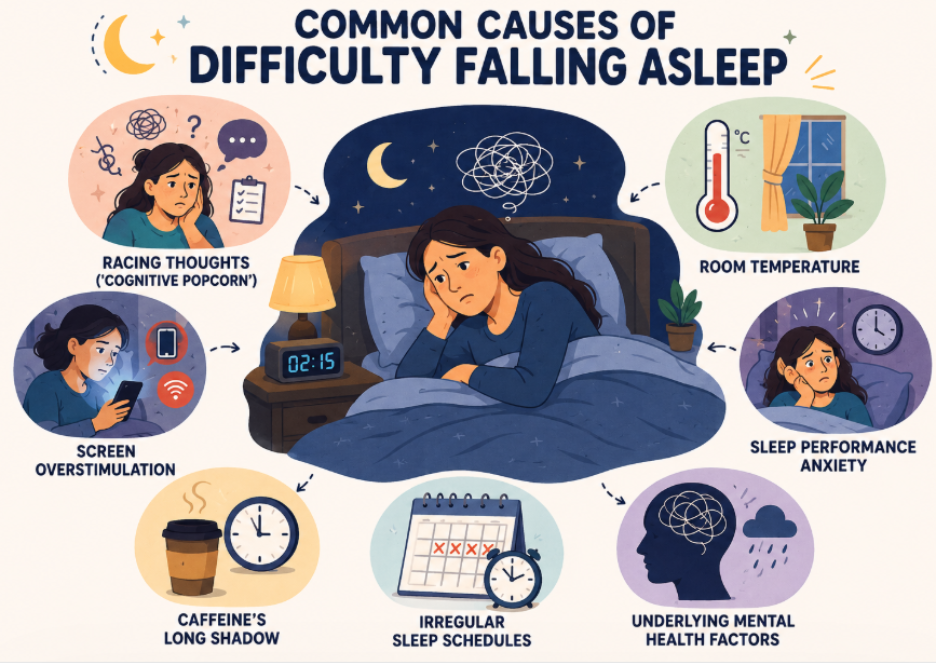
Why Is It Hard to Fall Asleep Quickly? (Common Causes)
Before trying sleep techniques, it helps to understand why falling asleep can feel difficult in the first place. Sleep is not something you can force. It happens when your brain and body feel calm, safe, and ready to rest. Modern lifestyles often disrupt that process.
Racing thoughts ('cognitive popcorn'). Your brain is wired to process unresolved problems. Without daytime structure to contain them, your mind treats bedtime as its personal admin hour. This is especially common when stress or anxiety is high during the day. Many people notice that the quieter the environment becomes, the louder their thoughts feel. Overthinking, replaying conversations, worrying about tomorrow, or mentally making to-do lists can all keep the nervous system alert instead of relaxed.
Screen overstimulation. Blue light from phones and laptops suppresses melatonin, your body's sleep hormone. Worse, social media and news activate a cortisol response that keeps your brain in alert mode long after you put the phone down. Endless scrolling also keeps the brain emotionally stimulated, making it harder to transition into a calm, sleepy state.
Caffeine's long shadow. Caffeine has a half-life of 5 to 6 hours, meaning it takes that long for your body to eliminate half of the caffeine consumed. A 4 pm tea still has 50 percent of its stimulant effect at 9pm. An afternoon coffee is still very much a bedtime problem. Even if you feel like caffeine does not affect you strongly, it can still reduce sleep quality and delay your body's natural sleep signals.
Room temperature. Your core body temperature must drop by 1 to 2 degrees celsius to initiate sleep. A warm room actively fights this process. Poor airflow, heavy blankets, or humid weather can make it harder for the body to shift into sleep mode comfortably.
Sleep performance anxiety. Trying too hard to sleep activates the very stress response that prevents it. The more you lie there telling yourself, 'I NEED to fall asleep, the more awake you become. This is one of the most common and most frustrating sleep traps. Many people also start clock-watching or calculating how many hours remain before morning, which further increases pressure and alertness.
Irregular sleep schedules. Frequently changing your sleep and wake times confuses your internal body clock. Sleeping very late on weekends, inconsistent routines, or shift-based schedules can disrupt your circadian rhythm and make it harder to fall asleep naturally at night.
Underlying mental health factors. Anxiety, depression, burnout, and PTSD are among the most common causes of chronic sleep difficulty. ADHD and chronic stress can also make it difficult for the brain to "switch off" at night. If your sleep problems feel bigger than a lifestyle fix, we will address this properly further down the page.
🔍 Did You Know? The 'Wrong Kind of Tired'
- You can be physically exhausted and mentally too wired to sleep at the same time.
- This is called 'tired but wired' and is extremely common in people with high-stress jobs or anxiety.
- It happens when the sympathetic nervous system (fight-or-flight) stays activated even after the body has wound down for the day.
- Breathing and muscle relaxation techniques target exactly this state.
10 Techniques to Fall Asleep Fast in 5 Minutes
Here are the techniques that actually work, starting with the ones most likely to help if you are lying in bed reading this right now. You do not need to try all 10. Start with 2 or 3 techniques that feel easiest or most natural for you.
For how to fall asleep fast consistently, commit to practising them every night for atleast two weeks. Results compound with repetition.
Technique 1: The Military Sleep Method (Target: 2 Minutes)
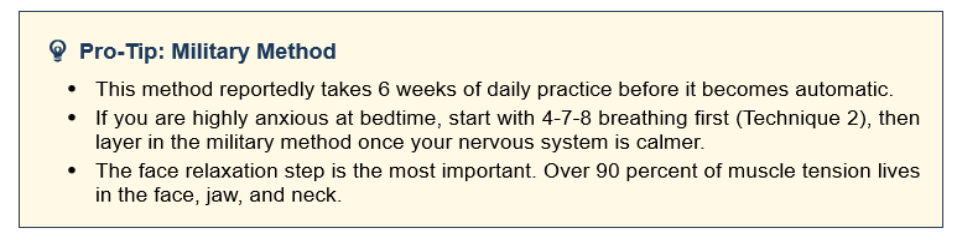
This one gets searched a lot, and for good reason. The military sleep method is widely associated with military training contexts, where rapid sleep under high-stress conditions is considered important for performance and recovery. It was first described by Bud Winter in his 1981 book Relax and Win: Championship Performance. The underlying mechanisms of progressive muscle relaxation combined with guided visualisation are well-supported by sleep science.
Here is exactly how to do it:
- Relax every muscle in your face: forehead, eyes, jaw, tongue. Let your face go completely slack.
- Drop your shoulders as far down as they will go. Let your arms go limp at your sides.
- Exhale and let your chest sink naturally.
- Relax your thighs, calves, and feet one by one.
- Clear your mind for 10 seconds. If thoughts appear, repeat the words 'don't think' slowly until they quiet.
- Hold one of these three images in your mind: lying in a wooden canoe on a still, silent lake; lying in a velvet hammock in a pitch-dark room; or simply repeating 'don't think, don't think' for 10 seconds.
Technique 2: 4-7-8 Breathing (Target: 60 Seconds to Calm)
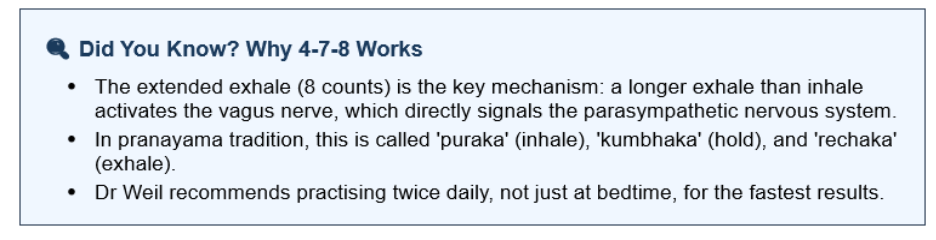
Developed by Dr Andrew Weil, 4-7-8 breathing draws inspiration from pranayama-based breathing practices used in yoga traditions (specifically anulom vilom) which Indian readers may already recognise. Research shows it activates the parasympathetic nervous system (the 'rest and digest' system), slows the heart rate, and reduces cortisol levels. It is one of the most effective and fastest tools for how to sleep fast at night when anxiety or racing thoughts are the problem.
Here is the step-by-step:
- Place the tip of your tongue behind your upper front teeth (and keep it there throughout).
- Exhale completely through your mouth, making a quiet 'whoosh' sound.
- Close your mouth. Inhale quietly through your nose for a count of 4.
- Hold your breath for a count of 7.
- Exhale completely through your mouth for a count of 8. That is one cycle.
- Repeat for 3 to 4 cycles in total.
Technique 3: Progressive Muscle Relaxation (PMR)
Developed by physician Edmund Jacobson in the 1920s, PMR is one of the most extensively researched behavioural sleep techniques in existence. It works by systematically tensing and releasing muscle groups, which teaches your body to recognise and deepen physical relaxation. Particularly effective if physical tension is your main sleep obstacle.
Here is how to do it:
- Start at your toes. Curl them tightly for 5 seconds. Then release all at once and notice the difference.
- Move to your calves: tense, hold 5 seconds, release.
- Continue upward: thighs, abdomen, hands (make a fist), arms, shoulders (shrug up to your ears), neck, and finally your face (scrunch everything up).
- At each area, hold for 5 seconds, then release completely. Let each part sink heavily into the mattress.
- By the time you reach your face, your whole body should feel noticeably warmer and heavier.
Short version for 3 minutes: just do face, shoulders, and legs. These three areas hold most of the body's sleep-preventing tension.
Recommended Watch: JPMR for Sleep
Technique 4: Body Scan Meditation
Similar to PMR but observation-based rather than tension-release. Instead of tensing and releasing, you simply notice each part of your body in turn. Particularly recommended for those whose sleep difficulty comes from anxiety or overthinking, it keeps the mind occupied with neutral physical sensations, leaving no bandwidth for anxious thought loops.
Close your eyes. Start at the crown of your head and slowly move your attention downward: scalp, forehead, eyes, jaw, neck, shoulders, chest, arms, hands, abdomen, hips, thighs, knees, calves, and feet. At each area, simply notice whatever you feel without judgement. Imagine each body part becoming heavier and sinking into the mattress beneath you.
Recommended Reading: How to Do a Body Scan Meditation (and Why You Should)
Technique 5: Paradoxical Intention
This one sounds counterintuitive, and that is exactly why it works. Paradoxical intention is an evidence-based technique from Cognitive Behavioural Therapy for Insomnia (CBT-i). Instead of trying to fall asleep, you deliberately try to stay awake: eyes closed, body relaxed, lying completely still.
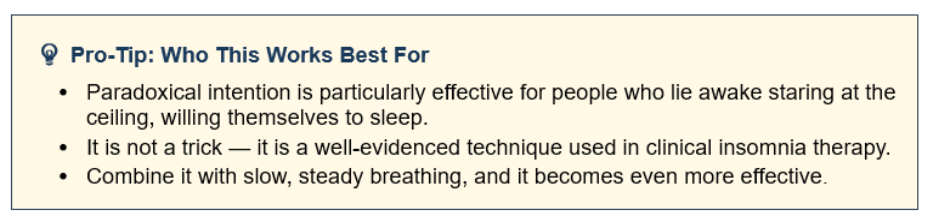
The logic is simple: sleep performance anxiety (the pressure of 'I MUST fall asleep NOW') activates a stress response that makes sleep harder. When you stop trying to force sleep, the pressure lifts and sleep arrives naturally. Think of it as the sleep equivalent of the old advice: 'if you want the cat to come to you, stop trying to catch it.'
Technique 6: The Cognitive Shuffle
A newer technique developed by sleep researcher Luc Beaulieu-Prévost. The cognitive shuffle works by generating random, disconnected, emotionally neutral mental images in quick succession: an apple, a bicycle wheel, a yellow umbrella, a wooden spoon, a cloud. Because your brain cannot build a coherent narrative or problem-solve from completely unrelated fragments, it disengages from anxious thought loops and drifts naturally toward the lighter state that precedes sleep.
How to do it: close your eyes. The technique involves choosing a random, emotionally neutral word, such as “cake.” Start with the first letter of the word, in this case “C,” and slowly think of different objects or items that begin with that letter, such as “car,” “carrot,” or “cottage,” while mentally visualising each one.
Once you run out of words for “C,” move on to the next letter in the word. Many people find they fall asleep before reaching the third letter.

Technique 7: The 5-Minute Combination Routine (1to1help's Recommendation)
This is not a single technique but the combination that most reliably induces sleep onset within 5 to 10 minutes. Think of it as the reliable starter pack while you build your personal toolkit.
⏱️ Your 5-Minute Sleep Routine
- MINUTE 1: Three cycles of 4-7-8 breathing. Inhale 4, hold 7, exhale 8. (Parasympathetic system activated.)
- MINUTES 2 to 4: PMR short version. Face for 60 seconds, shoulders for 60 seconds, legs for 60 seconds. (Physical tension released.)
- MINUTES 4 to 5+: Visualisation. Imagine a peaceful place in rich sensory detail. A quiet beach at dawn, a cabin in the mountains, a still forest path. Engage all five senses: what do you hear? What does the air feel like?
Technique 8: Body Cooling
Your body temperature must drop 1 to 2 degrees Celsius to initiate sleep. Research from the Sleep Foundation identifies 18 to 22 degrees Celsius as the optimal room temperature for sleep. A warm room counteracts the body's natural cooling process and significantly delays sleep onset.
The warm bath trick: taking a warm bath or shower 1 to 2 hours before bed paradoxically speeds up sleep. The warm water draws blood to the skin's surface. When you get out and cool down, your core body temperature drops sharply, which signals the brain that it is time to sleep. This is one of the most underused yet most effective home remedies for sleeping fast at night.
If your room is warm (as is common in Indian summers), even placing your feet outside the blanket helps. Blood vessel dilation in the hands and feet is one of the body's primary mechanisms for releasing heat.
Technique 9: White Noise and Pink Noise
Background noise works not by creating silence but by masking the unpredictable sounds that interrupt sleep onset. A car door slamming, a dog barking, a late-night conversation, these sudden sounds jolt the brain back to alertness. Constant background noise prevents those jolts.
- White noise: all equal sound frequencies, like static or a fan. The classic sleep masker.
- Pink noise: emphasises lower frequencies, like rainfall, ocean waves, or wind. Emerging research suggests it may stabilise slow-wave brain activity and improve sleep quality beyond just masking.
- Practical options: a ceiling fan (perfect for Indian summers), an air conditioner, dedicated white noise machines, or free apps like Calm or Insight Timer.
Technique 10: The 10-3-2-1-0 Rule

This is not a bedtime technique but a pre-sleep framework that systematically removes the most common sleep disruptors in the hours before you lie down. The idea is simple: you cannot expect to be energised throughout the day, crash onto your phone at 11pm, and expect your brain to switch off on command.
Treat the 10-3-2-1-0 rule as your daily sleep preparation checklist. The techniques above become far more effective when your system is not fighting caffeine, a heavy meal, screen stimulation, and unresolved work stress all at once.
Optimise Your Sleep Environment for Faster Sleep Onset
How to sleep fast at night is not just about what you do; it is also about where you do it. Your bedroom sends constant signals to your nervous system about whether it is safe to sleep. Getting the environment right is one of the highest-return changes you can make.
- Temperature: keep your room between 18 and 22 degrees Celsius. Cooler is better than warmer. Use a fan, AC, or light cotton bedding in Indian summers.
- Darkness: blackout curtains or a sleep mask. Even small amounts of light from LED clocks or street lamps, passing through curtains, suppress melatonin production. If you use a nightlight, choose warm amber or red-spectrum light as these affect melatonin the least.
- Noise control: earplugs or white noise. Unpredictable sounds are far more disruptive than constant background noise.
- Bed is for sleeping only: removing laptops, work materials, and avoiding scrolling in bed is not just a hygiene tip. Sleep specialists call this stimulus control therapy. When you regularly work or scroll in bed, your brain starts treating bed as an alert, active environment rather than a sleep one. This single change significantly shortens sleep onset over time.
- Scent: lavender has modest but genuine evidence for reducing anxiety and improving sleep quality. A lavender pillow spray or diffuser near the bed is a low-effort, low-cost addition.
- Clutter: A visually cluttered room can elevate background anxiety. A calm, clean sleep space signals psychological safety to your nervous system. This does not require minimalism, just intentionality.

Foods and Drinks That Help You Fall Asleep Faster
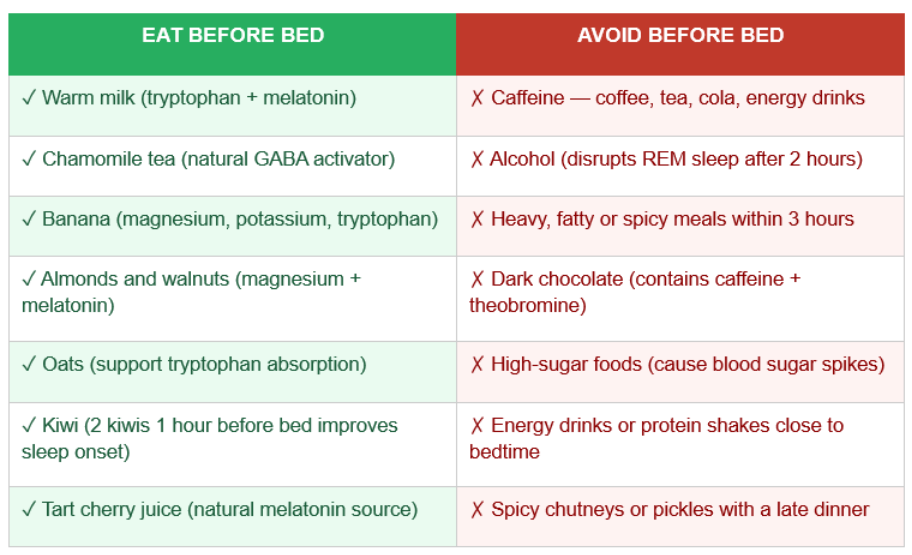
What you eat in the hours before bed significantly affects how quickly you fall asleep. This is a section most generic sleep articles skip over, but for readers who like a warm snack before bed or an evening coffee, it is very relevant.
Timing: aim to finish your main meal 2 to 3 hours before bed. If you are genuinely hungry close to bedtime, a small sleep-friendly snack works well: warm milk with a pinch of nutmeg and honey, or a small banana. Both contain compounds that directly support melatonin production and muscle relaxation.
💡 Pro-Tip: Evening Chai Lovers
- If you cannot give up evening chai, try switching to a caffeine-free herbal version: ginger and honey, or tulsi (holy basil) tea.
- Tulsi has adaptogenic properties that may help reduce cortisol levels in the evening.
- Chamomile tea with warm milk is one of the most effective natural sleep supports available.
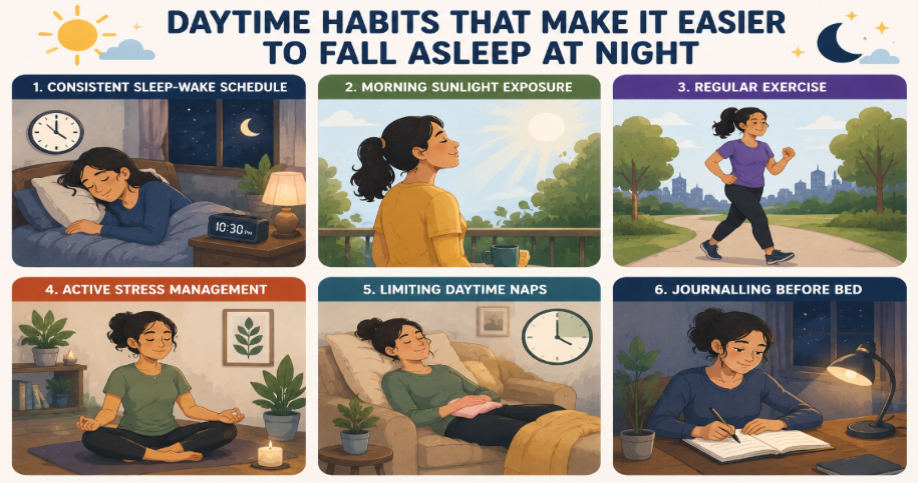
Daytime Habits That Make It Easier to Fall Asleep at Night
The fastest way to fall asleep at night is often found in what you do during the day. These are the habits that have the greatest cumulative impact on sleep quality and mental health.
- Consistent sleep-wake schedule. The single most powerful sleep hygiene intervention available. Going to bed and waking at the same time every day, including weekends, helps regulate the circadian rhythm and build reliable sleep pressure at the right time. Even a 30-minute variation either way is enough to disrupt the pattern.
- Morning sunlight. Ten to fifteen minutes of natural light within 30 to 60 minutes of waking anchors your circadian clock and directly improves sleep quality that night. This is free, effortless, and highly effective. Morning chai on the balcony or a short walk counts perfectly.
- Exercise. Regular moderate exercise, even 20 to 30 minutes of walking, significantly improves sleep quality. However, do not exercise vigorously within 2 hours of bedtime. The adrenaline response from intense exercise keeps the nervous system in an alert state.
- Manage daytime stress actively. Stress is the most common cause of elevated cortisol at bedtime, and cortisol directly delays sleep. Midday mindfulness practices, journalling, or even a short walk are all effective cortisol regulators. Addressing stress during the day means it does not follow you to bed.
- Limit naps. If you need a nap, keep it to 20 minutes or less and avoid napping after 3 pm. Longer or later naps reduce 'sleep pressure', the natural build-up of adenosine that makes you genuinely tired at night.
- Journal before bed. A 10-minute 'brain dump' before bed, writing down tomorrow's tasks, unresolved worries, or anything circling your mind externalises these thoughts and reduces their intrusive power at bedtime. Research shows it can improve sleep onset by giving the mind permission to stop processing.
When Anxiety Is Keeping You Awake: The Sleep-Mental Health Connection
This is the section that most sleep articles gloss over, and it is the most important one for a significant proportion of readers. If the techniques above help briefly but the problem keeps coming back, anxiety may be the actual issue rather than sleep hygiene.
The Anxiety-Insomnia Cycle
Here is what happens when anxiety drives sleep difficulty. Anxiety activates the sympathetic nervous system, releasing cortisol and adrenaline. These hormones suppress melatonin, raise body temperature, and keep the brain in an alert, scanning state. The harder you try to sleep, the more anxious you become about not sleeping, which releases more cortisol, making sleep even harder. Sleep specialists call this 'hyperarousal insomnia' and it is self-reinforcing without intervention.
The techniques in this article are effective at interrupting this cycle, especially 4-7-8 breathing, paradoxical intention, and PMR. But if the underlying anxiety is chronic, techniques alone eventually hit their limit.
Signs That Anxiety Is the Real Issue
- Racing thoughts that will not quiet down regardless of how physically tired you are
- Waking at 3 to 4am with worry thoughts that feel urgent and impossible to dismiss
- Dreading bedtime because you already know sleep is going to be a struggle
- Physical sensations at bedtime: racing heart, chest tightness, shallow breathing
- Feeling exhausted during the day but paradoxically wired at night (the 'tired but wired' pattern discussed earlier).
💬 If anxiety is driving your sleep difficulty:
- Cognitive Behavioural Therapy for Insomnia (CBT-i) is the gold-standard, first-line treatment for chronic insomnia. Research consistently shows it outperforms sleeping medication in long-term outcomes, with no risk of dependence.
- 1to1help's trained and qualified counsellors can help you address the thought patterns and behaviours that perpetuate sleep difficulty, and not just manage the symptom.
- Speaking to a counsellor about sleep-related anxiety is a more effective long-term strategy than any single technique.
When to Seek Professional Help for Sleep Difficulties
Occasional sleep difficulty is completely normal. Stress, illness, travel, and a difficult week at work can all temporarily disrupt sleep. The techniques in this article are effective for situational sleep difficulty and for building better sleep habits over time.
But there are specific signs that suggest sleep difficulty has moved beyond what lifestyle changes and bedroom techniques can address alone.
⚠️ When to get professional support
- You have difficulty falling or staying asleep more than 3 nights per week, for more than 3 months. This meets the clinical threshold for insomnia disorder.
- Sleep problems are significantly affecting your daytime functioning, such as concentration, mood, work performance, or relationships.
- You are relying on alcohol, sleeping pills, or other substances to sleep.
- You wake consistently unrefreshed despite getting adequate hours in bed.
- You suspect anxiety, depression, or burnout is contributing. A mental health professional should be involved.
- Your partner tells you that you stop breathing during sleep, snore loudly, or move excessively. These can indicate sleep apnoea or restless legs syndrome, which require medical evaluation.
What professional support looks like: Cognitive Behavioural Therapy for Insomnia (CBT-i) is the first-line, evidence-based treatment for chronic insomnia, proven more effective than sleeping medication in the long term, with no dependency risk. Mental health support through counselling or therapy addresses the underlying anxiety, depression, or burnout driving sleep difficulty. A sleep study may be recommended if a sleep disorder is suspected.
If your sleep difficulty feels connected to your emotional load, 1to1help's counsellors through their Employee Assistance Programme (EAP), provide confidential, professional support specifically for sleep-related mental health concerns. You do not have to figure this out alone, and you do not have to wait until things feel unmanageable.
The Bottom Line: Give It At Least Two Weeks
None of these techniques works like magic. What they are is science applied in a straightforward, manageable way to the specific things that prevent your body and mind from relaxing enough to sleep.
Pick two or three techniques from this list. Practise them every night for at least two weeks. Do not judge the results after night one. Sleep habits are built through repetition, not through one perfect session.
And if two weeks of honest practice does not move the needle, do not assume you are broken. It may mean your sleep difficulty has a root in anxiety, stress, or burnout that a technique alone cannot fully address. That is not a failure. It is useful information.
Through 1to1help’s Employee Assistance Programme (EAP), employees and their families can access confidential emotional wellness support and professional guidance for stress, anxiety, burnout, and sleep-related concerns. Whether you are struggling with racing thoughts at night, chronic sleep difficulties, or stress that affects your rest, speaking to a trained mental health professional can help address the underlying causes and support healthier sleep patterns.
FAQs
Q1. What is the fastest way to fall asleep?
The fastest techniques backed by research are the military sleep method (designed to help pilots fall asleep in 2 minutes), 4-7-8 breathing (activates the parasympathetic nervous system almost immediately), and progressive muscle relaxation. For most people, a combination works best: 1 minute of 4-7-8 breathing, 2 to 3 minutes of PMR for the face, shoulders and legs, then 1 to 2 minutes of peaceful visualisation. Reduce stimulants and screen time before bed to give these techniques the best chance of working. Consistent nightly practice is the most important factor; results build significantly after 2 weeks.
Q2. How to sleep fast in 5 minutes without medication?
Without medication, the most effective combination is 4-7-8 breathing to activate the parasympathetic nervous system, followed by progressive muscle relaxation to release physical tension, and paradoxical intention to remove sleep performance anxiety. Ensure your room is dark, cool (18 to 22 degrees Celsius), and quiet or has gentle background noise. Avoid screens and caffeine for at least an hour before bed. With consistent practice, this combination can reduce sleep onset to 5 to 10 minutes for many people. If sleep difficulty is persistent and feels linked to anxiety or stress, a counsellor trained in CBT-i at 1to1help can provide structured, medication-free treatment.
Q3. Does the military sleep method actually work?
The military sleep method has strong anecdotal support, and its component techniques, progressive muscle relaxation and guided visualisation, are individually well-evidenced in sleep research. Direct research on the combined method is limited, but the building blocks are sound. The key is consistency: it reportedly takes 6 weeks of daily practice to become automatic. If anxiety or racing thoughts are your primary challenge, start with 4-7-8 breathing or paradoxical intention first. The military method works best when physical tension, rather than anxious rumination, is the main barrier to sleep. See the Sleep Foundation for more on the underlying techniques.
Q4. Why do I always take so long to fall asleep?
Consistently taking more than 30 minutes to fall asleep is often caused by one or more of the following: an overactive stress response (elevated cortisol at bedtime), anxiety or chronic worry that activates at night when daily distractions are removed, an irregular sleep schedule that prevents the body from building sleep pressure predictably, too much caffeine or screen time close to bed, or an underlying mental health condition such as anxiety or depression. If this is a persistent pattern across many weeks, it is worth speaking to a counsellor or doctor rather than simply trying more sleep techniques.
Q5. Is it bad if I fall asleep in under 5 minutes?
Surprisingly, yes. Falling asleep in under 5 minutes consistently can be a sign of significant sleep deprivation rather than great sleep skills. Sleep specialists consider 10 to 20 minutes the normal, healthy range for sleep onset. Consistently falling asleep in under 8 minutes may indicate that your body is severely under-rested. If you fall asleep almost immediately whenever you have the opportunity, even at inconvenient times, it is worth discussing with a healthcare provider, as this can indicate conditions such as sleep apnoea or narcolepsy.
Q6. How can I fall asleep fast when I am not tired?
If you are not tired by your intended bedtime, the most effective approaches are paradoxical intention (try to stay awake — this removes the pressure that keeps you alert) and gentle body-scan meditation to shift attention from mental to physical awareness. More importantly, review your schedule: if you are not tired by your intended bedtime, your sleep window may need to be shifted later. Avoid napping during the day, increase physical activity, and try to get morning sunlight to anchor your circadian rhythm. Building genuine sleep pressure during the day is the most sustainable solution.
Q7. How to help kids fall asleep in 5 minutes?
For children, the most effective approaches adapt adult techniques into age-appropriate versions: the 'body squeeze' game (similar to PMR — squeeze your toes tight then let go, work upward), guided storytelling with eyes closed (imagining a gentle adventure), and deep belly breathing (ask the child to make their tummy rise and fall slowly like a balloon). A consistent bedtime routine is the single most evidence-based intervention for children's sleep: bath, brush, book, bed, at the same time every night. Avoid screens for at least 30 minutes before the routine begins. A cool, dark room is as important for children as for adults.
References
- Advanced Psychiatry Associates. (n.d.). Comprehensive guide to understanding and treating ADHD. Advanced Psychiatry Associates. Advanced Psychiatry Associates
- BBC Future. (2026, March 11). Cognitive shuffling: The micro-dreaming technique that helps your brain to rest. BBC. BBC Future
- Brain.fm. (n.d.). How to fall asleep fast. Brain.fm. Brain.fm
- Cleveland Clinic. (n.d.). Circadian rhythm. Cleveland Clinic. Cleveland Clinic – Circadian Rhythm
- Cleveland Clinic. (n.d.). Cortisol. Cleveland Clinic. Cleveland Clinic – Cortisol
- Cleveland Clinic. (n.d.). How long does it take to fall asleep? Cleveland Clinic Health Essentials. Cleveland Clinic – Fall Asleep
- Cleveland Clinic. (n.d.). Military sleep method. Cleveland Clinic Health Essentials. Cleveland Clinic – Military Sleep Method
- Cleveland Clinic. (n.d.). Parasympathetic nervous system (PSNS). Cleveland Clinic. Cleveland Clinic – Parasympathetic Nervous System
- Cleveland Clinic. (n.d.). Post-traumatic stress disorder (PTSD). Cleveland Clinic. Cleveland Clinic – PTSD
- Cleveland Clinic. (n.d.). Sleep hygiene. Cleveland Clinic Health Essentials. Cleveland Clinic – Sleep Hygiene
- Headspace. (n.d.). Guided imagery meditation. Headspace. Headspace
- Healthline. (n.d.). How long does caffeine last? Healthline. Healthline – Caffeine
- Healthline. (n.d.). Body scan meditation. Healthline. Healthline – Body Scan Meditation
- HelpGuide. (n.d.). How to fall asleep fast: Tips to get to sleep quickly. HelpGuide.org. HelpGuide
- Mayo Clinic. (n.d.). 5 things to know about popcorn brain. Mayo Clinic Press. Mayo Clinic Press
- Mayo Clinic. (n.d.). Melatonin side effects: What are the risks? Mayo Clinic. Mayo Clinic – Melatonin
- Medical News Today. (n.d.). What is the military sleep method? Medical News Today. Medical News Today
- News-Medical. (n.d.). What is adenosine? News-Medical.net. News-Medical
- Omnicuris. (n.d.). Urban health risk India: Heart and respiratory trends. Omnicuris. Omnicuris
- Sleep Foundation. (n.d.). Best temperature for sleep. Sleep Foundation. Sleep Foundation – Temperature
- Sleep Foundation. (n.d.). Cognitive behavioral therapy for insomnia. Sleep Foundation. Sleep Foundation – CBT-I
- Sleep Foundation. (n.d.). How to fall asleep fast. Sleep Foundation. Sleep Foundation – Fall Asleep Fast
- Sleep Foundation. (n.d.). Sleep hygiene. Sleep Foundation. Sleep Foundation – Sleep Hygiene
- Somnology MD. (2024, September). Paradoxical intention. Somnology MD. Somnology MD
- The Conversation. (2024). Alpha, beta, theta: What are brain states and brain waves and can we control them? The Conversation. The Conversation
- U.S. Department of Veterans Affairs. (n.d.). Progressive muscle relaxation. VA Whole Health Library. VA Whole Health Library
- UCLA Health. (n.d.). Feeling tired but wired? Here’s what might be causing it. UCLA Health. UCLA Health
- Verywell Mind. (2022). Military sleep method. Verywell Mind. Verywell Mind – Military Sleep Method
- Verywell Mind. (2022). What is a brain dump? Verywell Mind. Verywell Mind – Brain Dump
- WebMD. (n.d.). 4-7-8 breathing. WebMD. WebMD – 4-7-8 Breathing
- WebMD. (n.d.). Muscle relaxation for stress and insomnia. WebMD. WebMD – Muscle Relaxation
- WebMD. (n.d.). Pink noise and sleep. WebMD. WebMD – Pink Noise
- WebMD. (n.d.). Pranayama breathing. WebMD. WebMD – Pranayama
- WebMD. (n.d.). What happens to your body during sleep? WebMD. WebMD – Sleep Cycle
- YouTube. (n.d.). Sleep technique video [Video]. YouTube. YouTube Video
- National Center for Biotechnology Information. (2023). Sleep-related research article. PubMed Central. PubMed Central


.svg)
.svg)
.svg)
.svg)