

.png)


.png)

Workplace Well-Being & Support
12 Best Employee Mental Health Programs for 2026 (Ranked & Reviewed)

.png)
Written by
Aarohi Parakh,
Psychologist and Content Writer

Reviewed by
Sanjana Sivaram,
Psychologist and Clinical Content Head


Introduction
Somewhere in an HR drive, there is a document titled something like "Employee Wellbeing Strategy 2026." It has a section on the EAP, a section on mental health awareness month, a few slides on the wellness app that was procured last year. It was presented to leadership. It was approved.
And almost no one is using it.
This is the central problem with workplace mental health in India right now. It is not a shortage of programs. It is a graveyard of them. Yoga sessions with twelve attendees. Webinars where cameras stay off. Helpline numbers buried in onboarding decks that no one reads after day one. The State of Emotional Wellbeing Report 2025 found that workplace concerns accounted for 15% of all counselling sessions in India, up from 13% the year before. The need is rising. Utilisation of most programs is not.
Most corporate mental wellness programs are designed around availability rather than adoption. They exist. They can technically be accessed. What they are not designed for is the lived psychology and realities of the people they are meant to support, whether it is a 31-year-old white-collar manager in Bengaluru who does not even realize she is burning out yet, or a blue-collar worker for whom the program was never meaningfully designed in the first place.
The best employee mental health programs close that gap. They meet people where they are: in their language, at their level of readiness, through channels that do not require them to formally declare they are struggling. The twelve programs in this guide are the ones that have the evidence behind them to do exactly that.
Why Employee Mental Health Programs Matter for Your Business
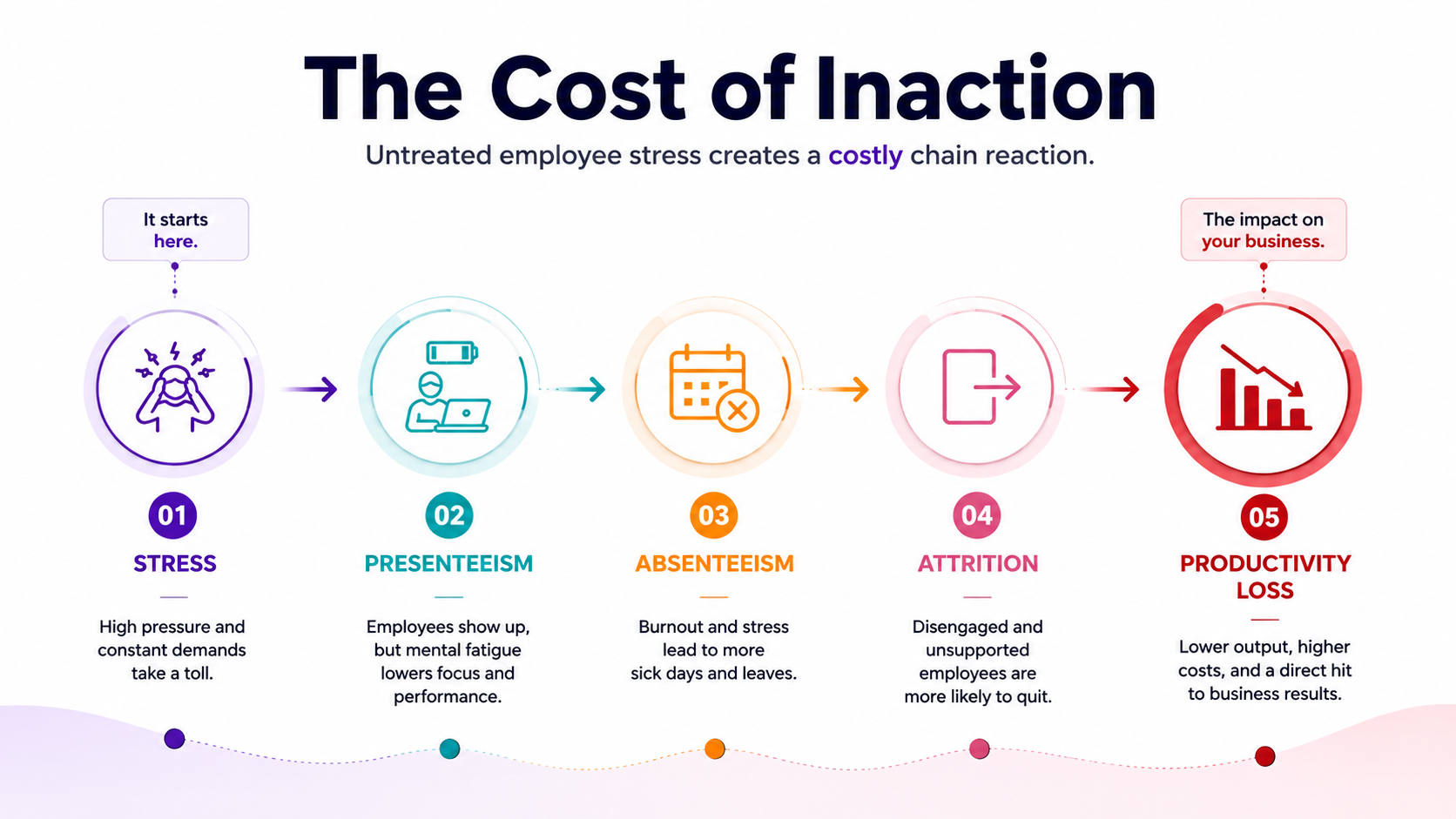
The business case for investing in mental health support for employees has never been clearer, and in India, the urgency is particularly acute.
Over a third of Indian employees report experiencing stress, anxiety, or other mental health challenges. Presenteeism, employees physically at their desks but too mentally depleted to function, costs India an estimated USD 1.03 trillion in productivity loss over fifteen years, according to a 2020 Institute of Public Health study. Depression alone leads to an average of 4.3 sick days per employee per year (NIMHANS, 2023).
The ROI on well-designed programs is substantial. Research consistently shows a return of USD 3 to USD 6 for every dollar invested in workplace mental health initiatives, through reduced absenteeism, lower healthcare costs, and productivity gains. A 2026 longitudinal study across 312 organisations found that structured mental health programs produced a 4.2:1 ROI on average, with a 38.7% reduction in absenteeism and a 42.3% decrease in presenteeism costs.
52% of employees report feeling more engaged and productive when their organisation offers mental health resources (MHFA England, 2024). Companies that prioritise mental health awareness see a 20% improvement in employee retention rates.
Despite this, only 0.09% of India's 1.1 million registered companies have implemented an Employee Assistance Programme. The gap between the cost of inaction and the investment required to act is significant, and narrowing.
The 12 Best Employee Mental Health Programs That Actually Work
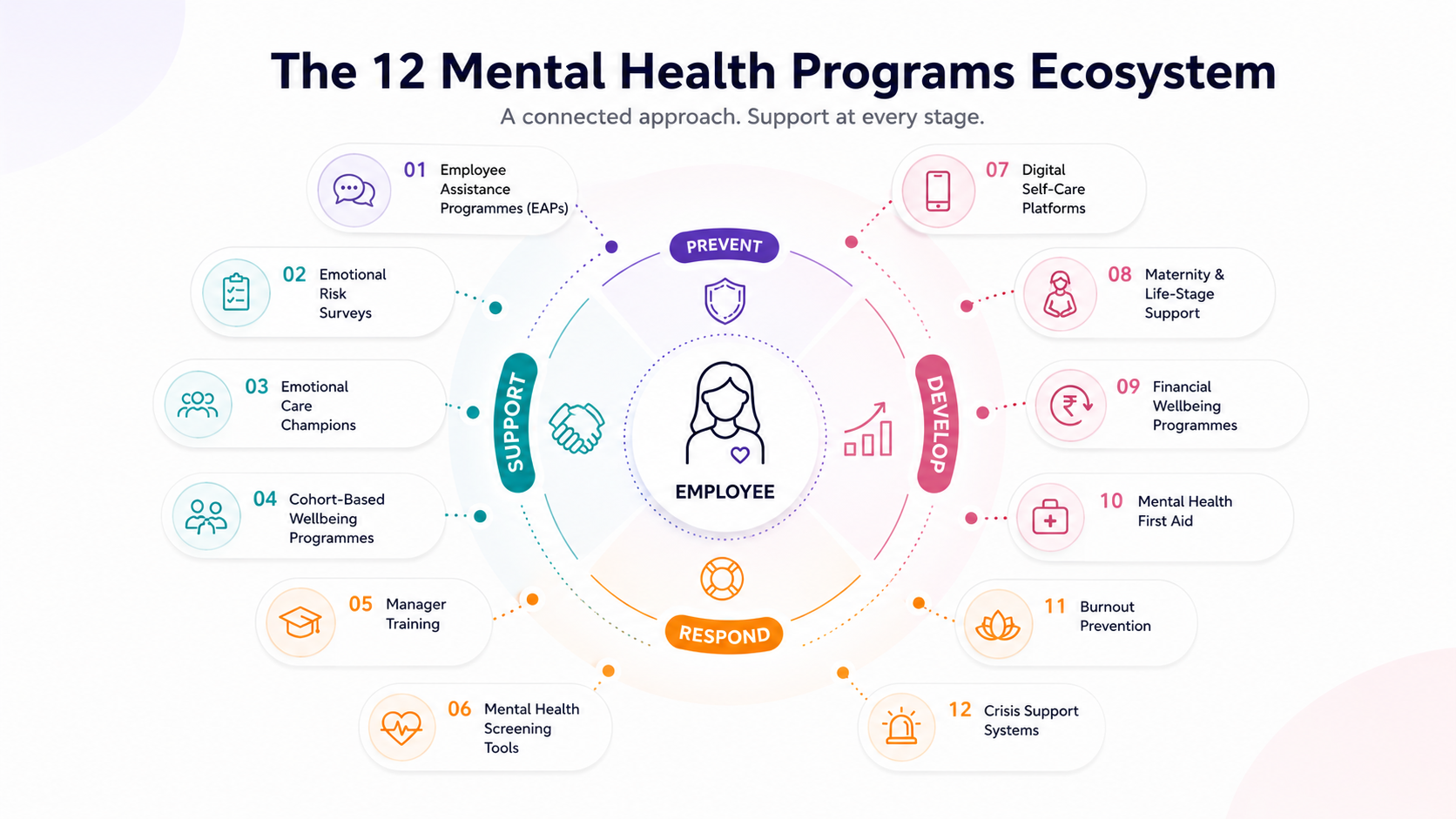
There is no universal best program. The right combination depends on your workforce size, demographics, risk profile, and existing infrastructure. What follows is a practical overview of the most effective program types, grounded in evidence and relevant to the Indian corporate context.
1. Employee Assistance Programmes (EAPs)
An Employee Assistance Programme (one of the most established employee assistance programs globally) is the backbone of any serious corporate mental wellness program. At its core, an EAP provides employees with confidential access to professional counselling, typically at no cost to the employee, covering personal, professional, and family concerns.
The traditional EAP model was essentially a phone number. Modern EAPs look very different: app-based access, video counselling, multilingual support, 24/7 availability, and clinical oversight that tracks outcomes rather than just utilisation.
What to look for in an EAP:
- Counsellors trained in Indian cultural and workplace contexts
- Support available in regional languages, not just English
- Session availability within 48 to 72 hours of request
- Family coverage, not employee-only
- Clinical outcome tracking (PHQ-9, GAD-7) to measure actual impact rather than just call volumes
EAPs show a 27% decrease in absenteeism when properly utilised (Bouzikos et al., 2022). The qualification is important: utilisation in India remains low due to confidentiality concerns and stigma. The best EAP providers in India address this through active engagement, not just passive availability.
1to1help's EAP has covered over 11 million lives across 1,000+ organisations in India. It operates through a network of 450+ professionally trained counsellors available in 13 languages, with 24/7 access via phone, app, and video. Critically, it is backed by 25 years of data on the Indian workforce: a level of contextual depth that newer entrants to the market cannot match.
2. Emotional Risk Surveys
Most organisations do not know where their people are struggling until it shows up as turnover, medical leave, or a crisis. An Emotional Risk Survey changes that.
An ERS is a structured, anonymised assessment that maps the emotional health of your workforce before problems surface. It gives HR leadership actual data on where burnout is concentrated, which teams are at risk, and what is driving psychological distress, segmented by department, role, age group, and other relevant demographics.
This is one of the more underutilised employee mental health benefits programs in India, partly because the category is new. But among organisations that have deployed it, it fundamentally changes how wellbeing strategy is built, from intuition-based to evidence-based.
1to1help's Emotional Risk Survey measures four domains: emotional regulation, resilience, symptoms of burnout, and workplace characteristics. Based on data from 13,000+ employees assessed through ERS, 33% of employees are at risk of burnout, 20% struggle with emotional regulation, and 50% of women employees report burnout symptoms. These are not industry averages. They are live data from Indian workplaces, and they are the kind of insight that changes what gets prioritised in a wellbeing budget.
Best for: Organisations that want to move from reactive to proactive mental health support. Strong starting point before designing any broader workplace mental health initiatives.
3. Emotional Care Champions (Peer Support Networks)
The single biggest barrier to employees using formal mental health support is the perceived distance between "I am struggling a little" and "I will call a counsellor." Most people do not make that leap. They talk to a colleague instead.
Peer support programmes formalise and strengthen that instinct. They identify, train, and support employees who become in-house emotional first responders: people their colleagues can approach before the situation reaches crisis level.
Peer support networks reduce stigma more effectively than top-down communications because the conversation comes from someone on the same team, not from a poster in the corridor. They extend the reach of formal mental health resources for companies into parts of the organisation where low utilisation would otherwise persist.
1to1help's Emotional Care Champions (ECC) programme trains employees through a structured four-phase journey: onboarding and pre-assessment, counsellor-led mentorship on mental health fundamentals, a practical workshop covering listening, empathy, and how to handle difficult disclosures, and group follow-up check-ins at three and six months. With 430+ active ECCs across 16+ organisations, the programme has created what is perhaps the best model for decentralised, peer-led wellbeing support in the Indian corporate context.
Best for: Organisations with distributed teams, large workforces, or historically low EAP utilisation. Works best in combination with a formal EAP.
4. Cohort-Based Wellbeing Programmes
Workplace stress management programs that treat everyone the same way rarely work well. The 25-year-old campus hire has different pressures from the 45-year-old people manager. The factory-floor shift worker has different needs from the remote-first tech employee. Cohort-based programmes address this by designing targeted interventions for specific employee groups.
Common cohorts in Indian organisations include:
- New or campus hires navigating their first professional environment
- First-time managers facing leadership pressure without adequate support
- Employees in high-stress functions: collections, customer service, healthcare, logistics
- Women employees, who face higher burnout risk
- Parents and caregivers managing dual pressures
- Senior leaders, who are often the last to seek help and the most visible to the rest of the organisation
1to1help's cohort programmes include 1to1GenZ, Feet on Street (for field-based employees), 1to1Shield, 1to1Parenting, 1to1Women, and a Leaders Programme, each designed around the specific stressors and communication styles of that group.
Best for: Organisations with identifiable high-risk cohorts or specific DEI commitments. Also useful for onboarding mental health support without requiring a full-organisation rollout.
5. Manager Training Programmes
Research is consistent on this point: the manager is the most powerful single variable in an employee's mental health at work. A well-intentioned but poorly equipped manager can make a struggling employee feel worse. A well-trained manager can be the reason someone seeks help before they reach crisis.
Manager training as a workplace mental health initiative focuses on three things: recognition (what does distress look like in a team member), response (how to have a supportive conversation without overstepping or dismissing), and referral (knowing when and how to connect an employee to professional support).
This is not therapy training. It is basic mental health literacy, and in Indian organisations, where stigma is high and hierarchy is strong, it has an outsized impact because managers set the cultural permission level for everyone below them.
Best for: All organisations. Should be a prerequisite before any other employee wellbeing solutions are deployed.
6. Mental Health Screening Tools
Clinical screening tools like the PHQ-9 (depression) and GAD-7 (anxiety) allow organisations to track the mental health status of employees at a population level, before and after interventions, to measure actual outcomes rather than proxy metrics.
These tools are already embedded in the 1to1help EAP's intake and follow-up process.
The 2025 State of Emotional Wellbeing Report found that among employees who completed counselling, 42% showed significant reduction in depression symptoms (PHQ-9) and 40% showed significant reduction in anxiety symptoms (GAD-7). That kind of data is what separates an evidence-based program from one that operates on hope.
Best for: Organisations that want to demonstrate and measure the clinical impact of their investment. Increasingly expected by large corporate EAP buyers.
7. Digital Self-Care Platforms
Not every employee who is struggling wants to speak to a counsellor. Some want to manage their own mental health with structured tools: guided meditations, CBT-based self-help modules, sleep programmes, stress trackers.
Digital mental health resources for companies fill the gap between "I do not need professional help yet" and "I am aware I need to look after myself." They are also higher utilisation than counselling because they do not require disclosure. An employee can use a breathing exercise or complete a mood tracker without anyone knowing.
When evaluating digital platforms, look for clinical validation of the content, personalisation features, and integration with your broader wellbeing ecosystem so that users who need more support can be seamlessly referred onward.
Best for: Large, distributed, or tech-savvy workforces. Best deployed as a complement to EAP rather than a replacement.
8. Maternity and Life-Stage Support Programmes
Transition points create vulnerability. Employees going through pregnancy, early parenthood, bereavement, or major caregiving responsibilities face mental health risks that generic corporate mental wellness programs are not designed to address.
Life-stage programmes provide specialised support precisely at these moments. 1to1help's 1to1maternity programme extends mental health support through pregnancy and the return-to-work period, with WhatsApp access and counsellor availability built specifically for new mothers. In a country where maternal mental health is drastically underaddressed, this kind of targeted support fills a real gap.
Best for: Organisations with significant female workforce proportions, high-attrition moments around parental leave, or DEI commitments to women's career progression.
9. Financial Wellbeing Programmes
Financial stress is one of the most underacknowledged drivers of poor mental health in Indian workplaces. Debt pressure, salary inadequacy, lack of savings, and the weight of being the primary earner for an extended family create a chronic low-grade anxiety that no counselling session can fully address if the underlying financial situation remains unresolved.
Financial wellbeing programmes address this directly through financial literacy workshops, access to certified financial counsellors, and tools for budgeting, debt management, and retirement planning. In India, where financial stress intersects with family obligation and social pressure in specific ways, these programmes need cultural grounding to land effectively.
The link to mental health is well-established. Our report found that financial concerns were among the most common personal stressors raised by employees in counselling. Organisations that address financial wellness alongside emotional wellness close a gap that purely psychological programmes cannot reach.
Best for: Workforces with high proportions of employees in their 20s and 30s, gig or contractual workers, and organisations in sectors with wide pay distribution.
10. Mental Health First Aid (MHFA) Training
Mental Health First Aid is a structured, internationally certified training programme that teaches employees how to recognise, respond to, and refer someone experiencing a mental health crisis. It is not therapy training. It is the workplace equivalent of physical first aid: basic, practical, and designed to be used in the moment before professional help arrives.
In the Indian context, MHFA training serves an important cultural function beyond its clinical purpose. It normalises mental health conversations at team level. When a significant number of employees have been through the training, the language changes, the awareness increases, and the stigma around seeking help starts to shift.
MHFA training is best deployed as a complement to peer support programmes like Emotional Care Champions, creating a workforce where trained individuals are distributed across teams, departments, and geographies.
Best for: Organisations with large, distributed workforces. Particularly effective in sectors with high mental health risk: healthcare, logistics, manufacturing, and BPO.
11. Burnout Prevention and Resilience Programmes
Burnout is not just severe stress. Burnout is a recognised occupational phenomenon characterised by chronic exhaustion that develops when sustained demand exceeds sustained recovery. The distinction matters because the interventions are different: burnout does not resolve with a mindfulness app. It requires structural change alongside individual resilience building.
Effective burnout prevention programmes operate at two levels. At the individual level, they build skills in stress recognition, recovery, and boundary-setting. At the organisational level, they address workload management, psychological safety, and the always-on cultural norms that are particularly acute in Indian corporates.
Our report found that 33% of employees assessed through the Emotional Risk Survey showed burnout risk. That is not a personal resilience problem at that scale. It is an organisational design problem that individual-level programmes alone cannot solve. The best burnout prevention workplace stress management programs make this distinction explicit and act on both levels.
Best for: High-pressure sectors (IT, BFSI, consulting, healthcare). Also effective as a preventive measure after periods of sustained organisational change or restructuring.
12. Crisis Support and High-Risk Response Systems
Every organisation, regardless of how good its preventive programmes are, will eventually face a mental health crisis involving an employee. Suicidal ideation, acute psychiatric episodes, trauma responses, and sudden bereavement all require a response capability that standard EAP counselling is not designed to deliver.
Dedicated crisis support infrastructure includes 24/7 crisis helplines with trained clinical staff, structured high-risk response protocols for HR and managers, and post-crisis support for affected teams. This is not the same as a general counselling helpline. Crisis response requires clinical specialisation, rapid access, and clear escalation pathways.
1to1help has managed over 17,000 crisis cases through structured high-risk response systems across its partner organisations. That depth of experience in the Indian context, where crisis disclosure patterns and escalation norms differ from Western models, is difficult to replicate quickly.
Best for: All organisations. Crisis support capacity is not optional. It is a baseline. Organisations without it are not just exposed to harm; they are exposed to significant legal and reputational risk.
How to Choose the Right Mental Health Program for Your Company
No single program is the right fit for every organisation. Here is a practical framework for making the decision.
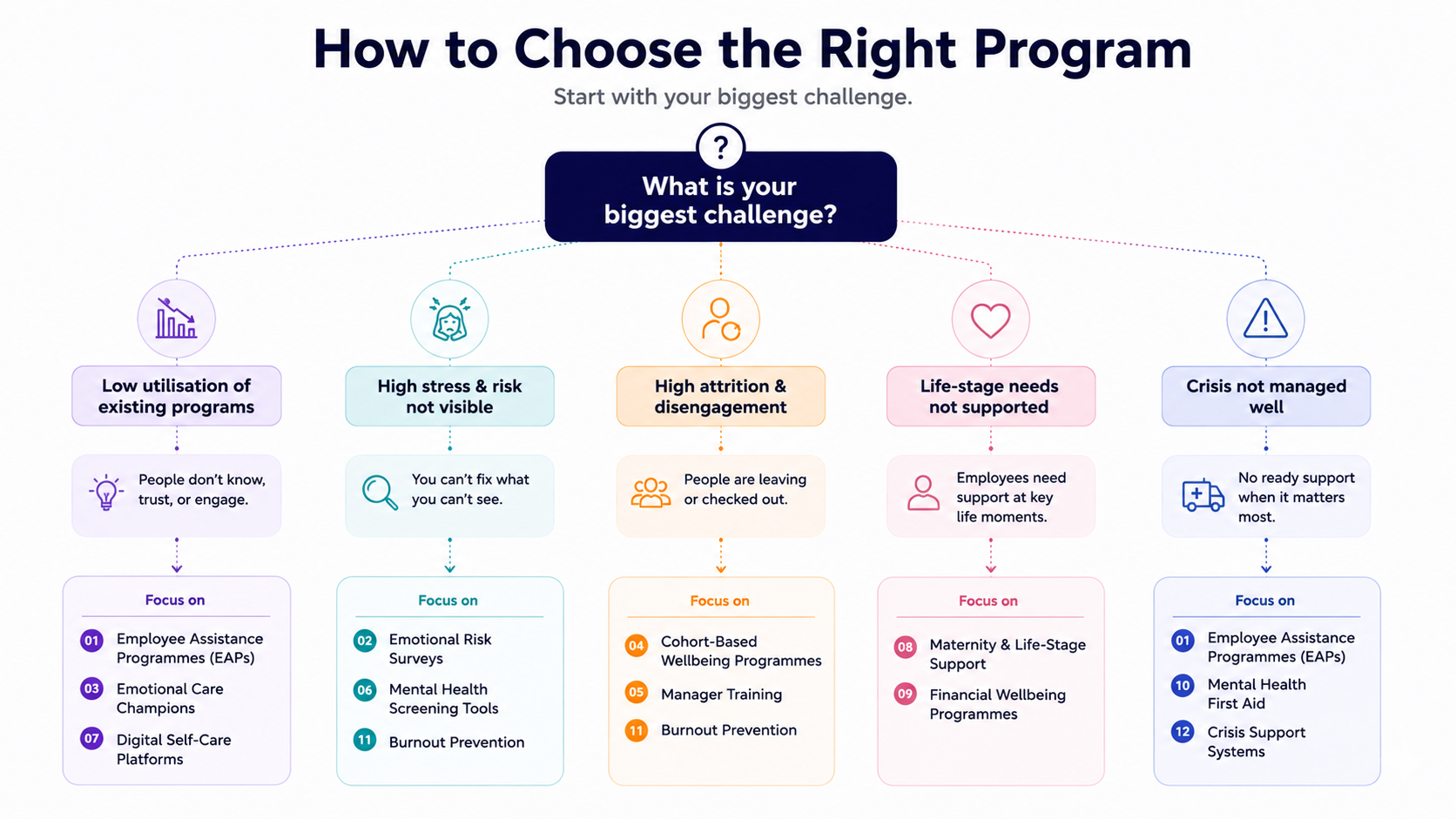
Step 1: Conduct an assessment
Before choosing anything, understand where your people are struggling. An Emotional Risk Survey gives you quantitative data. Anonymous pulse surveys, manager feedback, and exit interview themes give you qualitative texture. Without this step, you are guessing.
Step 2: Define your primary objective
Are you trying to reduce absenteeism? Improve retention? Respond to a specific incident or period of distress? Support a particular high-risk cohort? The answer shapes which type of mental health support for employees to prioritise.
Step 3: Assess current utilisation
If you already have an EAP and utilisation is below 15%, the answer is usually not to add more programs. The answer is to understand why employees are not using what they have. Stigma, awareness gaps, confidentiality concerns, and access barriers are the most common causes.
Step 4: Consider your workforce demographics
Multilingual support is not optional in India: it is the difference between a program that works for your headquartered professionals and one that works for your entire workforce. Regional language availability, cultural competency, and awareness of India-specific stressors (family pressure, hierarchy, financial strain) should be non-negotiable requirements.
Step 5: Plan for adoption, not just access
The best-designed program fails without a communication strategy. Employees need to understand what is available, how to access it, and, critically, that their use of it will not be disclosed to their employer. Internal champions, manager endorsement, and regular communications all drive adoption.
Step 6: Set measurement criteria before you start
Decide upfront what success looks like. Utilisation rate? Reduction in PHQ-9 scores? Absenteeism trend? Manager-reported team wellbeing? The most common failure mode in employee wellbeing solutions is launching without measurement, which makes it impossible to improve.
Key Features to Look for in Employee Mental Health Programs
When evaluating best employee mental health programs for your organisation, use this checklist.
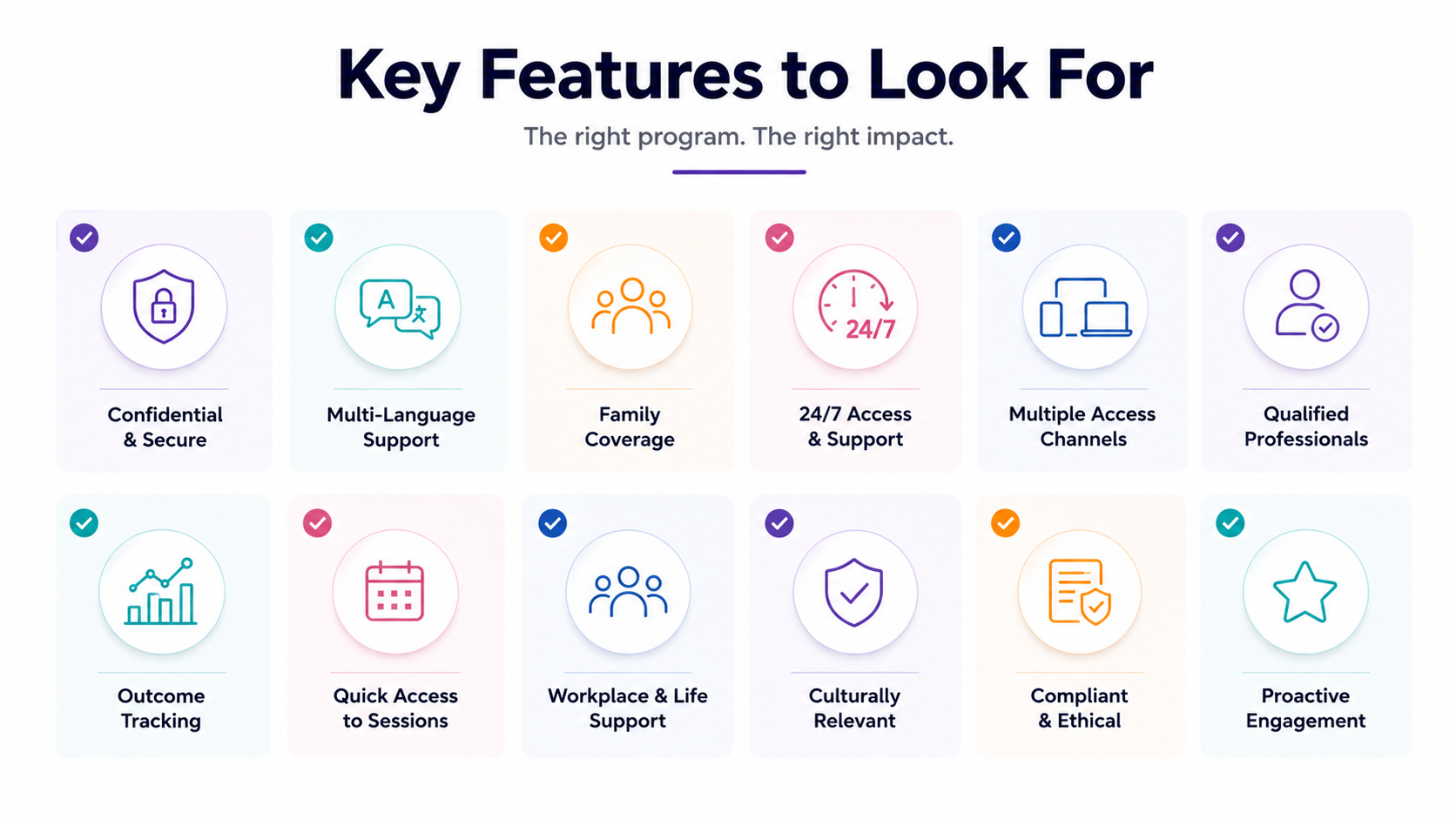
Must-haves:
- Confidentiality guarantee and clear data privacy policy
- Counsellors trained in workplace and Indian cultural contexts
- Multiple access channels: phone, app, video, chat
- Regional language support across major Indian languages
- Family coverage, not employee-only
- Outcome measurement built into the programme design
- 24/7 crisis support for high-risk situations
- Integration capability with your HRMS for reporting (without compromising individual confidentiality)
Important differentiators:
- Clinical credentialing of counsellors (RCI-registered psychologists, not just coaches)
- Employer-side analytics and population-level reporting
- Cohort-specific programmes beyond generic content
- Manager training included or available as an add-on
- Track record in India, not just global case studies
Emerging features worth evaluating:
- AI-supported matching of employees to counsellor type and modality
- Proactive outreach to at-risk employees (with appropriate consent)
- Peer support network integration
- Biometric and self-assessment screening tools
The gap between a checkbox EAP and a genuine employee wellbeing solution is usually visible in three places: how the confidentiality model is structured, whether the organisation receives population-level insights (without individual data), and whether there is any clinical outcome tracking. If a vendor cannot clearly explain all three, keep looking.
How to Measure Whether It Is Working
Measuring the effectiveness of employee mental health programs is one of the most common challenges HR teams faces. Here is how to do it properly.
Utilisation rate
The percentage of eligible employees who use the programme in a given period. Industry benchmark for a healthy EAP utilisation rate in India is 8 to 15%. Below 5% typically indicates an awareness or trust problem, not a features problem.
Clinical outcomes
Pre- and post-assessment scores on validated tools (PHQ-9 for depression, GAD-7 for anxiety) among employees who complete counselling. This is the most meaningful measure of whether the mental health resources for companies are producing actual clinical change. Our report found that 80% of employees who completed counselling showed measurable improvement in either depression or anxiety symptoms.
Absenteeism and presenteeism
Track sick leave trends before and after programme launch, segmented by team or cohort where possible. Also track self-reported presenteeism through pulse surveys, which is harder to measure but often more economically significant.
Manager-reported team wellbeing
Regular check-ins with managers on team morale, engagement, and visible distress signals give qualitative texture to the quantitative data.
Retention correlation
Compare attrition rates in teams or cohorts with high programme engagement versus low. Over time, this becomes one of the most compelling data points for sustaining budget commitment.
Employee satisfaction with the programme
Simple post-session ratings and periodic surveys on awareness, accessibility, and perceived value tell you whether the experience of using the programme is working, separate from whether the clinical outcomes are.
Do not let perfect measurement be the enemy of useful measurement. Start with utilisation and employee satisfaction, add clinical outcomes once you have a reporting infrastructure, and build toward the full picture over time.
Common Challenges and How to Solve Them
Even well-designed best employee mental health programs run into predictable obstacles in Indian workplaces. Here is how to address them.
Low utilisation
The most common problem. Causes: employees do not know the programme exists; they do not believe it is confidential; they fear career consequences; the access process feels effortful. Solutions: active internal communication (not just a launch email); manager endorsement; clear and repeated confidentiality messaging; frictionless access.
Stigma
Mental health help-seeking carries social risk in Indian workplaces. Framing matters: "support for stress and life challenges" has consistently higher uptake than "mental health services." Peer support networks and manager training reduce stigma faster than awareness campaigns alone because they normalise the conversation at team level.
Lack of leadership buy-in
Programmes without visible senior sponsorship rarely embed. Leaders who openly acknowledge using wellbeing support, or who visibly prioritise their own mental health, shift the culture faster than any policy communication. Leadership communication, not leadership delegation, is what moves the needle.
Confidentiality concerns
In India, 40% of employees worry about being judged if they share mental health concerns at work (NAMI, 2024). The confidentiality model of any programme must be communicated clearly, repeatedly, and specifically, including what the employer can and cannot see. Most employees do not read the fine print; they need to hear it directly from someone they trust.
Budget constraints
Mid-size and smaller Indian companies often believe comprehensive mental health support for employees is priced for large enterprises only. Per-employee-per-month costs for well-designed EAPs in India typically range from INR 400 to INR 1,200 depending on the scope of services. Measured against the cost of a single attrition event, which typically runs 6 to 9 months of salary, the economics favour investment even at conservative utilisation rates.
Generic programmes that do not fit the workforce
A programme designed for a global tech workforce will not resonate with a manufacturing floor in Nashik or a BPO workforce in Hyderabad. Localisation, in language and in cultural context, is not an add on. It is the difference between a programme that gets used and one that does not.
FAQs
1. What is the best mental health program for employees?
There is no single best program. The right fit depends on your workforce size, demographics, and specific challenges. For most Indian organisations, the most effective starting point is a full-service Employee Assistance Programme (EAP) with multilingual access, clinical counsellors, and outcome measurement. Organisations looking to move from reactive to proactive support benefit from combining an EAP with an Emotional Risk Survey, which maps where distress is concentrated before it becomes a crisis. Peer support through an Emotional Care Champions network extends reach into the organisation in ways that formal services alone cannot achieve.
2. How much do employee mental health programs cost?
EAP costs in India typically range from INR 400 to INR 1,200 per employee per month, depending on scope of services, family coverage, and organisation size. The more relevant number is ROI: research consistently shows a return of INR 300 to INR 600 for every INR 100 invested in workplace mental health initiatives, primarily through reduced absenteeism, lower turnover, and productivity gains. The cost of a single mid-level attrition event: recruitment, onboarding, and ramp-up time, typically 6 to 9 months of salary. That context reframes the investment considerably.
3. What should be included in an employee mental health program?
At minimum: confidential counselling access (phone, video, and chat), 24/7 crisis support, coverage for both personal and workplace concerns, multilingual availability, and clear confidentiality protocols. Strong programmes add clinical outcome tracking, family coverage, manager training, population-level analytics for HR, and targeted support for high-risk cohorts. The best workplace mental health initiatives also include a peer support layer through trained Emotional Care Champions and a proactive assessment mechanism such as an Emotional Risk Survey to identify risk before it becomes distress.
4. How do I know if an employee mental health program is working?
Track utilisation rates (benchmark: 8 to 15% for Indian workplaces), clinical outcomes through pre- and post-assessment tools like PHQ-9 and GAD-7, absenteeism trends, and employee satisfaction with the programme. Any provider offering only utilisation data without clinical outcomes is measuring reach, not impact. The 1to1help 2025 report found that 80% of employees who completed counselling showed measurable improvement in depression or anxiety symptoms. That kind of clinical data is what separates effective corporate mental wellness programs from ones that exist on paper.
5. Are employee mental health programs confidential?
The best programmes maintain strict confidentiality at the individual level. Your employer should not be able to access any information about who uses the programme or what they discuss. Providers share only anonymised, aggregate data with organisations, such as overall utilisation rates or population-level trend data. This separation is critical and should be made explicit in any vendor agreement. Employees who are not confident about confidentiality do not use the programme, regardless of how good it is.
6. What is the difference between EAP and other mental health programs?
An Employee Assistance Programme (EAP) is a foundational, confidential counselling service available to all employees. It is the primary delivery mechanism for mental health support for employees in most organisations. Other workplace mental health initiatives, such as peer support networks, digital wellness platforms, screening tools, and cohort programmes, are complementary layers. They extend reach, target specific populations, or address different entry points into wellbeing support. The most effective employee wellbeing solutions stack these layers around a core EAP rather than treating them as alternatives.
7. How do I get employees to actually use the programme?
Awareness is necessary but not sufficient. The research is clear: the strongest drivers of utilisation are manager endorsement, peer normalisation, and clear confidentiality messaging. Active internal communication, not a one-time launch email. It must be sustained over the life of the programme is what sustains utilisation.
Conclusion
The conversation around the best employee mental health programs in India has matured significantly. Five years ago, having any mental health support for employees was notable. Today, the question is whether what you have is actually working.
Workplace mental health initiatives that sit untouched in employee handbooks are not neutral. They create an impression of support that does not translate into actual help, and they erode the credibility needed to do better.
The programs that work share a few common traits. They meet employees where they are: in their language, in their cultural context, through channels that do not require them to formally identify as struggling. They are built around measurement, so that what is not working can be changed. And they treat mental health support for employees not as a compliance activity but as infrastructure: as foundational to how the organisation functions as payroll or safety systems.
For Indian organisations serious about building that infrastructure, the starting point is an honest needs assessment, followed by the right combination of EAP, risk measurement, peer support, and targeted cohort programmes, designed for how your workforce actually works, not for how the global HR template says it should.
If your organisation wants to better understand employee wellbeing risks, identify burnout trends early, and improve utilisation of mental health support, 1to1help’s Emotional Risk Survey can provide a practical starting point. And if you are ready to build or upgrade your EAP, 25 years of experience across 1,000+ Indian organisations is a meaningful place to start.
References
- 1to1help. (2025). State of Emotional Wellbeing Report 2025: Indian Workforce. 1to1help.net Private Limited.
- NIMHANS. (2023). Depression and workplace absenteeism data. National Institute of Mental Health and Neurosciences.
- Institute of Public Health, Bengaluru. (2020). Presenteeism and productivity loss estimates, India.
- WHO. (2022). Mental health in the workplace. World Health Organization. who.int
- Frontiers in Public Health. (2022). Workplace Mental Health Interventions in India: A Rapid Systematic Scoping Review.
- Bouzikos, S. et al. (2022). EAP impact on absenteeism and wellbeing. Cited in multiple meta-analyses.
- MHFA England. (2024). Key Workplace Mental Health Statistics for 2024.
- Zenodo / Frontiers. (2026). Workplace Mental Health Initiatives and Organizational Performance: Comprehensive Analysis of Intervention Effectiveness. 312 organisations, 28 countries.
- NAMI. (2024). Workplace Mental Health Poll. National Alliance on Mental Illness.
- Tandfonline. (2025). True Awareness of Mental Health Remains in the Shadow: Implementing Mental Health Support in Indian Workplaces.


.svg)
.svg)
.svg)
.svg)