


.png)


.png)

Personal Growth & Well Being
How to Build Self-Confidence: 10 Psychology-Backed Strategies That Work

.png)
Written by
Aarohi Parakh,
Psychologist and Content Writer

Reviewed by
Sanjana Sivaram,
Psychologist and Clinical Content Head


Introduction
Self-confidence can influence the way you approach opportunities, navigate setbacks, and connect with the people around you. It often shapes whether you speak up in a meeting, apply for a new role, set healthy boundaries in relationships, or simply trust yourself to make everyday decisions. Yet, many people struggle with self-doubt, wondering why confidence seems to come naturally to others but not to them.
If you've ever searched for how to build self-confidence, you're certainly not alone. Confidence isn't a quality that only a fortunate few are born with. For most people, it develops gradually through experiences, habits, and the beliefs they hold about themselves.
There may be times when your confidence dips after a setback, criticism, or major life change. Equally, there may be moments when it grows because you stepped outside your comfort zone or achieved something you once thought was impossible. The encouraging part is that confidence is not fixed. Like many psychological skills, it can often be strengthened with consistent practice and the right support.
In this guide, we'll explore what self-confidence really means, why it matters for your mental wellbeing, and ten psychology-backed strategies that may help you build lasting confidence in your personal life, studies, relationships, and career.
What Is Self-Confidence and Why Does It Matter?
Learning how to build self-confidence begins with understanding what confidence actually is and what it is not.
Self-confidence is the belief that you can handle situations, solve problems, and work towards your goals, even when the outcome is uncertain. It doesn't mean believing you'll always succeed. Rather, it reflects trust in your ability to learn, adapt, and cope with challenges along the way.
Many people also confuse confidence with self-esteem, but they are closely related rather than identical.
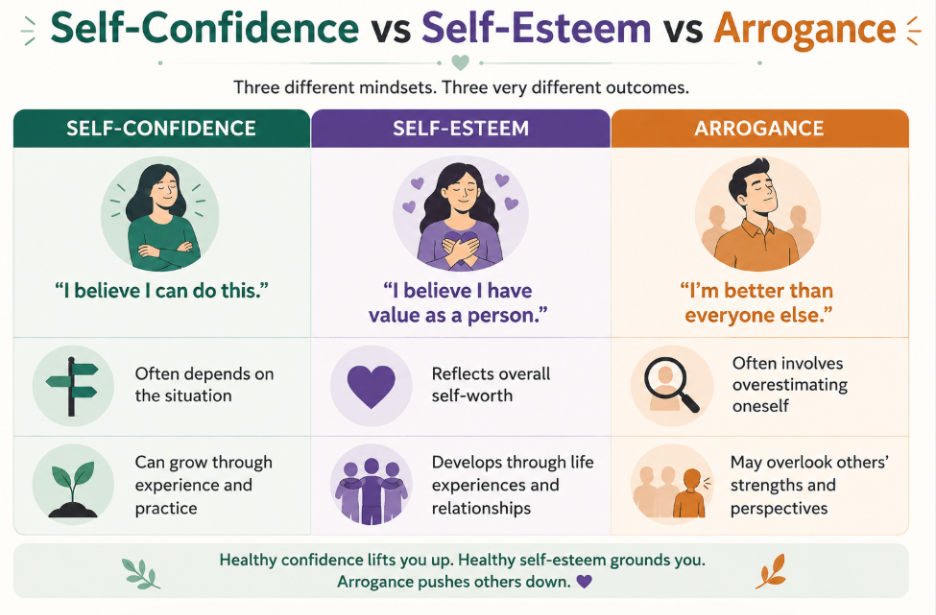
Someone may feel confident giving presentations at work but struggle with dating or public speaking. Similarly, a person with healthy self-esteem may still feel nervous before an important interview. Confidence can vary across different areas of life, whereas self-esteem tends to reflect a broader sense of self-worth.
It's also worth distinguishing confidence from arrogance. Healthy confidence usually allows room for curiosity, learning, and acknowledging mistakes. Arrogance, on the other hand, may involve dismissing feedback or believing one is inherently superior to others.
Research suggests that healthy self-confidence is associated with better psychological wellbeing, stronger resilience, healthier relationships, and improved performance across many areas of life. It may also encourage people to pursue opportunities they might otherwise avoid because of fear or self-doubt.
For many people in India, confidence can also be shaped by cultural and social influences. Academic expectations, competitive entrance examinations, workplace hierarchies, family responsibilities, and constant comparison through social media may all contribute to periods of self-doubt. These experiences are common and do not necessarily reflect your actual abilities.
Feeling under-confident from time to time is part of being human. The important thing to remember is that confidence is not a fixed personality trait. It is a skill that can often be developed through experience, reflection, and intentional practice.
What Causes Low Self-Confidence?
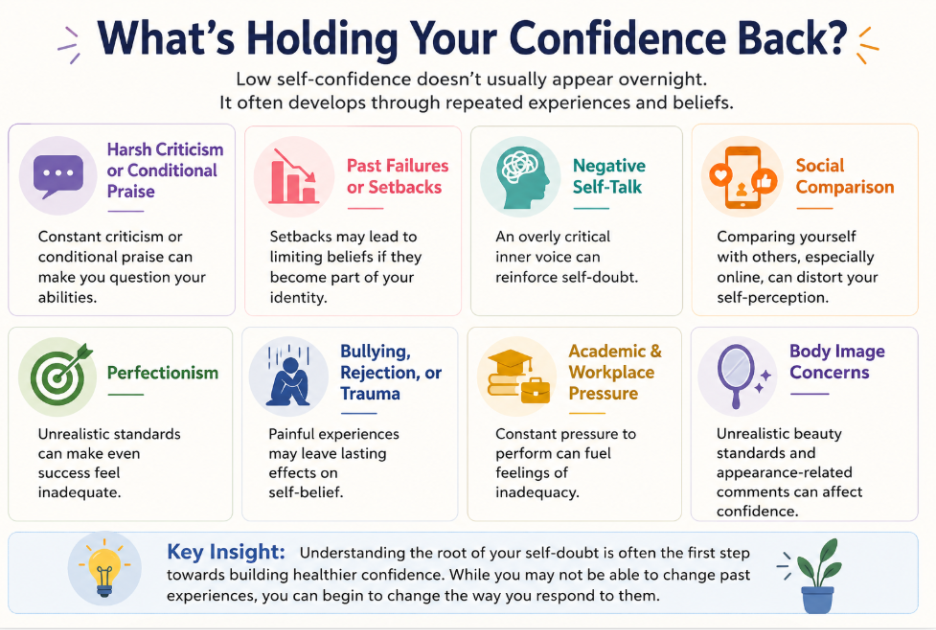
Before exploring how to improve self-confidence, it helps to understand where self-doubt might come from. There is rarely a single explanation. Instead, confidence is often shaped by a combination of past experiences, current circumstances, and the way we interpret them.
1. Childhood experiences
Our earliest relationships often influence how we see ourselves. Growing up with frequent criticism, unrealistic expectations, emotional neglect, or feeling accepted only when performing well may contribute to a persistent belief of "I'm not good enough." These beliefs can continue into adulthood unless they are recognised and challenged. It should, however, be noted that while early experiences can influence confidence, they do not permanently determine it.
2. Past failures and setbacks
Everyone experiences failure, but the meaning we attach to those experiences matters. One unsuccessful interview, examination, business venture, or relationship may gradually become internalised as "I always fail," even when there is evidence to the contrary.
3. Social comparison
It has never been easier to compare ourselves with others. Social media often presents carefully curated versions of people's achievements, lifestyles, and appearance, making it easy to feel left behind. In India, comparisons may also extend to academic scores, career milestones, marriage, income, or societal expectations, creating additional pressure to measure up.
4. Negative self-talk
Our inner dialogue can either support us or undermine us. Thoughts such as "I'll embarrass myself," "Everyone is judging me," or "I'm not capable enough" may feel convincing, even when they are not based on facts. Over time, these patterns can reinforce low confidence and make challenges feel more intimidating than they actually are.
5. Perfectionism and unrealistic expectations
Perfectionism often disguises itself as ambition, but it can leave little room for mistakes or growth. When success is defined as doing everything perfectly, even small setbacks may feel like evidence of failure, making confidence difficult to sustain.
6. Bullying, rejection, or traumatic experiences
Being repeatedly criticised, excluded, bullied, or experiencing emotionally painful events can have a lasting impact on how safe and capable a person feels. These traumatic experiences may influence confidence long after the situation has ended.
7. Academic and workplace pressure
Many students and professionals experience pressure to constantly perform, achieve, and stay ahead. Competitive examinations, demanding workplaces, and expectations to excel can sometimes lead people to question their abilities, even when they are doing well. This is one reason why signs of low self-confidence may appear even among highly capable individuals.
8. Body image concerns
Concerns about appearance can also affect confidence, particularly during adolescence and young adulthood. Unrealistic beauty standards, online filters, and comments from others may gradually shape how people feel about themselves beyond their physical appearance.
10 Practical Ways to Build Self-Confidence
Learning how to build self-confidence is rarely about making one dramatic change. More often, it involves taking small, consistent steps that gradually reshape how you see yourself. Psychology suggests that confidence grows through repeated experiences of competence. Every time you try something new, overcome a challenge, or recognise your progress, your brain gathers evidence that you are more capable than your inner critic may have led you to believe. Progress isn't always visible immediately. People sometimes stop practising because they expect to feel confident before they've had enough experiences to build it.
The following strategies are grounded in psychological research and can be adapted to your own pace and circumstances.
1. Set Small, Achievable Goals to Build Self-Confidence
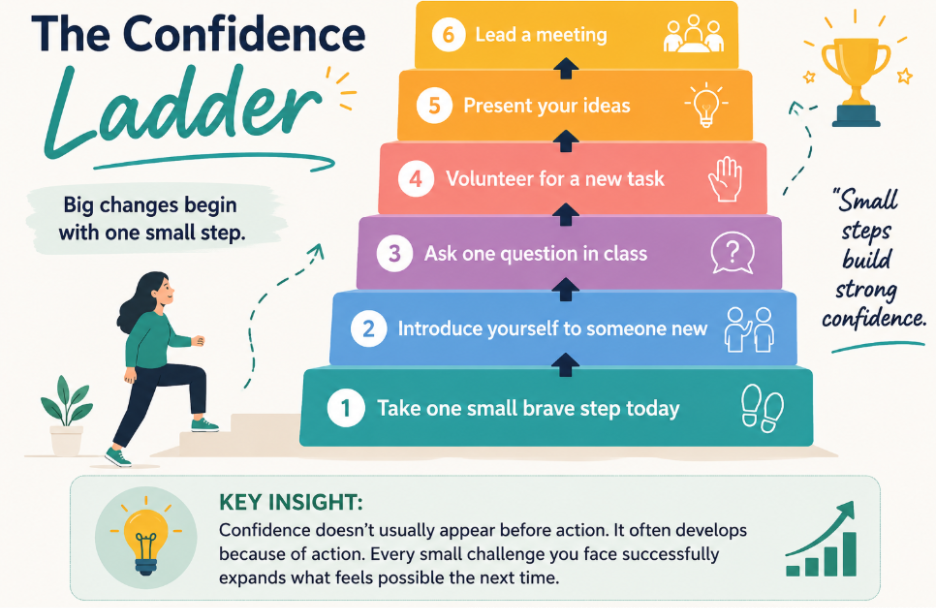
When confidence is low, it's natural to want quick results. However, setting goals that feel too ambitious can sometimes reinforce self-doubt if they seem out of reach. Starting small often creates a stronger foundation.
Instead of focusing on a major transformation, choose one realistic goal that feels slightly challenging but achievable. Using the SMART framework can help. Make your goal Specific, Measurable, Achievable, Relevant, and Time-bound.
For example, if speaking to colleagues feels intimidating, your first goal might simply be greeting one coworker each morning for a week. If public speaking makes you anxious, you could begin by asking one question during a team meeting rather than volunteering for a full presentation.
Each small success becomes evidence that you are capable. Over time, these micro-wins begin to accumulate, making larger challenges feel less intimidating.
💡 Psychologist's Perspective: Confidence often follows action, not the other way around. Waiting until you feel completely confident may keep you stuck. Taking one manageable step today can make the next step feel a little easier tomorrow.
2. Challenge Negative Self-Talk
One of the biggest barriers to confidence is not what happens around us, but the stories we tell ourselves about those experiences.
Imagine you're about to give a presentation.
Activating Event: You are asked to present in front of your team.
Belief: "I'm going to embarrass myself. Everyone will think I'm incompetent."
Consequence: You feel anxious, avoid eye contact, rush through the presentation, and later see this as proof that you lack confidence.
This pattern is explained by a cognitive behavioural therapy (CBT) framework known as the ABC Model, where our beliefs about an event often influence our emotions and behaviour more than the event itself.
The next time you notice a self-critical thought, pause and ask yourself:
- Is there evidence that this thought is completely true?
- What would I say to a friend in the same situation?
- Is there another, more balanced way of looking at this?
Replacing "I'm terrible at presentations" with "I'm still learning, and every presentation helps me improve" may feel more realistic and supportive. These small shifts in thinking can gradually help improve self-confidence over time.
3. Recognise and Build on Your Strengths
Many people who struggle with confidence become experts at noticing their weaknesses while overlooking what they already do well.
Take a few minutes to write down five qualities, skills, or achievements that you're proud of. They don't have to be extraordinary. Perhaps you're a patient listener, an organised planner, a creative problem solver, or someone others rely on during difficult times.
Psychologists also encourage identifying your character strengths, such as kindness, perseverance, curiosity, honesty, or teamwork. The VIA Character Strengths framework suggests that recognising and using your strengths more intentionally can contribute to greater wellbeing and confidence.
If this exercise feels difficult, ask someone you trust what they appreciate about you. Sometimes other people notice strengths that we dismiss or take for granted.
Building self-esteem and confidence isn't about pretending you have no weaknesses. It's about developing a balanced view of yourself that includes your strengths alongside the areas you're still working on.
4. Prepare Thoroughly Before Challenging Situations
Confidence isn't only about mindset. It is also influenced by competence.
The more prepared you feel, the more likely you are to trust yourself when facing a challenge. Whether you're preparing for a job interview, an important exam, a client meeting, or a difficult conversation, taking time to practise can reduce uncertainty and ease performance anxiety.
If you're delivering a presentation, rehearse it aloud several times rather than reading it silently. If you're attending an interview, practise answering common questions with a friend. Students preparing for examinations may find it more helpful to solve mock papers under timed conditions than repeatedly rereading notes.
Preparation doesn't guarantee perfection, but it does give your brain evidence that you've done everything reasonably possible to succeed. That preparation often becomes a reliable source of confidence when nerves begin to appear.
5. Practice Confident Body Language
Our thoughts influence our body, but the reverse can also be true.
When we're anxious, we often hunch our shoulders, avoid eye contact, speak softly, or make ourselves physically smaller. Adopting a more open posture may subtly influence how we feel and how others respond to us.
Research by social psychologist Amy Cuddy popularised the idea of "power posing", although later studies have produced mixed findings about how strongly these poses affect hormone levels and performance. Even so, there is broader evidence that posture, facial expressions, eye contact, and breathing can influence confidence through the mind-body connection.
You don't need to strike dramatic poses. Instead, try standing with your shoulders relaxed, maintaining comfortable eye contact, taking slower breaths, and speaking at a steady pace. These small physical adjustments may help you feel more grounded during interviews, presentations, social interactions, or important conversations.
6. Practice Self-Compassion Instead of Self-Criticism
Many people believe that being hard on themselves is the key to improvement. While self-reflection can be helpful, constant self-criticism often has the opposite effect. It may increase anxiety, reduce motivation, and make setbacks feel more personal than they need to be.
Psychologist Dr Kristin Neff describes self-compassion as having three key elements: self-kindness, common humanity, and mindfulness. In simple terms, it means treating yourself with the same understanding and encouragement that you would offer a close friend.
Imagine you didn't get selected for a job you were excited about. Instead of saying, "I'm not good enough," you might try saying, "This is disappointing, but one interview doesn't define my abilities. What can I learn for next time?"
Being compassionate towards yourself isn't about making excuses or lowering your standards. Rather, it helps create an emotional environment where learning and growth feel possible.
💡 Psychologist's Perspective: Research suggests that people who practise self-compassion are often more resilient after setbacks because they spend less energy judging themselves and more energy moving forward.
7. Step Outside Your Comfort Zone, One Step at a Time
Confidence rarely grows while staying within familiar routines. It often develops when we gradually face situations that feel slightly uncomfortable and realise we can cope with them.
Psychologists refer to this as graded exposure. Instead of diving into your biggest fear, you begin with a challenge that feels manageable and slowly build from there.
For example, if networking events make you anxious, your first goal could simply be introducing yourself to one new person. Once that feels easier, you might aim to have a five-minute conversation, and eventually attend a larger professional event with greater ease.
Students might begin by answering one question in class before volunteering for presentations. Similarly, someone who feels nervous about public speaking could start by speaking in a small team meeting before addressing a larger audience.
Each experience adds another piece of evidence that says, "I handled that better than I expected." Over time, your comfort zone naturally begins to expand.
8. Celebrate Progress, Not Just Perfection
When people think about confidence, they often focus on major achievements such as getting promoted, topping an exam, or completing a marathon. Yet confidence is more often built through recognising the smaller victories that happen along the way.
Perhaps you finally spoke up during a meeting, completed a difficult assignment, attended a social event despite feeling anxious, or simply challenged a negative thought. These moments deserve recognition because they represent progress.
One helpful practice is keeping a confidence journal. At the end of each day, write down three things you handled well, no matter how small they seem. Over time, this creates a collection of real-life evidence that challenges the belief that "I never do anything right."
Celebrating progress also shifts your focus from what is still missing to how far you've already come. That change in perspective can gradually strengthen both confidence and motivation.
9. Surround Yourself with Positive Influences
Confidence doesn't develop in isolation. The people around us often influence how we see ourselves, sometimes without us even realising it.
Supportive friends, family members, mentors, teachers, and colleagues can encourage us to take healthy risks, celebrate our achievements, and remind us of our strengths during difficult times. On the other hand, constant criticism, unhealthy comparison, or relationships that leave you feeling inadequate may gradually erode your confidence.
This doesn't necessarily mean distancing yourself from everyone who offers feedback. Constructive feedback helps us grow. The difference lies in whether someone critiques your behaviour while still respecting you as a person.
If possible, spend more time with people who encourage your growth, celebrate your progress, and inspire you to become a better version of yourself. Sometimes, borrowing someone else's belief in you is the first step towards believing in yourself.
10. Embrace Failure as Feedback
One of the most powerful ways to build lasting confidence is to change the way you think about failure.
Psychologist Dr Carol Dweck's research on the growth mindset suggests that people who view abilities as something that can be developed are more likely to persevere after setbacks than those who believe talent is fixed.
Rather than seeing failure as a verdict on who you are, try viewing it as information about what you could do differently next time.
Many successful individuals have experienced repeated setbacks before achieving their goals. Entrepreneurs often face failed ventures before building thriving businesses. Athletes lose competitions before winning championships. Professionals may receive several job rejections before finding the right opportunity.
The same applies to everyday life. A difficult conversation that didn't go well, an unsuccessful interview, or a disappointing exam result doesn't mean you lack potential. It simply highlights an opportunity to learn, adapt, and try again.
At the same time, not every setback immediately becomes a learning opportunity. Disappointment, frustration, and grief are natural responses to difficult experiences, and it is okay to take time to process those emotions before looking for lessons. Reflection is often most helpful once the initial emotional intensity has settled.
When you begin asking, "What is this experience teaching me?" instead of "What does this say about me?" you create space for confidence to grow, even in the face of setbacks.
Building Self-Confidence in Specific Life Areas
Confidence doesn't look the same in every situation. You might feel assured in one area of life while doubting yourself in another. Recognising where your confidence tends to dip can help you choose strategies that are most relevant to your daily experiences.
At Work
Learning how to be confident at work often begins with recognising the value you already bring. Before important meetings or performance reviews, remind yourself of your achievements, strengths, and the skills you've developed over time.
If speaking up feels intimidating, start small. Share one idea during a meeting, volunteer for a manageable project, or ask a thoughtful question. These seemingly minor actions gradually increase both visibility and confidence.
Many Indian workplaces also have hierarchical cultures, which can make it difficult to express opinions openly. Being confident doesn't mean being the loudest person in the room. It means communicating respectfully while trusting that your perspective deserves to be heard.
In Relationships
Healthy confidence also influences the way we connect with others. It allows us to express our needs, communicate honestly, and set boundaries without excessive guilt. Confidence includes being able to receive feedback without automatically viewing it as rejection
This can sometimes feel challenging in cultures where prioritising family expectations or avoiding conflict is encouraged. However, being assertive is different from being aggressive. You can respectfully say "no", express your feelings, or ask for support while still maintaining healthy relationships.
For Students and After Setbacks
Students often experience self-doubt because of examinations, peer comparison, or pressure to meet expectations. Rather than comparing your progress with classmates, focus on improving your own skills one step at a time. Speaking up in class, attempting challenging questions, or asking for help when needed are all opportunities to strengthen confidence.
Similarly, confidence may take a hit after a failed exam, job rejection, relationship breakup, or business setback. While these experiences can be painful, they don't define your potential. Instead of asking, "Why did I fail?", try asking, "What can I learn that will help me move forward?" Reframing setbacks as opportunities for growth is often an important step in building confidence after failure.
Self-Confidence Exercises and Daily Practices
Like physical fitness, confidence often grows through regular practice rather than occasional bursts of motivation. These simple self-confidence exercises can help reinforce healthier patterns over time.
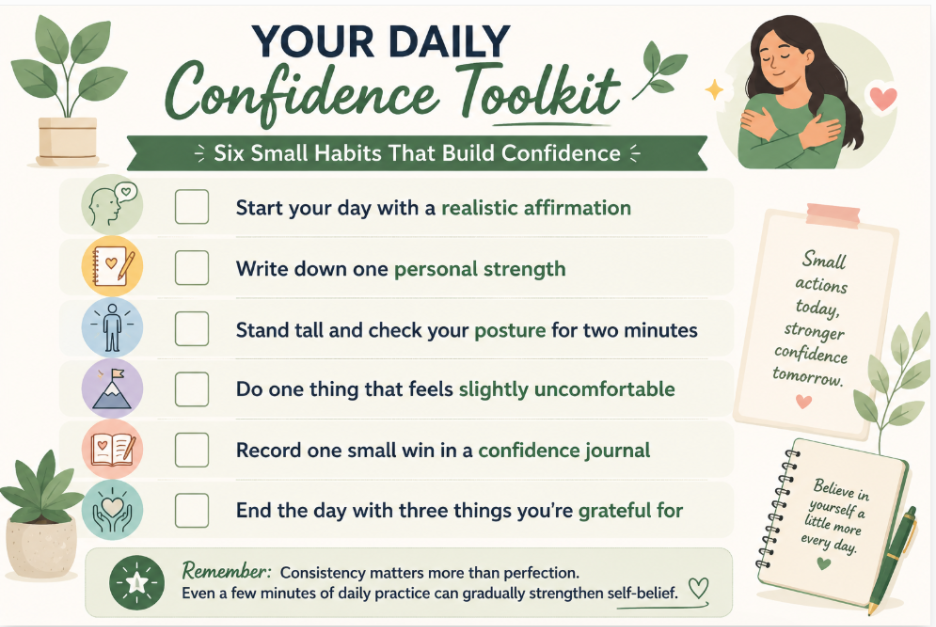
Positive affirmations tend to be most helpful when they feel believable. Instead of saying, "I'm the most confident person in the room," try, "I'm becoming more confident every time I practise." Affirmations tend to work best when paired with action.
Visualising yourself succeeding before an interview, presentation, or examination can also make unfamiliar situations feel more manageable. Finally, keeping a confidence journal helps create a record of progress that you can revisit whenever self-doubt returns.
When Low Self-Confidence Needs Professional Support
Everyone experiences periods of self-doubt. However, if low confidence begins affecting your work, relationships, studies, or emotional wellbeing for an extended period, additional support may be helpful.
Persistent self-criticism is sometimes linked with anxiety, depression, trauma, or deeply held negative beliefs about oneself. In some cases, confidence difficulties may also be associated with conditions such as social anxiety, Attention-Deficit/Hyperactivity Disorder (ADHD) or perfectionism, where fear of judgement, unrealistic self-expectations or difficulties with attention and organisation can gradually undermine self-belief. In these situations, building confidence isn't simply about "thinking positively". It often involves understanding where these beliefs came from and learning healthier ways to respond to them.
Therapeutic approaches such as Cognitive Behavioural Therapy (CBT), Acceptance and Commitment Therapy (ACT), and person-centred therapy may help individuals recognise unhelpful thinking patterns, develop self-compassion, and gradually rebuild confidence.
Need a little extra support?
If low self-confidence is affecting your quality of life, speaking with a 1to1help counsellor can provide a safe and confidential space to explore the underlying causes and develop practical strategies for lasting change.
Final Thoughts
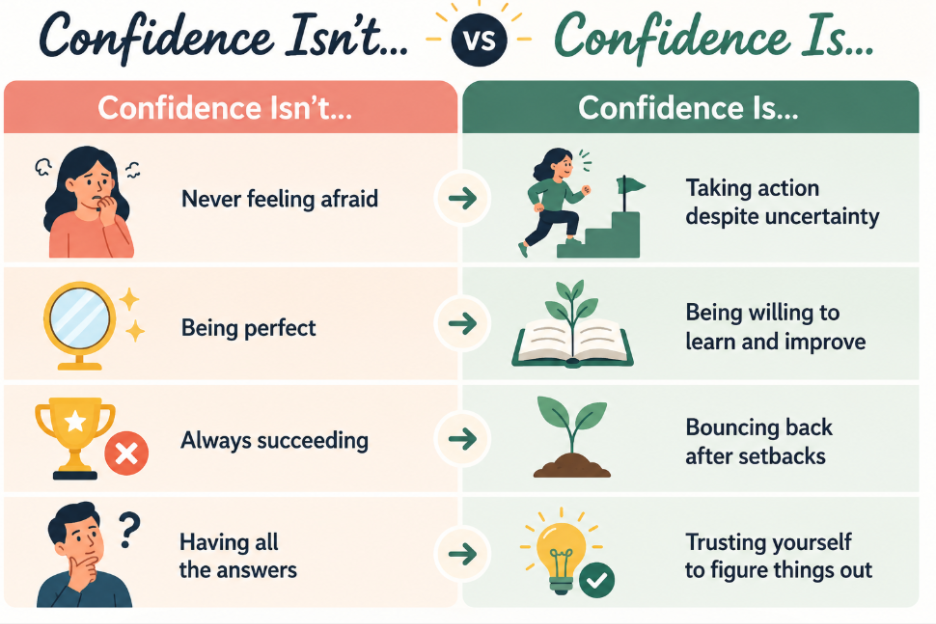
Building confidence isn't about becoming fearless or never experiencing self-doubt. It is about being willing to take action even when uncertainty, fear, or self-doubt are present. Every time you try something new, speak up despite feeling nervous, or learn from a setback, you strengthen your belief in your ability to handle whatever comes next. The journey may look different for everyone, and there will likely be moments when confidence feels stronger than others. That's completely normal. What matters is continuing to take small, intentional steps, because those moments of courage often become the foundation for lasting self-belief.
If low self-confidence has been affecting your work, relationships, studies, or emotional wellbeing, you don't have to navigate it alone.
🌱 Looking for Support?
Sometimes, persistent self-doubt has deeper roots that can be difficult to untangle on your own. Speaking with a trained mental health professional can help you better understand these patterns and develop practical strategies to build confidence over time.
Whether you're looking for online counselling or support through an Employee Assistance Programme (EAP), 1to1help offers confidential, evidence-based mental health support tailored to your unique needs.
FAQs
Q1. How can I build self-confidence quickly?
While there isn't an instant solution, confidence can begin to improve surprisingly quickly when you take small, consistent actions. Completing a manageable goal, preparing well for an important task, or challenging one negative thought can create early momentum. If you're wondering how to build self-confidence, remember that confidence usually grows through repeated experiences rather than overnight transformation.
Q2. How long does it take to develop lasting self-confidence?
There is no fixed timeline because confidence is shaped by your experiences, environment, and personal challenges. Some people notice changes within a few weeks of practising new habits, while deeper shifts in self-belief may take longer. Consistency is often more important than speed.
Q3. What is the difference between self-confidence and self-esteem?
Self-confidence refers to your belief in your ability to handle a particular task or situation. Self-esteem reflects your overall sense of self-worth. For example, you may feel confident giving a presentation while still struggling with feelings of inadequacy in other areas of life. Building both can contribute to greater emotional wellbeing.
Q4. How do I build confidence after failure?
Learning how to build confidence after failure starts with viewing setbacks as opportunities to learn rather than as proof of your abilities. Reflect on what happened, identify what you would do differently next time, and focus on taking one small step forward. Confidence is often rebuilt through action, not by waiting to feel ready.
Q5. Can low self-confidence cause anxiety or depression?
Low confidence doesn't always lead to anxiety or depression, but the two can sometimes be closely connected. Persistent self-doubt may increase worry, avoidance, or feelings of hopelessness. If these experiences begin affecting your daily life, professional support may be beneficial.
Q6. How can introverts build self-confidence without changing who they are?
Confidence isn't about becoming louder or more outgoing. Introverts can build confidence by recognising their strengths, preparing for important situations, communicating authentically, and gradually expanding their comfort zone. The goal isn't to change your personality but to trust your abilities.
Q7. How can I help my child develop healthy self-confidence?
Encourage effort rather than perfection, celebrate progress, and provide opportunities for your child to solve problems independently. Listening without judgement and offering unconditional support can help children develop confidence that isn't based solely on achievements or external praise.
References
- American Psychological Association. (n.d.). Exposure therapy. https://www.apa.org/ptsd-guideline/patients-and-families/exposure-therapy
- Atlassian. (n.d.). How to write SMART goals. https://www.atlassian.com/blog/productivity/how-to-write-smart-goals
- Bandura, A. (1977). Self-efficacy: Toward a unifying theory of behavioral change. Psychological Review, 84(2), 191–215. https://doi.org/10.1037/0033-295X.84.2.191
- Bandura, A. (1997). Self-efficacy: The exercise of control. W. H. Freeman.
- Dweck, C. S. (2006). Mindset: The new psychology of success. Random House.
- Healthline. (n.d.). ABC model: How changing your thinking can change your life. https://www.healthline.com/health/abc-model
- Indeed Editorial Team. (2025). What is self-confidence? Indeed Career Guide. https://in.indeed.com/career-advice/career-development/what-is-self-confidence
- Neff, K. D. (n.d.). Self-compassion. https://self-compassion.org
- Psychology Today. (2018). 5 reasons people have low self-confidence. https://www.psychologytoday.com/us/blog/shyness-is-nice/201812/5-reasons-people-have-low-self-confidence
- Psychology Today. (2023). 6 proven ways to build confidence. https://www.psychologytoday.com/us/blog/what-mentally-strong-people-dont-do/202305/6-proven-ways-to-build-confidence
- Psychology Today. (n.d.). Perfectionism. https://www.psychologytoday.com/us/basics/perfectionism
- ResearchGate. (2024). The importance of self-confidence. https://www.researchgate.net/publication/386132929_The_Importance_of_Self-Confidence
- Seligman, M. E. P. (2006). Learned optimism: How to change your mind and your life. Vintage Books.
- Verywell Mind. (n.d.). Negative self-talk and how it affects us. https://www.verywellmind.com/negative-self-talk-and-how-it-affects-us-4161304
- VIA Institute on Character. (n.d.). Character strengths survey. https://www.viacharacter.org
- Peer-reviewed journal articles
- Bandura, A., & Locke, E. A. (2003). Negative self-efficacy and goal effects revisited. Journal of Applied Psychology, 88(1), 87–99.
- MacBeth, A., & Gumley, A. (2012). Exploring compassion: A meta-analysis of the association between self-compassion and psychopathology. Clinical Psychology Review, 32(6), 545–552. https://doi.org/10.1016/j.cpr.2012.06.003
- Muris, P., & Petrocchi, N. (2017). Protection or vulnerability? A meta-analysis of the relations between the positive and negative components of self-compassion and psychopathology. Clinical Psychology & Psychotherapy, 24(2), 373–383.


.svg)
.svg)
.svg)
.svg)