


.png)


.png)

Personal Growth & Wellbeing
Low Self-Esteem and Self-Worth: Understanding the Signs, Causes, and How to Heal
.png)
.png)
Written by
Aarohi Parakh,
Psychologist and Content Writer

Reviewed by
Sanjana Sivaram,
Psychologist and Clinical Content Head


Introduction
Low self-worth rarely announces itself. It often shows up quietly, in the moments you say "yes" when you really want to say "no", work twice as hard to feel half as worthy, apologise for taking up space, or shrink yourself so others feel more comfortable.
If any of this feels familiar, you are far from alone. Research suggests that self-esteem naturally fluctuates across different stages of life and can be influenced by experiences such as criticism, rejection, workplace stress, and difficult relationships. For many people, periods of low self-esteem become a significant emotional challenge rather than a passing phase.
Unfortunately, much of the advice available online focuses on simply "thinking positively" or "being more confident". While confidence has its place, lasting change often comes from understanding something deeper: your sense of self-worth (i.e., the internal, deep-seated belief that you are valuable, meaningful, and deserving of respect simply because you exist)
This guide goes beyond quick confidence tips. Together, we'll explore where low self-esteem and self-worth come from, how they quietly influence everyday life, and practical, evidence-based ways to rebuild a healthier relationship with yourself.
Before we get there, start with a simple self-check.
Quick Self-Check: Could Low Self-Worth Be Affecting You?
Self-Reflection Checklist
Do any of these feel true for you?
☐ I struggle to accept compliments.
☐ I often compare myself to others.
☐ I feel guilty when I say no.
☐ One mistake makes me question my abilities.
☐ I constantly seek reassurance.
☐ My achievements never feel "good enough."
☐ I worry about disappointing others.
☐ I feel I have to earn love or approval.
If you recognised yourself in several of these statements, this article may help you understand why and, more importantly, what you can do about it. It should, however, be noted that this checklist is for reflection, and not diagnosis.
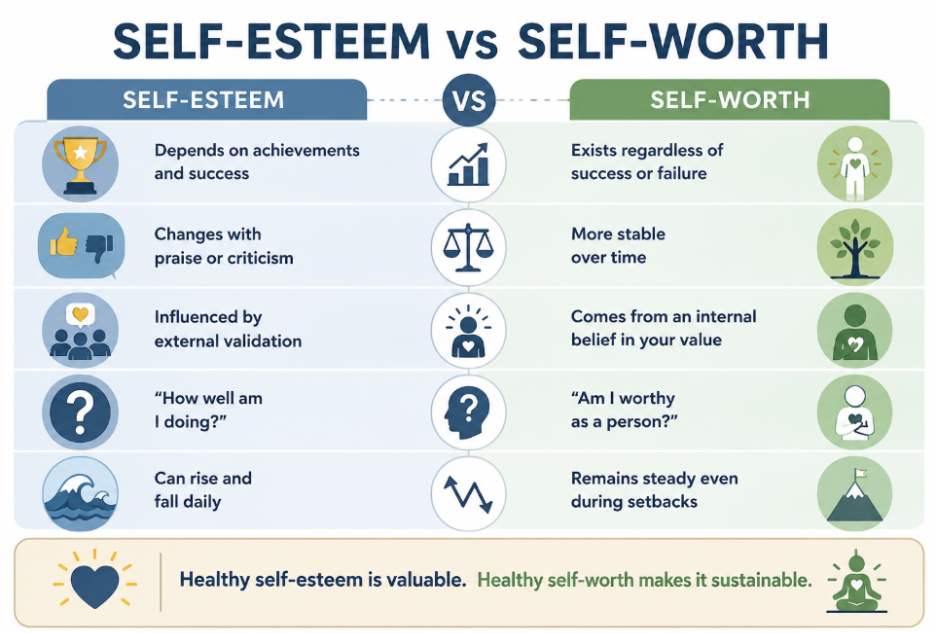
Self-Esteem vs Self-Worth
Many people use self-esteem and self-worth interchangeably. Although they are closely connected, they are not the same thing. Understanding the difference is often the first step towards lasting emotional wellbeing.
What is self-esteem?
Self-esteem refers to how you evaluate yourself based on things such as your achievements, appearance, abilities, relationships, or how you believe other people see you.
Because it depends on circumstances, self-esteem tends to fluctuate.
You might feel confident after receiving praise from your manager, completing a challenging project, or reaching a personal goal. Equally, criticism, setbacks, or rejection may leave you doubting yourself.
In other words, self-esteem often asks:
"How well am I doing?"
What is self-worth?
Self-worth is deeper.
It is the belief that you have inherent value simply because you are a human being, not because of what you achieve, produce, earn, or how others perceive you.
Someone with healthy self-worth can still feel disappointed after making a mistake or missing an opportunity. The difference is that they are less likely to conclude:
"I failed, therefore I am a failure."
Instead, they may think:
"This didn't go the way I hoped, but it doesn't define who I am."
Self-worth asks a very different question:
"Am I worthy of respect, care, and compassion regardless of today's outcome?"
The answer is intended to remain stable.
Why confidence alone often doesn't last
Many people spend years trying to improve their confidence.
They work harder. Collect more qualifications. Seek more recognition. Aim for the next promotion.
Hope that one more achievement will finally make them feel enough.
Sometimes it works, but often only temporarily.
Imagine an employee in a busy Indian corporate office.
After months of late nights, they receive an "Employee of the Quarter" award. For a few days they feel proud and validated. Then a new project begins, expectations increase, and the familiar inner voice returns:
"What if I can't do it again?"
"What if people realise I was just lucky?"
The achievement itself was real. But because their sense of worth depended on continued success, the reassurance faded quickly.
This is why focusing only on self-esteem can sometimes feel like chasing a moving target.
Every success briefly raises it. Every setback seems to pull it back down.
Nothing ever feels quite enough.
What Low Self-Worth Actually Looks Like
When people picture someone with low self-worth, they often imagine a person who appears shy, withdrawn, or visibly lacking in confidence.
Sometimes that is true. But low self-worth does not always look like insecurity.
In many cases, it hides behind behaviours that society actually rewards.
Someone may appear highly successful, endlessly helpful, funny, agreeable, or driven while privately feeling that they are never quite enough.
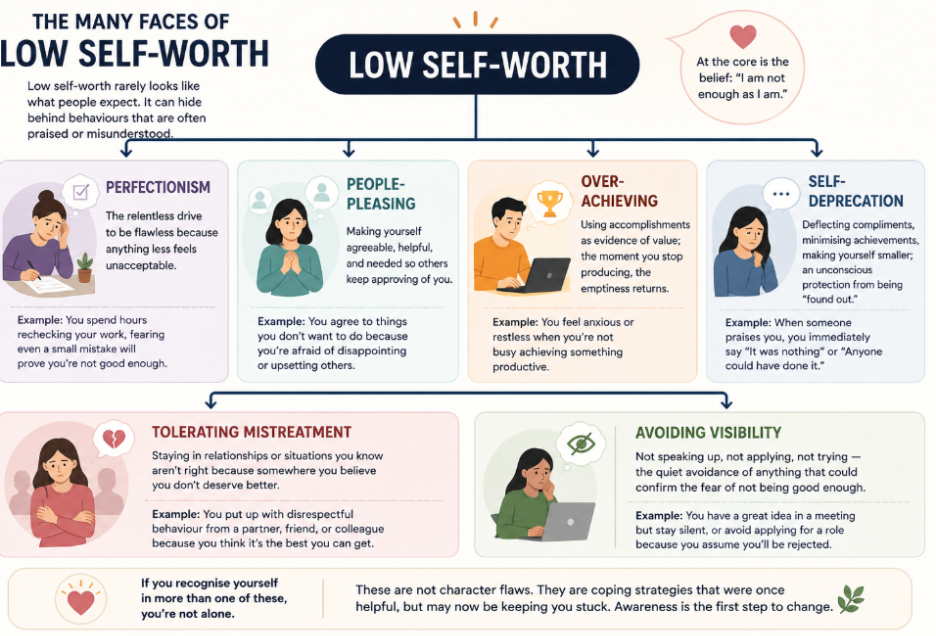
Here are some of the most common ways low self-worth can show up.
1. Perfectionism
Perfectionism is often seen as a strength, but it can sometimes be a way of trying to earn your worth. When your value feels tied to doing everything perfectly, even small mistakes can feel deeply personal.
For example: You spend days preparing a presentation at work and receive positive feedback from your manager. Instead of feeling proud, you replay the one slide where you stumbled and convince yourself that everyone noticed. The praise quickly fades, but the mistake stays with you.
Over time, the goal is no longer to do well. It becomes avoiding failure at all costs, making it difficult to ever feel "good enough".
2. People-Pleasing
Being caring and supportive is different from feeling responsible for everyone else's happiness. People-pleasing often comes from believing that saying no might make you less likeable or valued.
For example: A colleague asks if you can help with another project, even though your own workload is already overwhelming. You want to decline, but you agree anyway because you worry they might think you're selfish or uncooperative.
When this becomes a pattern, your needs gradually take a back seat while your sense of worth becomes tied to being useful to others.
3. Overachieving
Achievement can be deeply fulfilling, but it may become exhausting when it feels like the only way to prove your value.
For example: After months of hard work, you receive a promotion. For a day or two, you feel excited. Then a new thought creeps in: Now I have to prove I deserved it. Instead of celebrating, you're already worried about the next milestone.
Rather than bringing lasting confidence, each success becomes temporary evidence that you are "enough", until the next challenge arrives.
4. Constant Self-Deprecation
People with low self-worth often struggle to accept compliments because positive feedback feels unfamiliar or undeserved.
For example: Someone tells you, "You handled that meeting really well." Instead of saying thank you, you reply, "I just got lucky," or "Anyone could have done it." You dismiss the compliment before allowing yourself to believe it.
Although this may seem like humility, it can make it difficult to recognise your own strengths over time.
5. Tolerating Mistreatment
Low self-worth can sometimes make unhealthy situations feel normal because asking for better feels uncomfortable or unrealistic.
For example: Your manager regularly takes credit for your work, yet you hesitate to speak up because you worry about being seen as "difficult". Or you remain in a friendship where your efforts are rarely reciprocated because you convince yourself you're expecting too much.
When you don't believe your needs matter, it becomes easier to ignore them. It is also important to remember that people may remain in unhealthy situations for many reasons beyond self-worth, including practical constraints, dependence, power dynamics, or concerns about safety
6. Avoiding Visibility
Sometimes low self-worth doesn't push you to work harder. Instead, it encourages you to stay in the background.
For example: You see a job opening that matches your skills perfectly, but you never apply because you immediately assume someone else will be more qualified. Or during a team meeting, you have an idea but stay silent, only to hear someone else suggest the same thing later.
Avoiding opportunities may feel safer in the moment, but it can quietly reinforce the belief that your voice or abilities are not valuable.
💡 Did You Know?
Many behaviours associated with "being driven" or "being nice" may actually develop as coping strategies rather than personality traits.
For some people behaviours such as perfectionism, chronic people-pleasing and overworking may function as coping strategies for fears of rejection, inadequacy or not being ‘good enough’. The same behaviour can have very different motivations for different people
The encouraging news is that patterns learned over time can also be understood, challenged and gradually changed.
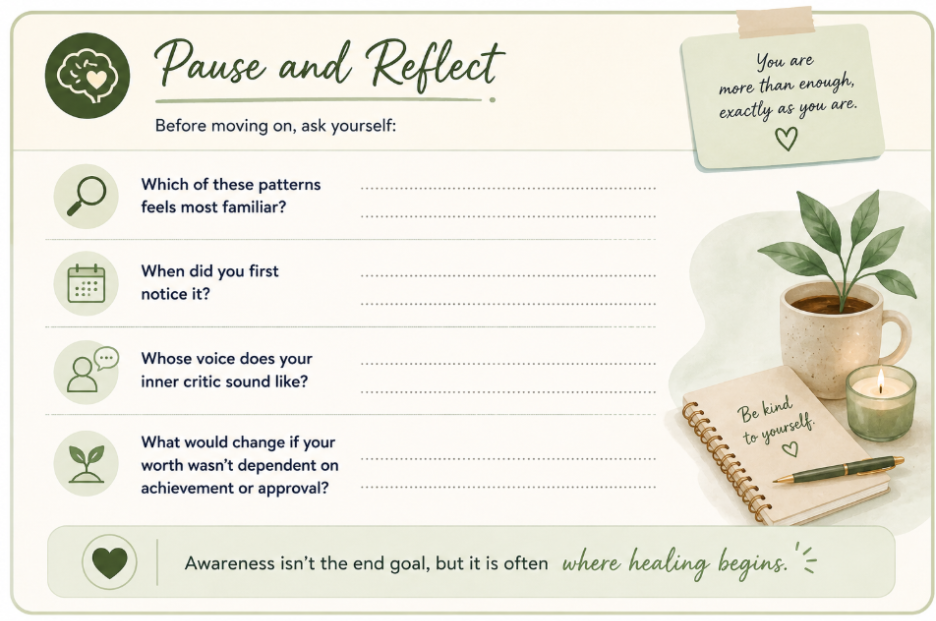
Where Does Low Self-Esteem Come From?
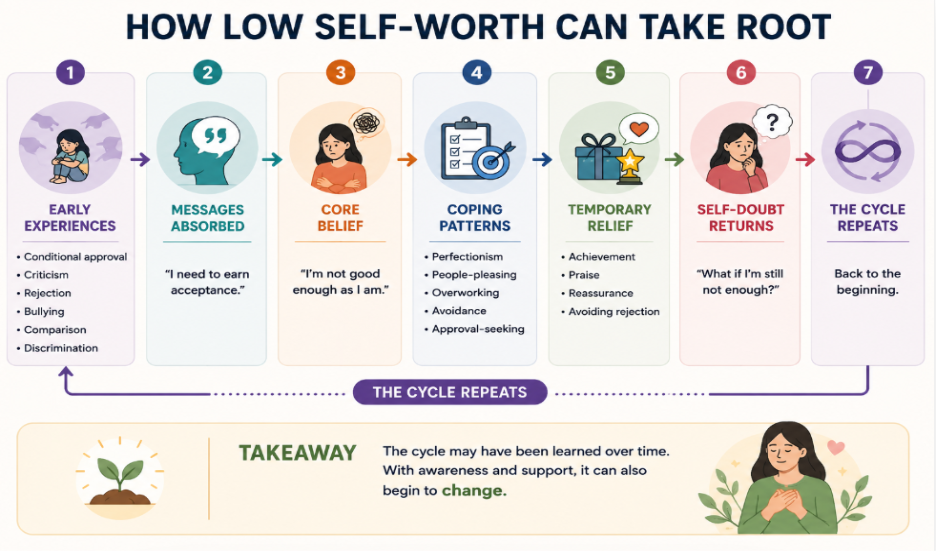
Low self-esteem or self-worth rarely comes from one experience. It is often shaped gradually by relationships, environments and messages absorbed over time about what makes us lovable, successful or “good enough”.
Research suggests that experiences such as childhood criticism, maltreatment, bullying and rejection can be associated with lower self-esteem. However, people respond to these experiences differently, and supportive relationships and later experiences can also influence how we come to see ourselves.
Understanding where low self-worth may have started is not about assigning blame. It is about recognising that what you learned to believe about yourself may not reflect who you truly are.
1. Conditional Love in Childhood
When affection or approval seems closely tied to achievement or behaviour, a child may begin to believe that love has to be earned.
For example, a child who scores 92% but regularly hears, “What happened to the other eight marks?” may gradually associate achievement with acceptance. As an adult, this can show up as needing promotions, praise or recognition to feel good enough.
The underlying belief may become: “I am worthy when I perform well.”
2. Criticism, Neglect or Emotional Unavailability
Repeated criticism can gradually become an internal voice, while emotional neglect may leave someone feeling that their needs do not matter.
For example, a child repeatedly told, “Stop being so sensitive,” may grow into an adult who apologises for expressing emotions or hesitates to ask for support.
Eventually, what someone else once said can begin to sound like your own inner critic.
3. Trauma, Bullying or Repeated Rejection
Bullying, abuse, humiliation, or repeated rejection can influence how someone sees themselves, particularly when these experiences happen during formative years.
A teenager repeatedly mocked for their appearance, for instance, may continue feeling unattractive years after the bullying has stopped. Campus-based support matters here — a Student Assistance Programme gives students a confidential space to process experiences like bullying or ragging with a qualified counsellor before they harden into long-term self-worth issues.
The important distinction is that an experience can shape a belief without making that belief true.
4. Perfectionism-Reinforcing Environments
Families, schools, and workplaces that consistently reward performance can unintentionally teach people to measure their worth through achievement. Women professionals navigating this pressure alongside caregiving responsibilities and workplace bias can find dedicated support through 1to1help's cohort-based wellbeing programmes, including 1to1Women's peer learning and leadership development track.
Consider an employee in a competitive Indian workplace where staying late is praised, responding during leave is considered dedication, and every appraisal immediately shifts towards the next target. Over time, resting may begin to feel like laziness rather than a normal human need.
Ambition itself is not the problem. The difficulty begins when “I want to do well” becomes “I must do well to feel worthy.”
5. Social Comparison and Social Media
Social media can expose us to a constant stream of other people's achievements, appearances, relationships and lifestyles.
You may open Instagram after an ordinary workday and see one friend announcing a promotion, another travelling abroad and someone else buying their first home. Within minutes, your perfectly normal life can suddenly feel inadequate.
The comparison is rarely fair. You are often comparing your full, unfiltered life with selected moments from someone else's. Research has linked frequent upward social comparison on social media with more negative self-evaluation and lower self-esteem.
6. Discrimination and Marginalisation
Self-worth is also shaped by the wider social environment. Repeated experiences of discrimination, prejudice or exclusion can communicate that certain identities or backgrounds are valued less than others.
Someone repeatedly overlooked at work because of gender, caste, disability, age or another aspect of identity may begin questioning their competence, even when the problem lies within an unfair environment.
This is an important reminder that low self-worth is not always simply a matter of “negative thinking”. Sometimes people internalise messages from environments that have repeatedly treated them as less worthy.
💡KEY INSIGHT
Understanding the origin of low self-worth is not about assigning blame. It is about learning to separate:
What happened to me
from
What I came to believe about myself.
Those two things are not necessarily the same.
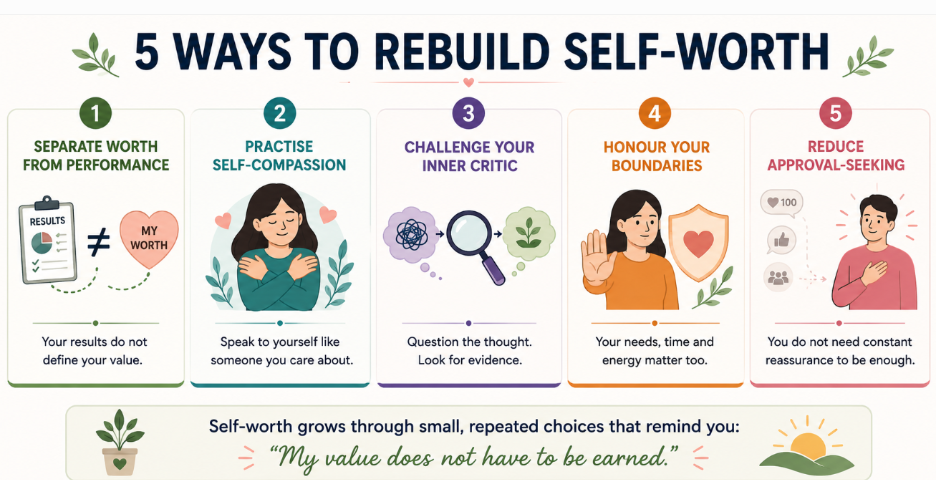
5 Evidence-Based Ways to Rebuild Self-Worth
Rebuilding self-worth is not about convincing yourself that you are amazing every day. It is about gradually loosening the belief that your value depends on how much you achieve, how perfectly you perform or how others respond to you.
This process takes practice. Some days, old patterns may still take over. What matters is learning to respond differently when they do.
Here are five practical, evidence-informed ways to begin.
1. Separate Your Worth from Your Performance
When self-worth is closely tied to achievement, a bad outcome can quickly become a judgement about who you are.
Imagine making a mistake in an important presentation. Your first thought might be, “I completely messed that up. I’m terrible at my job.” Notice how quickly one performance has become a verdict on your entire ability.
Instead, try separating what happened from who you are:
“I made a mistake during that presentation. I can learn from it, but it does not define my competence or value.”
This is not about ignoring mistakes. It is about seeing them in proportion.
TRY THIS: Each day, identify one thing you value about yourself that has nothing to do with productivity or achievement. Perhaps you listened patiently to a friend, acted with honesty, showed courage in an uncomfortable situation, or simply allowed yourself to rest when you needed it.
The more ways you recognise your value, the less one achievement or setback has to carry the weight of defining you.
2. Practise Self-Compassion, Not Constant Self-Improvement
When people struggle with low self-esteem, the instinct is often to “fix” themselves by becoming more successful, confident, disciplined or productive.
But if the belief underneath is “I’m not enough as I am,” endless self-improvement can sometimes reinforce the very problem you are trying to solve.
Self-compassion offers another approach. Psychologist Kristin Neff describes it through three core elements: self-kindness, recognising struggle as part of our shared human experience, and responding mindfully to difficult emotions.
Imagine being rejected after a job interview. Your inner critic might say, “Of course they didn’t choose you. You weren’t good enough.”
A more compassionate response could be:
“I’m disappointed because I really wanted this opportunity. Rejection hurts, but one decision does not determine my worth or what I’m capable of.”
Self-compassion does not mean pretending everything is fine. It means not attacking yourself when you are already struggling.
TRY THIS: THE SELF-COMPASSION LETTER
Think about something you currently criticise yourself for. Imagine that a close friend came to you with exactly the same struggle.
What would you say to them?
Write it down, then read those words back to yourself.
Notice whether you offer someone you love more patience than you usually offer yourself.
3. Challenge Your Inner Critic with Evidence
Low self-worth often speaks in absolutes:
“I always mess things up.”
“Nobody really values me.”
“I’m not capable enough.”
These thoughts can feel true simply because they have been repeated for a long time.
Cognitive behavioural approaches encourage us to examine thoughts rather than automatically accepting them as facts.
For example, suppose your manager asks you to revise a report and your immediate thought is:
“They must think I’m incompetent.”
Pause and look at the evidence. Did your manager actually say that? Have they previously appreciated your work? Could revisions simply be a normal part of completing a project?
A more balanced thought might be:
“There are changes needed in this report. That does not mean I am bad at my job.”
TRY THIS: When you notice a harsh self-critical thought, ask:
- Is this 100% true?
- What evidence supports it, and what evidence challenges it?
- What would I say if someone I loved said this about themselves?
The goal is not forced positivity. It is learning to think about yourself more accurately and fairly.
4. Set and Honour Your Own Boundaries
Boundaries are not only about telling other people what you will or will not accept. They also communicate something important to yourself:
“My needs matter too.”
This can feel surprisingly difficult if your self-worth has been built around being helpful, agreeable, or constantly available.
Consider an employee who receives a non-urgent message from their manager at 10 pm. They are exhausted, but respond immediately because they worry that waiting until morning might make them appear less committed.
A small boundary could simply be answering during working hours the next day.
The action may seem minor, but the message underneath is significant: I can be responsible at work without being available every moment.
TRY THIS: Choose one small boundary this week. It could be saying, “Let me check my schedule and get back to you,” instead of automatically saying yes, switching off work notifications after a certain time, or speaking up when something feels disrespectful.
Feeling guilty after setting a boundary does not necessarily mean the boundary was wrong. Sometimes guilt simply means you are doing something differently.
5. Reduce Conditional Approval-Seeking
Wanting reassurance and approval is human. The difficulty begins when other people’s responses become the main evidence that you are okay.
Suppose you send someone an important message and they do not reply for several hours. You reread your text, wonder whether you offended them, and ask a friend, “Do you think I said something wrong?”
When the person eventually replies normally, you feel relieved.
But the next unanswered message triggers the same anxiety.
Reassurance provided temporary comfort without changing the underlying fear.
The next time you feel an urge to seek immediate reassurance, create a small pause. Ask yourself:
“What am I afraid their response will mean about me?”
Then see whether you can tolerate not knowing for a little longer.
TRY THE 10-MINUTE PAUSE
1. Notice: “I want someone to reassure me.”
2. Name the fear: “I’m worried they are disappointed in me.”
3. Wait 10 minutes before seeking reassurance.
4. Ask: “Can I be uncertain about what they think without changing what I believe about myself?”
This does not mean never asking for feedback or support. Healthy relationships include both. The aim is to gradually reduce the need for someone else’s approval before you can feel secure in yourself.
💡A Small Reminder
Rebuilding self-worth often happens in ordinary moments rather than dramatic breakthroughs.
It may be the first time you say no without giving a lengthy explanation. The first compliment you accept with a simple “thank you”. The first mistake that disappoints you without making you question your entire identity.
These shifts can feel small while they are happening, but together, they may signal something important: your sense of worth is beginning to depend less on proving yourself and more on accepting yourself.
How to Know Your Self-Worth Is Rebuilding: Progress Markers
Rebuilding self-worth is rarely a straight line. You may feel more secure one week and find yourself slipping into familiar patterns the next. Progress is often quieter than expected, which means you may be changing without fully recognising it.
You might notice that:
You catch your inner critic and question it instead of immediately accepting it as fact.
- You say no without spending days feeling guilty or wondering whether someone is upset with you.
- Compliments begin to land more easily, without an automatic need to dismiss or minimise them.
- You make more choices based on what you genuinely want and need, rather than only what others expect.
- Mistakes still disappoint you, but they no longer define how you feel about yourself for days or weeks.
- You speak up in meetings, relationships or conversations where you might previously have stayed silent.
- You become less willing to tolerate disrespect, both from other people and in the way you speak to yourself.
Perhaps one of the clearest signs is that setbacks begin to feel like something that happened, rather than evidence of who you are.
Some weeks may still feel like regression. That does not necessarily mean the work is not helping. Old patterns often return under stress. Progress may simply mean noticing them sooner and choosing differently more often.
When Low Self-Worth Needs More Than Self-Help
Self-reflection, boundaries and self-compassion can be powerful tools, but some struggles with low self-esteem or self-worth may be rooted in experiences that are difficult to work through alone.
Professional support may be worth considering if you experience persistent self-loathing despite genuine efforts to change, repeatedly find yourself people-pleasing or tolerating mistreatment, or recognise that your self-worth is connected to trauma, abuse, neglect or painful early relationships. Support may also be particularly important when low self-worth occurs alongside depression, anxiety, disordered eating or other mental health difficulties.
Therapy does not simply teach you to “think positively”. Depending on your needs, different approaches may help explore and change deeper patterns. Cognitive Behavioural Therapy (CBT) can help identify and restructure negative core beliefs, while Acceptance and Commitment Therapy (ACT) may support greater self-acceptance and choices guided by personal values. Schema therapy may be helpful when longstanding patterns appear connected to unmet emotional needs or early experiences.
Therapy cannot give you worth because worth is not something another person can grant. What it can offer is a safe space to examine the experiences and beliefs that may have taught you to question it.
If low self-esteem or self-worth is persistently affecting your wellbeing, relationships or daily life, 1to1help’s online counselling can connect you with a trained mental health professional within 12 to 15 hours, confidentially and in your preferred language, without requiring a clinic visit.
Seeking support does not have to mean you have reached a crisis. Sometimes, asking for help can itself be an important way of recognising that your emotional needs deserve attention.
Conclusion: Building Self-Worth Starts with Recognising You Are Already Enough
Low self-worth can be quiet, persistent and deeply learned. But what has been learned through years of experiences, relationships and repeated messages may also be questioned and gradually reshaped.
The goal is not relentless confidence or never doubting yourself again. It is developing a steadier belief that even when you fail, disappoint someone or have an ordinary, unproductive day, you remain worthy of care, respect and a life that reflects who you genuinely are.
You do not have to earn your worth. You never did. If you are ready to build a healthier relationship with yourself, 1to1help has supported over 11 million people across India through counselling, workplace wellbeing support and compassionate one-to-one care. Whenever you are ready, support is available.
Note: The most appropriate approach depends on the person's concerns, goals and clinical context
FAQs
Q1. Is low self-worth the same as low self-esteem?
Not exactly. Self-esteem generally refers to how positively or negatively you evaluate yourself and may fluctuate with achievement, appearance, relationships or feedback. Self-worth refers to a deeper sense that you have value as a person regardless of performance or approval. The two are closely connected, so low self-worth can often contribute to low self-esteem.
Q2. What does low self-esteem mean?
Low self-esteem generally means having a persistently negative or critical view of yourself. You may doubt your abilities, struggle to accept compliments, compare yourself frequently with others or feel that mistakes confirm you are “not good enough”. It can look different for everyone and may sometimes hide behind perfectionism, overachievement or people-pleasing.
Q3. What can cause low self-worth?
Low self-worth may develop through a combination of experiences, including conditional approval in childhood, repeated criticism, emotional neglect, bullying, rejection, trauma, discrimination or environments that strongly link worth with achievement. Social comparison may also contribute. There is rarely one single cause, and people can respond very differently to similar experiences.
Q4. What is the difference between self-worth and self-esteem?
A simple way to understand the difference is this: self-esteem often asks, “How well am I doing?” while self-worth asks, “Do I still have value even when things do not go well?” Healthy self-worth provides a more stable foundation because it is less dependent on external success or approval.
Q5. Can low self-esteem improve?
Yes. Self-esteem and self-worth are not necessarily fixed. Psychological approaches such as CBT, self-compassion practices, healthier boundaries and examining long-held beliefs may help over time. If low self-esteem is persistent, linked to trauma or significantly affecting daily life, relationships or mental health, working with a qualified mental health professional may provide more personalised support.
References
- American Psychological Association. (n.d.). Self-esteem. Psychology Today. Psychology Today: Self-Esteem
- Better Health Channel. (n.d.). Self-esteem. Victorian Government Department of Health. Better Health Channel: Self-Esteem
- International Society of Schema Therapy. (n.d.). Schema therapy. International Society of Schema Therapy
- Mayo Clinic. (n.d.). Self-esteem: Take steps to feel better about yourself. Mayo Clinic: Self-Esteem
- Neff, K. D. (n.d.). Self-compassion. Self-Compassion.org
- PositivePsychology.com. (n.d.). What is self-worth and how do we increase it? PositivePsychology.com: Self-Worth
- PositivePsychology.com. (n.d.). Inner critic worksheets and exercises. PositivePsychology.com: Inner Critic Worksheets
- Psychology Tools. (n.d.). Learn about low self-esteem. Psychology Tools: Low Self-Esteem
- Verywell Mind. (n.d.). Signs of low self-esteem. Verywell Mind: Signs of Low Self-Esteem
- Webb, J. (n.d.). The difference between self-esteem, self-worth, self-confidence, and self-knowledge. Dr Jonice Webb
- Peer victimization and self-esteem: A meta-analysis of longitudinal studies. (2024). PMC, National Library of Medicine. PubMed Central article
- Article available via PubMed Central (PMC11837766). (2025). National Library of Medicine. PubMed Central article
- Self-esteem and related psychological constructs. (n.d.). In ScienceDirect. Elsevier. ScienceDirect book chapter


.svg)
.svg)
.svg)
.svg)