

.png)


.png)

Student Assistance Programme: 24×7 Crisis Care, Multimodal Counselling, & Wellbeing Support for Indian Campuses
Introduction
India's educational institutions are facing a challenge that can no longer be treated as a student welfare concern on the sidelines.
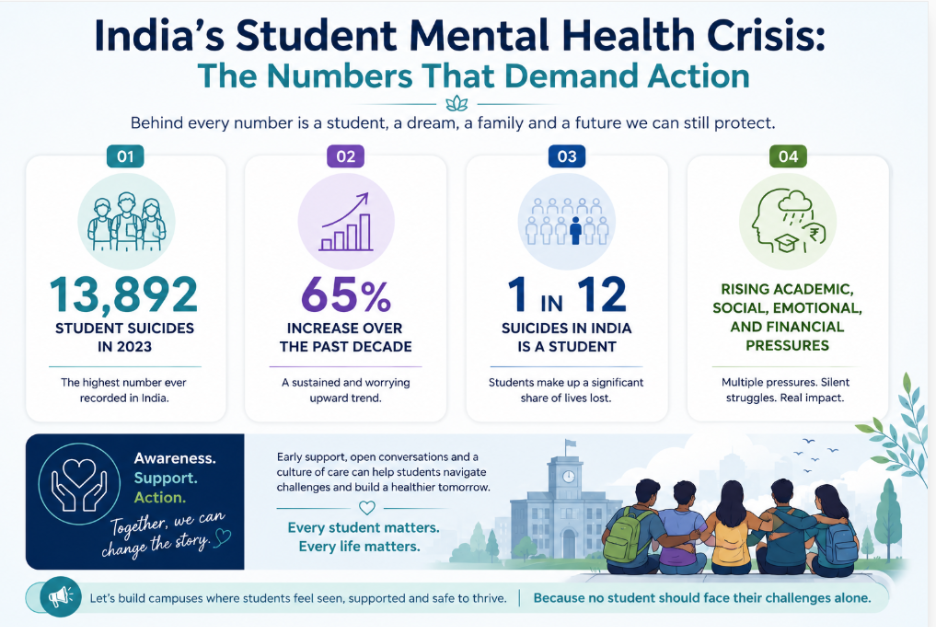
Student suicides accounted for nearly 8% of all suicides in India. These numbers represent far more than statistics. They reflect thousands of young people struggling with academic pressure, emotional distress, social isolation, uncertainty about the future, and a lack of timely support.
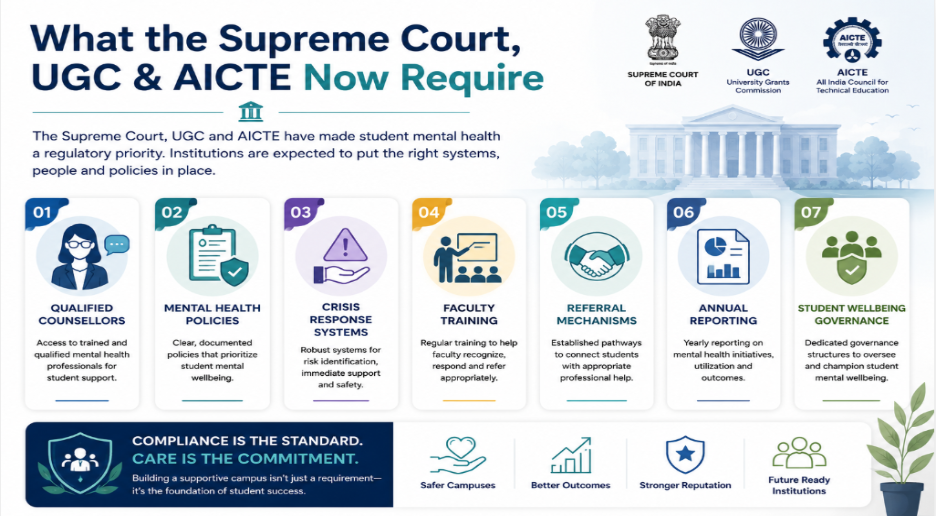
At the same time, student mental health is becoming a regulatory priority. The Supreme Court of India, the University Grants Commission (UGC), and the All India Council for Technical Education (AICTE) have all strengthened expectations around institutional responsibility for student wellbeing. Educational institutions are increasingly expected to provide access to qualified counsellors, establish crisis response mechanisms, train faculty and staff, and create systems that proactively support student mental health rather than reactively.
The challenge for many institutions is not recognising the need. It is building the infrastructure required to meet it.
This is where a Student Assistance Programme (SAP) becomes essential.
A Student Assistance Programme is a comprehensive campus wellbeing framework that provides students with confidential counselling, crisis support, self-help resources, and structured pathways to care. At the same time, it equips faculty and staff to recognise distress, strengthens institutional governance, and provides the reporting infrastructure required for modern student wellbeing management.
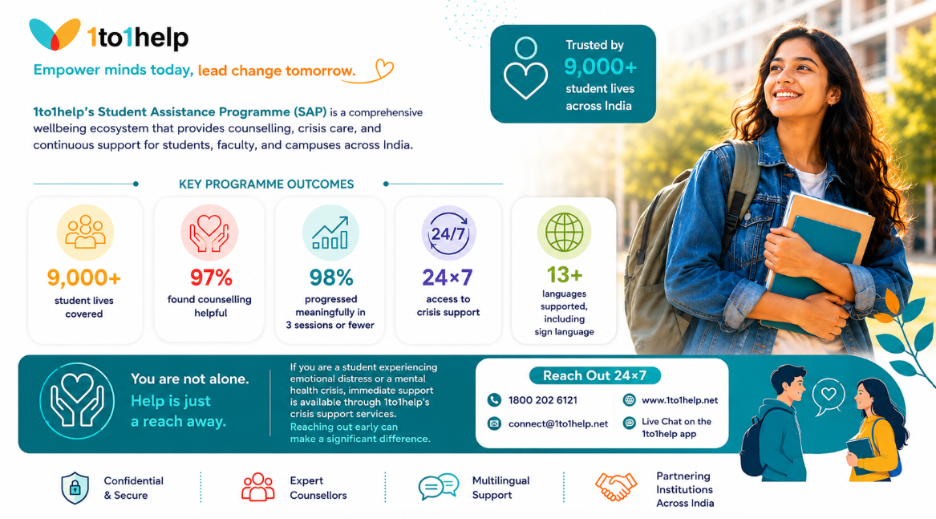
1to1help's Student Assistance Programme is designed specifically for educational institutions in India. Built on over 25 years of experience in behavioural health and wellbeing, the programme combines professional counselling, 24×7 crisis support, awareness initiatives, faculty enablement, and institutional reporting into one integrated ecosystem. The programme currently supports more than 9,000 student lives across Indian institutions, with 97% of individuals reporting counselling as helpful and 98% showing meaningful progress within three sessions or fewer.
Discover how 1to1help's Student Assistance Programme (SAP) helps colleges and universities create a proactive mental health ecosystem through counselling, emergency support, faculty enablement, awareness initiatives, and actionable wellbeing insights. This guide also explores the student mental health challenges facing Indian campuses and the regulatory requirements institutions must now address.
Source: Made by 1to1help
The Scale of Student Mental Health Crisis in India
Student mental health is no longer a niche wellbeing issue. It is one of the most pressing public health and educational challenges facing India today.
The conversation around student wellbeing often emerges after a tragedy, but the reality is far broader than the number of lives lost. Behind every reported suicide are thousands of students silently navigating anxiety, burnout, loneliness, academic pressure, identity struggles, financial stress, relationship difficulties, and uncertainty about the future.
The challenge is both widespread and measurable.
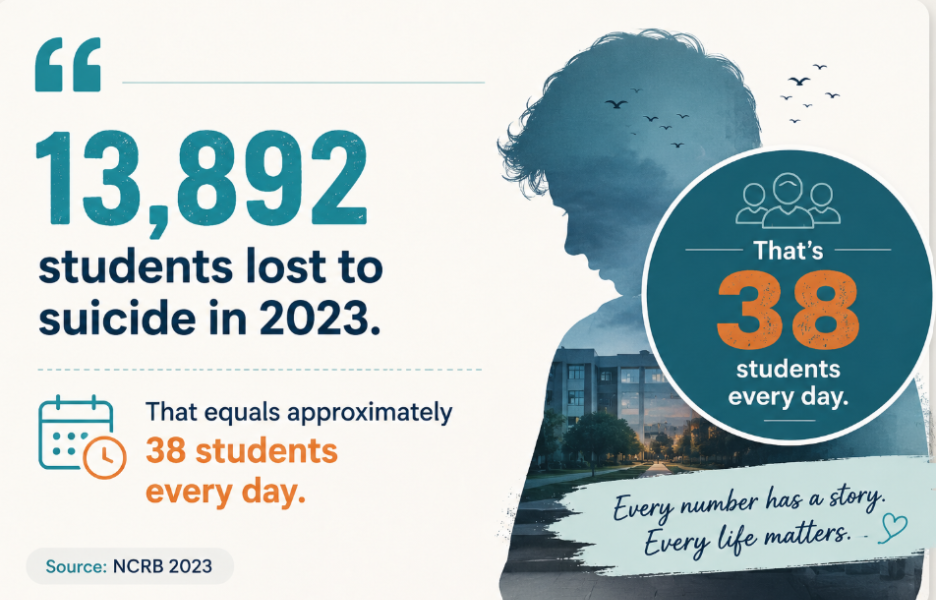
National Crime Records Bureau (NCRB) data, 13,892 students died by suicide in 2023, representing the highest number ever recorded. Over the past decade, student suicides have increased by approximately 65%, highlighting a sustained and worrying trend rather than a temporary spike.
The numbers become even more concerning when viewed alongside the realities of Indian education.
Competitive academic pressure: JEE, NEET, UPSC, and CAT preparation creates sustained, multi-year anxiety in millions of Indian students. Educational institutions play a critical role here — a structured Student Assistance Programme gives students access to confidential counselling and crisis support during high-pressure exam cycles like these.
Academic Pressure Is Only Part of the Story
The popular perception is that student distress is primarily driven by examinations. In reality, student mental health concerns are far more complex.
When young people enter colleges and universities, many experience major life transitions simultaneously.
They may be:
- Living away from home for the first time
- Navigating hostel life
- Building entirely new social networks
- Managing financial responsibilities
- Exploring identity and independence
- Coping with relationship challenges
- Adjusting to new academic expectations
These experiences are developmentally normal, but they can also be emotionally demanding.
Many students struggle silently because their concerns do not appear serious enough to warrant seeking help. Homesickness, loneliness, self-doubt, friendship conflicts, social anxiety, and uncertainty about career choices may seem minor in isolation. Yet when left unaddressed, they often compound over time.
The Hidden Mental Health Crisis
What makes student mental health particularly challenging is that much of the distress remains invisible.
- Students often continue attending classes, completing assignments, and participating in campus life while struggling internally.
- Faculty may observe declining attendance or falling grades without understanding the emotional factors driving those changes.
- Friends may notice withdrawal but feel unsure about how to help.
- Families may be hundreds of kilometres away.
As a result, many students reach crisis points without having accessed any form of support.
The Cost to Institutions
The consequences extend beyond individual wellbeing.
Student mental health directly affects:
- Academic performance
- Attendance and retention
- Campus safety
- Student engagement
- Graduation outcomes
- Institutional reputation
- Regulatory compliance
Institutions increasingly recognise that wellbeing and academic success are not separate goals. They are deeply interconnected.
A student who is emotionally supported is more likely to remain engaged, perform effectively, build healthy relationships, and contribute positively to campus life. Conversely, a student in distress may struggle academically, socially, and personally long before their challenges become visible through formal indicators.
This reality explains why student wellbeing is rapidly moving from a welfare function to a strategic institutional priority.
It also explains why regulators, educational leaders, and mental health professionals increasingly view student wellbeing infrastructure as essential rather than optional.
The question is no longer whether institutions should support student mental health. The question is how they can do so effectively, consistently, and at scale.
Source: Made by 1to1help, Content: NCRB Data
What Indian Institutions Are Now Required to Do: The Regulatory Mandate
The landscape of student mental health in India has changed significantly.
For years, mental health support was viewed primarily as a recommended best practice. Institutions that invested in counselling services, awareness programmes, or wellbeing initiatives were often considered progressive leaders.
Today, the situation is different.
Student mental health is increasingly becoming a matter of institutional responsibility, regulatory compliance, and governance.
Recent developments from the Supreme Court, UGC, and AICTE have created clear expectations around how educational institutions must support student wellbeing.
A Shift from Recommendation to Responsibility
The growing focus on student wellbeing reflects an important reality. Mental health challenges are no longer isolated individual concerns. They affect educational outcomes, campus safety, retention rates, and student success.
Recognising this, regulators have moved towards establishing structured requirements that institutions must fulfil.
The underlying principle is straightforward: Student wellbeing cannot depend solely on individual faculty members, informal support systems, or isolated counselling initiatives.
It requires an organised institutional framework.
Key Expectations Emerging Across Regulatory Bodies
While specific requirements continue to evolve, several themes consistently appear across recent guidance and mandates.
Institutions are expected to:
1. Provide Access to Qualified Mental Health Professionals
Students should have access to trained and qualified counsellors capable of providing professional support.
This includes mechanisms for both routine counselling and crisis intervention.
2. Establish Mental Health Policies
Institutions are increasingly expected to adopt formal mental health and wellbeing policies that outline responsibilities, referral pathways, support systems, and reporting structures.
3. Create Crisis Response Mechanisms
Every institution needs systems capable of responding effectively when students experience severe distress or emergencies.
This includes referral pathways, escalation protocols, and access to crisis support services.
4. Train Faculty and Staff
Faculty members are often the first adults to notice that a student is struggling.
As a result, institutions are expected to provide training that helps staff recognise warning signs, respond appropriately, and connect students with professional support.
5. Strengthen Reporting and Documentation
Wellbeing initiatives increasingly require documentation, governance structures, and measurable outcomes.
Institutions must demonstrate not only that support exists but also that it is accessible, utilised, and monitored appropriately.
Why Compliance Is Challenging
Many institutions assume that hiring a counsellor fulfils mental health requirements.
In reality, modern wellbeing expectations are considerably broader.
A single counsellor may provide valuable support, but they cannot alone deliver:
- 24×7 accessibility
- Faculty training
- Crisis infrastructure
- Awareness campaigns
- Digital self-help resources
- Institutional reporting
- Campus-wide wellbeing engagement
The regulatory direction emerging in India increasingly points towards comprehensive systems rather than standalone services.
This is precisely the gap that a Student Assistance Programme is designed to address.
By combining counselling, crisis support, awareness initiatives, faculty enablement, and governance infrastructure, an SAP helps institutions move from isolated interventions to a structured wellbeing ecosystem.

A wellbeing programme is no longer simply about counselling access. It is about creating a documented, measurable, institution-wide system that proactively supports students while meeting evolving regulatory expectations.
Source: Made by 1to1help, Content: Supreme Court Rulings, UGC & AICTE Guidelines
What Is a Student Assistance Programme?
A Student Assistance Programme (SAP) is a structured, professionally managed wellbeing support system designed specifically for educational institutions.
At its simplest, a Student Assistance Programme provides students with access to counselling and mental health support.
At its most effective, it creates a complete wellbeing ecosystem that supports students, faculty, staff, and institutional leadership.
The difference matters.
Many institutions have access to a counsellor. Far fewer have access to a comprehensive wellbeing infrastructure.
Why Student Wellbeing Requires More Than Counselling
Counselling is one important component of support. However, student wellbeing challenges often begin long before a student books an appointment.
- A student experiencing homesickness may need reassurance and resources.
- A student facing exam stress may benefit from self-help tools.
- A faculty member concerned about a struggling student may need guidance on how to respond.
- An institution may need visibility into emerging wellbeing trends.
A counsellor alone cannot address all of these needs. A Student Assistance Programme can.
Who Does a SAP Serve?
Students
Students receive confidential, accessible support across a wide range of concerns including academics, relationships, identity, family issues, emotional wellbeing, and crisis situations.
Faculty and Staff
Faculty members learn how to recognise distress, initiate supportive conversations, and connect students with professional help.
Institutions
Leadership teams gain access to implementation support, wellbeing insights, reporting tools, and governance infrastructure.
This makes the SAP both a student service and an institutional capability.
SAP vs a Standalone Counsellor
This distinction is important. A traditional counselling model typically relies on one or more professionals available during working hours.
A Student Assistance Programme extends far beyond this.
A comprehensive SAP may include:
- Multiple support channels
- 24×7 accessibility
- Crisis support
- Multilingual services
- Self-help resources
- Faculty training
- Awareness campaigns
- Group interventions
- Reporting dashboards
The goal is not simply to provide counselling. The goal is to create an environment where support is visible, accessible, and integrated into campus life.
.
What 1to1help's Student Assistance Programme Offers
Student wellbeing cannot be supported through counselling alone.
A student struggling with exam stress may need self-help tools before they need a counsellor. A faculty member who notices a student withdrawing from class may need guidance on how to respond. A student in acute distress may need immediate support at 2 a.m., not during office hours. An institution may need visibility into emerging wellbeing trends before they become serious risks.
This is why effective student wellbeing programmes are built as ecosystems rather than individual services.
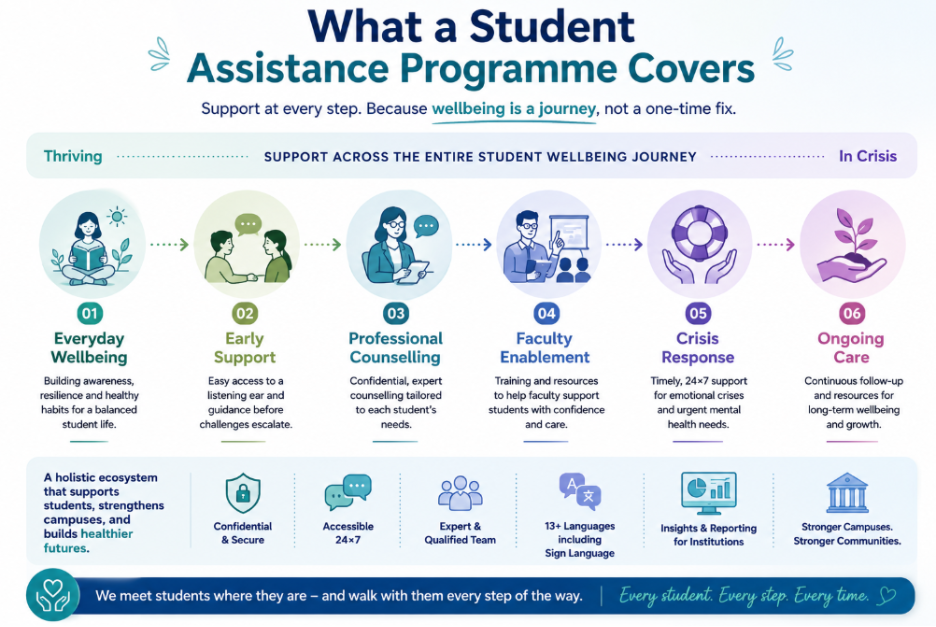
1to1help's Student Assistance Programme (SAP) brings together multiple layers of support designed to address prevention, early intervention, crisis response, and long-term wellbeing. Each layer serves a distinct purpose, but together they create a comprehensive framework that helps institutions fulfil their student wellbeing responsibilities at scale.
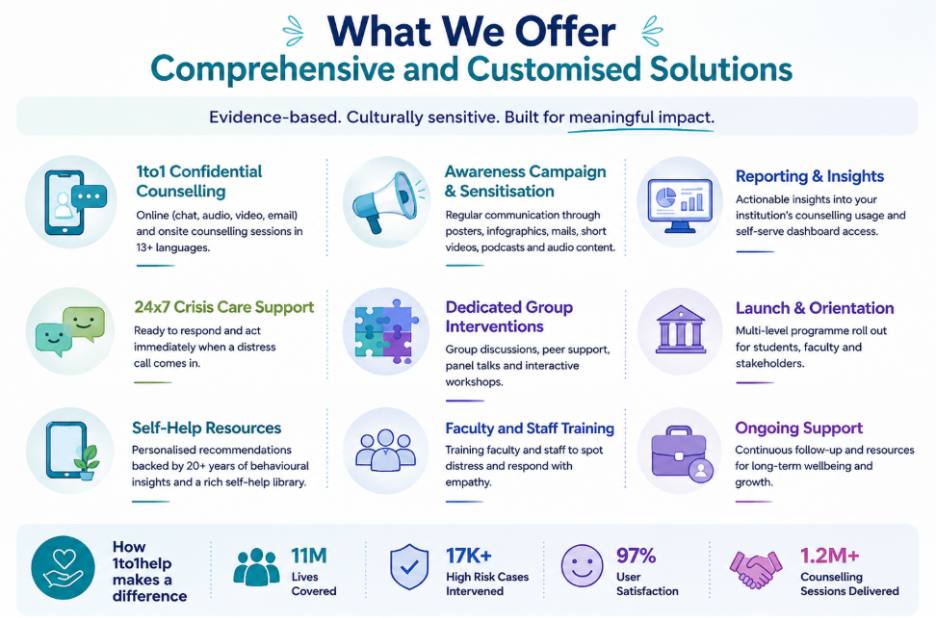
Student Counselling Services Through Confidential 1-to-1 Support
At the centre of the programme are confidential student counselling services delivered by qualified mental health professionals.
- Students can access support through multiple channels, including chat, phone, video consultations, and in-person counselling sessions. This flexibility allows students to seek help in the format that feels most comfortable and accessible to them.
- Support extends across the full spectrum of student concerns, including academic stress, bullying/ragging, examination anxiety, homesickness, relationship challenges, family conflict, low self-esteem, loneliness, emotional distress, and career uncertainty.
A critical challenge in counselling is ensuring that students connect with the right professional. 1to1help addresses this through a structured matching process that considers the nature of the concern, language preferences, and counsellor expertise. Support is available in more than 13 languages, including sign language, helping remove barriers that often prevent students from seeking help.
24×7 Student Helpline and Crisis Support
Student distress does not follow institutional schedules. Emotional crises can emerge late at night, during examination periods, over weekends, or during holidays when campus resources may be limited.
This is why access to a 24×7 student helpline is a critical component of any effective Student Assistance Programme.
The helpline provides round-the-clock support for concerns ranging from everyday emotional challenges to high-risk situations requiring immediate intervention. Whether a student is experiencing severe stress, panic, emotional overwhelm, or a mental health crisis, professional support remains accessible whenever it is needed.
Importantly, the service operates through clinically governed protocols validated by NIMHANS, ensuring that concerns are managed consistently, safely, and with appropriate escalation pathways when necessary.
For students, this means support is always available.
For institutions, it means reassurance that help is not limited to office hours.
Self-Care App and Wellbeing Portal
While counselling remains an important resource, student wellbeing is shaped by everyday habits and behaviours. The SAP therefore includes access to a digital self-care platform that supports students between counselling sessions and beyond moments of crisis.
- The platform functions as an everyday wellbeing companion, offering personalised tools that encourage greater self-awareness, emotional regulation, and resilience.
- Features include mood tracking, wellbeing activities, self-guided resources, and curated learning content designed to help students better understand and manage their emotional health.
By making wellbeing support available daily rather than only when difficulties arise, the platform helps students develop sustainable wellbeing practices that extend beyond individual counselling interactions.
Awareness Campaigns That Reduce Stigma
One of the most significant barriers to help-seeking is not the availability of support. It is the reluctance to access it.
Many students continue to associate counselling with weakness, failure, or severe mental illness. As a result, they often delay seeking support until concerns become more difficult to manage.
Awareness initiatives play a critical role in changing this narrative.
The Student Assistance Programme includes structured wellbeing campaigns delivered through posters, infographics, videos, podcasts, emailers, audio content, and other communication formats designed for campus environments.
These initiatives increase awareness of available support and help normalise help-seeking behaviour.
Crisis Support for Students in India Through Campus Response Training
Professional helplines are essential, but they are not the only line of support during a crisis.
Often, the first person to notice that a student is struggling is a faculty member, an administrator, a student leader, or a hostel representative.
This is why crisis support for students in India requires both professional expertise and informed support systems on campus.
The SAP includes crisis response training for designated campus stakeholders, helping them recognise warning signs, respond appropriately, and connect students with professional resources quickly.
The goal is not to turn faculty or student leaders into mental health professionals. The goal is to equip them with the awareness and confidence needed to act effectively when concerns arise.
This creates an additional layer of protection and strengthens the institution's overall response capability.
Group Interventions for Common Student Challenges
Many student concerns are shared experiences.
Academic pressure, homesickness, peer relationships, identity exploration, and adjustment difficulties affect large numbers of students across campuses.
Group interventions provide opportunities to address these concerns collectively. They are conducted in the form of webinars/seminars, sharing circles, group counselling, and workshops.
Facilitated by mental health professionals, these sessions create safe spaces for discussion, learning, reflection, and skill-building. They also help students recognise that they are not alone in what they are experiencing.
Faculty and Staff Enablement
Faculty members are often the first people to notice when a student is struggling.
Changes in attendance, participation, behaviour, or academic performance frequently become visible in the classroom long before a student seeks professional support.
Yet many educators report feeling uncertain about how to respond.
They want to help but worry about saying the wrong thing, overstepping boundaries, or missing important warning signs.
Faculty and staff enablement addresses this gap.
Through structured workshops and training initiatives, educators and administrators learn how to recognise signs of distress, engage students with empathy, and guide them towards appropriate professional support.
This strengthens the institution's overall wellbeing ecosystem by ensuring that support does not begin only when a student reaches a counsellor. It begins wherever a student first feels seen, heard, and understood.
Together, these layers create a comprehensive wellbeing ecosystem that supports students before, during, and beyond moments of distress.
That is what transforms student wellbeing from an isolated service into a sustainable institutional capability.
What the Institution Gets: Governance, Data & Implementation Support
Student wellbeing programmes are often evaluated through the lens of student outcomes. How many students accessed support? How many counselling sessions were delivered? How many wellbeing initiatives were conducted?
These questions matter. But for institutional leaders, they are only one part of the picture.
The real challenge is governance.
- How do you know whether support is reaching the students who need it most?
- How do you identify emerging wellbeing risks before they become crises?
- How do you demonstrate compliance with evolving regulatory requirements?
- And how do you build a sustainable wellbeing system that continues to function effectively year after year?
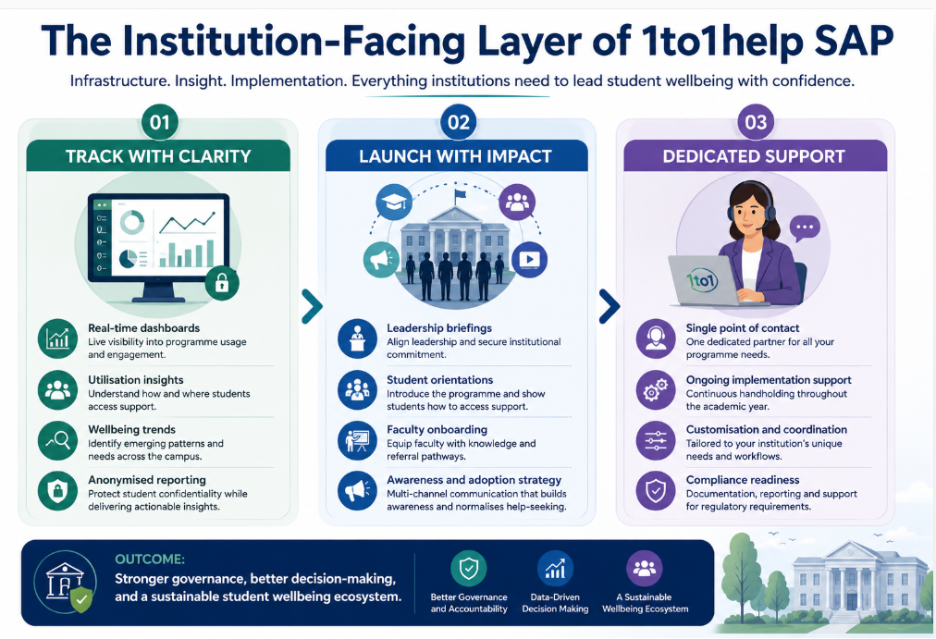
This is where the institution-facing layer of 1to1help's Student Assistance Programme becomes critical.
The SAP is not just a service for students. It is an institutional capability that gives leadership teams the infrastructure, visibility, and operational support they need to govern student wellbeing effectively.
Track with Clarity: Data and Reporting
A strong wellbeing strategy requires more than good intentions. It requires meaningful insight.
One of the challenges institutions face is that student distress often remains invisible until it begins affecting academic performance, attendance, retention, or campus safety. Without data, institutions are left reacting to individual incidents rather than understanding broader patterns.
The SAP addresses this through real-time reporting and wellbeing analytics that help institutions understand how support services are being utilised across the student population.
Leadership teams gain access to insights such as programme engagement, service utilisation patterns, and emerging wellbeing trends. These insights provide a clearer understanding of where support is being accessed, where gaps may exist, and how student needs are evolving over time.
Importantly, all reporting is anonymised and aggregated. Student confidentiality remains protected, while institutional leaders receive actionable information that supports decision-making.
The result is a more proactive approach to student wellbeing, in which interventions are informed by evidence rather than assumptions.
Institutions looking to identify emerging wellbeing concerns even earlier may also benefit from 1to1help’s Emotional Risk Survey, which helps assess psychosocial risk patterns across student populations before they escalate into more serious challenges.
Launch with Impact: Structured Programme Rollout
Even the most comprehensive student wellbeing programme will have limited impact if students and faculty do not know it exists.
One of the reasons many campus wellbeing initiatives struggle is not because support is unavailable, but because awareness is low. Students are often unsure about how to access services, whether they are confidential, or whether their concerns are serious enough to warrant seeking help.
Successful implementation therefore requires more than launching a programme. It requires building awareness, trust, and engagement from the beginning.
1to1help's implementation approach includes structured leadership briefings, student orientations, faculty onboarding, and communication initiatives designed to ensure that the programme becomes visible and accessible across campus.
This phased rollout approach helps normalise help-seeking behaviour and increases the likelihood that students will engage with support services early rather than waiting until concerns escalate.
For institutions, this translates into stronger programme adoption and greater return on investment from their wellbeing initiatives.
Dedicated Support: A Single Point of Contact
Implementing a campus-wide wellbeing programme is a significant undertaking.
Institutional leaders are already balancing academic operations, student services, regulatory requirements, faculty engagement, and administrative priorities. Managing the operational complexity of a wellbeing programme can quickly become an additional burden.
The SAP addresses this by providing dedicated implementation support throughout the academic year.
Each institution works with a designated point of contact who supports programme rollout, coordination, customisation, communication, and ongoing operational requirements.
This partnership model helps ensure that institutions are not navigating implementation challenges alone.
Instead of spending time troubleshooting operational issues, administration teams can focus on what matters most: creating an environment where students can thrive academically and personally.
The Compliance Architecture Behind the Programme
As student mental health moves from a wellbeing priority to a regulatory expectation, institutions increasingly need systems that support documentation, reporting, and governance.
This is particularly relevant in the context of evolving Supreme Court directives and UGC guidelines related to campus mental health infrastructure. The institution-facing layer of the SAP has been designed to support UGC mental health compliance through structured documentation and reporting processes.
This includes:
- Coded and anonymised counselling documentation
- Wellbeing utilisation and engagement reporting
- Faculty training records
- Crisis response documentation
- Annual wellbeing reporting data
- Service utilisation metrics that support regulatory submissions
Rather than treating compliance as a separate administrative exercise, the programme integrates governance requirements into the wellbeing infrastructure itself.
This reduces administrative burden while helping institutions build a more robust and accountable support ecosystem.
Ultimately, the institution-facing layer of the SAP ensures that student wellbeing is not left to chance. It becomes a measurable, governable, and sustainable part of institutional success.
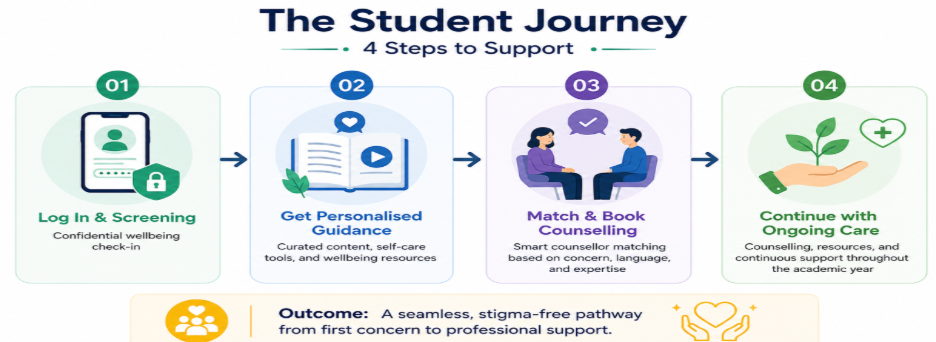
How Students Access Support: The 4-Step Journey
One of the most common questions institutions ask when evaluating a Student Assistance Programme is: how does a Student Assistance Programme work?
The answer is important because access to support should be immediate, intuitive, and stigma-free, not a bureaucratic process that adds friction when a student is already struggling. 1to1help's Student Assistance Programme is built around a seamless digital experience that removes barriers between a student in need and the professional support that can help them.
The entire student counselling process is designed to be simple, confidential, and easy to navigate, ensuring that students receive the right support at the right time.
Step 1 — Log In & Screening
Every student's journey with the SAP begins with a quick, confidential check-in through the secure 1to1help app.
This initial screening is not a diagnostic assessment. Instead, it is a compassionate and conversational process that helps students reflect on how they are feeling and identify the kind of support that may be most useful to them.
Students may be experiencing academic stress, relationship difficulties, emotional distress, homesickness, or uncertainty about the future. The check-in creates a safe space for students to articulate their concerns while helping the platform understand their needs.
The insights gathered at this stage inform every step that follows, ensuring that support is relevant and personalised from the very beginning.
Step 2 — Get Personalised Guidance
Based on the initial check-in, students receive personalised recommendations tailored to their unique concerns.
These may include curated articles, videos, wellbeing resources, and self-care tools designed to provide immediate support and practical guidance.
Not every student is ready to speak with a counsellor immediately. Some may prefer to explore resources independently, learn more about what they are experiencing, or begin building self-awareness before engaging in counselling.
By providing relevant support from the outset, the programme helps students take meaningful first steps towards wellbeing.
Step 3 — Match & Book Counselling
When a student decides they are ready to speak with a professional, the next step is connecting them with the right counsellor.
Rather than requiring students to navigate multiple options themselves, 1to1help's smart matching system recommends counsellors based on three key factors:
- The nature of the student's concern
- Preferred language
- Counsellor expertise
This matching process helps ensure that students are connected with professionals who are best equipped to support their specific needs.
Booking is simple and straightforward, reducing the uncertainty and friction that often prevent students from following through after deciding to seek help.
Step 4 — Continue with Ongoing Care
Support does not end after the first counselling session.
Students continue to have access to counselling, self-care tools, wellbeing resources, and ongoing guidance throughout the academic year. This creates continuity of care rather than isolated crisis intervention.
The focus is not on long-term dependency but on helping students build resilience, develop coping skills, and strengthen their overall wellbeing.
The effectiveness of this approach is reflected in programme outcomes. According to 1to1help data, 98% of individuals progress meaningfully within three sessions or fewer, demonstrating that timely, targeted support can often create significant positive change.
Multilingual Support That Removes Barriers to Care: The SAP provides support in more than 13 languages, including sign language, ensuring that language does not become a barrier to accessing care.
What Students Can Bring to the SAP: A Comprehensive Range of Concerns
One of the biggest misconceptions about counselling is that it is only for severe mental health difficulties or crisis situations.
Many students delay seeking help because they believe their concern is "not serious enough" to warrant support. They assume that stress, homesickness, self-doubt, relationship difficulties, or uncertainty about the future are simply part of student life and should be managed on their own.
In reality, these are often the very concerns that benefit most from early intervention.
1to1help's Student Assistance Programme is built on a simple principle: support is most effective when students access it early, before distress becomes crisis. Through confidential student counselling services, students can seek support for a wide range of academic, personal, emotional, and social challenges that affect their wellbeing and success.
Academic & Career Concerns
Academic life can be rewarding, but it can also be a significant source of stress.
Students frequently seek support for exam pressure, performance anxiety, fear of failure, academic procrastination, and difficulties with concentration or motivation. For many, the pressure extends beyond coursework to include concerns about future careers, placements, internships, and postgraduate opportunities.
Competitive examinations such as JEE, NEET, UPSC, and CAT can create additional pressure, particularly when students feel their future depends on a single outcome.
Students may also seek support during major transitions, such as moving from school to college, adjusting to university expectations, or navigating the shift from undergraduate to postgraduate education.
Professional student counselling services help students develop healthier coping strategies, improve confidence, and manage academic demands more effectively.
Campus Life & Social Concerns
For many students, entering college means adapting to an entirely new environment.
Living away from home for the first time, adjusting to hostel life, building new friendships, and navigating unfamiliar social settings can be both exciting and overwhelming.
Common concerns include loneliness, homesickness, friendship difficulties, peer pressure, social comparison, and anxiety linked to social media. Students may also seek support for relationship challenges, experiences of ragging or bullying, sexual harassment, discrimination, or the social isolation that can accompany moving to a new city for education.
While these concerns may not always appear severe, they can significantly affect emotional wellbeing, academic engagement, and a student's overall campus experience.
Emotional & Mental Wellbeing Concerns
Students also access support for a wide range of emotional and psychological concerns.
These may include anxiety, excessive worry, low mood, depressive symptoms, low self-esteem, emotional dysregulation, burnout, grief, and difficulties related to identity and self-concept. Students exploring questions related to sexuality, gender identity, or belonging may also seek a safe and supportive space for reflection.
Support is also available for students dealing with trauma, distressing life experiences, self-harm concerns, or thoughts of suicide.
In situations involving significant risk or emotional crisis, students have access to 24×7 support through the programme's helpline, supported by NIMHANS-validated crisis response protocols and escalation pathways.
The goal is to ensure that students receive timely support regardless of the nature or severity of the concern.
Family & Personal Concerns
A student's wellbeing is influenced by far more than what happens on campus.
Many students carry family responsibilities, financial pressures, and personal challenges that can affect their emotional health and academic performance.
Common concerns include family conflict, parental expectations, pressure to succeed academically, financial difficulties, personal or family health issues, bereavement, cultural adjustment, and uncertainty about major life decisions.
First-generation college students may face additional challenges as they navigate higher education without the guidance or experience that other students may have access to at home.
Student counselling services provide a confidential space to explore these concerns, gain perspective, and develop practical ways to move forward.
Why This Breadth of Support Matters
A student struggling with homesickness may begin withdrawing from campus life. A student experiencing relationship difficulties may find it harder to focus academically. A student overwhelmed by family pressure may start experiencing anxiety or burnout.
When these concerns go unaddressed, they rarely remain isolated.
They often compound over time, affecting wellbeing, academic performance, relationships, and engagement with campus life.
This is why the breadth of support offered through the SAP is so important. By providing access to support across a wide range of concerns, institutions create opportunities for early intervention and prevention.
Ultimately, helping students navigate everyday challenges is not separate from supporting mental health. It is one of the most effective ways to protect it.
Supporting Faculty and Staff: Why Institutional Wellbeing Starts with Educators
Student wellbeing does not exist in isolation. It is shaped every day by the learning environment, relationships, and support systems that surround students on campus.
An educator who is exhausted, unsupported, or uncertain about how to respond to a struggling student is limited in their ability to provide meaningful support. This is why effective student wellbeing programmes must extend beyond students themselves.
In most campus settings, a faculty member is the first adult to notice that something is wrong. They may observe declining attendance, changes in behaviour, reduced participation, emotional withdrawal, or sudden shifts in academic performance. Often, these warning signs emerge long before a student reaches out to a counsellor, informs their family, or comes to the attention of administration.
The critical question is not whether faculty notice distress. It is whether they know what to do next.
Faculty and Staff Enablement
The 1to1help SAP includes structured faculty wellbeing training designed to equip educators and administrators with the skills needed to support students appropriately while maintaining professional boundaries.
The programme focuses on three core competencies:
Recognition: Understanding how emotional distress may present in students, including the often-masked signs seen in high-achieving individuals who continue performing academically despite significant internal struggles.
Response: Learning how to initiate supportive conversations in a way that is empathetic, non-judgemental, and psychologically safe. Equally important, faculty learn what not to say when a student discloses a concern.
Referral: Understanding how to connect students with the appropriate professional support available through the SAP and how to follow up responsibly without compromising confidentiality.
These skills strengthen the institution's overall wellbeing ecosystem by ensuring that support begins at the earliest possible stage.
Faculty Stress Support
Educators face their own wellbeing challenges.
Academic workload, research expectations, administrative responsibilities, student-related concerns, and the emotional impact of supporting distressed students can all contribute to stress and burnout.
To address this, the SAP offers a Faculty Stress Support add-on programme. This two-hour workshop combines guided discussion, CBT-informed techniques, and mindfulness-based practices to help faculty manage stress more effectively and strengthen personal resilience.
By supporting educators themselves, institutions create healthier learning environments for everyone.
Institutions seeking a more comprehensive staff wellbeing strategy may also consider 1to1help’s Employee Assistance Programme, which provides counselling, wellbeing resources, and emotional support for faculty and administrative teams.
Supporting Compliance and Campus Wellbeing
Recent regulatory developments have highlighted the importance of staff preparedness in student mental health support.
The Supreme Court's guidelines emphasise the need for regular staff training in psychological first aid and distress recognition. The SAP's faculty enablement programme helps institutions meet these expectations through professionally delivered, documented training that can support compliance requirements.
Combined with broader campus counselling services in India, faculty training creates a stronger safety net for students and a more confident, informed educator community.
For institutions interested in developing peer-support and wellbeing champions alongside faculty training, the Emotional Care Champions programme by 1to1help can provide an additional layer of campus support.
Reducing Stigma, Building a Culture of Care on Campus
Even the most comprehensive counselling service cannot help students who are unwilling to use it.
Across educational institutions, stigma remains one of the most significant barriers preventing students from seeking support. Many continue to believe that asking for help is a sign of weakness, an admission of failure, or evidence that they cannot cope with the demands of student life.
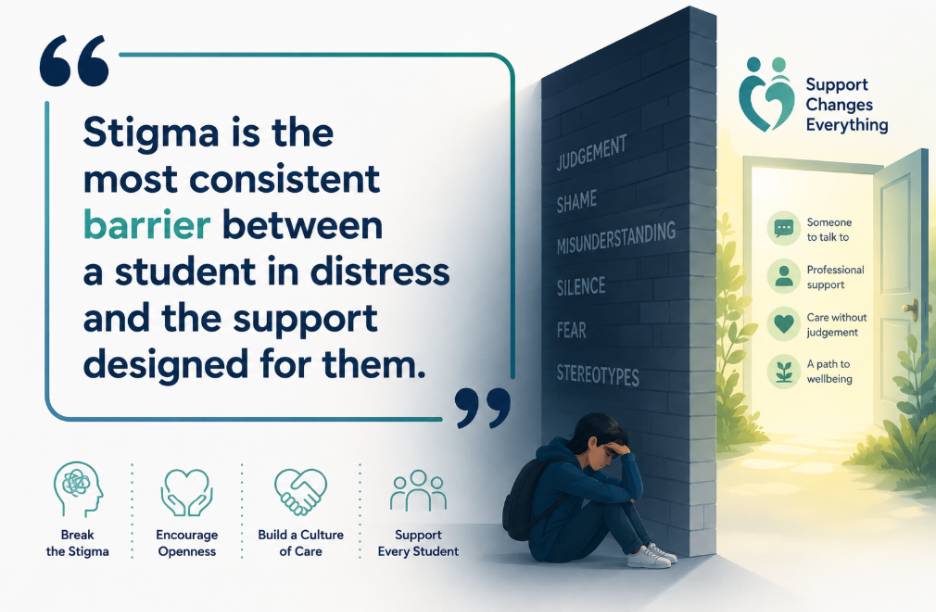
In India, mental health stigma is often shaped by powerful social and cultural influences. Expectations around resilience, family reputation, academic achievement, and self-reliance can make students reluctant to acknowledge emotional difficulties or seek support openly.
As a result, students frequently wait until concerns become overwhelming before accessing help.
Awareness Campaigns That Change Perceptions
Addressing stigma requires more than making support available. It requires actively changing the way people think about support.
The SAP includes structured awareness campaigns delivered across both physical and digital campus environments.
These initiatives include:
- Posters and infographics in classrooms, hostels, and common areas
- Digital mailers and wellbeing content
- Videos and podcasts that normalise conversations around mental health
- Audio campaigns designed for campus-wide engagement
Importantly, these campaigns are not simply educational materials about mental health conditions. They are designed to influence the cultural narrative around help-seeking.
When counselling is presented as a proactive act of self-care rather than a response to crisis, students become more willing to access support earlier.
Building a Culture of Care
Awareness campaigns are most effective when combined with accessible counselling services, faculty training, and crisis support systems.
Together, these elements help create a campus environment where student emotional wellbeing is visible, valued, and openly discussed.
Institutions can strengthen this culture-building effort through peer-support initiatives such as the Emotional Care Champions programme, which helps create additional touchpoints for early support and wellbeing awareness across campus.
Rather than existing as a back-office welfare function, wellbeing becomes part of everyday campus culture.
The Role of Group Interventions
The SAP also includes professionally facilitated group sessions focused on common student experiences such as exam stress, homesickness, peer pressure, and identity-related concerns.
These sessions provide practical support while serving a broader purpose.
When students hear others discussing challenges similar to their own, it reduces feelings of isolation and normalises help-seeking behaviour.
In this way, group interventions become an important component of broader campus mental health support, helping transform individual wellbeing into a shared community responsibility.
What Institutions and Students Gain from the SAP
The value of a Student Assistance Programme extends far beyond counselling sessions.
Its impact is felt across the student and faculty experiences and the institution's ability to create a safe, supportive, and compliant learning environment.
The outcomes of the SAP can therefore be understood across three distinct dimensions.
For Students
- Students gain access to confidential professional support that meets them where they are academically, emotionally, socially, and culturally.
- They receive a safe space to discuss academic pressure, relationship concerns, family challenges, emotional distress, and mental health difficulties without fear of judgement or disclosure.
- The programme also builds long-term resilience through self-care tools, digital wellbeing resources, and ongoing support mechanisms.
- Importantly, support is available in more than 13 languages, and including sign language, ensuring that students can access care in the language they think, feel, and communicate in most naturally.
Programme outcomes demonstrate the effectiveness of this approach, with 98% of indiviudals progressing meaningfully within three sessions or fewer.
For Faculty and Staff
- Faculty members benefit from clear guidance on how to recognise, respond to, and refer students experiencing distress.
- This replaces uncertainty with confidence and helps educators support students appropriately without feeling solely responsible for complex mental health concerns.
- The SAP also reduces the emotional burden often experienced by faculty when supporting struggling students by providing a clear pathway to professional intervention.
- In addition, faculty and staff have access to wellbeing resources and support that strengthen their own resilience and wellbeing.
For the Institution
For institutions, the benefits extend from compliance to culture.
- The SAP helps support emerging regulatory expectations through documented counselling records, training documentation, reporting capabilities, and governance structures.
- Early intervention reduces the likelihood of concerns escalating into high-risk situations, while access to real-time dashboards and wellbeing insights allows leadership teams to make more informed decisions.
- Institutions also benefit from stronger reputation and trust. Students and families increasingly seek campuses that demonstrate a genuine commitment to wellbeing and support.
- Most importantly, leadership gains confidence from knowing that a professionally governed support system is in place.
Today, the programme supports more than 9,000 student lives, with 97% reporting counselling as helpful and 98% progressing meaningfully within three sessions or fewer. These are not aspirational goals. They are measurable outcomes from a support system designed specifically for the realities and complexities of Indian campuses.
Conclusion
Student wellbeing can no longer be treated as a standalone counselling initiative or a reactive response to crisis.
As regulatory expectations evolve and student needs become increasingly complex, institutions require structured systems that support prevention, early intervention, crisis care, and long-term wellbeing.
1to1help's Student Assistance Programme brings these elements together through counselling, 24×7 crisis support, faculty enablement, awareness initiatives, and governance infrastructure. The result is a comprehensive wellbeing ecosystem that helps institutions meet their responsibilities while ensuring students receive timely, accessible, and meaningful support.
Institutions can further strengthen their wellbeing strategy by combining support services with proactive assessment tools such as the Emotional Risk Survey, enabling earlier identification of emerging student wellbeing risks.
Because when support is available early, students are better equipped to learn, grow, and thrive.
FAQs
Q1. What is a Student Assistance Programme (SAP)?
A Student Assistance Programme (SAP) is a structured wellbeing support system for educational institutions. It provides students with confidential counselling, crisis support, self-care resources, and access to professional mental health services while helping institutions strengthen wellbeing governance, faculty enablement, and compliance readiness.
Q2. Why do Indian campuses need a Student Assistance Programme now?
India lost 13,892 students to suicide in 2023, a 65% rise over the past decade. Student mental health has become both a wellbeing and governance priority. Rising student distress, increasing regulatory expectations, and the need for structured support systems have made comprehensive wellbeing programmes essential for educational institutions across India.
Q3. What services does 1to1help's Student Assistance Programme include?
The 1to1help SAP includes confidential counselling, 24×7 crisis support, a self-care app, awareness campaigns, faculty enablement, group interventions, crisis response training, and institutional reporting support.
Q4. What concerns can students bring to the SAP counsellors?
Students can seek support for academic, emotional, social, family, career, financial, identity-related, and mental health concerns. The programme is designed to support students before challenges escalate into crisis.
Q5. How does a student access the SAP?
Students begin with a confidential wellbeing check-in through the 1to1help app, receive personalised guidance, connect with a counsellor through smart matching, and continue accessing counselling and wellbeing resources throughout the academic year. A 24×7 helpline is also available for immediate support.
Q6. Is the SAP confidential? Can the institution see student counselling records?
Yes. Counselling is confidential. Institutions receive only anonymised and aggregated programme-level insights and utilisation data. Individual counselling records are not shared with the institution.
Q7. How does the SAP help institutions meet UGC and Supreme Court compliance requirements?
The SAP supports compliance through counselling services, 24×7 crisis support, faculty training, documentation, reporting, and governance infrastructure aligned with emerging regulatory requirements.
Q8. How can an institution get started with 1to1help's SAP?
Institutions can connect with 1to1help to discuss their student population, wellbeing priorities, and implementation requirements. The programme is then customised to the institution's needs, supported by structured onboarding and ongoing implementation guidance.
References
- Centre for Mental Health Law & Policy. (2024, October 3). Takeaways from the NCRB data on suicide for 2023: What has changed? https://cmhlp.org/imho/blog/takeaways-from-the-ncrb-data-on-suicide-for-2023-what-has-changed/
- Cleveland Clinic. (2022). Social anxiety disorder (social phobia). https://my.clevelandclinic.org/health/diseases/22709-social-anxiety
- Council of Europe. (n.d.). Improving well-being at school. https://www.coe.int/en/web/campaign-free-to-speak-safe-to-learn/tackling-discrimination/-/asset_publisher/4a3esYbkstv9/content/improving-well-being-at-school
- Forbes. (2023, October 7). Robinson, B. 7 strategies to cope with the stress of career uncertainty. https://www.forbes.com/sites/bryanrobinson/2023/10/07/7-strategies-to-cope-with-the-stress-of-career-uncertainty/
- Healthline. (2023). CBT techniques and tools for everyday life. https://www.healthline.com/health/cbt-techniques
- International Journal of Advanced Research in Science, Communication and Technology. (2024). Mental health challenges among students in higher education. https://ijarsct.co.in/Paper12641.pdf
- International Institute of Mental Health and Life Skills Promotion. (2025, July). Supreme Court guidelines on mental health in education institutions. https://www.mhfaindia.com/news/supreme-court-guidelines-mental-health-education-india
- International Institute of Mental Health and Life Skills Promotion. (2025). Student mental health crisis in Indian campuses: Why support systems matter. https://www.mhfaindia.com/blog/college-university/student-mental-health-crisis-indian-campuses-support
- Interventions Alliance. (n.d.). Student assistance programs: Supporting student wellbeing. https://recovered.org/drug-and-alcohol-resources-for-educators/student-assistance-programs
- IDRA. (n.d.). Preventing sexual harassment in schools: A proactive agenda. https://www.idra.org/resource-center/preventing-sexual-harassment-in-schools-a-pro-active-agenda/
- PACTA. (2025). Supreme Court mandates new mental health policies for students. https://www.pacta.in/post/supreme-court-mandates-new-mental-health-policies-for-students
- PositivePsychology.com. (2024). Mindfulness exercises, techniques, and activities. https://positivepsychology.com/mindfulness-exercises-techniques-activities/
- SCC Online. (2026, January 17). UGC guidelines for mental health in higher educational institutions. https://www.scconline.com/blog/post/2026/01/17/ugc-guidelines-for-mental-health-in-higher-educational-institutions/
- The Print. (2025, August 22). UGC's draft mental health norms call for standardised student-counsellor ratio and well-being centres. https://theprint.in/india/education/ugcs-draft-mental-health-norms-call-for-standardised-student-counselor-ratio-well-being-centres/2827423/
- The Times of India. (2024, October 3). Student suicides up 65% in a decade, NCRB data shows sharper rise than overall suicides. https://timesofindia.indiatimes.com/education/news/student-suicides-up-65-in-a-decade-ncrb-data-shows-sharper-rise-than-overall-suicides/articleshow/124248503.cms
- Verywell Mind. (2023). What is self-concept? https://www.verywellmind.com/what-is-self-concept-2795865
- WebMD. (2024). Homesickness and mental health: What to know. https://www.webmd.com/mental-health/what-to-know-about-homesickness-and-mental-health
- World Health Organization. (n.d.). Social isolation and loneliness. https://www.who.int/teams/social-determinants-of-health/demographic-change-and-healthy-ageing/social-isolation-and-loneliness
- Zen by QualCode. (2025). Supreme Court mental health guidelines 2025: What educational institutions need to know. https://zenbyqualcode.com/mind-matters/supreme-court-mental-health-guidelines-2025/
- Yeo, C., & Choi, N. (2011). The impact of counselling services on student wellbeing and educational outcomes. Emotional and Behavioural Difficulties, 16(4), 421–437. https://doi.org/10.1080/02643944.2011.651226


.svg)
.svg)
.svg)
.svg)