

.png)


.png)

Cohort-Based Wellbeing Programmes: Tailored Employee Wellness Journeys for Every Workforce
Introduction
Organisations today recognise that employee wellbeing is no longer a nice-to-have. It is a strategic priority that influences engagement, productivity, retention, leadership effectiveness, and organisational culture. As a result, many have invested in employee wellness programmes, Employee Assistance Programmes (EAPs), wellbeing portals, counselling services, and digital health platforms.
Yet one challenge continues to persist.
Why do many wellbeing initiatives struggle to achieve meaningful employee engagement?
The answer often lies in a simple reality: today's workforce is far from homogeneous.
A fresh graduate navigating their first corporate role, a field sales professional constantly on the move, a working parent balancing career and family responsibilities, a content moderation professional exposed to distressing material, and a senior leader making high-stakes decisions all experience work differently. Their wellbeing needs are shaped by their roles, life stages, and lived experiences.
This is where cohort-based wellbeing programmes make the difference.
Rather than offering the same intervention to every employee, they provide structured wellbeing journeys tailored to specific employee groups with shared workplace or life experiences. Working alongside a broader employee wellness programme, they deliver support that is more relevant, more engaging, and ultimately more effective.
Trusted by over 1,000 leading employers across India, 1to1help has developed seven cohort-based wellbeing programmes for field sales professionals, shift workers, content moderation professionals, Gen Z employees, women professionals, working parents, and senior leaders.
In this guide, we'll explore why targeted wellbeing is becoming essential for modern organisations, how cohort-based programmes complement an Employee Assistance Programme, and how they help organisations build a healthier, more inclusive, and high-performing workforce.
Why Universal Wellbeing Programmes Are No Longer Enough
For years, organisations have approached employee wellbeing through universal initiatives such as counselling services, wellness webinars, mindfulness sessions, fitness challenges, and digital wellbeing platforms. These programmes have played an important role in normalising conversations around mental health and making support more accessible.
However, as workforces have become more diverse, it has become increasingly clear that one approach cannot address every employee's needs equally.
Consider just a few examples.
- A fresh graduate navigating the transition from campus to corporate life.
- A field sales professional spending weeks on the road while managing demanding targets.
- A shift worker balancing fatigue, disrupted sleep, and irregular routines.
- A senior leader making high-impact decisions while supporting their teams through uncertainty.
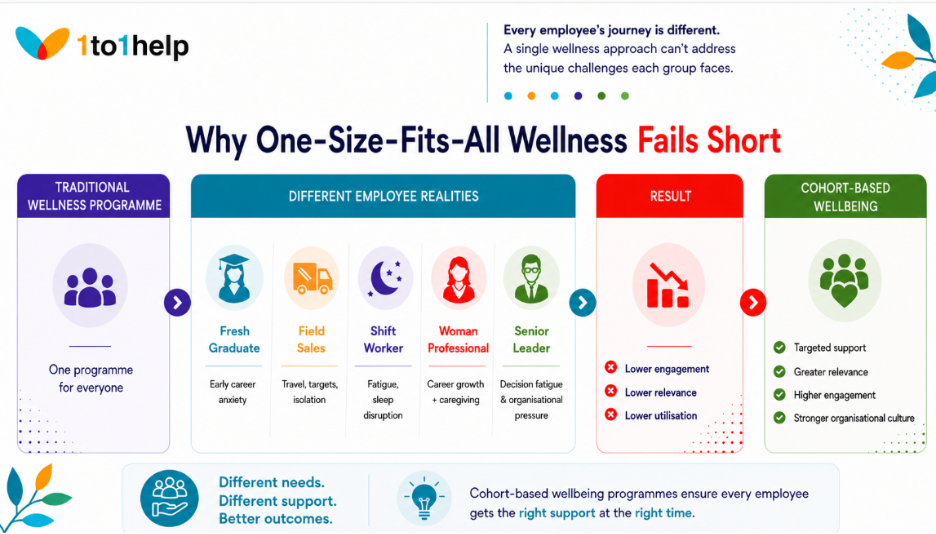
Although they work for the same organisation, their wellbeing challenges are fundamentally different. Yet many employee wellness programmes continue to offer the same resources, messages, and interventions to everyone.
The result is often lower engagement, reduced relevance, and limited long-term impact. Employees struggle to see themselves reflected in the support being offered, making it less likely that they will participate consistently or apply what they learn. This growing disconnect is reflected in recent research.
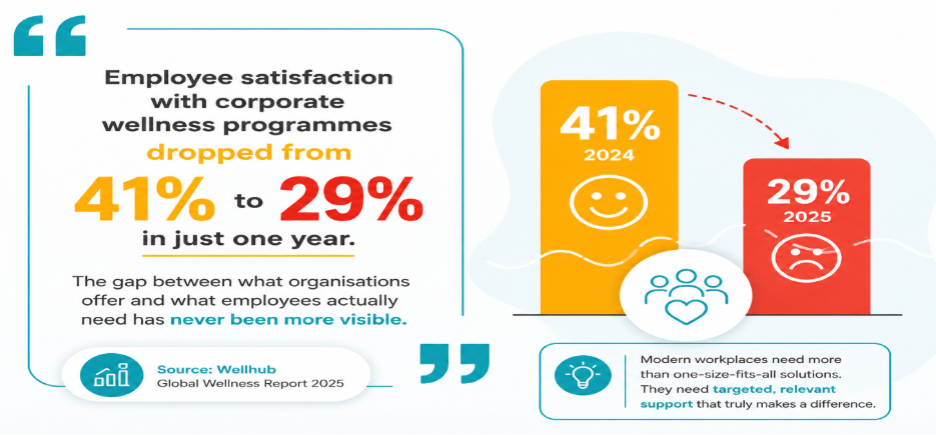
Employee satisfaction with corporate wellness programmes dropped from 41% to 29% in a single year, highlighting a widening disconnect between the support organisations provide and what employees actually find valuable. (Wellhub, 2025)
The challenge becomes even more significant when viewed through the lens of India's changing workforce. By 2025, Gen Z is expected to account for approximately 27% of India's workforce, bringing new expectations around flexibility, mental health, career development, and authentic organisational support. Research also suggests that 67% of Gen Z employees want employers to actively support their mental health, making wellbeing a deciding factor when choosing and staying with an employer.
This does not mean universal wellbeing programmes have failed. They remain an essential foundation of every workplace wellbeing strategy. But they work best when complemented by interventions designed around the realities of specific employee groups.
Rather than asking, "How can we support every employee in the same way?", leading organisations are asking a more effective question:
"How can we support different employees in ways that reflect the realities of their work and lives?"
Cohort-based wellbeing programmes are one answer to that question, providing targeted support that is more relevant, engaging, and meaningful for today's diverse workforce.
What Are Cohort-Based Wellbeing Programmes?
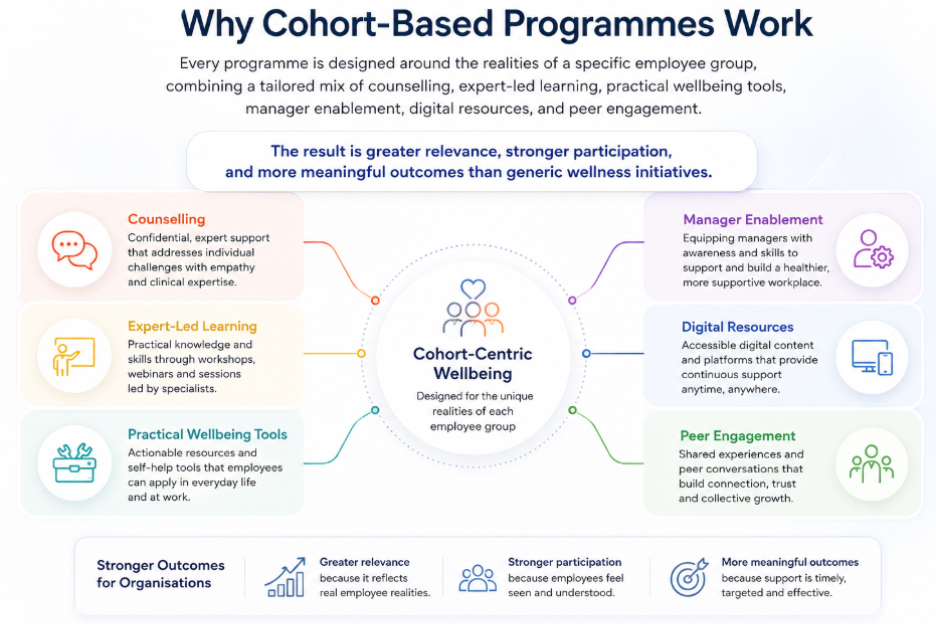
A cohort-based wellbeing programme is a structured wellbeing journey designed around the specific emotional, professional, and contextual needs of a defined employee group rather than the broader employee population. Unlike generic employee wellbeing services that offer the same resources to everyone, these programmes recognise that employees with shared roles, life stages, or experiences often face similar challenges and benefit from targeted support.
Instead of asking employees to adapt generic wellbeing advice to their circumstances, cohort-based programmes begin by understanding the realities of a specific group. This shapes every aspect of the programme, from the topics covered and learning journey to the practical tools, peer discussions, and expert guidance participants receive.
The Three Characteristics of Cohort-Based Wellbeing Programmes
1. Specificity: Built Around Real Employee Experiences
Every programme is designed around the realities of a specific employee group rather than broad wellbeing themes.
For example:
- Shift workers explore fatigue management, sleep hygiene, and maintaining healthy routines despite irregular schedules.
- Women professionals focus on leadership confidence, work-life integration, and career progression.
- Fresh graduates learn strategies to navigate the campus-to-corporate transition, build workplace confidence, and prevent early career burnout.
By reflecting employees' lived experiences, the support feels immediately relevant, encouraging stronger engagement and practical application.
2. Group-Based Learning That Harnesses Shared Experience
The word cohort is intentional.
Participants are brought together because they share similar roles, responsibilities, or life stages. This creates a psychologically safer environment where conversations feel authentic, challenges are understood without lengthy explanations, and practical learning is rooted in shared experience.
A field sales professional discussing the emotional impact of constant travel is surrounded by colleagues facing similar realities. Likewise, working parents can openly exchange experiences and practical strategies with others navigating similar family responsibilities.
The shared experience itself becomes part of the wellbeing journey, fostering connection, reducing isolation, and creating support networks that often continue beyond the programme.
3. A Structured Journey Rather Than a One-Off Event
Unlike standalone wellbeing activities, cohort-based programmes are delivered as structured journeys where each session builds on the previous one. Participants progressively develop healthier habits, stronger coping strategies, and greater confidence through guided learning, reflection, and practical application.
Rather than creating short-term awareness, the focus is on supporting meaningful and lasting behaviour change.
How Cohort-Based Programmes Complement an Employee Assistance Programme
One of the most common misconceptions is that cohort programmes replace an Employee Assistance Programme (EAP). In reality, they serve different but complementary purposes.
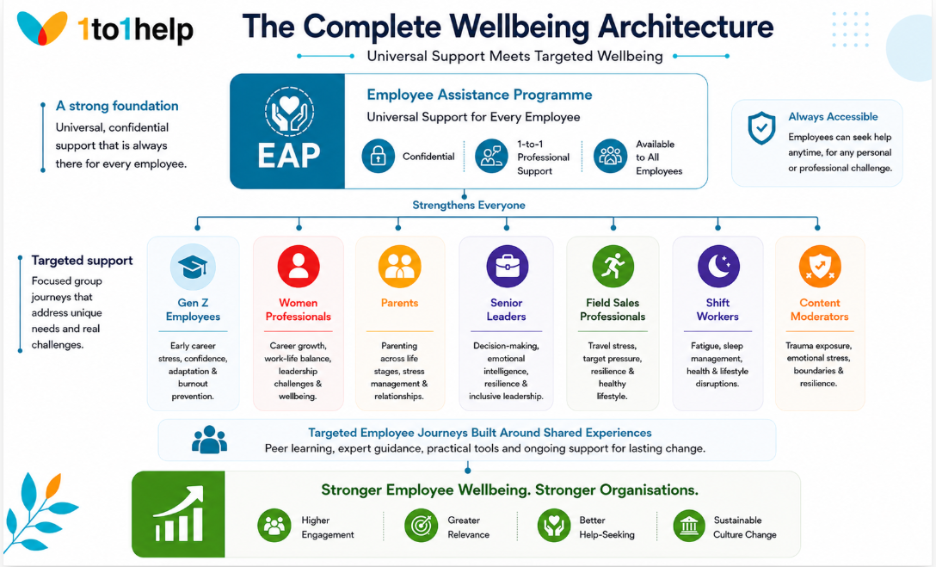
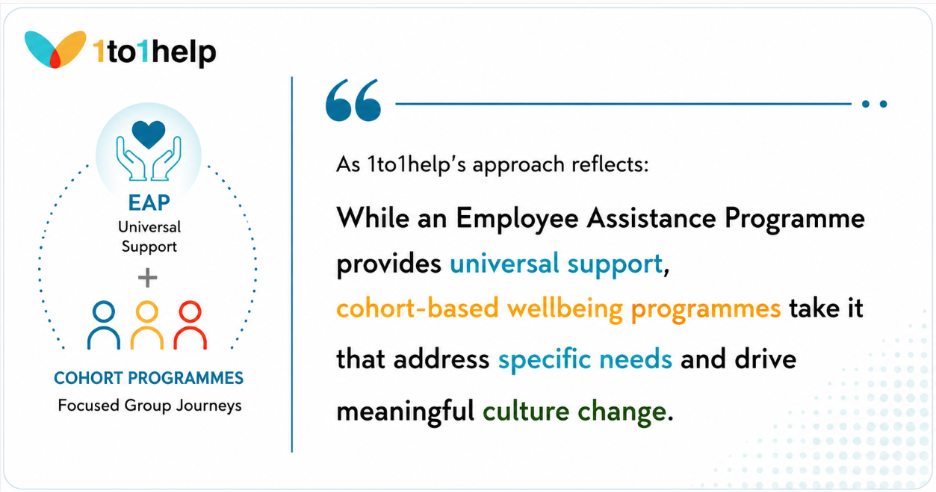
An Employee Assistance Programme provides confidential, professional support that is available to every employee whenever they need it. Cohort programmes build on this foundation by bringing together employees with shared experiences to strengthen resilience, encourage peer learning, and address common challenges before they escalate.
Together, they create a layered wellbeing strategy that combines accessible individual support with proactive, group-based interventions tailored to different workforce segments.
Cohort-Based Wellbeing vs Generic Group Wellness
Many organisations conduct organisation-wide wellbeing webinars, mindfulness sessions, or awareness campaigns that are open to everyone. While these initiatives help build awareness, they differ fundamentally from cohort-based programmes.
A generic wellbeing session on managing stress offers broad guidance for the entire workforce. A cohort programme for shift workers, on the other hand, explores fatigue management, sleep recovery, nutrition, and work-life adjustment within the context of irregular schedules.
The difference is not simply the audience. It is the depth, relevance, and practical application of the learning.
Universal wellbeing initiatives create the foundation. Cohort-based programmes build on that foundation by ensuring employees feel understood, represented, and supported in ways that reflect their unique realities.
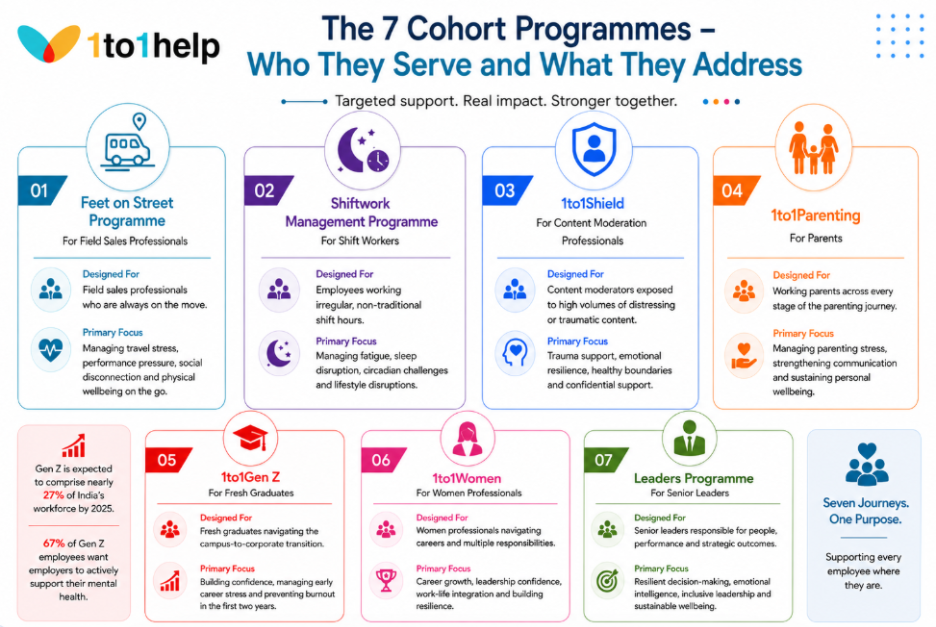
1to1help's Cohort-Based Programmes: Seven Journeys for Seven Distinct Groups
Every employee brings a unique combination of responsibilities, experiences, and pressures to work. While organisations increasingly recognise the importance of employee wellbeing, meaningful support requires more than broad wellness initiatives. It requires an understanding of the realities different employee groups face every day.
Recognising this, 1to1help has developed seven distinct cohort-based wellbeing programmes, each designed around the lived experiences of a specific employee group. These are not generic wellbeing programmes repackaged for different audiences. They are structured wellbeing journeys built from the ground up to address the emotional, behavioural, and professional challenges unique to each cohort. By combining expert guidance, counselling, practical wellbeing tools, peer learning, and preventive interventions, these programmes help organisations provide support that is relevant, timely, and impactful.
Feet on Street Programme: For Field Sales Professionals
Field sales professionals occupy one of the most demanding roles in any organisation. Their workplace is constantly changing, their schedules are rarely predictable, and success often depends on balancing customer relationships with ambitious performance targets. Long hours on the road, irregular meals, extensive travel, and limited interaction with colleagues can gradually contribute to physical fatigue, emotional isolation, and chronic stress.
The programme has been developed specifically for these realities.
- Rather than offering generic stress management, it combines confidential counselling, wellbeing webinars, practical self-help resources, nutrition guidance, financial wellbeing support, and manager sensitisation to help employees maintain healthier routines while sustaining performance.
- The programme also includes assessments and awareness initiatives that enable organisations to identify emerging wellbeing concerns early and provide timely support.
By addressing both emotional resilience and lifestyle challenges, Feet on Street helps field professionals perform consistently without compromising their wellbeing.
.png)
Travel stress, performance pressure, healthy lifestyle habits, emotional resilience, financial wellbeing and sustained performance.
Shiftwork Management Programme: For Shift Workers
Shift work is not simply working outside regular office hours. It changes the body's natural rhythms, affects sleep quality, disrupts eating patterns, limits family time, and can create feelings of social isolation. Over time, these challenges influence both physical and psychological wellbeing, increasing the risk of fatigue, burnout, and reduced engagement.
The programme recognises that supporting shift workers requires more than standard wellbeing initiatives designed around a nine-to-five schedule.
- The programme combines confidential counselling, specialised workshops, nutrition consultations, focus group discussions, manager awareness sessions, and digital wellbeing resources to help employees manage fatigue, regulate stress, improve sleep habits, and build healthier routines despite irregular schedules.
By addressing mental and physical wellbeing together, organisations can create a safer, healthier, and more productive shift workforce.
Sleep health, fatigue management, stress reduction, nutrition, work-life balance and resilience.
1to1Shield: For Content Moderation Professionals
Content moderators play a vital role in creating safer digital platforms, yet they often work in one of the most emotionally demanding professions. Continuous exposure to graphic, violent, or distressing content can lead to secondary traumatic stress, emotional fatigue, reduced coping ability, and compassion fatigue. These are occupational risks associated with the role rather than individual weaknesses.
Built specifically for Trust and Safety roles, 1to1Shield provides trauma-informed mental health support tailored to the unique realities of content moderation.
- The programme combines confidential counselling available around the clock, structured wellbeing check-ins, psychoeducation on trauma and emotional boundaries, group sessions on resilience and stress management, and onsite as well as digital access to support.
- Developed using real-world content moderation experience and grounded in trauma therapy and behavioural science, the programme helps professionals build healthier coping strategies while ensuring strict confidentiality and psychological safety.
Secondary trauma, emotional regulation, resilience, psychological boundaries and confidential support.
1to1Parenting: For Parents
For working parents, the demands of professional life continue long after the workday ends. Parenting brings continuous transitions, from pregnancy and early childhood through adolescence, each presenting new emotional, developmental, and practical challenges. Balancing these responsibilities while maintaining personal wellbeing is rarely straightforward.
- The programme supports employees across the entire parenting journey through a combination of expert-led webinars, confidential counselling, facilitated peer discussions, and practical parenting resources.
- Rather than treating parenting stress as an individual concern, the programme acknowledges it as an important life stage that organisations can actively support.
- Employees receive guidance on communication, child development, work-life integration, and managing family transitions, helping them feel more confident both at home and at work.
Parenting guidance, communication, work-life integration, family wellbeing and emotional resilience.
1to1Gen Z: For Fresh Graduates
By 2028, Gen Z is expected to make up around 27% of India's workforce, bringing new expectations around wellbeing, learning, and workplace culture. Research also shows that 67% want employers to actively support their mental health, while opportunities for learning and growth strongly influence whether they remain with an organisation.
The transition from campus to corporate life is exciting but emotionally demanding. New professionals must quickly adapt to unfamiliar workplace cultures, professional expectations, feedback systems, and increased personal responsibility.
- 1to1Gen Z has been created to support this transition through expert-led learning, peer conversations, confidential counselling, emotional wellbeing check-ins, and practical self-monitoring tools.
- By helping young employees build confidence, strengthen resilience, develop interpersonal skills, and recognise early signs of stress, the programme supports long-term wellbeing rather than waiting until burnout occurs.
Campus-to-corporate transition, confidence, resilience, workplace adjustment and burnout prevention.
💡Workplace Insight: Supporting employees during key career and life transitions, such as joining the workforce, becoming a parent, or stepping into leadership, often delivers greater long-term impact than reactive wellbeing interventions introduced only after problems emerge.
1to1Women: For Women Professionals
Women professionals often navigate workplace challenges that extend beyond role expectations. Career progression, leadership aspirations, caregiving responsibilities, workplace bias, and the emotional labour of balancing multiple roles can create pressures that generic employee wellbeing programmes may not fully address.
- The 1to1Women Programme provides a dedicated space where women can strengthen resilience, build confidence, and navigate professional growth with practical support.
- Through counselling, facilitated discussions, assessments, experiential activities, peer learning, and evidence-based wellbeing strategies, the programme helps participants manage workplace challenges while prioritising their personal wellbeing. It creates opportunities for reflection, shared learning, and sustainable growth, enabling women to thrive both professionally and personally.
Career growth, confidence, resilience, leadership development and work-life integration.
Leaders Programme: For Senior Leaders
Leadership brings influence, but it also carries significant emotional responsibility. Senior leaders make decisions that shape organisational culture, guide teams through uncertainty, and balance business outcomes with people priorities. Yet their own wellbeing often receives the least attention.
The programme recognises that healthy organisations require healthy leaders.
- Designed for senior leadership teams, it focuses on strengthening emotional intelligence, resilient decision-making, inclusive leadership, and self-awareness while equipping leaders to foster psychologically safe workplaces.
- Through guided reflection, practical leadership tools, and expert facilitation, the programme helps leaders sustain their own wellbeing while building cultures where employees feel supported, trusted, and empowered to perform at their best.
Emotional intelligence, resilient leadership, psychological safety, inclusive leadership and sustainable performance.
Collectively, these seven programmes demonstrate that meaningful employee wellbeing is not achieved through one universal intervention. It is created by understanding the different realities employees experience and providing support that reflects those realities.
Together with 1to1help's Employee Assistance Programme, these cohort-based wellbeing programmes enable organisations to build a more personalised, inclusive, and future-ready wellbeing strategy that supports every employee where they are.
The Diverse Indian Workforce: Why Targeted Wellbeing Is Not Optional
India's workforce is changing at a pace that few organisations have experienced before. Today's employees span multiple generations, work across vastly different occupational environments, and bring evolving expectations of what meaningful workplace support should look like. As a result, organisations can no longer rely on generic employee wellness initiatives. To deliver measurable outcomes, corporate wellness programs in India must recognise that wellbeing is shaped by an employee's role, life stage, and lived experience.
- One of the most significant shifts is generational. As Gen Z's presence in the workforce continues to grow, organisations are seeing a generation that approaches mental health very differently from those before it. They are more comfortable seeking support, expect open conversations around wellbeing, and place greater value on employers that invest in their personal and professional development.
- Research found that 84% of Gen Z employees are more likely to stay with organisations that invest in their learning and growth, highlighting that career development, psychological wellbeing, and employee engagement are increasingly interconnected rather than separate priorities. This shift is influencing organisational culture far beyond Gen Z, raising expectations for every generation in the workplace.
- At the same time, India's workforce remains one of the world's most multigenerational, bringing together Baby Boomers, Gen X, Millennials, and Gen Z under one organisational roof. Each generation has been shaped by different workplace experiences, communication styles, and attitudes towards mental health. A wellbeing initiative that resonates with early-career employees may feel irrelevant to senior professionals managing leadership responsibilities or employees approaching retirement. Effective employee health and wellness programs therefore require flexibility, personalisation, and relevance rather than uniformity.
- Generational diversity is only one part of the picture. India's economy also has large concentrations of occupational groups with specialised wellbeing needs. Millions of employees work rotating shifts that affect sleep, physical health, and family life. Large field sales and mobile workforces spend much of their time travelling, balancing demanding targets with limited opportunities for peer interaction. India is also home to one of the world's largest content moderation workforces, where employees are routinely exposed to psychologically distressing material as part of their roles.
- Alongside these occupational realities, women professionals continue to navigate documented barriers to career progression while balancing disproportionate caregiving responsibilities. These are not isolated employee experiences. They are structural workforce realities that require equally specialised wellbeing responses.
- Employee expectations have also changed significantly since the pandemic. Wellbeing is no longer viewed as a workplace perk but as an essential part of a healthy employment relationship. According to Wellhub's State of Work-Life Wellness 2025 report, 88% of employees say wellbeing is as important as their salary, while organisations continue to underestimate the impact wellbeing has on attraction, engagement, and retention. When employees receive the same generic wellbeing programme regardless of their role or circumstances, it can signal that their unique experiences are neither recognised nor valued.
- For organisations operating in high-attrition sectors such as IT, BFSI, manufacturing, retail, and healthcare, this has become a strategic business challenge. Wellbeing is increasingly influencing employer brand, employee engagement, and talent retention.
Organisations that invest in targeted, cohort-based wellbeing programmes demonstrate a deeper understanding of their workforce and are better positioned to build resilient teams, strengthen trust, and create cultures where employees feel seen, supported, and able to perform at their best.
Beyond Individual Wellbeing: How Cohort Programmes Drive Culture Change
The most valuable outcome of a cohort-based wellbeing programme is not simply that individual employees feel less stressed or more resilient, although those outcomes are important. Its greater impact lies in what happens after the programme ends. Employees return to their teams with a shared understanding of wellbeing, a common language for discussing challenges, and stronger relationships that continue to influence how they work together. This is where an employee wellbeing program begins to shape organisational culture rather than individual behaviour alone.
Unlike traditional wellbeing initiatives that employees experience in isolation, cohort programmes create a collective learning journey. Participants share similar workplace realities, discuss common challenges, and develop practical strategies together. As trust grows within the group, conversations around mental health become more open, help-seeking becomes more acceptable, and wellbeing shifts from being an individual responsibility to a shared commitment.
This collective approach complements, rather than replaces confidential counselling through an Employee Assistance Programme (EAP). Individual counselling provides professional, confidential support when someone is experiencing emotional distress or facing a personal challenge. Cohort programmes strengthen the wider workforce by building shared capability across teams. They create collective resilience, encourage peer accountability, and normalise conversations around wellbeing long before employees reach a point of crisis. Together, they form a more comprehensive ecosystem of employee wellbeing support services, addressing both individual needs and organisational culture.
The impact of this group format becomes even more powerful when employees share similar roles or life experiences.
- For field sales professionals and shift workers, simply being surrounded by colleagues who genuinely understand the realities of constant travel, demanding targets, fatigue, or disrupted routines reduces the sense of isolation that often intensifies workplace stress. The shared experience itself becomes a source of validation and support.
- For Gen Z employees, cohort learning reflects their natural preference for learning through collaboration, discussion, and shared experiences. Rather than passively receiving information, they build confidence by exchanging perspectives with peers facing similar workplace transitions.
- Women professionals similarly benefit from learning alongside colleagues navigating comparable leadership aspirations, workplace dynamics, and work-life integration challenges. These peer relationships frequently evolve into informal mentoring, professional networks, and ongoing sources of encouragement that extend well beyond the programme.
- Senior leaders perhaps experience one of the most profound shifts. Leadership can be isolating, with few opportunities to openly discuss uncertainty, emotional pressure, or difficult decisions. A confidential cohort of peers creates a rare space where leaders can reflect honestly, learn from one another, and strengthen their capacity to lead with empathy and psychological safety. The conversations that begin within the programme often influence leadership behaviours, team dynamics, and organisational culture long afterwards.
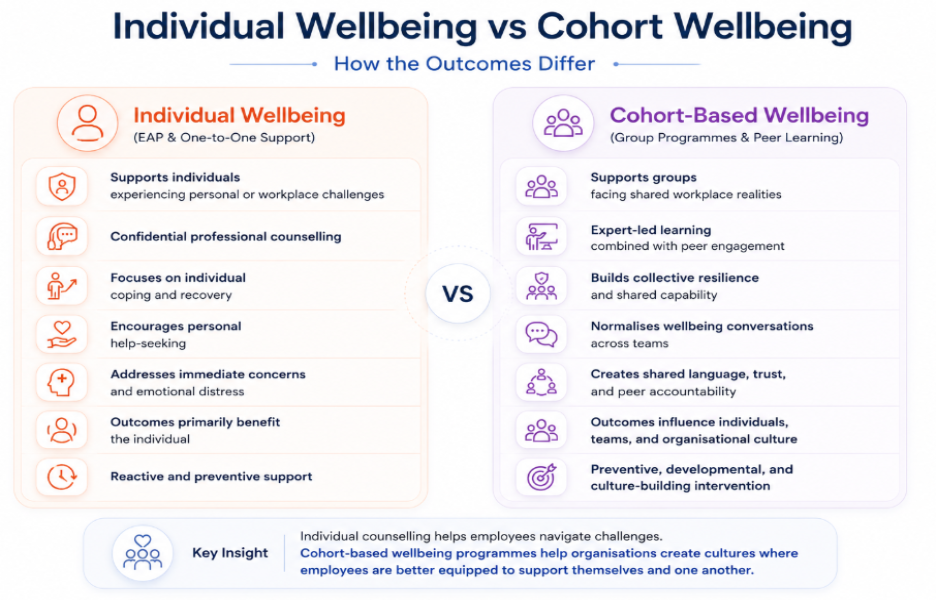
This is why 1to1help views culture change as a deliberate outcome rather than an unintended benefit. Cohort-based programmes do more than improve individual wellbeing. They help create teams that communicate more openly, support one another more effectively, and develop a shared commitment to building psychologically healthier workplaces. When organisations invest in these shared experiences, they are not only supporting individual employees but also shaping the everyday behaviours, relationships, and norms that define a resilient workplace culture.
The EAP and Cohort Programmes: Complementary, Not Competing
For many HR leaders, introducing cohort-based wellbeing programmes raises an important question: If we already have an Employee Assistance Programme (EAP), why do we need another wellbeing intervention?
The answer lies in recognising that these are not competing solutions. They serve different purposes within the same wellbeing ecosystem. While an EAP provides universal, individual support, cohort programmes strengthen wellbeing at the group level. Together, they create a layered approach that enables organisations to move from supporting employees one person at a time to building a workplace where wellbeing becomes part of the organisational culture.
At the foundation of this architecture is the Employee Assistance Programme (EAP). It ensures that every employee, regardless of role, location, or life stage, has access to confidential, professional support whenever they need it. Whether someone is experiencing work-related stress, relationship concerns, financial challenges, or a personal crisis, the EAP provides timely access to qualified mental health professionals. At 1to1help, the EAP extends to employees and their dependants, offers support in more than 13 languages, and is available 24×7, making it a cornerstone of comprehensive employee wellbeing services.
Cohort programmes build on this foundation by addressing challenges that emerge across specific groups before they become individual crises. Rather than responding to isolated concerns, they help employees with similar roles or life experiences develop practical coping strategies, stronger peer connections, and a common language around wellbeing. This group-based approach enables organisations to address occupational and life-stage challenges that a standalone corporate employee wellness program cannot fully resolve through individual counselling alone.
The interaction between these two layers creates one of the strongest advantages of a mature wellbeing strategy. Consider a shift worker who participates in a Shiftwork Management Programme. Through the cohort journey, they gain practical tools to manage fatigue, improve sleep habits, and connect with colleagues facing similar challenges. Just as importantly, the programme normalises conversations around mental health and introduces professional support as a natural part of workplace wellbeing. If that employee later experiences persistent stress or a personal concern requiring individual care, they are more likely to access the EAP because trust has already been established and help-seeking has been normalised.
This relationship works in both directions. Insights from aggregated EAP data can help organisations identify emerging workforce trends, while cohort programmes proactively address patterns affecting specific employee groups. Together, they create a continuous cycle of prevention, early intervention, and personalised support that strengthens both individual wellbeing and organisational resilience.
For organisations, the distinction is strategic. An EAP establishes the foundation for individual care. Cohort programmes extend that foundation by embedding wellbeing into everyday team experiences, strengthening inclusion, encouraging peer support, and building psychologically safer workplaces. Together, they transform wellbeing from a reactive service into a long-term organisational capability.
The Case for High-Risk Cohorts: When Standard Wellbeing Cannot Reach Far Enough
Most organisations invest in an Employee Assistance Programme, organise wellbeing webinars, and offer access to self-help resources. These interventions create an important foundation, but they are rarely designed for employees whose wellbeing challenges are built into the nature of their work.
For high-risk occupational cohorts, the question is not "Do we have a wellbeing programme?" but "Does our wellbeing programme understand the realities of this role?"
Case Example 1: When a Generic Wellness Campaign Isn't Enough
A global technology company launches an organisation-wide wellbeing month featuring resilience workshops, yoga sessions, and mindfulness webinars.
Most employees benefit.
The Trust & Safety team doesn't.
Their challenge is not finding time to meditate. It is returning every day to review violent, abusive, or traumatic online content as part of their core responsibilities. General wellness initiatives help raise awareness, but they cannot address secondary trauma or compassion fatigue.
What changes?
Instead of a generic intervention, the organisation introduces 1to1Shield, providing trauma-informed counselling, regular wellbeing check-ins, and specialised psychological support designed specifically for content moderation professionals.
Case Example 2: When Wellbeing Doesn't Fit the Work Schedule
A manufacturing company invests in an employee health and wellbeing program with lunchtime wellbeing sessions, fitness challenges, and nutrition workshops.
Office-based employees participate regularly.
Night-shift employees rarely do.
Not because they are disengaged, but because the programme has been built around office hours rather than shift work. Fatigue, disrupted sleep, and irregular routines remain unaddressed.
What changes?
The organisation introduces the Shiftwork Management Programme, delivering practical support around sleep, fatigue management, nutrition, stress, and lifestyle habits that align with rotating schedules rather than expecting employees to adapt to conventional working patterns.
Case Example 3: When Wellbeing Never Leaves the Office
An FMCG company notices rising stress and attrition among its field sales teams despite offering counselling, health checks, and regular wellbeing webinars.
The feedback is consistent.
"Most of these initiatives happen when we're travelling or meeting customers."
For employees who spend their week on the road, managing targets, rejection, and long travel hours, office-based wellbeing initiatives often remain out of reach.
What changes?
The organisation implements the Feet on Street Programme, bringing targeted counselling, wellbeing resources, nutrition guidance, manager sensitisation, and resilience-building directly into the context of field-based work, making support practical, accessible, and relevant.
High-risk cohorts do not require specialised wellbeing programmes because they are "difficult" employee groups. They require specialised support because their work exposes them to predictable occupational challenges that standard wellbeing interventions were never designed to address.
Wellbeing That Reflects the Whole Person: Gen Z, Women, and Parents
Not every wellbeing challenge begins at work. For many employees, it is shaped by a life stage, identity, or responsibility that influences how they experience work every day. Generic wellbeing programmes often overlook these realities because they focus on the workplace rather than the whole person.
For organisations committed to building an inclusive culture, supporting these employee groups is not simply about offering additional benefits. It is about recognising that different life experiences require different kinds of support.
Case Example 1: Helping a Graduate Find Their Place
A leading IT company hires 300 graduates through campus placements. Within six months, managers notice a pattern. New hires hesitate to ask questions, struggle with feedback, and report feeling overwhelmed despite performing well.
The issue isn't capability. It's the transition.
Moving from college to the workplace means adapting from a relatively unstructured routine to a highly structured environment defined by fixed office hours, deadlines, performance expectations, and organisational hierarchies. A generic induction programme cannot prepare employees for these emotional adjustments.
A dedicated wellbeing programme for Gen Z employees, such as 1to1Gen Z, bridges this gap by helping young professionals build confidence, emotional resilience, and healthy coping strategies during the critical early years of their careers, reducing the risk of early burnout while supporting long-term growth.
Case Example 2: Supporting Women Beyond the Workplace
A high-performing manager is considered ready for a leadership role, yet she hesitates to apply. Between leading her team, caring for ageing parents, and managing family responsibilities, she feels she is constantly balancing competing expectations.
Performance is not the barrier.
The challenge lies in navigating workplace aspirations alongside realities that many women continue to experience throughout their careers.
A women employee wellbeing programme, such as 1to1Women, creates a dedicated space for peer learning, reflection, counselling, and leadership development, enabling women professionals to build confidence, share experiences, and develop practical strategies for sustainable career growth.
Case Example 3: When Parenting Doesn't End After Office Hours
A project lead signs off from work only to begin another shift at home, helping with homework, managing bedtime routines, and caring for a teenager preparing for board exams. The next morning, they return to work carrying the emotional demands of both roles.
The challenge isn't a lack of commitment to work.
It's that parenting and professional responsibilities are deeply interconnected, influencing concentration, energy, and emotional wellbeing every day.
1to1Parenting provides working parents wellbeing support through expert guidance, confidential counselling, peer discussions, and practical tools that help parents navigate every stage of the parenting journey, from pregnancy through adolescence, while maintaining their own wellbeing alongside their careers.
These examples reinforce an important principle. Employees do not leave their life experiences at the workplace door. Whether someone is entering their first job, building a career, or raising a family, these transitions shape how they engage, perform, and thrive at work. Organisations that recognise the whole person, rather than only the job role, create wellbeing strategies that are more inclusive, more relevant, and ultimately more effective.
What Organisations Gain from Cohort-Based Wellbeing Programmes
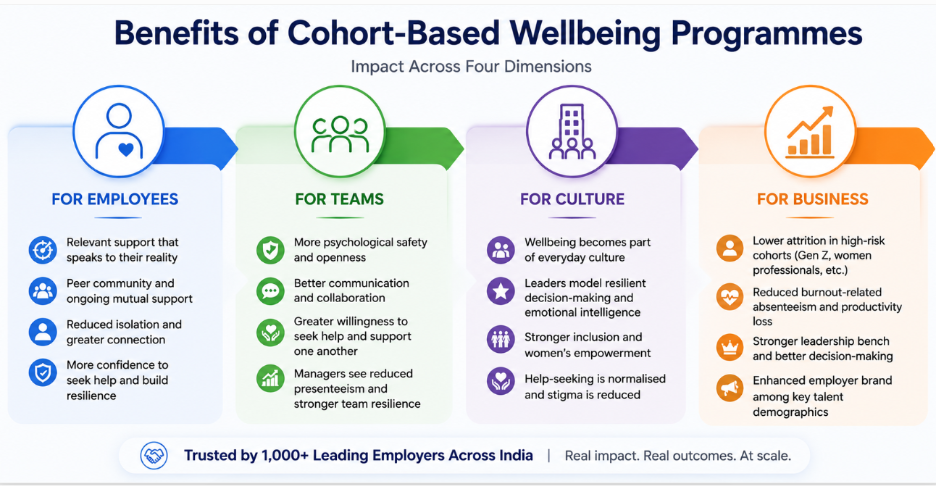
The benefits of corporate wellness programs are most meaningful when they create lasting change across the organisation. Cohort-based wellbeing programmes do exactly that by delivering outcomes at four interconnected levels: the individual employee, the team, organisational culture, and business performance.
For Employees
Employees receive employee wellbeing support services that reflect their role, life stage, and lived experiences, leading to:
- More relevant and personalised wellbeing support.
- Stronger peer connections with colleagues facing similar challenges.
- Reduced isolation and greater confidence to seek help when needed.
For Teams
As employees learn and grow together, teams benefit from:
- Better communication and stronger psychological safety.
- Greater willingness to support one another during high-pressure periods.
- Shared resilience and healthier ways of working together.
For Organisational Culture
Cohort programmes help embed wellbeing into everyday workplace culture by:
- Normalising conversations around mental health and wellbeing.
- Strengthening inclusive leadership and peer support.
- Creating a culture where employees feel seen, valued, and supported.
For Business Performance
Targeted wellbeing investments also contribute to measurable organisational outcomes, including:
- Improved retention among key talent groups.
- Reduced burnout and its impact on engagement and productivity.
- Stronger employer brand and leadership capability.
Trusted by 1,000+ leading employers across India, 1to1help's cohort-based wellbeing programmes demonstrate how targeted interventions can complement broader wellbeing strategies while creating meaningful outcomes for employees, teams, and organisations alike.
Conclusion
The future of workplace wellbeing is not one-size-fits-all. As India's workforce becomes more diverse in its roles, life stages, and wellbeing needs, organisations must move beyond generic initiatives towards support that is targeted, relevant, and meaningful.
By combining the universal reach of an Employee Assistance Programme with specialised cohort-based wellbeing programmes, organisations can create a comprehensive wellbeing ecosystem that supports individuals, strengthens teams, and builds a culture where people can truly thrive.
Ready to Build a More Personalised Wellbeing Strategy?
Whether you're looking to strengthen your existing Employee Assistance Programme or introduce cohort-based wellbeing journeys for specific employee groups, 1to1help can help you design a wellbeing strategy that reflects the realities of your workforce.
Explore 1to1help's Employee Assistance Programme to provide confidential, 24×7 support for every employee, or discover our Cohort-Based Wellbeing Programmes to deliver targeted interventions that improve engagement, resilience, and organisational culture.
Because meaningful wellbeing begins when every employee feels understood, supported, and empowered to succeed.
FAQs
Q1: What are cohort-based wellbeing programmes?
Cohort-based wellbeing programmes are structured wellbeing journeys designed for specific employee groups with shared roles, life stages, or workplace experiences. Unlike generic wellness initiatives, they address the unique challenges of groups such as Gen Z employees, field sales professionals, shift workers, women professionals, working parents, and senior leaders. By combining expert guidance, peer learning, and targeted support, these programmes create more relevant wellbeing experiences and stronger organisational impact.
Q2: How do cohort-based wellbeing programmes differ from a standard EAP?
An Employee Assistance Programme (EAP) provides confidential, one-to-one counselling and support for employees and their dependants whenever they need help. Cohort-based wellbeing programmes complement the EAP by offering structured group journeys for employees facing similar challenges. While the EAP focuses on individual support, cohort programmes build collective resilience, peer learning, and shared wellbeing within specific employee groups. Together, they create a comprehensive workplace wellbeing strategy.
Q3: Which cohort programmes does 1to1help offer?
1to1help offers seven cohort-based wellbeing programmes tailored to different workforce segments: Feet on Street for field sales professionals, Shiftwork Management for shift workers, 1to1Shield for content moderation professionals, 1to1Parenting for working parents, 1to1Gen Z for fresh graduates, 1to1Women for women professionals, and the Leaders Programme for senior leaders. Each programme is designed around the specific wellbeing needs of its cohort.
Q4: Why do Indian organisations need cohort-based wellbeing programmes specifically?
India's workforce is increasingly diverse, with employees differing in roles, life stages, and wellbeing needs. A single wellbeing programme cannot effectively address these varied experiences. Cohort-based wellbeing programmes provide targeted support that improves engagement, strengthens resilience, and helps organisations create more inclusive workplaces. They are particularly valuable for high-risk occupational groups and employees navigating important career or life transitions.
Q5: Can cohort programmes be customised for our organisation?
Yes. 1to1help's cohort-based wellbeing programmes can be adapted to suit your organisation's workforce, business priorities, and wellbeing goals. Depending on the employee groups you wish to support, programmes can be tailored in terms of delivery, language, learning focus, and implementation approach while maintaining their evidence-based framework.
Q6: How are outcomes tracked across the cohort programmes?
1to1help measures programme outcomes through structured, anonymised reporting that helps organisations understand participation, engagement, wellbeing trends, and overall programme impact. These insights enable HR teams to evaluate effectiveness, identify emerging workforce needs, and continuously strengthen their wellbeing strategy while maintaining employee confidentiality.
Q7: How does the 1to1Women programme support women professionals specifically?
The 1to1Women programme supports women professionals through counselling, peer learning, expert-led discussions, and practical strategies focused on career growth, resilience, work-life integration, and leadership development. It provides a supportive environment where women can share experiences, build confidence, and navigate workplace challenges alongside peers facing similar realities.
Q8: How can we get started with 1to1help's cohort-based wellbeing programmes?
Getting started is simple. Connect with the 1to1help team to discuss your workforce composition, wellbeing priorities, and organisational goals. Based on your needs, the team will recommend suitable cohort-based wellbeing programmes, customise the implementation approach where required, and support you through programme rollout and ongoing impact measurement.
References
- Businessworld People. (2025, April 9). Navigating multigenerational workplace dynamics. https://www.bwpeople.in/article/navigating-multigenerational-workplace-dynamics-550435
- HR Executive. (2025, April 3). Gen Z is leading the way on wellbeing. Here's how HR can take advantage. https://hrexecutive.com/gen-z-is-leading-the-way-on-wellbeing-how-hr-can-take-advantage/
- Infeedo. (2025). Gen Z workforce in India: What top employers need to know in 2025. https://www.infeedo.ai/blog/gen-z-workforce-india-top-employers-2025
- Management Dynamics. (2025). Multigenerational workforce and organisational dynamics. Management Dynamics, 25(2). https://managementdynamics.researchcommons.org/journal/vol25/iss2/4/
- Mindful. (n.d.). Getting started with mindfulness. https://www.mindful.org/meditation/mindfulness-getting-started/
- Navigate Well. (2024). Preparing for the Gen Z workforce. https://www.navigatewell.com/resources/insights/preparing-for-gen-z-workforce
- Pew Research Center. (2019, January 17). Where Millennials end and Generation Z begins. https://www.pewresearch.org/short-reads/2019/01/17/where-millennials-end-and-generation-z-begins/
- Psychology Today. (n.d.). Emotional intelligence. https://www.psychologytoday.com/us/basics/emotional-intelligence
- ScienceDirect. (n.d.). Secondary traumatic stress. https://www.sciencedirect.com/topics/medicine-and-dentistry/secondary-traumatic-stress
- ScienceDirect. (n.d.). Shift worker. https://www.sciencedirect.com/topics/social-sciences/shift-worker
- Wellhub. (2025). State of Work-Life Wellness 2026: Executive summary. https://wellhub.com/en-us/blog/wellness-and-benefits-programs/state-of-work-life-wellness-2026-executive-summary/
- World Health Organization. (n.d.). Social isolation and loneliness. https://www.who.int/teams/social-determinants-of-health/demographic-change-and-healthy-ageing/social-isolation-and-loneliness


.svg)
.svg)
.svg)
.svg)