



.png)

Personal Growth & Well Being
What is Self-Exploration? Meaning, Process, and How to Begin

.png)
Written by
Aarohi Parakh,
Psychologist and Content Writer

Reviewed by
Sanjana Sivaram,
Psychologist and Clinical Content Head


Introduction
There is a particular kind of restlessness that many of us recognise. It surfaces during a quiet commute, in the space between one deadline and the next, or sometimes in the middle of the night. It is the feeling of not quite knowing who you are underneath the roles you play, the opinions others hold of you, and the identity you have built around your work and relationships.
Self-exploration is the process of turning towards that restlessness rather than away from it. More precisely, self-exploration is the deliberate, reflective process of investigating your inner world: your values, beliefs, emotions, strengths, patterns, and motivations, with the goal of greater self-knowledge and more intentional living.
It is not the same as overthinking or spending hours analysing oneself, nor is it the privilege of people who have time to spare. It is, in many ways, one of the most practical things a person can do. What you understand about yourself shapes how you work, how you relate to others, how you make decisions under pressure, and how you recover when things go wrong.
This guide covers the meaning and process of self-exploration, the key stages involved, seven practical techniques, reflective questions, and the best quotes on self-discovery from thinkers across the world and from the Indian tradition. Whether you are looking to understand yourself more deeply, navigate a difficult life transition, or simply feel more grounded in who you are, this guide serves as a gentle starting point.
What is Self-Exploration? Definition and Meaning
Self-exploration, at its most straightforward, is the process of asking honest questions about your inner life and sitting with the answers long enough for something meaningful to emerge. It involves examining your values, emotions, thought patterns, fears, desires, and the experiences that have shaped who you are today.
In psychological terms, self-exploration is closely linked to what researchers call metacognition: the capacity to think about your own thinking. Fleming (2021) describes metacognition as a foundational skill that allows us to observe our own mental states with a degree of detachment, which is precisely what self-exploration requires. This capacity underpins both cognitive behavioural therapy (CBT) and psychodynamic approaches, where the therapist and client work together to examine internal patterns and their origins.
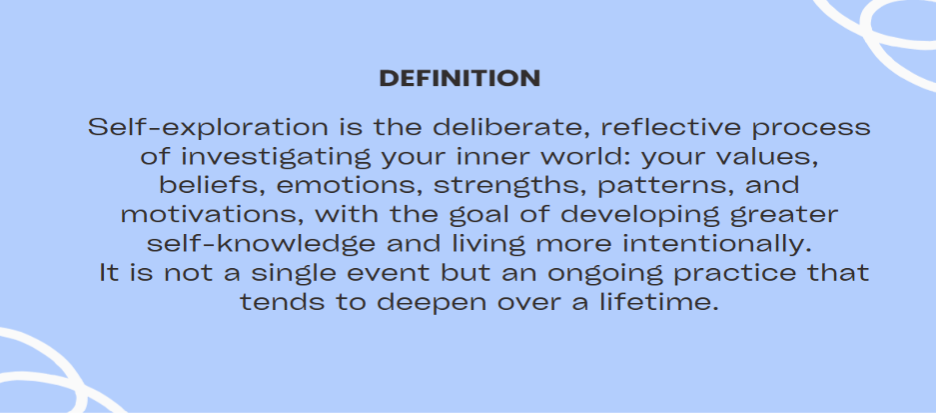
It is worth distinguishing between two related but different ideas. Self-exploration is the ongoing process, the journey of investigation, inquiry, and reflection. Self-discovery refers more specifically to the insights and realisations that emerge from that process: the "aha" moments where something about yourself becomes clearer. You might think of self-exploration as the practice, and self-discovery as one of its outcomes.
Why Self-Exploration Tends to Matter
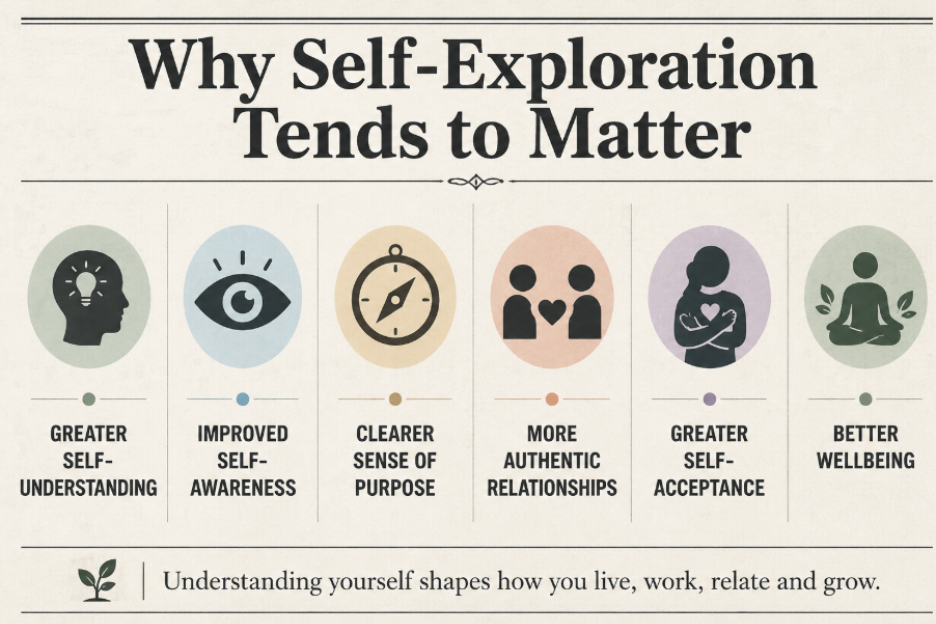
The benefits of self-exploration are not abstract. Research and clinical practice suggest it may contribute to a range of meaningful outcomes:
- Greater self-understanding: knowing why you react in particular ways, what you genuinely value, and what tends to drain or energise you
- Improved self-awareness: recognising your emotional patterns before they drive behaviour you later regret
- Clearer sense of purpose: understanding what matters to you independent of external expectations
- More authentic relationships: when you know yourself more honestly, you tend to be more honest with others
- Greater self-acceptance: acknowledging your limitations alongside your strengths with less defensiveness
- Better wellbeing: a sense of coherence about who you are tends to be associated with lower stress and greater psychological resilience
None of these outcomes arrives quickly or neatly. Self-exploration is rarely linear. But many people find that even a modest, consistent practice of reflection begins to shift how they relate to themselves and to the world around them.
- Recommended Reading: How to Build Self-Confidence
Self-Exploration in Human Values: The Indian Academic Perspective
If you have come across the phrase "self-exploration in human values" in the context of Indian university curricula, engineering colleges, or workplace learning programmes, you are encountering a distinct and rich tradition that frames self-exploration in a particular way, one that is worth understanding on its own terms.
In the Indian academic tradition of human values education, self-exploration is defined as the process of dialogue between what you are and what you really want to be. It is a process of self-investigation and self-evolution: not simply understanding your current self, but understanding the gap between your present reality and your authentic aspirations, and taking steps to bridge it.
Unlike many contemporary approaches that focus primarily on understanding thoughts, emotions, or personality traits, the human values perspective places greater emphasis on understanding what leads to lasting happiness, fulfilment, and harmony in life. It encourages individuals to examine not only who they are today but also whether their choices, relationships, and goals align with what they genuinely value. Self-exploration, therefore, becomes both a process of understanding and a guide for living.
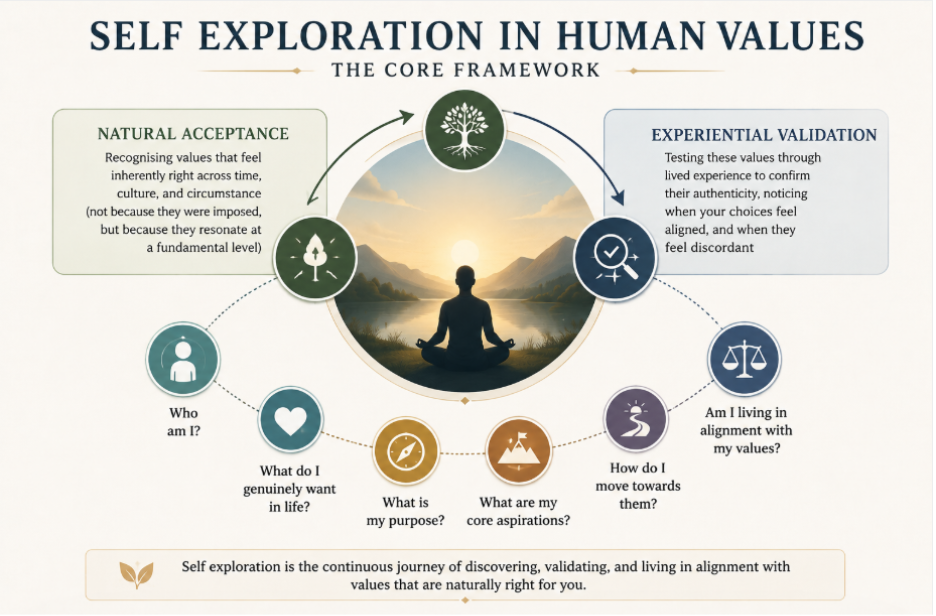
This framework has two foundational components. The first is natural acceptance: recognising the values and aspirations that feel inherently right to you, regardless of who is watching or what your social environment expects. The second is experiential validation: testing those values through real-life choices and noticing what happens. Do your choices bring a sense of coherence and satisfaction, or a persistent feeling of disconnection?
Together, natural acceptance and experiential validation create a continuous cycle of reflection, action, and learning. Rather than relying solely on external measures of success, individuals learn to evaluate whether their choices are helping them move closer to the person they genuinely want to become.
Indian Workplace Context
For many Indian professionals, particularly those navigating the tension between personal values and organisational or family expectations, this framework offers something genuinely useful. Self-exploration in the human values sense is not about rejecting social obligations, but about developing enough clarity about your own values to make choices more consciously rather than simply reacting to pressure.
This tradition is also relevant in corporate wellbeing settings. When employees understand their own values more clearly, they tend to make more coherent decisions, experience less internal conflict, and engage more authentically with their work. When self-exploration reveals a significant gap between who you currently are and who you want to be, professional support through counselling or an Employee Assistance Programme can help you navigate that gap in a structured, supported way.
The 4 Stages of Self-Exploration
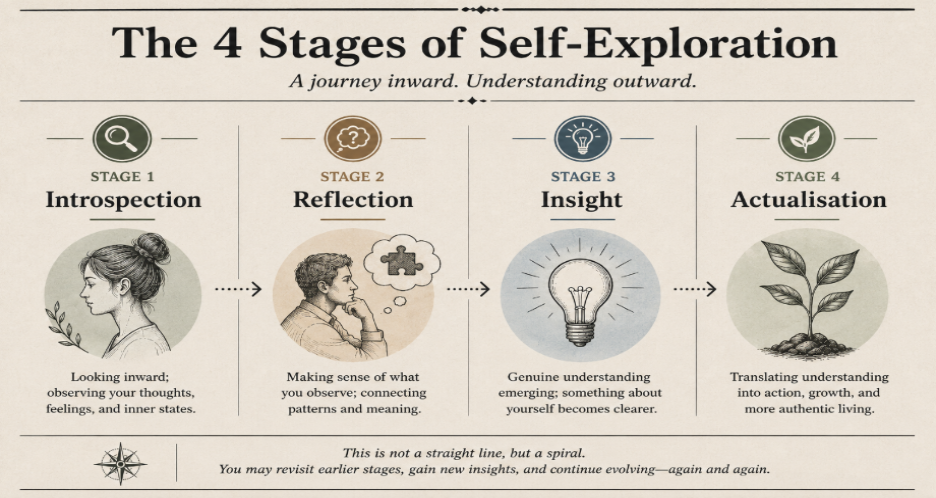
Self-exploration tends to unfold in a broadly recognisable sequence, though the reality is rarely as structured as any diagram suggests. People move between these stages fluidly, circling back to earlier stages as life changes and new layers of self-understanding become available.
Stage 1: Introspection
Introspection meaning: introspection is the conscious examination of your own mental states: your thoughts, feelings, sensations, and motivations. It is the act of turning your attention inward and noticing what is actually there, as honestly as you can manage, without immediately judging or explaining what you find.
Introspection is the starting point of self-exploration. Before you can reflect on your patterns or gain insight into your values, you need to develop the habit of actually noticing your inner experience. This sounds straightforward, but for many people, particularly those who have spent years in fast-paced, output-focused work environments, it requires real practice.
A few introspection prompts that may be useful to begin with:
- "What am I feeling right now, and what might have triggered it?"
- "What thought patterns do I notice most often in difficult situations?"
- "When do I feel most like myself, and what is different about those moments?"
Stage 2: Reflection
Reflection is what happens when you take the raw material of introspection and begin to make sense of it. Where introspection looks inward to observe, reflection examines that inward data in context: connecting experiences across time, identifying patterns, and beginning to understand why things are the way they are.
Journalling is probably the most widely recommended tool for the reflection stage, and for good reason. Writing externalises your thoughts, creates a small but meaningful distance from them, and allows patterns to emerge across entries that are harder to see when everything remains inside your head.
💡Pro-Tip: Reflection is not the same as rumination. Reflection tends to move towards understanding and then towards action. Rumination circles the same painful territory without resolution. If you notice your inner reflection becoming repetitive and distressing rather than clarifying, that can be a useful signal to seek a conversation with a counsellor.
Stage 3: Insight
Insight is the stage most people associate with the word "self-discovery": the moment when something about yourself becomes genuinely clearer. These moments can feel sudden, but they rarely are. They tend to emerge gradually, after sustained reflection has softened your defences enough that a truth can land.
It is worth noting that insight is not always comfortable. Sometimes what becomes clearer is something you would have preferred not to know about yourself: a pattern of avoidance, a value you have not been honouring, a fear that has been driving more of your behaviour than you realised. Kristin Neff's research on self-compassion is particularly relevant at this stage. Her work suggests that meeting difficult self-knowledge with kindness rather than self-criticism tends to make people more willing to actually change, not less.
Stage 4: Actualisation
The final stage connects self-exploration to action. Maslow's concept of self-actualisation describes the ongoing orientation towards becoming the most complete version of yourself: not a fixed destination, but a direction of travel that unfolds across a lifetime. Self-actualisation is not reserved for people who have resolved all their difficulties. It is available to anyone who is genuinely trying to grow in alignment with their deepest values.
Practical steps at the actualisation stage might include:
- making one specific change based on an insight you have gained;
- having a conversation you have been avoiding;
- setting a boundary that reflects a value you have clarified; or
- seeking professional support to help bridge the gap between who you currently are and who you want to become.
Self-Exploration Techniques: 7 Ways to Discover Your Inner Self
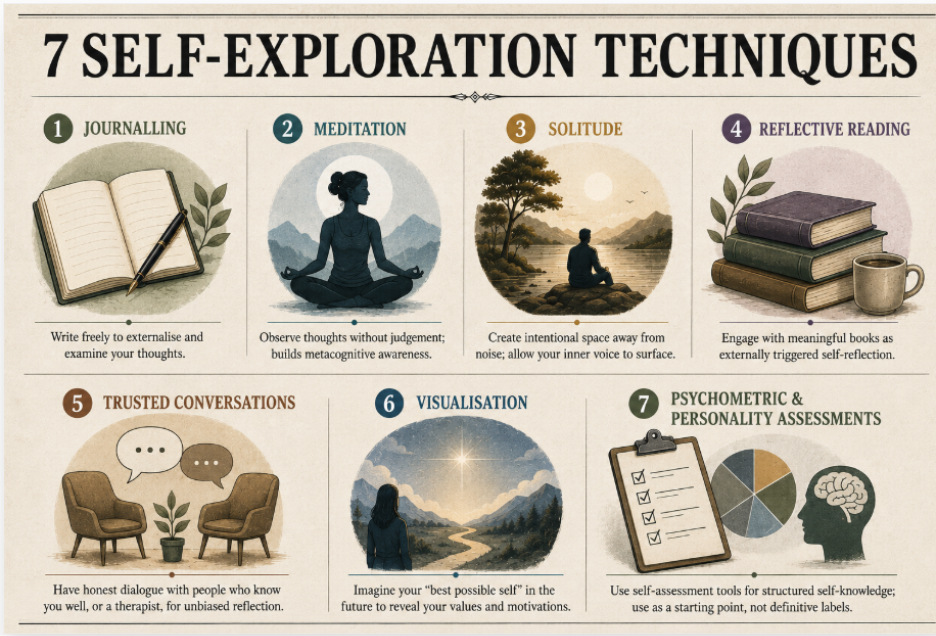
There is no single correct way to practise self-exploration. Different approaches work for different people, and most people find a combination more effective than any single method. What all effective techniques share is this: they create a container for honest inner inquiry, free from distraction and the pressure to perform.
Technique 1: Journalling and Journal Prompts for Self-Discovery
Journalling is one of the most accessible and consistently recommended self-exploration techniques, and the research broadly supports its value for self-awareness and emotional processing. The key is to move beyond daily diary entries towards prompts that invite genuine inquiry.
Even five minutes of free writing daily can be enough to get started. The act of putting words on a page creates a small but meaningful distance between you and your thoughts, which is the first step towards genuine reflection. Over time, patterns emerge in your writing that are harder to see when everything remains inside your head.
Journal Prompts for Self-Discovery
- What do I value most in life, and am I genuinely living by those values right now?
- What am I most afraid of, and what might that fear be trying to protect?
- What would I pursue if I were more confident that failure was simply a part of learning?
- What patterns keep repeating in my relationships, and what might they be reflecting about me?
- When did I last feel genuinely alive and engaged? What was I doing, and who was I with?
- If my actions over the past month were all someone had to judge my values by, what would they conclude?
Technique 2: Meditation and Mindful Self-Awareness
Meditation, particularly mindfulness-based practice, builds the capacity to observe your own thoughts without immediately identifying with them. This is the metacognitive skill that underlies all self-exploration: the ability to watch yourself think, rather than simply being swept along by the current of your thoughts.
Jon Kabat-Zinn's Mindfulness-Based Stress Reduction (MBSR) framework is one of the most well-researched approaches in this area. Even brief daily meditation, 10 to 15 minutes, appears to support the kind of calm, non-reactive inner observation that makes honest self-exploration more possible.
Technique 3: Solitude
Genuine solitude is increasingly rare and increasingly valuable. It is important to distinguish it from loneliness, which involves an unwanted absence of connection. Productive solitude is chosen, intentional, and directed inward: a solo walk without headphones, a quiet morning before others in the household are awake, a digital detox hour.
Indian cultural context: The Indian philosophical tradition has long recognised the value of what might be called "Ekanta": solitude cultivated for contemplation and self-inquiry. In a culture where communal living, family obligations, and social noise are constant companions, carving out even brief periods of genuine solitude can be a meaningful act of self-exploration.
Technique 4: Reflective Reading and Learning
Reading biographies, psychology books, or philosophical texts can function as a form of externally triggered self-reflection. A well-written biography often works as a mirror: the reader recognises something of their own experience in another person's choices, struggles, and growth. The distance of fiction or biography can sometimes allow you to see yourself more clearly than direct introspection does.
Technique 5: Trusted Conversations and Professional Support
Honest conversation with people who know you well and are willing to be truthful can be a powerful tool for self-exploration. The reflections that others offer, particularly the recurring observations across different relationships, tend to contain useful signals about patterns you may not be able to see from inside your own perspective.
Professional support, through therapy or counselling, offers the most structured and supported form of self-exploration available. A trained therapist can provide a safe, structured space for self-exploration, drawing on approaches and techniques that best fit an individual's needs and goals. This is particularly valuable when self-exploration surfaces uncomfortable emotions, unresolved experiences, or patterns that feel difficult to shift on one's own. Professional counselling support provides a confidential, unbiased space that close relationships cannot always offer.
Technique 6: Visualisation
Visualisation involves deliberately imagining future scenarios to reveal implicit motives and values.
A simple practice: spend 10 minutes imagining your "best possible self" in five years. What does your daily life look like? How do you spend your time? Who is with you? What are you contributing?
The specific details that feel emotionally compelling in this exercise tend to point towards values and aspirations that may not yet be fully conscious.
Technique 7: Psychometric Tools and Personality Assessments
Structured self-knowledge tools, such as personality assessments, values inventories, and strengths surveys like the VIA Character Strengths Survey, can offer a useful starting framework for self-exploration. They are best understood as starting points rather than definitive labels: a personality profile can give you useful language for understanding your tendencies, but the real work of self-exploration lies in testing that language against your actual lived experience.
In workplace settings, tools like the 1to1help’s Emotional Risk Survey offer a structured lens for understanding where your emotional wellbeing currently sits and where attention might be most valuable.
Recommended Reading:
- How to be the best version of yourself
- Think Positive: A Practical Guide to Harnessing the Power of Positivity
Self-Reflection Questions to Ask Yourself
Good self-reflection questions are not designed to have quick, neat answers. They are designed to open something up: to help you look at yourself from a perspective you have not tried before. The ten questions below span values, identity, relationships, fear, purpose, and self-compassion. You might find it useful to choose one and stay with it across several journalling sessions rather than moving through all ten at once.
Question 01 - What are my core values?
Not the values you think you should have, but the ones that actually seem to guide your decisions when things are difficult. Where do you notice yourself unwilling to compromise?
Question 02 - What are my genuine strengths and limitations?
Strengths are not just skills or abilities; Which activities make you feel energised, engaged, and naturally capable? Which situations consistently challenge you, drain your energy, or highlight areas where you need support, growth, or different strategies?
Question 03 - What experiences have most shaped who I am?
Often the experiences that have shaped us most are not the ones we would choose. Which formative moments do you find yourself returning to, and what did they teach you about yourself?
Question 04 - What do I genuinely want in life?
Separate from what others expect of you or what you feel you "should" want. If external expectations disappeared tomorrow, what would still feel worth pursuing?
Question 05 - How do I tend to respond to difficulty?
Do you withdraw, attack, seek control, or reach out for support? Understanding your default responses to pressure can reveal a great deal about your core emotional patterns.
Question 06 - What kind of legacy do I want to leave?
Not necessarily a grand legacy. Simply: how do you want to be remembered by the people you care about most? What would you want them to say about how you showed up?
Question 07 - What am I most afraid of, and what might that fear protect?
Fear is often a pointer towards something deeply valued. A fear of failure frequently protects a deep care about contribution or belonging. What does your fear suggest you care most about?
Question 08 - When do I feel most alive and energised?
Csikszentmihalyi's concept of "flow" describes states of deep engagement where time seems to dissolve. When do you enter something close to this state? What are you doing?
Question 09 - What recurring patterns do I notice in my relationships?
Patterns that recur across different relationships tend to reflect us more than the other people involved. What themes keep arising for you?
Question 10 - What would I tell my younger self?
This question integrates your past with your present self-compassion. What do you wish you had known or believed earlier? That wisdom often reflects where you have genuinely grown.
For Indian Professionals: Question 10 tends to be particularly resonant for those navigating rapid life transitions: first-generation urban migrants, professionals who have moved far from their hometowns, or anyone managing the gap between their family's expectations and their own developing sense of identity. It can surface both grief and a surprising degree of self-compassion.
Self-Discovery Quotes to Inspire Your Journey
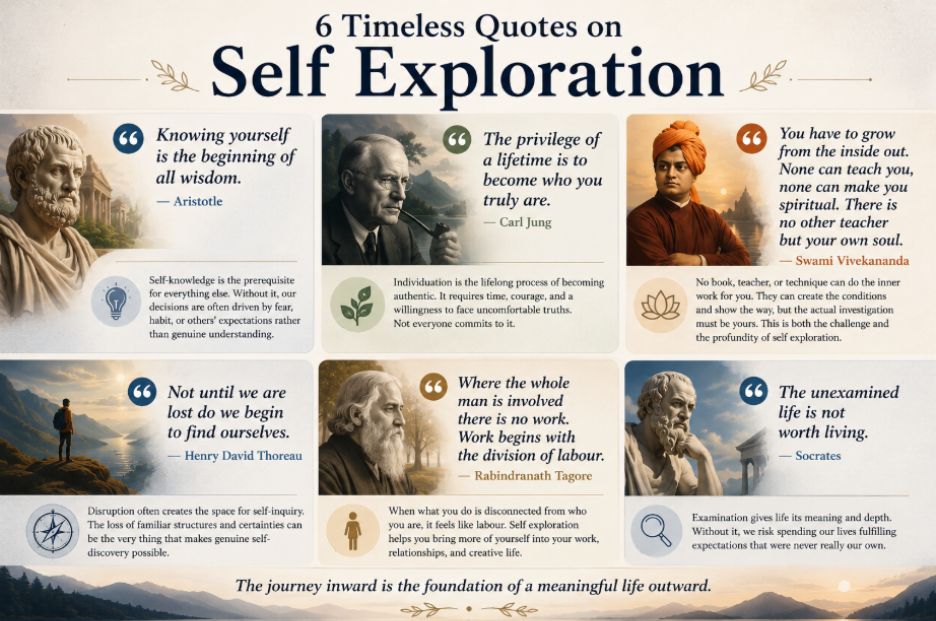
The process of self exploration has occupied thinkers, philosophers, and psychologists across centuries and cultures. The quotes below have been selected not simply for their elegance, but because each one tends to shift something when read slowly and honestly. Alongside each quote is a brief reflection on what it might mean in the context of a genuine self-exploration practice.
How to Begin Your Self-Exploration Journey: 5 Practical Tips
Beginning a self-exploration practice does not require a retreat, a therapist, or a dramatic life event. It requires a decision to take your inner life seriously, followed by a series of small, consistent actions. The tips below are drawn from clinical experience and are designed to be genuinely actionable for people with ordinary, busy lives.
- Focus on one question at a time: Depth tends to work considerably better than breadth in self-exploration. The temptation is to work through a long list of reflective questions quickly; the more productive approach is to sit with one question across multiple journalling sessions or conversations until something genuinely new surfaces. The most valuable insights typically arrive in the second or third week of sitting with the same question, not in the first reading.2
- Approach yourself with curiosity rather than judgement : The quality of your attention matters more than its frequency. Self-exploration conducted with harsh self-criticism tends to produce defensiveness and avoidance rather than genuine insight. The "beginner's mind" concept from Zen practice is useful here: approaching your own inner life as if you were encountering it for the first time, with openness and without expecting it to be a particular way.
- Start a journal and make it a daily habit: Even five minutes of free writing each day is a meaningful start. You do not need to write beautifully or coherently. The goal is simply to externalize your thoughts, which creates the necessary distance for reflection. Over weeks and months, patterns emerge in your writing that can be remarkably illuminating. Linking the journalling practice to an existing habit (morning tea, the commute home) helps it stick.
- Seek honest input from people you trust, and consider professional input too: The people who know us well often see patterns in us that we cannot see from inside our own perspective. Recurring observations across different relationships are particularly worth paying attention to. When you want a more structured, unbiased form of reflection, working with a counsellor or therapist provides something that close relationships cannot always offer: a professionally trained, emotionally safe, non-judgemental space for genuine self-exploration. If self-exploration surfaces difficult emotions or unresolved experiences, professional counselling support can help you go deeper safely
- Be patient with yourself, and with the process: Self-exploration is never linear. You will circle back to the same questions at different stages of life and find significantly different answers, which is exactly as it should be. Identity is not fixed; it continues to develop throughout adulthood. What feels like going in circles is often actually a spiral: returning to familiar territory but from a higher vantage point. Be patient when insights feel slow to arrive, and be gentle when what emerges is not what you hoped for.
A note on the self-exploration journey: Self-discovery is a lifelong process. By taking the first step to know yourself more honestly, you open the door to opportunities and insights that tend to accumulate and compound over time. There is rarely a moment of complete arrival: only the ongoing, often deeply meaningful practice of paying attention to your own inner life.
- Recommended Reading: Having An Existential Crisis? Here are 5 Ways to Solve It
A Final Thought
Self-exploration is, at its heart, an act of respect towards yourself. It is the decision to treat your inner life as something worth understanding rather than something to be managed, suppressed, or shaped entirely by external expectations.
It does not require dramatic life changes or hours of reflection each day. More often than not, it begins with simple questions, honest observation, and a willingness to stay curious about who you are and what truly matters to you. Over time, this practice can bring greater clarity, self-acceptance, and confidence in your choices.
The journey is rarely linear. You may uncover strengths you had overlooked, values you want to honour more fully, or patterns that no longer serve you. At times, you may also encounter emotions, memories, or questions that feel difficult to navigate on your own. This is a natural part of the process.
At 1to1help, our counsellors support individuals through exactly this kind of inner work, combining psychological expertise with a deep understanding of the realities that Indian professionals and families navigate every day.
Ready to begin your journey of self-discovery? Connect with a 1to1help counsellor through your Employee Assistance Programme (EAP) and take the next step towards greater self-awareness, clarity, and wellbeing.
FAQs
Q1. What is self-exploration?
Self-exploration is the deliberate, reflective process of investigating your inner world: your values, beliefs, emotions, thought patterns, motivations, strengths, and limitations, with the goal of developing greater self-knowledge and living more intentionally. In psychological terms, it is closely linked to metacognition: the ability to think about your own thinking and examine your inner experience with genuine curiosity and openness. Self exploration is not a single event but an ongoing practice that tends to deepen across a lifetime. It forms the foundation of personal growth, self-awareness, and emotional wellbeing. In Indian academic and philosophical traditions, self exploration is defined as the process of bridging who you currently are with who you truly want to be: a dialogue between your present self and your authentic aspirations.
Q2. What is self-exploration in human values?
In the context of human values education, widely taught in Indian universities and professional development programmes, self-exploration refers to the process of understanding what you are versus what you truly want to be. It is a framework for value clarification: identifying the values that feel naturally acceptable to you regardless of time, place, or cultural influence, and then validating them through lived experience. The process involves two components: natural acceptance (recognising what feels inherently right) and experiential validation (testing those values through real-life choices and their outcomes). Self-exploration in human values is ultimately about living in alignment with your core nature rather than simply responding to external expectations.
Q3. What is introspection, and how is it different from self exploration?
Introspection is the practice of examining your own thoughts, feelings, and mental states, looking inward to observe what is happening inside you right now. Self-exploration is a broader process that includes introspection as its starting point, but goes considerably further: it connects those internal observations to patterns, values, and meaning over time, and ultimately translates insight into action and growth. Think of introspection as the "what": what am I thinking and feeling right now? And self-exploration as the "why and what next": why do I think and feel this way, what does it mean, and how does it guide me towards a more authentic life? Both practices are valuable, and neither is complete without the other.
Q4. How do I start the process of self-exploration?
Begin with one simple reflective question rather than trying to understand everything at once. "What do I value most in life?" or "When do I feel most like myself?" are powerful starting points. Keep a journal and spend 5 to 10 minutes writing each day freely: externalising your thoughts creates distance from them and allows patterns to emerge over time. Practise sitting in solitude without distraction: a quiet morning, a solo walk, a brief meditation, to give your inner voice space to surface. Seek honest input from people who know you well and are willing to be truthful. If self-exploration brings up uncomfortable or unresolved emotions, working with a therapist or counsellor provides a structured, safe environment to go deeper. This is particularly valuable when past experiences or recurring patterns are involved.
Q5. Is self-exploration the same as self-awareness?
Self-awareness and self-exploration are closely related but distinct. Self-awareness is the capacity: the ability to observe yourself, your emotions, your behaviours, and their impact on others. Self-exploration is the active practice of using that capacity to investigate your inner world with depth and honesty. You can have some degree of self-awareness without engaging in deliberate self-exploration, and a sustained practice of self-exploration tends to deepen and expand your self-awareness over time. In psychological terms, self-awareness is the state; self-exploration is the ongoing practice that strengthens and develops that state. Both are foundational to emotional intelligence, personal growth, and sustained mental wellbeing.
References
- American Psychiatric Association. (2024). Rumination: A cycle of negative thinking. https://www.psychiatry.org/news-room/apa-blogs/rumination-a-cycle-of-negative-thinking
- BBC Bitesize. (n.d.). Self-reflection and self-awareness. https://www.bbc.co.uk/bitesize/articles/zw3246f
- Cleveland Clinic. (2022). Cognitive behavioral therapy (CBT). https://my.clevelandclinic.org/health/treatments/21208-cognitive-behavioral-therapy-cbt
- Kristin Neff. (n.d.). Self-compassion. https://self-compassion.org/
- Mindful. (n.d.). Everyday mindfulness with Jon Kabat-Zinn. https://www.mindful.org/everyday-mindfulness-with-jon-kabat-zinn/
- Nye, R. (n.d.). Self-exploration. In Psychology Lexicon. https://www.psychology-lexicon.com/cms/glossary/52-glossary-s/25564-self-exploration.html
- Peterson, C., & Seligman, M. E. P. (n.d.). VIA Character Strengths Survey. VIA Institute on Character. https://www.viacharacter.org/
- PositivePsychology.com. (n.d.). Self-exploration: Definition, benefits, and exercises. https://positivepsychology.com/self-exploration/
- Psych Central. (n.d.). Self-exploration: Getting to know thyself. https://psychcentral.com/blog/self-exploration-getting-to-know-thyself
- Psychology Today. (2025). The 4 types of visualization. https://www.psychologytoday.com/us/blog/the-big-reframe/202502/the-4-types-of-visualization
- Psychology Today. (2025). Why is metacognition so important for good thinking? https://www.psychologytoday.com/us/blog/thoughts-on-thinking/202504/why-is-metacognition-so-important-for-good-thinking
- ScienceDirect. (n.d.). Self-exploration. https://www.sciencedirect.com/topics/psychology/self-exploration
- ScienceDirect. (n.d.). Self-criticism. https://www.sciencedirect.com/topics/psychology/self-criticism
- Simply Psychology. (n.d.). Maslow's hierarchy of needs and self-actualization. https://www.simplypsychology.org/maslow.html
- Simply Psychology. (n.d.). Psychodynamic approach. https://www.simplypsychology.org/psychodynamic.html
- Stanford Encyclopedia of Philosophy. (n.d.). Self-knowledge. https://plato.stanford.edu/entries/self-knowledge/
- University College London. (2023). Narrative self and self-understanding [Research paper]. https://discovery.ucl.ac.uk/id/eprint/10164520/
- Zen Habits. (n.d.). A guide to mindfulness for beginners. https://zenhabits.net/beginner/
- Scribd. (n.d.). Self-exploration as the process for value education. https://www.scribd.com/doc/238922504/Self-Exploration-as-the-Process-for-Value-Education


.svg)
.svg)
.svg)
.svg)