

.png)


.png)

Personal Growth & Well Being
The Power of Positive Thinking: Benefits, Quotes, and How to Cultivate a Positive Mindset

.png)
Written by
Aarohi Parakh,
Psychologist and Content Writer

Reviewed by
Sanjana Sivaram,
Psychologist and Clinical Content Head


Introduction
Have you ever noticed how two people can face the same difficult situation and walk away with very different interpretations of it?
One person might think, "This always happens to me. I am just not good at this."
Another might think, "This did not go as planned. What can I learn from it?"
The situation has not necessarily changed. The way it is being interpreted has.
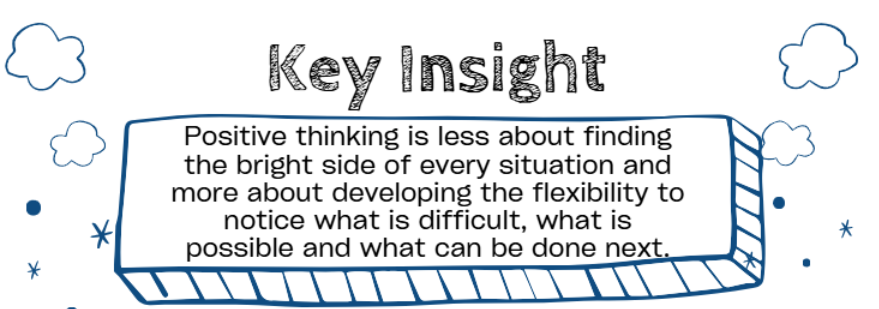
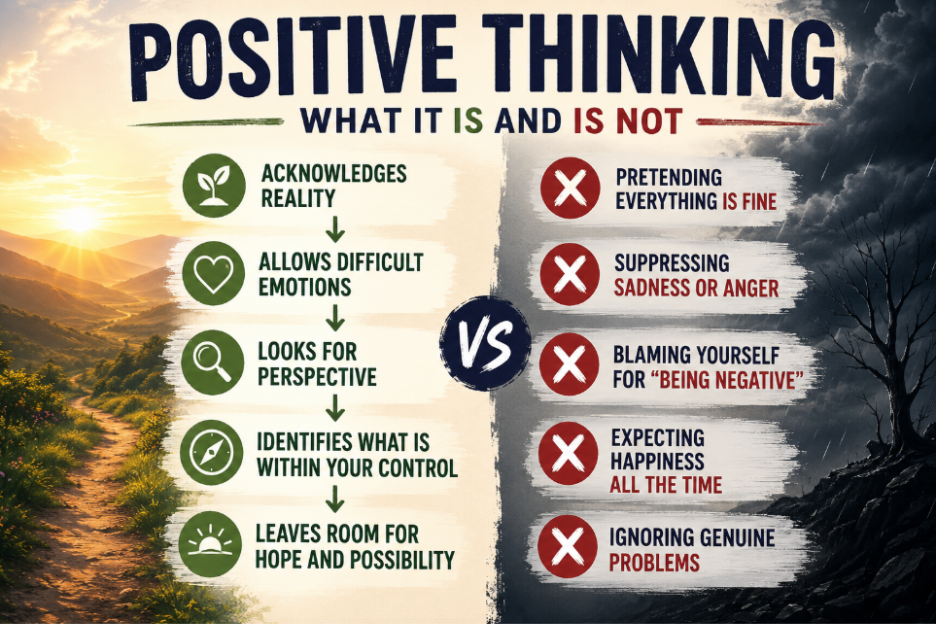
That is where the power of positive thinking comes in. Positive thinking does not mean pretending that everything is fine, forcing yourself to feel happy or ignoring difficult emotions. Rather, it can involve learning to approach situations with greater flexibility, hope and perspective, particularly when things do not go according to plan.
Importantly, positive thinking is not the same as toxic positivity. Telling someone to "just stay positive" while they are grieving, overwhelmed or struggling can feel dismissive. A healthier positive mindset can make room for sadness, anger, disappointment and uncertainty while still leaving space for the possibility that things can change.
In this guide, we explore the science and benefits of positive thinking, what a positive attitude really means, common negative thought patterns, practical positive thinking examples and some inspiring positive thinking quotes to carry with you.
What Is Positive Thinking? Definition, Science, and What It Is NOT
Positive thinking is the practice of approaching thoughts, experiences, and challenges with a constructive, hopeful perspective while still acknowledging reality and difficult emotions. It does not mean replacing every negative thought with a positive one or ignoring feelings that may be difficult or uncomfortable.
It is sometimes confused with optimism, positive affirmations, or simply "looking on the bright side". While these can form part of a positive mindset, positive thinking can be more nuanced.
The field of positive psychology, particularly associated with psychologist Martin Seligman, has explored qualities such as optimism, resilience, wellbeing, and human strengths. Seligman's work on learned optimism suggests that people can develop more balanced and flexible ways of interpreting setbacks, while still recognising what went wrong and what may need to change.
For example:
- "I failed this presentation because I am terrible at public speaking" can feel permanent and personal.
- "That presentation did not go well, but I can identify what I need to practise" leaves room for change.
The second interpretation does not deny the setback. It simply treats it as information rather than a verdict on the person's identity.
Research by psychologist Barbara Fredrickson offers another useful perspective. Her broaden-and-build theory proposes that positive emotions such as joy, interest, contentment and love can broaden the range of thoughts and actions available to us. Over time, these experiences may help build psychological, social and intellectual resources.
This does not mean that people should try to feel positive all the time.
In fact, that can become toxic positivity, where genuine emotions such as grief, anger or fear are dismissed in the name of maintaining a positive attitude. Healthy positive thinking is more compatible with emotional honesty.
This distinction can be particularly relevant in high-pressure Indian academic and workplace environments. When someone is expected to "stay strong", "not complain" or "look at the positive side", they may sometimes need the opposite: permission to acknowledge that something is genuinely difficult.
A positive mindset can then begin with a more realistic thought:
"This is hard, and I may not know what happens next. But I can think about what I need right now and what I can do from here."
That is a very different idea from simply forcing yourself to be cheerful.
10 Benefits of Positive Thinking: What the Science Actually Shows
The benefits of positive thinking are often presented as though optimism is a cure-all. The evidence is more nuanced than that.
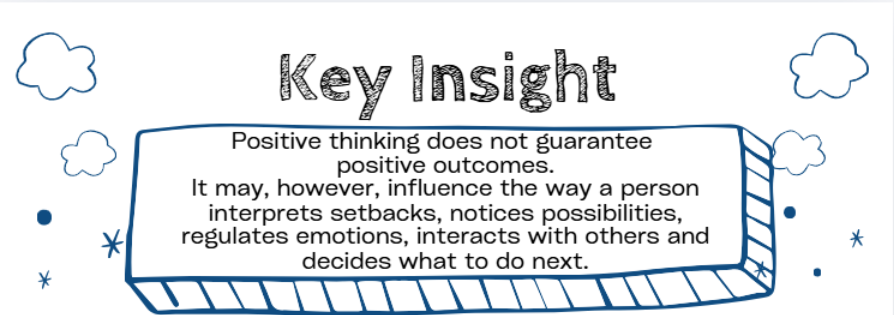
Research does suggest that optimism and positive emotional states are associated with several aspects of psychological and physical wellbeing. However, associations do not necessarily mean that positive thinking alone causes these outcomes. Genetics, socioeconomic circumstances, relationships, health behaviours and access to support can also play important roles.
With that caveat, here are ten areas where positive thinking may be helpful.
1. Improved Mood and Happiness
Positive thinking may contribute to a more positive emotional experience by helping people notice opportunities, supportive relationships and experiences of pleasure that can otherwise get overlooked.
Fredrickson's broaden-and-build theory suggests that positive emotions can widen attention and thought-action possibilities. Instead of becoming completely absorbed in a problem, a person experiencing a positive emotion may be better able to notice alternatives, connect with others, or explore a new approach.
This can create what researchers have described as an upward spiral, where positive emotional experiences support behaviours and resources that make future wellbeing more likely.
It does not mean that someone should feel happy during every difficult moment. Rather, small experiences of appreciation, connection, humour or hope may provide psychological breathing space.
2. Better Physical Health
Optimism has been associated with several health outcomes, although it would be inaccurate to say that positive thinking directly prevents illness.
A large prospective study from the Nurses' Health Study followed 70,021 women and found that higher dispositional optimism was associated with lower mortality risk after accounting for a range of factors. The researchers also considered health behaviours and health conditions, which suggests that behaviour may partly explain the relationship.
This makes intuitive sense in everyday life. Someone who feels hopeful about the future may be more inclined to engage in behaviours such as regular exercise, attending health check-ups, maintaining social connections, or persisting with healthy routines. These behaviours may be associated with greater hope, although the relationship is not necessarily causal and may also be influenced by other factors.
The important takeaway is not that thinking positively can replace medical care. It is that psychological outlook may form one part of a much larger picture of health.
3. Increased Longevity
One of the most widely discussed studies in positive psychology is the University of Kentucky "nun study". Researchers analysed autobiographies written by 180 Catholic nuns when they were young adults and examined their emotional content in relation to later survival. Greater positive emotional expression in the autobiographies was associated with lower mortality risk later in life.
The study is fascinating, but it should not be interpreted as proof that positive thinking adds a fixed number of years to a person's life. The relationship between psychological wellbeing and longevity is complex.
What it does suggest is that emotional wellbeing may be relevant to health across the lifespan.
4. Better Relationships
Our emotional states can influence the people around us. When someone approaches a conversation with warmth, curiosity and generosity, the interaction may become easier and more reciprocal. Positive emotions can also encourage people to engage socially, which may strengthen relationships over time.
Research on emotional contagion suggests that emotions can spread between people, meaning that the mood brought into an interaction can sometimes influence the emotional climate around it.
This can be especially relevant at work. A manager who responds to mistakes with curiosity rather than humiliation may create a very different environment from one who reacts with criticism.
A positive attitude does not mean avoiding accountability. It may simply change how accountability is communicated.
5. Greater Success and Achievement
Positive thinking can be useful when it supports persistence rather than unrealistic expectations.
This connects with the idea of a growth mindset, associated with psychologist Carol Dweck. A growth-oriented perspective treats abilities as capable of development through learning, effort, and appropriate strategies.
Research has found that people with stronger growth-mindset beliefs can respond to mistakes in more adaptive ways, although the wider growth-mindset evidence is more mixed than popular summaries sometimes suggest.
For a student preparing for an entrance examination or a professional navigating a difficult appraisal, the useful shift may be from:
"I am not good enough."
to:
"What does this feedback tell me about what I need to work on?"
That shift can make continued effort feel more possible.
6. Less Stress and Greater Emotional Resilience
Optimism does not necessarily remove stressful events. Deadlines, financial worries, family conflict, and workplace pressure can still happen.
What may change is how a person appraises and responds to them. Someone who believes that a difficult period is temporary may be more likely to look for coping strategies rather than assuming the situation will remain permanently overwhelming.
Positive emotions may also broaden attention, giving people access to a wider range of possible responses when they are not completely consumed by threat.
This is one reason positive thinking can be understood as a resilience-building practice rather than a mood-management technique. However, resilience is shaped by a range of factors, including circumstances, social support, coping resources and the nature of the stressor. Struggling during a difficult period does not mean that someone is "not positive enough".
7. Improved Confidence and Self-Efficacy
Positive thinking can also influence how capable people believe themselves to be.
Psychologist Albert Bandura's concept of self-efficacy refers to a person's belief in their ability to organise and carry out actions needed to manage particular situations.
This is subtly different from simply thinking, "I am amazing."
A more useful form of positive self-talk might be:
"I have handled difficult sales review meetings before. I can prepare for this one too."
The statement is grounded in evidence from past experience. It is therefore more likely to feel believable than an exaggerated affirmation.
Over time, noticing small instances of competence can provide a stronger foundation for confidence.
8. Better Problem-Solving
A positive emotional state may sometimes help people approach problems with greater flexibility.
Research by Alice Isen and colleagues found that positive affect improved performance on certain creative problem-solving tasks. This fits with Fredrickson's broader theory that positive emotions can expand the range of thoughts and actions that come to mind.
Imagine being stuck on a project. If the internal narrative becomes, "There is no solution", attention may narrow around the problem.
A more flexible thought could be:
"The obvious approach has not worked. What else could I try?"
The problem remains. The thinking space has changed.
9. Increased Creativity
Creativity tends to benefit from psychological flexibility, curiosity, and the willingness to explore alternatives.
Studies have found relationships between positive emotional states and creative performance, including insight-based problem-solving.
This can have practical relevance beyond artists and writers. Creativity is involved in product development, teaching, leadership, entrepreneurship, parenting and everyday problem-solving.
A team that feels psychologically safe to suggest an unusual idea may generate possibilities that a highly critical environment would shut down early.
10. More Balanced Decision-Making
Positive thinking may also influence decision-making, but more positivity is not necessarily better.
Some research suggests that positive affect can support flexibility and efficiency in certain decision-making contexts. At the same time, decisions require attention to risk, evidence, and uncertainty.
The goal, therefore, may be calibrated optimism rather than blind optimism.
A balanced decision might sound like:
"There are risks here. Let me understand them properly, while also considering what could go well."
That is often more useful than either extreme: assuming everything will work out or assuming everything will go wrong.
What Is a Positive Attitude? And How Is It Different from Positive Thinking?
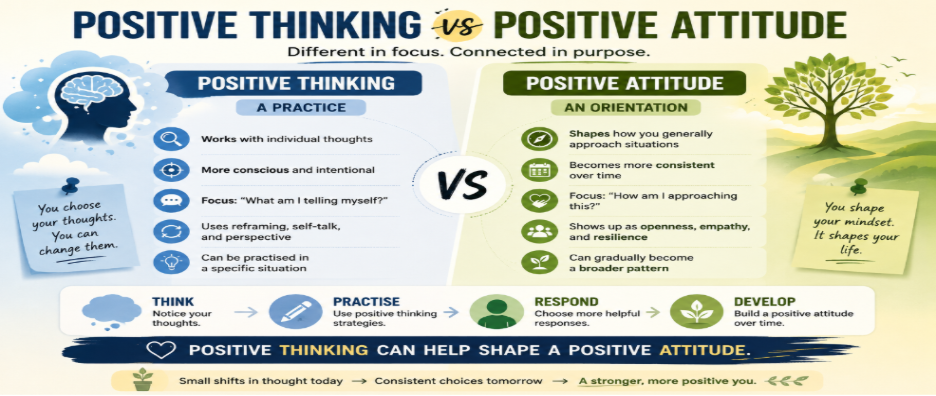
A positive attitude can be understood as a broader tendency to approach life, people, and situations with openness, constructive intent, and a degree of optimism.
Positive thinking is more specific. It involves actively noticing and working with thoughts and interpretations.
One way to remember the difference is:
Positive thinking is the practice.
A positive attitude is the broader orientation that may develop through repeated practice.
For example, consider someone receiving difficult feedback at work.
Positive thinking might involve consciously challenging the initial thought, "My manager thinks I am incompetent", and replacing it with, "I do not know exactly what my manager thinks. I can look at the feedback and decide what is useful."
A positive attitude might show up more broadly in what happens next: listening without immediately becoming defensive, taking responsibility where appropriate and remaining open to improvement.
Can a positive attitude change?
It can. Personality and circumstances certainly influence how people respond, but patterns of thinking and behaviour can also be learned and practised.
The aim does not need to be becoming "the most positive person in the room". A more realistic goal may be becoming slightly more flexible in how you interpret situations.
Identifying Negative Thought Patterns: 6 Cognitive Distortions That Can Undermine Positivity
Everyone experiences unhelpful thoughts from time to time. The problem is usually not having one negative thought. It becomes harder when a particular thinking pattern repeats so often that it starts to feel like fact.
In cognitive behavioural therapy, these patterns are often described as cognitive distortions.
1. All-or-Nothing Thinking
This involves seeing situations in extremes, with little room for the grey zone.
"I either get this promotion or I have failed."
"I ate badly today, so my entire health routine is pointless."
A useful reframing exercise is to replace the binary judgement with a spectrum.
Ask:
"If 0 is the worst possible outcome and 10 is the best, where would I honestly place this?"
Completing 70% of a planned task might be a 7/10 rather than a failure.
The goal is not to inflate the score. It is to create enough space for a more accurate assessment.
2. Jumping to Conclusions
This can involve mind reading, where we assume we know what another person is thinking, or fortune telling, where we predict what will happen without sufficient evidence.
For example:
"My colleague did not reply. They must be annoyed with me."
"I have been shortlisted, but I will probably fail the interview."
Try an evidence check:
What evidence supports this thought?
What evidence does not support it?
What else could be happening?
This can be particularly useful when anxiety is filling in the gaps.
3. Catastrophising
Catastrophising involves imagining that the worst possible outcome is likely to happen, sometimes escalating from a relatively manageable problem to a life-changing disaster.
A missed deadline becomes, "My manager will lose trust in me, I will lose my job and my career will be over."
The concern may be real. The chain of predictions is where the thinking can become distorted.
Try decatastrophising:
- What is the worst realistic outcome?
- What is the best realistic outcome?
- What is the most likely outcome?
- If the difficult outcome happened, what could I do about it?
For students and professionals working in high-pressure environments, this exercise can be particularly useful because performance can sometimes become closely linked to identity.
If catastrophising is frequent, intense or interfering with daily life, professional counselling may provide a more structured way of understanding the pattern.
4. Labelling
Labelling turns a behaviour into an identity.
"I made a mistake" becomes "I am stupid."
"I struggled with this task" becomes "I am incompetent."
The difference may seem small, but the second statement leaves much less room for change.
Try separating behaviour from identity:
Instead of: "I am terrible at this."
Try: "I am finding this difficult right now."
This is also consistent with the broader idea behind a growth mindset. A difficulty can become something to work on rather than a fixed description of who someone is.
5. Personalisation
Personalisation involves taking excessive responsibility for something that has several contributing factors.
For example:
"My team missed the target. It is completely my fault."
A more balanced interpretation might be:
"I had a role in the outcome, and there were also factors that were outside my control."
This can be especially relevant for managers who feel responsible for every outcome within their team.
Responsibility can be healthy. Excessive responsibility can become exhausting.
6. Mental Filtering
Mental filtering happens when attention becomes heavily focused on one negative element while positive or neutral information is overlooked.
Imagine receiving nine positive comments and one critical comment after a presentation. If the critical comment occupies your thoughts for the rest of the day, mental filtering may be at play.
One simple practice is to deliberately record three things that went reasonably well before reviewing what did not.
This is not about pretending the criticism does not matter. It is about making sure the criticism does not become the only thing that matters.
How to Think Positively: 7 Practical Strategies
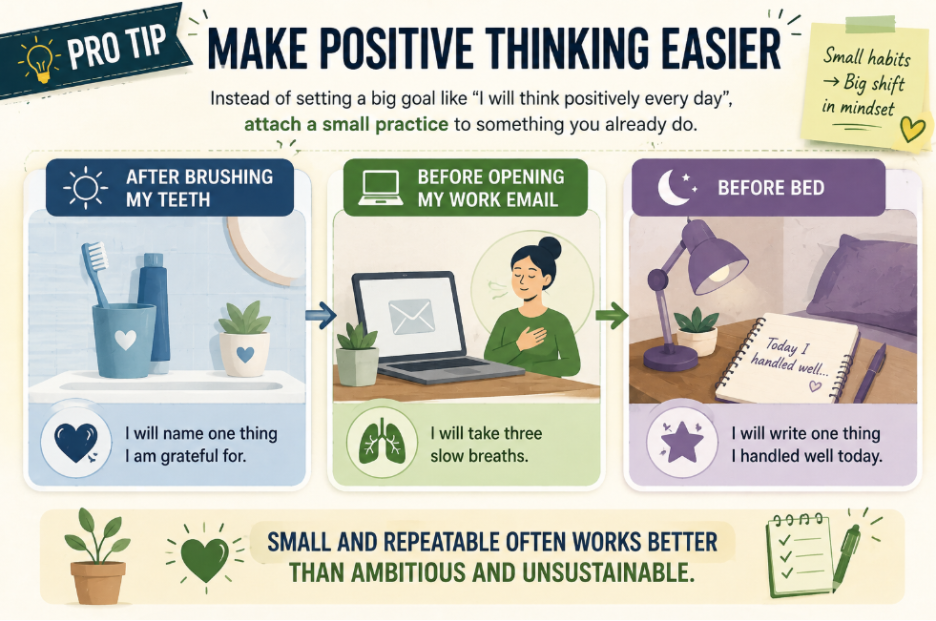
Positive thinking is unlikely to become a habit simply because someone decides to "be more positive". It tends to develop through repeated, small practices.
1. Practise Gratitude, Not Forced Positivity
Gratitude can help shift attention towards what is going well without requiring a person to deny what is difficult. It is not meant to cancel out difficult emotions. Someone can appreciate what they have and still feel angry, sad, disappointed or overwhelmed.
One widely used exercise is the Three Good Things practice. At the end of the day, write down three things that went well and briefly note why they happened.
They do not have to be extraordinary.
"Had a good cup of chai."
"Finished the report."
"Had a meaningful conversation with Mum."
The value may come from deliberately noticing experiences that would otherwise pass unnoticed.
For more practical exercises, readers can explore 1to1help's guide to positive thinking techniques.
2. Challenge Negative Thoughts
When a negative thought appears, try not to argue with it immediately.
First, identify it.
Then ask:
What is the evidence?
Am I assuming something I cannot know?
Is there another reasonable interpretation?
What would I say to someone I care about in the same situation?
This process is often referred to as cognitive reframing.
For example:
Automatic thought: "I completely messed up."
Balanced thought: "The meeting did not go as I hoped. There were some things I handled well and some things I could improve."
3. Practise Positive Self-Talk
The way people speak to themselves can influence how they approach stressful situations.
Instead of:
"I cannot do this."
Try:
"This feels difficult, but I can take it one step at a time."
Interestingly, research by Ethan Kross and colleagues found that using one's own name or non-first-person language during self-talk can support self-distancing and, in certain stressful situations, improve performance and reduce distress.
So before a difficult presentation, someone might say:
"Aayushi, you have prepared for this. Take one question at a time."
rather than:
"I am going to panic."
It may feel slightly unusual at first, but the psychological distance can be useful.
4. Surround Yourself with Positive People
Positive thinking is not purely an individual exercise. The people around us can influence emotional states, expectations and even the way we interpret everyday events.
This does not mean cutting out everyone who is struggling or insisting that friends remain cheerful. Rather, notice which relationships tend to leave you feeling supported, understood and energised, and which repeatedly leave you feeling diminished.
In Indian families and workplaces, relationships can be particularly layered. A relative may be deeply caring while also being highly critical. A manager may be demanding while still being supportive.
Instead of categorising people as "positive" or "negative", it may be more helpful to ask:
"How do I feel and behave when I am around this person?"
5. Develop Cognitive Flexibility
A positive mindset becomes easier when you treat thoughts as mental events rather than unquestionable facts.
Mindfulness can help by creating a small pause between noticing a thought and acting on it.
Try the STOP technique:
S: Stop what you are doing.
T: Take a breath.
O: Observe your thoughts, emotions and body sensations.
P: Proceed with the next intentional action.
This can take less than a minute.
At work, it might mean pausing before replying to a frustrating email. At home, it might mean taking a breath before responding to an argument.
6. Practise Self-Compassion
Positive thinking can become exhausting when it turns into another standard you are failing to meet. Self-compassion offers a gentler alternative.
Psychologist Kristin Neff's model includes self-kindness, common humanity and mindfulness. In simple terms, this means noticing that something hurts, recognising that struggle is part of being human and responding to yourself with care rather than harsh judgement.
Try asking:
"If a close friend were going through exactly this, what would I say to them?"
Then consider saying something similar to yourself.
7. Create a Positivity-Friendly Environment
Your environment can influence what you repeatedly notice. Consider your information diet. How much time is spent scrolling through distressing news, comparison-heavy social media or workplace messages after hours?
Small environmental cues can also help.
A meaningful photograph, a calming phone wallpaper, a short morning walk, music that lifts your mood, or five minutes of sunlight can become reminders to pause and reconnect.
The aim is not to create a permanently cheerful environment. It is to make supportive cues easier to access when life becomes demanding.
Positive Thinking Examples: What It Looks Like in Real Life
Positive thinking can sound abstract until it appears in ordinary situations.
Example1: Overcoming Obstacles
J.K. Rowling's early publishing journey involved multiple rejections before Harry Potter was published. Similarly, India's space programme has seen failures alongside significant achievements.
The lesson is not that every setback leads to success, but that setbacks can become opportunities to learn and adapt.
Instead of: "This did not work, so I have failed."
Try: "This did not work. What can I learn for the next attempt?"
Example 2: Improving Health
Missing one workout does not have to mean abandoning a health goal altogether.
Instead of: "I have ruined my entire health plan."
Try: "I missed today. I can return to my routine tomorrow."
A positive mindset can help keep the next healthy action within reach.
Example 3: Responding to Feedback
After receiving critical feedback at work, it can be tempting to interpret it as a judgement of one's ability.
Instead of: "My manager thinks I am not good enough."
Try: "There is feedback here that I can understand and act on."
The aim is to treat feedback as information rather than a verdict on identity.
Example 4: Academic and Workplace Pressure
For Indian students and professionals, exams, appraisals, promotions and competition can sometimes trigger all-or-nothing thinking.
Instead of: "If I do not clear this, I am a failure."
Try: "This result matters, but it is one outcome in a much longer journey."
Similarly, a disappointing appraisal could become an opportunity to understand what needs to change rather than proof of professional inadequacy.
Example 5: Building Relationships
Positive thinking can also show up in small interactions.
Instead of assuming, "They don't care", someone might ask, "Is there something I may not be understanding?"
Instead of focusing only on what went wrong, they might notice and acknowledge what the other person did well.
The common thread: Positive thinking does not change the situation itself. It can change the perspective from which the situation is approached.
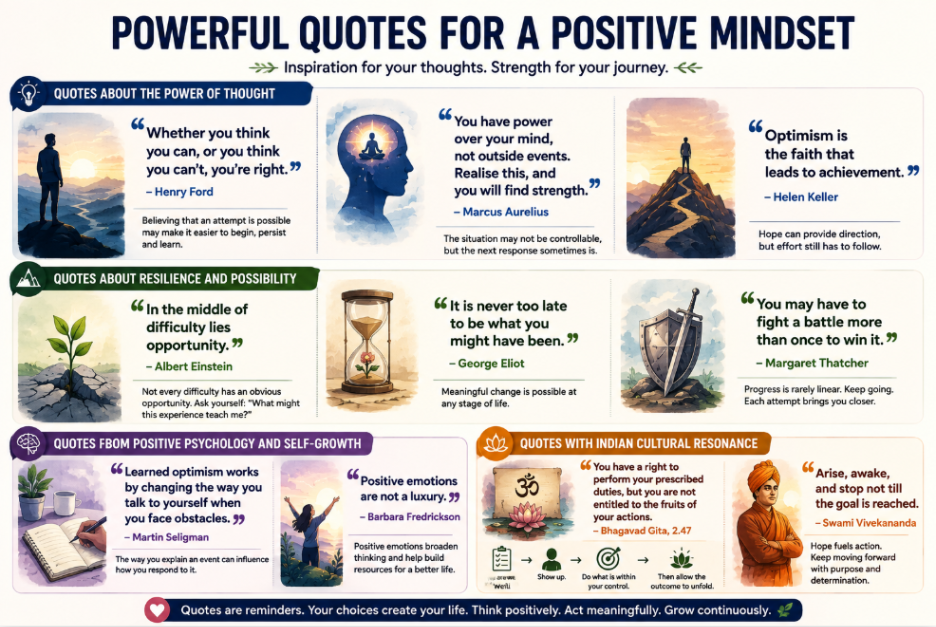
Positive Thinking Quotes to Inspire Your Mindset
Sometimes a short sentence can become a useful mental anchor.
The most meaningful positive thinking quotes aren't necessarily the ones that promise everything will work out. The better ones can remind us of perspective, agency and resilience.
One More Thought to Carry Forward
Positive thinking quotes work best when they become more than something saved on a Pinterest board or shared on Instagram.
A useful quote can become a mental anchor.
When a familiar negative thought appears, recalling a sentence that represents a more balanced perspective can create a small interruption in the thought spiral.
That interruption may be enough to ask:
"What would I like to do next?"
Toxic Positivity: When "Think Positive" Becomes Harmful
There is an important difference between positive thinking and toxic positivity.
Toxic positivity refers to the pressure to maintain a positive outlook regardless of what is happening, often by dismissing genuine emotions or difficult experiences.
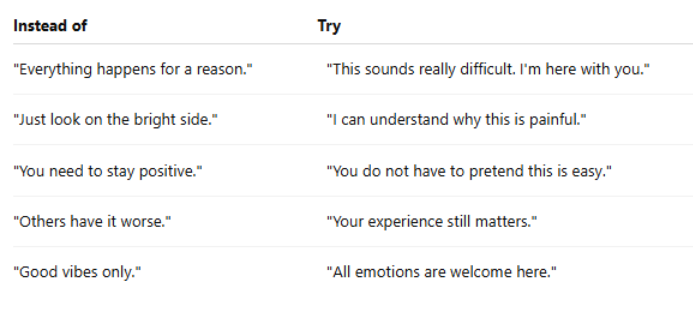
It can sound like:
"Everything happens for a reason."
"Just be grateful."
"Look on the bright side."
"Others have it worse."
"Good vibes only."
These statements may sometimes be well-intentioned. However, when someone is experiencing grief, anxiety, disappointment or anger, they can communicate that difficult emotions are unwelcome.
A more emotionally supportive response might be:
Authentic positive thinking can hold two ideas at the same time:
"This is difficult."
and
"I can still look for what may help."
That distinction matters.
In Indian families and workplaces, phrases such as "do not complain", "be grateful for what you have" or "stay strong" can sometimes come from genuine care. Yet if they leave someone feeling unable to talk about distress, they may unintentionally discourage emotional processing or help-seeking.
A psychologically healthier approach might be to make room for the whole experience.
If someone has lost a job, they may feel frightened and still hope to find another one.
If someone has failed an examination, they may feel devastated and still begin planning their next step.
If someone is grieving, they do not need to find a positive lesson immediately.
Positive thinking is not the absence of pain. It is the possibility of finding perspective while pain is present.
If persistent negative thinking feels difficult to shift alone, confidential professional support at 1to1Online Counselling can provide space to understand the underlying patterns rather than simply trying to replace every negative thought with a positive one.
The Bottom Line: Positive Thinking Is About Perspective, Not Pretending
Positive thinking does not mean expecting everything to work out or feeling happy all the time. It can simply mean learning to approach difficult experiences with a little more flexibility, perspective, and hope.
Instead of asking, "How can I stay positive?", it may be more helpful to ask:
"Given what I am experiencing, what is the most helpful way I can think, respond, and move forward?"
Small shifts in perspective can gradually shape a more positive mindset. And if persistent negative thinking or emotional challenges begin affecting everyday wellbeing, seeking support can be a meaningful step.
Need a little support? Through the 1to1help Employee Assistance Programme (EAP), employees can access confidential counselling and mental health support to help navigate stress, emotional challenges, relationships and other personal or workplace concerns. Sometimes, you do not have to figure everything out on your own.
FAQs
Q1. What are the main benefits of positive thinking?
Positive thinking may support better mood, resilience, relationships, problem-solving and confidence. Research also links optimism with healthier behaviours and some physical health outcomes. However, positive thinking is only one factor in overall wellbeing and does not guarantee positive outcomes.
Q2. What is toxic positivity and why is it harmful?
Toxic positivity involves dismissing difficult emotions with messages such as "just be positive" or "look on the bright side". It can make people feel that sadness, anger or grief are unacceptable. Healthy positive thinking acknowledges difficult emotions while still making space for hope and possibility.
Q3. What are some positive thinking examples in daily life?
Positive thinking might mean viewing a mistake as something to learn from rather than proof of failure, treating feedback as useful information, or reminding yourself that one difficult experience does not define your future. It can also involve noticing small things that went well each day.
Q4. How is positive thinking different from a positive attitude?
Positive thinking is the active practice of examining and reframing thoughts. A positive attitude is a broader way of approaching people and situations with openness, resilience and constructive intent. Over time, consistent positive thinking may contribute to developing a more positive attitude.
Q5. Can positive thinking improve mental health?
Positive thinking practices may support emotional wellbeing and resilience, particularly when combined with self-compassion, mindfulness and healthy coping strategies. However, they are not a substitute for professional support. If persistent negative thinking, anxiety or low mood is affecting everyday life, speaking with a qualified mental health professional may help.
References
- Bandura, A. (1977). Self-efficacy: Toward a unifying theory of behavioural change. Psychological Review, 84(2), 191–215. https://doi.org/10.1037/0033-295X.84.2.191
- Burns, A. B., Brown, J. S., Sachs-Ericsson, N., Plant, E. A., Curtis, J. T., Fredrickson, B. L., & Joiner, T. E. (2008). Upward spirals of positive emotion and coping: Replication, extension, and initial exploration of neurochemical substrates. Personality and Individual Differences, 44(2), 360–370. https://doi.org/10.1016/j.paid.2007.08.015
- Conversano, C., Rotondo, A., Lensi, E., Della Vista, O., Arpone, F., & Reda, M. A. (2010). Optimism and its impact on mental and physical well-being. Clinical Practice & Epidemiology in Mental Health, 6, 25–29. https://doi.org/10.2174/1745017901006010025
- Danner, D. D., Snowdon, D. A., & Friesen, W. V. (2001). Positive emotions in early life and longevity: Findings from the nun study. Journal of Personality and Social Psychology, 80(5), 804–813. https://pubmed.ncbi.nlm.nih.gov/11374751/
- Dweck, C. S. (2006). Mindset: The new psychology of success. Random House. Mindset: The New Psychology of Success
- Fredrickson, B. L. (2001). The role of positive emotions in positive psychology: The broaden-and-build theory of positive emotions. American Psychologist, 56(3), 218–226. https://doi.org/10.1037/0003-066X.56.3.218
- Fredrickson, B. L. (2004). The broaden-and-build theory of positive emotions. Philosophical Transactions of the Royal Society B: Biological Sciences, 359(1449), 1367–1378. https://doi.org/10.1098/rstb.2004.1512
- Fredrickson, B. L., & Joiner, T. (2002). Positive emotions trigger upward spirals toward emotional well-being. Psychological Science, 13(2), 172–175. https://doi.org/10.1111/1467-9280.00431
- Isen, A. M., Daubman, K. A., & Nowicki, G. P. (1987). Positive affect facilitates creative problem solving. Journal of Personality and Social Psychology, 52(6), 1122–1131. https://doi.org/10.1037/0022-3514.52.6.1122
- Kim, E. S., Hagan, K. A., Grodstein, F., DeMeo, D. L., De Vivo, I., & Kubzansky, L. D. (2017). Optimism and cause-specific mortality: A prospective cohort study. American Journal of Epidemiology, 185(1), 21–29. https://doi.org/10.1093/aje/kww182
- Kross, E., Bruehlman-Senecal, E., Park, J., Burson, A., Dougherty, A., Shablack, H., Bremner, R., Moser, J., & Ayduk, O. (2014). Self-talk as a regulatory mechanism: How you do it matters. Journal of Personality and Social Psychology, 106(2), 304–324. https://doi.org/10.1037/a0035173
- Neff, K. D. (2003). Self-compassion: An alternative conceptualisation of a healthy attitude toward oneself. Self and Identity, 2(2), 85–101. https://doi.org/10.1080/15298860309032
- Neff, K. D., Kirkpatrick, K. L., & Rude, S. S. (2007). Self-compassion and adaptive psychological functioning. Journal of Research in Personality, 41(1), 139–154. https://doi.org/10.1016/j.jrp.2006.03.004
- Purol, M. F. (2021). Optimism: Enduring resource or miscalibrated perception? Social and Personality Psychology Compass, 15(5), e12593. https://doi.org/10.1111/spc3.12593
- Seligman, M. E. P., Steen, T. A., Park, N., & Peterson, C. (2005). Positive psychology progress: Empirical validation of interventions. American Psychologist, 60(5), 410–421. https://doi.org/10.1037/0003-066X.60.5.410
- Mayo Clinic Staff. (2023, November 21). Positive thinking: Stop negative self-talk to reduce stress. Mayo Clinic. Mayo Clinic
- American Psychological Association. (2018). Learned optimism. APA Dictionary of Psychology. APA Dictionary of Psychology: Learned optimism
- Cleveland Clinic. (n.d.). Cognitive behavioural therapy (CBT): What it is and what it treats. Cleveland Clinic
- Harvard Health Publishing. (2022, May 4). How to recognize and tame your cognitive distortions. Harvard Medical School. Harvard Health Publishing
- Greater Good in Action. (n.d.). Three Good Things. University of California, Berkeley, Greater Good Science Center. Three Good Things


.svg)
.svg)
.svg)
.svg)