

.png)


.png)

Mental Health Concerns
Employee Counselling: Meaning, Types, Process, Benefits and Importance in HRM (2026)

.png)
Written by
Aarohi Parakh,
Psychologist and Content Writer

Reviewed by
Sanjana Sivaram,
Psychologist and Clinical Content Head


Introduction
Kavya is a high-performing finance manager at a Hyderabad-based tech firm. Three months ago she returned from maternity leave. Since then, she has been arriving late, missing deadlines she would once have treated as non-negotiable, and declining every team lunch invitation. Her manager, Rohan, assumes she is adjusting to motherhood. HR has no record of any concern. Nobody has spoken to Kavya directly. Six weeks later, she submits her resignation.
When Rohan finally asks her why, she says something that stays with him: "I just needed someone to talk to. I did not think this was a place where that was possible."
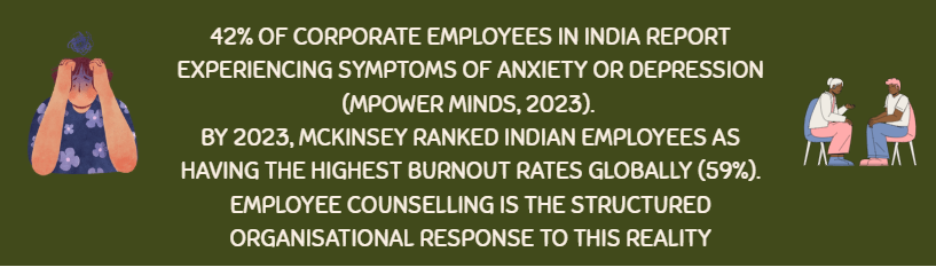
This guide exists for managers like Rohan and HR teams to help change this narrative. It is a comprehensive reference on employee counselling covering its meaning, types, process, benefits, and importance in Human Resource Management (HRM), written specifically for the Indian workplace context, where the stakes of getting this right have never been higher.
What Is Employee Counselling? (Meaning and Definition)
Definition
Employee counselling is a confidential, structured discussion between a trained counsellor and an employee, aimed at helping the employee understand, address, and resolve personal, emotional, or work-related problems that are affecting their job performance or overall well-being.

It is worth being precise about what employee counselling is and is not. This distinction matters greatly in India, where employees can confuse counselling with disciplinary action and may avoid it for that very reason.
- It is NOT a disciplinary action or performance warning
- It is NOT performance management in disguise
- It is NOT an informal chat with a sympathetic manager
- It is a structured, professional interaction with a specific purpose: supporting employee wellbeing and, through that support, enabling better functioning at work
Though counselling in the context of employment differs from counselling in a therapeutic setting, what is common to both is a strong relationship between the client and the counsellor, developed and expressed by the counsellor through attitudes of genuineness, acceptance, and empathy.
Employee counselling also known as employee counseling in HRM operates across three levels: individual (addressing a specific employee's challenge), team (resolving interpersonal dynamics), and organisational (responding to systemic stressors such as restructuring or layoffs). In India, it is increasingly formalised through Employee Assistance Programmes (EAPs) and is gaining traction under the psychosocial safety obligations of the Occupational Safety Health and Working Conditions (OSHWC) Code 2020.
Employee Counselling vs Coaching vs Mentoring: What Is the Difference?
HR professionals are frequently asked to distinguish between these three. The comparison table below is the clearest way to do it:
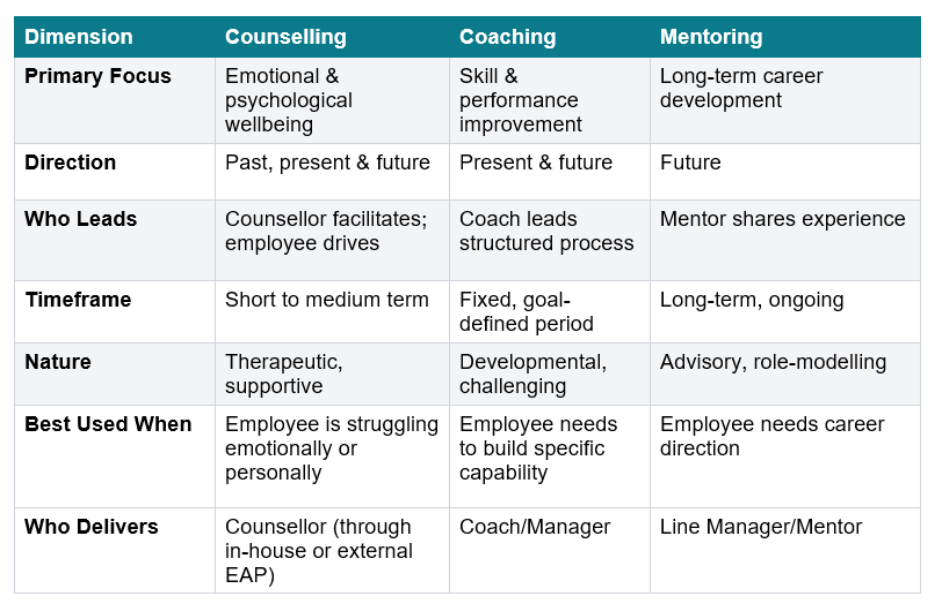
For a deeper dive into the counsellor's step-by-step workflow, see our companion guide on the complete process of employee counselling.
💡Pro-tip: In the Indian workplace, the biggest risk is that counselling gets merged with discipline in the employee's mind. The first communication about any counselling session should explicitly state: this is a confidential support conversation, not a performance review. That single line changes the employee's entire posture going into the session.
Need and Objectives of Employee Counselling
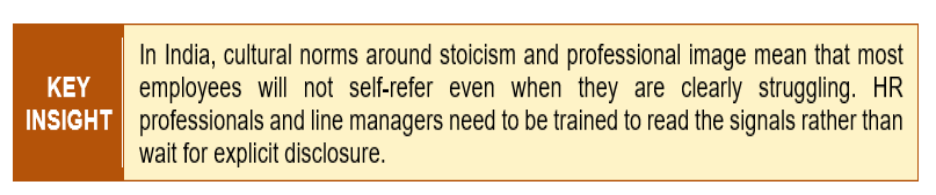
Modern Indian workplaces face significant psychological pressure. Reports suggest that over 60% of Indian employees experience work-related stress, with more than half reporting high stress levels in corporate settings.
Additionally, a survey by CII and MediBuddy found that around 62% of employees reported stress and burnout, highlighting the growing mental health burden in Indian organisations.
Mental health support is thus now one of the top demands from employees. Despite this growing need, access to structured support remains limited. Only about 1 in 10 employees have access to Employee Assistance Programmes (EAPs), and as few as 0.09% of companies in India have formally implemented EAPs.
This gap between high psychological distress and low access to support systems highlights why employee counselling is no longer optional, it is a critical function within HRM.
Employee counselling is not a reactive tool of last resort. It is a proactive, structured organisational response to these realities. The situations in which it is needed span the entire employee lifecycle:
- Persistent underperformance despite training, feedback, and coaching
- Behavioural changes: withdrawal, irritability, erratic attendance, loss of initiative
- Personal crises: bereavement, divorce, financial distress, health concerns
- Work-related crises: target pressure, role ambiguity, interpersonal conflict, workplace harassment
- Post-incident support: after layoffs, restructuring, accidents, or traumatic events
- Onboarding challenges: new joiners struggling with role adjustment or relocation
- Pre-retirement and career transition support
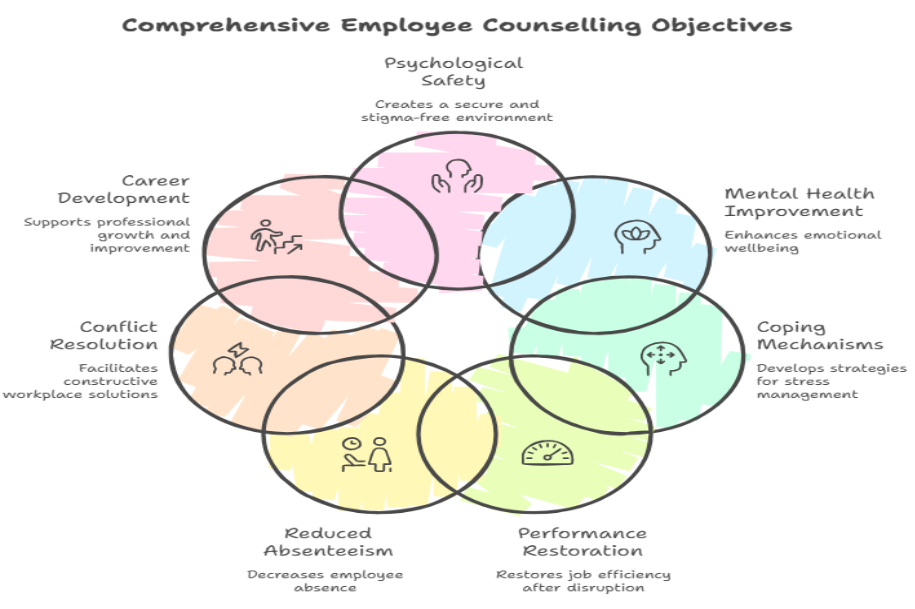
Core Objectives of Employee Counselling
- Improve employee mental health and emotional wellbeing
- Help employees develop effective, lasting coping mechanisms for stress
- Restore normal job performance after emotional disruption
- Reduce absenteeism, attrition, and presenteeism
- Facilitate constructive resolution of workplace conflicts
- Support career development and performance improvement
- Build a psychologically safe, stigma-free workplace culture
Types of Counselling: 3 Core Approaches

Types of employee counseling can vary based on the specific needs and challenges of individuals within an organization. Understanding this is essential for HR professionals who need to match the right approach to the right situation. The three core types differ fundamentally in who leads the conversation, what they aim to achieve, and what level of specialist training they require.
1. Directive Counselling (Counsellor-Centred)
Directive counselling, sometimes called prescriptive counselling, places the counsellor in an active, guiding role. The counsellor listens to the employee's problem, analyses it, and prescribes a course of action. The employee is expected to follow the counsellor's lead.
How It Works
- Counsellor controls the direction and pace of the session
- Specific, structured questions guide the conversation
- Direct advice and instructions are provided
- The employee follows an agreed action plan set largely by the counsellor
Advantages
- Efficient and structured: produces clear, time-bound outcomes
- Effective for employees who are genuinely unable to make independent decisions
- Works well in performance management and disciplinary contexts
Limitations
- Can create dependency: the employee follows instructions rather than internalising solutions
- Does not address underlying emotional root causes
- As Keith Davis observed: 'people do not wish to take advice normally, no matter how good it might be'
Best Used For
Performance improvement plans, conduct issues, new employee adjustment, disciplinary counselling.
Case Example: The New Joiner Who Could Not Find His Footing
Aakash joined a large Mumbai-based financial services firm straight out of a tier-two college in Nagpur. Within six weeks, his manager flagged him to HR: he was missing process deadlines, making basic calculation errors, and visibly anxious in team meetings. He had received two rounds of feedback, but nothing seemed to change.
HR suggested a directive counselling approach. The counsellor met with Aakash, walked through the specific gaps clearly without judgement, and prescribed a structured 30-day plan: daily check-ins with his team lead, a spreadsheet skills refresher, and a preparation template for meetings. The counselor set the agenda, monitored progress weekly, and adjusted the plan on Day 15.
Outcome: By Day 40, Aakash's error rate had dropped significantly, and he was contributing in meetings. He later said, 'I needed someone to tell me exactly what to fix. I did not know where to start on my own.'
2. Non-Directive Counselling (Employee-Centred)
Non-directive counselling, developed by psychologist Carl Rogers as person-centred therapy, inverts the power dynamic entirely. The employee leads the conversation. The counsellor's role is to provide a safe, non-judgmental, empathetic space in which the employee feels free to express themselves and discover their own solutions.
How It Works
- Counsellor uses active listening, reflective questions, and unconditional positive regard
- Employee is encouraged to express feelings freely without fear of judgement
- No advice is given; the counsellor facilitates self-discovery
- Employee finds their own solutions through guided exploration
Advantages
- Addresses root causes, not surface symptoms
- Leads to genuine, lasting attitudinal change: what Keith Davis called 'reorientation'
- Builds employee self-reliance and emotional intelligence
- Reduces psychological tension through the safe expression of feelings
Limitations
- Requires trained professional counsellors only
- Time-intensive and more expensive to deploy at scale
Best Used For
Mental health and emotional wellbeing concerns, personal crises, burnout, long-term behavioural challenges.
India-specific note: Non-directive counselling is particularly important in Indian organisational contexts. The combination of hierarchical power dynamics and mental health stigma means employees need explicit assurance that they will not be judged before they speak honestly. This model provides that assurance structurally.
Case Example: The Senior Analyst Who Went Quiet
Sunita was a 38-year-old senior data analyst at a Pune-based IT company, known for her attention to detail and calm under pressure. Over two months, her manager noticed she had become withdrawn, stopped offering opinions in product reviews, and had taken four days of unplanned leave. Her performance metrics were still acceptable, but something had clearly shifted.
HR referred her to the company's external EAP counsellor, who used a non-directive approach. In the first session, the counsellor simply asked: 'What has been going on for you lately?' and then listened without interrupting for nearly twenty minutes. Sunita spoke about her mother's recent cancer diagnosis, a dysfunctional family dynamic around caregiving decisions, and her guilt about 'not being present enough at work or at home'. The counsellor did not advise. They reflected, summarised, and gently asked what she felt she needed.
Outcome: Over four sessions, Sunita identified that she needed to request a temporary hybrid arrangement and to speak to her manager about her situation, something she had been too afraid to do. The counsellor did not suggest either of these: she arrived at them herself. She returned to full engagement within six weeks. Her manager later said he wished she had come to him sooner. She said she had needed the sessions to feel safe enough to do so.
3. Participative/Co-operative Counselling (The Middle Path)
Participative counselling, the most widely used approach in practice, is a mutual, collaborative exchange between counsellor and employee. Neither fully counsellor-led nor fully employee-led, it blends the efficiency of the directive approach with the depth of the non-directive one. This is sometimes called co-operative counselling.
How It Works
- Counsellor and employee jointly explore the problem
- Both contribute perceptions, knowledge, and insights
- Solutions are co-created rather than prescribed or self-discovered
- Employee is empowered but guided throughout
Advantages
- Balances the strengths of both other approaches
- Does not require specialist clinical training: can be facilitated in structured settings with trained professionals, while ensuring referral to qualified counsellors when needed
- More accepted by independent-minded employees who resist being told what to do
- Builds mutual trust through collaborative engagement
Limitations
- Requires skilled facilitation to prevent drift toward being too directive or too passive
- Can feel unstructured to employees expecting clear answers
Best Used For
Most workplace counselling scenarios: performance development, career guidance, conflict resolution, work-life balance concerns. The default model in most Indian EAP settings.
Case Example: The Team Lead Caught Between Two Worlds
Ramesh was a 33-year-old team lead at a Chennai-based manufacturing company. His performance reviews had been consistently strong, but in the past quarter he had started snapping at team members and missing his own reporting deadlines. His skip-level manager flagged the change to HR.
In initial conversations with HR, Ramesh was reluctant to open up. He was not in crisis but was clearly carrying something. HR referred this to a qualified counsellor: the counsellor opened by sharing what they had observed factually and without blame, then invited Ramesh to share his perspective. As the conversation developed, Ramesh described feeling trapped between a demanding new director who had changed the team's KPIs mid-quarter and a junior team he felt responsible for protecting. He had not felt able to voice this upwards.
The counsellor and Ramesh worked together to map the specific pressure points, identify what was within his control, and draft a conversation he could have with the director. The counsellor offered frameworks; Ramesh shaped them to his situation. They co-created the plan.
Outcome: Ramesh had the conversation with his director. The KPIs were not changed, but the timeline was adjusted, and he was given one additional resource. The irritability with his team disappeared almost immediately once he felt the pressure had somewhere to go.
Extended Types in Organisational Contexts
- Personal counselling: addresses family, relationship, or financial issues affecting work
- Performance counselling: focused on specific job performance deficits
- Career counselling: guidance on transitions, promotions, and role alignment
- Retirement counselling: psychological preparation for the transition out of work
- Disciplinary counselling: formal process triggered by conduct or policy violations
- EAP counselling: structured professional support delivered through Employee Assistance Programmes — confidential, often externally provided, and typically covering 3-12 sessions per employee per year
The Process of Employee Counselling: Step by Step
The process of employee counselling follows three broad phases: rapport building, exploration, and action planning. Each phase contains specific steps that, when followed in sequence, produce meaningfully better outcomes than ad hoc conversations. The infographic below maps the six steps clearly:

To understand each stage in detail, along with common counselling challenges, best practices, and practical tools to improve workplace outcomes, read our related articles on this topic:
Common Counselling Errors That Counsellors Must Avoid
In Indian workplaces, sessions often fail not because of poor intent but because of predictable process errors:
- Dominating the session with questions rather than listening
- Giving premature advice before the problem has been fully explored
- Projecting personal assumptions or biases onto the employee's situation
- Rushing to solutions: skipping the exploration phase produces compliance without commitment
- Neglecting confidentiality: even mentioning the fact of a counselling session to a colleague causes lasting damage to trust
- No follow-up: one-and-done sessions have minimal lasting impact
💡Pro-tip: The single most common mistake in Indian workplace counselling is jumping straight from 'what is the problem?' to 'here is what you should do'. The exploration phase, Step 4, is where the real work happens. A counsellor who rushes it gets surface compliance. One who spends time in it gets genuine, lasting change.
Benefits of Employee Counselling: For Employees and Organisations
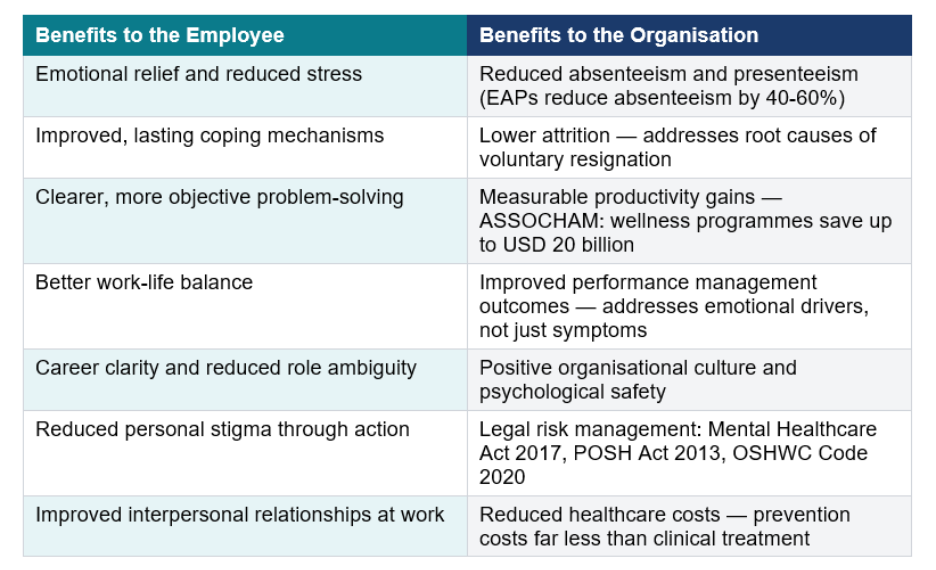
The benefits of employee counselling fall into two distinct but connected categories: those experienced by the individual employee, and those that accrue to the organisation. Both matter for the business case, and both should be communicated when rolling out a programme.
Benefits of Employee Counselling for Employees
For the employee, the primary benefit of counselling is the experience of being genuinely heard in a professional context, often for the first time. Beyond that immediate relief, counselling delivers lasting outcomes:
- coping strategies that transfer to future challenges,
- clearer thinking about their own situation, and
- a restored sense of agency over their working life.
Career counselling, specifically, helps employees align their role with their genuine skills and aspirations. For employees experiencing burnout or role ambiguity, this alignment is often the difference between retention and resignation.
Benefits of Employee Counselling for Organisations
The organisational case for counselling investment is straightforward.
- According to WHO research on mental health at work, every USD 1 invested in employee mental health yields USD 4 in improved productivity.
- EAP programmes specifically reduce absenteeism by 40-60% in organisations that implement them with genuine commitment rather than minimal compliance.
- ASSOCHAM estimates that successful employee wellness programmes, of which counselling is a core component, save Indian companies up to USD 20 billion annually and produce measurable reductions in absenteeism across participating organisations.
- Replacing one entry level employee costs 50-75% of their annual salary. Counselling that retains three such employees pays for an entire annual EAP contract.
Importance of Employee Counselling in HRM
Also referred to as employee counseling in HRM in international literature, the importance of employee counselling has shifted in recent years from a welfare consideration to a strategic HRM function. Here is why it now sits at the centre of modern people management:
Counselling as the Third Layer of Performance Management
When feedback and coaching have not resolved a performance gap, the next step is not escalation, but deeper exploration of underlying factors. At this stage, referral to structured employee counselling support may be appropriate.
A more effective three-tier model is: feedback (performance gap identified), coaching (skill development), and counselling (addressing deeper emotional or behavioural factors through qualified professionals).
In practice, many Indian organisations move directly from feedback to formal performance improvement plans, bypassing this support layer. As a result, Performance Improvement Plans (PIPs) often produce resignation rather than recovery.
Counselling in Talent Retention
India's attrition rate is 17.1% in 2025, and projected at 13.6% in 2026. E-commerce leads at 28.7%, IT averages 25%, and metals and mining stays lowest at 8.6% across all major sectors.
Burnout and unresolved personal distress are consistently among the top drivers of voluntary resignation. Structured employee counselling addresses these root causes directly. For a detailed examination of the barriers that prevent programmes from achieving this impact, see our guide on common issues in employee counselling and how to overcome them.
Counselling in Change Management
Major organisational changes such as restructuring, mergers, layoffs, leadership transitions trigger widespread anxiety that neither team meetings nor cascaded communications can adequately address. Structured counselling support during transitions reduces resistance, stabilises performance, and signals to employees that the organisation is committed to their wellbeing even in difficult periods.
Counselling, DEI and the Indian Workforce
Counselling programmes tailored to the unique stressors of women employees, LGBTQ+ employees, employees with disabilities, neurodivergent employees, and employees from marginalised communities are a cornerstone of genuinely inclusive HRM. In India, where social identity intersects with workplace experience in complex and consequential ways, generic counselling that ignores these intersections often fails the employees who need it most.
Counselling and Legal Compliance in India
The legal obligation landscape for employer-supported mental health is evolving rapidly. The Mental Healthcare Act 2017 prohibits discrimination against employees on the basis of mental health conditions. The POSH Act 2013 requires organisations to provide support to employees after sexual harassment incidents. The OSHWC Code 2020 creates implied duties of psychosocial safety. Employee counselling programmes are the primary mechanism through which organisations demonstrate compliance with all three.
Counselling in the Digital and Hybrid Era
Remote and hybrid work in India has intensified isolation, blurred work-life boundaries, and removed the informal peer support that used to buffer individual distress in shared offices. Digital EAP platforms, AI-assisted first-contact tools, and flexible counselling options fill the gap that in-person social infrastructure once covered.
The HR Professional's Role: Counsellor or Connector?
HR professionals are often the first point of contact for a distressed employee. SHRM and MHFA India both recommend that HR professionals receive basic counselling skills training, not to become therapists, but to conduct effective, empathetic first conversations and make warm referrals to qualified counsellors. The goal is to be a connector, not a clinician.
Qualities of an Effective Employee Counsellor
Whether you are vetting an external EAP provider or building internal systems to support employee wellbeing, these are the qualities to look for in an effective employee counsellor. Line managers while not counsellors, should be equipped to have supportive conversations and make appropriate referrals when needed.
- Active listening: genuine, full attention without interruption or premature judgement; reflected through body language, brief summaries, and absence of the urge to fill silences
- Empathy: the ability to understand and share the feeling of another without projecting personal experience; distinct from sympathy, which judges; empathy simply witnesses
- Confidentiality and trustworthiness: non-negotiable; a single breach, even inadvertent, destroys the counselling relationship and deters future help-seeking across the organisation
- Non-judgmental stance: suspension of personal biases, moral judgements, and cultural assumptions; essential in India's diverse, multicultural workplaces

- Communication clarity: ability to ask open questions, use silence effectively, summarise accurately, and deliver feedback constructively
- Problem-solving orientation: guiding employees toward actionable solutions without prescribing them unilaterally
- Cultural competence (India-specific): understanding of how caste, gender, religion, regional identity, and family dynamics shape how employees experience and express psychological distress
- Knowing when to refer: recognising the limits of workplace counselling and making warm, de-stigmatising referrals to clinical professionals when the employee's needs exceed what an EAP can safely address
💡Pro-tip: When reviewing an EAP provider's counsellor roster, ask for the proportion of counsellors with specific workplace psychology training, the languages they practise in, and their process for specialisation matching. A counsellor with strong relationship counselling skills and no understanding of organisational dynamics will struggle to help a burned-out IT project manager effectively.
Employee Counselling in India: The Current Landscape and EAP Ecosystem
The demand for Indian corporate EAP market is growing steadily, driven by post-pandemic mental health awareness, rising workplace stress, and increasing organisational focus on employee well-being. This growth makes India one of the fastest-developing markets for employee counselling programs globally, and also one of the most complex to implement effectively.
The Indian EAP Delivery Model
Most Employee Assistance Programs (EAPs) in India provide 3 to 12 confidential counselling sessions per employee per year. These services are typically delivered through multiple channels, including:
- Mobile applications
- Phone helplines
- Video-based counselling
- In-person sessions
Many organisations also extend EAP coverage to immediate family members, recognising that family-related concerns are a major source of employee stress in the Indian context.
Common Types of EAP Providers in India
The Indian EAP ecosystem includes a mix of:
- Professional counselling helplines (human-led support)
- Digital mental health platforms (peer + professional models)
- AI-assisted mental health tools (self-guided interventions)
- Comprehensive corporate EAP providers (integrated well-being solutions)
This diversity reflects the need to cater to different levels of care: from preventive support to clinical intervention.
Cultural Challenges Unique to the Indian Context
- Mental health stigma: Employees may fear that seeking counselling could impact career growth
- Hierarchical workplace culture: Difficulty opening up due to authority dynamics
- Confidentiality concerns: Perception that personal information may reach HR
- Language barriers: Limited regional language access reduces reach in non-metro populations
These challenges are explored in detail in our guide on common issues in employee counselling, including stigma, confidentiality, access barriers, and ROI measurement in Indian workplaces.
The AI Counselling Frontier in India
AI-assisted counselling tools are increasingly used as part of a stepped-care model, allowing employees to seek help anonymously before transitioning to human counsellors when needed.
These tools help:
- Reduce stigma
- Improve accessibility
- Enable early intervention
Importantly, AI is positioned as a complement and not a replacement for human counselling, with organisations adopting hybrid models for better outcomes.
Named Indian Employer Programmes Worth Noting
- EY India 'r u okay?' programme: peer-led mental health ambassador initiative across India offices
- Wipro Well-being initiative: comprehensive EAP covering counselling, financial wellbeing, and physical health
- Infosys EAP: multilingual counselling access across domestic and international locations

A Final Word
Kavya, the finance manager from our opening, did not need a performance improvement plan. She did not need a warning letter. She needed someone to talk to. She needed an organisation structure to make that possible.
Employee counselling, done well, is that structure. It is not a welfare concession. It is not an HR box-ticking exercise. It is one of the most evidence-backed, cost-effective, and humanising investments an organisation can make in its people.
If you are building a counselling programme from scratch, the most valuable next step is understanding the process in depth. Our step-by-step guide on the complete process of employee counselling walks through every phase from identification to follow-up with practical tools for each stage.
And if your programme exists but is not working as well as it should, the obstacles are well-documented and solvable. See our guide on common issues in employee counselling: challenges and solutions for a diagnostic framework and actionable remedies.
Ready to Build a Mentally Healthier Workplace?
If your organisation is looking to implement or strengthen employee counselling, structured and confidential EAP models can significantly improve both employee well-being and organisational outcomes.
1to1help’s EAP Programme offers:
- Confidential, professional counselling support
- Multi-channel access (in-person, telephonic, digital)
- Preventive and crisis intervention services
- Customised solutions for Indian workplace contexts
With data from over 100,000 counselling sessions annually and outcomes that include a 53% reduction in depression symptoms and a 48% reduction in anxiety within just a few sessions, 1to1help's programmes are evidence-based, scalable, and designed to meet your employees where they are, whether they are in a metro office, working remotely, or based in a Tier 2 city.
The best investment isn’t just in employee counselling, it’s in making sure employees can actually use it.
FAQs
Q1. What is employee counselling?
Employee counselling is a structured, confidential process in which a trained counsellor engages an employee in a supportive discussion about a problem affecting their job performance or personal wellbeing. The objective, as defined by Keith Davis, is to help the employee better understand their problem and develop a constructive course of action to resolve it. In Indian organisations, employee counselling covers a wide range of issues: workplace stress, interpersonal conflict, performance difficulties, personal crises (family, financial, bereavement), career transitions, and mental health concerns. It is a key component of modern HRM and Employee Assistance Programmes (EAPs) affecting approximately 5-7% of employees in any given workforce at any given time.
Q2. What are the main types of employee counselling?
There are three core types of employee counselling used in HRM. (1) Directive counselling: the counsellor analyses the problem and advises the employee on what to do. Counsellor-centred; best for performance and conduct issues. (2) Non-directive counselling: the employee leads the conversation and the counsellor provides an empathetic, non-judgmental listening space. Client-centred; addresses root emotional causes; requires a trained professional; the most appropriate approach for personal and mental health concerns in Indian workplaces. (3) Participative (co-operative) counselling: the most widely used approach, blending directive and non-directive elements, with counsellor and employee jointly exploring the problem and co-creating solutions. Extended types include performance counselling, career counselling, retirement counselling, disciplinary counselling, and EAP-delivered clinical counselling.
Q3. What is the process of employee counselling?
The process of employee counselling involves six key steps: (1) Identify the need — triggered by HR, a line manager, or the employee themselves; (2) Prepare — arrange a private, confidential setting and review relevant information; (3) Build rapport — open warmly, signal confidentiality, and create emotional safety; (4) Explore — use active listening and open questions to help the employee identify and understand their problem; (5) Action plan — co-create a realistic set of solutions with clear timelines; (6) Follow up — review progress two to four weeks later and adjust as needed. A common error in Indian workplaces is skipping directly to advice-giving without adequate exploration, which produces surface compliance rather than genuine behavioural change.
Q4. Why is employee counselling important in HRM?
The importance of employee counselling in HRM operates across four dimensions. Strategically, it reduces attrition by addressing the psychological factors driving resignation. Operationally, it improves performance by resolving emotional root causes that neither feedback nor training can touch. Legally, it supports compliance with the Mental Healthcare Act 2017, the POSH Act 2013, and the OSHWC Code 2020. Culturally, it builds a workplace where employees feel safe seeking support, which in India, where mental health stigma remains high, is itself a significant organisational achievement.
Q5. What is the difference between employee counselling and employee coaching?
The key difference is focus and purpose. Employee counselling addresses emotional, psychological, or behavioural problems disrupting an employee's wellbeing or performance: it is remedial and supportive, dealing with the 'why' behind an issue. Employee coaching focuses on improving skills, performance, and capabilities: it is developmental and future-oriented, addressing the 'how' of performing better. The three-tier intervention model moves from feedback (gap identified) to coaching (skill development) to counselling (deeper emotional root cause). Each layer addresses a progressively more complex problem.
Q6. Is employee counselling confidential in India?
Confidentiality is the foundational principle of employee counselling. Without it, employees will not engage honestly, and the process fails. In India, the Mental Healthcare Act 2017 protects the privacy of mental health information. External EAP counsellors operate under strict professional ethics and do not share individual session content with employers. The only exceptions are universally accepted mandatory-reporting situations: imminent risk of harm to self or others, or a legal obligation under a court order. Communicating confidentiality clearly and repeatedly before programme launch is the single most effective driver of utilisation and trust.
References
- AIHR. (n.d.). Human resource basics. https://www.aihr.com/blog/human-resource-basics/
- AIHR. (n.d.). Organizational restructuring. https://www.aihr.com/blog/organizational-restructuring/
- AITS Rajampet. (n.d.). Coaching and counseling. https://aitsrajampet.ac.in/images/pdf/mba/learning-management-system/UNIT3-COACHING-AND-COUNSELING-UNIT4-ANNUAL-STOCK-TAKING-min.pdf
- Banner Health. (n.d.). Common health concerns. https://www.bannerhealth.com/services/healthy-aging/common-health-concerns
- Counselling Tutor. (n.d.). Congruence in counselling. https://counsellingtutor.com/counselling-approaches/person-centred-approach-to-counselling/congruence-in-counselling/
- CultureMonkey. (n.d.). Employee counseling. https://www.culturemonkey.io/employee-engagement/employee-counseling/
- DGFASLI. (n.d.). Occupational safety and health guidelines. https://dgfasli.gov.in/public/Admin/Cms/AllPdf/650059fbb8f1a9.98699174.pdf
- Economics Discussion. (n.d.). Employee counselling: Meaning, concept, types, benefits and challenges. https://www.economicsdiscussion.net/human-resource-management/employee-counselling/employee-counselling-meaning-concept-types-benefits-and-challenges/31639
- Employers Health. (2017). EY Assist report. https://www.employershealthco.com/wp-content/uploads/2017/04/EY-Assist.pdf
- Escalon Services. (n.d.). The true cost of employee turnover. https://escalon.services/blog/hr/the-true-cost-of-employee-turnover-how-to-calculate-and-reduce-it
- Express Healthcare. (2019). Cigna TTK survey on stress. https://www.expresshealthcare.in/news/cigna-ttk-releases-surevey-on-stress/410521/
- Forbes. (2024). Overcoming career transition challenges. https://www.forbes.com/sites/josephliu/2024/10/17/3-keys-to-overcoming-career-transition-challenges/
- GetVisit. (n.d.). Confidential employee counseling. https://getvisitapp.com/blog/mental-health/confidential-employee-counseling-workplace-mental-health-trust/
- HMHub. (n.d.). Employee counselling. https://hmhub.in/human-resource-planning/employee-counselling/
- HR Acuity. (n.d.). Workplace harassment. https://www.hracuity.com/blog/workplace-harassment/
- Indeed. (n.d.). Interpersonal conflict. https://www.indeed.com/career-advice/career-development/interpersonal-conflict
- Indeed. (n.d.). PIP meaning. https://www.indeed.com/hire/c/info/pip-meaning
- India Code. (2013). Sexual Harassment of Women at Workplace Act. https://www.indiacode.nic.in/bitstream/123456789/2104/1/A2013-14.pdf
- India Code. (2017). Mental Healthcare Act. https://www.indiacode.nic.in/bitstream/123456789/2249/1/A2017-10.pdf
- IntechOpen. (n.d.). Employee counselling chapter. https://www.intechopen.com/chapters/1153201
- Investopedia. (n.d.). Financial distress. https://www.investopedia.com/terms/f/financial_distress.asp
- Investopedia. (n.d.). Layoff. https://www.investopedia.com/terms/l/layoff.asp
- Investopedia. (n.d.). Presenteeism. https://www.investopedia.com/terms/p/presenteeism.asp
- Journal of Indian Psychiatry. (2024). Mental health and well-being at the workplace. https://journals.lww.com/indianjpsychiatry/fulltext/2024/66002/mental_health_and_well_being_at_the_workplace.16.aspx
- Livemint. (2023). India tops workplace burnout survey. https://www.livemint.com/news/india/india-tops-in-workplace-burnout-survey-with-59-reporting-symptoms-mckinsey-health-institute-11698999238983.html
- MBA Knowledge Base. (n.d.). Types and methods of employee counseling. https://mbaknol.com/human-resource-management/types-and-methods-of-employee-counseling/
- MHFA India. (n.d.). https://www.mhfaindia.com/
- ModWM. (n.d.). Pre-retirement planning tasks. https://www.modwm.com/pre-retirement-tasks-to-address/
- Newcastle Physiotherapy. (n.d.). Diagnostic imaging. https://www.newcastle-physiotherapy.com.au/n/-diagnostic-imaging-for-musculoskeletal-injuries-x-rayultrasoundct-scan-mri/
- Positive Psychology. (n.d.). Self-discovery. https://positivepsychology.com/self-discovery/
- Prompt Personnel. (n.d.). Work stress in India. https://www.promptpersonnel.com/work-stress-time-for-the-government-to-intervene/
- Psychology Today. (n.d.). Divorce. https://www.psychologytoday.com/us/basics/divorce
- RPG Group. (n.d.). Stress in India report. https://www.rpggroup.com/assets/images/media/killer-stress-india-today..pdf
- SHRM. (n.d.). https://www.shrm.org/
- Simply Psychology. (n.d.). Client-centred therapy. https://www.simplypsychology.org/client-centred-therapy.html
- Slideshare. (n.d.). Employee counselling presentation. https://www.slideshare.net/slideshow/employee-counselling-4152204/4152204
- Taggd. (n.d.). Employee assistance program. https://taggd.in/hr-glossary/employee-assistance-program/
- The Live Love Laugh Foundation. (2025). Transforming mental health in corporate India: A roadmap for action. https://cdn.thelivelovelaughfoundation.org/the_live_love_laugh/uploads/media/source/kWBIhg-Transforming-Mental-Health-in-Corporate-India.pdf
- Verywell Mind. (n.d.). Active listening. https://www.verywellmind.com/what-is-active-listening-3024343
- Verywell Mind. (n.d.). Bereavement. https://www.verywellmind.com/bereavement-definition-symptoms-causes-traits-treatment-5197038
- Verywell Mind. (n.d.). Unconditional positive regard. https://www.verywellmind.com/what-is-unconditional-positive-regard-2796005
- Vantage Circle. (n.d.). Employee counseling. https://www.vantagecircle.com/en/blog/employee-counseling/
- WHO. (n.d.). Mental health at work. https://www.who.int/news-room/fact-sheets/detail/mental-health-at-work
- Wisemonk. (n.d.). Managing attrition in India. https://www.wisemonk.io/blogs/managing-attrition-in-india


.svg)
.svg)
.svg)
.svg)