


.png)


.png)

Work Related Concerns
Workplace Crisis Management: A Complete Guide for Indian Organisations (2026)
.png)
Written by
Aarohi Parakh,
Psychologist and Content Writer

Reviewed by
Sanjana Sivaram,
Psychologist and Clinical Content Head


Introduction
Consider this illustrative scenario. In March 2020, imagine a mid-sized IT services company in Pune with no established work-from-home policy, limited remote-access infrastructure and no documented plan for office closure. Within 72 hours of a lockdown announcement, its HR head might suddenly find herself handling hundreds of employee queries through a single WhatsApp number, coordinating laptop distribution while maintaining physical distancing, and managing client escalations remotely from home.
They survived. But not because they had a plan. They survived because a handful of people made very good decisions under enormous pressure, without any framework to fall back on.
That is not crisis management. That is crisis improvisation. And the difference matters enormously.
Workplace crisis management is the structured, organisation-wide capability to prepare for, respond to, and recover from events that threaten operations, employee safety, or organisational reputation. In simple terms, it means having a clear process for deciding what to do, who takes charge, and how to keep people informed when normal operations are disrupted.
It is not a document you file away. It is a living capability that must be built, practised, and maintained.
This guide explains what crisis management means, the types of workplace crises Indian organisations may face, how to build a practical crisis management plan, and how HR can support employees before, during and after a crisis.
What Is Workplace Crisis Management?
Crisis management is the structured, organisation-wide approach to anticipating, responding to, and recovering from events that threaten operations, employee safety, or organisational reputation.
So, what is crisis management in the workplace? It is the process of preparing an organisation to deal with unexpected events that create immediate instability, while protecting people, maintaining essential operations and managing stakeholder trust.
It is worth distinguishing this from risk management. Risk management happens before a threat materialises. It identifies vulnerabilities, maps probability and impact, and puts mitigation measures in place. Crisis management activates when a threat has already arrived. The two functions are complementary, not interchangeable.
In the workplace context, a crisis could be a ransomware attack that locks an organisation's systems at 9 am, a key executive departure announced over social media before the board is informed, a factory fire on the night shift, or a sexual harassment complaint that escalates into public media coverage. The common thread is urgency, uncertainty and consequence.
The crisis management meaning is therefore broader than emergency response alone. It includes preparedness, decision-making, communication, recovery and learning.
The stakes are significant. According to PwC's Global Crisis Survey, 69% of business leaders reported experiencing at least one significant crisis in the preceding five years, while 95% expected to face another. PwC research has also highlighted an integration gap, with only 23% of respondents saying their organisational resilience functions were very well integrated.
Indian organisations face a particularly layered risk environment. Monsoon-related disruptions, industrial accidents, rapid digital transformation creating cybersecurity exposure, and sector-specific regulatory requirements can create a complex mix of operational, legal and human challenges.
The organisations that manage crises best are not necessarily the ones that face fewer of them. They are the ones that prepare as if a crisis is possible, understand their vulnerabilities, and know how to respond when normal operations are disrupted.
Types of Workplace Crises Indian Organisations Must Prepare For
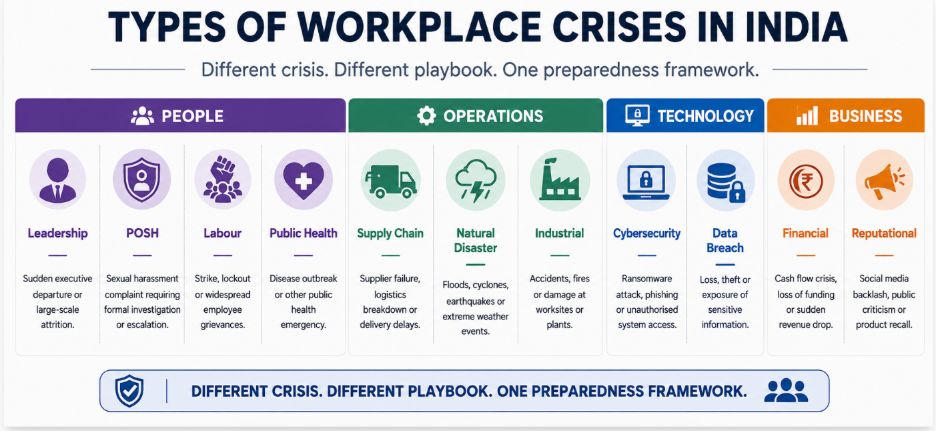
Not all crises look alike. Understanding the range of crises relevant to Indian organisations is the first step towards building a response that is specific rather than generic.
A crisis may begin with a technology failure, a natural disaster, a workplace incident, a financial shock or a reputational issue. The right response depends on the nature of the event, its potential impact and the people or functions affected.
The following crisis management examples illustrate the main categories Indian organisations should consider when developing their crisis management plans.
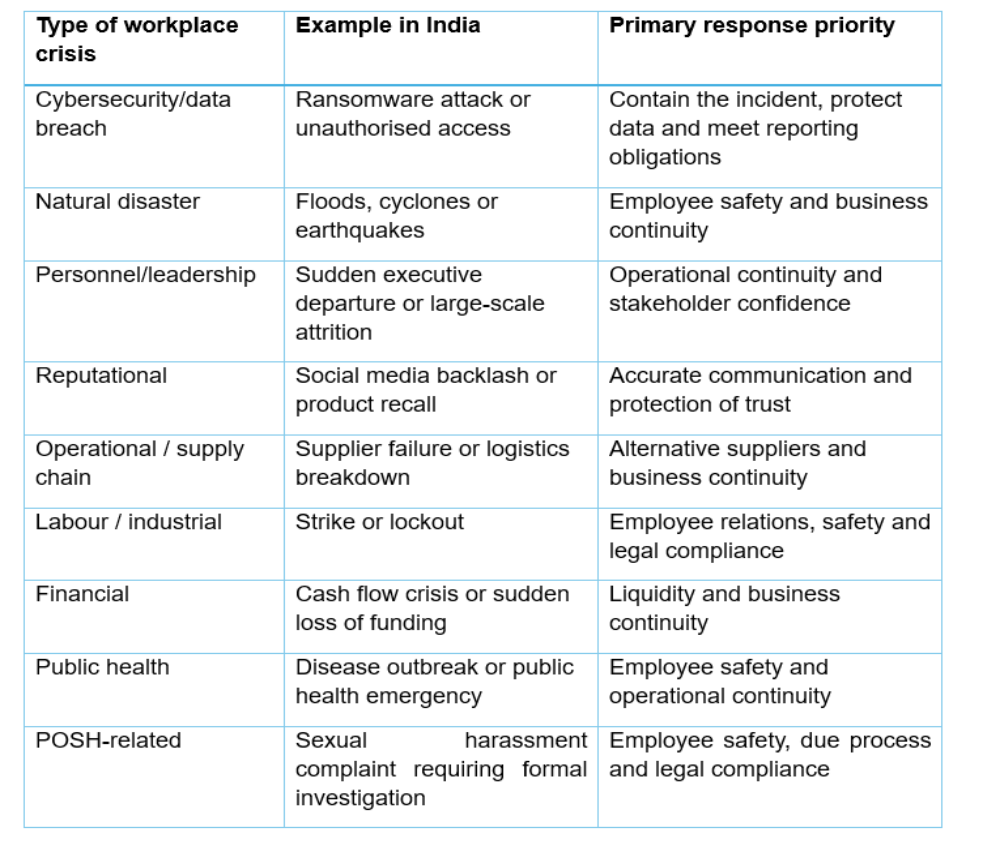
A brief note on each category that deserves specific Indian context:
Cybersecurity and data breaches are not a distant threat for Indian organisations. Ransomware, phishing, unauthorised access and other cyber incidents can disrupt operations while creating financial, legal and reputational consequences.
India's digital data protection framework includes specific requirements relating to personal data breaches. Organisations should also consider separate cybersecurity incident reporting obligations, including applicable requirements under CERT-In directions. Because regulatory requirements and implementation timelines can change, organisations should verify the current requirements relevant to their sector and incident before relying on a crisis playbook.
For organisations handling significant volumes of personal data, a data breach response playbook should therefore cover containment, internal escalation, evidence preservation, stakeholder communication, legal review and applicable regulatory reporting.
Natural disasters are particularly relevant for manufacturing, logistics and businesses operating in regions vulnerable to flooding, cyclones or other extreme weather events. The Chennai floods of 2015 demonstrated how quickly infrastructure disruption can affect entire business districts, while disasters such as the 2023 Sikkim floods and landslides highlighted the vulnerability of regional supply chains.
For Indian organisations, crisis management planning should therefore consider not only employee evacuation and safety, but also alternative work locations, remote access, supplier dependencies, emergency communication and business continuity.
Labour and industrial crises remain a significant consideration for organisations operating in India's manufacturing and industrial hubs. Strikes, lockouts, workplace accidents and unresolved employee grievances can disrupt production and quickly become wider operational or reputational issues.
Clear communication, escalation protocols and defined decision-making responsibilities can help organisations respond before a localised issue becomes a wider business crisis.
POSH-related incidents that escalate into reputational crises represent a category that organisations should not underestimate. When a sexual harassment complaint is mishandled, delayed or communicated inappropriately, the issue may extend beyond the internal process and create wider consequences for employee trust and organisational reputation.
The response must balance confidentiality, due process, employee safety and legal compliance. A crisis management plan should therefore clearly establish who is responsible for escalation, communication and legal advice when a sensitive workplace complaint develops into a wider organisational crisis.
Financial crises can hit Indian MSMEs and startups particularly hard. Cash flow disruptions, investor withdrawal, sudden revenue loss or loss of a major client can move from a serious concern to an existential threat within weeks.
Business crisis management should therefore include financial contingency planning, access to emergency funding where appropriate, insurance considerations and clear authority for emergency expenditure.
Each of these situations requires a different response playbook. A natural disaster protocol and a data breach protocol share very little procedural overlap, and that is precisely why scenario-specific planning matters.
A strong crisis management plan does not attempt to predict every possible event. Instead, it identifies the scenarios most relevant to the organisation and gives people a tested framework for responding to them.
The Crisis Management Cycle: Prepare, Respond, Recover
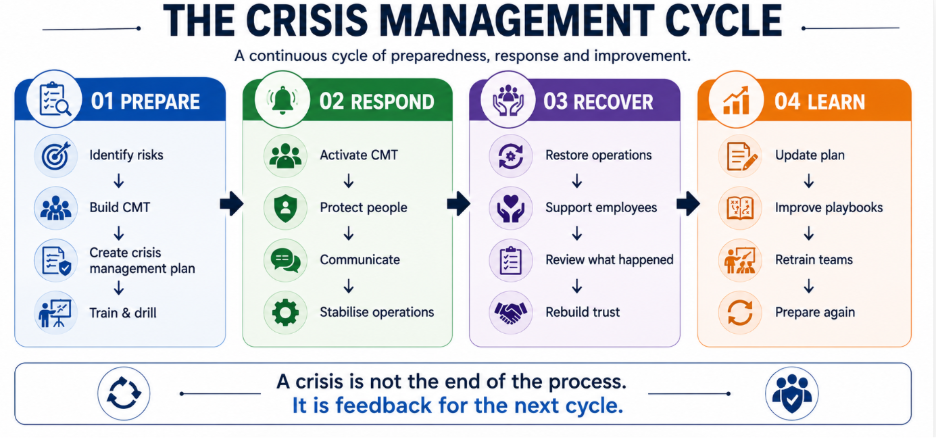
Crisis management is not a single event. It is a continuous cycle with three distinct phases: prepare, respond and recover. Together, these phases form the crisis management process, helping organisations move from anticipating potential threats to responding effectively and learning from what happened.
Phase 1: Prepare
This is where most of the real work happens, long before any crisis arrives.
- Conduct a Business Impact Analysis (BIA) to understand which functions, systems and teams are critical and what their failure would cost.
- Identify the most likely and highest-impact crises for your specific industry, geography and organisation.
- Form and train a Crisis Management Team (CMT) with clearly defined roles and documented deputies.
- Draft a Crisis Management Plan with scenario-specific response playbooks.
- Build communication infrastructure that does not depend on the office being accessible. Cloud-based HR systems, remote communication protocols and off-site document storage are not conveniences. They are crisis infrastructure.
- Run drills and tabletop simulations regularly so that people understand their roles before a real crisis occurs.
Indian organisations in the IT and BPO sectors learned many of these lessons during COVID-19. The post-pandemic standard is that remote readiness is part of crisis readiness, not separate from it.
Phase 2: Respond
When a crisis is confirmed, the response phase activates.
- Convene the Crisis Management Team immediately.
- Follow the "golden hour" principle: communicate early with confirmed information. Silence can allow rumours and speculation to fill the information gap.
- Communicate internally first, where appropraite. Employees should not learn about a serious workplace crisis through external media.
- Assign decision-making authority clearly. In a crisis, unclear ownership can create paralysis.
- Make decisions based on the information available rather than waiting for perfect information.
- Document key decisions and their rationale in real time. This becomes valuable during the post-crisis review.
- The aim of the response phase is not to solve everything immediately. It is to protect people, establish control, reduce uncertainty and stabilise the organisation.
Phase 3: Recover
Recovery is the phase that organisations can most easily overlook. Once the immediate threat passes, there is often a temptation to declare the crisis over and return to normal. However, recovery is where organisational resilience is strengthened or neglected.
- Restore operations in a phased, deliberate manner.
- Support employee wellbeing and reintegration. Crises can have effects that continue after systems and workplaces return to normal.
- Conduct a Post-Crisis Review (PCR) within two to four weeks of resolution.
- Identify what worked, what failed, and what needs to change.
- Update the Crisis Management Plan based on lessons learned.
- Communicate recovery progress to relevant internal and external stakeholders.
Learn and Improve
Although prepare, respond and recover form a useful crisis management cycle, learning from recovery should feed back into preparedness.
A crisis, serious incident or simulation can therefore lead to updates to the plan, training, communication protocols or response playbooks where necessary. This creates a continuous improvement loop rather than suggesting that crisis management universally follows four formal phases.
Prepare → Respond → Recover → Learn → Prepare again
This is what turns crisis management from a document into an organisational capability.
How to Build a Workplace Crisis Management Plan (Step by Step)
A Crisis Management Plan (CMP) is a documented strategy that defines who acts, what they do, how they communicate, and in what sequence when a crisis occurs. Without one, responses tend to be reactive, slow and inconsistent, which can turn a manageable incident into a much larger organisational crisis.
Effective crisis management planning does not mean trying to predict every possible emergency. It means identifying the scenarios most relevant to the organisation and creating clear responsibilities, escalation routes, communication protocols and response actions before they are needed.
Here are six practical crisis management steps organisations can follow:
Step 1: Conduct a Risk Assessment
Identify the most likely and highest-impact crises for your specific organisation, sector and geography. Do not do this in isolation from the people who see risk up close. Involve frontline employees, department heads, and the legal and compliance team. They routinely spot vulnerabilities that leadership may miss.
Map identified risks on a simple grid of likelihood versus impact. Prioritise the top five to seven scenarios for detailed planning.
The first step of crisis management planning is therefore not writing the document. It is understanding what the organisation actually needs to prepare for.
Step 2: Form a Crisis Management Team
Assign specific roles with clear authority, not just job titles. Each role should have a documented deputy because a crisis does not wait for key people to become available.
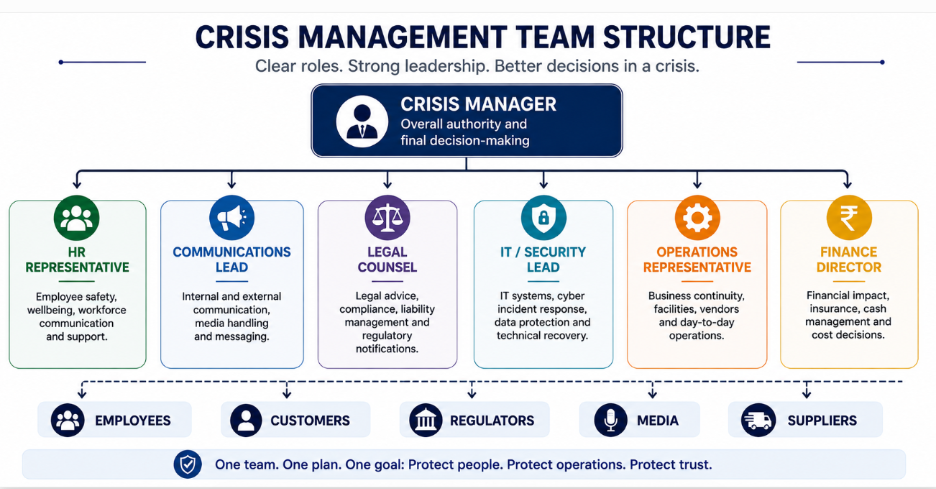
The core roles typically include the Crisis Manager, HR Representative, Communications Lead, Legal Counsel, IT or Security Lead, Operations Representative and Finance Director.
The team should also understand who has authority to activate the plan, who communicates externally and who takes over if a key decision-maker is unavailable.
Step 3: Define Activation Triggers
Not every disruption constitutes a crisis. Agree on clear, pre-set thresholds so the CMT is not convened for minor incidents, while genuine crises are not downplayed into routine operational issues.
Depending on the organisation, activation triggers might include:
- System downtime exceeding a defined threshold
- A significant data breach or cyber incident
- Any incident involving media enquiries
- A fatality or serious injury on the premises
- A major operational disruption affecting customers
- A sensitive workplace complaint requiring formal escalation
The exact thresholds should reflect the organisation's size, sector, risk profile and legal obligations.
Vague triggers create hesitation at precisely the moment when speed matters.
Step 4: Build Communication Protocols
Design communication infrastructure assuming that your office may be inaccessible, your primary systems may be down and your team may be working from different locations.
For internal communication, consider cloud-accessible HR platforms, emergency SMS cascades, designated WhatsApp groups for the CMT, employee helplines and pre-approved email templates.
For external communication, prepare media contact lists, holding statements, regulator notification checklists and customer communication workflows.
For listed organisations, regulatory communication should also reflect applicable disclosure requirements.
The single biggest communication mistake organisations make in a crisis is trying to build these systems after the crisis has started.
Step 5: Draft Scenario-Specific Playbooks
For each top-priority risk scenario, create a dedicated response playbook.
Each playbook should include:
- A first-60-minutes checklist
- A decision tree for escalation
- Pre-drafted communication templates
- Role-specific task lists
- Relevant regulatory notification requirements and timelines
- Key internal and external contacts
A natural disaster playbook and a data breach playbook share very little content. That is by design. Each should reflect the risks, decisions and stakeholders relevant to that scenario.
Step 6: Test, Drill and Refine
A plan that has never been tested is a hypothesis, not a plan.
Conduct tabletop exercises, where the CMT works through a simulated scenario without activating the full emergency response. Run live drills where appropriate, including evacuation exercises and IT failover tests.
Debrief after every exercise and document what needs to change. Update the plan rather than letting the same weaknesses show up in the next simulation.
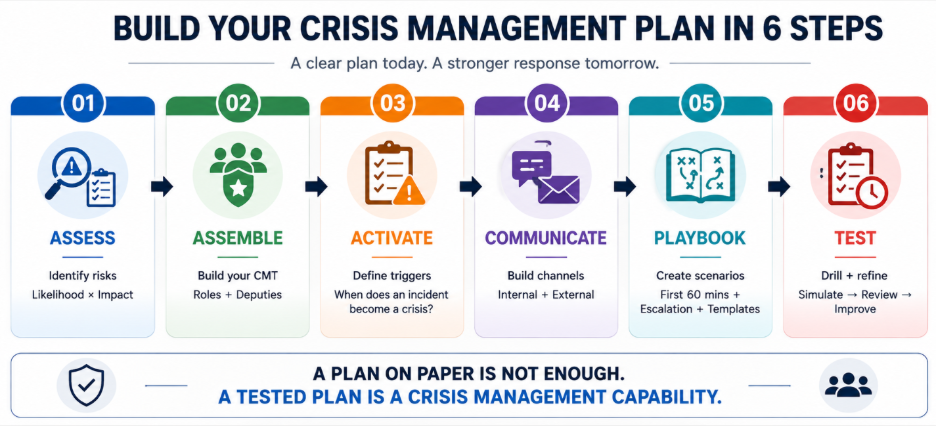
These six steps of crisis management create the foundation of a practical crisis management plan. But the plan only becomes useful when people know how to use it under pressure.
Crisis Management Plan Checklist
Before considering the plan ready, check that it includes:
- Key organisational risks identified
- Crisis Management Team appointed
- Deputies identified for critical roles
- Activation triggers defined
- Emergency communication channels tested
- Scenario-specific playbooks created
- Regulatory contacts and requirements documented
- Crisis drills scheduled
- Post-crisis review process documented
- Plan review date established
Treat a crisis management plan as a living document. Review it regularly and update it whenever there is a significant organisational, operational, technological or regulatory change.
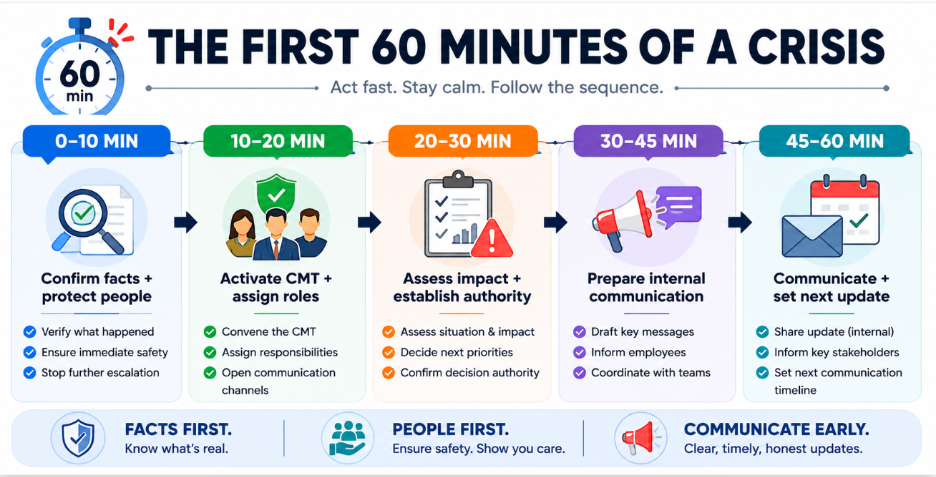
Building and Leading Your Crisis Management Team
A Crisis Management Team (CMT) is only as effective as its people, roles and preparation. The team brings together leaders from different functions who can make decisions quickly, coordinate the response and communicate clearly when it matters most.
A strong CMT is central to an organisation's crisis management strategy because it establishes clear ownership when normal reporting structures may not be sufficient. Members should be selected not only for their seniority, but also for their ability to make sound decisions with incomplete information and under significant time pressure.
Crisis Manager
The Crisis Manager has overall coordination authority and final decision-making responsibility. This role typically falls to the CEO or COO in smaller organisations and to a senior operations, risk or business continuity leader in larger organisations.
The Crisis Manager must remain composed under pressure, communicate clearly and keep the team focused on action rather than analysis paralysis.
HR Representative
The Crisis Manager coordinates the response and has clearly defined decision-making authority within the crisis-management structure. This role typically falls to the CEO or COO in smaller organisations and to a senior operations, risk or business continuity leader in larger organisations.
The Crisis Manager must remain composed under pressure, communicate clearly and keep the team focused on action rather than analysis paralysis.
Communications Lead
The Communications Lead is responsible for crisis messaging across internal and external channels. This includes coordinating employee updates, media statements, customer communications and social media monitoring.
The communications function should work closely with the Crisis Manager and Legal Counsel to ensure information is accurate, timely and consistent.
Legal Counsel
Legal advises on regulatory compliance, liability exposure and external communications. Depending on the organisation and nature of the crisis, this may include disclosure requirements, employment law, data protection obligations and other sector-specific regulations.
IT / Security Lead
The IT or Security Lead manages cybersecurity incidents, system recovery, data protection and technical containment. For a data breach, this role works closely with Legal and Communications to establish what happened, what information may have been affected and what actions are required.
Operations Representative
The Operations Representative maintains business continuity by managing facilities, suppliers, vendors and critical operational processes. This role helps determine which business functions can continue, which must pause and what alternatives are available.
Finance Director
The Finance Director manages crisis-related cash flow, insurance claims, emergency procurement and financial impact assessment. During a major disruption, Finance also helps leadership understand the organisation's financial capacity to sustain operations and recovery.
Choose for Capability, Not Just Seniority
CMT members must be able to make decisions with incomplete information, collaborate across functions and remain effective under pressure. These are trainable skills, but they should be developed before a crisis through tabletop exercises, simulations and regular drills.
A CMT should be small enough to make decisions quickly, but broad enough to represent every function that may be critical to the response. Every key role should also have a documented deputy so that the crisis management process does not depend on one individual being available.
Crisis Communication: The Most Critical Skill
If one capability can significantly influence how a crisis unfolds, it is communication. In a crisis, employees, customers, regulators and the public need accurate information quickly. Poor communication creates uncertainty, while silence allows rumours and speculation to fill the gap.
This is where crisis management public relations becomes particularly important. Organisations need to manage not only the crisis itself, but also how information is communicated and understood by different stakeholders.
Communicate Early, Even When You Do Not Have All the Answers
The rule is simple: communicate early, even when not all the facts are available.
This does not mean speculating or sharing unverified information. It means acknowledging what has happened, explaining what is known, outlining what is being done, and committing to a time for the next update.
Silence is rarely neutral during a crisis. When employees and stakeholders do not receive information from the organisation, they may seek it elsewhere.
Internal Communication First
Employees should receive important information before they hear about the crisis through news reports or social media.
Use multiple channels simultaneously, depending on the nature of the crisis:
- SMS or emergency alerts
- Intranet or internal HR platforms
- Designated messaging groups
- Employee helplines
- Manager-led team communication
Never rely on a single communication channel. If the crisis has affected office infrastructure or IT systems, the organisation must still have a way to reach employees.
The Five Principles of Crisis Messaging
1. Be factual.
Share what is confirmed and avoid speculation.
2. Be empathetic.
Acknowledge the impact on employees and other affected people, not just the operational consequences.
3. Be clear.
Explain what is happening, what the organisation is doing and what employees need to know or do.
4. Be honest about uncertainty.
It is acceptable to say, "We do not yet know X, and we will provide an update by 5pm." This is more effective than vague reassurance.
5. Commit to the next update.
Give people a clear timeframe for when they can expect further information. Predictable communication can reduce uncertainty and maintain trust.
External Communication
Customers, regulators, partners and the media may also require timely and factual updates.
For listed organisations, communication should take account of applicable SEBI disclosure requirements. For data-related incidents, organisations should also follow the regulatory and reporting requirements relevant to the incident.
For media-facing situations, prepare a holding statement as early as possible. It does not require complete information. It should acknowledge the situation, confirm that the organisation is responding, communicate concern for employee or customer safety where relevant, and provide a timeframe for the next update.
For example:
"We are aware of the situation and are actively investigating. Employee safety is our top priority. We will provide a further update by [time]."
This is not an attempt to avoid difficult questions. It is a responsible way to communicate while facts are still being established.
Social Media Monitoring
In India, a crisis can surface on LinkedIn, X or WhatsApp groups before traditional media reports it. Organisations should therefore assign responsibility for monitoring relevant social channels during an active crisis.
The objective should not be to delete criticism or suppress discussion. Instead, organisations should monitor emerging concerns, correct factual inaccuracies where appropriate, direct people towards official information and ensure that responses remain consistent with the approved communication strategy.
Communication After the Immediate Crisis
Crisis communication does not end once the immediate threat has passed.
Employees, customers and other stakeholders should receive updates about recovery, changes made as a result of the incident and any relevant next steps. Where the organisation made mistakes, acknowledging them and explaining what is being done differently can help rebuild trust.
Effective crisis management in PR is therefore not simply about protecting reputation during an incident. It is about communicating responsibly throughout the entire crisis management process.
The Role of HR in Workplace Crisis Management
HR plays a critical role in the people-related aspects of workplace crisis management. This is because most crises have a human dimension, from employee communication and wellbeing to workforce continuity and support.
Before a Crisis
HR's pre-crisis responsibilities are often the least visible and the most impactful.
- Lead crisis awareness training and incorporate crisis preparedness into onboarding.
- Maintain up-to-date employee emergency contact records.
- Ensure cloud-based HR systems are in place so that people data and communications are accessible even if the office is not.
- Integrate crisis planning into HR policy frameworks, including workforce continuity and leave protocols.
During a Crisis
HR carries a set of responsibilities that no other function can absorb.
- Protect employee safety and legal rights under applicable labour legislation.
- Manage internal communications with empathy alongside factual accuracy.
- Handle workforce disruption, whether that involves redeployment, furloughs, or, in the most severe cases, redundancies, in full compliance with the Industrial Disputes Act and other applicable law.
- Ensure access to Employee Assistance Programmes (EAPs) so employees have somewhere to go with the anxiety, confusion, and distress that crises create, even before the crisis is resolved.
After a Crisis
The post-crisis HR role is where most organisations fall short.
- Support structured reintegration. Employees cannot simply return to normal the day operations resume. They need debriefs, team check-ins, and the space to process what happened.
- Monitor for delayed psychological impact. Psychological responses can continue or emerge after a crisis. Stress, anxiety, exhaustion, or reduced engagement may occur during a crisis, shortly afterward, or later, and individual responses can vary considerably.
- Lead the post-crisis learning process. HR is often best placed to capture the human lessons from a crisis, the communication breakdowns, the support failures, and the moments of unexpected resilience.
Research from HR Planning for Crisis Management (ResearchGate, 2018) found that organisations which incorporated employee welfare into their crisis management plans were significantly more likely to achieve full operational recovery than those focused exclusively on protecting systems and infrastructure.
Post-COVID, major Indian organisations including TCS, Wipro, and HCL have formalised HR crisis playbooks as a standard capability. For smaller organisations, this remains a meaningful gap that forward-thinking HR leadership can address.
Supporting Employee Wellbeing During and After a Crisis
Crises create fear, uncertainty, and anxiety. These are not soft concerns. They directly affect decision-making capacity, productivity, and the pace of recovery. Leaders who ignore the emotional dimension of a crisis do not protect their organisation from it. They extend it.
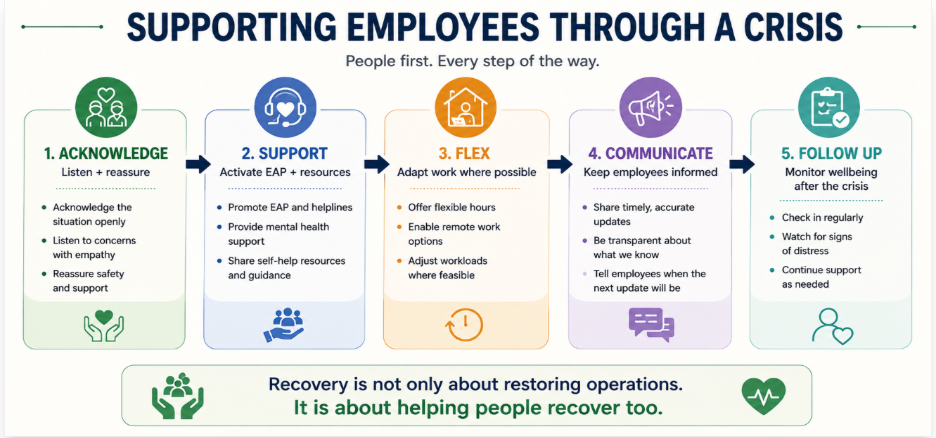
Acknowledge the Human Experience
Employees need to hear that what they are feeling is understood and that their safety matters more than operational metrics. This does not mean abandoning urgency. It means communicating in a way that treats people as people, not as operational variables.
Phrases that work: "We understand this is an anxious time." "Your safety is our first priority." "We do not have all the answers yet, but we are committed to keeping you informed."
Deploy Employee Assistance Programmes Actively
Employee Assistance Programmes (EAPs) offer confidential counselling, mental health support, and practical guidance. In a crisis, passive availability is not sufficient. EAPs need to be actively promoted, with direct links, helpline numbers, and a clear message from senior leadership that using them is encouraged, not stigmatised.
In India, where mental health stigma remains a genuine barrier, the way leadership communicates about EAPs during a crisis can meaningfully affect uptake. Access to professional counselling support during and after a crisis is not a benefit add-on. It is a recovery tool.
Flexible Work Arrangements
Where operationally possible, offer remote work, flexible hours, or reduced targets during the acute phase. This is not a productivity concession. It signals genuine care and reduces the anxiety load employees are already carrying.
Regular, Honest Updates
Uncertainty is a significant driver of anxiety. Even a message that says "we have no new updates yet but will communicate again at 6pm" is better than silence. Regular, predictable communication, even when there is little new information to share, maintains trust and reduces the fear that something is being withheld.
Watch for Delayed Signs
The risk period does not necessarily end when the crisis resolves. Some employees may continue to experience persistent or worsening distress, sleep difficulties, anxiety, low mood, concentration problems, trauma-related symptoms or difficulty returning to usual functioning after normal operations resume. Responses can vary considerably, and workplace monitoring should focus on identifying when someone may need support rather than diagnosing a mental health condition.
Build a structured post-crisis support period into HR planning. Over the following weeks, HR and managers can pay attention to changes in engagement, absenteeism and other workplace patterns, alongside informal check-ins with employees. These changes may indicate that someone could benefit from additional support, but they should not be treated as indicators of a mental health diagnosis.
Train Managers for the Human Response
Managers are often the first organisational point of contact for employees during a crisis. They can be trained to notice observable changes, respond supportively and know when to direct employees towards appropriate professional support.
Training can focus on active listening, appropriate language, boundaries, escalation and referral, rather than expecting managers to identify or diagnose specific mental health conditions. In India, where conversations about mental health are still evolving in many professional settings, this kind of preparation can help managers respond with greater confidence and sensitivity.
Post-Crisis Recovery: Lessons Learned and Building Long-Term Resilience
Recovery is not simply returning to normal. It is an opportunity to understand what happened, address weaknesses and strengthen the organisation's ability to respond to the next disruption.
Conduct a Post-Crisis Review
Within two to four weeks of resolution, bring the Crisis Management Team together for a structured Post-Crisis Review (PCR).
Review:
- What happened and what early warning signs were missed
- How quickly the organisation detected and responded
- What worked well
- What failed or was missing
- The financial, operational, reputational and human impact
- What needs to change in the crisis management plan
The 5 Whys framework can help teams move beyond immediate triggers and identify underlying weaknesses.
Update the Crisis Management Plan
Treat a crisis management plan as a living document. Update scenarios, communication templates, responsibilities, and escalation procedures after significant incidents and serious drills.
An outdated plan can create false confidence because employees may assume they are prepared when the information and processes they rely on are no longer relevant.
Rebuild Trust
Trust is rebuilt through consistent action, not announcements alone.
Organisations should communicate honestly about what happened, explain what has changed and demonstrate those changes over time. Where mistakes were made, acknowledging them can be an important part of rebuilding credibility.
Build Organisational Resilience
Resilience is developed between crises, not during them. Organisations can strengthen resilience by:
- Maintaining backup systems and alternative suppliers
- Testing emergency communication channels
- Running regular crisis simulations
- Training managers to support employees
- Maintaining accessible EAP and wellbeing support
- Reviewing the crisis management plan regularly
- Updating plans when significant operational or regulatory changes occur
ISO 22301 can provide a useful international reference point for business continuity management, while organisations should also consider applicable Indian regulatory and sector-specific requirements.
Conclusion: Build a Crisis-Ready Workplace
Every organisational crisis is also a human experience.
Systems can be restored, data can be recovered and operations can resume. But employees who felt uninformed, unsupported or unprotected may carry that experience long after the immediate crisis has ended.
Effective workplace crisis management therefore needs more than a contingency document. It requires clear leadership, tested processes, responsible communication and meaningful support for employees throughout the crisis management process.
The goal is not to predict every crisis. It is to build an organisation that can respond with clarity, compassion and confidence when the unexpected happens.
Support your employees before a crisis becomes a crisis
An Employee Assistance Programme can give employees confidential access to professional support when they are dealing with workplace stress, personal challenges or the emotional impact of a difficult event.
Explore 1to1help's Employee Assistance Programme
For organisations looking to strengthen employee wellbeing and crisis preparedness, 1to1help provides EAP solutions including confidential counselling, crisis support, manager support and wellbeing resources.
Disclaimer: This guide is intended for HR professionals, business leaders, and organisational risk practitioners. It does not constitute legal advice. For regulatory compliance specific to your industry or organisation, consult qualified legal counsel familiar with Indian law.
FAQs
Q1. What is the meaning of crisis management in the workplace?
Workplace crisis management is the structured approach an organisation uses to prepare for, respond to and recover from events that threaten its people, operations or reputation. It includes planning, crisis response, communication, recovery and continuous improvement.
Q2. What are the key steps of crisis management?
The main crisis management steps are:
- Conduct a risk assessment
- Form a Crisis Management Team
- Define crisis activation triggers
- Build communication protocols
- Create scenario-specific playbooks
- Test, review and refine the plan
After a real crisis, a Post-Crisis Review should be used to identify lessons and update the plan.
Q3. How do you manage a crisis at work effectively?
Effective crisis management starts before an incident occurs. Organisations should have a documented plan, trained decision-makers, clear escalation procedures and tested communication channels. During a crisis, prioritise safety, activate the CMT, communicate confirmed information and establish clear decision-making authority. Recovery should include employee support and a formal review.
Q4. What is a crisis management plan and why does every organisation need one?
A crisis management plan (CMP) defines who does what, when they act, how decisions are made and how information is communicated during a crisis.
It helps reduce confusion and delays by giving employees and leaders a tested framework to follow when normal processes are disrupted.
Q5. What is the role of HR during a workplace crisis?
HR plays a key role in the human side of crisis management. Its responsibilities can include employee safety and communication, workforce continuity, applicable legal and policy requirements, access to EAP support and post-crisis wellbeing. HR also helps managers support employees while maintaining appropriate professional boundaries.
Q6. How should a company communicate during a workplace crisis?
Crisis communication should be fast, factual, empathetic and consistent. Communicate internally before employees learn about the situation through external sources, use more than one communication channel and clearly distinguish confirmed information from what is still being investigated.
Always tell people when they can expect the next update.
Q7. What are common examples of workplace crises affecting Indian organisations?
Common examples include:
- Cybersecurity incidents and data breaches
- Floods, cyclones and other natural disasters
- Industrial accidents
- Supply chain disruption
- Labour disputes
- Financial crises
- Sudden leadership changes
- Public health emergencies
- POSH-related incidents that escalate into wider organisational concerns
Each crisis requires a response appropriate to its specific risks, stakeholders and regulatory requirements.
References
- Asana. (2025, October 13). Crisis management plan: 6 steps, team & checklist guide. Asana
- Factorial. (2025, April 9). Navigating crisis management in the workplace. Factorial
- Folsom, S., & Garretson, R. (2020, June 1). How to conduct a post-crisis evaluation. Risk Management Magazine. Risk Management Magazine
- Holtom, B., Edmondson, A. C., & Niu, D. (2020, July 9). 5 tips for communicating with employees during a crisis. Harvard Business Review. Harvard Business Review
- International Organization for Standardization. (2019). ISO 22301:2019: Security and resilience: Business continuity management systems: Requirements. ISO
- Lean Enterprise Institute. (n.d.). The 5 Whys. Lean Enterprise Institute
- Ministry of Electronics and Information Technology. (2025, November 13). Digital Personal Data Protection Rules, 2025. Government of India. Digital Personal Data Protection Rules, 2025
- National Foundation for Food Safety. (2020, October 21). Creating a successful crisis management plan. NSF. NSF
- Mayo Clinic. (n.d.). Post-traumatic stress disorder (PTSD): Symptoms and causes. Mayo Clinic
- PwC. (2019, June 3). 69% of business leaders have experienced a corporate crisis in the last five years yet 29% of companies have no staff dedicated to crisis preparedness. PwC Global Crisis Survey
- Securities and Exchange Board of India. (n.d.). Regulations. SEBI regulations
- AIHR. (n.d.). The HR role in crisis management: How to enhance preparedness and prevention. AIHR
- Teale. (2025, August 22). Crisis management in the workplace: How to anticipate, respond, and recover effectively. Teale


.svg)
.svg)
.svg)
.svg)