




.png)

Personal Life & Relationships
Live-In Relationships in India: Meaning, Laws, Rights, and Emotional Realities
.jpg)
.png)
Written by
Aarohi Parakh,
Psychologist and Content Writer

Reviewed by
Sanjana Sivaram,
Psychologist and Clinical Content Head


Introduction
More couples across Indian cities are choosing to live together outside of marriage, drawn by the promise of independence, the opportunity to understand long-term compatibility more deeply, and shared living costs. Yet many enter these arrangements with little understanding of what the law actually says, what protections exist, and what emotional realities tend to surface once you share a home.
In India, live-in relationships are legally recognised, not through a specific "live-in relationship act," but through a combination of landmark Supreme Court judgments and the Protection of Women from Domestic Violence Act, 2005.
This article brings together everything you might want to know, from the legal framework and the landmark Uttarakhand Uniform Civil Code (UCC) of 2025 to the psychological terrain that cohabiting couples often navigate.
What is the Meaning of a Live-In Relationship?
A live-in relationship generally refers to an arrangement where two people who are not legally married choose to live together in a shared home, typically with the intention of building a committed partnership. It differs from a casual arrangement in that it tends to involve a degree of emotional investment, shared domestic responsibilities, and a degree of mutual commitment, such as emotional exclusivity, long-term planning, shared decision-making, or supporting each other through everyday life, even without the formalisation of marriage.
In Indian law, the Supreme Court has used a more precise phrase: a relationship "in the nature of marriage." This formulation, which emerged from the landmark Velusamy vs D. Patchaiammal (2010) judgment, is important because it sets a legal threshold. Not every live-in arrangement automatically qualifies for legal protection. The courts have held that for a live-in relationship to attract the protections available under the Protection of Women from Domestic Violence Act, 2005, it must have certain characteristics that make it resemble a marriage in substance:
- Both parties should be of legal age,
- Both should be unmarried (not in a subsisting marriage, i.e., a legal, existing marriage that has not been terminated by divorce, annulment, or the death of a spouse), and
- The couple should have lived together for a meaningful period while presenting themselves publicly as partners.
It is also worth understanding the social landscape in which live-in relationships are becoming more visible in India. Urbanisation, economic independence among women, inter-faith and inter-caste partnerships, delayed marriage, and work-related migration are all contributing to a gradual, if uneven, shift in how younger Indians approach long-term relationships. The trend is most pronounced in metro cities, though it is slowly making its way into smaller cities and university towns.
It is also important to note that live-in relationships in India are not limited to heterosexual couples. Following the Supreme Court's recognition of LGBTQ+ rights in Navtej Singh Johar vs Union of India (2018), queer couples increasingly choose cohabitation as a way of building committed partnerships, particularly in the absence of legal marriage recognition for same-sex couples in India as of May 2026. However, queer couples may face additional legal ambiguity, housing discrimination, and social stigma compared to heterosexual couples.

Is Live-In Relationship Legal in India?
The short answer is yes. Live-in relationships between two consenting, unmarried adults are legal in India. They are not a criminal offence, and the courts have been clear on this. However, the legal landscape is more nuanced than a simple yes-or-no answer might suggest, so it is worth understanding how this recognition came about and what it actually means in practice.
The Foundation: Supreme Court Judgments
There is no single Indian legislation called the "Live-in Relationship Act." Instead, legal recognition has been built through a series of Supreme Court rulings that have progressively established the rights of people in such relationships.
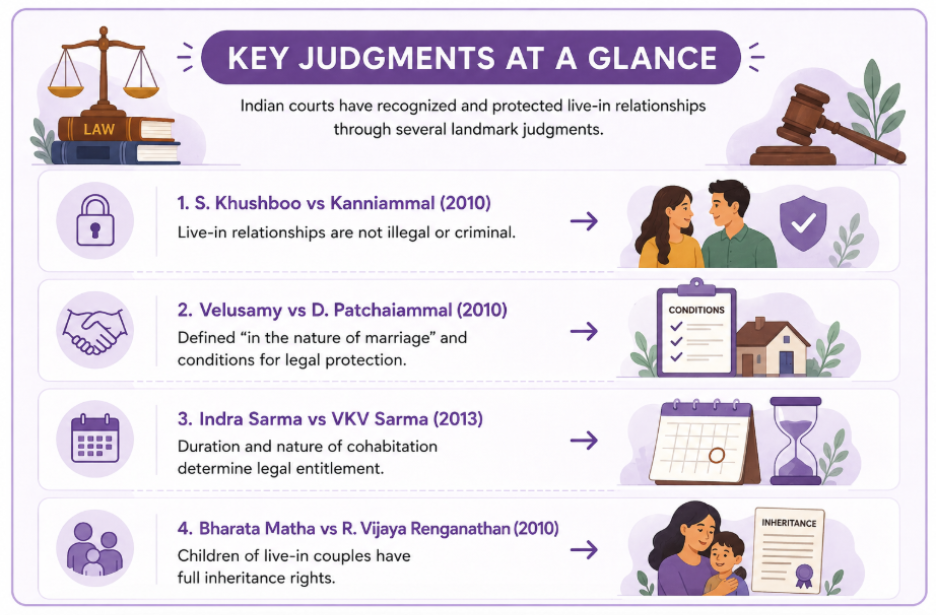
S. Khushboo vs Kanniammal (2010) is often considered the foundational ruling. The Supreme Court held that live-in relationships between consenting adults cannot be treated as an offence. The court noted that while such arrangements may attract moral or social disapproval in certain communities, they are not illegal under any Indian law. This judgment was particularly significant because it directly challenged the notion that cohabitation outside marriage is inherently criminal or immoral.
Velusamy vs D. Patchaiammal (2010) added an important nuance. The court defined what kind of live-in relationship qualifies as being "in the nature of marriage" and therefore entitles a woman to legal protection under the Domestic Violence Act. The conditions laid down were: both partners must be of legal age, both must be unmarried, they must have voluntarily cohabited for a significant period, and they must have presented themselves to the world as a couple. A brief liaison would not typically meet this threshold.
Indra Sarma vs VKV Sarma (2013) further expanded the court's thinking. The Supreme Court noted that the duration and nature of the relationship are key determinants of legal entitlement, reinforcing that short-term or informal encounters do not create the same obligations as a long-standing cohabiting partnership.
Bharata Matha vs R. Vijaya Renganathan (2010) addressed the rights of children born from such relationships. The court ruled that these children are legitimate and have inheritance rights under Section 16 of the Hindu Marriage Act, 1955, which was a significant development in protecting children who might otherwise have been left legally vulnerable.
A Significant Development: The Uttarakhand UCC 2025
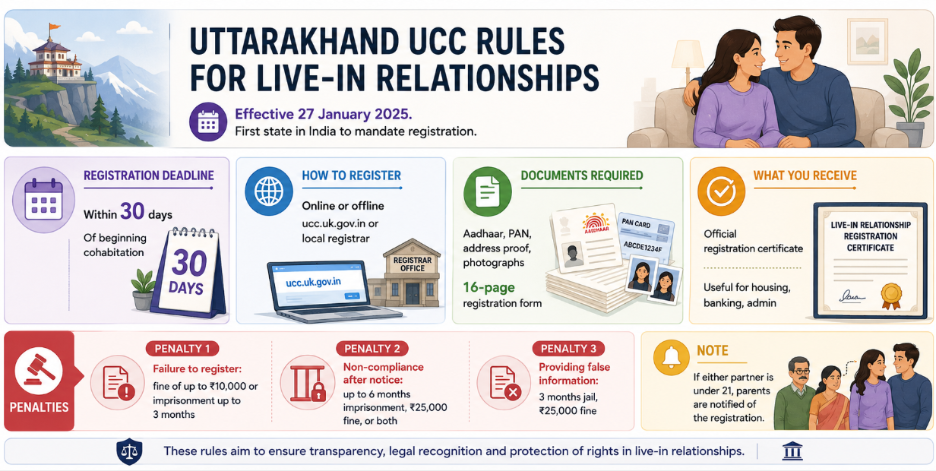
In January 2025, Uttarakhand became the first Indian state to do something quite significant: it mandated the registration of live-in relationships under its Uniform Civil Code (UCC), which came into effect on 27 January 2025. This is the most significant legal development in this space since the Supreme Court rulings of 2010, and we discuss it in detail in the next section.
Live-in relationship rules in India — The Legal Framework and Uttarakhand UCC
If you are wondering about the specific rules that govern live-in relationships in India, the answer depends partly on where you live. There are general conditions that apply nationwide based on Supreme Court jurisprudence, and there are also specific rules that now apply in Uttarakhand under the new Uniform Civil Code.
General rules under Indian law (nationwide)
✓ Both partners must be adults (18 years or older for women; 21 years or older for men)
✓ Both must be unmarried and not in any other subsisting marriage
✓ The relationship must be consensual
✓ The couple should have cohabited for a meaningful period
✓ No central law currently requires formal registration (Uttarakhand is the exception)
The Uttarakhand UCC 2025: What Changed and Why It Matters
The Uttarakhand Uniform Civil Code is, by most accounts, a landmark piece of legislation. It introduced mandatory registration for live-in relationships in the state, a first for India. Here is what couples in Uttarakhand, or couples with Uttarakhand residency, need to be aware of:
The Live-In Relationship Certificate
One practical outcome of registering under the Uttarakhand UCC is that couples receive an official certificate of registration. This document can serve as proof of the relationship for a range of administrative purposes, including opening joint bank accounts, applying for housing, and other situations where couples might otherwise struggle to demonstrate their partnership without a marriage certificate. For those living in Uttarakhand, this certificate represents a meaningful upgrade in legal recognition.
Prohibited Relationships Under the UCC
The Uttarakhand UCC also specifies 74 prohibited relationship types, mirroring the prohibitions on marriage, primarily involving close family ties and specific degrees of kinship. Outside these prohibitions, any two consenting unmarried adults who meet the age criteria may register.
The National Picture as of May 2026
At the time of writing, no central law mandates registration of live-in relationships across India. Discussions about a nationwide UCC have been ongoing, and several other states, including Uttar Pradesh, Gujarat, and Assam, have signalled interest in following Uttarakhand's lead. However, no such legislation has been enacted at the central level as of May 2026. Outside Uttarakhand, the legal framework for live-in relationships continues to rest on Supreme Court jurisprudence and the Protection of Women from Domestic Violence Act.
💡Pro-tip: If you are in Uttarakhand or have Uttarakhand residency, check whether your relationship requires registration under the UCC. The 30-day window from commencement of cohabitation is strict, and missing it can carry legal consequences. You can begin the process at ucc.uk.gov.in.
Legal Rights of Women in Live-In Relationships in India
One of the most important things for women in live-in relationships to understand is that legal protection exists, though it is not automatic as it is for marital rights. The key statute is the Protection of Women from Domestic Violence Act, 2005 (DVPA), which was extended to cover women in live-in relationships "in the nature of marriage" through the very judgments discussed earlier. Unlike marriage, where certain legal rights and obligations arise automatically upon formalisation, women in live-in relationships may first need to establish that the relationship was stable, long-term, and marriage-like in nature before certain protections can apply.
What the Velusamy Criteria Mean in Practice
For a woman to access DVPA protections, her relationship needs to meet the conditions set out in Velusamy vs D. Patchaiammal (2010):
- both partners were of legal age at the time of cohabitation,
- both were unmarried,
- the relationship was voluntary,
- it lasted for a significant period, and
- the couple presented themselves as a couple to their social world.
If these conditions are met, the relationship is treated as being "in the nature of marriage" for the purposes of the Act.
Rights under the DVPA:
✓ Right to residence: The right to continue living in the shared home
✓ Protection orders: The right to seek court orders protecting against abuse or harassment
✓ Maintenance: The right to claim financial maintenance from the partner
✓ Compensation: The right to seek compensation for losses suffered as a result of domestic violence
✓ Child custody: Rights in relation to the custody of children born from the relationship
The Uttarakhand UCC Addition
Under the Uttarakhand UCC, women in registered live-in relationships have an additional right: the right to claim maintenance if the relationship is abandoned. This is a meaningful upgrade from the pre-UCC position in the state and represents one of the tangible benefits of registration beyond the administrative certificate.
What About Men's Legal Rights?
Indian law currently does not provide an equivalent gender-neutral framework for men in live-in relationships comparable to the protections available to women under the DVPA. Men may still pursue remedies through general civil law, property law, child custody proceedings, or criminal law where relevant, but there is no dedicated legislation specifically protecting male partners in cohabiting relationships. This legal asymmetry is an important part of the broader public debate around live-in relationship rights in India.
Rights of Children Born in a Live-In Relationship in India
A question that many couples think about, or perhaps worry about, concerns the legal standing of children born from a live-in relationship. The Supreme Court has been reasonably clear on this point.
In Bharata Matha vs R. Vijaya Renganathan (2010), the Supreme Court ruled that children born to unmarried parents in a live-in relationship are legitimate and may have inheritance rights under Section 16 of the Hindu Marriage Act, 1955. This was a significant development because it extended protections that had previously applied mainly to children born from void or voidable marriages.
However, these protections are not automatic in every live-in relationship and generally depend on factors such as the nature, stability, and duration of the relationship being recognised by the court as resembling a marriage.
The Uttarakhand UCC and Children
Under the Uttarakhand UCC, children born in registered live-in relationships have explicit legal recognition and inheritance rights within the state's new framework. While this largely reflects what the Supreme Court had already established nationally, registration provides additional documentary clarity, which may be useful for administrative purposes such as school admissions, passport applications, and other situations where proof of parentage is required.
Custody after Separation
In the event that a live-in relationship ends, custody of any children is determined by the same standard applied in divorce proceedings: the best interest of the child. Neither parent's relationship status, nor the absence of a legal marriage, affects this determination. Courts will weigh factors such as the child's age, relationship with each parent, stability of the home environment, and the child's own expressed wishes (where appropriate).
Advantages of Live-In Relationships
There are genuine, substantive reasons why many couples choose to cohabit before or instead of marriage. Understanding these not just superficially but in their fuller psychological and practical dimensions can help you make a more informed decision.
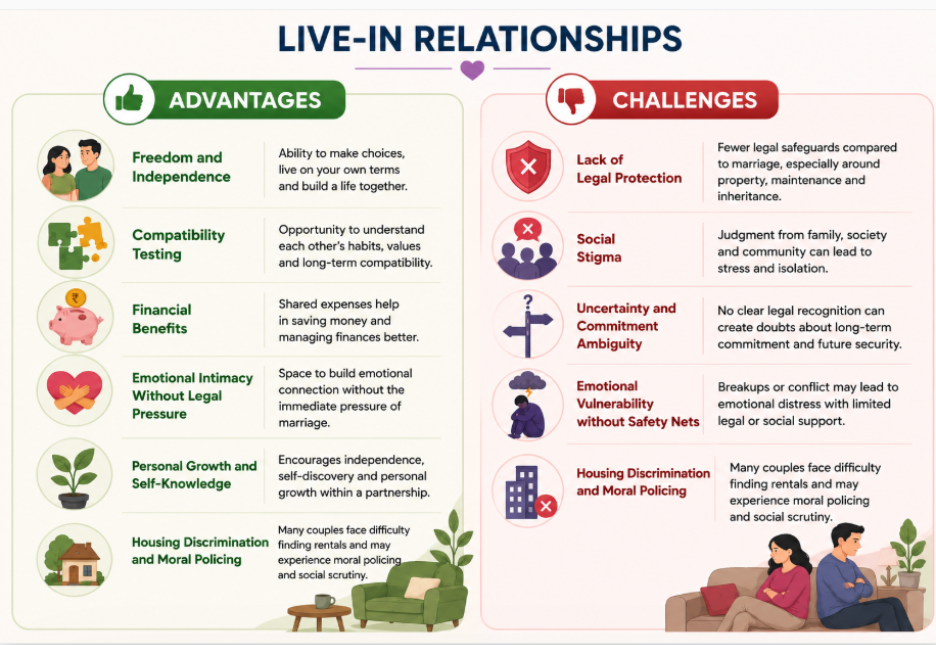
Freedom and Independence
Living together without legal binding tends to preserve a stronger sense of individual identity. Research in relationship psychology, notably Esther Perel's work on desire and autonomy, suggests that relationships where both partners maintain distinct identities tend to report higher long-term satisfaction. For women from more conservative backgrounds in India, independent cohabitation may represent a genuinely new experience of personal agency within a relationship.
Compatibility Testing
Relationship researcher John Gottman's work has long suggested that daily habits, emotional regulation during conflict, and lifestyle compatibility shape long-term relationship satisfaction. Living together reveals these dimensions in ways that dating simply cannot. You learn how your partner deals with stress, how they communicate when tired, what their standards are around shared space, and how they handle disagreement.
Financial Benefits
In metro cities like Mumbai, Bengaluru, and Delhi, shared accommodation can save anywhere from ₹10,000 to ₹30,000 per month in rent alone, depending on the locality. For young professionals who have relocated for work and are independently managing significant living costs, this can be a meaningful practical consideration.
Emotional Intimacy Without Legal Pressure
For individuals who have experienced difficult family situations, previous relationship breakdowns, or personal trauma, a live-in arrangement may allow the development of genuine emotional intimacy without the additional weight of legal commitment. The ability to build trust gradually, at one's own pace, has real psychological value and should not be dismissed as emotional avoidance.
Personal Growth and Self-Knowledge
Sharing a home with a partner in a non-legally-bound arrangement often accelerates self-awareness in ways that dating does not. You begin to notice your own triggers, the patterns you bring into conflict, the kind of space you need, and the ways in which you show up for another person. This kind of self-knowledge can be genuinely useful regardless of where the relationship eventually goes. It can help individuals develop greater self-awareness and develop insights for self-development and growth.
Challenges and Disadvantages of Live-In Relationships
It would be incomplete, and ultimately unhelpful, to talk about the advantages of live-in relationships without acknowledging the very real challenges that tend to emerge. These are not reasons to avoid cohabitation, but they are worth going in with open eyes about.
Lack of Legal Protection
Outside Uttarakhand, property division in the event of a separation remains legally ambiguous. A jointly maintained home, shared savings, or accumulated assets have no automatic legal framework governing their division. One practical safeguard some couples consider is a cohabitation agreement, a document (ideally drafted with a lawyer's help) that records each partner's financial contributions and intentions regarding shared assets.
Social Stigma
Stigma around live-in relationships operates very differently across India's urban-rural divide and across generations. Metro cities tend to be more accepting, but family disapproval remains a significant and emotionally costly reality for many couples. For inter-faith or inter-caste couples, the stigma can be amplified considerably. The psychological toll of navigating family rejection while simultaneously managing a new shared living arrangement is real and deserves to be taken seriously.
Uncertainty and Commitment Ambiguity
Attachment theory research suggests that ambiguous commitment can heighten anxiety in relationships, particularly for those with anxious attachment styles. When one partner desires more formality or clarity about the future and the other does not, this imbalance can become a persistent source of relationship distress. Acknowledging this dynamic honestly, rather than suppressing it to preserve the peace, tends to be more effective in the long run.
Emotional Vulnerability without Safety Nets
In a marriage, legal protections create an implicit commitment architecture that shapes how partners navigate conflict. In a live-in relationship, the possibility of exit is more real and more immediate, which can paradoxically make couples less willing to have difficult but necessary conversations. This pattern, of avoiding hard topics to protect the relationship's fragility, is one of the leading causes of unresolved tension in long-term live-in relationships.
Housing discrimination and moral policing
Many live-in couples in India, particularly unmarried and queer couples, continue to face practical barriers in securing rental housing. Landlords, housing societies, and resident welfare associations (RWAs) may refuse accommodation on the basis of marital status, religion, caste, or sexual orientation. In some cases, couples also encounter moral policing, social scrutiny, or intrusive questioning from neighbours and local communities. The emotional strain of constantly having to justify or conceal one's relationship can become an additional source of stress within the partnership itself.
Live-In Relationship vs Marriage — Key Differences
Couples often find themselves wondering how a live-in relationship compares to marriage, not just legally but emotionally and socially. Neither arrangement is inherently superior. The right choice tends to depend on individual values, family context, personal readiness, religious beliefs, and life circumstances. What follows is a factual comparison across five key dimensions.
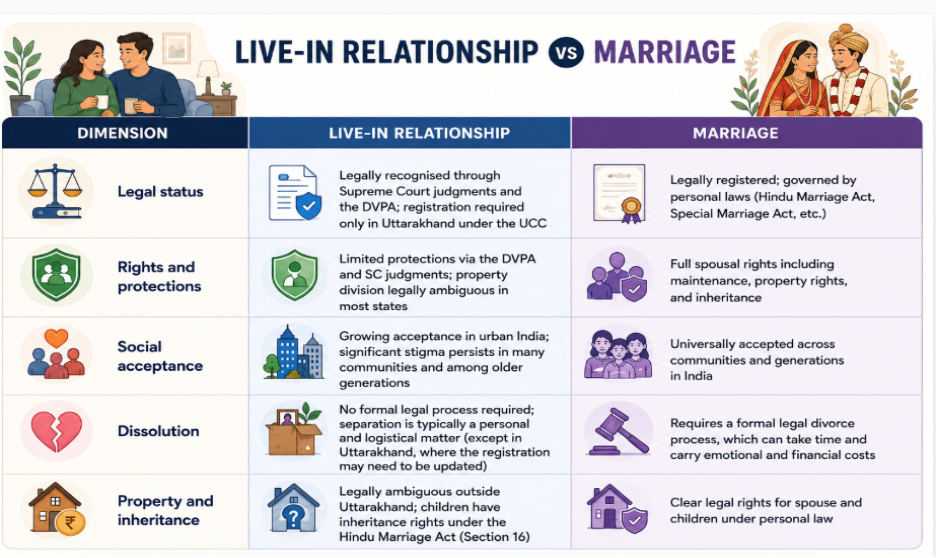
Marriage can provide clearer legal and social markers of commitment, which some individuals may find emotionally reassuring. At the same time, marriage can also bring its own expectations and pressures. In contrast, live-in relationships may offer greater flexibility and autonomy, though some partners may experience more uncertainty. Regardless of the structure, both relationships rely on the same core foundations: communication, conflict resolution, emotional maturity, and mutual respect.
It is also worth noting that many Indian couples, particularly in urban areas, increasingly view a live-in period as a form of compatibility trial before a love or arranged marriage. This is a valid approach, but it works best when both partners have had an honest conversation about their long-term intentions from the outset. Entering a live-in relationship with different unspoken assumptions about where it is heading is one of the more common sources of heartbreak down the line.
Note: For many queer couples in India, live-in relationships are not simply a preference but one of the few socially and legally accessible forms of long-term partnership currently available.
The Emotional Realities of Living Together — What Couples Often Don't Expect
This is perhaps the dimension that receives the least coverage in most discussions about live-in relationships, and yet it is often the one that matters most in practice.
The Adjustment Phase is Almost Universal
The first three to six months of cohabitation are, for the vast majority of couples, more challenging than anticipated, regardless of how well they knew each other beforehand. Personalities, habits, routines, sleep schedules, standards of cleanliness, and conflict styles that were invisible in a dating context become very visible, and sometimes difficult to adjust to, in a shared living arrangement. Knowing this in advance does not make it entirely smooth, but it does help to normalise the experience rather than interpreting early friction as a sign that something is fundamentally wrong.
Attachment Styles and Live-In Relationships
Secure, anxious, and avoidant attachment patterns tend to play out quite differently in cohabitation than they do in dating.
🟢Secure Attachment
Tends to navigate cohabitation with more ease; can express needs without fear of abandonment; comfortable with interdependence and individuality coexisting
🟡Anxious attachment
May experience heightened insecurity without the legal safety net of marriage; the absence of formal commitment can amplify fears of abandonment and trigger reassurance-seeking behaviour
🟤Avoidant attachment
May feel their personal space or independence is threatened by high levels of emotional closeness, constant proximity, or frequent demands for reassurance, and may respond by emotionally withdrawing. To the other partner, this can sometimes come across as indifference or lack of care
💡Key Insight: Understanding your own attachment style, and your partner's, is not about labelling or pathologising. It is about being able to name what you are experiencing and communicate it more effectively. A counsellor trained in attachment-informed approaches can be particularly helpful in this regard.
The Commitment Ambiguity Paradox
When two partners do not share the same implicit expectations about where a relationship is heading, a difficult dynamic can develop. The partner who wants more formality or clarity often suppresses their needs to avoid rocking the boat. Over time, this emotional suppression tends to build into resentment, and when it eventually surfaces, it can feel explosive and disproportionate to what triggered it. The issue was not the last argument; it was everything that came before it that was never said. This pattern is one of the more common drivers of breakups in long-term live-in relationships that might otherwise have been navigable.
Social Isolation
Couples who face family disapproval of their live-in arrangement often find themselves in a peculiar kind of isolation. They may not be able to celebrate milestones openly, may be excluded from family occasions, and may find their social support network quietly contracting. This isolation, which can happen gradually and without anyone fully acknowledging it, adds a layer of stress to an arrangement that is already navigating its own emotional terrain.
Separation without a Script
Ending a live-in relationship involves dividing a shared home, untangling shared finances, and navigating a shared social world, all without the legal framework that makes divorce, painful as it is, at least structured. The logistical and emotional complexity of this process is underacknowledged. Professional support during and after a live-in breakup can significantly ease the transition and help both partners process what happened with greater clarity.
Factors to Consider Before Moving In Together
The decision to move in together is worth approaching with some deliberateness. Here are some of the more important things to think through, ideally together, before you sign that lease.
Open communication about the relationship's direction
It is worth having an honest conversation, before you move in, about where you each see the relationship going. This does not need to be a pressure-laden "define the relationship" moment. It is simply about making sure both partners are broadly aligned on their expectations, so that one person is not quietly counting down to a proposal while the other is treating the arrangement as open-ended indefinitely.
Financial Transparency
Before moving in, discuss each other's income broadly, debts, spending habits, and financial expectations. Agree on how rent and utilities will be split, and whether any joint financial arrangements, such as a shared account for household expenses, make sense. Financial misalignment is one of the most reliably cited sources of tension in cohabiting relationships.
Respect, Equality, and boundaries
Cohabitation tends to surface assumptions about gender roles and domestic labour more quickly than dating does. It is useful to discuss, in advance, how household responsibilities will be divided and to be honest about each other's expectations. The absence of traditional gendered role structures can be a genuine freedom in a live-in relationship, but only if both partners actively engage with it rather than defaulting to unspoken assumptions.
Legal Preparedness
Understanding your legal rights before you move in is a sensible step, not a pessimistic one. If you are in Uttarakhand, be aware of the UCC registration requirement and the 30-day timeline. If you are elsewhere in India and moving in with someone, it may be worth noting that without a cohabitation agreement, your financial contributions to shared property will have limited legal protection if the relationship ends.
Exit Clarity
One of the more uncomfortable but genuinely useful conversations to have before moving in together is a brief one about what separation would look like, practically speaking: who would stay in the shared home, how shared belongings would be handled, and what would happen to any joint financial accounts. Having this conversation before it becomes emotionally charged makes it much easier to navigate.
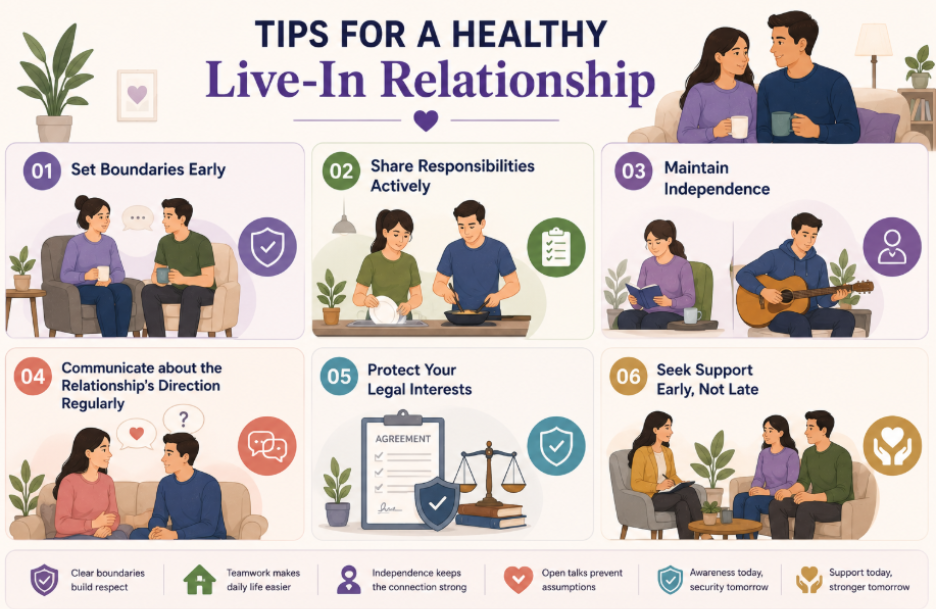
Tips for a Healthy Live-In Relationship
Cohabitation, like any significant relationship commitment, tends to go better with some intentional practices in place. Here are some that tend to make a meaningful difference.
Set Boundaries Early
Boundaries in a shared home include personal space, time spent alone versus together, standards for hosting guests, sharing the relationship on social media, and, in the Indian context, how family visits and parental involvement are handled. These conversations can feel slightly awkward at the beginning, but they tend to prevent much more uncomfortable conflicts later.
Share Responsibilities Actively
Rather than waiting to see who picks things up or falls into default patterns, try conducting an explicit audit of household tasks early on and agreeing on who does what. The goal is not an exact 50-50 split but a distribution that both partners feel is fair and sustainable. Revisit this periodically, as circumstances change.
Maintain Independence
Esther Perel's observation that desire often requires a degree of distance is worth taking seriously. Couples who maintain their individual friendships, hobbies, and personal time tend to report more sustained relationship vitality than those who merge completely into each other's lives. Independence is not distance. It is what makes coming home to each other feel like a genuine choice rather than a default.
Communicate about the Relationship's Direction Regularly
Not every conversation needs to be a high-stakes discussion about the future. But checking in with each other periodically about how the arrangement feels, what each of you might need more or less of, and where you both see things heading, tends to prevent the quiet accumulation of unspoken expectations that can corrode a relationship over time.
Protect your Legal Interests
Keep records of significant financial contributions you make to shared assets. If the relationship involves substantial shared financial commitments, a brief consultation with a lawyer about a cohabitation agreement may be worthwhile. For couples in Uttarakhand, remember to register within the 30-day window under the UCC.
Seek Support Early, not Late
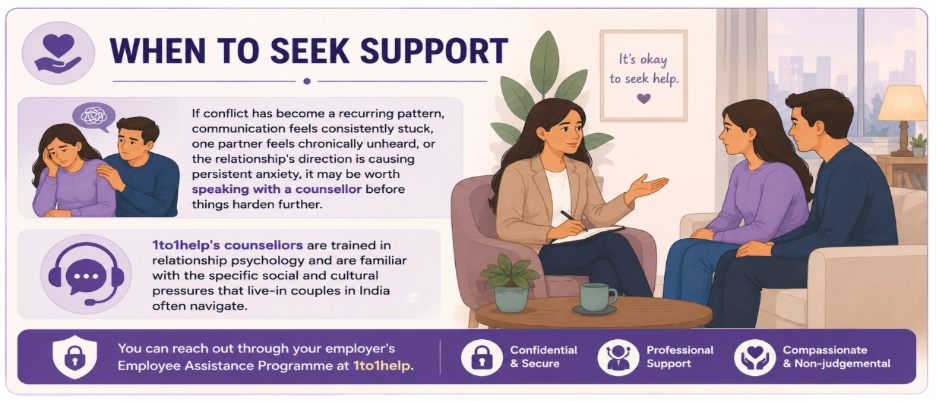
If conflict is becoming a pattern, or if communication feels consistently stuck, a few sessions with a relationship counsellor can often course-correct before patterns become entrenched. If your employer offers an Employee Assistance Programme (EAP), counselling through it is typically confidential and provided at no direct cost to you.
Common Myths About Live-In Relationships in India
A number of persistent myths surround live-in relationships in India. Some are simply outdated. Others are actively harmful because they prevent people from seeking legal protections they are entitled to. Here are five worth addressing directly.
Myth: Live-in relationships are illegal in India
Fact: This is false. The Supreme Court has unequivocally held, most clearly in S. Khushboo vs Kanniammal (2010), that live-in relationships between consenting unmarried adults are not illegal and cannot be treated as a criminal offence. The persistence of this myth is harmful because it leads couples to avoid seeking legal protection when they genuinely need it.
Myth: Women have no legal rights in a live-in relationship
Fact: Women in live-in relationships that qualify as being "in the nature of marriage" have meaningful rights under the DVPA, including the right to residence, maintenance, protection orders, and compensation. In Uttarakhand, registered relationships confer additional maintenance rights. These protections are real, if imperfect, and women should be aware of them.
Myth: Live-in relationships lead to a lack of commitment
Fact: Commitment is fundamentally behavioural, not documentary. Gottman Institute research consistently shows that what predicts long-term relationship success is how couples treat each other day to day, not whether they have signed a legal document. Couples who choose each other deliberately and consistently demonstrate a form of commitment that is arguably more active than one maintained by legal default.
Myth: Live-in relationships are only a stepping stone to marriage
Fact: While many couples do use a live-in period as a way of assessing compatibility before marriage, many others, in India and globally, choose long-term cohabitation as their preferred relationship structure. This is a valid, thoughtful adult choice and not a sign of indecision or emotional immaturity. What matters is that both partners are on the same page about it.
Myth: Live-in relationships are only for the young
Fact: Divorced individuals, widowed adults, and older professionals who value independence while seeking companionship are increasingly choosing live-in arrangements. The UCC's age provisions apply to any consenting adult (18+ for women, 21+ for men), with no upper age limit. The reasons someone might choose cohabitation over remarriage at 55 may be quite different from those at 28, but neither is less valid.
Conclusion
Choosing to live together outside of marriage is, at its heart, a deeply personal decision, one that sits at the intersection of individual values, relationship readiness, family context, and practical circumstances. What this article has tried to offer is a clearer picture of what that decision actually involves in India today: the legal recognition that does exist (and what it requires to access), the significant legal developments brought about by the Uttarakhand UCC in 2025, and the emotional realities that tend to emerge once the initial excitement of setting up a shared home gives way to the everyday texture of living together.
There is no single right answer about whether a live-in relationship is the right choice. What tends to matter more than the choice itself is the degree of honesty and communication that goes into making it, and the willingness to seek support when the going gets difficult.
Whether it is managing family disapproval, navigating recurring conflict, adjusting to cohabitation, rebuilding trust, or processing the uncertainty that can sometimes emerge in live-in relationships, professional support can make a meaningful difference. 1to1help's counsellors are trained in relationship psychology and understand the unique cultural, familial, and social pressures that couples in India often navigate. Through your organisation's Employee Assistance Programme (EAP), you may already have access to confidential counselling support at no direct cost to you. Seeking help early is not a sign that a relationship is failing; often, it is what helps prevent disconnection from becoming entrenched.
FAQs
Q1. Is a live-in relationship legal in India?
Yes, live-in relationships between consenting unmarried adults are legal in India. The Supreme Court established this clearly through multiple landmark judgments, most notably S. Khushboo vs Kanniammal (2010) and Velusamy vs D. Patchaiammal (2010). There is no central legislation that specifically registers or governs live-in relationships, though Uttarakhand became the first state to mandate registration under its Uniform Civil Code (UCC), effective 27 January 2025. Across India more broadly, live-in relationships are legally recognised through the Protection of Women from Domestic Violence Act, 2005, and through Supreme Court jurisprudence, particularly when the relationship qualifies as being "in the nature of marriage."
Q2. What are the rules for a live-in relationship in India?
Under general Indian law, the core conditions for a legally recognised live-in relationship are: both partners must be adults (18+ for women, 21+ for men); both must be unmarried and not in any subsisting marriage; the relationship must be consensual; and the couple should have cohabited for a meaningful period while presenting themselves as a couple. No central registration is required across India. In Uttarakhand specifically, the UCC (effective January 2025) mandates registration within 30 days of cohabiting, either online at ucc.uk.gov.in or offline at the local registrar's office. Failure to register in Uttarakhand can result in fines of up to ₹10,000 or imprisonment of up to three months.
Q3. What rights does a woman have in a live-in relationship in India?
Women in live-in relationships that qualify as being "in the nature of marriage" under the Supreme Court's Velusamy criteria have rights under the Protection of Women from Domestic Violence Act, 2005. These include: the right to continue residing in the shared home; the right to seek protection orders; the right to claim maintenance; and the right to compensation for domestic violence. In Uttarakhand, women in registered live-in relationships can also claim maintenance if the relationship is abandoned under the UCC. Children born from live-in relationships have full inheritance rights under Section 16 of the Hindu Marriage Act, 1955, as established by the Supreme Court in Bharata Matha vs R. Vijaya Renganathan (2010).
Q4. What is the Uttarakhand UCC, and how does it affect live-in relationships?
The Uttarakhand Uniform Civil Code (UCC), effective 27 January 2025, made Uttarakhand the first Indian state to mandate registration of live-in relationships. Under the UCC, couples must submit a "statement of live-in relationship" to the district registrar within 30 days of beginning cohabitation. Both online and offline registration options are available. Required documents include Aadhaar, PAN, proof of residence, and photographs. Couples receive an official registration certificate on approval, which can be useful for housing, banking, and administrative purposes. Penalties for non-registration range from fines of ₹10,000 to imprisonment of up to three months. Women in registered relationships gain the additional right to maintenance if abandoned. Several other states have signalled interest in adopting similar frameworks, though none had enacted legislation as of May 2026.
Q5. What are the emotional challenges of a live-in relationship?
The most commonly experienced emotional challenges in live-in relationships include: an adjustment phase in the first few months, when differences in habits, routines, and conflict styles become more visible; attachment anxiety, where uncertainty about long-term commitment can heighten insecurity, particularly for those with anxious attachment styles; commitment ambiguity, where partners with different expectations about the future may fall into patterns of suppressing important conversations; social isolation when family disapproval cuts couples off from their wider support networks; and the complexity of separation, which involves dividing a shared life without the structured framework that legal divorce provides. If you or your partner are navigating any of these challenges, speaking with a relationship counsellor provides a confidential, structured space to work through them. You can reach 1to1help's counsellors through your employer's EAP or at 1to1help.com.
Recommended Reading
References
- Cambridge University Press. (n.d.). Annulment. In Cambridge Dictionary
- Cleveland Clinic. (n.d.). Attachment styles.
- Government of Uttarakhand. (2025). Uniform Civil Code portal. UCC Uttarakhand
- Government of India. (2005). The Protection of Women from Domestic Violence Act, 2005. India Code
- HelpGuide.org. (n.d.). Relationship help.
- IndiaFilings. (n.d.). Live-in relationships in India.
- Indian Kanoon. S. Khushboo vs Kanniammal & Anr.
- Indian Kanoon. Velusamy vs D. Patchaiammal.
- Indian Kanoon. Indra Sarma vs V.K.V. Sarma.
- Indian Kanoon. Bharata Matha & Anr vs R. Vijaya Renganathan & Ors.
- Indian Kanoon. Section 16, Hindu Marriage Act, 1955.
- Indian Kanoon. Relevant Supreme Court observations on live-in relationships.
- Insights on India. (2025). Live-in relationship.
- Institute for Family Studies. (n.d.). Seven questions for couples to consider before moving in together. Institute for Family Studies
- Lloyd Law College. (n.d.). Legal rights of live-in partners in India.
- Marriage.com. (n.d.). Advantages of live-in relationships.
- Perel, E. (2016). Mating in captivity. Discussed in The Marginalian
- Priya, A. (n.d.). Legal status of live-in relationships. Drishti Judiciary
- PubMed Central (PMC). (2016). Attachment styles, relationship functioning, and psychological wellbeing.
- SCC Online. (2021). Live-in relationships: Social myths, legal realities and the way forward. SCC Online Blog
- Style Yahoo. (n.d.). Disadvantages of being in a live-in relationship.
- The Gottman Institute. (n.d.). Research on couples and relationships. The Gottman Institute
- The Wire. (n.d.). Live-in relationships and social stigma in India.


.svg)
.svg)
.svg)
.svg)